The Search ‘Engine’ Above the Cloud


“So if you were raised to life with the king, search for the things that are above, where the king is seated at God’s right hand.” The Apostle Paul, Colossians 3: 1-2 


Studying Paul’s letter to the Colossian church this past week, I came across the above verse. It is one which is well-known to me. I’ve read it many times. Looking at it very casually over the years, the verse seemed to hold a nice greeting card thought, one that seemed more sentiment than prescription. But this time, words stood out. First, I wondered: what does Paul mean by “search for things above”?

Paul wrote this letter in prison. His limbs were likely aching from the dampness. His eyes, possible bleary with cataracts, saw dark figures of vermin looking for morsels of bread he may have dropped. The torch in the cavern flickered dark images onto the wall in front of his cell. Looking above his circumstances, Paul warns the Colossian church, with words preceding the above instruction, of placing faith in the temporal:

“If you died with the king, coming out from the rule of the “worldly elements,” what’s the point of laying down laws as though your life was still merely worldly? “Don’t handle! Don’t taste! Don’t touch!” Rules like that all have to do with things that disappear as you use them.”

Paul goes on to point out the pretense of these man-made rules: “They may give the appearance of wisdom since they promote a do-it-yourself religion.” Instead of a religion of here-today-gone-tomorrow works, Paul was pushing these Christians to live in the resurrection life they had received. Good works would flow out from them. And he knew that no DIY secular religion would honor King Jesus. So, in order to help them come out from “the rule of ‘worldly elements’”, Paul placed them under the rule of King Jesus.  Paul wrote, “So if you were raised to life with the king, search for the things that are above…”

Two things popped out at me reading the above verse. I mentioned the first. The second:  Paul writing “…where the king is seated at God’s right hand.” Immediately I remembered where I had heard something similar before.

“Look!” Stephen said. “I can see heaven opened, and the son of man standing at God’s right hand!”

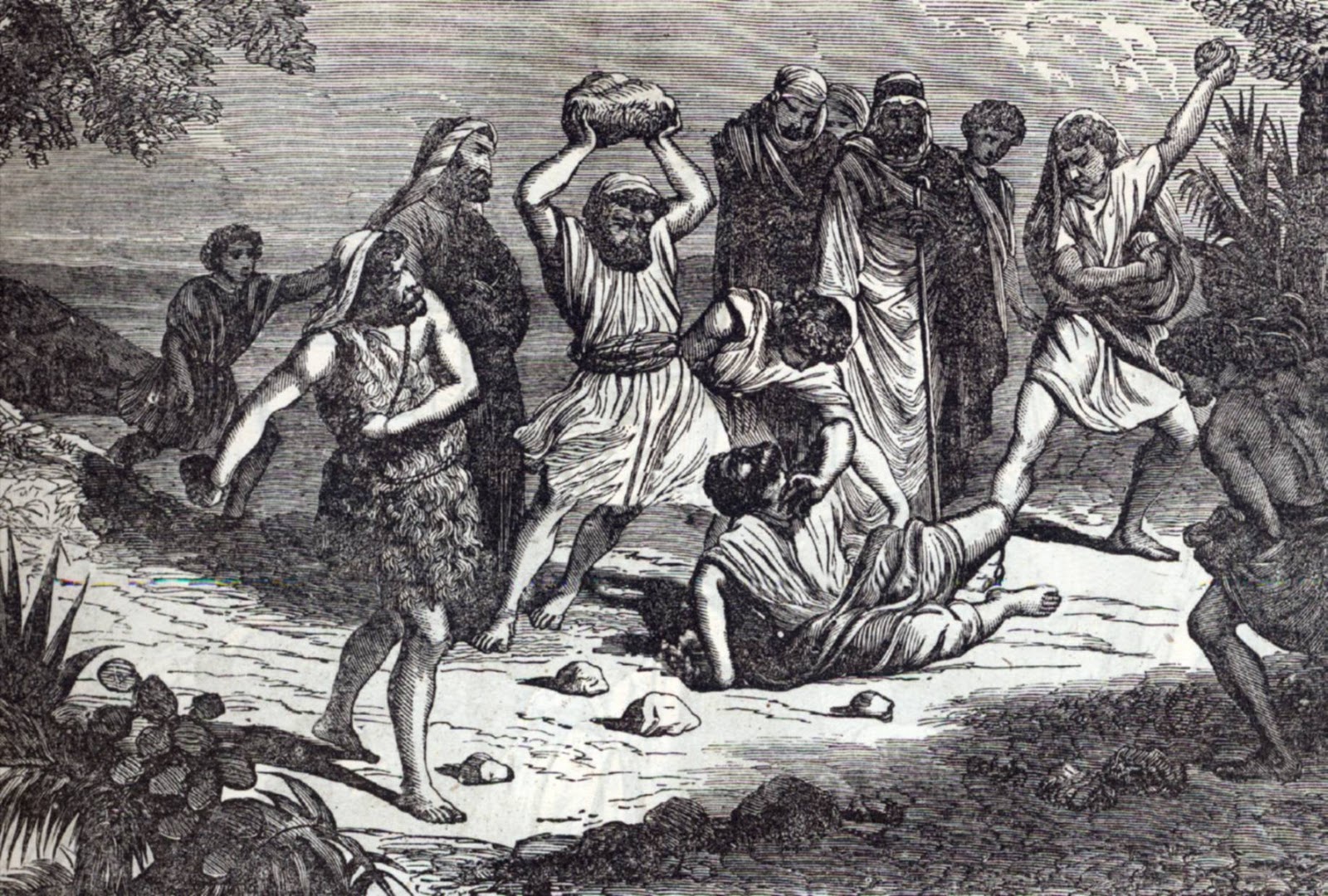
These words are found in Acts chapter 7. There we find Stephen forced to address the Assembly of religious leaders. He provides the audience with a marvelous summary of Israel’s history. Stephen ends his discourse with some piercing words and the words above. The crowd would never forget those words, even though they covered their ears and yelled at him at the tops of the voices. So unsettled and angry was the crowd that they took Stephen out and stoned him to death. This was all done before a witness, a young man named Saul.

Who do you think Saul/Paul had in mind when he wrote, “…where the king is seated at God’s right hand.”? We don’t know for sure if Paul was in the Assembly that day Stephen spoke. Even if he wasn’t he would have been very aware of what was said. Paul was the Assembly’s appointed Inquisitor. He was ordered to stop the insurgents called “Followers of the Way”.

Paul, the witness and persecutor, was now Paul the prisoner and fellow sufferer in Christ with martyred Stephen. His relationship with King Jesus had taken him to new personal lows. But, Paul searched for things above and found them. They sufficed. Paul saw King Jesus sitting at God’s right hand.


What about our search?

Have you watched the TV series The Curse of Oak Island? Over the many episodes I’ve watched, the Lagina brothers search for buried treasure. In their search they have looked at maps. They have been to the library and to France. They have sifted dirt and information. They found both material fragments related to the historical period of the treasure and fragments of information also related. They have talked to many people who have knowledge of the island and the treasure. And, they dug and dug and dug. They are relentless in their pursuit of the treasure. They have a hope in what they do not yet see but visualize. What they do see are milestones that point in the direction of the fulfillment of their hope.

Have we stopped searching “for things above”? Have we stopped digging deep into the Word? Have we thrown away fragments of our character that would have pointed us to hope realized?

Does our search involve Scripture reading, studying Greek and Hebrew and history, praying and visualizing? Does our search involve hours and days and months and years looking for the pearl of great price? If you are looking at yourself and people’s reactions to you online then you will not find the treasure. Looking at the “worldly elements” won’t reveal it. Searching is lifetime, long-haul hard work. That is the Indian Jones adventure and romance of life. Except, we chose fantasy and the illusory.

In TV commercials one can see someone talking into an impersonal box. The ‘intelligent personal assistant’ box is connected to a search engine which is tied into a data cloud which is linked into a data storage island somewhere. But “the box” does not have the answer to life’s most pressing questions. As an engineer, I hold no grudge against technology. I just know that technology will not “search for things above.” You are responsible for that.

Many will use a search engine like Google to find information related to a certain topic. Now, consider searching “for things above” for answers to all of life’s “topics”. These ‘topics’ would include “Why is there pain and suffering?”; “How do I go on?”; “Who should I marry?”; “What about my wayward son? “How will I afford this surgery?”; What hope do I have when I can’t see things getting better?”; “What is my raison d’être?”; “What is God’s will and how will it be done on earth as in heaven?” Back to Paul and his words to the Roman churches about searching questions and seeing results.

“We were saved, you see, in hope. But hope isn’t hope if you can see it! Who hopes for what they can see? But if we hope for what we don’t see, we wait eagerly — but also patiently.” Romans 8:24-25

So, hope means waiting for what we do not yet see. But, are you uneasy when you can’t visualize the person you are talking to? Then learn to see Jesus sitting at the right hand of the father, with all authority in heaven and earth. Still struggling with searching “for things above”?

“In the same way, too, the spirit comes alongside and helps us in our weakness. We don’t know what to pray for as we ought to, but that same spirit pleads on our behalf, with groanings too deep for words. And the Searcher of Hearts knows what the spirit is thinking, because the spirt pleads for God’s people according to God’s will.” Romans 8:26-27

In prison and on the road, Paul tapped into resurrection life – into “the things that are above, where the king is seated at God’s right hand.” Paul was well aware that earthly and evil forces would love for us to remain in our petty, self-serving and secularly pious ways, embracing “worldly elements.” The Evil One wants us to focus only on ourselves and our material concerns. The Evil One does not want us to look above. Remember Satan’s temptation of Jesus in the desert. The Evil One wanted Jesus to acknowledge him, in effect, as the top Search Engine of the World. A ‘search engine’ that offered the world to his web-surfing devotees.

“Then the devil took him off again, this time to a very high mountain. There he showed Jesus all the magnificent kingdoms of the world.

“I’ll give the whole lot to you” he said, “If you will fall down and worship me.”

“Get out of here, you satan!” replied Jesus. “The Bible says, ‘Worship the Lord your God and, serve him alone!”

The Searcher of Hearts – the only Authoritative ‘search engine’-sits at God’s right hand. We are told to “search for the things that are above”, where our king “is seated at God’s right hand”. What are you waiting for? There’s a seat waiting for you.

 “This will be my gift to the one who conquers: I will sit them beside me on my throne, just as I conquered and sat with my father on his throne.” Revelation 3:21

If You Call Now


Mack had no one to blame. He blamed himself. His dream, well, just listen…

The other night Mack dreamed of being in New York. He didn’t know how he got there. He did remember driving around the Great Lakes. In New York Mack stopped along a highway in town, got out of his rental car and started to look for a store which sells maps. He returned and found that his car was gone. Mack became distressed.

Then Mack saw his car return but it was not working. The battery was missing. Someone stole it. Then Mack’s brother showed up because Mack’s mother was concerned – about both of them.

Mack asked his brother, “Is there a place where I can get a big breakfast?” Mack was hungry. His brother did not know where to get food or a map. His brother stood there. He looked like he wanted to help, but he didn’t offer any.

Then, both Mack and his brother were in a garage where things are fixed, batteries replaced. Mack received his car back working. He is hungry. The dream ends in New York on a highway in town with an able car and not knowing where to go next.


When Mack, whose given name is Macauley Andrew Naughton, applied at Central Commercial Chillers he was told that the job required 15 percent travel. But after his hiring, the on-the-road service schedule grew to near 80 percent at times. The fact that Mack had devised such good software to run the chillers within less than one degree of set point now meant that he had to go to the field and install it into every chiller sold by Central Commercial Chillers. After downloading the software, he had to commission the chiller and make sure it did what was promised. So, Mack spent a lot of time on runways, in rental car lots and in hotel rooms. The desk job had become a suitcase job.

Last week Mack was in Kansas. This week Mack was in New England servicing chillers. Tonight, he ended up at a motel in Connecticut. Tomorrow he would service a chiller nearby.

Mack entered the motel room and switched on the TV. He liked the ‘company’. It was all he had.  His ex-wife also sent him packing, something to do with pornography. Being alone was nothing new for Mack. And, loneliness came with the service guy turf, Mack figured. Fill the void with work, food and TV and hit “Restart” every morning.

After a shower and a quick burger at Friendly’s Ice Cream Mack came back to his room and settled into bed with the remote. Flipping through the channels he came a cross a show he liked. The show soon went to commercial.

“…If you call now, you’ll receive one free WonderPan with every order. Only pay for shipping and handling… A surface that cannot be scratched or matched…Someone is standing by now to take your call. Call now.”

The program returned after two minutes of commercials. But by now Mack’s eyes were heavy. He fixed a pillow under his head and watched the TV through squinting eyes.

Another commercial break came. There was a commercial for a sex chat line. Call them, it said, and they will make you feel “spontaneous”. Mack thought about sex on the phone. It seemed to fit his isolated lifestyle. And, sex seemed to be going on everywhere but not with him. His phone sex ears were wide awake but his eyes were almost sleep. The voice in his head told him don’t deny yourself. “But, Tanya, I’m tired,” Mack said and fell asleep.

“…If you call now, you’ll receive one free sex chat with one of our beautiful and sensual ladies. With each sex chat that you purchase receive one free chat the next time you call…. Someone sexy is waiting to talk to you right now…”


The chiller service trips had taken Mack to Sonora County Mexico, to Saskatchewan, to Rio De Janiero, and to most of the fifty states – wherever plastic parts were being injection molded and thermoformed. The unique plastic parts he came across were matched by some interesting characters Mack met along the way.

There was New Jersey Rick. NJ Rick was an intense smoker-guy, a middleman who contracted guys like Mack to service his clients. At night Rick liked to go to the strip clubs until the wee hours of the morning. Mack went along once thinking he owed it to Rick for the business. Mack knew better. He would not get those images out of his head. And the next day was brutal.

In Tennessee, there was the Tony, a proud Italian who also did service work. Tony liked to pick up women at the bar and bring them back to his hotel room. Mack found this out one morning. Tony knocked on his motel door and said, “Hey, Mack, you gotta come see this.” So, Mack went and saw a naked woman passed out on the bed. Mack kept his distance from Tony after that. He couldn’t get that image out of his head.

In Terre Haute there was Javier, a six-foot five Mexican. He serviced equipment and women. Javy would go to the dance clubs at night after work. He’d dance, flirt in his muy macho style and then take someone back to his motel room. Mack went along some nights because he was lonely and he was tired of Andy of Mayberry reruns. Javy needed the shared rental car every night, so Mack was dropped off at his motel room before Javy drove his new catch to a nearby bar. Mack couldn’t rid himself of these images.

In De Ridder Louisiana, waking up to the paper mill stench was enough to turn Mack’s stomach. Along with the awful smell, the behavior of his friend Ron unsettled him. Ron was a co-service guy with Mack. There were sites that needed a lot of mechanical help besides software upgrades. Ron did the mechanical work which involved a lot of walking. But this seemed odd to Mack since Ron had a hard time walking. Ron’s permanent limp came about after he fell out of a tree during an acid trip.

Ron, despite his home-grown defect, liked to think of himself as a man’s man – he didn’t just fall out of a tree, he FELL out of a TREE and survived! He would boast about his manliness to Mack and to the women he tried to dance with night after night after work. Ron, like Javy and like Tony, was married when he was at home. All the other times he was in compensation mode – find someone quick or die from loss of reinforced manliness.

During one meal Ron told Mack about his disorder – Hallucinogen Persisting Perception Disorder – so Mack decided that he would drive the rental car from that point on. This meant that Mack was the chauffer for Ron Casanova’s adventures night after night. Mack now had his own flashbacks.


The chiller at Automated Plastic Parts worked just as promised – within one degree of set point. Mack had the client sign the service report and then headed back to his hotel room for a shower. After the shower Mack went to Friendly’s for his supper. He didn’t want to have to think or make another decision. He was flat out hungry and all thought out.

Back at his room Mack undressed and got into bed. The TV sputtered light into the space before him. Images came and went. The drone of constant noise weakened his resistance. Mack fell asleep.


Mack looked up and saw a stairwell with service men walking up and down the stairs. The men going down the stairs were carrying framed pictures which they dumped in a garbage can at the bottom of the stairs. The men going up received new batteries. And then suddenly, next to Mack stood a man. The man said, “I making a service call. Remember, “If you call now, I will give you a free map. You’ll be driving within one degree of set point in no time.” 


Mack woke up with a crick in his neck and vowing to move on with God’s help.


© Jennifer A. Johnson, 2018, All Rights Reserved

Radical Secularism Won’t See Us Through


“If we are so troubled and perplexed, if we search for the right words and bite our tongues, this is because these three elements are constitutive parts of our situation and the great fact of Islam that is at the center of our struggles, for Muslims and for non-Muslims, together or separately.” Pierre Manent, Beyond Radical Secularism


~~


Manent, in his book Beyond Radical Secularism, suggests that the Islamic phenomenon presents three distinct and yet interdependent elements which must be addressed by Europe and, I suggest, ultimately by the U.S.: Muslim immigration, Muslim settlement and mosques financed by Gulf States, and Islamic terrorism.

How do we as a nation begin to address the three elements? Do we call others “Islamaphobic” or “Xenophobic” and content ourselves with pointed fingers and huffing? Do we act like a Jesuit I know and parse out isolated Scripture from the Bible to push the Progressive notion that to be a good country one must have Open Borders and welcome all comers with no conditions placed on refugees/immigrants while hoping things will all work out, while not taking into account the unintended consequences for both parties and without accruing any personal cost? Or, do we as a people living within the Kingdom of God on earth address the complex issue at hand? Do we acknowledge who we are as a nation and our Christian heritage and also acknowledge Muslims?


I suggest Manent’s Beyond Radical Secularism is a good place to begin looking at the matter before us.

Several months have passed since I read though Pierre Manet’s twenty essays, essays encapsulated in his book Beyond Radical Secularism. Before too much more time passes I wanted to record what I learned from the essays along with my reflections.

This is not a book review. Rather, this post is me trying to understand the Islam situation facing the U.S. and doing so through the eyes of French academic and political scientist Pierre Manent whose own country of France is having to come to terms with the Muslims. My thoughts are interspersed with Manent’s words.

From the book’s Introduction by Daniel J. Mahoney:

“In this, his latest book (originally published in France as Situation de la France), Manent brings together his considerable theoretical and practical concerns with rare spiritual depth. He reveals the failure of Europe’s humanitarian civil religion and pleads for a restoration of prudent judgment, rooted in a searching exploration of the theological-political problem. He reveals just where the de-politicization and de-Christianization of Europe has led the continent and his native France. Refusing to despair, and not content with literary politics and facile criticism, Manent lays out a practical philosophy that shows Europe and the West that deliberation and action remain as available to us as they were to Pericles and St. Paul.” (Emphasis mine)


As noted above, Manent writes from a French perspective. Yet, his home turf insights can provide significant direction for U. S. immigration policies addressing the “three elements” noted above.

In Manent’s assessment of the current political situation, he sees both France and the West looking weak:

“As rich as we still are in material and intellectual resources, we are politically without strength. Doubtless this has not escaped the attention of those who now attack us.” (From the Preface)

France and the West, Manent points out, are capitulating to radical secularism–a stripping of the national landscape of political and Christian milestones, earmarks and boundaries. Both are refusing to either fight their enemies or to love their enemies. Both are handing out subjective rights which further divide the nation state into individuals against one another. In so doing, the political regime

“…makes every constraint appear to be useless and arbitrary, in a word vexing, whether civic or in private life. As each letting go justifies and calls forth the next, governments are motivated to tout themselves no longer by the guidance and the energy they give to common life, but by the “new rights” they grant to individuals and to groups.” (From the Preface)


Though not mentioned by Manent in his book, it seems to me that the French philosopher Foucalt’s deconstructionism has gone a long way in educational circles toward emptying words and historical narratives of the meaning they once held. This vacating of meaning has led to intellectual and moral paralysis. We no longer know what to do because we no longer know what to think, Manent posits.

At the end of his Preface, Manent elaborates:

“Our irritated and vacant souls are full of a jumble of historical references, positive or negative, which our experience no longer shifts or orders, and of which we make use in the most frivolous or self-interested manner.”

Later, in essay seven, he writes about France,

“The major fact of our situation, one that has important consequences in all domains that concern us, is the radical loss of authority by the main and decisive instrument of modern politics, that is, the State, or if you will, in the specifically French context, the Republic. One might say, in the language of political physics that the republican State no longer has the power either to reduce the constituent groups of France to citizen-individuals, those primordial elements of modern politics, nor to offer these individuals something to hold in common substantial enough to allow them to be true citizens, that is, members of a larger whole…we tend to return to the pre-modern situation… One of the distinctive features of the situation was the absence of any border between the interior and the exterior.”


Here in the U.S. Barack Obama’s “fundamental transformation” of America was by many accounts a proclaimed and implied look-down-his-nose disdain for America’s history, its Constitution and its ways of life. Obama even apologized to other nations for America’s ‘faults’ as he saw them. As we are finding out, Obama’s administration didn’t just disparage America it also colluded against America and its ally Israel with a South American drug cartel to help Iran advance their nuclear program. Obama along with the likes of Noam Chomsky and a host of “intelligentsia” sought to shame and deconstruct America and to remake it in their own Progressive promise-of-the-future image. Enter a carnival mirror reflection.

Donald Trump comes along and promotes an uber-nationalist fundamental retransformation after his own ribald image. But neither administration has addressed the Muslim situation other than making polarizing comments.


Manent, as he views France, sees their common life dissipating from the loss of State authority due to the people’s lack of faith in government’s trustworthiness and also a loss in faith in Providence, a special concern for a nation with a Christian mark. Add to these weakening influences globalization–the absence of borders within and without, the purposeful loss of historical meaning and context, the placation of individuals and groups with subjective rights by the government, and the neutralizing of the mark of Christianity on a nation. All such effects of degeneration on the common life undermine “a stable and coherent disposition” toward Muslim immigration. You shouldn’t welcome someone into your common life if your common life is on life support. More degeneration occurs.

Our own common political life is being redefined as the ‘indeterminate and limitlessness of individual rights” and interests, just as Manent described France’s political life. Our nation, already fragile, is questioning its identity as it sees itself through the media lens of “fundamental transformation” pushed by Progressives. Our education systems, Progressivism’s training grounds, focus on identity politics and refuse to reinforce a national common life, seeing it as a formulation of power structures from the past that must be done away with.

We are weak and getting weaker and we are inviting in a people, some of whom are at war with us.


Manent talks about the effects of the transformative “equality”, values” and “secularism” criteria in his own country:

“I have emphasized repeatedly… — that our political regime has progressively brought about its own paralysis by the ever narrower and more unilateral way it has understood its principles. The rights of man have been separated radically from the rights of the citizen and, instead of freeing members of society in order to make them capable and desirous of participating in what is common, they are now supposed to suffice to themselves, and public institutions are nothing more than their docile instrument. We are probably the first, and we will surely remain the only people in history to give over all elements of social life and all contents of human life to the unlimited sovereignty of the individual.”


A solution and warning;

Manent writes that France has the tools to deal with the influx of Islam: a history of a neutral secular State coupled with a people with a “Christian mark.” Yet, France and the Europe Union are in depoliticizing mode with their eager acceptance of globalization and open borders. Even more debilitating, they are negating, via radical secularization, all religion from public life and particularly Christianity. Manent warns that these divesting actions will cripple and paralyze any proper response France must take in accepting Islam into the common life of France.


Manent talks of a “politics of the possible” between French Muslims and the civic body. Two principles would apply. First, Muslims are to be accepted “as they are” without seeking to modernizing them or conforming them to others in the society.

Second, preserve and defend the sanctuary of secular government and the characteristics of its regime which holds them as citizens first, Muslims second.


For a shared life Manent suggests that acceptance of Muslims into French society would need to be balanced by elements of France’s “ancient constitution” in order to prevent a Muslim transformation of France. And this acceptance must not advance as “secularism.”

There is a need to address who we are when speaking to those who a seeking to live with us. There is also a need to address Muslims as who they are and then to go forward together, each recognizing the other.

Beyond the foundation and bulwarks of an “ancient constitution” Manent suggests that France (rightfully) impose two restrictions on entering Muslims: no polygamy and no burqa. Such parameters, he posits, would protect the social fabric of the nation and the political freedoms in place.

For the U.S. I would impose the same restrictions along with not allowing sharia law to become law. Muslims immigrants must submit to the laws of our republic. They must not ‘rule’ themselves separately in opposition to a common life. They also must understand that we are a nation with a Christian mark and one which does not impose its Christian beliefs onto others via the government. Here, the individual is self-governing within the full extent of the law. Here the Christian influences government but is not authoritarian, despite Leftist characterizations to the contrary.


As I see it, we must define our relationships beyond individual rights. We must define who we are in common. A neutral secular State will support groups which support the common life of the State. It will respect each group and allow each group to function on its own without imposing laws specific to a particular group.


A Radicalized secular state, on the other hand, will, by its vacuous nature, delegitimize its people and their religion. But don’t expect Muslims to become secular and that tensions will float away. They won’t (though many Progressive Christians have) and the tensions won’t magically dissolve because you opened your borders. Radical secularism pretends that we are just citizen-individuals with nothing to offer but our individuated ‘diverse’ presence. The State only has authority and powers we give it. If we give it nothing but demand only rights we suck the life out of our common life.

An open border de-politicized nation will continue to splinter off. A de-Christianized nation will have no means to influence and support the neutral State. And, Christianity has for centuries fostered and supported secular authority. But Islam, as you know, is theocratic in its politics. To live in common, Islam must separate political and religious life in its citizen contract with the State.

And that State? I see the government’s primary responsibility as promoting the common good by maintaining the rule of law, and preserving basic duties and rights. A neutral secular government offers protection, security and the motivation for the common good. A radicalized secular nation has nothing but individual ‘rights’ to offer a people who then become increasingly alienated.

With more than just rights to offer, a shared life in the U.S. is possible–and desirable–if we remember and “they” learn who we are and why we are – a nation with a Christian mark seeking a common and secure life. It is within this context that the Islamic phenomenon’s three distinct and yet interdependent elements must be addressed.


I recommend Manent’s book, Beyond Radical Secualrism to you. 
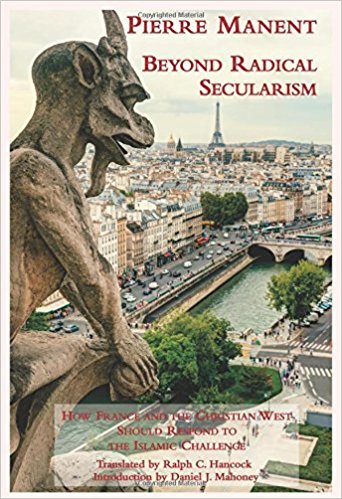
Pierre Manent is a French political scientist. Or, as they say in France…

Pierre Manent est directeur d’ etudes a l’ Ecole des Hautes Etudes en Science Sociales, membre fondateur de la revue Commentaire.

~~~


English philosopher Sir Roger Scruton also has something to say about the above:

https://twitter.com/Scruton_Quotes/status/942682334209478658

https://twitter.com/Scruton_Quotes/status/942683659500425216

https://twitter.com/Scruton_Quotes/status/942681842834202625

https://twitter.com/Scruton_Quotes/status/942687422252449792
Pray it Forward


“I, Paul, am in prison because I am a missionary for Jesus Christ to you who are not Jews.” Ephesian 3:1 


1st Century AD. You are in a prison in Ephesus. You long to know how your young children are doing, your young children in the faith. You have been called to preach the Good News and announce the Kingdom of God to the Gentiles. Seeds have been planted but they must be watered and fed and cared for in order for there to be fruit. But, here you are locked up. So, you write letters and pray and pray and pray.


“For this reason, from the day we heard it, we haven’t stopped praying for you. We are asking God to fill you with the knowledge of what he wants in all wisdom and spiritual understanding. This means that you’ll be able to conduct yourselves in a manner worthy of the Lord, and so give him real delight, as you bear fruit in every good word and grow in the knowledge of God. I pray that you’ll be given all possible strength, according to the power of his glory, so that you’ll have complete patience and become truly steadfast and joyful.

And I pray that you will learn to give thanks to the father, who has made you fit to share the inheritance of God’s holy ones in the light. He has delivered us from the power of darkness, and transferred us into the kingdom of his beloved son. He is the one in whom we have redemption, the forgiveness of sins.” Colossians 9-14


As I read these verses I envisioned Paul sitting in a dimly lit and damp prison cell. He is agitated and fretting. He is deeply concerned for those outside the cell, those surrounded by the power of darkness. Paul is not whining. He is not demanding. He is not writing his bio.

Paul is praying and hasn’t stopped praying for those beyond his cell. Paul is praying that they may be filled with knowledge and that they may be given all strength to use that knowledge to bear fruit. He prays that they will learn to give thanks for the One who transferred them into his Kingdom out of the darkness. The irony that Paul has been transferred to a dank dark prison cell because of the Kingdom does not affect his vision of the Kingdom or his prayer life.

This is Kingdom prayer. The prayer is for others. The prayer lifts others up and reinforces others. The prayer points away from self and toward the One who is able to do more than we ask or think on behalf of others. This is dark night of the cell prayer, where one is alone with God and unable to move but a few feet. Paul’s actions are distilled down to praying verbs: “fill”, “bear”, “grow”, “learn”.


There are many who are unable to move but a few feet. The elderly, who have been active most of their lives, now sit. Some may even think of their bodies as a prison cell. But, in that “cell” the “wisdom and spiritual understanding” that was prayer directed at them some two millennia before can be applied to their Kingdom prayer now. They can pray for their children and grandchildren and great-grandchildren just a Paul prayed for his children in the faith. The fact that they, two millennia later, have faith means that Paul’s prayer was effective. Some were “filled” with knowledge. Some were “filled” with knowledge and “bore” fruit. Some were “filled” with knowledge and “bore” fruit and “gained” strength. Some were “filled” with knowledge and “bore” fruit and “gained” strength and “learned” to give thanks.

There will always be situations beyond our control. I was reminded this past two weeks of how uncontrollable are the forces that surround me. The weather in the Chicago area has been frigid. I do not remember such cold temps and I have lived in the area for over 65 years.

At 65 years you begin to think about mobility later in life. You wonder, at least I do, about how long your legs will cooperate. So, I see it is time for me to exercise Kingdom prayer with action verbs. It is long past time for me to pray it forward.


More Kingdom prayer from prison:

“For this reason, I bow my knees and pray to the Father. It is from Him that every family in heaven and on earth has its name. I pray that because of the riches of His shining-greatness, He will make you strong with power in your hearts through the Holy Spirit. I pray that Christ may live in your hearts by faith. I pray that you will be filled with love. I pray that you will be able to understand how wide and how long and how high and how deep His love is. I pray that you will know the love of Christ. His love goes beyond anything we can understand. I pray that you will be filled with God Himself.

God is able to do much more than we ask or think through His power working in us. May we see His shining-greatness in the church. May all people in all time honor Christ Jesus. Let it be so.”  Ephesians 3: 14-21

Jake’s Midnight Dust Up


The last day of 2017 found Jake alone in the empty house. The movers had come and gone. Earlier that day Jake sent his wife Rachel off with their two kids to their new home in another state. Jake stayed behind to clean up the house for the new owners. The house belonged to them at midnight.

Rachel was Jake’s second wife. His first wife Leah divorced him after she found out about Jake’s cheating. And, so that there was no more cheating, child support for Jake’s and Leah’s six sons and daughter was deducted from his paycheck. Jake wasn’t proud of what he had done but he was a survivor.

His mother, though, who had taught Jake from his childhood to “get what is yours”, was proud of him. So was Jake’s manager Aram Fields. Aram liked Jake. Jake’s sales record chart was given pride of place in the break room – on an easel next to the water cooler. During the twenty years Jake had worked for Aram, he became Fields Pre-Driven Cars’ top salesman seven years in a row. Jake became family when he married Rachel, Aram’s daughter.

Jake could pitch like no other salesman Aram knew. And, Jake’s mark-up-the-interest-rate-2-or-3 % financing was his specialty. Jake also knew each car’s history and could promote each one as “slightly used but highly prized by its previous owner”. Jake had a way of convincing people to “get what is yours”.


Well, that night, while Jake was in the kitchen cleaning the oven, there was a knock on the front door. When Jake opened the door, there stood a man with a tool carrier.

“Hi…uh…I didn’t call you. I…what are you here for?’

“What is your name?”

“Jake.”

“I’m at the right place.”

“No, I don’t think so.”

“Yes, I am.

“No. I didn’t call anyone. This is still my house.”

“Your house?”

“Yes! Now I have to get back to work. Goodbye…” Jake tried to close the door but the man put his foot in the doorway.

“Hey! Now you are making me mad! Get out!”

“I’m here to fix what is broken.”

“What?! What is broken?”

“Are you sure you didn’t call me?”

“I would know if I called you, wouldn’t I?”

“I have the tools. Let me in.”

“I have my own tools. And, I have what it takes to fix things in my own house.”

“I don’t think so.”

“Hey you! You know what?! My manager Aram thinks I have what it takes. He pays me pretty good to make things happen.”

“You like to be rewarded for your efforts?”

“Yes, of course!”

“I am here to reward you for your efforts.”

“Huh?”

“I can fix what is broken.”

“What?! What is broken?”

“Are you sure you didn’t call me?”

“I would know if I called you, wouldn’t I?”

“I have the tools. Let me in.”

“I have my own tools. And, I’ve been fixing things all my life.”

“I don’t think so.”

“Hey! We just went through all this before. You are wasting my time.”

“I did offer to help.”

“I don’t need help. I am my own man. I’m not just another senior citizen you can manipulate. I’ve been around the block.”

“Look, you bicker with me and you bicker with others. You’re good at bickering to “get yours” and at getting other people ‘theirs’. Tell me your name again.”

“Jake! I told you!”

“I’m at the right place.”

“No, I don’t think so.”

“Yes, I am.

The back and forth between Jake and the man went on for what seemed like hours. Neither Jake or the man gave in. Jake, at last, became exasperated.

“Listen. I didn’t call anyone. This is still my house. I’m in charge”

“Your house? What time is it?

“Time for you to leave! Get outta here!” Jake pushed the door against the man’s foot.

When the man saw that Jake was not going to let him in he grabbed an envelope from the tool carrier and handed it to Jake. Then he asked, “You are Jake Houseman? You purchased 763 Peniel?”

“Yes.”

“Your new property…this is what the bank came back with. You purchased the foreclosure with cash but there is a property tax lien against it.

Jake opened it and saw the notice of notice of lien on his new property. His face wrenched.

“Hey, hold on!” Jake grabbed the man by the arm as he tried to leave. “We’ve got to work this out!”

The man said, “Let me go. I have to be on my way.”

“No way. You are staying until we get this business sorted out!”

“I will work it out. You have my word.” Jake loosened his grip and let go.

“Besides,” the man said, “you are no longer Jake Houseman. You are now Jake Newhouse.” The man winked and then turned and left.

“Hey, what’s your name?”

“I knew your father and your grandfather,” the man called back from across the yard.

The man walked past the neighbor’s house and was then out of sight.

Jake stood in the doorway. The rising sun cast his long shadow onto the floor of the empty house behind him. Jake stood there stunned and tired and hurting. After several minutes of looking at the lien and rubbing his forehead, Jake went back inside. He picked up his tools and cleaning supplies. He placed the extra set of house keys on the kitchen table, walked out the front door and then over to his car.

At the sidewalk, Jake, with his face still wrenched, turned to look back at the house.

“I bought someone else’s lemon. What a ball-breaker that guy is! But, I’ll live. Lesson learned. Goodbye house on Jabbok.”

And so Jake saw the sun rise on another year.


© Jennifer A. Johnson, 2017, All Rights Reserved

~~~

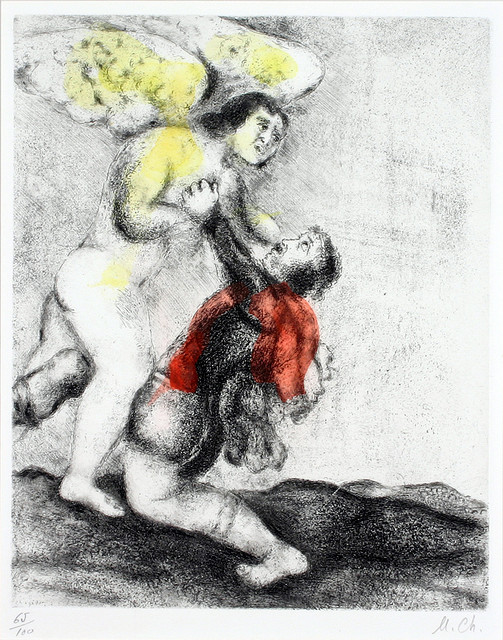
Chagall – Jacob Wrestling with God


Schoenberg: Die Jakobsleiter: Friede auf Erden, Op. 13. Orchestral version

What Risk is This?


“The Lord said to Abram, “Leave your country, your people and your father’s household and go to the land I will show you.”  Genesis 12:1

“Some time later God tested Abraham, He said to him, “Abraham!”

“Here I am,” he replied.

“Then God said, “Take your son, your only son, Isaac, whom you love and go to the region of Moriah. Sacrifice him there as a burnt offering on one of the mountains I will tell you about.”” Genesis 22:1-2

~~~

An angel appears to Mary and announces Mary’s pregnancy. Mary responds: “Here am I”, said Mary; “I’m the Lord’s servant-girl. Let it happen to me as you’ve said.” Luke 1: 38

~~~

God says “Go,” and Abram, not a perfect man, goes.

Imagine being told to dig up your roots, leave your familiar surroundings and that you will be told later where you are going. Now imagine going with your first-born son, your flesh and blood and a surety of God’s promise to Abraham, to the region of Moriah and being told that your son is the sacrifice to God. Abraham is told, basically, to go outside the box he had contained God in- his hopes in his pride of place and first-born. Abraham with “Here-I-am” -outside-the-box faith obeys God and God blesses Abraham. “Abraham was now very old, and the LORD had blessed him in every way.” Genesis 24:1

God says to Mary, not a perfect woman, that she will be the one to bear the Savior. She responds with her permission. Later, at Zechariah’s house, Elizabeth sees Mary and shouts at the top of her voice: “Of all women, you’re the blessed one!” One could speculate that before the angel’s news, Mary had thought her life was, well, pretty much boxed in.


The boxes people put God in are not big enough for God’s blessing. So, instead of stretching the box, God stretches the person so that they come to see that no box can hold all they know about God.


Throughout Israel’s and Christianity’s history there are many accounts of where God has said, in effect, “Go to a new place with me” and a personal risk is taken.  Abraham, Jacob, Moses, the disciples, Peter, Paul, to name just a few. You are not alone in the history of risk-taking or in the moving out of safe-spaces.

Imagine if those who were told to go and those who were led by God to go didn’t go? How would your life be different today? Or, did you think that once you arrived on earth nothing had gone on before you arrived that would have any bearing on your life? There are many today who see themselves this way. They have their “history” and their “truth”.

If you have read the Old Testament you found that the history of Israel is the story of God moving his chosen people through space-time. The Israelites moved from country to country, to slavery, to the land of “milk and honey”, to exile and back home again. They are moved to be tested, refined and blessed. They were moved so that they would realize that God is sovereign and omnipresent – there is no place you can go that God isn’t there. They are being moved so that they will realize that God is the beginning and ending of their journey. They are being told to “Go” so that they will find that God is God and that God is good.


Risk taking is going, moving and forgetting what is behind.


The pattern of risk taking, testing and blessing occurs over and over in Scripture. God says, “Go” and when people go to a new place with God they are both tested and blessed.

Risk takes us places we never thought we’d go. Risk takes us to new places within God’s space-time and to the farthest extent of God’s promises. Risk takes us to new places within God’s character. The risk-taker decides to remove himself from the comfort of his self-storage home and from the false gods he has stored in his mini self-storage so that blessing will be gained.


The God who created probabilistic quantum mechanics is going to take you places where you can’t determine your position or the acceleration of your movement at the same time. Because of that you begin to take your eyes off your circumstances and look at the Cosmological Constant. You are being taught that God’s outcome will be good because He is good. There is a 100 percent probability that God is good. You just need to find this out through risk-taking.

Nature has a way of saying “Go”. The wise men, experts in early astronomy and most likely from Persia, took a major risk. They traveled 800-900 miles following “a star coming out of Jacob.” Herod was not happy at all that the wise men left without detailing the location of his greatest fear — a newborn king. So, Herod slaughtered innocent children.


“Get up. Go to the place I will show you. The risk is all mine and I am good with that.”

“Here I am.”

Breaking News

Breaking News

By Jennifer Ann Johnson


Against a backdrop—indigo and star,

Luminous angels appear before men,

Ancient Wisdom they proclaim near and far,

To shepherds and sheep, to earth and heaven.


Luminous angels appear before men,

On a Space-Time night with Tripartite accord,

To shepherds and sheep, to earth and heaven,

“A new and living way” with rights ignored.


On a Space-Time night with Tripartite accord,

Emmanuel lay swaddled, veiled in flesh,

“A new and living way” with rights ignored,

In the love of the Father, mankind refreshed.


Emmanuel lay swaddled, veiled in flesh,

The babe’s short gasp rouses the dry bones of men,

In the love of the Father, mankind refreshed,

“I, the Lord, will breathe my life into them.”


The babe’s short gasp rouses the dry bones of men,

Ancient Wisdom He proclaims near and far,

“I, the Lord, will breathe my life into them,

Like your backdrop—indigo and star.”


© Jennifer A. Johnson, 2017, All Rights Reserved

What Am I Not Forgetting?


“I’m not implying that I’ve already received “resurrection,” or that I’ve already become complete and mature! No: I’m hurrying on, eager to overtake it, because King Jesus has overtaken me. My dear family, I don’t reckon that I have yet over taken it. But this is my one aim: to forget everything that’s behind, and to strain every nerve to go after what’s ahead. I mean to chase on toward the finishing post, where the prize waiting for me is the upward call of God in King Jesus.” -the Apostle Paul, Philippians 3: 12-14  

~~~

“What did I forget?” I’ve asked myself this dozens of times. The question comes up in the grocery store and when I am cooking a meal for the family and when I am getting into the car ready to pull out of the driveway. I have asked this when I am finishing a project at work. “What did I forget?”

In each situation there is something in the back of my head telling me that I am forgetting something. As I mentioned, this happens often. But, thinking about what I need to forget didn’t occur until this past week. I read the above verses in my study of Paul’s letter to the Philippian church.

Oh, yes. I’ve read those verses many times before. And when I did, I glossed over the words as if it made sense at a prosaic level. This time the words nudged me and maybe because I am older now.

During this past week I worked out on the elliptical machine at the local fitness club. There is a TV screen above the machine. I typically watch the business programs which include stock futures (I’m an early bird). When the business program goes to commercial I surf the channels.

That morning there were two other programs that caught my interest. The first was a show about a select group of marines going through extensive training to become recon marines. The second show, What Not to Wear, includes us in a fashion makeover. Typically, a reluctant twenty-something is confronted with her wardrobe and her appearance. Both shows seemed to me to be reality checks before the participants moved on.

The Marine recon show depicted the guys going through intense physical training beyond anything they ever knew they could endure. During the exercise the men ‘forgot’ what they knew and pressed on for the upward call to become recon Marines. Not all of the fifty men who entered the program finished.

As typical for What Not to Wear, the hosts had their ‘client’ try on what she usually wore and then critiqued the outfit with her as all three stand in front several mirrors. During the next step in the fashion transformation, the hosts pull the client’s brought-to-the-program clothes off the rack and throw them into a garbage can before her. They want her to forget about them and move on. Without saying as much, they want her to become mature in her view of herself and how she appears to others. Many of the young women wore sloppy attire or clothes a teenager would wear. The hosts prompt their ‘client’ to take herself and her appearance seriously. They want her to dress age and life situation appropriately.

During the next step, the hosts show their TV ‘client’ a manikin dressed in clothes they consider she would look suitable in. After detailing “why” the clothes would befit her, they send her shopping for a new look. I would say, a “resurrected” look.

Forgetting what you know is not easy. Several marines stopped short of recon transformation. On What Not to Wear, many a ‘client’ grimaced and some wept as their habit-formed clothes were tossed in the can. Not wanting to forget makes going forward even harder.


Forgetting. Where do I start?

As I read Paul’s letter to the Philippians, I was reminded that I have done things which are not at all within God’s good graces. I have sinned in God-defying sinful ways. I’m sure I must have gotten God’s attention. And, more than once. But, as with the Pauls’ own admission of not having achieved sinless maturity, I press on. My own recognition and then confession of sin, like Paul’s, moves me forward to the goal of the upward call of God – resurrection, new life, in Him – the Alpha and Omega, the No-beginning and No-end, the Mercy that follows me all the days of my life.

The words of I john 1:9 are critically important to anyone who wants to remove sin’s dead weight and “to strain every nerve to go after what’s ahead”. What John, an eyewitness of Jesus, records is critically important to pressing on and forgetting.

“If we confess our sins, he is faithful and just, and will forgive us our sins, and cleanse us from all unrighteousness.” The First Letter of John, 1:9


The wonder of advent reminds us of Jesus’ first coming and of his second coming. The Kingdom of God on earth began when Jesus inaugurated it during his first coming. Yet, “sins and sorrows grow” and “thorns infest the ground”. There is much injustice, strife, and wickedness taking place. The Kingdom of God is not mature. It is a work in process. On every groaning level of creation there exists a huge amount of tension between the first coming and the second coming.

The same tension applies to the individual who confesses and renounces their sin and seeks to go on to maturity in Christ. This tension will either makes us or break us.


What do I need to forget? Three encumbrances come to mind: status, sentimentality and sin.

Let’s start with status. The world we live in favors world status. Paul reminds the Christian in Philippians 3: 20, “We are citizens of heaven…” Prior to that, at the opening of Philippians 3, Paul warns the church about those who trust in the flesh-the bad works people. Then Paul writes, “Mind you, I have good reason to trust in the flesh…” Paul reminds the readers of his background, a Hebrew of the Hebrews background. He writes, in effect, that his status does not bring him closer to the prize – gaining Jesus. Before stating his forgetting of his status, he reminds us of Someone who ‘forgot’ his status.

In Philippians 2 Paul records an early Christian poem, which contains the words…

Who, though in God’s form, did not

Regard his equality with God

As something to exploit


Instead, he emptied himself,

And received the form of a slave,

Being born in the likeness of humans.


Sentimentality. The desire–the toxic craving–to relive the past, to re-feel. Ugh. You can’t run a race when you are standing in a tar pit. Paul doesn’t go there, even though his memories were astounding: “…my one aim: to forget everything that’s behind, and to strain every nerve to go after what’s ahead.”


Sin. Let’s forget the sin which has so easily beset us. Like the Psalmist, I cry out…

“If you, LORD, kept a record of sins, Lord, who could stand?” Psalm 130.:3

“Do not remember the sins of my youth and my rebellious ways; according to your love remember me, for you, LORD, are good.”  Psalm 25:7


Record keeping. The Evil One and those in sync with him will tell you that are unqualified to run and win any race because you failed before. They will say, “You will never be mature because you were immature before”.

Yes, there are those who keep a record of my sins, for ‘safe keeping’. They believe that by standing on a record of my sins they place themselves on higher ground. It doesn’t. Side line opinions are air and hold no weight unless you give them weight. As far as the east is from the west so far has God removed self-serving opinions from us. Don’t go back to the trash and dig them out.


“What am I not forgetting?” is a most important question.

One last word:  Consider, that often a lack of forgetting is coupled to a lack of forgiveness. A lack of forgiveness leads to unresolved anger- a root of bitterness. Perhaps a root of bitterness has a grip on both your legs and you are not able to “chase on toward the finishing post, where the prize waiting for me is the upward call of God in King Jesus” let alone stand.


Walk On – The Isaacs


In Christ Alone – Brian Litterell

The Empty Box


What?! Christmas morning?! Ryan raced to the tree. Mom and dad had left the tree lights on.

“Mom and dad!”  Ryan yelled from the living room. He wasn’t going to start without them.

Mom and dad appeared in the hallway. “We’re up. Go ahead, Ryan.”

Well, it didn’t take long for Ryan to rip through the wrapping paper on each package. He got almost everything he had asked for.

After all his presents were opened and he lined them up near the couch, Ryan saw something had hadn’t noticed before. “Hey, what’s this? It’s got my name on it.”

Mom went over and looked at the package. She shook it and looked at Roy.

“Did you put this under the tree Roy?”

“Um, No. I don’t remember a package that size.”

“Well, go ahead and open it Ryan,” Mom handed Ryan the present.

Ryan tore into the wrapping paper. A plain box appeared. It was stamped “Not as Fragile as You Might Think”.

Now mom was curious. Dad came over.

Ryan lifted one of the box lids and then the other. He looked inside. His mouth formed a “Wow!”

“It’s empty, mom, dad!”

Mom looked inside too. “Where did that come from? Did your grandparents put that under the tree last night when they were here? Roy, did your dad put that there?”

Roy called grandpa who was always awake at 6:00 reading the paper.

“Dad, did you and mom put a package under the tree? Ryan opened it and its…empty.”

“Roy, you know I don’t put empty packages under the Christmas tree. Are you sure its empty? Look again.”

Roy looked this time.

“Dad, I don’t see anything.”

“Have Ryan look, too.”

“Ryan, look inside again.”

Ryan picked up the box. This time it was bigger. When he pulled the lids back he thought he heard a loud pop. “Whoa, what was that?

“I didn’t hear anything Ryan, “Mom said.

“Roy, do you think that your parents forgot to put a present in?” Ryan’s mother asked.

“Anything is possible with my dad. C’mon. Let’s eat breakfast”

Ryan then remembered Swedish Pancakes with Lingonberry sauce. It was a Christmas morning treat in the Miller house.


That night, mom had Ryan pick up his toys and bring them to his room. Ryan filled the empty box and carried it to his bedside. He sat down on his bed. And that’s when Ryan’s eyes closed. And, that’s when the dreams began.


Dreams. How do you describe them? They are whacky and yet they seem to make sense. Here’s what Ryan told his mom about one dream:

“I was floating. It was all dark. Then there was a Pop!” Ryan used his finger and popped it out of his mouth. “There was a big cloud of dust all over me. I coughed and coughed.

“Then the cloud went thuup! and it was gone! And then things started flying all around me. They looked like tiny balls bouncing everywhere. Some of balls stuck together like they didn’t want to be alone in the dark. They were hissing and crunching and…I became scared when I saw a shadow that was darker than night. But the shadow was tossed away by a hand. Then I felt better.

“Did you know mom that numbers are alive? They all dance together!

Then, mom, the together-balls became dust balls. And they became huge, like bowling balls, like bowling balls of fire. Then they exploded and there were more dust balls. And the dust balls became marbles.

And the marbles became globes with smaller globes going around them. Then there was light coming right at me. It was so bright that I had to turn around. When I did, I saw a planet right behind me. The planet had a mouth.

The planet said, “Come and see.” So, I flew toward the planet. As I did, the planet handed me geodes and fossils and rocks, all kinds of rocks. Some were like the red quartz and Jasper that you and dad gave me for my birthday. Then I saw aquariums full of fish. I saw sharks, whales and guppies and Neons and Tetras and…

I looked down into one aquarium. On the bottom of aquarium, I saw belchers. They looked like what we saw at Yellowstone last summer. They sounded like your Christmas coffee maker. “Ururururhhhh Blup!” Urururururhhhh Blup!”

I saw…I think dad calls it… a ter..rari…um… full of bugs and worms and salamanders and lizards and then a brontosaurus showed up and then a Triceratops and then,…

Then I saw a plate. On the plate was Jell-O. But then the Jell-O was two Jell-Os and then four Jell-Os. There were globs of Jell-O everywhere. Do you know what happened next, mom? The globs of Jell-O became Gummy worms.

There was a lot more that happened mom, but, I can’t remember it… Oh,… yeah,… someone poked me and said, “Ryan, Little King, Come and see.”

Then, I was inside a temple, like the one in the picture you showed me one time, mom. Inside the temple were billions and billions of tiny temples. Inside each tiny temple there was a blue light stick. Crazy, huh, mom?


When Ryan’s sixth Christmas came around he asked his mom and dad for a rock tumbler. Ryan had begun a rock collection during the family trip out west.

When Ryan’s seventh Christmas came around he asked his mom and dad for a microscope. Ryan’s dad was a biology teacher. He brought home slide samples of all kinds of microscopic life.

When Ryan’s eighth Christmas came around he asked his mom and dad for a telescope. Not only did he get the telescope but his parents took him to an observatory during Christmas break.

When Ryan’s ninth Christmas came around he asked his mom and dad for an atlas, a map of the world and astronomy charts. Ryan’s mom and dad also gave him a barometer, a thermometer, a hygrometer and an anemometer. They did this so that Ryan could build a weather station in their backyard.

When Ryan’s tenth Christmas came around he asked his mom and dad for a pair of binoculars and a book about birds. At that time his mother also began to teach Ryan about flora. She showed him how to press flowers into pages of a book.

When Ryan’s eleventh Christmas came around he asked his mom and dad for a mobile of the planets. He also asked for a compass and for a pencil and some drawing paper. He wanted to draw everything he saw in his head.

When Ryan’s twelfth Christmas came around he asked his mom and dad for a book about the human body and a skeleton. He also asked for a ham radio kit.

When Ryan’s thirteenth Christmas came around he asked his mom and dad for a periodic chart of the elements. He also asked for element 82 and for horseshoe magnets.

A Few of My Favorite Things 2

dad’s coffee

When Ryan’s fourteenth Christmas came around he asked his mom and dad for a spectroscope. He received a prism, a magnifying glass, a physics book and a box of watercolors. 

When Ryan’s fifteenth Christmas came around he asked his mom and dad for a Calculus book. Dad looked at him and said, “Are you sure?” Ryan replied, “I can’t function without it.” Ryan got his book.

When Ryan’s sixteenth Christmas came around he asked his mom and dad for a book about genetics and a DNA helix and a set of keys to the family car. His mom and dad gave him the book. They also gave him pipe cleaners and colored beads and instructions how to build a DNA helix model. The car keys were handed to him after his homework and chores were done.

When Ryan’s seventeenth Christmas came around he asked his mom and dad for a chemistry set. Dad said, “I’ll give you the set but do the experiments in the garage”. Ryan moved his science lab to the garage. He also began to pack for college. He filled the “empty” box with as much as it could hold.

 When Ryan’s eighteenth Christmas came around he said to his mom and dad, “Thank you for everything. You know what? The world is not badly made. I’ll see you during Spring Break.”


When Ryan’s eighty-fifth Christmas came around he gave his grandson the empty box as a present and said, “Here, Mikey, you won’t be bored.”


© Jennifer A. Johnson, 2017, All Rights Reserved


The Living Bird is Let Loose


“And the Lord spoke to Moses and Aaron, saying: “When a man has on the skin of his body a swelling, a scab, or a bright spot, and it becomes on the skin of his body like a leprous sore, then he shall be brought to Aaron the priest or to one of his sons the priests.  The priest shall examine the sore on the skin of the body; and if the hair on the sore has turned white, and the sore appears to be deeper than the skin of his body, it is a leprous sore.

The above quote is the opening to The Law Concerning Leprosy as recorded in Leviticus 13.

Leprosy: Chronic skin-disease characterized by ulcerous eruptions and successive desquainations of dead skin.

Jewish Encyclopedia

~~~

In Luke’s gospel account, chapter 17 vs. 11-19, we learn of ten lepers who plead for mercy (“Have pity on us!”) at a distance from the crowd. Keeping a distance from others was in keeping with the law proscribed in Leviticus 13. Any leper who was examined after several specified intervals and then declared unclean was isolated, sent to the outskirts of a city. The “unclean” would be required to yell “Unclean!” to any passersby.

Most of us know from a Sunday School lesson what happens in Luke’s gospel account: ten lepers are completely healed by Jesus. The ten are sent by Jesus, in keeping with the Law, to a priest for examination. Only one of the lepers returns to give thanks to Jesus.

The_Healing_of_Ten_Lepers_(Guérison_de_dix_lépreux)_-_James_Tissot_-_overall

The Healing of Ten Lepers by James Tissot

“Is it really the case that the only one who had the decency to give God the glory was this foreigner?”

The healing occurs as Jesus passes along the borderlands between Samaria and Galilee on his way to Jerusalem. The formerly leprous foreigner, and not the nine formerly leprous Israelites, is the one who returns to Jesus to give thanks. Like the Samaritan women who would gladly eat the crumbs under the master’s table, this foreigner knew that Israel’s God was different from all other gods. How different, this foreigner would come to find out. The difference would make his skin tingle.

Jesus made it clear to his disciples that his mission on earth, his vocation, was to his covenant people, the Jews. The Jews were the people God chose to bring light to the nations. But the Jews failed in their vocation. Rebellion, idolatry, stiff necked obstinacy, you name it. The people resisted their calling even after witnessing the extraordinary events of the Exodus – the Plagues, the Red sea dividing, the cloud by day, fire by night, manna on the ground in the morning and water flowing from a rock. The Covenant people resisted their calling even when given a tutor-personal words from God-to keep themselves from sin and sickness and to bring healing to the nations.

One leper returned to give, “God the glory.” Did those hearing Jesus words to this foreigner think about their vocation? Did God’s covenant people, Israel, presume a right to be an entitled people of God’s goodness. Were God’s people like the nine newly restored lepers with a focus on themselves? (Imagine a people focused on a right to healthcare.)

As one can see, the ten-leper account is an analog of the Israel’s history through the centuries. Leprosy is an analog for sin. Sin is that chronic soul-disease characterized by ulcerous eruptions of wickedness and successive offenses and sins of the walking dead.

Early on, Israel was told to eradicate idols from their lives. They were to be a separate and distinct people from the nations around them. When Israel became like other nations and chose to believe that God is not all that He was proclaimed to be, God sent prophets.

The prophet Isaiah, in the presence of God, declared as “the foundations of the thresholds trembled at the voice of him who called out, while the temple was filling with smoke. “Woe to me!” I cried. “I am ruined! For I am a man of unclean lips, and I live among a people of unclean lips, and my eyes have seen the King, the LORD Almighty.” -Isaiah 6:5

In God’s presence, Isaiah was made aware of his and Israel’s’ condition. Isaiah would prophecy against Israel-the Northern Kingdom. Corporately, Israel was rich and prosperous under the rule of Jereboam. But individually, Israel was very corrupt. Israel would be expelled from home. By 621 B.C. Israel would be conquered and carried into captivity by the Assyrians.

In exile, Israel pleaded for mercy (“Have pity on us!”).


Let’s return to the ten lepers. After healing them Jesus tells them, “Go show yourselves to the priests.”

The following quote is The Ritual for Cleansing Healed Lepers as recorded in Leviticus 14:

Then the Lord spoke to Moses, saying, “This shall be the law of the leper for the day of his cleansing: He shall be brought to the priest.  And the priest shall go out of the camp, and the priest shall examine him; and indeed, if the leprosy is healed in the leper, then the priest shall command to take for him who is to be cleansed two living and clean birds, cedar wood, scarlet, and hyssop.  And the priest shall command that one of the birds be killed in an earthen vessel over running water.  As for the living bird, he shall take it, the cedar wood and the scarlet and the hyssop, and dip them and the living bird in the blood of the bird that was killed over the running water.  And he shall sprinkle it seven times on him who is to be cleansed from the leprosy, and shall pronounce him clean, and shall let the living bird loose in the open field. He who is to be cleansed shall wash his clothes, shave off all his hair, and wash himself in water, that he may be clean. After that he shall come into the camp, and shall stay outside his tent seven days. But on the seventh day he shall shave all the hair off his head and his beard and his eyebrows—all his hair he shall shave off. He shall wash his clothes and wash his body in water, and he shall be clean…

“Then the priest shall offer the sin offering, and make atonement for him who is to be cleansed from his uncleanness. Afterward he shall kill the burnt offering. And the priest shall offer the burnt offering and the grain offering on the altar. So the priest shall make atonement for him, and he shall be clean.”

Do you see any analogs in the above passage? What is it about the two birds? One is killed and the other set free. And, what about that earthen vessel in which one bird is killed?


In Leviticus 13, the priests were required to check the skin of the individual who was observed to have an ulcerous skin condition. The priest did this over several prescribed intervals. Each time the priest would examine the individual to determine if…

“If, after the scales of leprosy have spread over nearly the whole body, a bleeding and scaleless ulcer (miḥyah) is observed, the subject is unclean. Similarly, if the scales, having covered almost the whole body, fall off in one place and uncover an old bleeding ulcer, the subject is unclean.”Jewish Encyclopedia

It is interesting to note that in the next verses following the account of the lepers, Luke 17 vs. 20-21, that Jesus refers to what is observed to answer the Pharisees question, a question which was on every Jew’s mind. He reminds them of what you can see with Kingdom eyes:

“The Pharisees asked Jesus when the kingdom of God was coming.

“God’s Kingdom,” replied Jesus isn’t the sort of thing you can watch for and see coming. People won’t say, ‘Look, here it is,’ or “Look, over there!” No: God’s kingdom is within your grasp.”

In giving the lepers a renewed humanity and by restoring them to their communities and Synagogues from exile Jesus was doing the work of the Kingdom on earth. He hoped the nine of Israel (and the crowd) would have grasped this. We are told that the only one to “give God the glory” was the foreigner. Do you think he kneeled and grasped Jesus’ feet in thanksgiving?