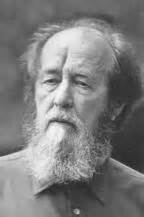
It may have been in the later 1970s that I became aware of Alexander Solzhenitsyn. I don’t recall exactly what brought him to my attention. It may have been news reports of the Soviet Union’s exiled dissident. Solzhenitsyn had been deported from the USSR and stripped of Soviet citizenship in 1974. He later came to live in the US for almost twenty years.
With the admixture of the Cold War, the horror stories coming out of the USSR, reports of Solzhenitsyn’s moral courage and my youthful desire to make a difference in the world I soon became enthralled by Russia and Solzhenitsyn.
During the 1980s I read Solzhenitsyn. I read all three volumes of The Gulag Archipelago, an eye-opening history of the Soviet police state and One Day in the Life of Ivan Denisovich, a novella. These works forever etched on my mind the Stolypin cars used to resettle passenger and livestock together; Stalin’s Cult of Personality, his purges, his deportations, his gulags and his murder of tens of millions of people.
In addition to media reports about Soviet atrocities in the 1980s I traveled to Poland for business purposes. I used a polish translator. It turned out that the translator, a Pole, was once a CIA agent who worked inside Russia. He told me about the atrocities done to the Poles by the USSR and the KGB. He hated what the Soviets had done to his people. From my perspective, except for the occasional flower stands on the streets, Warsaw and Bialystok looked gray and depleted of life from the effects of Communism.
Solzhenitsyn, an author who documented life under Stalin with short stories, novels and poems that included harsh critiques of Stalin and totalitarianism, survived prison camps – the gulags – and assassination attempts by the KGB. But, Solzhenitsyn kept writing, speaking out against the evil being done to the Russian people. This is why Solzhenitsyn is a hero to me unlike any ‘hero’ regarded today. This man suffered for the truth he did not hesitate to speak.
Born the month that Dwight D. Eisenhower was elected to the presidency, I was raised during the Cold War days (1947-1991). I recall the election of John F. Kennedy and the US ‘cold shoulder’ standoffs with the Soviet Union and the Eastern Bloc.
The two superpowers, the US and the USSR, stood diametrically opposed politically, economically and ideologically. Solzhenitsyn would speak to one of those powers when he gave his Harvard commencement address on June 8, 1978 – A World Split Apart. For some context, the speech was made the summer after Jimmy Carter was sworn in as President on January 20, 1977.
I came across the speech again yesterday. I reread it on the train last night, on my way home from work.
Though I prefer shorter posts I would like to share the power of these words with you plus some poignant commentary about Solzhenitsyn’s works and words from the book The Conservative Foundations of the Liberal Order by Daniel J. Mahoney.
First, from the book, Chapter 7, The Totalitarian Subversion of Modernity: Solzhenitsyn on the Self-deification of Man and the Origins of the Modern Crisis are some words of warning for any democratic impulse:
“The experience of totalitarianism, that “twentieth-century invention,” as Alexander Solzhenitsyn once called it, ought to have permanently discredited all facile or naïve progressivism. But as the previous chapter attests, too many in the West mistakenly identified the fall of Communism in the East-central Europe and the Soviet Union with “the overflowing triumph of an all-democratic bliss.” The writings of Solzhenitsyn (1918-2008) provide unique resources for understanding both the evils of totalitarianism and the limits of democratic euphoria.”…
Regarding Solzhenitsyn publishing of August 1914 in 1972:
“If August 1914 provided a devastating critique of the sclerotic character of the old Russian regime, of the unwillingness of its purblind bureaucrats and courtiers to adjust thoughtfully to conditions of modernity, it is also clear that Solzhenitsyn had no sympathy for those left-liberals then or in his time who flirted with nihilism, apologized for terrorism, and showed contempt for the best spiritual and cultural traditions of the Russian nation. The luminous essays by Solzhenitsyn and his collaborators in From Under the Rubble contemplate a Russian future freed from evils of ideological despotism. At the same time, its contributors warned against the slavish imitation of the worst features of contemporary Western democracy, including its scientism, subjectivism, and rejection of the classical and Christian resources of the Western tradition.” (emphasis mine)
The chapter then goes on to speak of Solzhenitsyn’s indictment of Marxism and collectivism, as well, his “Augustinian defense of freedom – but no special privileges – for religious believers.”
Under the chapter’s section The Fragility of Modern Liberty:
“Solzhenitsyn, though, remains what has always been – an eloquent and principled defender of liberty and human dignity. Yet, Solzhenitsyn is acutely aware of the fragility of the Enlightenment principles that under gird the regime of modern liberty… Solzhenitsyn’s refusal to sever freedom from an order of truth sets him apart from every radically modern articulation of human liberty and makes him suspicious in the eyes of those who identify liberty with the rejection of all natural or divine limits.” (emphasis mine)
There is way too much depth about Solzhenitsyn and the weakness of our modern democracy in The Conservative Foundations of the Liberal Order for me to relate here and now. I highly recommend the book to you.
Now to Solzhenitsyn’s words:
Intro: The Soviet and Russian novelist, dramatist, and historian during his commencement address delivered at Harvard University, June 8, 1978, without wavering, noted that the problems of the two superpowers were not the military strengths and ideological differences of each turned against each other but rather their lack of a moral center and moral courage.
Because Solzhenitsyn was addressing a western audience, an elite Western audience at Harvard, his speech was decidedly a stinging indictment of the West – its materialism and it’s almost “unlimited freedom of choice of pleasures, its self-serving, inbred media and its disavowal of its spiritual roots:
“However, in early democracies, as in the American democracy at the time of its birth, all individual human rights were granted because man is God’s creature. That is, freedom was given to the individual conditionally, in the assumption of his constant religious responsibility. Such was the heritage of the preceding thousand years. Two hundred or even fifty years ago, it would have seemed quite impossible, in America, that an individual could be granted boundless freedom simply for the satisfaction of his instincts or whims. Subsequently, however, all such limitations were discarded everywhere in the West; a total liberation occurred from the moral heritage of Christian centuries with their great reserves of mercy and sacrifice. … State systems were becoming increasingly and totally materialistic. The West ended up by truly enforcing human rights, sometimes even excessively, but man’s sense of responsibility to God and society grew dimmer and dimmer.” (emphasis mine)
And…
“If humanism were right in declaring that man is born only to be happy, he would not be born to die. Since his body is doomed to die, his task on earth evidently must be of a more spiritual nature. It cannot be unrestrained enjoyment of everyday life. It cannot be the search for the best ways to obtain material goods and then cheerfully get the most of them. It has to be the fulfillment of a permanent, earnest duty so that one’s life journey may become an experience of moral growth, so that one may leave life a better human being than one started it. It is imperative to review the table of widespread human values. Its present incorrectness is astounding. It is not possible that assessment of the President’s performance be reduced to the question how much money one makes or of unlimited availability of gasoline. Only voluntary, inspired self-restraint can raise man above the world stream of materialism.” (emphasis mine)
And…
“It would be retrogression to attach oneself today to the ossified formulas of the Enlightenment. Social dogmatism leaves us completely helpless in front of the trials of our times. Even if we are spared destruction by war, our lives will have to change if we want to save life from self-destruction. We cannot avoid revising the fundamental definitions of human life and human society. Is it true that man is above everything? Is there no Superior Spirit above him? Is it right that man’s life and society’s activities have to be determined by material expansion in the first place? Is it permissible to promote such expansion to the detriment of our spiritual integrity?” (emphasis mine)
In the speech Solzhenitsyn speaks of “…our Earth – divided against itself;” “…all of a sudden the twentieth century brought the clear realization of this society’s fragility.;” ”…the persisting blindness of superiority;” “A decline in courage may be the most striking feature that an outside observer notices in the West today.;” “…and the decline of courage, at times attaining what could be termed a lack of manhood, is ironically emphasized by the occasional outbursts and inflexibility on the part of those same functionaries when dealing with weak governments and with countries that lack support, or with doomed currents which clearly cannot offer resistance.. But they get tongue-tied and paralyzed when they deal with powerful government and threatening forces, with aggressors and international terrorists.”
Sounds familiar, doesn’t it? Even when echoed from the distance of 1978.
Take a look at what drives you and perhaps you will see why America is no longer a nation under God, no longer a nation of civil courage, of moral decency. As Solzhenitsyn points out in his address the West has become humanist anthropocentric: “the proclaimed and practiced autonomy of man from any higher force above him…with a willful denial of a “Supreme Complete Entity.”
Liberty and the rule of law is not enough to keep us right side up. “Whenever the tissue of life is woven of legalistic relationships, this creates an atmosphere of spiritual mediocrity that paralyzes man’s noblest impulses.”
And, perhaps you will now understand why people would vote for a president who uses class warfare rhetoric to promote the sands of material security as foundational to life’s happiness and not the bedrock of spiritual fortitude.
Please read the speech in its entirety. You will be better for it. Solzhenitsyn’s Harvard Address 6-8-1978




 Cindy Wity