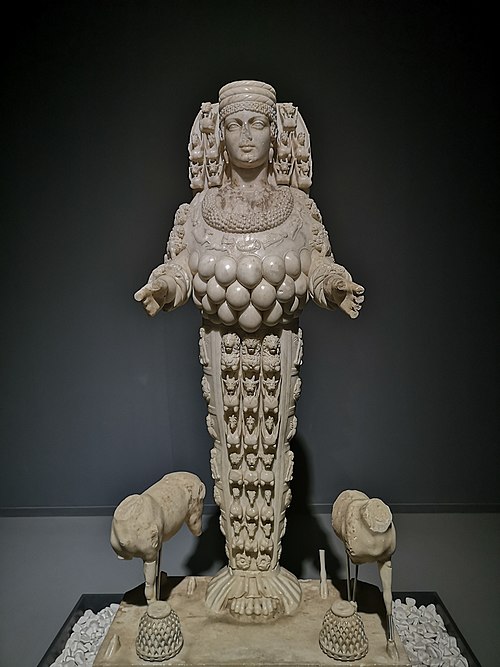
Surface Readings

Now is the age of anxiety. ― W H Auden

“THE END IS NEAR.” Phenomena Pending.

Impending doom has been in the news during my entire lifetime. You can view some of the headlines and pronouncements here: Wrong Again: 50 Years of Failed Eco-pocalyptic Predictions.

Before I came on the scene in the early 50s, the advent of nuclear weapons in the 40s posed the threat of nuclear war annihilation. Adding to American’s anxiety and panic during the Cold War period that followed was the new mass medium of 1950s television. Its B&W news, public service announcements, documentaries, and science fiction programming brought into homes the stark magnitude of the nuclear age.

One response during that anxious time was to use ‘Duck and Cover’ drills in schools across the United States. Students were trained as to what they should do in case of an atomic attack – dive under their desks and cover their heads (Producing another Atomic Kid!).

And though in the early 60s the concept of Mutual Assured Destruction (MAD) was discussed as a mutual deterrent, no one knew what would happen as in 1962 when the Cold War nearly escalated into nuclear war. The United States and the Soviet Union faced off during the Cuban Missile Crisis. The escalating arms race was at issue.

Released in 1965, Barry McGuire’s The Eve Of Destruction protest song addressed the instability in the world – the prospect of nuclear war, the Vietnam War, the middle east conflict and civil rights.

During the late 60s and early 70s, I was involved in the Chicago area Jesus People movement. I remember attending a Larry Norman concert where he sang, I Wish We’d All Been Ready. (Sadly, the song refers to a “Rapture” event, a popular escape plan for Christians based on a mis-reading of scripture.)

Life was filled with guns and war
And everyone got trampled on the floor
I wish we’d all been ready . . .

There’s no time to change your mind
The Son has come and you’ve been left behind . . .

A man and wife asleep in bed
She hears a noise and turns her head
He’s gone
I wish we’d all been ready . . .

Spectacularly wrong environmental and climate predictions were made around the time of the first Earth Day in 1970. Some in 1971 predicted an Ice Age. Not one of the alarmist climate crisis predictions during my lifetime (or yours) have ever come to pass.

Nor did the wild claims of ‘The Adam and Eve Story’, written by a former US Air Force employee, UFO researcher and self-proclaimed psychic Chan Thomas in 1966. For the past 59 years the book has been kept under wraps by the CIA. The claims of the book are based around periodic cataclysmic events in history. The next one he proposed would be a sudden reversal of Earth’s magnetic poles, thereby wreaking havoc and total destruction to the planet in a matter of hours.

“You Never Want a Serious Crisis to Go to Waste.”

Along with the many end-of the world scenarios came Pop eschatology. The end-times prophecy business has been around during my entire lifetime. Not long ago I received a flyer announcing a weekend End-Times Prophecy seminar to be held at a local hotel.

In 1995 a series of books fictionalizing events surrounding a supposed rapture and seven-year tribulation period prior to the second coming of Christ began to appear on best-seller lists. The 16 Left Behind lowbrow thrillers of the Left Behind series, authored by Tim LaHaye and Jerry Jenkins, arrived on the scene twenty-five years after another end-times book.

When Hal Lindsey and C. C. Carlson came out with The Late Great Planet Earth in 1970 it sold millions of copies. Their ‘non-fiction’ end-times book was later adapted (1979) into a documentary film narrated by Orson Welles. 

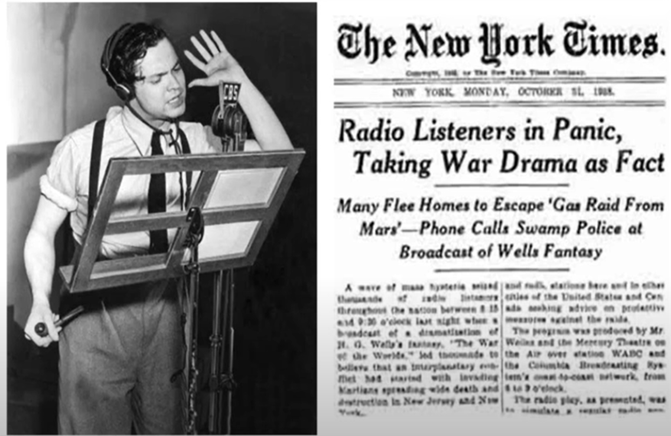
Some readers might recall that Orson Well’s, on October 30, 1938, gave a dramatic War of the Worlds radio broadcast. It scared the heck out of a lot of people. Some say Lindsey’s book did the same.

The Pop eschatology of LGPE, applied to current events such as the Cold War, was released shortly after the Israel’s Six-Day War. The authors aligned their dispensational theology with contemporary geopolitical events to show that civilization was headed for doomsday. They pushed hardcore Zionism.

 Men Who Stare at Charts

The Left Behind series, The Late Great Planet Earth, and much of today’s “prophecy”, are steeped in John Nelson Darby’s dispensational theology and “rapture” nonsense. Darby (1800-1882) was an Anglo-Irish Bible teacher, clergyman, and founder of the Plymouth Brethren and the Exclusive Brethren. Among other things, he thought that Christians should not be involved in politics (as if Jesus ascended to the Father only to leave us here to ponder salvation in different epochs, to develop dispensational theology charts to schedule God’s acts, and to console ourselves with millennial dreams.)

In my estimation, dispensational theology, which didn’t exist in the church history until Darby came along and the Scofield Bible expanded its reach, is a way of charting Scripture into manageable chunks of salvation history and a way of managing God and expectations. This theology proposed to show how God planned for people’s salvation in each historical period by what relates to Israel, what relates to the church, and what the End Times will look like. It was a way to get a handle on dates and times and God.

Dispensational theology and its offshoot Pop eschatology seem to be a science project applied to theology. Darby, the originator of a pre-trib rapture, lived during the 1800s, a period following the Enlightenment when knowledge by way of rationalism and of empiricism was emphasized.

I don’t know that anyone cares about dispensational theology except for a few wonky theologians. If you do, then see The Rise and Fall of Dispensationalism: How the Evangelical Battle Over the End Times Shaped a Nation and What Is Dispensationalism and Who Believes It?

Pop eschatology looks at the geopolitical landscape, cherry picks what is literal and symbolic, and crams headline news into end-time predictions. But “de-coding” symbolic scripture prophecies to give a detailed scenario of end-time events is not Christian eschatology. It’s trying to time the market for the I wish we’d all been ready crowd to jump in. It’s manipulation of scripture and of people to produce a turn to God out of FOMO.

~~~

Added 6-23-2025, in light of the Israel/US attack on Iran’s nuclear facilities:

I have a great deal of sympathy for Christians who still believe the lore that dispensationalism offers. I understand what motivates them and why. But, it is well past time for the church to provide better Bible teaching that does not encourage American Christians to develop misplaced loyalties. American Christians have duties to their nation and their church. But for too many American Christians, misplaced theological convictions have led to political loyalties that prioritize Israel over both the church and their own nation.

https://www.jchasedavis.com/p/rumors-of-war

Questions Abound

This post is not meant to be a reproach to making sense and order of what is happening around us. That’s what we do, especially in a time and under those who “forsake the law and praise the wicked” (Prov. 28:4):

Why did Joe Biden award the wicked Hillary Clinton and George Soros the Presidential Medal of Freedom?

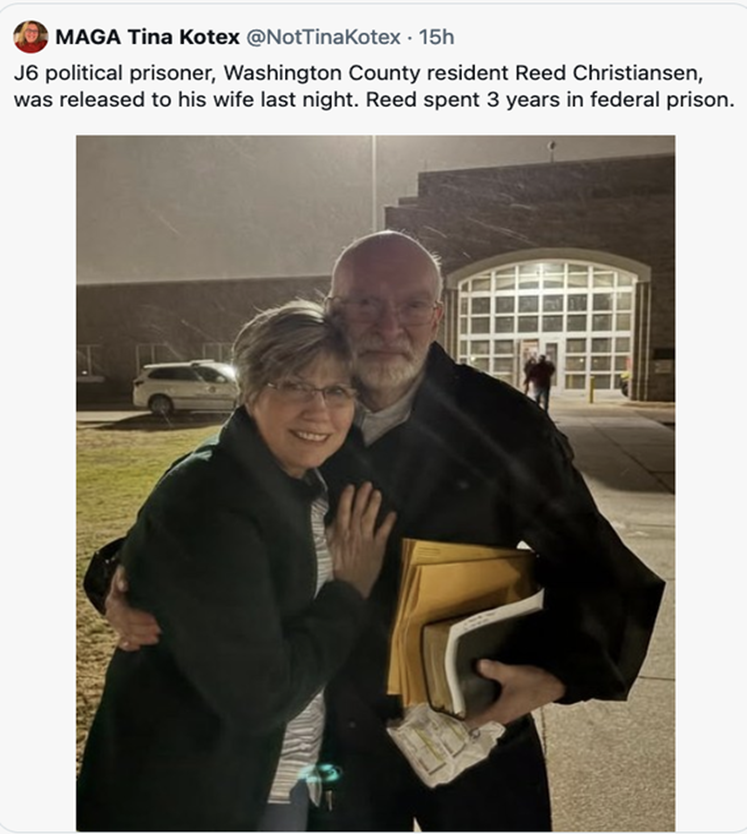
And why did Biden pardon the treasonous General Mark Milley and the murderous Anthony Fauci? Why did Joe Biden preemptively pardon them and the illegal Jan. 6 committee? (I don’t believe these Federal pardons are legal. In any case, states can bring charges against them.)

Why did Joe Biden commute the sentences of 37 of the 40 men on federal death rowa list that includes at least five child killers and several mass murderers? Biden gave the reprieve to some of the nation’s most violent murderers — nine of them found too dangerous to live after butchering fellow inmates — as part of his effort at “ensuring a fair and effective justice system.”

Why did Joe Biden preemptively pardon capitol police officer Michael Byrd, the one who murdered unarmed US Air Force veteran Ashli Babbit on J6?

Why haven’t the “Spies Who Lie” – 51  intelligence agents – who signed a letter in 2020 saying emails from Hunter Biden’s laptop carried “classic earmarks of a Russian information operation in an effort to interfere with the election been brought to justice? (Trump just yanked their security clearances.)

How does one justify Biden protecting Ukraine’s border with billions and billions of US taxpayer dollars and weapons as being more important than protecting our own overrun borders and our exposed citizens? And how does one justify Biden and Ukraine escalating the war with Russia to a point that’s dangerously close to nuclear war?

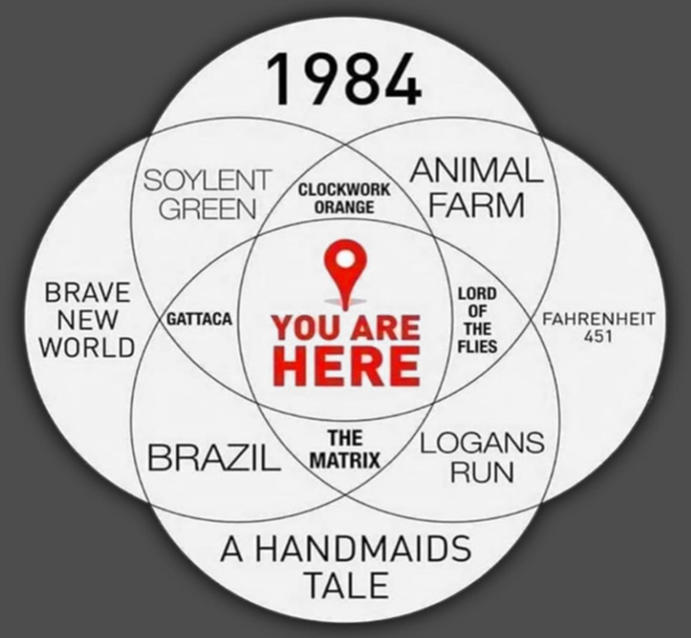
And what about those (Globalists, WEF, WHO) who appear to use dystopian novels as their guidebook to immanentize the eschaton with their version of sense and order – a New World Order – under the guise of saving the planet (from the people living here)?

And, going forward, why turn over our future to godless pagan Globalists and their anti-human tokenization of life?  Why let them concentrate power in human-replacing AI?

(Thank God. Trump just signed executive orders to get the U.S. out of the WHO and out of the Paris Climate Accord. He also signed an EO barring central bank digital currencies (CBDCs). CBDCs could facilitate a social credit scoring system that controlled a person’s behavior and assets.

Trump also signed EOs to secure the border with a National Emergency and EOs that work to eliminate “government censorship of free speech” and the “weaponization of government” against “political adversaries of the previous administration.” Thank God Christians were involved in politics this last election!

Seeing evil expand its reach over the last four years of the illegitimate Biden regime and finding out that there were Christians who supported four more years of it just to say “No” to Trump, had me horrified at where this world is headed. With Trump as president now we have some buffer against the evil that works to overcome us. The fight against dark forces is not over.)

Alarm bells should go off when you hear dogmatic pronouncements such as “Trump will destroy democracy” and “humanity is unequivocally facing a climate emergency.” These preposterous statements are meant to manipulate. We must be careful as to what and who we put our trust in.

When things converge and become dark, ugly and threatening, imaginations take on visions of the end times. And unless you are a nihilist and believe in Nothing except power, you desire a time when things will be put right. Most of us want justice to prevail in the end and to see all of our best hopes realized.

Despite literal, surface-level interpretations of conditions here on earth leading to end-of the world predictions, false prophecies, doomsday scenarios, worries about near-Earth asteroids, hyperbolic threats of “mass extinction” due to a “climate crisis”, and a “global crisis of unprecedented reach and proportion” (Fauci’s gain-of-function pandemic) The End has not happened during my 70+ years. Why?

“THE END IS IN PROCESS.”

The delay of The End, the delay in Christ’s Parousia or Second Coming, is God’s patience and grace giving people time hear the truth and to repent. How do they hear the truth? Those who have entered God’s kingdom as a result of his first appearance have a role in bearing witness to the nations to bring about God’s universal kingdom before his Second Coming.

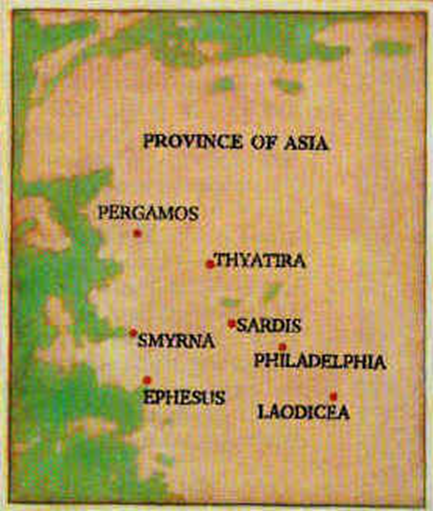
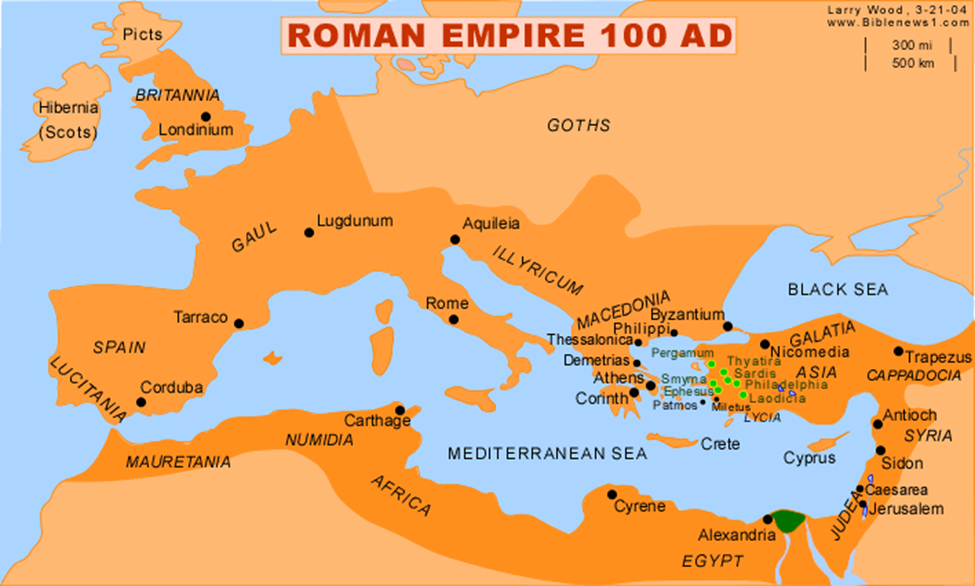
Before “God through Christ Jesus judges the secret thoughts of all” (Paul in Rom. 2:16), all nations are to hear the gospel message. God’s desire is that all people hear the truth about His Son and turn to him and away from the worship of false gods and false power. This is what John of Patmos communicates to seven struggling churches in a Roman province in Asia with his apocalyptic prophecy Revelation.

John of Patmos writes to the seven churches, each in their own context, about their witness within the context of the worldwide tyranny of Rome and the broader context of God’s cosmic battle against evil and his purpose for his creation and kingdom.

John makes it clear that witness of the truth proceeds based on the church’s loyalty to God’s kingdom and the church knowing the truth worth dying for and on the church being a faithful witness of that truth even unto death. The truth:  Jesus Christ, the Lamb Who was slain, is One with God and worthy of all worship and praise.

Revelation was written within the setting of the Roman empire. Early Christians were struggling against the “satanic trinity: the dragon or serpent (the primeval, supernatural source of all opposition to God), the beast or sea-monster (the imperial power of Rome), and the second beast or earth-monster (the propaganda machine of the imperial cult).”[i] The worship and witness of only the One True God and not of the Roman emperor put these early Christians in serious opposition to this “satanic trinity.”

Regarding a surface reading of events and of scripture (sometimes called “the plain meaning of the text”), consider the reverse engineering applied to the Genesis creation account to create a ‘Biblical origins’ response to Darwin’s On the Origin of Species and later, for the Scopes Monkey Trial.

Based on research that includes astrophysics, geology, and the James Webb Space Telescope, the universe is estimated to be 13.8 -26.7 billion years old. But reverse engineering of earth’s age using a literal surface reading interpretation of the creation account in Genesis estimates the earth to be about 6-10,000 years old. In terms of Jewish and Chrisitan thinking over millennia, the young earth creationism (YEC) position came about recently.

The YEC position has tied itself to concerns of Biblical inerrancy as if only a plain reading of the text, the lowest level of understanding, is what makes the Bible the Word of God. The fact that the Bible was written for us but not to us, the YEC position doesn’t allow for a historically contextual understanding to be taken into account.

Consider that the same reverse engineering used for the creation account (recently, the attempt to conform physical evidence into a Young-Earth biblical framework) has often been applied to End Time accounts in scripture to conform events to dispensational theology.

The prophecy and theology of Revelation relates not literal dates and geopolitical events but cosmic eventualities and resolutions. Its message for those in Christ is to persevere while living with evil opposition all around and with the tension of the imminence and delay of Christ’s return.

John encourages the churches: the enemies of God are finally defeated to make way for the ushering in of God’s fully realized everlasting kingdom. Heaven and earth will be joined together.

The delay of The End is a concern in heaven. John writes (Rev. 6): When [the Lamb] broke the fifth seal, I saw under the altar the souls of those who had been slaughtered for the word of God and for the testimony they had given; they cried out with a loud voice, “Sovereign Lord, holy and true, how long will it be before you judge and avenge our blood on the inhabitants of the earth?” 

John’s apocalyptic vision, filled with symbols and with descriptions of mythical characters evoking the book of Daniel, summons our imaginations to visualize things as heaven sees them. John’s prophecy, like the hundreds of OT prophecies he alludes to, is to reveal God’s POV.

 Revelation, you see, is what history has been all about. With that understanding, we carry on “knowing what soon must take place” (Rev. 1:1).

More about Revelation in my next post.


[i] Bauckham, R. (1993/2018). The theology of the Book of Revelation. PP 88-89

~~~~~

The Tribulation and the Rapture – Dr. Walter Martin (Historic Premillennial)

~~~~~

“Can you give me a hand moving these?”

Daily Cartoon: Monday, May 13th | The New Yorker

Reports from Davos before President Trump speaks:

Personhood For Rivers And Trees: Larry Taunton On The Fundamentally Anti-Human Sentiment Of WEF

Noor Bin Ladin Reporting From WEF: The Golden Age Is Incompatible With AI Replacement

A Place of Worship

Like all buildings, the building at 133 Adams St., was built for a purpose.

The west-side structure wasn’t a grand soaring Gothic edifice like other churches in Chicago. Rather, it was a simple structure built with minimal resources under the direction of a simple man and his wife: Daan and Linnea De Leeuw. They wanted a blue-collar Bible church for their growing family and the growing community.

The church was built according to the De Leeuw’s plans and the money God provided. Once the corner lot with an existing house was purchased and a permit issued, church members raised the structure as they could only afford to pay the building contractor.

Around a cornerstone with the inscription “1952+”, a concrete block building was erected with a pitched roof and no steeple. Three white stone crosses were set in relief on the brick face of the building. A parking lot was created. The old house on the corner became the parsonage.

The interior of the sanctuary was no nonsense. The concrete block side walls were painted-beige. Three windows with amber bubble glass lined each side wall. Forest green curtains bordered the windows. The walls around the windows were bare except for a small wooden rack near the organ. It held the numbers of the previous service and Sunday school attendance and the offering amount.

Front and center on the platform stood a large wing pulpit. Three large minister chairs were behind it along the choir loft. A piano and an organ flanked the platform. On the back wall above the choir loft was a plaque which read “God is in His Holy Temple. Let All the Earth Keep Silent. Hab. 2:20.”  

To the right of the platform and behind a large rectangular hole in the wall was the baptistry. A landscape was painted on the walls surrounding the water tank.

On the main floor in front of the pulpit was the oak communion table. “This Do In Remembrance of Me” was carved on the front. The table held the offering plates and a flower arrangement – the only element of beauty in the building.

Opposite the platform, sixteen rows of chairs back, was the entrance to the sanctuary. A clock was hung centered above the double door entrance to let the minister know when to end the service.

When the church was dedicated, Daan became its pastor. Thirty families joined the church. Over time there were altars calls, baptisms, weddings, and banquets. Weekly children’s programs were developed. The church membership grew. Two hundred more voices were added to the congregational government.

At one point it was decided that the church could take on more debt and expand. A large wing, at a right angle to the sanctuary, was added. The addition included a gym and kitchen upstairs and classrooms downstairs.

With a growth in membership came an increase in disagreements. Disputes arose about what Biblical texts meant, about how things should be handled, about who should or shouldn’t be a member, and about finances. Church business meetings became so rancorous that Daan and Linnea decided to leave the church, move far away, and abandon the building and its original purpose. With the De Leeuw’s departure, a pastoral search committee was formed to find a replacement.

The search would repeat itself over and over every few years as there was always dissatisfaction and disappointment with each person they brought in. Interim pastors would fill the pulpit more often than a full-time minister. Families, frustrated with the lack of cohesion, stopped coming.

Many began attending other local churches and some moved away. Membership dropped down to just a few of the original builders and attendees. As such, the church was no longer financially sustainable. The building and property were sold to a Jehovah’s Witness congregation which turned it into a Kingdom Hall.

A few years later the JWs sold the church when they moved across town to another building. The new owner was a restaurateur.

After rezoning to change the corner property to commercial use, he converted the gym into a banquet hall. There was a large kitchen adjacent to it. The sanctuary was converted into an entertainment venue. The classrooms became multipurpose rooms. One large room was made into a salon with hairstylists, nail specialists and an electrologist. A Yoga studio was set up in another and the other rooms became storage and stock rooms.

A large sign that said Transitions Banquet Hall & Entertainment Venue was installed in front of the three raised crosses. Garish lighting illuminated the sign and the outside walls. Neighbors were none too pleased about the lights, the traffic and the noise so close to their homes. They had lived by a non-disruptive house of worship and now a disturbing spectacle had taken its place.

Wedding receptions were held in the banquet hall. The room could accommodate two-hundred guests, a DJ and a dance floor. Strobe lights and a disco ball light hung from the ceiling.

In the sanctuary, singers, comedians, and magicians performed. Drinks were served. The concrete block walls, painted red, were covered with photographs of past and present entertainers. Sound speakers hung in the corners of the room.

The banquet hall and entertainment venue operated successfully for seven years, but there was something about it that was always at odds with the neighbor’s conventionalism. Concerned also about the area’s decline, its noise, rising crime, and rising property taxes, and wanting a better quality of life, homeowners fled the area. Boarded up properties, trash, and overgrown weeds began to appear.

It was only a matter of time before Transitions’ customer base eroded away. Wedding bookings dropped off and entertainment acts no longer booked. With the loss of customers and income, the building’s upkeep went into disrepair and service quality dropped off. The owner decided to start up again somewhere else. So, he put the property up for sale. But no offers were forthcoming.

Over a decade the abandoned buildings became covered with graffiti. The cornerstone and crosses, too. The onetime place of worship became an eyesore condemned by the community. At city board meetings neighbors voiced concerns about what was going on in the building and in the former parsonage. People were coming and going day and night. Was the building, once a symbol of hope for those who met there, now a heroin den?

The onetime house of worship would be fondly remembered through pictures on Facebook and good times associated with it. But the deserted and decaying house of worship now stands as a remembrance of the disputes which brought about its demise and abandonment of purpose.

Would a developer come along and renovate and repurpose the existing buildings? Would the developer know the building’s original purpose? Would he, instead, tear it down and build new? Would he keep the cornerstone or discard it for a new milestone?

~~~~~

The Angelus – Jean-Francois Millet 1857-1859

Millet: “The idea for The Angelus came to me because I remembered that my grandmother, hearing the church bell ringing while we were working in the fields, always made us stop work to say the Angelus prayer for the poor departed.

An X-ray of the painting on request of Dali who was impressed greatly by the contrast between the idyllic background and tragic poses of the peasants. It appeared that originally instead of the basket of potatoes Millet had depicted a baby coffin. Thus the couple was burying their child.

The Angelus (painting) – Wikipedia

What’s Your Relationship with Wisdom?

Imagine. You are the half-brother of a new baby brother. The little guy seems to be prized above all else. Certainly, there was a big fuss about his birth. Field workers showed up just to see him. They talked of angels appearing.

A couple years later, sages come from a long way away. They talk of being guided by a star to find a newborn king. They give your half-brother expensive gifts.

Then your father has a dream. He says that authorities want to kill your brother. Your father and step-mother suddenly take your brother and flee to another country. You and your brothers and sisters stay with relatives in Bethlehem. When they return with the boy, your family moves to Nazareth in Galilee. There are too many eyes on Bethlehem, your father says.

You can’t forget the time your family went to up Jerusalem for the Festival of the Passover. Afterward, walking for a day toward home, your step-mother finds out that your half-brother is not around. When asked about his whereabouts, you said “How should I know where he is? Am I his baby sitter?”

Your family walks back to Jerusalem to look for him. Your father and mother ask folks along the way if they’ve seen your brother. It turns out, after three days of looking for that guy, that you find him in the temple courts, sitting among the teachers, listening to them and asking them questions. He’s got their attention! The nerve of your twelve-year kid brother!

Your step-mother was panicky. She was not at all happy when we finally found him. She said to him, “Son, why have you treated us like this? Your father and I have been anxiously searching for you.”

And he says “Why were you searching for me? Didn’t you know I had to be in my Father’s house?” That sounded like crazy talk.

You, Jacob, and your brothers, Joses, Judah, and Simon and your sisters Salome and Mary are astonished at the attention your father and step-mother and others give to your half-brother. You become jealous and find it easy to look askance at him. You are not alone in these feelings.

When he teaches in your synagogue, people whisper “Where’d he get all this? Where’d he get this wisdom? How does he have that kind of power in his hands?” Everyone was wondering “Who is this guy?” “Isn’t he just a local yokel like the rest of us?” They took offense at him.

He is your brother, so you try to reserve judgement. He does say and do astonishing things but you find it really hard to believe in him. He’s been a mystery since the beginning. You and your three brothers think that if he really is such a big deal he should go show himself to the whole world. The four of you push him to do this. But he goes in a deadly direction.

After your half-brother’s resurrection, you are convinced beyond any doubt that he is the Christ, God’s great mystery. You agree with the apostle Paul that he became to us wisdom from God. And, that everything that we have – right thinking and right living, a clean slate and a fresh start – comes from God by way of Jesus Christ.

~~~

Who is Jacob, in translations called James? He was a half-brother of Jesus and therefore, an eyewitness of his life. He was likely one of the sources for the gospel of Luke along with Peter, Cleopas, Mary, and Joanna. James could vouch for the infancy narrative and childhood of Jesus. The gospel of Luke notes, in the account of the boy Jesus at the temple, that “Jesus grew in wisdom and stature, and in favor with God and man.” Both James and Mary would know this.

James is mentioned in the gospel of Mark (6:3) and the gospel of Matthew (13:55). He is in Paul’s list of eyewitnesses who saw the risen Lord (1 Cor. 15: 5-7).

Paul mentions that he received his apostleship in the same tradition as the Jerusalem apostles, including Peter and James (Gal. 1:18). He mentions James first, and then Peter and John, as “pillars” in his allusion to the temple (Gal. 2:9).

After the resurrection, the Jerusalem church became the mother church of the Christian movement under the leadership of The Twelve and James. James is mentioned as head of that church (Acts 12:17; 15:13-21; 21:18-25). (It needs to be said: all first-century Christianity was Jewish. Early Christianity was a distinctive form of Judaism. James writes from the same Jewish heritage and wisdom tradition that Jesus taught from. “Christianity” was not a break from the past.)

Jacob wrote the letter/book of James.

James is considered the Proverbs of the New Testament. Written with knowledge of Jewish wisdom-traditions and Torah, James is simple and direct in his words. He writes wisdom sayings – practical moral instruction. He doesn’t pull any punches.

James instructs us to match faith with good works and to “Show by your good life that your works are done with the gentleness born of wisdom.” And not just any wisdom. We are to choose “wisdom from above” and not the “earthly, unspiritual, devilish” kind. (James 3: 13-18).

It has been suggested that the New Testament book of James “has been heavily influenced by two sources, the first of which is Jesus’ teaching about life in the Kingdom of God, especially the Sermon on the Mount (Matt. 5-7).“ See “hearers and doers” example in Matthew 7: 24-27 and James 1:22-25.

“The second key influence is the biblical wisdom book of Proverbs, especially the poems in Proverbs 1-9.” See Proverbs 1-9  and James 1:5 regarding the importance of acquiring wisdom.

Reading James, I see the parallels and influence of Proverbs and the Sermon on the Mount. I also read James in terms of another selection of wisdom literature: the Book of Job. Therein, hardships and trials require a new perspective. The letter of James, written to the Jewish Christians throughout the Diaspora, speaks of the need for wisdom and Job-like perseverance in a world where people struggle and suffer because of what they profess.   

Read James with the Book of Job in mind:

My brothers and sisters, whenever you face various trials, consider it all joy, because you know that the testing of your faith produces endurance. And let endurance complete its work, so that you may be complete and whole, lacking in nothing.

And . . .

Blessed is anyone who endures temptation. Such a one has stood the test and will receive the crown of life that the Lord has promised to those who love him. No one, when tempted, should say, “I am being tempted by God,” for God cannot be tempted by evil and he himself tempts no one. But one is tempted by one’s own desire, being lured and enticed by it; then, when desire has conceived, it engenders sin, and sin, when it is fully grown, gives birth to death. (James. 1: 12-15)

And . . .

Indeed, we call blessed those who showed endurance. You have heard of the endurance of Job, and you have seen the outcome that the Lord brought about, for the Lord is compassionate and merciful. (James. 5:11)

The Book of Job tell us where not to look for wisdom.  Job 28: 12-15 says that we won’t find wisdom and understanding in the human realm:

“But where shall wisdom be found?

And where is the place of understanding?

Mortals do not know the way to it,

and it is not found in the land of the living.

The deep says, ‘It is not in me,’

and the sea says, ‘It is not with me.’

It cannot be gotten for gold,

and silver cannot be weighed out as its price.”

James tells us where to look for wisdom:

 If any of you is lacking in wisdom, ask God, who gives to all generously and ungrudgingly, and it will be given you. But ask in faith, never doubting, for the one who doubts is like a wave of the sea, driven and tossed by the wind. For the doubter, being double-minded and unstable in every way, must not expect to receive anything from the Lord. (James. 1: 5-8)

~~~

The Lord by wisdom founded the earth;
    by understanding he established the heavens;
by his knowledge the deeps broke open,
    and the clouds drop down the dew.

Prov. 3: 19-20

The Lord created me [Lady Wisdom] at the beginning of his work,
    the first of his acts of long ago.
Ages ago I was set up,
    at the first, before the beginning of the earth. . .

I was beside him, like a master worker,
and I was daily his delight,
    playing before him always,
playing in his inhabited world
    and delighting in the human race.

Prov. 8: 22,30-31; Proverbs 1:20–33 and Proverbs 8:1—9:12

Christians typically start their version of the creation narrative in Genesis 1 and 2. I start with what many scholars consider, based on archaic language, style, themes, and similar works, the oldest book of the Bible, the Book of Job. After hearing the human perspective about the cosmos from Job’s friends, I want the Divine perspective which includes the Wisdom Hymn in Job 28.

God alone knows the way to Wisdom,

he knows the exact place to find it.

He knows where everything is on earth,

he sees everything under heaven.

Job and his friends thought the world worked a certain way. They thought God acted a certain way. But they lacked Divine perspective – wisdom. After all that is said in the human realm, God questions Job from out of a whirlwind:

“Where were you when I laid the foundation of the earth? Tell me, if you have understanding.”

“Have you ever in your days commanded the morning light?”

“Where does light live, or where does darkness reside?”

“Can you lead out a constellation in its season?”

God reveals to Job and his friends their utter lack of understanding of how the complex cosmos is ordered. He describes intricate wonders of creation (Job 38-41) and challenges Job to even begin to understand His world. It becomes quickly evident that it is not their place to question God’s rectitude or wisdom.

To illustrate further, God instructs Job with the ways of Behemoth and Leviathan (Job 40-41).

Wisdom from God matches us up with the created order and the Creator. Wisdom is working with God’s created order, avoiding disorder and recognizing non-order (John Walton). See Uncharted Understanding | Kingdom Venturers

Having information is not having knowledge. Having information is not having wisdom. Knowledge is knowing what to do with information. Wisdom is understanding, discernment, and character supplied by God and applied with knowledge. Lady Wisdom calls us to good sense, sound judgment, and moral understanding. Wisdom has the capacity to contemplate profounder problems of human life and destiny.

It is the wisdom of the clever to understand where they go,
    but the folly of fools misleads.
Prov. 14:8

To get wisdom is to love oneself;
    to keep understanding is to prosper.
Prov. 19:8

Buy truth, and do not sell it;
    buy wisdom, instruction, and understanding.
Prov. 23:23

James, steeped in Jewish wisdom-traditions, knows that wisdom belongs to the very nature of God himself. He knows that wisdom comes to man only as a divine gift. He writes telling readers to ask for the divine gift of wisdom by faith.

 If you don’t know what you’re doing, pray to the Father. He loves to help. You’ll get his help, and won’t be condescended to when you ask for it. Ask boldly, believingly, without a second thought. People who “worry their prayers” are like wind-whipped waves. Don’t think you’re going to get anything from the Master that way, adrift at sea, keeping all your options open. (James 1:5-8)

The beast Behemoth is not worried:

A raging river does not alarm it;
    it is secure, though the Jordan should surge against its mouth.

-Job 40: 23

~~~~~

Proverbs: Lady Wisdom and Lady Folly

Proverbs: Lady Wisdom & Lady Folly

~~~~~

Foster Care

Ronda Paulson and her husband Corey founded Isaiah 117 House to provide a safe and loving home for children awaiting placement in the foster care system. Isaiah 177 House was featured on Mike’s Facebook show, Returning the Favor. Ronda tells how her appearance on the show affected her mission, her life, and especially her health. 

Podcast – Mike Rowe

Isaiah 117 House

~~~~~

O’Keefe strikes again.

https://x.com/i/status/1861189891985678696

Wisdom (and the restoration of Democracy):

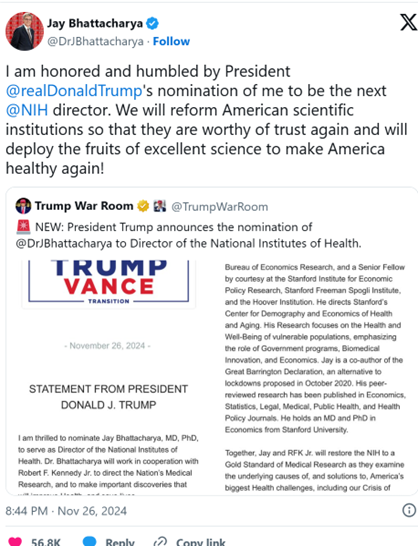
The Trump-Vance transition team announced that Stanford Professor Jay Bhattacharya, MD, PhD, author of “The Great Barrington Declaration,” is his pick to lead the National Institutes of Health. This is a terrific choice; Dr. Bhattacharya is highly respected and was right about the negative effects of lockdowns during the COVID pandemic when so many others were wrong. He didn’t back down despite numerous attempts to silence him. (Emphasis mine.)

(Professor Jay Bhattacharya is ten-thousand times better than former NIH director Dr. Francis Collins!!)

Trump Nominates Professor Who Sounded Alarm on COVID Lockdowns—and Was Censored—to Lead NIH – RedState

What Jay Bhattacharya, Trump’s NIH Pick, Has Said About Anthony Fauci – Newsweek

Restoring order (and Democracy):

Mexican President Claudia Sheinbaum addressed U.S. President-elect Donald Trump’s renewed threats of steep tariffs this week, asserting that migrant caravans are no longer reaching the U.S.-Mexico border.

Migrant Caravans Not Reaching Border, Claudia Sheinbaum Says After Trump Threats – Newsweek

~~~

Doris Lee, Thanksgiving, 1935, Art Institute of Chicago, Chicago, IL, USA.

The Fowler’s Snare Chronicles

There is no way back but there is a way through.

The day that brothers Bryce and Blake returned to campus after a fencing tournament they were immediately escorted to the IU auditorium where the first session of the Ex Novo Institute in Basic Life Process had already started. It seemed to them that the whole student body was in attendance. They stood at the back of the balcony with the others who came in late.

Up front, a large screen projected a woman’s face. Her owlish eyes darted back and forth behind the circular frames of her glasses. The small, and yet imposing woman, had cropped black hair and was dressed in something like a military uniform. She was speaking from a podium off to the left of the screen.

“There will no longer be any recognition of the past. Clear your mind of all that came before. You are students of today. Your mindset is today. Your thoughts are today’s thoughts. When you complete the Basic Life Process course, you will become stewards of the New Way Forward and not of the dug-up past.”

Bryce and Blake gave each other a puzzled look.

“You will no longer be weighed down with the obligations of tradition and faith. Tradition and faith brought you guilt and prejudice and racism and greed and violence. You are to rid yourself of such baggage. Your motivations and direction will come from Central Screen. Central Screen will be your personal Event Horizon.”

A logo appeared on the large screen. Beneath the words “Central Screen” was what looked like graph paper curved into a cone pointing down. At the edge of the taper was “Event Horizon”. The cone’s tip was labeled “Singularity.”

“You will be given a new set of values from Central Screen. All that is good will come from Central Screen. There is no such thing as a morality that stands outside human society. Morality is subordinated to the General Will as shown on Central Screen.

“You will no longer have to worry about what is good and the right thing to. You won’t need religion. The Central Screen software will make particular ethical perceptions clearer by demonstrating how they exemplify more general rules based in scientific certainty. The software will provide a systematic accounting of reality that our intuitive moral perceptions and judgements can only hint at.”

When the first session had concluded, a student approached the speaker, Director Argans. She scanned the student’s face with her CenSoid App. “Yes, Alistair?”

“Director Argans, I am currently in the humanities doctoral program here at IU. My doctoral thesis is on Dante, Botticelli, and the Florentine Renaissance. I rushed back from Italy for this required course. Am I to understand, what you’re saying is, that the independent study of the humanities, the study of all languages and literatures, the arts, history, and philosophy is no more? Everything is to be found on Central Screen?

“Alistair, as you will learn on Day Three, anything that holds a bellicose inspiration from the past is a danger to the organization of peace. You will learn what unites us as world citizens. You want to live free from oppressive and pugnacious attachments to the past, don’t you Alistair? To see what can be, unburdened by what has been.

“It was pope Francis, Alistair, who said “a conservative is one who clings to something and does not want to see beyond that.” He also said that it was a “suicidal attitude because one thing is to take tradition into account, to consider situations from the past, but quite another is to be closed up inside a dogmatic box.

“And, wasn’t it Rousseau who said that people in their natural state are basically good. But this natural innocence, however, is corrupted by the evils of society? We are in the process of creating a new society using simple rational principles provided through Central Screen.”

“Well, Miss Argans, I never thought of art as bellicose or of being in a dogmatic box.”

“Alistair, you will after session three. Humanities stirs the emotions and emotions cloud reason. You will be given a new set of “realistic” or “rational” values to work with. In our workshops you will learn a new way forward with Central Screen AI. What will it profit you, Alistair, if you gained that doctorate and lose yourself with a suicidal attitude in the process?”

Another student broke in and Alistair wasn’t able to ask another question. He walked away stunned by what he had heard.

~~~~

“That was ten years ago this month.”

Comet got up from his chair and looked out the attic window of the Victorian house on Jefferson St. in Martinsville, Indiana. Seeing no threat, he sat back down and faced Scribe who was typing.

“That Ex Novo session was ten years ago this month. Make sure to note the dates in this chronicle. And listen, sis,” Comet emphasized, “no real names go into this eyewitness account. If these chronicles get into the wrong hands we’d be done for and so would mother and father and Grace downstairs. We are recording the diabolical acts of the Save Democracy party as Comet and Scribe. Let’s call this next chronicle Surface.”

“Surface?” asked Scribe.

“The Save Democracy party wants nothing to do with the past. Many in our world read and study history to know how to proceed. Practical wisdom is case based. But the Party studies the future, rewrites the past and proceeds with abstract theoretical reasoning or surface knowledge.

The party leadership operates like a ship’s captain heading out to sea and who ignores the traditional knowledge passed down through generations used by navigators to read the stars, winds, and currents.

“The Save Democracy party leadership ignores the guidance of the vast ocean underneath and the vast night sky above, the enduring connection to the space and time we all travel in. It ignores charts and says “I know my way around. I know where I want to go. I know the way forward just by looking at the surface” and “I know how to use a rudder.”

“The ship will move and be tossed about because the ocean surface is never still. Wind-driven waves and currents will steer the boat this way and that. It may take on water and go all Titanic. If not, it will end up lost at sea without a way back to port. Scribe, we have escaped. But most have been forced into steerage aboard the Surface ship of fools!”

“Got it, said Scribe. “I think.” She inserted another sheet of paper into the typewriter. “Did you finish what happened during that first Ex Novo Institute?”

“Ah, no. After the first session I came up and questioned Miss Argans about my law classes and finishing them up. She told me the same thing she said to the guy in front of me. When I left her, I noticed that I was being followed. I went to the second session – we all had to. It was the same lecture as the day before: tear it all down and start over. That time many of the students were clapping. Maybe out of fear or maybe because the words resonated with what they had been taught over the years.

“During the third session I saw the same people who had been following me. They were removing people from the auditorium. I snuck out. I went into hiding. We’ve been hiding ever since.”

Comet got up and took another look out the attic window. He remembered the day he saw the Rooms for Rent sign in the front yard. The widow Grace was happy to have them around to help keep things up and to keep her company. She also needed the money. The socialist economy had created hyperinflation. She let them rent two rooms.

Comet and Scribe arrived together. Their parents, who didn’t want either of them to grow up in the Save Democracy system, thought it best if they stayed out of sight together.

The house was a good location for Comet, a former astronomy student at IU. He spent many nights at IU’s Goethe Link Observatory just eleven miles north of Martinsville. He felt safe there in the middle of the night.

~~~~~

The street was quiet. What Comet thought unsettling was the Save Democracy party headquarters in the Morgan County Courthouse a few blocks away and the massive 5G tower standing next to it monitoring all digital communications and transactions.

“So, you were going to tell me what happened before all this Ex Novo business.” Scribe put another sheet of paper in the portable Smith-Corona typewriter.

Seeing no threat on the street Comet began pacing to give his account.  “Let’s call this next chronicle The Surface Comes to Power.”  Scribe began typing.

“Four years before the first Ex Novo days, a November election was held. But the man elected was not allowed into the White House. The Save Democracy party and a few others in the House of Representatives passed a resolution saying that the man was an “insurrectionist” and therefore disqualified under Section 3 of 14th Amendment “insurrection” clause. With Secret Service agents counting the electoral votes, together they refused to certify the election on January 6, 2025.  

“The Counting and Certification of Electoral Votes in Washington, DC, had been designated a National Special Security Event by the Secretary of Homeland Security. The military received an amended directive allowing for their direct involvement in civilian law enforcement operations under emergency conditions, including situations where there is an imminent threat. The military was used by the Save Democracy to facilitate a coup, a coup set in motion four years before on January sixth. An “insurrection” setup scenario had been initiated by the Save Democracy party in concert with the FBI, “deep state” actors, and later with a show trial.

“Right after the election, the twenty-fifth amendment was used to depose the current feeble-minded president. He was replaced by a puppet, the feeble-minded Vice president. The elected Vice President was given an office but no access to the White House or policy.  

“The Save Democracy party, over time, having taken control of both the house and senate with the votes of non-citizens, absentee votes counted after the election, and massive voter fraud, then removed the conservative members of the Supreme court with expulsions based on made-up ethics violations.

“The court was then reconstituted to hold fifteen members of the Save Democracy party. All challenges to the constitutionality of such sweeping changes failed because the plaintiffs were told they had no standing. No subsequent challenges were brought before the court after the Save Democracy party Speaker of the House tore up the U.S. Constitution during a State of the Union speech.

“It was then declared that the electoral college would be abolished and all future elections would have the oversight of the new Elections Council.

“Using the military “under emergency conditions” to keep the peace, Save Democracy members were quickly installed throughout state and local governments and the courts where there hadn’t been support for the Save Democracy party. The newly installed were given a mandate to defend One People, One Equality, One Equity, the motto of the Save Democracy party. The ensuing reign of terror went well beyond the atrocities of the French Revolution.”

Scribe stopped typing. “French Revolution? I don’t know what that is. Will the readers know?”

Comet sat down and faced her. “You were only six years old when the Save Democracy party took over the country. The party didn’t want anyone to learn history as it would expose them and their ways. You weren’t given a chance to learn history. I’ll explain the French Revolution later. You are an autodidact. You’ve learned a lot on your own already. I better go on. Have you got everything so far?”

“Yeah, go a little slower. I’m not used to typing on this thing” Scribe added another sheet of paper to the typewriter.

“OK. The Save Democracy party members immediately enacted permanent martial law. The Party media said that martial law had been imposed because of the civil unrest due to “perverse and macabre” political foes – those who didn’t accept what had happened to their country. Martial law allowed the Save Democracy party members to keep in check “extremist elements”, to control the drug trade for profit, and to exploit terrorism for its own ends.

“The operation of new penal codes was entrusted, not to legal authorities, but to local oversight committees. They hunted down those thought to be a threat to the community. Anyone could be accused of being disloyal to the Save Democracy party even based on hearsay. Anyone – father, mother, grandmother, grandfather, and child – could be imprisoned, tortured or executed for allegedly being critical of the Save Democracy party. Many were arrested on fabricated charges just to keep people living in fear of the local Save Democracy party.

“A favorite form of torture in many towns was the “Underneath pit.” An arrestee was thrown into a ten-foot-deep hole in the ground. The hole was exposed to the elements. The width of the pit was barely bigger than the person thrown in. He or she would not be able to bend or change their position. The hole was the prisoner’s latrine. After many days the person would become a sliver of flesh with only the feeling of anger keeping them alive. These tortures are still going on today.

“With the new power they had been given, local Save Democracy party members kept up the perpetual and brutal oppression of citizens. They loved to dehumanize. For them it was a game. They found new ways of doing so and posted them on Central Screen. Limitless coercion and terror were essential to the Save Democracy party’s New Way Forward.

“Random terror was meant to convey the constant and unyielding force of the Party’s control over humanity. It emphasized a future devoid of freedom and individuality. The end product was to create mindless and unfeeling oxen for the party.

“Out of fear of being sent home and losing benefits – a threat made on Party media – fifteen million illegal migrants voted for Party candidates every election.

“Once the Save Democracy party had full control, it was decided that vast numbers of the population had to be culled, as the welfare system, hospitals, schools, and prisons were overwhelmed. Some in the party just wanted to lower the population numbers out of climate concerns. So, a gain-of-function virus was released from a bioweapons lab in California. Millions of people suffered and died from the higher levels of spike protein in the One Health self-amplifying mRNA vaccine.

“The Committee of Public Singularity was established out of fear of a viral outbreak of past knowledge. The Committee created the Ex Novo-Institute in Basic Life Process to deal with the Underneath, a mindset that had been banned as extremist.

“The idea behind the institute was to make a clean sweep of human nature. At the compulsory meetings people were told that the Save Democracy party was building from scratch a new ideal society on the concepts of humanitarianism, social science, and collectivism using Central Screen programming. The analog past was to be replaced with a digital future controlled by Central Screen AI.

“What I learned during the Ex Novo sessions was that voiding the past and human attachments were required by the New Way Forward. Old thoughts, old habits, old culture, and old customs had to be destroyed. No one was to experience any connection with family, friends, children or about anything, past or present. They were to die to all that. All of life was to come from the Party’s Central Screen. All of life was to come from the Surface.”

~~~~

“You staying with me, Scribe?”

“Yeah. This stuff you’re telling me is nasty. I don’t like thinking about it.” Scribe shivered.

“Yeah, it is. That’s why we are making a record of it. People need to know what happened. Right now, the Save Democracy party is erasing anything connected to the past. Let’s keep going.”

Once again, Comet got up and looked out the window. The neighborhood was quiet.

During the first days at the house, Grace talked about Martinsville. The first settlers, she said, arrived in Morgan County in 1822. Large numbers of Quakers migrated here from the south because of their opposition to slavery. 

She also said Martinsville was nicknamed the City of Mineral Water. Oil workers discovered the foul-smelling mineral water while drilling. Mineral water was thought to have healing properties. It was used in the Martinsville Sanitarium which operated as a health resort until about 1957. But now, she said, the Sanitarium was being used by the Party for optogenetic experiments on citizens.

That’s what her last renters, neuroscience students, told her. The Party is controlling subjects with the presence of light to alter cell behavior with regard to reward, motivation, fear, and sensory processing.

Seeing nothing on the street that concerned him, Comet continued dictating while pacing.

“In tandem with the Ex Novo-Institute, there was an even more invasive program: ReCognify Conditioning. The Save Democracy party, along with the social programmers of the World Economic Forum, claimed that human nature is no different to that of a programmable machine.

“Transhumanist scientists began implanting vast numbers of the population with synthetic memories using brain chips to create a new ideal human. The ReCognify program had been initially tested on criminals. According to one unauthorized release of Party documents, customized AI-generated content converted visual information into codes delivered directly to the brain and stored in DNA and RNA, forever altering the subject.

“Prisoners were implanted with synthetic memories of their crimes – but from the perspective of their victim or victims. The embedded artificial memories prompted reactions like remorse, empathy, and understanding.

“The ReCognify program then began to be used on the general population to wipe away past memories and to make people docile and pliable to the Party’s party authority. The Ex Novo Institute was the means to bring in those subjects the Party thought would be troublemakers. But not everyone would submit to ReCognify and the “forced forgetting” process.”

“Hold it,” said Scribe. “The ink is beginning to wear thin. I need another ribbon. I wonder if . . .”

“We’ll ask Grace if she has more,” Comet said. “C’mon. We need a break.”

~~~~

“We know that the son of God has come and given us understanding so that we know the truth. And we are in the truth, in his son Jesus the Messiah. This is the true God; this is the life of the age to come.”

Father Denny stopped reciting 1 John from memory when the barn door creaked opened. Everyone drew quiet. Bryce and Blake and their wives appeared at the door. Father Denny waved them in. The couples greeted him and six others of the Underneath community.

The group met to support each other in a barn on a southern Indiana farm. They had been living on the farm, hiding from the Save Democracy for the past ten years. The refuge was Father Denny’s idea.

Anglican priest Father Mason Denny, a gaunt bewhiskered marathoner, left his Indy parish and moved to the sweeping 80-acre working farm to help his friend Tom and his wife Sally. The Binghams were in their seventies and working the farm had become too much for them. They had no idea what happened to their children. They hoped the Save Democracy party hadn’t taken them.

Seeing the possibilities and after much prayer, Father Denny knew that he had to create a refuge to help those of the Underneath escape the “fowler’s snare,” as he called the Save Democracy party’s operations. A portion of the farm land was already being used as a short-term RV campsite. Using all of his retirement funds, he converted the campsite into a mobile home park and began rescuing students.

When the Ex Novo Institute staff began pulling students out of the audience for the ReCognify program, Father Denny brought several students to the farm. The students knew Father Denny and trusted him. He had been a chaplain on campus, providing spiritual services in the Beck chapel on the IU campus. This was before the Save Democracy party banned all such meetings as subversive.

The rescued students lived in the mobile homes and worked the farm. From their organic garden they harvested green onions, Italian greens, tomatoes, asparagus, spinach, strawberries, green beans, heirloom tomatoes, summer squash, blackberries, melons, and herbs. From the field, they gathered sweet corn.

They grew an array of flowers – zinnias, gladiolus, dahlias, and sunflowers – and tended goats, rabbits, and chickens.

Every Saturday they held a farmer’s market to sell produce, goat cheese, pastured eggs, and pies and to barter with locals for butter, flour, meat, and diesel fuel.

Father Denny found a way to sustain the Underneath, a mindset that had been banned. But it had come at a personal cost.

~~~~

Comet and Scribe sat at the farmhouse kitchen table with Tom, Sally, Father Denny, and Skippy, Tom and Sally’s three-legged Airedale.

Comet and Scribe had recently found their way to the refuge. Grace, the woman they were staying with, gave them directions to the farm after local Party authorities came around one day looking for them. One of her neighbors, who had received a ReCognify implant, had given them away.

Comet asked Scribe to read the transcript of what Grace related about her husband.

“Bill was a mechanic in a manufacturing company. He told me that every day in the lunch room there were news reports on the TV saying that inflation was transitory and that the economy was doing great and that wages rose again for the fourteenth quarter in the row. Bill began posting his pay stubs on his tool box to show that it wasn’t true. His foreman came along and told him to take it down or face dismissal. Bill didn’t take it down and he was dismissed. The Party wouldn’t allow him to work again.”

Comet described how he and Scribe were recording what took place the last fifteen years. He explained his use of “Surface” to describe the operation of the Save Democracy party.” Father Denny agreed with his analogy.

Comet and Scribe were eager to hear Father Denny’s story. They said they would record the story and use false names and places.

“Scribe, you don’t have to keep lugging that portable typewriter around.” Tom offered. “We can hide it under a floorboard in the other room. No one will find it there.”

Scribe nodded and smiled in relief.

“Are we ready Scribe?” Father Denny asked. 

“Ready, sir,” Scribe replied. Father Denny began.

“During my twentieth year as rector of an Indy church, I lost my wife Ellen to the effects of the mandated vaccine. Despite my protestations and my own refusal to take the mRNA vaccine, she thought it a Christian thing to do to obey the authorities, especially as the Party had mandated “No vaccine. No church gathering.”

“After Ellen’s passing, I came to realize that the authorities had more in mind than a vaccine mandate. I was faced with a choice.

“You see. Churches not obeying Save Democracy party directives were closed. The churches with what I call “cultural Christians” – those that obeyed mandates and focused on . . .” he paused and looked over at Comet, “. . . Surface issues pushed by Central Screen Apps, issues such as social justice, equity, race, gender, sexuality, and creation care – remained open.

The Party knew that the fate of its project of atheistic secularization was tied to the religious feelings people had. The Party saw that it couldn’t convert the religious with ideology. But it could use religion to further its ideology and fill the void of absence of spirituality.

“I saw that the spiritual way of life was to be replaced with the Surface way of life. Religious symbols were to be replaced with secular symbols. The church and the gospel were being replaced with Assemblies of the General Will and the “well done” of social credit scores. The Party worked to fill the ideological and spiritual absence of religion.

“As a way to reorient churches, ministers were forced to sign a social contract acknowledging that Man is born free, and everywhere he is in chains and that all people should unite with the General Will of the people to bring about the common good of the New Way Forward.

“The General Will, as dictated by the Central Screen app, meant the total subordination of citizens. All rights, all property and all religion would be subject to the General Will. Freedom would be associated with obedience. As such, the General Will directive provided Party members a defense for oppressing and destroying those who did not obey including those of the Underneath.

“The deeper-than-surface Christianity that I call the “Underneath” was an ideological, political and spiritual problem for the Save Democracy party. The “error correction” of “the science” didn’t work on the Underneath. Its underlying history, tradition, and transcendent gospel had to be rooted out and destroyed.

“The Save Democracy party understood that those like myself and those here on the farm and elsewhere – disciples of Jesus – are not directed by Central Screen. We are directed by the Lord of heaven and earth. We don’t compromise and hold back a reserve of ourselves to maintain the status quo and avoid trouble. We speak to the fiction and lies around us and that has brought suffering.

“The cultural Christians of Central Screen desire the good feelings of social justice activism but none of the adversity attached to proclaiming the gospel message. They portray themselves as being and doing right with social justice standards. Jesus quoted Isaiah to the Pharisees and legal experts when a dispute arose about a manmade imperative:

‘These people make a big show of saying the right thing,
    but their heart isn’t in it.
They act like they are worshiping me,
    but they don’t mean it.
They just use me as a cover
    for teaching whatever suits their fancy,
Ditching God’s command
    and taking up the latest fads.’

“Compromised, they live within the lie. They perpetuate and legitimize the ideological fiction of the Party. They become oppressed and the oppressor, persecuting critics of Central Screen activism.

“The party also knew that it couldn’t convert those of the Underneath with what they called the “Reformation” – the ideological work of scientific atheism through the Ex Novo Institute. They saw those of the Underneath as tenacious holdouts.

“Ex Novo programming was meant to show that The General Will is the purpose of life. Faith in The General Will was to become an inner conviction. Then, they assumed, all illusions about heaven and the afterlife and the kingdom of God fade away and disappear. The Surface was to be one’s spiritual refuge.

“When the vestry came to me one day and said “we need to show pronoun hospitality” I told them that I would retire. I could see that many in the congregation did not believe the lies of Central Screen, but they felt, as Vaclav Havel wrote in his essay The Power of the Powerless, that they must behave as though they did, or they must at least tolerate them in silence, or get along well with those who did.

“Havel went on to say that “They need not accept the lie. It is enough for them to have accepted their life with it and in it. For by this very fact, individuals confirm the system, fulfill the system, make the system, are the system.”

“Seeing this mindset in the congregation, I told the vestry I would leave and go on the road and see the country. I ended up here on Tom and Sally’s farm in southern Indiana. I expected my son to join me here at the farm when he returned from his doctoral research trip to Italy. But that didn’t happen.

“I lost contact with him son after he returned to the states. I was frantic and looked for him all over campus. Those I asked said that the last time they saw Alistair was at the end of the first session of the Ex Novo Institute. They said he was asking questions.”

“I was there. I was behind him in line,” Comet jumped in.

Father Denny felt a sinking sensation in his stomach.  “I know Alistair. I knew that he would question things and exercise his point of view. But I also knew that the Save Democracy party accepted no challengers. So, I imagine the worst and pray for his safe return.”

Father Denny sighed heavily. “That was ten years ago and I haven’t heard a word about my son since.”

~~~~

The rescue from the third Ex Novo Institute session that December day happened quickly. The students were not able to inform their families. Telling them their whereabouts would put their families at serious risk. When the students didn’t sign in for the next Ex Novo Institute session, their families would be contacted and would be forced to take Truth Test Serum to tell the Party’s enforcement squad where they were. Having no knowledge of where the students were, they would be released. Father Denny later found a way to tell them that “they were safe and not to worry.”

Refugees Erin and Joseph were fourth-year neuroscience students. Jeremy studied computer science. Quinn had been a biotechnology major and worked part time at the Ray Bradbury Center at the IU Indy campus. Steven and Melanie were pre-med students.

Bryce was working on a Masters in epidemiology when he met Bryn, who was studying Environmental Health. Blake was working on his master’s degree in Business Analytics when he met Alice who was studying Business Admin Medicine. Father Mason Denny married the two couples in a ceremony held on the farm.

Mobile homes housed the former students. Each couple had a mobile home. Erin, Quinn, and Melanie shared a mobile home, as did Joseph, Jeremy and Steven. Father Mason Denny had a room in the farmhouse. Comet and Scribe had rooms in the farmhouse.

The members of the Underneath brought with them as many books as they could when they escaped Ex Novo and ReCognify. Father Denny brought his library to the farm. No other books would be available.

The Save Democracy party had dictated that books and education created inequality and unhappiness and were therefore banned. Libraries no longer contained books. Libraries were converted into ReCognify centers. The outside world had been cut off from knowledge that wasn’t Central Screen provided.

There were no electronics – phones, computers, TVs, radios, GPS devices – and no Central Screen app on the farm grounds. This was done to secure the location. Father Denny told the group that “The farm isn’t off the grid. We are hiding in the open and keep a low profile.”

Isolated from their families, members of the Underneath farm refuge supported each other. Weekdays were filled with farm work. At night the group ate together and then gathered in the barn or at the fire pit behind a thicket. They read texts out loud and recited memorized scripture. Each had committed entire Scripture texts to memory.

Father Denny had told them that “memorization is a means to internalize information of sacred nature, a transmutation of the metaphysical into flesh and blood and marrow.” It was also, he said, a means to create a memory palace – a mental sanctuary of information tied to farm scenes so that they can recall what was memorized. This, he said, would sustain them if captured by the Party.

On Sundays, the farm’s Underneath community came together for a liturgical service. They sang, prayed, and recited scripture. Father Denny administered to the group and administered the Eucharist.

Comet and Scribe set all this down under the heading “Rescue, Refuge, and New Reality.”

~~~~

The nights of the Underneath community were filled with readings and recitations, music and drama.

One night, Alice read Wise Blood by Flannery O’Connor. Over several nights, Father Denny read Vaclav Havel’s essay The Power of the Powerless. Other nights he read Father Brown stories. Over several nights, Jeremy read Robinson Caruso and Comet read Treasure Island. Quinn recited the poem ‘Dover Beach’ by Matthew Arnold.

Alister talked about his trip to Italy, and about the Italian Renaissance, Dante, and Botticelli.

Sally played the piano, Melanie played the flute, Jeremy the guitar, and Father Denny played some of his Big Band LPs for dancing.

One night they acted out Hamlet. Bryce and Blake played Hamlet and Laertes and fenced during the last Act. The brothers had, at one time, been in the U.S. Olympic fencing team.

One fire-pit night Alice quipped that women make the best archeologists because they are good at digging up the past. And Bryn said the smarted person in the Bible was Abraham: “He knew a Lot.”

One night they came together to listen to Quinn read Fahrenheit 451.

When Quinn finished reading the first chapter, Jeremy said “Read the part again, the part where fire chief Captain Beatty explains to Montag about how books had lost their value.”

Quinn turned back a few pages and read.

“Surely you remember the boy in your own school class who was exceptionally ’bright’, did most of the reciting and answering while others sat like so many leaden idols, hating him. And wasn’t it this bright boy you selected for beatings and torture after hours? Of course it was. We must all be alike. Not everyone born free and equal, as the constitution says, but everyone made equal. Each man the image of every other; then all are happy, for there are no mountains to make them cower, to judge themselves against. So! A book is a loaded gun in the house next door. Burn it. Take the shot from the weapon. Breach man’s mind. Who knows who might be the target of the well-read man?’

“Wow!” Said Jeremy. “That’s what the Party was pushing during Ex Novo. Exactly that!”

Father Denny added, “Polish poet Czesław Miłosz once said that “In a room where people unanimously maintain a conspiracy of silence, one word of truth sounds like a pistol shot.””

Comet and Scribe took notes.

~~~~

Comet brought his refractor telescope with him to the farm. One late night the group headed outside to explore the night sky. The area around the farm had little light pollution, so the evening sky sparkled with illumination.

The moon was full that night and the entire earth-facing surface was clear to see. Comet pointed the telescope at the lunar surface. Everyone took a turn viewing.

Scribe, waiting her turn, caught sight of something coming from the road. The moonlight-etched figure walked and weaved toward them like one of the disoriented ReCognits. The figure stumbled down, got up and tried to wave but fell down again and stayed down.

The group moved closer. Bryce turned the man over and lifted the soiled hair from his face.

“It’s Alister! he shouted. “Help me get him up.”

~~~~

Alister opened one eye and saw his father sitting in a chair. He was asleep.

“Dad,” Alister whispered.

Father Denny jolted up from the chair. “I just had a dream that you came home.”

“I had the same dream,” Alister replied. “I guess we’re on the same wavelength.”

Father Denny felt Alister’s head. “You have a fever. Here, drink this water.” He propped up Alister and helped him drink. “How do you feel?”

“I feel weak. I have a headache and a stiff neck. I ache all over.”

“Can you talk about what happened?’

“Maybe later today.” With that Alister closed his eyes and fell asleep.

That evening Sally came downstairs and told father Denny that Alister was awake and his fever was down. Father Denny, Tom, Comet and Scribe went up to see Alister. He was sitting up in bed with Skippy on his lap. He smiled when they entered the room

Father Denny, seeing that Alister’s face was no longer pale, put the back of his hand on his forehead. “You’ve cooled down, thank God.”

“I’m ready to tell you what happened.” Alister took a long drink of water. The four took their place around the bed.

“After that first Ex Novo Institute session, I went up to Director Argans to ask about continuing my doctoral program. I won’t go into all she said right now, but I left with the understanding that the Party had put the kibosh on everything pertaining to cultural memory and intellectual diversity. Everything was to be the General Will of the people.

“When I left the auditorium, I went to my room and packed. I was going to come here. But then two Save Democracy party goons came in and took me to their headquarters on campus. There, over many days I was subjected to constant Central Screen videos. I was deprived of food and sleep. People I knew came in and tried to coax me into signing my allegiance to the Party. I wouldn’t.

“They must have seen that they needed to break me even more so I was placed in solitary confinement.  They put a sign above the cell. It read “The Divine Comedy.”

“I don’t know how long I was in there. What sustained me was my faith in God and what I had learned.

“Sometime, after a lifetime in that cell, I was brought outside. The fresh air in my lungs revived me. But then they dropped me into a deep hole in the ground. They said that if I wanted to be part of the Underneath that I would be put underneath.

“The hole was so tight that I could not move side to side or up and down. And it was so deep that I could not climb out. I was left there, day and night, in all kinds of weather and with bugs. I was in there maybe twenty days. Then one night I felt a rope on my face. I looked up and saw no one.

“I pulled on the rope and it was secure. I tried to climb it but I was too weak. But then a voice said “Hold on.” So, I did.

“I was pulled out to the surface and onto the ground. When I looked, there was no one around. No one.”

The group looked at each other.

“I found my way here.”

~~~~

When Alister had fully regained his strength, the Underneath community held a Eucharistic service in thanksgiving for his rescue and homecoming.

The first reading, Jeremiah 51:45-48, was read by Bryce:

“Get out of this place while you can,
    this place torched by God’s raging anger.
Don’t lose hope. Don’t ever give up
    when the rumors pour in hot and heavy.
One year it’s this, the next year it’s that—
    rumors of violence, rumors of war.
Trust me, the time is coming
    when I’ll put the no-gods of Babylon in their place.
I’ll show up the whole country as a sickening fraud,
    with dead bodies strewn all over the place.
Heaven and earth, angels and people,
    will throw a victory party over Babylon
When the avenging armies from the north
    descend on her.” God’s Decree!”

Alister read from Psalm 124: 6-8:

“Oh, blessed be God!
    He didn’t go off and leave us.
He didn’t abandon us defenseless,
    helpless as a rabbit in a pack of snarling dogs.

We’ve flown free from their fangs,
    free of their traps, free as a bird.
Their grip is broken;
    we’re free as a bird in flight.

God’s strong name is our help,
    the same God who made heaven and earth.”

Blake read the epistle, 2 Corinthians 6:16-18:

“Don’t become partners with those who reject God. How can you make a partnership out of right and wrong? That’s not partnership; that’s war. Is light best friends with dark? Does Christ go strolling with the Devil? Do trust and mistrust hold hands? Who would think of setting up pagan idols in God’s holy Temple? But that is exactly what we are, each of us a temple in whom God lives. God himself put it this way:

“I’ll live in them, move into them;
    I’ll be their God and they’ll be my people.
So leave the corruption and compromise;
    leave it for good,” says God.
“Don’t link up with those who will pollute you.
    I want you all for myself.
I’ll be a Father to you;
    you’ll be sons and daughters to me.”
The Word of the Master, God.

Father Denny read the gospel, Luke 21:11-19:

“Jesus went on, “Nation will fight nation and ruler fight ruler, over and over. Huge earthquakes will occur in various places. There will be famines. You’ll think at times that the very sky is falling.

“But before any of this happens, they’ll arrest you, hunt you down, and drag you to court and jail. It will go from bad to worse, dog-eat-dog, everyone at your throat because you carry my name. You’ll end up on the witness stand, called to testify. Make up your mind right now not to worry about it. I’ll give you the words and wisdom that will reduce all your accusers to stammers and stutters.

 “You’ll even be turned in by parents, brothers, relatives, and friends. Some of you will be killed. There’s no telling who will hate you because of me. Even so, every detail of your body and soul—even the hairs of your head!—is in my care; nothing of you will be lost. Staying with it—that’s what is required. Stay with it to the end. You won’t be sorry; you’ll be saved.””

Using the Jeremiah text, Father Denny spoke on “Come out of her, my people! The world, Babylon, would have you come out as its own creation but we have come out as sons and daughters of the Father.”

He then read Revelation 18:4-5:

“Get out, my people, as fast as you can,
    so you don’t get mixed up in her sins,
    so you don’t get caught in her doom.
Her sins stink to high Heaven;
    God has remembered every evil she’s done.
Give her back what she’s given,
    double what she’s doubled in her works,
    double the recipe in the cup she mixed;
Bring her flaunting and wild ways
    to torment and tears.
Because she gloated, “I’m queen over all,
    and no widow, never a tear on my face,”
In one day, disasters will crush her—
    death, heartbreak, and famine—
Then she’ll be burned by fire, because God,
    the Strong God who judges her,
    has had enough.

The Eucharistic Feast followed.

~~~~

On the following Saturday, at 9 AM, two tables were set up along the roadside. They were covered with fresh produce, flowers, eggs, goat cheese, and a cooler with rabbit and chicken meat. Local people began to come along and exchange goods.

Bryce thought that everything was going well that beautiful August morning. But then he noticed something and whispered to Blake, “Don’t look. I think that’s Director Argans getting out of that car on the right. She has white pointy hair now.”

Blake, conversing with customers, saw her approach the table. When the farm stand customers saw a uniform, they got in their cars and drove off.

“Where is your sign?” It was Director Argans.

“I’m sorry ma’am. What sign?” Blake looked puzzled.

“The “People of The General Will Unite” sign!” She crossed her arms and waited for an answer.

“Ma’am, here is our sign.” Blake grabbed the grease board from the table, erased “THANK YOU FOR COMING OUT,” and wrote something on it. He read it out loud: “We are compliant and obedient and there is no need to worry about us.”

Director Argans looked it over, huffed, and then her black eye brows shot up above the frames of her round glasses and her jaw dropped. She was looking between Bryce and Blake. Alister had come up to the table. Director Argens grabbed an apple from the basket on the table and headed back to her car.

Bryce breathed a sigh of relief. He looked over at Blake and said “Good one! She doesn’t know who we are compliant and obedient to.” And together, they said “There is no need to worry about us!”

~~~~

Comet and Scribe created a circular letter to send to other Underneath communities in hiding.

It began . . . “These chronicles have been written with eyewitness accounts so that you may know the history and extent of evil in the land. There are many other evil acts of the “Save Democracy” party which are not recorded here.

“These Fowler’s Snare chronicles have been written so that you may share in our faithful witness:

We have escaped like a bird

from the snare of the fowlers;

the snare is broken,

and we have escaped.

Our help is in the name of the Lord,

who made heaven and earth.”

©Lena Johnson, Kingdom Venturers, 2024, All Rights Reserved

Image Bearers in the Age of Images

Ephesus, a major seaport on the eastern Mediterranean and the capital of a Roman province in Asia, was a vibrant hub of commerce, and a center of Roman rule and the Roman imperial cult.

Centuries before becoming a political capital, Ephesus was a center of religious activity. Communities of Jesus-followers living in the Greek city of Ephesus at the end of the first century AD would be confronted daily with political and cultic imagery. The city was renowned for its devotion to various gods and goddesses.

Artemis

Christians in that Greco-Roman setting would be well aware of one of the most prominent goddesses: Artemis. Her temple was famous for its great size and for the magnificent works of art that adorned it (See video below.)

The Greek goddess Artemis was worshipped as the goddess of hunting, wild animals, and fertility. Her Roman counterpart was Diana. Goddess Diana shared similar aspects of deity with Artemis. She was worshipped as a benefactress of the countryside and nature, hunters, wildlife, childbirth, crossroads, the night, and the Moon (See video below.)

During his second missionary journey to Ephesus, the Apostle Paul caused a big stir with the Artemis image industry (c. A.D. 52) (Acts 18:19).

The Lady of Ephesus no 718 1st century AD Ephesus Archaeological Museum

“Around that time there was a major disturbance because of the Way. There was a silversmith called Demetrius who made silver statues of Artemis, which brought the workmen a tidy income. He got them all together, along with other workers in the same business.

“Gentlemen,” he began. “You know that the reason we are doing rather well for ourselves is quite simply this business of ours. And now you see, and hear, that this fellow Paul is going around not only Ephesus but pretty well the whole of Asia, persuading the masses to change their way of life, telling them that gods made with hands are not gods after all! This not only threatens to bring our business into disrepute, but it looks as if it might make people disregard the temple of the great goddess Artemis. Then she – and, after all, the whole of Asia, indeed the whole world worships her! – she might lose her great majesty.” (Acts 19:23-28)

The temple of Artemis was one of the wonders of the world. Its great size and lavish decorations were a major attraction for the many pilgrims and tourists who came to Ephesus. Their Artemis image purchases provided the guild of silversmiths the coin to produce more images and to sustain their livelihoods. After listening to Demetrius, “the whole city was filled with uproar” and people shouted “Great is Ephesian Artemis!”

We read in Acts 19 that the town clerk quieted the crowd. A riot would bring the Roman army down on them. He said, “Citizens of Ephesus, who is there who does not know that the city of the Ephesians is the temple keeper of the great Artemis and of the statue that fell from heaven?”

Nike

Jesus-followers living in Ephesus would also be conscious of ubiquitous images of Nike, a Greek goddess who personified Victory. That Muse website has more about Nike:

“. . .she was almost always represented in Greek art as a beautiful, winged woman. Her main role in life was to fly around battlefields, rewarding victors. The winning soldiers received a wreath of laurel leaves, symbolizing fame and glory. But she also visited and crowned outstanding athletes and heroes.”

In Roman mythology Nike is called Victoria. She is depicted as holding a palm leaf with her right hand while carrying a laurel wreath on the other. She was worshipped by the Roman army as personifying speed, strength, and victory.

Polytheism

The citizens of cosmopolitan Ephesus were polytheistic. It was common for them to add new gods to their personal pantheon. Like with Artemis (Diana) and Nike (Victoria), different gods had different roles.

Polytheism was not a religion with written scriptures. People knew the multiplicity of Greco-Roman deities by their images and myths – their form of theology. Seeing their gods was a way to believe and to practice their contractual religion (do ut des, “I give that you might give”). Offerings and sacrifices were offered to the gods in return for certain favors.

Contrary to the explicit polytheism all around them – pagan temples, pagan priests, pagan priestesses, pagan worshippers and pagan idols – Christians, along with the Jews, were monotheistic. Ephesians tolerated Christians who worshipped a new and different god (except as noted above with Paul) as there were many gods divided up among many peoples. And it seems, at that time, that the Roman government did not yet have a policy of persecution of the Christians; official action was based on the need to maintain good order, not on religious hostility. 

Political and Cultic Imagery

Citizens of this capital of the Roman Empire in Asia Minor would also celebrate and worship deified Emperors who claimed being a divine son of god. Julius Caesar, Augustus, Tiberius, and subsequent Roman emperors were regularly referred to as “son of god” (divi filius). Coins were struck with the imperial image on one side and “son of god” on the other.

The Roman Empire, claiming divine authority on earth, spread its political influence in religious terms using monuments, iconography, myths, and Imperial cult rituals.

Symbolizing victory, Victoria’s (nike’s) image was vital to the Roman military. Her likeness, with crowns, laurel wreaths, or palm branches as victory emblems, was seen on coins, sculptures, and architectural reliefs, triumphal arches, and monuments.

Worship of Victoria was also thought to bring good fortune and help with politics, business, and personal undertakings.

The goddess Artemis had been worshiped for centuries. Her great temple in Ephesus (one of the seven wonders of the world) and the cult of Ephesian Artemis was vitally important to the citizens, as notes N.L. Gill in his post The Cult Statue of Artemis of Ephesus:

“The Ephesians’ goddess was their protector, a goddess of the polis (‘political’), and more. The Ephesians’ history and fate were intertwined with hers, so they raised the funds needed to rebuild their temple and replace their statue of the Ephesian Artemis.”

The Dispatch

Into this political and cultic context at the end of the first century AD, a circular letter was sent around to Jesus-follower communities in and around Ephesus.

1 John is a pastoral letter that presents a no-nonsense counter-cultural narrative. It is full of contrasts: those born of the world and those born of the father, light vs. darkness, truth vs. falsehood, righteousness vs. sin, love of the Father vs. love of the world, and the Spirit of God vs. the spirit of the Antichrist. 

The letter was penned by an eyewitness of gospel events and one who had seen way beyond the images and idols and imperial power of Rome. 1 John is a rebuke to the claims of the Antimessiahs and to the appeal of a pagan culture. It also provided spiritual reinforcement for the letter’s recipients.

1 John was most likely written by John the Elder (and not John the son of Zebedee and one of the Twelve; more below) around 90 AD during the reign of Domitian (81-96 A.D.). (Domitian believed in the divine nature of his rule, aligning himself with the lineage of the first Roman emperor Augustus. He saw himself as an absolute ruler and took pride in being called master or god: “dominus et deus.”)

John opens his letter, not with the typical (“grace and peace”) greeting, but with an authoritative “we” reassurance of his and other’s experience of Jesus, the son of God. He speaks in terms of visual, aural, and physical contact with the Messiah. This is crucial for what he writes against the “Antimessiahs”.

“That which was from the beginning, which we have heard, which we have seen with our eyes, which we have gazed at, and our hands have handled – concerning the Word of Life!” That life was displayed, and we have seen it, and bear witness, and we announce to you the life of God’s coming age, which was with the father and was displayed to us. That which we have seen and heard we announce to you too, so that you also may have fellowship with us. And our fellowship is with the father, and with his son Jesus the Messiah. We are writing these things so that our joy may be complete.” (1 John 1: 1-4)

John the Elder closes the circle of the fellowship of the joy bound by linking those (“we”) who were physically present with the Messiah with the Ephesian Christians who heard the gospel message and believed that Jesus is the Messiah, so that “our joy may be complete.”

(NB: The “joy” talked about here is not the DNC slogan “Joy”– a cover for the Harris cackle. Rather, John’s “our joy” completed would be the satisfaction of a deep yearning by the “we” for the readers to believe that Jesus is the son of God and the Messiah and for them to be included in the dancing embrace of the father, son and spirit.)

John then writes in terms of the associative “we” about what it means for followers of Jesus to have fellowship with him: we are not to deceive ourselves about our sin, we keep the Lord’s commandments and we show rightly ordered love. (1 John 1: 6 – 2:11).

Conflict Within and Without

The letter’s opening brings to the fore one of the main purposes of the letter: to reaffirm that Jesus, the son of God and the Christ, (mentioned some 24 times in the letter) did have a real body and not, as some were saying, that Jesus only seemed to be human, and that his human form was an illusion (Docetism). This thinking had come into Ephesian churches.

Stephen Bedard writes at the History of Christianity:

“Docetism was a doctrine in the early years of the Christian church that claimed that Jesus didn’t have a physical body. The name comes from the Greek dókēsis which means “to seem.” It refers to the belief that Jesus only seemed to have a physical body. . .

“It was understood that mind/spirit was good and body was bad. Since Jesus is good, he must be all spirit and not body at all. In modern language, Jesus was almost a hologram. He looked perfectly human but underneath the image, there was no muscle or bone.”

Those worshipping images would not believe that a god would come down and dwell in the flesh. They believed the gods stayed up and away from humans and did their own thing. Intellectual sorts, who were anti-incarnation, unethical, and loveless Gnostics, were deceiving Ephesian Christians (1 John 2:26).

John presented truth tests to discern whether they were false teachers. Anyone who denied that Jesus is the Messiah was not from God (1 John 4:2-3). They were a “liar” and an “Antimessiah” (1 John 2:22).

He writes about “the spirit of truth” and the spirit of error (1 John 4:6). And, that “many false prophets have gone out into the world” (1 John 4:1). “They went out from among us, but they were not really of our number” (1 John 2:19)

Denying that Jesus was the Messiah, the Antimessiahs split off from the church community. They didn’t accept Scripture’s references about Jesus or the testimony of eyewitnesses. (They were revisionist historians who, like many in Progressive churches today, homed in on his sayings. They think of Jesus in terms of being a fellow traveler who imparted esoteric truths.) Whatever love or joy the Antimessiahs had went with them when they left the church.

In his second letter, John echoes this warning: “Many deceivers, you see, have gone out into the world. These are people who do not admit that Jesus is the Messiah has come in the flesh. Such a person is the Deceiver – the Antimessiah!” (2 John 2:7)

(Ongoing conflict: Earlier (c. A.D. 52), Priscilla and Aquila, who had come to Ephesus with Paul, instructed a Jew named Apollos in the way of the Lord. Apollos then “vigorously refuted his Jewish opponents in public debate, proving from the Scriptures that Jesus was the Messiah. (Acts 18:28))

Beside the conflict within the local churches, there was the ever-present Roman Empire that expected worship of the emperor. John writing over and over that Jesus is the son of God (and not the emperor) put the Christians in direct opposition to Rome. But it seems that, at that time, Rome was somewhat lax about forcing the Jews and Christians to burn incense for the emperor. If these two groups did disturb Rome’s Pax Romana, they would be dealt with.

 (Calling Jesus “Lord” and having a “kingdom of God” message also conflicted with the Roman empire’s ‘divine’ prerogatives.)

Living as a Conquering Contradiction

As mentioned above, imperial Rome spread political propaganda through religion. And throughout Ephesus there would be visual representations of Roman conquest and power: grand architecture and monuments, centurions and soldiers all around, and the conquering, overcoming, prevailing, subduing, obtaining victory, Nike/Victoria images around the city and on coins.

Perhaps, with all of these images in mind, John the Elder writes:

“. . . everything fathered by God conquers the world. This is the victory (nike, νίκη) that conquers the world: our faith. (1 John 5:4):

Conquering Attitude

We, the “fathered by God” no longer continue sinning (1 John 3: 9; 5:18).

Because we are “fathered by God” we understand that we are God’s children (1 John 3: 1) and that loving one another is a character trait of all who know the father (1 John 4:7).

And because we are “fathered by God” and “God is love” (1 John 4:7-12), we as his children need not live in fear like the pagans who look to capricious gods and superstitious practices and the Roman state for understanding and favor. (Sounds like Progressives today.)

We understand that “the one in you is greater than the one who is in the world” (the Antimessiah) (1 John 4:4).

We believe that Jesus the Messiah has been fathered by God (1 John 5: 1), (The center of Christianity is the Incarnation of Jesus, God becoming flesh and dwelling among humanity. John railed against the Antimessiahs because he and others had witnessed the flesh and blood presence and power of the true Messiah. Jesus wasn’t some esoteric figure floating in the air. He wasn’t a statue or icon of a god. Jesus, son of God, Messiah, was “displayed” to John and others as a new way of being human.)

We understand that “we are from God, and the whole world is under the power of evil one” (1 John 5:19) (As Paul wrote to the Ephesian church some 30-40 years before:

“For our struggle is not against flesh and blood, but against the rulers, against the authorities, against the powers of this dark world and against the spiritual forces of evil in the heavenly realms.” – Ephesians 6:12)

As the letter comes to a close, John reemphasizes his message:

We know that the son of God has come and given us understanding so that we know the truth. And we are in the truth, in his son Jesus the Messiah. This is the true God; this is the life of the age to come. (1 John 5:20-21).

The letter of 1 John ends with a succinct pastoral exhortation based on what was said at the beginning of the letter about the reality of what John and others had witnessed: “keep yourself from idols.”

Christians are not to get involved with unreality. They are not to collude with evil. Early Christians believed that idol worship in its various forms was used by demonic forces. The Apostle Paul in 1 Corinthians 10:21–22:

“You cannot drink the cup of the Lord and the cup of demons. You cannot partake of the table of the Lord and the table of demons. Or are we provoking the Lord to jealousy? Are we stronger than he?”

Those of us born of the father live in the tension of contrasts: light vs. dark, truth vs. falsehood, righteousness vs. sin, love of the Father vs. love of the world, and the Spirit of God vs. the spirit of the Antimessiahs. We are to overcome that tension with the reality of Jesus, son of God and Messiah.

I see tremendous forces (DEI, ESG, LGBTQ, Critical Race theory, WEF, WHO, Globalism, etc.) at work to conform everyone into a monolithic unity of enforced pluralism subject to one Satanic Beast. Those who confess loyalty to the Beast will find it easier to get a job, move up, gain tenure and more. Those who don’t will be called “weird” and sacrificed to the Beast.

In the milieu of this sociocultural pluralism, it would be quite easy to glide into a religious pluralism and end up worshipping the vaunted images of the world and rage against those who don’t – “Great is Ephesian Artemis!”

And, with the multiplicity of political and cultic images generated daily to influence behavior, it would be quite easy to glide into a religious pluralism so as to be accepted, to have “likes” and clicks and to avoid the pressure being applied by the culture. One would thus end up having a form of godliness (virtue signaling) but denying its power (2 Timothy 3:5). Neither John the Elder nor I want anything to do with such people.

For those who question the uniqueness or claims of Christian faith, John’s letter with truth tests would be in order.

Not longer just image bearers of the One True God, we are more: overcoming image bearers of Jesus, the son of God, Messiah, and Lord.

~~~~

This circular pastoral letter was most likely written by John the Elder and not John the son of Zebedee, one of the Twelve. John was from an aristocratic family in Jerusalem and a member of the High Priest’s family.

According to Polycrates, bishop of Ephesus late in the second century, John (the Elder), “who leaned back on the Lord’s breast,” was a (Jewish high) “priest” (who had officiated in the Jerusalem temple early in his life), a “witness”, and a “teacher” (Eusebius, Hist. Eccl. 5.24.2-7). (cf. Acts 4:6 & John 18:15, John’s record of Jesus’ high priestly intercessory prayer in John 17, and his courtyard access John 18:15).

John the Elder was most likely the Beloved disciple who was mentioned in John 21: 20-23. Because of his proximity to Jesus, John the Elder was an eyewitness of the events of gospel history. He was at Jesus’ crucifixion and given charge over Mary. He eventually brought her with him to Ephesus.

“When Jesus saw his mother there, and the disciple whom he loved standing nearby, he said to her, ‘Woman, here is your son,’ and to the disciple, ‘Here is your mother.’ From that time on, this disciple took her into his home.” (John 19:26-27)

Several years younger than the Twelve Apostles, John the Elder survived most of them. It seems that he lived into the reign of Trajan (AD 98-117) as prominent Christian teacher in Asia. (We don’t know why he is called John the Elder. “Elder” may refer to John’s old age (Likely 80-90 years old at the end of the first century) more than an honorific. He writes to his “little children” in his letters.

John the Elder most likely wrote the Gospel of John and the three Johannine letters – 1, 2 & 3 John.

~~~~~

What would Ancient Ephesus have looked like? (city that once housed an ancient wonder of the world) (youtube.com)

Temple of Artemis at Ephesus – Sanctuary of the Ephesian Diana (learning-history.com)

Greek Mythology Explained | Artemis: Goddess of the Hunt | Miscellaneous Myths (youtube.com)

~~~~~

Within days, global elitists will try to put world government on steroids. The perpetrators don’t want us to know it, but that’s the purpose of the upcoming “Summit of the Future” and the accord it is supposed to adopt, dubbed the “Pact for the Future.”

Rather than openly doing so by voting to revise the United Nations Charter, the idea is to launch a “process” to be conducted largely behind closed doors. The UN’s Secretary-General and former president of the Socialist International, Antonio Guterres, however, has let slip that process’ goal – namely, granting him authority unilaterally to declare and dictate the responses to emergencies caused by any of a number of so-called “complex global shocks.”

Read the UN document here>>>> “Pact for the Future” – The Socialist Manifesto (malone.news)

Contact your representatives!!

Take action here>>> THE U.N. IS NOT A WORLD GOVERNMENT – KEEP IT THAT WAY! | AlignAct

9-11-2024:

HOUSE TO VOTE TO ENSURE SENATE VOTES ON W.H.O. TYRANNY; IT MUST DO THE SAME ON THE U.N.’S NEXT (substack.com)

Globalist Ambitions at the U.N.’s Summit of the Future (rumble.com)

BRIEFING: Globalist Ambitions at the U.N.’s Summit of the Future – Sovereignty Coalition

~~~~~

My sister sent me this video. I agree with Hamrick:

Church, Unite for the Soul of America! | Ezekiel 33:1-5 | Gary Hamrick (youtube.com)

I get the sense that there are Christians who want to hurry off to heaven. They believe that there will be a rapture and they will be taken away from the trouble on earth and therefore voting doesn’t matter. Understand, there will be NO rapture. That is a misinterpretation of Scripture. Go vote!!

~~~~~

Nicole Shanahan on X: “Who really are the MAGA People? https://t.co/Zk6rvijCge” / X

~~~~~~

In late August officials [of China’s Communist Party] published regulations for dealing with them [the corrupt, criminal and disloyal], too. The aim is to reform or expel people who show a “lack of revolutionary spirit” . . .

Religious members are seen as another problem. Newbies must swear that they are atheist. But many still harbour beliefs in the supernatural. . . According to the regulations, religious folk should be given a chance to renounce their beliefs—and kicked out if they do not.

How to get kicked out of China’s Communist Party (archive.is)

~~~~~

Contentious Culture Wars in a Polarized Political Age: A Conversation with Sociologist James Davison Hunter

Contentious Culture Wars in a Political Age: A Conversation with Sociologist James Davison Hunter (youtube.com)

Contentious Culture Wars in a Polarized Political Age

Contentious Culture Wars in a Polarized Political Age: A Conversation with Sociologist James Davison Hunter – AlbertMohler.com

~~~~~


[i] Bauckham, R. (1993/2018). The theology of the Book of Revelation. PP 88-89

https://doi.org/10.1017/cbo9780511819858

In Deep

One day, Peter sat down with Mark and told him about the challenges of being a disciple of Jesus and what he witnessed.

“Jesus called the twelve of us together, gave us instructions, and sent us out in pairs to several areas in Galilee. We announced that the kingdom of God had arrived, and that people should repent. We cast out unclean spirits. And we anointed many sick people with oil and cured them. We were doing what he had been doing.

“When we returned from our mission, we were anxious to share with him all that we had done and taught. We must have looked tired and hungry. He said we all needed a break. People were constantly coming and going around us. So much so that we didn’t have time to eat.

“We got in the boat and sailed to a deserted spot. But the crowd saw us going, realized what was happening and arrived there first. When Jesus got out of the boat and saw the huge crowd, I could tell that he felt deeply sorry for them. He said they were like a flock without a shepherd. So, he began to teach them many things.

“There was nothing to eat at that deserted place and it was getting late in the day. We wanted the Teacher to send the crowd away so they could buy food in the countryside or in the villages. But then he said “We don’t need to send them away. Why don’t you give them something.”

“We looked at each other wondering what in the world he was suggesting. Was he serious? Philip said “It would take more than half a year’s wages to buy enough bread for each one to have a bite!”

“Then he said “Well, how many loaves have you got? Go and see.”

“My brother Andrew found a boy with five small barley loaves and two small fish. But we were standing in front of thousands of people.

“Jesus had us sit everyone down, group by group, on the green grass. So, we made everyone sit in companies of hundreds and fifties. Then Jesus took the five loves and the two fish, looked up to heaven, and blessed the bread. He broke it and gave it to us to give to the crowd. Then he broke the fish into pieces and handed to it to us to give to the crowd. Everyone ate and had their fill including me and the others of our group. Over five thousand people were fed.

“We gathered up the leftovers and there were twelve baskets of broken pieces and of the fish. Everyone was full and tired.

“And then, just like that, Jesus told us to get into the boat and sail toward the opposite shore. He dismissed the crowd and then went off up the mountain to pray.

“Mark, you won’t believe what happened. We had rowed about three or four miles and were in the middle of the sea. It had been hard rowing all night. A stiff wind coming down from the mountains on the eastern shore of the lake was working against us.

“Then, in the dead of night, we all thought we saw a ghost walking on the water. It was about to go past our boat. We were scared out of our wits. We were yelling “Who goes there?!” And then, just like that, we hear “Cheer up! It’s me. Don’t be afraid.” When the figure came closer, we could see that it was Jesus. He was walking on the water!

“I said “if it’s really you, Master, then give me the word and I’ll come to you on the water.” And he said “Come along, then.”

“So, I got out of the boat, and would you believe it Mark, I walked on the water. But then I saw the wind chopping the waves and the chaos at my feet and I began to sink just like that. I called out to the Teacher. He put his hand out and caught me before I went under. He looked at me and said “A fine lot of faith you’ve got! Why did you doubt?” I was shivering and feeling pretty low, so I said nothing as we walked to the boat and climbed in.

“As soon as we got in the boat the wind stopped blowing just like that. And just like that we reached the shore. And just like that we went from being scared out of our minds to being thunderstruck by what had taken place, just like before.

“I told you, Mark, about the last storm we faced on the Sea of Galilee. It came up suddenly from the West. Waves beat against the boat and it quickly began to fill with water. That time Jesus was with us. He was asleep and we woke him up to help us bale out water. He got up, scolded the wind, and said to the sea “Silence! Shut up!” Things went to a dead calm, just like that. Then he said “Why are you scared? Don’t you believe yet?”

We were terrified when we saw this. We looked at each other and said “Who is this? Even the wind and the sea do what he says.”

This time we fell down and worshipped Jesus saying, “You are really God’s son!”

“We made landfall at Gennesaret and tied the boat up. As soon as we landed people recognized Jesus. They began to bring sick people on stretchers to where they heard he was.

“And Mark, wherever Jesus went, in the villages, towns or open country, people brought their sick to the marketplace and begged him to let them touch the edge of his cloak. And whoever touched the hem became well. The healed were getting up from their stretchers and were running around praising God. You should have seen it.”

(The above is an imagined retelling of Mark chapter 6 referencing Matthew chapter 14, Luke chapter 9, and John chapter 6)

~~~

Did Jesus have Peter and the other apostles wade into waters over their heads to remove the scales from their eyes? Did he put them through the wringer to squeeze out unbelief? It would seem so.

The Twelve – fishermen, a tax collector, and other regular guys – are sent to districts of Galilee on a kingdom of God mission well outside the range of their experience. This while earthly kingdoms get word of their kingdom message and of the power at work in them. And this while there is news of the arrest and beheading of John the Baptist by Herod.

When the Twelve return to Jesus, he has the group sail to a deserted area for a break away from the constant flow of people. But upon arriving they are met by an enormous crowd that had figured out where they were going. Then the Twelve are asked to provide food for the thousands listening to Jesus.

Having no resources other than a meager five loaves and two fish, the Twelve are assigned by Jesus to have everyone sit down in groups, to pass out the baskets of bread and fish that he hands them, and to collect the leftovers. Menial labor after a lofty mission and no rest for the Twelve.

That evening, Jesus sends the Twelve rowing across a sea that was known for its challenges. (Nature is no respecter of persons except for Jesus.) And on that sea, in the early morning hours, they encounter a ghost-like figure that scares the beJesus into them.

We don’t always get the inner perspective of the disciple’s thoughts and feelings in the gospel of Mark. But in at least two accounts we learn that the Twelve were “terrified” (Mk. 4:41) and “astounded” (Mk. 6:51) by the Who of “Who is this?” and “Who goes there?”

It is one thing to hear about divine revelation in the synagogue, to hear the words He made known his ways to Moses, his deeds to the people of Israel (Ps. 103:7). It is quite another to encounter God’s ways and deeds in person. And what the “terrified” and “astounded” Twelve experienced was God’s favor, care, and protection for those he chose to be with.

Peter, a fisherman who spent most of his time on the water in a boat, walked on the water with the Son of God right there urging him to do so and ready to catch him. For, faith is more than floating along on what you think you know.

The Twelve, schooled by each unsettling situation the Teacher had them face – strong winds and a sudden storm at sea, a scary specter, a supply shortage, and steady streams of the sick and sheep without a shepherd – discovered God’s power, His presence, His plenty, and His pity.

To their uncertainty, their fears, their inadequacy, and their helplessness, God’s presence was revealed.

“Who is this?” “Who goes there? “

“Cheer up! It is I AM.

~~~

Isaac, Joseph, Moses, Joshua, Gideon, Saul, David, Solomon, Jeroboam, Asa, Jehoshaphat, and Jeremiah were promised the presence of God. The Presence was promised to Jacob:

“Know that I am with you and will keep you wherever you go, and will bring you back to this land; for I will not leave you until I have done what I have promised you.” (Genesis 28:15) (Emphasis mine.)

Jesus made the same promise to his followers before he ascended into heaven:

I am with you, every single day, to the very end of the age.” (Matt. 28:20)

And beyond . . .

And I heard a loud voice from the throne saying, “Look! God’s dwelling place is now among the people, and he will dwell with them. They will be his people, and God himself will be with them and be their God. (Rev. 21:3) (Emphasis mine.)

The Real Presence is with you in the Holy Eucharist. Jesus is literally and wholly present—body and blood, and divinity—in the elements of bread and wine. 

The age-to-age continuum of God’s promise of presence with us, expressing His covenant faithfulness, is the premise of our faith. He will not abandon us. The praxis of knowing that – living by faith – operates within The Presence continuum.

~~~

The time the Twelve spent with Jesus was eye-opening – but not always mind’s eye opening.

After Mark tells us that the apostles were overwhelmed with astonishment (having just watched Jesus walking on the water) he adds a comment (Mk. 6:52): they didn’t understand what Jesus had done with the fishes and loaves – their hearts were hardened.

Mark doesn’t explain this last note. Maybe, when presented with the existential reality of what took place that afternoon, the Twelve chose to ignore it or had no place in their imagination for it. Or maybe, their hearts were hardened by God.

Recall that during the Ten Plagues of Egypt, Pharoah’s heart was hardened by God and remained that way even after Pharoah’s magicians threw in the towel when they couldn’t fabricate further “miracles”:

The magicians said to Pharaoh, “This is God’s doing.” But Pharaoh was stubborn and wouldn’t listen. Just as God had said

Exodus 9:15-16 gives us the reason why Pharoah’s heart was hardened. God tells Moses to confront Pharaoh and tell him the following:

You know that by now I could have struck you and your people with deadly disease and there would be nothing left of you, not a trace. But for one reason only I’ve kept you on your feet: To make you recognize my power so that my reputation spreads in all the Earth. You are still building yourself up at my people’s expense. (Emphasis mine.)

We don’t know why the Twelve couldn’t take in what had happened that afternoon. But I wonder: did they later recollect that experience and understand the multiplication of loaves and fishes in the context of the Exodus? God fed thousands in the wilderness.

Did they later recollect their experiences (walking on water, Jesus intending to pass by the boat, disclosure of God’s presence with them, a healing hem) and understand them in context of the Exodus?

God controlled nature (the Red Sea) so that Israel can walk through/on it.

God passing by Moses (Ex. 33:22)

God revealed Himself to Moses as “I Am” in a physical phenomenon (a burning bush).

Israelites were healed by a physical object – by looking at a snake made of fiery copper (Num.21-4-9),

With the events described by Peter in Mark’s gospel and the events of Israel’s history, Jesus’ kingdom mission for the world is equated with the Exodus mission of rescue and redemption for Israel.

~~~~~

Podcast: Three books by O.T. scholar Iain Proven

The Old Testament is often maligned as an outmoded and even dangerous text. Best-selling authors like Richard Dawkins, Karen Armstrong, and Derrick Jensen are prime examples of those who find the Old Testament to be problematic to modern sensibilities. In his new book Seriously Dangerous Religion: What the Old Testament Really Says and Why It Matters (Baylor UP, 2014), Iain W. Provan counters that such easy and popular readings misunderstand the Old Testament

Discussed in this podcast are three books authored by OT scholar Iain Proven:

A Biblical History of Israel, Second Edition

Convenient Myths: The Axial Age, Dark Green Religion, and the World that Never Was

Seriously Dangerous Religion: What the Old Testament Really Says and Why It Matters

I’ve read Convenient Myths and Seriously Dangerous Religion. I recommend both books.

Iain W. Provan, “Seriously Dangerous Religion

Iain W. Provan, “Seriously Dangerous Religion: What the Old Testament Really Says and Why It Matters” (Baylor UP, 2014) – New Books Network

~~~~~

The Promise in Person

“Surely the Lord is in this place—and I did not know it!”

Born into a dysfunctional family? Making your own way through life anyway you can? Does God know where to find you?

When Rebekkah’s time to give birth came, sure enough, there were twins in her womb. The first came out reddish, as if snugly wrapped in a hairy blanket; they named him Esau (Hairy). His brother followed; his fist clutched tight to Esau’s heel; they named him Jacob (Heel). Isaac was sixty years old when they were born.

The boys grew up. Esau became an expert hunter, an outdoorsman. Jacob was a quiet man preferring life indoors among the tents. Isaac loved Esau because he loved his game, but Rebekah loved Jacob. (Genesis 25:24-28.)

Years later, Jacob the heel-grabber buys Esau’s birthright with a bowl of stew. The birthright was recognition of the chief position in the family and the inheritance of a double portion of everything a father owned. Esau rashly “sells” the birthright to Jacob for a bite to eat after a day of hunting.

Jacob said, “Make me a trade: my stew for your rights as the firstborn.” And Esau said, “I’m starving! What good is a birthright if I’m dead?” Esau did not appreciate the gravity of birthright.

Jacob had had his eye on the birthright and saw the moment to grasp it by cooking up a stew.(Genesis 25:19-34)

Years after that, Jacob the heel-grabber, by tricking his weak blind father, grasped the blessing that Isaac had in store for his favorite son Esau. The blessing was more personal than the birthright. It provided, with God’s assurance, a purpose and a path for the family’s future.

God had promised to bless Abraham and, through his descendants, the world (Genesis 12:1-3). The blessing was passed on to Isaac who first heard of God’s personal presence (Genesis 26):

I am the God of Abraham your father;
    don’t fear a thing because I’m with you.
I’ll bless you and make your children flourish
    because of Abraham my servant.

The scheme was concocted by the boy’s mother Rebekkah. She was going by what God had told her when she was pregnant:

“Two nations are in your womb,
    two peoples butting heads while still in your body.
One people will overpower the other,
    and the older will serve the younger.” (Genesis 25)

When Esau found out about the stolen blessing, he was furious and ready to kill Jacob. Rebekkah gets word of this. She pretends like nothing has happened and lies to her husband Issac. She presses Issac to send Jacob some five-hundred miles away – to her homeland. She says that Jacob should find a wife there among her kin and not from among the locals.

So, Isaac sends Jacob away, to Paddan-aram and to Laban, the brother of Rebekah. Turns out, Laban is a schemer just like his sister. (Genesis 29)

Jacob left his hometown Beersheba in a hurry and headed toward Haran. On his way he came to a place outside the city of Luz in the land of Canaan. He camped there for the night since the sun had set. He took one of the stones there, set it under his head and lay down to sleep. And he dreamed of a ziggurat stairway that reached all the way to the sky. Messengers of God were going up and down the stairway, between earth and heaven. (Genesis 28:10-12)

Jacob saw God standing beside him and saying, “I am God, the God of Abraham your father and the God of Isaac. I’m giving the ground on which you are sleeping to you and to your descendants. Your descendants will be as the dust of the Earth; they’ll stretch from west to east and from north to south. All the families of the Earth shall be blessed in you and in your offspring. Yes. I’ll stay with you, I’ll protect you wherever you go, and I’ll bring you back to this very ground. I’ll stick with you until I’ve done everything I promised you.

Jacob woke up from his sleep. He said, “God is in this place—truly. And I didn’t even know it!” (Genesis 28:10-16)

At the foot of the stairway and not from the towering top of the ziggurat, a man-made temple where mortals ascend to the gods, God revealed himself to Jacob as the same God who spoke to Abraham. He confirms Jacob’s place and identity in the chosen line. Jacob is given a divine promise of presence.

And that very night the Lord appeared to Isaac and said, “I am the God of your father Abraham; do not be afraid, for I am with you and will bless you and make your offspring numerous for my servant Abraham’s sake.” Genesis 26:24, cf. 26:28

God has come all the way down the stairway to be where Jacob is (intimacy) to announce himself to Jacob. It is on the earth where human beings sleep that we encounter God and not at the top of the ziggurat of philosophical reasoning and empirical research.

This is the first time Jacob encounters God. It’s his first acknowledgement of a transcendent dimension to his life. He is gob smacked by the experience. To mark the spot of God’s presence, he places a stone pillar, pours oil over it to sanctify it, and calls the location Bethel – house of God. This is Jacob’s first religious response. Then Jacob vowed a conditional vow:

“If God stands by me and protects me on this journey on which I’m setting out, keeps me in food and clothing, and brings me back in one piece to my father’s house, this God will be my God. This stone that I have set up as a memorial pillar will mark this as a place where God lives. And everything you give me, I’ll return a tenth to you.” (Genesis 28: 18-19)

Jacob’s vow to God is all about taking care of himself. He is preoccupied with personal well-being and wanting his father’s assets. He is obsessed with blessing and property. His vow is not a commitment but a bargain. His personal bandwidth, even with the presence and promise of God, hadn’t expanded. But God’s encounters with Jacob would continue.

As noted above, Jacob as he was leaving the land promised to him, has an encounter with God in a “ladder” dream. When he returns to the land, he has another encounter with God – a wrestling match at the river Jabbok (emptying).

Like all of us, Jacob is a work in progress. He is of questionable character and not someone we would have thought of to be the namesake (Israel) of a line of people who are to represent God’s character to the world. But God, in His wisdom and mercy, works with Jacob- his faults, his dysfunction, his deceitful ways, and his sins – and seeks to redeem him for his purposes. God is slow to anger and plenteous in mercy (cf. Psalm 103: 6-18) (unlike many judgmental types today who are loathe to work with God to redeem relationships with those they do not deem worthy).

Of course, there is much more to the Jacob/Israel story than presented here. But this was presented so that you might know that God will encounter us. He may find us in a dysfunctional family (Jacob). He may find us roaming a desert watching a flock of sheep when most of our time on earth is behind us (Moses). He may find us sitting beneath a tree or up a tree (Nathaniel, Zaccheus). He may find us working on a fishing boat (Simon, Andrew, James, John) or at a tax collecting booth (Matthew).

The incomparable and personal God will search for us, the lost sheep and the lost bad pennies, to make his presence and promises known. When we find out that we are found, what will be the response?

~~~~~

For another perspective on God tracking us down, read what Fr Donovan learned when he was attempting to evangelize the Masai, a fiercely independent semi-nomadic tribe of herders spread over thirty thousand square miles of Tanzania.

A Masai elder contrasted ways of faith in hunting terms: a white hunter shooting an animal from afar to a lion wrapping its limbs and claws around its prey. You will want to read this to find out about the lion:

The Hound of Heaven – A Sermon preached in Duke University Chapel on September 16, 2007 by the Revd Dr Sam Wells

The Hound of Heaven (duke.edu)

~~~~~

Who is God? – with Iain Provan

Who is God? – with Iain Provan (gospelconversations.com)

Iain W. Provan | Faculty | Regent College (regent-college.edu)

~~~~~

Passion – Crushing Snakes (Live From Passion 2020) ft. Crowder, TAYA (youtube.com)

Uncharted Understanding

Hadn’t things already been mapped out? Most thought they knew the system of cosmic order and justice in a world of evil, suffering, and chaos. But the course they followed, was it determined by superstitious and romantic assumptions?

Someone had a novel idea: write a prose tale of events and characters employing an extreme case to exemplify, expand, and examine common notions at the time. What was created is similar to a parable.

The conventional wisdom was that you take care of the gods through ritual and they take care of you. You forget the gods and the gods got angry. And then one had to work to appease the gods to regain favor and benefits. This quid pro quo piety-for-prosperity symbiosis between contingent and capricious gods and mankind was considered the foundational principle in the cosmos. It was thought to represent order and justice in the cosmos.

Two particular issues were scrutinized by the author. (1) Was the Retribution Principle (RP) – the righteous will prosper and the wicked will suffer – the foundational principle of the cosmos? (2) Does anyone serve God for nothing?

The characters or figures in the fictional account:

The Arbiter – a character representing God

The Challenger. His function was adversarial: to point out issues with people and policies and to present arguments against a person or policy.

Job, a ritually pious man and the subject of the problem posed.

Eliphaz, Bildad, Zophar, and Elihu. They are Job’s friends, counselors, advice givers, and challengers.

An unnamed friend of the heavenly court. He offers supplemental material.

The following is a brief summary of the account:

One day the Arbiter was holding court. Heavenly beings were there to report on what was going on in the cosmos. Among them was the Challenger.

The Arbiter pointed out Job to the Challenger. There was no on quite like him, he said. He considered Job to be honest through and through, a man of his word, totally devoted to him, and someone who hated evil with a passion. Job even made sacrificial atonement to the Arbiter for his children just in case they sinned during their partying.

Knowing that Job was incredibly wealthy and the most influential man in all the East, the Challenger alleged that a self-interest symbiosis with the Arbiter motivated Job. Righteous people like Job behaved righteously, he contended, because of the expectation of a reward from the Arbiter.

Was this true? Was the Retribution Principle the Arbiter’s policy? Was reward Job’s motivation to be righteous? Does Job serve God for nothing? The Challenger wanted to find out. He picked Job to be the unwitting focus of his posed problematic policy:

“So do you think Job does all that out of the sheer goodness of his heart? Why, no one ever had it so good! You pamper him like a pet, make sure nothing bad ever happens to him or his family or his possessions, bless everything he does—he can’t lose!

“But what do you think would happen if you reached down and took away everything that is his? He’d curse you right to your face, that’s what.”

With the Arbiter’s go ahead, Job, a blameless and upright man was exposed to devastating loss. Yet, in spite of losing everything including his sons and daughters, Job maintained his integrity. And, he didn’t blame the Arbiter.

Seeing the failed result of this trial, the Challenger wanted to further test his proposition – that righteous behavior is based on physical blessing:

“A human would do anything to save his life. But what do you think would happen if you reached down and took away his health? He’d curse you to your face, that’s what.”

The Arbiter once again gave the go ahead but with the condition that Job does not lose his life in the process. Job was then struck with terrible sores. He had ulcers and scabs from head to foot. He used pottery shards to scrape himself. He went and sat on a trash heap among the ashes. Job was in extremis.

Job’s despair – William Blake

And it was there, among the ashes, that Job gets his first feedback into the horrendous situation that he finds himself and has had no control of:

 His wife said, “Still holding on to your precious integrity, are you? Curse God and be done with it!”

Job’s wife responded with imperatives to her husband: accept the tragic situation, curse God, and accept the fate of death – in effect, “life is not worth living Job”. It should be noted that if Job does what she says, the Challenger’s claim would be proven true: benefits had motivated him all along. But Job tells her that she is out of line:

“You’re talking like an empty-headed fool. We take the good days from God—why not also the bad days?”

The study records that after all that had been inflicted on Job, he remained blameless and said nothing against the Arbiter.

Included in this tale are three cycles of dialogs that Job had with his three friends Eliphaz, Bildad, and Zophar. These three heard of Job’s situation and came to console him. When they saw him, it was written, they sat quietly mourning. They thought Job was on the way out.

Later, after days of silence, they each in turn offer Job their worldly wisdom about his dire state. They believed there was something off about him and his thinking. So, they each try to find fault with Job and they each reaffirm the Retribution Principle in the process.

The Arbiter, they tell Job, protects the righteous and punishes the wicked. Regarding the reason for his suffering, they tell Job that no mortal is righteous and how can mortals understand what the Arbiter demands.

Their advice to Job: put away sin, restore your righteousness, plead your case before the Arbiter, and regain benefits. Notably, their counsel was contrary to Job’s wife’s directive when she told her husband to just be done with the RP and die. The friends, like Job’s wife, do tell Job to accept the tragic situation but they want him to revise his thinking and his life and then he will find that life is worth living through restored benefits.

Job Rebuked by His Friends – William Blake

The three friends counsel was in line with the Challenger’s claim: there’s a symbiotic relationship between piety and prosperity. To defend this principle, they reject any notion of Job’s righteousness. For them, the end game was material reward.

If Job acted in accord to what his three friends said, he would validate the Challenger’s claim. But Job has not been swayed by their words directing him back to benefits. He has shown that his righteousness stands apart from benefits. And so, the three friends are silenced.

Job does question the Arbiter’s justice:

“Does it seem good to you to oppress, to despise the work of your hands and favor the schemes of the wicked?”

In saying his suffering is undeserved, Job claims that what has happened to him cannot be justified by his behavior. He thinks the RP system of justice is broken and the Arbiter is being petty.

The dialog with the three friends ends with them not finding fault with Job’s behavior. Job maintained his innocence all along. He had done nothing wrong and admitted to no wrong doing. And Job does not expect any benefit or reward. He does serve the Arbiter for nothing. As such, he refutes the Challenger’s claim.

In standing by his righteousness, Job believed there was an advocate or mediator (a redeemer) who would show up and vindicate him. This seems to be Job pointing a finger at the Arbiter and wanting the Arbiter to justify his actions to Job. The Arbiter remained silent throughout the dialogs.

After the dialogs, supplemental material is inserted. Someone who has not been involved (an unnamed friend of the heavenly court?) offers poetic insight that speaks to the cosmic issues raised. He provides perspective from territory not explored in the dialogs.

He asks “Where do mortals find wisdom? and “Where does insight hide?” And he answers: “Mortals don’t have a clue, haven’t the slightest idea where to look.”

With what’s been dug up so far in the dialogs, these questions raise issues: what man has found- the Retribution Principle – is this the foundational principle of order in the cosmos? Is justice the foundational principle of the cosmos? If neither is true, then what is?

The supplemental material would have us understand that the foundational principle of the cosmos is wisdom and not justice. And, that the Arbiter alone knows the exact place to find wisdom. For the Arbiter is the only source of wisdom and its only evaluator.

The poem states that the Arbiter, after focusing on wisdom and making sure it was all set and tested and ready, created with wisdom thereby bringing order and coherence to the cosmos. What’s man to do? Totally respect the wisdom of the Arbiter. Insight into that wisdom means shunning evil

After this poetic insert there are three speeches.

Job begins by pining for the past: “Oh, how I long for the good old days, when God took such very good care of me.” The RP was working and things seemed coherent. He was in a good place then and in good standing socially.

“People who knew me spoke well of me; my reputation went ahead of me. I was known for helping people in trouble and standing up for those who were down on their luck.”

But now, Job says, things are not good. His role and status in society has reversed – from honor to dishonor. He’s the butt of jokes in the public square. He’s mistreated, taunted and mocked. And the Arbiter has remained silent. He laments:

“People take one look at me and gasp.
    Contemptuous, they slap me around
    and gang up against me.
And the Arbiter just stands there and lets them do it,
    lets wicked people do what they want with me.
I was contentedly minding my business when the Arbiter beat me up.
    He grabbed me by the neck and threw me around.

For Job, things are incoherent. It’s a dark night for Job’s soul. He feels abandoned, empty, and desolate along with enduring extreme physical agony.

The trauma he is experiencing may have scrambled his senses. He lashes out at the Arbiter:

“I shout for help, you, and get nothing, no answer! I stand to face you in protest, and you give me a blank stare!”

“What did I do to deserve this?” he says. “Haven’t you seen how I have lived and every step I take?”

Job tries to restore coherence with an oath of innocence. He lists forty-two things that he is innocent of and then pleads for a vindication scenario: “Oh, if only someone would give me a hearing! I’m prepared to account for every move I’ve ever made – to anyone and everyone, prince or pauper.”

As things seem to be out of control, Job considers the Arbiter something of a wild card, an unknown or unpredictable factor. He’s being capricious like all the other gods.

After Job speaks, another friend enters the conversation. Elihu, younger than the others, has been waiting and listening to the conversation. He’s somewhat brash in addressing the group. Elihu, in a somewhat superior way, wants Job and the others to know that he is speaking on behalf of the Arbiter.

“Stay with me a little longer. I’ll convince you.
    There’s still more to be said on God’s side.
I learned all this firsthand from the Source;
    everything I know about justice I owe to my Maker himself.”

Elihu is angry with the older three friends. They had condemned Job and yet were stymied because Job wouldn’t budge an inch—wouldn’t admit to an ounce of guilt. And they ran out of arguments. He contends that the wisdom of their many years – the conventional thinking about the self-interest symbiosis and the carrot sticks of the Retribution Principle – did nothing to refute Job.

Elihu presents another accusation angle and it’s not the motivation claim of the Challenger. He starts by repeating Job’s words:

“Here’s what you said.
    I heard you say it with my own ears.
You said, ‘I’m pure—I’ve done nothing wrong.
    Believe me, I’m clean—my conscience is clear.
But the Arbiter keeps picking on me;
    he treats me like I’m his enemy.
He’s thrown me in jail;
    he keeps me under constant surveillance.’”

Job thought that he was being scrutinized way too much by the Arbiter. He was being excessively attentive and petty.

Elihu is angry at Job for justifying himself rather than God. Job, he claims, regards his own righteousness more than the Arbiter’s and is therefore self-righteous and proud. That is why he is suffering. And, his suffering, Elihu claims, may not be for past sins but as a means to reveal things now to keep him from sinning later.

Elihu heard Job questioning the Arbiter’s justice: Job was not happy about a policy where the righteous suffer; something was off with the RP system or its execution. Job thought that the Arbiter could do a better job of things. Job, claims Elihu, doesn’t know what he is talking about and speaks nonsense.

He comes at Job with a defense of the transcendence of the Arbiter.

“The Arbiter is far greater than any human.
So how dare you haul him into court,
    and then complain that he won’t answer your charges?
The Arbiter always answers, one way or another,
    even when people don’t recognize his presence.”

And,

“Take a long, hard look. See how great he is—infinite,
    greater than anything you could ever imagine or figure out!

Against Job’s “senseless” claims, Elihu says that the Arbiter is not accountable to us. The Arbiter is not contingent and not bound to our scrutiny. In a break with the conventional wisdom – the quid pro quo piety-for-prosperity symbiosis with the gods – Elihu says that neither righteousness and wickedness have an effect on the Arbiter.

The Arbiter, he says, “is great in power and justice.” He uses nature to explain:

“It’s the Arbiter who fills clouds with rainwater
    and hurls lightning from them every which way.
He puts them through their paces—first this way, then that—
    commands them to do what he says all over the world.
Whether for discipline or grace or extravagant love,
    he makes sure they make their mark.”

Elihu wants Job to know that no one can out-Arbiter the Arbiter. He poses a theodical reason for Job’s suffering –the Arbiter’s justice. And that is how he tries to introduce coherence to Job’s situation. He thinks justice is the foundational principle of the cosmos.

Elihu’s justice and cosmic order also includes the RP. At one point he tells Job that if people listen and serve the Arbiter, they will complete their days in prosperity and their years in pleasantness.

Finally, from out of a whirlwind, the Arbiter speaks. He remains silent about Job’s oath of innocence.

Starting with “Who is this that darkens counsel by words without knowledge?” the Arbiter asks Job rhetorical questions which reveal the utter lack of understanding of those who thought they knew how the complex cosmos was ordered.

“Where were you when I laid the foundation of the earth?”

“Have you ever in your days commanded the morning light?”

“Where does light live, or where does darkness reside?”

“Can you lead out a constellation in its season?”

Job and friends had reduced cosmic order to be a mechanical system of automatic justice: the Retribution Principle. The Arbiter would have Job know that he and his friends don’t know all the ins and outs of how the cosmos is ordered including why there is suffering. And that he is not to be defined and held accountable by their systems of thought.

After detailing some of the knowledge and intricate design that went into the ordered cosmos, a cosmos that encompasses the yet-to-be ordered, the disordered, and wild things, the Arbiter then corners Job: “Now what do you have to say for yourself? Are you going to haul me, the Mighty One, into court and press charges?” The Arbiter agrees with Eliphaz’s assessment of Job: Job is self-righteous.

Job responds: “I’m speechless, in awe—words fail me. I should never have opened my mouth! I’ve talked too much, way too much. I’m ready to shut up and listen.”

The Arbiter challenges Job: “Do you presume to tell me what I’m doing wrong? Are you calling me a sinner so you can be a saint? Go ahead, show your stuff. Let’s see what you’re made of, what you can do. I’ll gladly step aside and hand things over to you—you can surely save yourself with no help from me!”

To exemplify their differences and respective roles, the Arbiter instructs Job with examples of imaginative creatures seemingly both natural and mythical: Behemoth and Leviathan

Job is compared to Behemoth: “Look at the land beast, Behemoth. I created him as well as you. Grazing on grass, docile as a cow . . .”

Behemoth – William Blake

Behemoth is content and well-fed, strong, first of its kind, cared for, sheltered, not alarmed by turbulence. Behemoth is an example of stability and trust: “And when the river rages, he doesn’t budge, stolid and unperturbed even when the Jordan goes wild.”

The Arbiter is compared to Leviathan, the sea beast with enormous bulk and beautiful shape.

“Who would even dream of piercing that tough skin or putting those jaws into bit and bridle?”

Leviathan can’t be tamed or controlled and should not be challenged or messed with. “There’s nothing on this earth quite like him, not an ounce of fear in that creature!”

The Arbiter has drawn a vast distinction between himself and Job.

Job had been speaking about his own righteousness and God’s justice. Behemoth is not an example of righteousness or of a questioning attitude. Rather, Behemoth is an example of stability amidst turbulence (crisis). Behemoth symbolizes creaturely trust.

Leviathan, not an example of justice, is the image of a rather terrifying creature. There is nothing wilder than the Leviathan. Leviathan cannot be domesticated. It would be utter folly to tangle with such a creature.

Behemoth and Leviathan – William Blake

After the Arbiter finishes his description of Leviathan, Job answers:

You asked, ‘Who is this muddying the water,
    ignorantly confusing the issue, second-guessing my purposes?’
I admit it. I was the one. I babbled on about things far beyond me,
    made small talk about wonders way over my head.
You told me, ‘Listen, and let me do the talking.
    Let me ask the questions. You give the answers.’
I admit I once lived by rumors of you;
    now I have it all firsthand—from my own eyes and ears!
I’m sorry—forgive me. I’ll never do that again, I promise!
    I’ll never again live on crusts of hearsay, crumbs of rumor.”

The Arbiter accepts Job’s admission that he was both ignorant and wrong about the Arbiter. Job has grown in his understanding: justice is not automatic – good is not rewarded and evil punished mechanically. The Arbiter is not a contingent being. He is not beholden to Job. He is not accountable to Job. Job cannot force the Arbiter to act.

The Arbiter, who heard Elihu say true things about the Arbiter, addresses Eliphaz:

“I’ve had it with you and your two friends. I’m fed up! You haven’t been honest either with me or about me—not the way my friend Job has!”

The Arbiter tells them to go to Job and sacrifice a burnt offering on their own behalf and Job will pray on their behalf – just as Job did for his own children just in case they’d sinned. The Arbiter accepts Job’s prayer.

After Job had interceded for his friends, God restored his fortune—and then doubled it! Job’s later life was blessed by the Arbiter even more than his earlier life. He lived on another 140 years, living to see his children and grandchildren—four generations of them! Then he died—an old man, a full life.

Job’s restoration at the end does not make up for the losses he incurred. The restoration seems to reset the stage for Job to bring the understanding he gained during his suffering to a new generation. He will tell his daughters to have Behemoth-like trust in the Arbiter and not in a mechanical system of justice.

He may even tell them that prayer is not a cause-and-effect mechanism. Prayer is listening to God.

~~~

As we find out, this fictional tale is not an answer as to why there is suffering or benefit, for that matter. The author’s narrative was meant to educate and expand the reader’s understanding of Yahweh in a world where there are things that make people suffer. Its purpose was to challenge conventional thinking about order, justice, and Yahweh.

The narrative asked questions: Is the Retribution Principle (RP) – the righteous will prosper and the wicked will suffer – the foundational principle in the cosmos? And, does anyone serve the Arbiter for nothing?

The first question is answered through two contrasted views of reality: the old-time religion of piety-for-prosperity as order and justice in the cosmos and the Arbiter’s Wisdom as being the foundational principle in the cosmos. The second question is resolved by Job.

He continued to serve the Arbiter (and did not curse him as the Challenger supposed would happen) during his suffering. He did so without expectation of reward thereby rejecting the piety-for-prosperity symbiosis that was thought to exist between the gods and man.

We find out that the Arbiter, not Job, is put on trial. Under great suffering, Job questioned the Arbiter’s policies. He wondered if the Arbiter was petty and unjust.

The Arbiter, with no need to defend himself, corrects Job. For, Job did not begin to understand what’s involved in the mysteries of creation nor about cosmic order and justice. Job and his friends were not the source of Wisdom.

The Arbiter, along with the supplemental “wisdom” poetry, raised Job’s and the reader’s focus on suffering – the “raging waters” – up to great heights – the uncharted territory of creation beyond man’s comprehension where one would find a Leviathan-like being beyond our control.

This brief summary does not begin to extract the wealth of wisdom and understanding found in Dr. John Walton’s study of the book of Job:

Job (The NIV Application Commentary): Walton, John H.: 9780310214427: Amazon.com: Books

Dr. John Walton, Job (30 mini-lectures) – YouTube

How should we understand our world?

Session 25: The World in the Book of Job: Order, Non-order, and Disorder by John Walton from Dr. John Walton, Job (30 mini-lectures) – YouTube

John H. Walton (Ph.D., Hebrew Union College) is professor of Old Testament at Wheaton College. Previously he was professor of Old Testament at Moody Bible Institute in Chicago, Illinois.

Bibliography: Block, Daniel I., ed. Israel: Ancient Kingdom or Late Invention? Nashville: Broadman & Holman, 2008; Longman, Tremper III, and John H. Walton. The Lost World of the Flood: Mythology, Theology, and the Deluge Debate. Downers Grove: InterVarsity, 2018; Walton, John H. Ancient Near Eastern Thought and the Old Testament: Introducing the Conceptual World of the Hebrew Bible. Second edition. Grand Rapids: Baker, 2018; idem. Genesis 1 as Ancient Cosmology. Winona Lake: Eisenbrauns, 2011; idem. Old Testament Theology for Christians: From Ancient Context to Enduring Belief. Downers Grove: InterVarsity, 2017; idem. The Lost World of the Israelite Conquest: Covenant, Retribution, and the Fate of the Canaanites. Downers Grove: InterVarsity, 2017; idem. The Lost World of the Torah: Law as Covenant and Wisdom in Ancient Context. Downers Grove: InterVarsity, 2019.

~~~~~

“The suffering and evil of the world are not due to weakness, oversight, or callousness on God’s part. But rather, are the inescapable costs of a creation allowed to be other than God.” – John Polkinghorne

~~~~~

In light of the severe suffering and trauma that Job is exposed to, some may see the Arbiter’s response as cold and clinical, unfeeling and even autistic. Some in this day and age may hold that feelings and victimhood are core principles for understanding the world and may bad mouth the Arbiter for not being empathetic. Some might assert that his response is not their version of the RP’s justice and order- social justice. They may want an Arbiter to express himself like they do. Finding out that the Arbiter is beyond all reckoning unsettles them.

~~~~~

The Uncertainty Specialist with Sunita Puri

Pain is like a geography—one that isn’t foreign to palliative care physician, Dr. Sunita Puri. Kate and Sunita speak about needing new language for walking the borderlands and how we all might learn to live—and die—with a bit more courage.

In this conversation, Kate Bowler and Sunita discuss:

How to walk with one another through life’s ups and downs—especially health ups and downs

What “palliative care” means (and how it is distinct from hospice)

The difference between what medicine can do and what medicine should do

Sunita’s script for how to talk to patients facing difficult diagnoses

Sunita Puri:The Uncertainty Specialist – Kate Bowler

~~~~~

“Here be dragons” (Latin: hic sunt dracones) means dangerous or unexplored territories

“Here be Dragons” was a phrase frequently used in the 1700s and earlier by cartographers (map makers) on faraway, uncharted corners of the map. It was meant to warn people away from dangerous areas where sea monsters were believed to exist. It’s now used metaphorically to warn people away from unexplored areas or untried actions. There are no actual dragons, but it is still dangerous.

The Psalter world map with dragons at the base:

Your Best Lent Now

“Be All You Can Be” is not just the Army’s recruiting slogan. It is the appeal of self-help books, magazines, videos, seminars, and podcasts. It is the allure of prosperity gospel and the appeal of bucket lists. It is also the speculative assurance of transhumanism, the technological heir of evolutionary progressivism. There are plenty of gurus, gimmicks, and gizmos ready to give you Your Best Life Now.

We can live at full potential by taking seven steps. We can name-it-and-claim-it wealth, health, and total victory over circumstances. We can choose to have incredible experiences and to do incredible things before we die. And we can, one day, live with boosted cognition and become a radically enhanced superhuman. Why, we can conquer the whole universe by human will and consciousness and with a little help from my “Be All You Can Be” friends.

Certainly, such offerings have purchase. People want to be healthy, financially secure and control outcomes. And people want to “feel” alive.

Just as certain, “Be All You Can Be” taps into a fear of missing out on Your Best Life Now before you kick the bucket. “You Only Live Once” is the high-octane fuel in the motivator engine – get busy and live full throttle. The FOMO messaging comes from all corners, including from the expected self-help speakers both secular and Christian and from celebrities.

“Go for it now. The future is promised to no one.”

Wayne Dyer, self-help author and a motivational speaker.

“A life of adventure is ours for the taking, whether we’re seven or seventy. Life for the most part is what me make it. We have been given a responsibility to live it fully, joyfully, completely, and richly, in whatever span of time God grants us on this earth.

Luci Swindoll, author and speaker with Women of Faith

Dream as if you’ll live forever. Live as if you’ll die today.

James Dean

The possibility of “A New You” born out of the intensity of experiences and the dramatic are oft portrayed as producing “real” life, while the prosaic life of simple acts of truth, goodness, and beauty are deemed ho-hum and therefore not worth exploring and exploiting. (The dramatic life vs. the prosaic life is found in a close reading of Tolstoy’s Anna Karenina.)

The self-improvement racket has spawned cottage industries such as “biblical manhood” and “biblical womanhood”. Such topics, that get at our core identities and callings, are prone to scams, as Karen Swallow Prior writes in her Opinion: The ‘Biblical Manhood’ Industry Is A Scam:

In my recent book, “The Evangelical Imagination,” I devote an entire chapter to the notion of “improvement,” showing how this early modern concept contributed to the rise of the self-help movement in the 19th century and has spilled over into Christian thinking and practice today.

Many of the publications centered on “biblical manhood” and “biblical womanhood” are just a continuation of this Victorian (and secular) movement.

As you reflect on how to be within the time you have, do you envision having a multiplicity and intensity of experiences – 101 Incredible Things to Do Before You Die? Do you hear yourself speaking the “it” you want and believing you will receive “it” and “it” will come to pass? Do you see yourself embracing a you-can-have-it-all “Be All You Can Be” life? Is the bucket list of your now filled to the brim with FOMO activity?

Does submission to digital technology effect how to be within the time you have?

An interesting concept, noted in the context of the digital revolution suddenly increasing
“the rate and scale of change in almost everyone’s lives,” is presented by the Lionel Trilling Professor in the Humanities Edward Mendelson in his essay “In the Depths of the Digital Age”:

In Thomas Pynchon’s Gravity’s Rainbow (1973), an engineer named Kurt Mondaugen enunciates a law of human existence: “Personal density … is directly proportional to temporal bandwidth.” The narrator explains:

“Temporal bandwidth” is the width of your present, your now…. The more you dwell in the past and future, the thicker your bandwidth, the more solid your persona. But the narrower your [bandwidth] sense of Now, the more tenuous you are.

The genius of Mondaugen’s Law is its understanding that the unmeasurable moral aspects of life are as subject to necessity as are the measurable physical ones; that unmeasurable necessity, in Wittgenstein’s phrase about ethics, is “a condition of the world, like logic.” You cannot reduce your engagement with the past and future without diminishing yourself, without becoming “more tenuous.”

As I read this: if you’re just constantly in the moment rushing from one thing to the next without the context of the past and future, your personal density becomes diffuse and unsupportable.

Alan Jacobs, the Distinguished Professor of Humanities in the Honors Program at Baylor University, provides his insight into Mondaugen’s Law, in his web article To survive our high-speed society, cultivate ‘temporal bandwidth’. He writes that a . . .

. . . benefit of reflecting on the past is awareness of the ways that actions in one moment reverberate into the future. You see that some decisions that seemed trivial when they were made proved immensely important, while others which seemed world-transforming quickly sank into insignificance. The “tenuous” self, sensitive only to the needs of This Instant, always believes – often incorrectly – that the present is infinitely consequential.

It seems to me, and your own experience will bear this out, that This Instant is the impetus of Your Best Life Now and that self-help schemes produce the thinness and self-deception of a tenuous now.

(The wicked thrive in the tenuous now. The wicked want nothing to do with the past or the future. The narcissistic now is all the wicked care about.)

Is there a better way to address our frailty, finitude, imperfection, and self-esteem and produce a thicker bandwidth?

As a follower of Jesus, I look to him for affirmation and not from the world’s gurus, gimmicks, and gizmos.

As a follower of Jesus, I’ve seen that for the world, the drive to succeed is paramount and can be all-consuming. But I’ve come to understand that I can’t have it all and be it all in my mortal life. I am content with that. I have no fear of missing out. The Lord knows the desires of my heart and what I need. (See Psalm 37 & Matt. 6:32)

As a follower of Jesus, I’ve come to understand that the density of my “Temporal bandwidth” does not consist in an abundance of possessions (Luke 12:15) nor in the abundance of experiences (Luke 10: 20).

As a follower of Jesus, I’ve learned from Job to not be deceived into thinking of life in terms of “what’s in it for me”. Nor will I be incentivized by a Retribution Principle that has God prospering the “righteous” with material gain and health while inflicting suffering on the wicked.

As a follower of Jesus, I understand, contrary to the world’s notion of acquiring power, that I am a sheep cared for by the Good Shepherd. (See Psalm 23 & John 10: 1-30) My Temporal bandwidth is within his care. My personal density is being thickened; my persona becoming more solid. Seven decades into life and I know this to be true.

And, there’s the realization that unmeasurable moral aspects of life are as subject to necessity as are the measurable physical ones. They’re a condition of the world, like logic.

Ash Wednesday: “Remember that you are dust, and to dust you shall return.” With these words and the ash-cross marked on our foreheads we are engaged with our past and our future.

Ash Wednesday and Lent, the 40-day season of prayer, fasting and of giving up things, addresses our frailty, finitude, imperfection, and self-esteem. This Lent Be All You Can’t Be before the Lord and He will lift you up.

~~~~~

The Blessing of Imperfect Days with Kate Bowler – February 21, 2023

In this conversation, Kate shares about her work detailing the Prosperity Gospel movement from an academic standpoint, and how her own setbacks and health catastrophe in a cancer diagnosis both deepened her sense of being loved by God and softened her toward those desperate for a miracle.

Kate and Cherie’s conversation goes through deep waters, but does so with much humor and heart. We hope you’ll listen and share it with your friends and loved ones.

The Blessing of Imperfect Days with Kate Bowler

Episode 56 | Blessings for Imperfect Days with Kate Bowler | The Trinity Forum (ttf.org)

Blessings for Imperfect Days – YouTube

I WAS ON THE TODAY SHOW (youtube.com)

Kate Bowler, in her dissertation and later book Blessed: A History of the American Prosperity Gospel argues that these diverse of Christian faith-fueled abundance can be understood as a movement, for they stem from a cohesive set of shared understandings. First, the movement centered on Faith. It conceived of faith as an “activator,” a power given to believers that bound and loosed spiritual forces and turned the spoken word into reality. Second and third respectively, the movement depicted faith as palpably demonstrated in wealth and health. It could be measured in both in the wallet–one’s personal wealth–and in the body–one’s personal health–making material reality the measure of the success of immaterial faith. Last, the movement expected faith to be marked by victory. Believers trusted that culture held no political, social, or economic impediment to faith, and no circumstance could stop believers from living in total victory here on earth.

~~~~~

Escaping the Prosperity Gospel

In this episode Mikel Del Rosario and Costi Hinn discuss the prosperity gospel, focusing on Hinn’s spiritual journey out of the religious movement. This interview was recorded before March 2020.

Escaping the Prosperity Gospel – The Hendricks Center (dts.edu)

~~~~~

For those committed to human flourishing, absorbing that transhumanism is a scientific nonstarter would be a major boon. But a singular focus on information is not limited to this arena. It increasingly pervades our day-to-day existences, in terms of how we proceed in our professional and social lives, as well as when others decide what counts about us (or even who we “are”), often without our awareness. Prospects for societal improvement depend, in part, on our becoming more conscious of this informational frame, especially where it is a mismatch with the nonlinear and richly contextual nature of what matters most to us as human beings.

Why transhumanism is fundamentally wrong. (slate.com)

~~~~~

Authority Issues

Looking back, how many of you, during the COVID planned-demic, wore a mask, or worse, received the experimental DNA-altering jab because you feared losing access to someplace or someone, or losing your job? Authoritarians, and their media handmaids, made a point of telling you to fall in line and fear repercussions. Authoritarians control people with narratives that are to be taken as gospel.

If you and I did not practice the gospel of safetyism – a means to scare everyone into conformity under authoritarian rule – then you and I were portrayed as heartless and extremists.

Let us not forget. The abusive, manipulative and corrosive nature of authoritarianism has been evidenced the past two years. Our lives, families, and communities have incurred massive blows from the hammer of unconstrained authority. Liberty – freedom of thought, word and association – be damned!

It has been and continues to be the authoritarians who see themselves as the most intellectually and morally advanced people. They have no issue telling others what to do and making them do so with jackboot mandates. They speak in terms of power to truth.

One ubiquitous televised authority told you that he was “science” – period! Based on this pronouncement, you and I were to immediately end critical thinking and questioning about COVID “science”. We were to submit to the apotheosis of “the science”.

Several authorities used manipulative ways to bring about conformity to their will: This is a pandemic of the unvaccinated!

Now, one authority figure is saying “I think we all agree the most important thing going on in the world right now is the war in Ukraine”. Really?! Ukraine’s border is more important than the massive invasion happening at our own southern border? What this authority figure is really saying is that the military-industrial complex must be served first before the concerns of Americans.

The last two years have also shown us that authoritarians demand that the bio-industrial complex be served at the expense of freedom and human life.

You see, for the military-industrial complex to financially survive it must produce and sell weaponry . . . and war. For the bio-medical complex to financially survive it must mass produce new serums and pandemics to sell.

Repurposed drugs like Hydroxychloroquine and Ivermectin are not money makers. Of course, the politicians and media who support the military complex and/or the bio-medical complex and not the repurposed drugs are rewarded.

There is no question in my mind that very significant powerbrokers around the world have either planned to take advantage of the next pandemic or created the pandemic. – Dr. Michael Yeadon, ex-Pfizer VP

Global authoritarians are now telling us to believe in climate change and to be prepared to pay a price to fix it. Yet, scientists say there is no climate emergency.

Those who have read my blog since 2020 know that I haven’t accept COVID authority. I did not get the jab and I will not wear a mask. I have questioned everything that comes from the CDC and on TV. I have witnessed true science being denied so that authoritarians can have their way.

I have linked to hundreds of commentaries that question the validity of COVID “science” via each post’s “Informed Dissent”. I question what is posited as “the science” and gospel truth. I question authority and take on challenges.

What follows is a common authority challenge presented to Christians from the pulpit and elsewhere, as you will see:

The conversation that follows started with a recent social media post that included a video.

The post: What’s your authority – God’s Word or man’s word? The age of the earth issue is not a science VS faith or an interpretation issue, it’s actually an authority issue. And that issue affects the Gospel. Find out how in this episode of Creation Basics.

The video: No Verses Support This, Yet Christians Believe It…

Does the Bible support evolution or billions of years? Whatever your final authority is will determine how you answer this question.

The video’s premise: “adding billions of years into the Bible destroys the concept of Biblical authority”.

Underlying premises: science is secular thinking; empirical science doesn’t apply to creation origin; “If the Bible isn’t true to the facts of the real world, about the age of the earth, then there is really no reason to trust it . . . “; (and Bible skeptics and atheists might get the upper hand).

Per the video’s premise, I’m a Biblical authority denier for “believing the secular geologic time scale”. To this and to the brazen and distorted underlying premises of Biblical authority and the gospel as compromised by science, I had to write a reply.

My comment to the post:

Wow! This video is messed up. This way of thinking is messed. up. Authority issue? Pitting manmade “Biblical authority” against manmade science authority? What foolishness. The physical world existed long before God gave the cosmos function and order. Genesis tells us that God set up the existing cosmos to be his temple within 7 literal days. Genesis 1 -11 should be understood as being written to ancient Near East people. The Genesis account made sense, in temple terms, to these readers. They understood Genesis as describing functional origins rather than accounts of material origins.
Genesis begins with the functional origins of an existing universe that science confirms came into existence billions of years before.
Genesis is theological history and science the physical history. I see no conflict.

*****

Marq, a proponent of Answers In Genesis message, replied to my comments:

If the Bible is fantasy than how did it know that there were springs in the oceans, Genesis 7&8?

BTW, God created the earth the seas and all that is in them in six twenty-four-hour days. Although it could be six twenty-hour days.

BTW, if you’d like to refute the Bible try proving abiogenesis. Omne vivum ex vivo. If you can give us the formula to prove abiogenesis, maybe we could then entertain the idea of evolution being plausible.

You see no conflict? Jesus said it was real history. There is your conflict. I can’t trust in someone who is either a liar or is delusional. Maybe you don’t have that problem, but I do.

*****

My reply to Marq:

I didn’t say the Bible is fantasy. The OT was written for us but it wasn’t written to us. It was written to ancient Israel who understood Genesis in temple creation terms- functional terms – and not in physical material creation terms. You are forcing Scripture – taking it out of context – to have it say what you want it to say.
I grew up with the same reductionist thinking. I went to Moody Bible Institute. I was taught that Genesis was literal – but Gen. 1-11 is not literal. God used true mythology to give ancient Israel an explanation of origins and operations.
BTW: God gave us two Scriptures – the Bible and science. We can learn from both scripture and science while not forcing the other to have it mean something that is not true.
The study of scripture and science must include history, ancient history. We must look at all of the evidence God laid out. The people in the ancient world understood things differently than we do. Genesis was written to them so we must read Genesis in their context of language, culture and meaning. which included mythology to explain things.
Study the ancient history, the language and culture. God didn’t give us a Sunday School color-in-the-lines paper to take home. He gave us a world to explore.

*****

Marq replied:

I know what you meant, as I have debated theistic evolutionists. I’m saying we have proof of the literal interpretation.

We know from science that springs actually exist and it was written in Genesis 7&8, you know that part you said is mythology. It wasn’t until 1971 that science proved it and it was only postulated by science in the 1960’s.

So, your mythology takes [sic] crumbles into reality. Also, the migration of people in Genesis eleven is also proven by archeology and now it is shown by the Y-chromosome DNA again sowing [sic] it’s not mythology.

It has been proven repeatedly that life only begets life, omne vivum ex vivo, just as Genesis said. Remember paganism has always believed the universe created itself.

Finally, as I said Jesus would be a liar because he taught that Genesis was true history as did the apostle Paul to Areopagus and not an allegory.

As Jesus said, “John 3:12 If when I tell you earthly things, ye believe not, how should ye believe, If I shall tell you of heavenly things?”

Do you believe Jesus raised Himself from the dead? Do you believe He walked on water? Do you believe He raised Lazarus from the dead? If you do, what scientific proof do you have of those events?

*****

My reply to Marq:

You have provided no proof of a literal interpretation. You provided inuendo, circular reasoning and crumbling logic.

You say that science backs up some things in Scripture and therefore proves Genesis 1-11 to be literal and not myth. Based on that you tell me that since science cannot prove other things in scripture therefore scripture trumps science and myth. Let’s talk mythology.

Modern man views mythology as being false. C.S. Lewis, for one, thought otherwise. God, the great storyteller, revealed Himself through different mythologies throughout history. The core ideas behind the myths were “literally” fulfilled in the first century via Jesus of Nazareth’s incarnation, death, and resurrection.

Myths as false?

Jesus spoke to the multitudes in myth-like parables. These tales were not literal historic events. These were allegorical, metaphorical, and symbolic stories that were spoken in contemporary terms. The parables conveyed truth to the listener.

God gave us science so we could explore and understand the physical world that he created. Science is not a discipline that explains things metaphysically just as theology is not a discipline that explains creation in physical terms. Science is NOT in conflict with scripture – except when secularists and fundamentalists make it so. God gave us both science AND scripture to reveal Himself to us. The material world is incredibly important to God – the word became flesh.

Genesis 1-11 is the true myth written to ancient Israel living within a pagan culture. It wasn’t written specifically to a Sunday school class in the ‘50s that had been taught to hate Darwin and evolutionary creation.

Ancient cultures understood all that is not in science-based terms but in metaphysical-based terms. The saw their world as controlled by gods. They had temples to these gods. The temples were thought of as the cosmos. In their way of thinking, the creation of a temple is the creation of the cosmos.

The apostle Paul addressed the god/temple way of thinking during his speech to the Athenians at the Areopagus. He tells them about the “Unknown God” who created the world. He goes on to say that this “Unknown God” does not live in a temple made by human hands. God created a temple out of the cosmos so that people could seek him out and know him.

Genesis 1 is an account of God inaugurating order (out of the existing chaos) and functionality for his cosmic temple. Genesis 1& 2 is not an account of material origins and material preparations for his temple. Genesis 1 & 2 should be understood as a temple-based explanation of creation.

Over 6–24-hour days God ordered the existing chaos (after the Big Bang) and gave it functions. Heaven and earth, sea and dry land, light and dark, night and day, seedtime and harvest, seasons . . . On the seventh day God “rested” in his cosmic temple and oversaw his creation.

The English word “created” used for Genesis 1:1 translation does not help our understanding. The Hebrew word (bara), in its ancient context, does not imply God creating the universe ex nihilo and it does not imply a function-giving interpretation. Within its context in scripture (about 50x) it does seem that ancient Israel viewed things in functional terms rather than material terms.

*****

Marq’s response:

Nice try! But the Y-chromosome and as I said the springs in the seas in ch. 7,8, and 11 shows it is not an allegory.

Just as omne vivum ex vivo destroys any concept of evolution. There is zero evidence of evolution or your logic. Evolution uses circular reasoning which creationists exposed, because evos use fossils to date the rocks and rocks to date the fossils based on their belief of the rock strata presupposition.

Even SCOTUS when evolutionists brought suit to keep creationism out of school could not confirm evolution so SCOTUS said creationism could not be taught because of separation of church and state.

When our own school board in Columbus, Ohio was allowing creationism to be taught alongside evolution in 1976 evolutionists showed up arguing against it saying separation of church and state. Again, they did not present facts because there are none. I was present at the meeting and as always creationists brought facts.

Evolutonists are scared of facts as there are none that a reasonable person would consider. As Richard Dawkins found out when he debated A. E. Wilder-Smith at Oxford University. Wilder-Smith and another creationist of whom I can’t recall his name was able to persuade quite a few people at this bastion of evolutionary dogma.

After it was over Dawkins refused to openly debate and warned other evolutionists not to debate openly.

Instead of engaging me on evidence you too resort to innuendos. As I said if God was just using parables than how did springs (fountains) end up being real? How did Genesis 11 and the migration of Shem, Ham, and Japheth turn out to be true? or omne vivum ex vivo?

You, and your evo friends, are the ones hiding behind mythology.

Let’s settle this argument. Give me the mathematical formula that proves evolution. One that can be demonstrated time and time again.

Stop hiding behind mythology and it takes millions of years to hide behind the fact that you have no answers. Evolution is only in fairy tale books fit for little children.

Genesis 7:11 In the six hundredth year of Noah’s life, in the second month, the seventeenth day of the month, in the same day WERE ALL THE FOUNTAINS OF THE GREAT DEEP WERE BROKEN UP, and the windows of heaven were opened,

Job 38:16 “Have you entered into the springs of the sea, or walked in the recesses of the deep?

Matthew 24:37 For as were the days of Noah, so will be the coming of the Son of Man. 38 For as in those days before the flood they were eating and drinking, marrying and giving in marriage, until the day when Noah entered the ark, 39 and they were unaware until the flood came and swept them all away, so will be the coming of the Son of Man.

May God open your eyes.

*****

My reply:

Your words: “the Y-chromosome and as I said the springs in the seas in ch. 7,8, and 11 shows it is not an allegory.” How?!? That literal things existed that science later discovered and therefore Genesis 1-11 could not be a myth explaining existence in temple-making terms to ancient people? So, according to you, everything in Genesis 1-11 must be considered literal because things existed? Your logic makes no sense.

Here’s another example of the same illogic:

“As I said if God was just using parables than how did springs (fountains) end up being real?”

By the same logic, learning some 2000 years after Jesus told the parable of the Good Samaritan that there were actual Samaritans and Levites in Jesus’ time would mean that what Jesus said in parable format should be discounted as false and not literal authoritative. NB: their literal existence didn’t refute the use of parable by Jesus to speak (the unseen) kingdom truths.

Does everything have to be literal to be proven true? If so, that is a sad commentary on modern man. If so, that supposition also shows that left brain literal thinking has taken over.

Back on track, we are talking about whether Genesis 1-11 is a myth explaining to Israel the setup of a cosmic temple or Genesis as a literal science explanation of creation using 6-7 24 hr. days. Right?

We are talking about whether the cosmos is billions of years old (a science calculated estimate) old or 6-8k years old (a young earth creationist calculated estimate). Right?

The video would have us believe that if we do not accept the authority of scripture – a 6-24 hr. day material creation postulated by Answers in Genesis – then we are misled and are denying scriptural authority. What utter nonsense and pretentiousness! What a con job!

I don’t believe in spontaneous generation. I don’t know any biologists who do. I don’t know anyone who does. Evolution is a scientific theory that doesn’t contradict the Bible. (Note: social Darwinism is not something, as a Christian, I adhere to.) Like with the study of ancient cultures, it is more than OK to look at historical evidence: rock strata, fossil records, and genetics. It is Ok to understand the biogeography of nature. It is OK to study the natural order. It testifies of God.

“The Heavens declare the glory of God; the skies proclaim the work of his hands” (Psalm 19:1)

And so it is that understanding of the stars has led scientists to refine the ages of the stars in globular clusters, and now estimate them to be about 13 billion years old. This means that the stars in the globular clusters must have formed within the first several hundred million years of the universe’s existence!

No mythology: The approximate age of the universe can be derived using Hubble’s law: v = H0d where (d) is the distance between two galaxies, (v) their apparent separation velocity, (H0) the expanding universe (Hubble’s) constant. The velocity of the galaxy, aka, redshift, is directly proportional to its distance.

Q.E.D.

*****

Marq’s next response:

Flavius Josephus, Jesus, and all of the Apostles all believed Genesis 1-11 was true chronological history reserved for mankind and not mythological or allegorical account not to be taken as literal.

So, it’s the evolutionists job to prove what is obvious to any casual observer.

Romans 1:18 For the wrath of God is revealed from heaven against all ungodliness and unrighteousness of men, who by their unrighteousness suppress the truth. 19 For what can be known about God is plain to them, because God has shown it to them. 20 For his invisible attributes, namely, his eternal power and divine nature, have been clearly perceived, ever since the creation of the world, in the things that have been made. So they are without excuse. 21 For although they knew God, they did not honor him as God or give thanks to him, but they became futile in their thinking, and their foolish hearts were darkened. 22 Claiming to be wise, they became fools, 23 and exchanged the glory of the immortal God for images resembling mortal man and birds and animals and creeping things.

From Flavius Josephus Antiquities of the Jews Book 1, Chapter 3:9. Now when Noah had lived three hundred and fifty years after the Flood, and that all that time happily, he died, having lived the number of nine hundred and fifty years. But let no one, upon comparing the lives of the ancients with our lives, and with the few years which we now live, think that what we have said of them is false; or make the shortness of our lives at present an argument, that neither did they attain to so long a duration of life, for those ancients were beloved of God, and [lately] made by God himself; and because their food was then fitter for the prolongation of life, might well live so great a number of years: and besides, God afforded them a longer time of life on account of their virtue, and the good use they made of it in astronomical and geometrical discoveries, which would not have afforded the time of foretelling [the periods of the stars] unless they had lived six hundred years; for the great year is completed in that interval. Now I have for witnesses to what I have said, all those that have written Antiquities, both among the Greeks and barbarians; for even Manetho, who wrote the Egyptian History, and Berosus, who collected the Chaldean Monuments, and Mochus, and Hestieus, and, besides these, Hieronymus the Egyptian, and those who composed the Phoenician History, agree to what I here say: Hesiod also, and Hecatseus, Hellanicus, and Acusilaus; and, besides these, Ephorus and Nicolaus relate that the ancients lived a thousand years. But as to these matters, let every one look upon them as he thinks fit.

II Peter 3:1 This is now the second letter that I am writing to you, beloved. In both of them I am stirring up your sincere mind by way of reminder, 2 that you should remember the predictions of the holy prophets and the commandment of the Lord and Savior through your apostles, 3 knowing this first of all, that scoffers will come in the last days with scoffing, following their own sinful desires. 4 They will say, “Where is the promise of his coming? For ever since the fathers fell asleep, all things are continuing as they were from the beginning of creation.” 5 For they deliberately overlook this FACT, that the heavens existed long ago, and the earth was formed out of water and through water by the word of God, 6 and that by means of these the world that then existed was deluged with water and perished. 7 But by the same word the heavens and earth that now exist are stored up for fire, being kept until the day of judgment and destruction of the ungodly.

******

My reply:

“What is obvious to any casual observer” is that you are dropping a lot of names and scripture bombs to conceal your lack of a coherent argument. None of your references support a literal 6-24 hr day creation. They just refer to creation as creation.

Of course, Jesus believed in creation. NT writers told us that he is the creator (Jn. 1, Col. 1). But nothing in the NT tells us that Jesus spoke of or believed in literal 6-24 hr. days of creation.

Colossians 1: 15 “He is the image of God, the invisible one, The firstborn of creation”.

How should we understand the “firstborn of creation” words from this early Christian hymn? In literal terms? By the authority of scripture, we can fully acknowledge the metaphor that Jesus is the “firstborn of creation.”

A metaphor helps us understand a truth we cannot fully grasp. This, it seems to me, is how Genesis 1-11 was written – in true myth to an ancient people.

Remember the words of Jesus: “Destroy this temple, and in three days I will raise it up.” Those around him took it literally. It wasn’t until the resurrection that the disciples understood what he meant.

Remember Jesus saying “If you’ve got ears, then listen!” after he told them parables. The multitudes loved the literal feedings, the literal healings, and the literal exorcisms. They came to him for the literal. But the things of the kingdom of God, expressed in parables, were not literal enough for most of them.

Jesus telling Nicodemus that he must be born again confused him.

There are many, many metaphors, allegories and true myths in scripture. Is Song of Solomon literal? Should I cut off my hand if it makes me sin? Genesis 1-11 as true myth should not upset anyone’s theology.

One last word on Genesis 1-2.

In the last two chapters of the Revelation of John we find that God’s cosmic temple-based explanation of creation, written as true myth to ancient Israel in Genesis 1-2, is fully realized.

“I heard a loud voice from the throne, and this is what it said: “Look! God has come to dwell with humans! He will dwell with them, and they will be his people, and God himself will be with them and will be their God.” Rev. 21: 3

The peace of the Lord be with you.

*****

Marq’s next response:

I forgot to mention that I went to a Messianic Synagogue to learn Hebrew. They believe in the literal interpretation of Genesis and Yeshua as God incarnate.

They were also taught as children the literal interpretation of Genesis as Jews. In fact, most orthodox Jews believe in the literal translation of Genesis. Again, this counters your argument that they did not believe in the literal interpretation of Genesis 1-11.

*****

My friend, I cannot vouch for what others think or for the generation of their beliefs.

As I understand it, you believe the verb bara’ translated as “create” infers a material creation of the universe that lasted 6 -24 hr days. The seventh day is tacked on as a non-workday, I guess.

We would both agree that Hebrew lexicons translate the verb bara’ as “create”. That is the closest English word. The definition given for bara’ is to create, shape and form.

Bara’ (Gen. 1:1) can be God choosing to give order and purpose to the material creation out of the existing chaos. Bara’ can describe a formative process and a function-giving process.

Examples of bara’ would be an artist who “creates” a painting or an architect who “creates” a temple. The materials are there and the scope/vision is there. Creation is the application of materials and vision to produce the desired outcome.

That creation understanding is my understanding of the literal 7 days of Genesis. God gave functions and roles to the existing creation to support mankind. Man was created to be the caretaker-priest of his temple creation. We find out later that Adam, an archetype of caretaker-priest mankind, needed someone to help with the caretaking of the temple. Hence Eve, derived from one-half of Adam and another such archetype.

Reading the 7 days of Genesis in functional terms and not in material creation terms, makes sense. God is inaugurating his cosmic temple over the 6 24 hr days. On the seventh God “rests’ or sits and rules in his cosmic temple. Ancient people would understand the temple building, temple inauguration, and priests serving temple gods.

Note: the temple theme begins in Genesis 1 and goes through scripture to the last chapters of John’s Revelation. Temple creation, tent-tabernacle, Solomon’s temple, the second temple, new creations as the temple of God, and finally God dwelling with man and . . .

“I saw no temple in the city, because the Lord God the Almighty is it temple, together with the Lamb.” Rev. 21: 22

Finally, my initial comment was directed to the video posted. I rejected its premise:

The age of the earth issue is not a science VS faith or an interpretation issue, it’s actually an authority issue. And that issue affects the Gospel

The Catholic church also had “authority” issues. Those issues led to the Inquisition to combat “heresy”. The Inquisition generated dread – people feared being rejected by the church and loss of salvation. There were horrific consequences if they did not profess whatever they were told to profess. They accepted, out of fear of losing their salvation, whatever they were told to accept. The video reminded me of the Inquisition and how church authorities felt threatened by those questioned what their authority dictated.

People of science should never be marginalized and ostracized by the Christian community.

I’m done here. Thank you for the back and forth.

The peace of the Lord be with you.

*****

Marq’s final words:

Ultimately, what you are saying is that the universe created God?

The first Law of Thermodynamics says the universe cannot create itself and the 2nd Law says it had to be created.

This is just common logic, otherwise, God is just as material and useless as the pagan gods and Jesus would just be a clown.

It’s funny because the Catholic Church has always believed in evolution and the scientific community which is why they adopted the pagan Aristotle and Ptolemy. It’s the evolutionists who are running the inquisition. They are saying that evolution is a fact that needs no proof.

Again, the only proof you’ve proffered for evolution is that Genesis was meant as an allegory.

Since the Laws of Thermodynamic are mathematical proofs and cannot be refuted, evolutionists try to say we don’t understand so their sycophants fall in line. You do not demand that evos put up or shut up.

You’d think after thousands of years they’ve spent trying to convince people they could put something together that was coherent.

May God open your eyes to the obvious truth.

And . .

Thank you too for conversing!

**********

Marq’s replies reveal that he totally missed what I was saying all along. Or, he just didn’t want to deal with what I was saying except in scripted terms. Marq’s final words are defensive and dismissive. He does not offer new information in support of a literal 6-day 24 hr. creation. Before that, he claimed that others believe that his position is true and therefore that proves it to be true.

And like the unconscionable video message, Marqe pits science against scripture, as if God’s own material creation would betray God’s own word to us.

Legal experts from Jerusalem set up a similar adversarial scenario – “it’s not the way we say it’s supposed to be” vs. the way it is.  The Gospel according to Mark chapter 3, vs. 22-30 records Jesus being accused of being possessed by an unclean spirit because he cast out demons. His response: “How can the Accuser cast out the Accuser?”

And how could material creation betray the creator? Even the stones would be shouting out praise to the Living Word if all else is silent!

In my responses I never said or implied that the universe created itself or that God didn’t create the universe. I was stating that scripture, and Genesis in particular, is not scientific revelation. The opening chapters of Genesis are true myth written to an ancient people and their understanding.

Apparently, he thinks that since I am positing Genesis 1 & 2 as true myth – God’s way of explaining creation to an ancient people – that I am saying God didn’t create the world. God did create the universe and, as I tried to convey, perhaps not in the way that Marq insisted it happened. And, of course, the laws of thermodynamic operate in the physical world.

I don’t read Genesis, and scripture as a whole, as scientific revelation. Scripture is a revelation of identity, function and purpose. We find out from scripture who God is and who we are and what we are to be about.

To convey this in contemporary terms, God used the culture, language and understanding of an ancient writer (and every writer of scripture since) to convey what He wanted the people of that time to know. Genesis was written in their ancient terms.

I responded to Marq, not for a debate, but so that I could present another look at Genesis 1-11. Not once did he respond to my temple creation viewpoint. Instead, he tied me in, as if going by a young earth creationist playbook, with evolutionists and the godless cabal who deny the authority of “6-day 24 hr. material creation” and therefore the authority of the Bible. (Here I am being accused of being a scripture denier, not a “COID science denier”.)

The opening of the video presents a red herring argument: “scripture doesn’t mention billions of years” Well, scripture is not a scientific journal of events.

 Scripture also doesn’t mention, among many other things, that the earth revolves around the sun. Science figured that out and church authoritarians rallied against such a finding because it didn’t align with their teaching. Huh.

Again, scripture is a revelation of identity and relationships. Genesis 1 & 2 names the functions of the cosmic temple, Adam and Eve are the named archetypes of mankind, genealogies follow, Jesus names the twelve, Saul is renamed Paul, new names are handed out as recorded in the John’s Revelation. Names and relationships.

What the video would have us believe: “If you don’t affirm what I saying about a literal Genesis account as being authoritative then the gospel you believe cannot be authoritative.” This setup is not just childish and unconscionable. It is a demonic point of view.

Because science and scripture present different ways of understanding reality, they will not look like they sync. And that is not a justification to reject either one. To suggest that science should be rejected in order to support “Biblical creation” is also a demonic point of view.

Scripture is authoritative. Interpretation is not. Every directive from an authority should be questioned, whether it be from pastor, priest, Pope, Jesuit, professor, the CDC or politician. Don’t roll over and play dead. Study and become convinced of what you believe. As a trailblazer who will not stand being shamed for referring to scripture and science maps, “carve out a straight path for the word of truth- the gospel” (2 Tim. 2:15).

Recall that Jesus had to constantly inform and upbraid legal experts and Pharisees. Many of these self-styled authoritarians presented themselves as “the most intellectually and morally advanced people” in the community and therefore qualified to communicate authoritatively. But they had settled on interpretations of God’s word that missed the mark. As synagogue authorities they passed on their interpretations to the communities in which they lived.

It is a serious matter to Jesus if the interpretation and teachings of God’s word causes anyone to stumble (see Matt. 18:1-7). And remember: the only one who possesses all truth is Jesus, and he served as a model of meekness.

*****

EXCLUSIVE: Archbishop Vigano Calls for 3-Day Fast for Jan 6 Detainees | Human Events | humanevents.com

MIT Adopts Free Speech Resolution: “We Cannot Prohibit Speech as Offensive or Injurious.” – JONATHAN TURLEY

*****

Informed Dissent:

Equity Investment Executive Ed Dowd: 1.7 Million Americans Placed on Disability – Directly Related to COVID Vaccine (VIDEO) (thegatewaypundit.com)

Warning from Ed Dowd: 7,500 Americans are killed or disabled EACH DAY as vax jabs take heavy toll… USA imploding under “decivilization” assault – NaturalNews.com

VAX DEATHS LABELED SUICIDE BY LIFE INSURANCE COMPANIES — NOT COVERED (bitchute.com)

9-Year-Old Boy from Ontario Dies Suddenly After Suffering a Blood Clot in his Brain (thegatewaypundit.com)

The most detailed evidence yet of the devastating damage Covid vaccines can do – The Conservative Woman

12ft | Pfizer’s COVID-19 Vaccine Linked to Blood Clotting: FDA

Why Does Peter Hotez Think We Are Mass Murderers? (substack.com)

quick updates on covid vaccine fertility issues (substack.com)

Top Australian Doctor Who Advocated for COVID Vaccine Finally Breaks Her Silence – Says Doctors are Censored – Reveals She and Her Wife Both Suffer Serious COVID Shot Injuries (thegatewaypundit.com)

EU announces first ‘direct carbon tax’ on individuals… – CITIZEN FREE PRESS

“The lawsuit, filed in October, 2021 by Liberty Counsel, represents more than 500 current and former health care workers who were unlawfully discriminated against and denied religious exemptions from the COVID shot mandate.”

Final Approval in $10.3 Million Settlement Case for Health Care Workers Granted by Court (thegatewaypundit.com)

People are turning down Remdesivir at hospitals, so the hospitals are still giving Remdesivir to them, but under another name: Veklury
Generic Name: Remdesivir
Brand Name: Veklury
Same deadly fauci drug.

Arizona Border Hospital Hit With $20 Million Bill For Treating Illegal Migrants – ‘It’s Unsustainable’ (thegatewaypundit.com)

SLU Encourages Students to Speak Out Against Proposed Minor Protection Rule for Public Libraries – Young America’s Foundation (yaf.org)

White House Can’t Mandate COVID Jabs for Federal Contractors: Appeals Court | NTD

How Twitter Rigged the Covid Debate (thefp.com)

What Could Go Wrong? Startup Releases Particles into The Atmosphere to Stop “Climate Change” (thegatewaypundit.com)

Do vaccines cause autism? It sure looks like it to me. (substack.com)

The (Covid) Law is an Ass – No Jab, No Job (substack.com)

700% diabetes surge predicted as Covid vaccine is linked to diabetes | Sharyl Attkisson

Confidential Pfizer and Government Documents confirm ADE, VAED, and AIDS due to COVID-19 Vaccination have led to Millions “Dying Suddenly” & still counting – The Expose (expose-news.com)

No hock Sherlock!

The left hates humans:

Democrat Gov. Hochul Legalizes Composting Human Remains in New York (thegatewaypundit.com)

Hmmmmm:

Spending Bill Funnels Over $300 Million Related To A Future Flu Pandemic, Including For ‘Surveillance Tools’ (nationalfile.com)

Omnibus Pork Thread:   Thread by @RepDanBishop on Thread Reader App – Thread Reader App

Perspective:

The gift that keeps on giving:

Omnibus Shows Congress’s Priorities: Authoritarianism & War | ZeroHedge

18 Republicans Voted to Pass the McConnell-Schumer Omnibus (dailysignal.com)

ANOTHER NASTY SURPRISE: GOP Sellouts Gave Biden Regime $11 MILLION to Target Gun Owners in Repulsive Omnibus Bill (thegatewaypundit.com)

Annus horribilis:

The year the West erased women – UnHerd

Where are the adults?

Stanford University Walks Back Plan to Eliminate ‘Racist’ and ‘Harmful’ Words Like ‘American,’ ‘Grandfather’ After Backlash (thegatewaypundit.com)

Secretary Pete Buttigieg AWOL as Massive Southwest Airlines Cancellations Create Holiday Travel Hell Across Nation (thegatewaypundit.com)

‘Kidults’ Now Responsible For a Quarter of All US Toy Sales – Summit News