Visitations

Brooke was not one to go looking for treasure among the trash, but the sight of a huge yard sale where unwanted items were offered for a second or third chance at redemption, she could not pass up. She parked her car and joined the dozen or so couples walking among the array of tables each presenting a collage of things once valued, then set aside, then remembered and revalued, and now priced for sale. The once attached were up for adoption.

Photo by Greg Ruffing

Atop one table sat a black 1926 electric singer sewing machine. Beneath it, against the leg of the table leaned a B & W photograph – a coastal landscape. Brooke bent down to look at it. The seller, an eighty-something woman got up from her chair and leaned across the table.

“You see something, don’t you dearie? Hang it where you will see it every night.”

The woman went on to say that she was selling her things because her son was putting her in a home “where memories walk the halls.”

A tall man with winsome blue eyes and a half smile walked up to her side. “Mom, that’s not so.” He spoke with a voice that, for some reason, reminded Brooke of a vanilla latte.

The woman grabbed his arm. “This is my son Chet.”

Brooke was curious. “Chet? I’ve not . . .”

“My father liked Chet Baker, you know, the jazz trumpeter and vocalist.” He showed her the Chet Baker Sings and Plays LP also for sale.

“Here,” proposed Chet, “this LP and this book of poetry go with the photograph.” He placed them in front of her.

Brooke held up the framed photograph. Unable to read any signature in the lower right-hand corner, she asked the woman who the photographer was.

“My late husband. Henry took up photography after he retired. He was a romantic soul with a wanderlust about him. He loved to drive back roads to new places and take pictures. This was taken when we were along the coast in northeast England.”

“It has a certain charm to it,” Brooke remarked.

“It has charmed me for years. Looking at it, I hear his sweet husky voice. But you don’t need to know all that. See for yourself.”

This last comment seemed odd to Brooke but it did lend to the photograph a certain mystical attraction. After imagining the photo hanging in her new studio apartment in the city, Brooke paid the woman and brought the three items home.

That afternoon she measured, nailed, and hung the framed 24 X 36 framed photograph in the middle of a white wall that held nothing else. She stood back to look at it.

The shoreline divided the sea on the left and cliff terrain on the right. Above the water, clouds blotted out the sun but rays of light streaked down from their edges. On the beach stood a woman. She was not looking at the water but back toward the land. What she sees is not in view. Her shadow is stretched out before her.

Brooke’s studio apartment was on the fifth floor, above the street lights. At night, the glow of the city, manufactured moonlight, immersed the small studio and the futon where she slept.

~~~

The next weekend, Brooke’s boyfriend Alex arrived to take her to dinner. He sat down on the futon to wait for her as she finished getting ready. On the side table was a book with a worn cover. He picked it up and thumbed through it and put it down.

“You reading poetry now?”

“I got it a yard sale last weekend. I bought the photo on the wall and the woman who sold it to me gave me the book.”

Alex looked over at the photo. “It’s kinda bleak. You know they make color photos these days, don’t you? And what is that woman looking at?”

Alex picked up the book again and turned to one of the dog-eared pages.

“Let’s see what Lord Byron says . . .”

“There is a pleasure in the pathless woods,
There is a rapture on the lonely shore,
There is society where none intrudes,
By the deep Sea, and music in its roar:


“I love not Man the less, but Nature more,
From these our interviews, in which I steal
From all I may be, or have been before,
To mingle with the Universe, and feel
What I can ne’er express, yet cannot all conceal.”

“Brooke, did I tell you that I wrote limericks when I was a kid?”

No, you didn’t,” Brooke responded from the bathroom.

“There once was a man from Tijuana

Who had a pet Iguana,

He played the trumpet

And so did his pet,

But don’t ask me if I wanna.”

“Want to hear another?

“If you must.”

“There once was a man named Paul

Whose name he couldn’t recall,

When the time came to sign on the old dotted line

The old man just had to stall.”

“Brooke, did I tell you that I’m reading a novel?”

“Oh yeah, which one?” Brooke walked into the living room.

“A Tom Clancy novel.”

 “I’m ready. Let’s go.”

That night they dined at Cooper’s Tap, a pub that served beer and sarnies and big screen soccer. Brooke ordered a smoked gouda and apple melt sandwich and Alex a rosemary roast beef and brie sandwich.

During their weekend outings to Cooper’s, Alex, after a few pints, would be outgoing to the point of talking to everyone at the bar. He’d slap a guy on the back and place his hand on the back of the woman next to him, as if old friends. Brooke saw something endearing about that aspect of Alex but also something needy.

The evening ended as it had the last six months of dating – at the door. Brooke was not going to make any overnight commitment until she felt something substantial to hang her heart on.

With the futon opened and the bed made, Brooke nestled in for the night. She grabbed the book from the side table and looked for a poem. She settled on A Daughter of Eve by Christina Rossetti and read it aloud.

“A fool I was to sleep at noon,

  And wake when night is chilly

Beneath the comfortless cold moon;

A fool to pluck my rose too soon,

  A fool to snap my lily.

“My garden-plot I have not kept;

  Faded and all-forsaken,

I weep as I have never wept:

Oh it was summer when I slept,

  It’s winter now I waken.

“Talk what you please of future spring

  And sun-warm’d sweet to-morrow:—

Stripp’d bare of hope and everything,

No more to laugh, no more to sing,

  I sit alone with sorrow.”

She put the book down and looked over at the photograph before turning out the light.

~~~

In the coming weeks her father, mother and sister would each make separate visits to see her new apartment, ask about her new job and meet Alex. Her father was the first to visit.

When Roland arrived, he stood in the middle of the 500 square foot studio apartment scratching his head over the amount of rent his daughter paid for such a small place. “You don’t even have room to have people over for a meal.”

Brooke said it was what she could afford and the apartment was just a few blocks from her job. She didn’t have a car payment.

Her father sat down on the futon and asked about her job.

“I’m an ER charge nurse now in the Level 1 trauma center. I oversee 15 nurses. We see about 35 patients a shift.”

“Do you like your job? Are you OK seeing all that gore?” her father asked.

“Well, I never ever get used to seeing someone without a face or massive amounts of hemorrhaging or exposed brain matter. Burns – especially severe ones- are gruesome. But I do what I have to do knowing that those brought in need patching up.”

“What about this Alex guy? You like him?

“He’s nice. He’s kinda like Joey, the guy I was dating in high school. He makes me laugh. But he is a bit too much, dad, so, I dunno. Maybe that will change over time change. You’ll meet him tonight.”

That evening Brooke and her father met up with Alex at Cooper’s. After a few pints and a couple games of darts, the two men wandered around the pub talking up those sitting at the bar. Alex introduced Roland to his bar-mates.

Brooke watched her father in his element. He could read a room and invite himself into it. As a sales rep, he wined and dined many clients. Tonight at Cooper’s, he was her father and someone’s sales rep and his everyman self.

It was her father’s out-of-town trips that were behind Brooke’s mother divorcing her father ten years before. That and the affair she had with Douglas while her father was not around. This, Brooke felt, left her father bitter and anxious to regain what he lost – a major customer.

When the evening ended, Brooke and her father said goodnight to Alex. On the way to the apartment Brooke asked her father what he thought about Alex.

“He’s a good egg. Fun to be around.” He paused. “Is your mother still seeing that creepy sweater-wearing guy?”

“Yes, dad.”

Brooke offered her father the futon for the night. He protested and said the air mattress he brought with would do. He spent a half-hour blowing into it, his face turning beet red. With a sheet, a pillow, and some blankets, he made his bed and settled in.

“Nite Brookes.”

“Nite dad.” Brooke turned off the light. The room took on the city’s silver glow.

“You can sleep with this garish light?”

“Garish? I’ve never heard you use that word before.”

“Janinne used it.”

“Who is Jannine?”

“I met her tonight. She’s a high school English teacher. She gave me her number.”

The next morning, Brooke awoke to find her father sitting in a chair taking antacid pills. His heartburn was bothering him again.

Brooke wanted to sleep longer as her father was up several times to the bathroom and when he was asleep he snored. But she got up to make some coffee for herself and toast for her father.

“I had a dream last night,” her father began. “I saw Janinne on the beach. She was looking for me.”

Brooke pointed to the photograph.

“Yeah, that’s what I saw.” He walked up and looked it over. “That’s what I saw. That is Janinne.”

“C’mon.”

“That’s her.”

“You only met her last night. And how could she be in a photo taken by some guy on a trip to the northern coast of England?”

“That’s her. She told me to come to her on the beach.”

Brooke smiled. “Are you taking anything else besides those antacid tablets?”

“Kismet. I’m taking kismet,” her father replied.

“Is that another word she taught you?”

“Yeah. She knows a lot of fancy words.”

That day Brooke took her father to the hospital where she worked. She introduced him to the RNs on her staff. Later they ate a sandwich at a bistro and then took in a movie her father wanted to see: “a shoot-em-up with car chases and women who liked bad boys.”

That night they returned to Cooper’s. Her father was hoping to see Janinne. He called her earlier that day but had to leave a voice mail. Father and daughter played several games of darts and went home early.

Back at the apartment, Roland sat in the chair feeding himself antacid tablets and looking at the photograph. He called Janinne’s number again and left a message again asking if everything was OK and if she had ever been to England’s northern coast.

“How about a poem dad?”

“Huh? A poem? Do I look like I need a poem?”

“This is Love Sonnet XI by Pablo Neruda.”

“Oh, boy.”

“I crave your mouth, your voice, your hair.

Silent and starving, I prowl through the streets.

Bread does not nourish me, dawn disrupts me, all day

I hunt for the liquid measure of your steps.

“I hunger for your sleek laugh,

your hands the color of a savage harvest,

hunger for the pale stones of your fingernails,

I want to eat your skin like a whole almond.

“I want to eat the sunbeam flaring in your lovely body,

the sovereign nose of your arrogant face,

I want to eat the fleeting shade of your lashes,

“and I pace around hungry, sniffing the twilight,

hunting for you, for your hot heart,

like a puma in the barrens of Quitratue.”

“That’s what Kismet does to a person. Makes their stomach ache.”

When Brook turned off the light, the cool reflected light of the city filled the room. Her father complained again about the light and then slept and snored and got up three times. In the morning, he kissed his daughter on the forehead as she lay in the bed and said goodbye.

~~~

Two months later, Brooke’s mother Shirley arrived for the weekend. Douglas stayed home.

Her mother, an interior designer, brought potted chrysanthemums and a bowl of oranges to “feng shui up” the apartment. “The flowers,” she said, “would bring positive energy and the oranges would enhance the level of energy and promote peace, luck, wealth, and prosperity.”

Looking over the studio apartment, Brooke’s mother commented that she liked the space and what her daughter had done with it. She loved the photograph. Brooke told her how she came by it.

“You can find such interesting things at yard sales,” her mother said. “That’s where I met Doug. He was looking for vintage wine glasses.”

In the evening, the pair went to the Hope and Cheese Wine Bar. Shirley talked about Doug’s palate for wine tasting, his love for pinot noir, and his recent divorce. Then she talked about her yoga classes and the clients she meets there. Brooke talked about her job.

“Is your father still belting down the beers and taking those Rolaids?”

“Yes, mom.”

Shirley swirled the wine in her glass, then picked it up and sniffed the aroma. “This wine reminds me of chocolate chip cookies baking.”

When they returned to the apartment, Brooke set up the futon for the night. Her mother would share the bed with her. Before turning out the lights, Brooke showed her mother the book of poems.

“Poems. Oh, how charming.”

“Listen to this, Annabel Lee by Edgar Allen Poe . . .

“For the moon never beams,

without bringing me dreams

of the beautiful Annabel Lee;

And the stars never rise,

but I feel the bright eyes

of the beautiful Annabel Lee;

And so, all the night-tide,

I lie down by the side of my darling — my darling —

my life and my bride,

in her sepulchre there by the sea —

in her tomb by the sounding sea.”

“Lovely dear. Please turn off the light.” Her mother turned over and Brooke turned off the light.

That night, rain pelted the large street window. Each droplet became a small rivulet that with the city lights gave the room an animated other world feel.

In the morning, Brooke awoke to find her mother sitting in the chair holding up her phone.

“Listen to this poem Doug sent me . . .

“How can I keep my soul in me, so that
it doesn’t touch your soul? How can I raise
it high enough, past you, to other things?
I would like to shelter it, among remote
lost objects, in some dark and silent place
that doesn’t resonate when your depths resound.
Yet everything that touches us, me and you,
takes us together like a violin’s bow,
which draws *one* voice out of two separate strings.
Upon what instrument are we two spanned?
And what musician holds us in his hand?
Oh sweetest song.”

“Who wrote that?”

“Ah,” she scrolled down, “Rilke. Rainer Maria Rilke.”

“I talked to Doug this morning. I told him about your apartment and the wine bar. He said he thought of me last night as he sat drinking a glass of pinot noir. He imagined me standing on a beach waiting for him. Can you believe it. I didn’t even tell him about your photograph. Isn’t that coincidence or karma or whatever they call it?

“Kismet.”

“Yeah. Kissssmet. Dougie made reservations for the two of us at Do Tell Inn. It’s right on the Do Tell Vineyard in California. We will spend the week tasting wines.”

“How nice. I was planning to go to church today. Wanna come?”

“You go to church now?

“Yeah, ever since I moved here. I . . .”

“You need a good man in your life, Brooke. And church. Isn’t that for old folks on their way out. I was hoping to go see that furniture store on fourth avenue.”

“How about we go to church together, then go to the furniture store if it is open on Sunday, then to Hope and Cheese and then later you can meet Alex and booze it up with him.

“Brooke! That’s not me!” she huffed. “Alright, I’ll go to church with you and we’ll do the rest.”

They went to church. The priest gave a sermon about the hope for new creation and hope requiring imagination to see beyond one’s immediate circumstances. He ended by reading a poem.

After the service, Brooke and her mother found the furniture store to be closed so they headed over to Hope and Cheese.

With two Chardonnays poured and a plate of cheese, Brooke asked her mother what she thought about church.

“He’s hot. I love his sweet husky voice.”

Brooke looked at her. “What? You mean the priest?”

“Yeah. Is he married? You should find out.”

“I meant about what was said.”

“Yeah, well, your father could use some of that down-to-earth stuff. Who knows what planet he’s on.”

With that Brooke decided to end that conversation and let her mom go back to talking about Doug. Later, after a nap, the two met Alex for dinner at Cooper’s.

The evening began with introductory conversation and several pints for Alex. Shirley didn’t like the house wine so she began drinking pints with Alex when he showed her how to play darts. Brooke watched Alex and her mother having a good time and couldn’t picture her father and mother ever having fun together.

Later that night back at the apartment, Brooke asked her mother about this.

“Oh yes, we had some good times, but things, things, well, you know, things change. He treated me like equal friends when we began our marriage. I loved that but after I had you and Bailey, I realized that I had different needs. I was taking care of you and your sister and pursuing my interior design business and your father needed to be on the road to sell. Then I met Doug at the 2020 Interior Design Expo and I couldn’t see myself the same way. Things change, Brooke. One day you’re a soccer mom in a van driving kids to activities and the next, kisskarma, someone sees you as a creative artist and drives you to wine tastings.”

The next morning, they got up early, hugged, and said their goodbyes. Brooke had to go to work and her mother had to catch a train.

~~~

A month later, Brooke’s younger sister Bailey arrived at the airport. Before heading to Brooke’s apartment, they drove over to Sense of Bean for coffee.

There, Bailey talked about her job as an HR manager and asked Brooke how it went seeing mom and dad.

“Ah, well, you know them. The same as always. Dad starts conversations with everyone he meets and mom finishes everyone’s conversations. It’s weird seeing them with someone else.” Brooke went on to talk about the time spent with them.

“Are you still seeing Alex?” Balley asked.

“Yeah, we still going out. But . . .”

“Why?”

“I dunno. He’s likable, but . . .”

“Have the two of you . . .?”

“No. I want to see who he is without it.”

 After coffee, they walked down the street to Off the Hook clothing resale shop. Bailey bought a plaid flannel shirt and Brooke, a paisley sherpa jacket and a vintage coral bracelet. They headed to the apartment with their purchases.

Inside, Bailey gave the studio a quick look. “It’s small but you don’t need much.” She went over to the large window. “Buildings everywhere you look. And grey everywhere you look.” As she stepped back from the window, a bird glanced off the glass. 

“Mom would say that is a sign,” said Bailey. “Some force in the universe is trying to get in touch with you about your future, your romantic future.”

“I think the bird took it as a sign to not fly into a solid wall of glass in the future,” replied Brooke.

Bailey turned and saw the photograph. “That photo. Is that you?” She walked up for a closer look.

“That’s . . . I bought it at a yard sale.  Chet . . .”

“Chet? Who’s Chet?”

“He was at the yard sale helping his elderly mother sell her things. He offered me this book of poetry,” she held up the book, “and an LP along with the photograph.” Brooked pulled the LP out from the closet and showed Bailey.

“Is Chet the guy on the album?” Bailey asked.

“No, his father named him Chet after,” she looked at the record jacket, “Chet Baker.”

“Don’t know him or his music.”

“I have no way of playing this.” Brooke replied. “Alex doesn’t either.”

That evening Brooke and Bailey went over to Cooper’s so Bailey could meet “dentist Alex.”

Inside, pints were clinking and conversations thrummed. Alex was standing at a small table talking to someone at the next table. When Brooke and Bailey walked up, he broke off his conversation.

“This must be Bailey.”

“It is,” Brooke replied. “She’s here for the weekend.”

The bar maid walked up, handed them menus and took their drink order.

“So, you’re a dentist Alex,” Bailey asked.

“Yes, I am,” Alex replied. “I help people put their money where their mouth is.”

“How’s that working out for you?” Bailey asked.

“Good. I have a lot of word-of-mouth referrals.” Alex flashed a smile. “Brooke says you are an HR manager. Will you be doing a performance review of me tonight?”

Bailey laughed. “I didn’t bring the forms. And, anyway, before I’d hire you, I would need three references and they can’t be from your mother, your cat or your dental hygienist.”

Alex flashed another smile. “I heard that Victor Frankenstein used human resources. Is that true?”

“He found what he needed on Monster.com,” Bailey shot back.

The back and forth between Alex and Bailey went on all evening. Brooke had never seen this side of either of them before tonight.

Later that night, back at the apartment, Brooke asked Bailey what she thought of Alex.

“Well, he’s kinda nice kinda screwball.”

“Help me make up the futon bed.”

Before turning off the light, Brooke asked, “Are you ready for some poetry?”

“Bring it on,” replied Bailey. 

“This is Wild Nights—Wild Nights! by Emily Dickinson

Wild Nights – Wild Nights!
Were I with thee
Wild Nights should be
Our luxury!

Futile – the winds –
To a heart in port –
Done with the compass –
Done with the chart!

Rowing in Eden –
Ah, the sea!
Might I moor – Tonight –
In thee!”

Bailey responded “Ooh la la!”

“Here is some Lord Byron . . . She Walks in Beauty:

She walks in beauty, like the night
Of cloudless climes and starry skies;
And all that’s best of dark and bright
Meet in her aspect and her eyes”

“Oh boy! He’s so dramatic!” remarked Bailey.

“That photograph, that’s you, isn’t it?”

“How so?”

“You are standing alone on a beach, a vast ocean behind you, and you are looking or waiting for someone on shore.”

“Maybe that’s why I bought it. That and . . .”

“He made an impression on you, didn’t he?

“There was something . . . “

“A book of poems, a Chet LP, and thou beside me is the vibe I’m sensing,” Bailey teased.

“He probably wanted to help his mom get rid of stuff.”

“He probably thought you walk in beauty, like the night. How does the rest of it go?”

“The rest is goodnight, Bailey.” Brooke turned off the light.

~~~

The next day, Saturday, Brooke and Baily returned to Sense of Bean for coffee and a scone. After coffee, the two headed down the street to Bound to Be Bookstore.

After browsing and finding nothing of interest, Bailey asked, “What should I read?”

Pride and Prejudice by Jane Austen,” Brooke replied. “You’ll meet Mr. Darcy and Mr. and Mrs. Bennet, and Elizabeth and her sisters Jane, Mary, Kitty, and Lydia.

Bailey flipped through the pages. “I don’t know. Too stuffy.”

Anna Karenina. You’ll meet Anna, Stiva, Levin, and Dolly. “

“It’s too long and those Russian names.” Bailey left the bookstore with Book Lovers by Emily Henry.

In the early evening, Brooke and Bailey went to Hope and Cheese Wine Bar. The atmosphere was chatty with cool jazz playing in the background. They sat at the counter and ordered chardonnays and a plate of cheese to share.

The wine server talked up the wine, its origin, and its flavor notes. The ladies liked the attention.

At one point, Bailey asked, “Do you know who Chet Baker is? My sister here was given an LP of his music but she doesn’t have any way to play it.”

The server, a short mustachioed man in his sixties, said, “Yes. You’re in luck.” He went behind the wine bar. Moments later, a male voice began singing in a sensual half-whispered way.

“You don’t know what love is
‘Til you’ve learned the meaning of the blues
Until you’ve loved a love you’ve had to lose
You don’t know what love is . . .”

The man returned from behind the wine bar. “That’s Chet. You’ll hear his horn in this recording, too. He was part of the West Coast cool jazz sound in the early 1950s. How is your chardonnay, ladies?

“It’s a bit too fruity, “Bailey replied. Brooke nodded.

“I’ll pour you an oak-barreled chard.” He proceeded to pour two glasses. “This has notes of vanilla and butterscotch and a buttery smoothness.”

Brooke, having watched her mother, swirled the wine in her glass, picked up the glass, held it to her nose for a few seconds, took a sip, and said “There was a picture postcard that fell out of the record jacket.” She reached into her purse, pulled it out and handed it to Bailey.

“The postcard is addressed to Chet from his parents in England.” Bailey turned the card over and read the inscription on the B & W photo, “Captain Cook Monument, Whitby.”

“Chet would like his postcard back,” teased Bailey. “It’s destiny. You should go back to the yard sale and hand it to him and find out if he is married.”

Brooke hemmed her response: “The yard sale is every Saturday May through August, but I doubt he’s still there.”

“Go to his house. You have his address. He’s waiting for you to come back. Look, you live the big city by yourself and mister smiley boyfriend – find out what love is.”

Bailey took another sip of wine. “Yum. You could ask Chet about your photograph. You could ask him about Captain Cook.”

Bailey then asked the server for another pour of wine and if he knew who Captain Cook was.

“Is this Trivia night? I . . . I couldn’t guess.”

A man sitting at the bar heard the question. “He was a British naval captain, navigator, and explorer who sailed the Pacific Ocean and expanded the horizons of the known world. How’s that for an answer?”

“You win,” replied Baily. She turned to Brooke. “Expand your horizons, girl.”

At the end of the evening, Brooke and Bailey returned to the apartment and went right to bed. It was planned that early the next morning Brooke would drive Bailey to the airport and hopefully arrive back in time for church.

~~~

On the way to the airport the next morning, Bailey talked about what her husband and two boys were up to. And she talked up Chet. Brooke listened until the last few minutes before arriving. She had hesitated to say anything to her younger sister about the traumatic nature of her job. She didn’t know what Bailey would do with the information. But in the last few moments she felt compelled to say something about her reality.

“Just the other day a woman arrived in the ER with severe burns all over her body. A verbal argument between the woman and a 45-year-old man escalated and the man poured flammable liquid on her and set her on fire. She’s in critical condition at a hospital.”

“Every day EMS brings in patients transfigured by what people do to each other and to themselves. My compassion is wearing thin. I need a life-line of my own. That is why I’m going to church. To find that.”

As the car pulled up to the curb Bailey put away her phone and pulled a plane ticket out of her purse. “Smiley not doing it for you? Call me. I’m having the family over for Thanksgiving. Bring Chet. Thanks.” She got out and headed to check-in.

Driving back from the airport, Brooke had time to reflect: managing life-or-death situations in the ER had become second nature and so did the ritual of going to places like Cooper’s or Hope and Cheese or Sense of Bean. But what was also becoming second nature was accepting that there was nothing more to this life.

If there was more than what she saw every day in the ER – the cruelty and sadness of life, the suffering, and random casualties, what was it? If there was more than what she saw every time in the diversions of city life, what was it? Her full-but-empty life was one-dimensional and lonely. Being alone in the big city didn’t bother her. Being alone in the universe did.

She wondered if the ritual of going to church and connecting with God would add depth to her life and to help her see things differently or would it become another routine. Would that connection help her deal with the impact of her job?

She reflected on the fact that this was her fourth time attending church, beside going with her mother one Sunday and attending a friend’s wedding many years before. During childhood her family never bothered to attend. On Sundays, her father wanted to be home after traveling all week and her mother was busy with friends and interior decorating clients.

Brooke made it to church that morning. She followed the printed liturgy. Someone read scripture about knowing the love of Jesus that no one could begin to fully comprehend and someone read about a shepherd looking for a lost sheep. The priest gave a sermon about the lost sheep that was once attached to the flock being found by the shepherd and brought back into the fold.

After the service, Brooke went over to the flower shop on the main flower of the hospital and bought a Golden Days Basket of fresh cut fall flowers arranged in a wicker basket. She placed the arrangement of sunflowers and asiatic lilies, red roses, gold and burgundy chrysanthemums, solidaster, and brown copper beech on the lamp table next to the futon.

Before turning off the light that night, Brooke thought about the yard sale and Chet and Thanksgiving dinner with mom and Doug and dad and whoever and Bailey and her husband and kids and whether Alex should come with her and tomorrow morning in the ER.

She remembered the insert that came with the church worship guide the day she attended with her mother. It contained a poem by Luci Shaw, The “O” in Hope. She read it.

“Hope has this lovely vowel at its throat.
Think how we cry “Oh!” as the sun’s circle
clears the ridge above us on the hill.
O is the shape of a mouth singing, and of
a cherry as it lends its sweetness
to the tongue. “Oh!” say the open eyes at
unexpected beauty and then, “Wow!”
O is endless as a wedding ring, a round
pool, the shape of a drop’s widening on
the water’s surface. O is the center of love,
and O was in the invention of the wheel.
It multiplies in the zoo, doubles in a door
that opens, grows in the heart of a green wood,
in the moon, and in the endless looping
circuit of the planets. Mood carries it,
and books and holy fools, cotton, a useful tool
and knitting wool. I love the doubled O
in good and cosmos, and how O revolves,
solves, is in itself complete, unbroken,
a circle enclosing us, holding us all together,
every thing both in center and circumference
zeroing in on the Omega that finds
its ultimate center in the name of God.”

When she turned off the light, windowlight illuminated the room. The B & W photograph stood out in relief on the white wall. And there was the woman on the beach standing alone and looking at something outside the frame. And Brooke said “Oh!”

©J.A. Johnson, Kingdom Venturers, 2025, All Rights Reserved

Wayward Christian Empathy

Want to see what Christian empathy tends to look like?

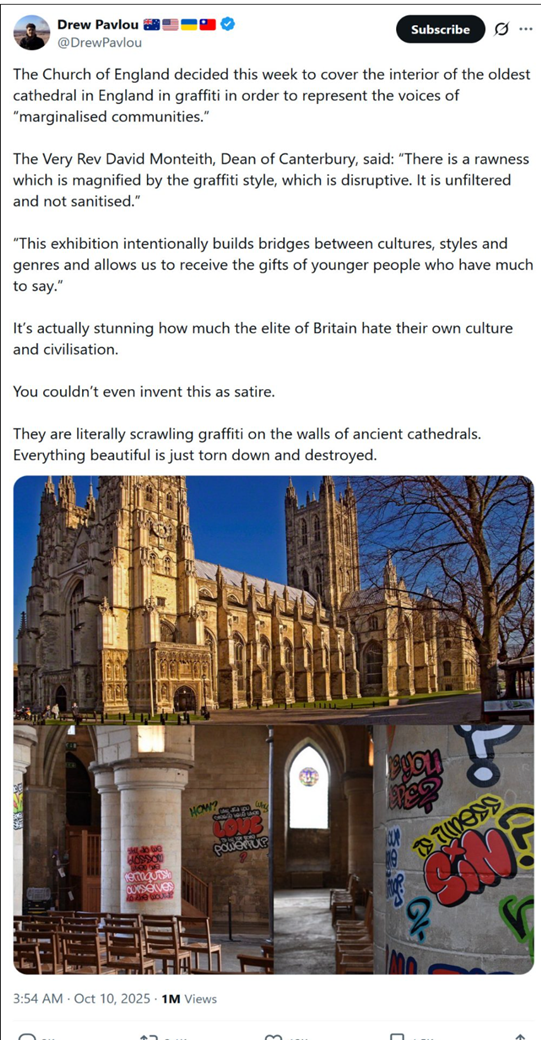
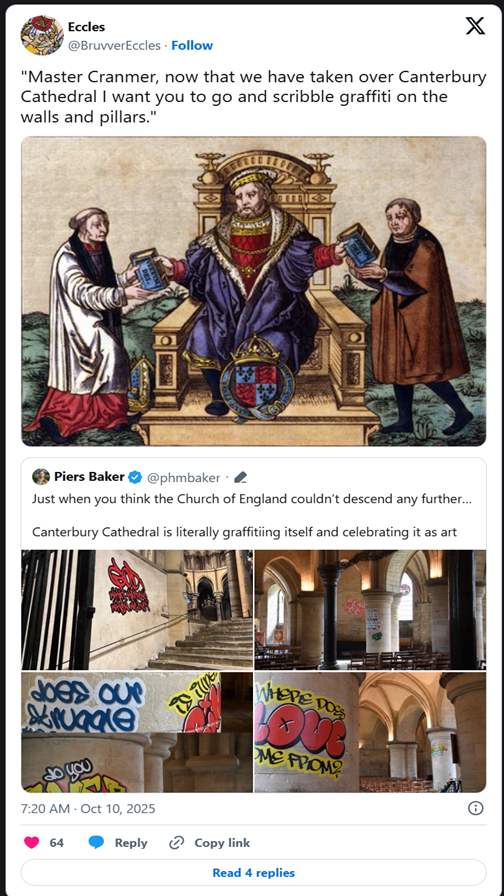
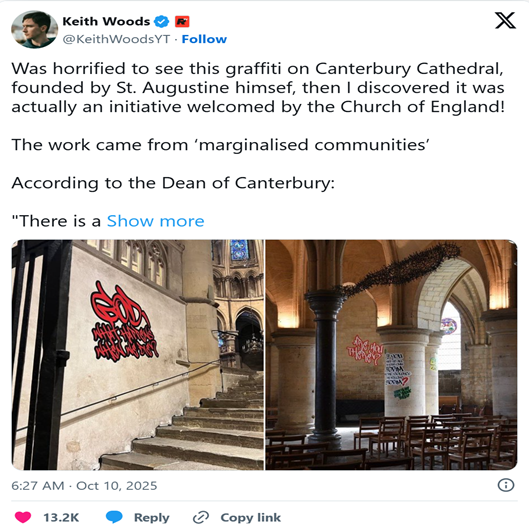
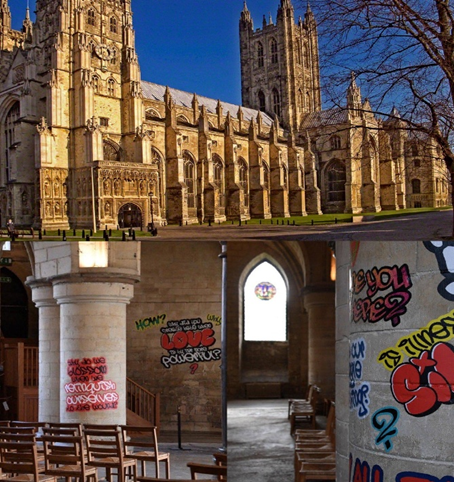
No. This pop-project isn’t satire. The Church of England, so obsessed with its moral performance, really did cover the interior of the oldest cathedral in England in graffiti in order to represent themselves to the world.

As reported by The Independent,

The installation created by poet Alex Vellis is designed to contrast with the ancient, traditional architecture in the church to offer new interpretations of faith and worship. 

Per the partnered gay priest and dean of Canterbury, David Monteith, “There is a rawness which is magnified by the graffiti style, which is disruptive. There is also an authenticity in what is said because it is unfiltered and not tidied up or sanitised. Above all, this graffiti makes me wonder why I am not always able to be as candid, not least in my prayers.

“This exhibition intentionally builds bridges between cultures, styles and genres and, in particular, allows us to receive the gifts of younger people who have much to say and from whom we need to hear much.”

“Mr Vellis said the language of the graffiti was “of the unheard”.

He added: “By temporarily graffitiing the inside of Canterbury Cathedral, we join a chorus of the forgotten, the lost, and the wondrous. People who wanted to make their mark, to say ‘I was here’, and to have their etchings carry their voice through the centuries.”

Reading the motivation behind the Church of England’s self-vandalizing approach to empathy, one has to wonder, as with many decisions made in our times, – where are the adults? And what is next on the empathy checklist? Will the CoE leaders, in order build “bridges between cultures, styles and genres” and to “welcome the stranger,” get tattoos and piercings? Hand out drugs and needles? Perform a satanic mass?

The understanding, resonating, and self-differentiating human voices of previous centuries are becoming the “chorus of the forgotten, the lost, and the wondrous,” the voices “of the unheard” in the Church of England, throughout Europe, and the U.S. Those voices are deemed non-empathetic and must be shouted over with graffiti.

Those who, with ancient wisdom, made their mark of truth, beauty, and goodness, must now be overwritten with graffiti.

The desire to look like the world, like walking in another’s shoes, as inclusive and pluralistic, is beneficial for the state and its open borders immigration policies which deface homelands and cultures with graffiti.

Per Olivia Murray at American Thinker,

“Canterbury Cathedral, a sixth-century English church—making it more than 1,400 years old—has gotten a paint job…in graffiti. And as it turns out, this act of vandalism wasn’t an act of street delinquency, it was actually commissioned by the church’s stewards. . ..”

“Call me crazy, but this seems counterproductive. Real Englanders, Brits by blood and spirit, with an undying love for their culture and home, are beyond fed up with what the Dean of Canterbury calls “marginalized communities.” These “marginalized communities” are parasitic, they’re destroying the cohesion of England and the nation’s society, and they’re given preferential treatment by the government, that’s ostensibly, representing the English people.”

Murray continues:

“Progressives really have an extraordinary ability to turn something unbelievably precious and beautiful into utter trash—how can you make Canterbury Cathedral look like a derelict warehouse in an inner city, or resemble a dirty freight train car?”

~~~

Christian empathy tends to be wayward, moving away from truth, beauty and goodness and toward a seamless identity with what those in the world think they need and want – a trait that Jesus never had.

Christian empathy tends toward a desire to be seen as acceptable to the world so that the world would, by virtue of such, respond – a trait that Jesus never had.

As we read the hymn in Philippians 2, we learn that Jesus made himself accessible to the world.

As we read in gospel according to John 2:13-25, we learn of his distinctiveness from the world, from what those in the world thought they needed and wanted.

When the Court of the Gentiles within the temple ground, the place designated for believing Gentiles to pray and worship became cluttered with the clink of coins, the braying of animals, and the sounds of commerce, Jesus, “Making a whip of cords, he drove all of them out of the temple, with the sheep and the cattle. He also poured out the coins of the money changers and overturned their tables. He told those who were selling the doves, “Take these things out of here! Stop making my Father’s house a marketplace!” His disciples remembered that it was written, “Zeal for your house will consume me.

Note in the above accounts of the desecration of the cathedral, the SJW go-to descriptor ‘marginalised communities’. This indicates the current naming convention that paints humans in the Marxist graffiti of “oppressed” and “oppressor” while avoiding terms that speak of repentance and redemption.

~~~

It is easy to snicker in utter disgust at the perversion of an ancient cathedral, but what are Christians doing with what they have been given? Are Christians preserving the good, the true, the beautiful that has been passed down? Are Christians adding or subtracting to what we’ve been given. Are Christians looking at screens all day?

Should Christians continue to build churches that look like commercial buildings? It seems that after the reformation, Protestants decided that beauty wasn’t utilitarian so why bother with it.

Are we composing music that goes beyond the folksy and often cloying church worship music? Are we writing operas, symphonies, fugues, sonatas? Hymns with actual embedded theology?

Are we creating works of art and literature that draw people to them or are we on screens and social media all day looking at and posting pictures? Early Christian art showed the immanence of God—his closeness to us—and his transcendence, his otherness. The Chosen is not art. It is redux sentimentality akin to watching a rerun of a Billy Grahm crusade or using crayons to color a Jesus picture.

Are we writing poetry that examines life – the wounding, the good, the true and the beautiful? Or, is that the purpose of MSM? Knowing God involves both spiritual and sensory engagement. Poetry can express both.

None of the above prompts are utilitarian and instantly beneficial. Hence, some will avoid a second thought about them.

From stained glass to straining for attention, the graffiti installation recognizes the ego in rebellion to the good, the true and the beautiful while virtue signaling empathy. Not only is the installation profane, it is an act of profound laziness. Evil is lazy and does not promote the spiritual growth of another.

The church of England, the dancing daughter of Herodias, offers its beguiling movements to please guests and the reigning authority. This while John the Baptist, who called people from all strata of society including King Herod to repentance, sits tied up in jail, his head to be removed with the axe of “Silence!”

Want to see what Christian empathy tends to look like?

The Brave New World’s Arch-Community Songster of Canterbury

There is an intense irony here that gets to the heart of the self-inflicted problems of the Church of England today. Sarah Mullally has been very clear on the kind of Church she believes in – she’s a supporter of LGBTQ+ rights and activism, she has strongly backed asylum and migration, she is a self-declared feminist, and she is both politically and it seems religiously progressive. As Bishop of London, she boasted about representing a diverse and multicultural city, and put her experience in handling diversity as one of the key qualifications and evidence of positive experience she could bring to being the Archbishop of Canterbury. (Emphasis mine.)

“The Church of England has lost 80 per cent of Anglicans on the planet” « Quotulatiousness

Added 10-18-2025:

Helen Andrews | Overcoming the Feminization of Culture | NatCon 5

Helen [Andrews] argues that the rise of “wokeness” wasn’t born from Marxism, academia, or even Obama-era politics. That in itself had people shocked. Helen theorizes that it actually came from something way simpler… the quiet but steady feminization of America’s most powerful institutions.

Somebody finally figured out how ‘wokeism’ started – and no, it wasn’t Obama or Marxism… – Revolver News

Helen Andrews wrote in The Great Feminization | Compact

“Wokeness is not a new ideology, an outgrowth of Marxism, or a result of post-Obama disillusionment. It is simply feminine patterns of behavior applied to institutions where women were few in number until recently . . .

Everything you think of as wokeness involves prioritizing the feminine over the masculine: empathy over rationality, safety over risk, cohesion over competition . . .

“The threat posed by wokeness can be large or small depending on the industry . . . The field that frightens me most is the law. All of us depend on a functioning legal system, and, to be blunt, the rule of law will not survive the legal profession becoming majority female. The rule of law is not just about writing rules down. It means following them even when they yield an outcome that tugs at your heartstrings or runs contrary to your gut sense of which party is more sympathetic. 

“The problem is not that women are less talented than men or even that female modes of interaction are inferior in any objective sense. The problem is that female modes of interaction are not well suited to accomplishing the goals of many major institutions.”

~~~~~

“THE EIGHT PRINCIPLES OF UNCIVILISATION

1. We live in a time of social, economic and ecological unravelling. All around us are signs that our whole way of living is already passing into history. We will face this reality honestly and learn how to live with it.

2. We reject the faith which holds that the converging crises of our times can be reduced to a set of ‘problems’ in need of technological or political ‘solutions’.

3. We believe that the roots of these crises lie in the stories we have been telling ourselves. We intend to challenge the stories which underpin our civilisation: the myth of progress, the myth of human centrality, and the myth of our separation from ‘nature’. These myths are more dangerous for the fact that we have forgotten they are myths.

4. We will reassert the role of storytelling as more than mere entertainment. It is through stories that we weave reality.

5. Humans are not the point and purpose of the planet. Our art will begin with the attempt to step outside the human bubble. By careful attention, we will reengage with the non-human world.

6. We will celebrate writing and art which is grounded in a sense of place and of time. Our literature has been dominated for too long by those who inhabit the cosmopolitan citadels.

7. We will not lose ourselves in the elaboration of theories or ideologies. Our words will be elemental. We write with dirt under our fingernails.

8. The end of the world as we know it is not the end of the world full stop. Together, we will find the hope beyond hope, the paths which lead to the unknown world ahead of us.”
― Paul Kingsnorth, Uncivilisation: The Dark Mountain Manifesto

Why I’m Taking Music & Art Lessons – Margarita Mooney Clayton

The Satisfaction of Making Art – Margarita Mooney Clayton

~~~~~

From St. Augustine’s Confessions (Book 10, Chapter 27). St. Augustine reflects back on his own conversion from a life of profligacy to one of love and intimacy with God.

Chapter XXVII.-He Grieves that He Was So Long Without God.

Too late did I love Thee, O Fairness, so ancient, and yet so new! Too late did I love Thee For behold, Thou wert within, and I without, and there did I seek Thee; I, unlovely, rushed heedlessly among the things of beauty Thou madest. Thou wert with me, but I was not with Thee. Those things kept me far from Thee, which, unless they were in Thee, were not. Thou calledst, and criedst aloud, and forcedst open my deafness. Thou didst gleam and shine, and chase away my blindness. Thou didst exhale odours, and I drew in my breath and do pant after Thee. I tasted, and do hunger and thirst. Thou didst touch me, and I burned for Thy peace.

https://orthodoxchurchfathers.com/fathers/npnf101/npnf1027.html#P1660_683954

~~~~~

The Ghent Altarpiece (Adoration of the Mystic Lamb) (1432) by Jan van Eyck

Fortitude is The Way’s Forward

About that time there occurred no small disturbance concerning the Way. Acts 19.23

Charlie Kirk – devoted husband, father, and follower of Jesus – was assassinated. Churches must speak of his faithful, courageous outspoken Christian witness and of his martyrdom.

Yet, there will be Christians and churches that will balk at any mention of Charlie Kirk, intimidated by the same silencing forces behind the assassination. They will remain silent while evil celebrates.

From Bluesky To Reddit, Democrats Celebrate Charlie Kirk’s Assassination; Trump Slams Radical Left  | ZeroHedge

There are church leaders who will not talk about Charlie the man. Rather, they will talk about coming together as a people. “Aren’t we supposed to be one?” “Politics divide us.” So, they tiptoe around evil afraid to name it and who is doing it, afraid of division in the ranks and a possible loss of the ministry they created.

But this is not a time for cowering and equivocating. This is not the time to play to Karens, to those who clutch pearls, to those with delicate sensibilities who cluck in disgust at anything they don’t approve of.

This is not a PBS kumbaya moment. This is a time to see what you see, name it, and to gird up your loins to do battle with the reality of evil and that requires naming it.

This is a come to your senses moment. Charlie Kirk was assassinated for speaking the gospel of Jesus Christ. This was not a tragedy, a happenstance, just another act of violence. This was a deliberate act of evil against Charlie, the Church, the Lord and his kingdom on earth.

 Jesus spoke of the evil intentions within the human heart. Those included murder. And the Apostle Paul wrote of the outward characteristics of those who defile themselves with evil intentions (2 Tim. 3):

“You need to know this: bad times are coming in the last days. People will be in love with themselves, you see, and with money too. They will be boastful, arrogant, abusive, haters of parents, ungrateful, unholy, unfeeling, implacable, accusing, dissolute, savage, haters of the good, traitors, reckless, puffed up, lovers of pleasure rather than lovers of God, holding a pattern of godliness but denying its power. Avoid people like that!”

If you need evidence of the above, go on social media.

Many church leaders do not understand that the church is both a ministry of reconciliation and a ministry of the sword and division. Jesus came to reconcile the world to himself, not by generating political peace for a particle group (the Jews) but with a sword that separated truth and error, light and darkness, good and evil (Matt. 10:34).

The ministry of the sword says “Avoid people like that!” The ministry of the sword says that there will be The Great Divorce based on the choices we make.

Unlike the world, with its message of looking for deliverance down and in where evil intentions lie, the ministry of reconciliation is about putting lives and the world to right by looking up and out beyond ourselves for our salvation. And so, the ministry of reconciliation entails reckoning with what Paul said to Timothy: “all who want to live a godly life in Christ Jesus will be persecuted.”

Jesus’ ministry was one of public and private dialog. Hearing his discourse, some became followers of The Way. They accepted that Jesus was the Way to the Father and the Truth about God, the world and themselves, and the Life that death could not extinguish. And some walked away to become followers of their own dark and vain imaginations.

Charlie Kirk, like Jesus, pursued truth in the public square. And like the Apostle Paul in a public square in Ephesus, he persuaded and drew away a considerable number of people by saying that gods made with hands are not gods. This was bad for local business (Hence, the epigraph. See Acts 19.)

 Some accepted Charlie’s words and joined in the pursuit of truth. Others mocked and protested him and continue to do so after his assassination. Like with Jesus, we see again how much the darkness hates the light and wants to extinguish it (Jn. 3: 19-21).

There are those who think they know Charlie via the main stream media. I’ve heard Christians justify their disdain of Charlie and what he stood for with their moral authority. Clearly invested in their tribal reputation, I heard them spout chapter and verse of their righteous indignation in podcasts and in articles. They say, in effect, “We want nothing to do with him and his ilk.”

But the man’s public life was there for all to see. He aligned it with his understanding of the Way, the Truth, and the Life. He refused to call darkness light or exchange reality for comforting illusions. He refused to serve lies, like so many Christians. Charlie was not intimidated by the darkness. He had fortitude. That was his way forward and that is The Way’s forward.

The Lord detests the way of the wicked,
    but he loves those who pursue righteousness. Prov. 15:9

~~~~~

Charlie Kirk’s Witness to a Pagan Shows What Separated Him From Most Other Conservative Leaders

Links:

On the left-wing social media app Bluesky, the assassination of Charlie Kirk is being celebrated like a national holiday. The entire site reads like a grotesque party, with users cheering, laughing, and even dancing over the murder of a young husband and father, shot down for the simple crime of thinking differently.

And it doesn’t stop there. The mob on Bluesky is now taking it even further by openly naming other conservatives they want to see assassinated next. Like this is some kind of “Hunger Games” to them.

Go to this link to see screen captures of who they want killed:

Calls to ‘haul’ Bluesky CEO before Congress grow LOUDER… – Revolver News

House Dems shout ‘No!’ when Boebert requests spoken prayer for Charlie Kirk

Pawn Star demands action for Charlie, people are very angry. (Language)

“I support Charlie Kirk’s killer. He did us a favor, I would have killed him myself”

Tens of thousands #WalkAway after seeing celebrations of Charlie Kirk’s assassination…

Watch Live: Tyler Robinson, 22, Named As Suspect In Charlie Kirk Assassination | ZeroHedge

~~~~~

Mozart

Introitus
Requiem aeternam dona ets, Domine,
et lux perpetua luceat ets.
Te decet hymnus, Deus, in Sion,
et tibi reddetur votum in Jerusalem.
Exaudi orationem meam,
ad te omnis caro veniet.
Requiem aeternam dona ets, Domine,
et lux perpetua luceat ets.

Entrance
Grant them eternal rest, O Lord,
and may perpetual light shine on them.
Thou, O God, art praised in Sion,
and unto Thee shall the vow
be performed in Jerusalem.
Hear my prayer, unto Thee shall all flesh come.
Grant them eternal rest, O Lord,
and may perpetual light shine on them.

Lip Service

The Observant Observer

Is Israel’s Restoration Project Under Attack?

Tevye Lev, Opinion

Gennesaret. The Pharisees, together with legal experts from Jerusalem, were on the scene to investigate Jesus when they witnessed some of his followers eating with unwashed hands – a brazen breach of a long-held practice of ceremonial washings and ritual purity rules.

The Pharisees, as do all Jews, never eat without first washing their hands. This is to maintain the tradition of the elders, who when they come from the marketplace, never eat without first washing. There are other traditions too: the washing of cups, pot, and bronze dishes.

Known for strict Torah observance by way of oral tradition, the Pharisees consider that being ritually impure is to be morally impure. One rabbi described eating with unwashed hands as no different than lying with a harlot.

As our readers are aware, the Pharisees claim that the Law that God gave to Moses consisted of the written Law and the oral traditions of the Jewish people, the oral law being an interpretation of the Torah according to what they believe to be the spirit of the Law. It consists of a collective body of ordinances that have evolved from the Law to regulate religious observances and the daily life and conduct of the Jewish people. 

Ritual hand washing is seen as an extension of Moses’ directive to Aaron and his sons for them to wash their hands and feet prior to entering the Tabernacle.

A legal expert described the ritual before partaking of a meal: “First you wash your hands to make them clean, and then perform the ritual to make them spiritually clean. You recite a prayer during the ritual washing: ‘Blessed be Thou, O Lord, King of the universe, who sanctified us by the laws and commanded us to wash the hands.’”

 As part of a renewal movement, the Pharisees are working to purify Israel from worldly influence and bring about the conditions for the national restoration of Israel based on the near-at-hand expectations of the prophets.

They instituted synagogues so we could gather locally and not have to travel to the temple and be under literal Torah observance. At the same time, they insist on the binding force of oral tradition and show no mercy towards those that subvert those customs. When Jesus’ followers didn’t wash their hands before eating, they became immediately suspect of breaking oral tradition.

Word here in Jerusalem is that Jesus has been on a whirlwind tour throughout Galilee proclaiming the “good news of the arrival of the kingdom of God.” Religious leaders have taken note and are concerned about anyone claiming to be the revolutionary, as others had failed and have made things worse for the Jews. Pharisees and legal experts went to Gennesaret to look into Jesus.

The Pharisees-from an etching by Friedrich Ludy

When confronted about his disciple’s blatant break with the tradition of the elders (not washing their hands before eating), Jesus clearly took issue with what he considers to be progressive revisionist practices that generate spiritual pretenders. He quoted the words of the prophet Isaiah:

These people make a big show of saying the right thing,
    but their heart isn’t in it.
They act like they’re worshiping me,
    but they don’t mean it.
They just use me as a cover
    for teaching whatever suits their fancy.”

He went on to state that the Pharisees were setting aside God’s commands to preserve human tradition. He provided an example, focusing on what he considered to be another application of their revisionist interpretation of the Law with their use of Korban – something to be offered to God or given to the sacred treasury in the temple.

He began by quoting Moses: “Honor your father and mother” and “Anyone who slanders father and mother should die.”

Jesus contended with the Pharisee’s practice of telling people that in lieu of giving to their parents they could redirect their gift by calling it “Korban,” thereby leaving their parents without the help they need. He seems to be implying that instead of honoring parents and thereby God as the Law would have it, this practice is actually an insult to both.

He went on to say that the result of this revisionist interpretation of the Law that they zealously promote and enforce, and others like it, is to nullify God’s word.

It is reported that Jesus then called the crowd together and said this:

“Listen to me, all of you, and get this straight! What goes into someone from outside does not make them unclean. What makes someone unclean is what comes out of them.”

Is Jesus doing away with ritual purity or is he suggesting something else?

Are the Pharisees hypocrites when they show their piety and devotion to God with hand washing?

Is Jesus undermining the Pharisee’s Israel restoration project that is attempting to force into effect an end of history kingdom of God that they approve of?

Here in Jerusalem, the Pharisees are forming councils to censor and block any attempts to circumvent their restoration agenda which includes oral tradition.

(The above is based on the gospel of Mark 7: 1-23.)

~~~~~

Here’s an inciteful take on Deuteronomy that will revise what you thought you knew.

The Gospel According to Moses

For the renowned scholar, Dr. Daniel Block, Deuteronomy is the “Gospel according to Moses.” Moses’ farewell pastoral addresses call God’s people to remember his grace in salvation, covenant relationship with him, and his revelation of a way of blessing in a lost world.

Daniel I. Block, “The Gospel According to Moses: A Commentary on Deuteronomy”

Daniel I. Block, “The Gospel According to Moses: A Commentary on Deuteronomy” (Inspirata Publishing, 2023) – New Books Network

Remaining Podcasts here:

Daniel I. Block, “Hearing the Gospel According to Moses Volume 2: Chapters 12-23” (Inspirata, 2024) – New Books Network

Daniel I. Block, “Hearing the Gospel According to Moses: Chapters 24-34” (Inspirata, 2024) – New Books Network

~~~~~

Here’s an excellent April 3, 2025 PBS/Frontline documentary of things you won’t hear from MSM including CNN, MSNBC and Fox News. Put away political animus to gain insight. (Some coarse language.)

Trump’s Power & the Rule of Law: Steve Bannon (interview) | FRONTLINE

~~~~~

Osvaldo Golijov’s “Tenebrae”: Melismatic Echoes of Couperin

In Western Christianity, Tenebrae occurs in the final days of the Holy Week, and commemorates the sufferings and death of Christ. It involves the gradual extinguishing of candles, leading to a void of darkness.

Metaphorical darkness, light, and space formed the inspiration for Tenebrae, a 2002 chamber work by Argentine composer, Osvaldo Golijov (b. 1960).

Carnation, Lily, Lily, Rose, 1885 – 1886 – John Singer Sargent

Victims of Vestment Veneer

“The vulnerable have not been adequately protected and this has brought harm to many and offense to the Church at large.”

That indictment is from The Bishops’ Presentment in the Matter of Stewart E. Ruch III, Bishop of the Diocese of the Upper Midwest.

A 10-person board of inquiryfound grounds to try Ruch for violation of his ordination vows and for “conduct giving just cause for scandal or offense, including the abuse of ecclesiastical power” and for “disobedience, or willful contravention” of the denominational or diocesan bylaws.”

Ruch framed his own mishandling of the matter as “regrettable errors,” as I noted in my September 10, 2023 post What Say You. (There, you will find many links and background to the sordid matter.)

Kathryn Post writes:

Ruch has admitted to making “regrettable errors” in the case. After learning of the allegations in 2019, Ruch took two years to initiate an investigation or even share the news with members of his diocese. By that time, at least nine others had told abuse survivor’s advocates that they had been abused and groomed by Mark Rivera, a lay leader at Christ Our Light Anglican Church in Big Rock, Illinois, who had previously been a volunteer leader at Church of the Resurrection in Wheaton, Illinois, which is the diocesan headquarters. . .

The presentment lists more than 10 cases where lay or clergy leaders in Ruch’s diocese were “credibly accused of misconduct” and claims Ruch “habitually neglected” to appropriately handle abuse allegations. (Emphasis mine.)

You can download and read the Presentment’s charges and the extensive allegations of misconduct below.

Pictured From left: Chris Lapeyre, Mark Rivera, Stewart Ruch, Rand York

From the Anglican Church in North America website, News and Updates on The Ecclesiastical trial of Bishop Stewart Ruch III:

In December 2022, Mark Rivera, a former Lay Catechist in an Illinois church affiliated with the Anglican Church in North America (ACNA), was convicted of multiple counts of child sexual abuse.  The alleged mishandling of the disclosure of this abuse led to scrutiny of the ACNA’s Diocese of the Upper Midwest, the ecclesiastical entity primarily responsible for overseeing the parish where Rivera volunteered. Other accusations of misconduct and canonical violations by leaders of the Diocese were also made and investigated. 

Mark Rivera, convicted of felony child sexual abuse and assault, was sentenced on March 6, 2023 to 15 years in the department of corrections. On April 12 Rivera also pled guilty to one count of felony criminal sexual assault in connection to rape allegations made against him by his former neighbor and was sentenced to 6 years in the department of corrections.

More information at these links:

Former Anglican Lay Pastor Mark Rivera Sentenced to 15 Years in Prison

Mark Rivera Pleads Guilty to Felony Sexual Assault, Sentenced to 6 More Years

Now, six years after a 9-year-old child came forward with sexual abuse allegations against a lay minister in an Illinois church, an ecclesiastical trial is finally taking place. The Living Church reports:

The ecclesiastical trial of the Rt. Rev. Stewart Ruch III, bishop of the Anglican Church in North America’s Diocese of the Upper Midwest, is slated to begin July 14 [2025]. The second bishop to be tried in the ACNA’s Court for the Trial of a Bishop since the denomination’s founding in 2009, Bishop Ruch will face charges involving alleged mishandling of sexual abuse disclosures, and alleged habitual promotion of abusive ministers in his diocese and at his cathedral, Church of the Resurrection in Wheaton, Illinois.

~~~

My Perspective

I am familiar with Church of the Resurrection or “Rez” and with Stewart Ruch and Rand York. I am familiar with an early portion of Rez’s history – meeting at Glenbard West High School. I had been attending a large Baptist church in Wheaton when I heard about Rez. This was during the 90s.

What drew me to the church was the Anglican liturgy, the common book of prayer and, more than anything, the weekly Real Presence Eucharist which the Baptist church did not provide.

There was a charismatic element to Rez. Many of its members were tied in with Leanne Payne’s Pastoral Care Ministry. The ministry dealt with the healing of broken sexuality and addictions. Payne held annual week-long Healing Prayer seminars (PCMs) at Edman Chapel on the campus of Wheaton College.

Many who attended the PCMs attended Rez and so did many Wheaton College students. The students were bused from the campus to GWHS every Sunday. This was the milieu in which Stewart Ruch, Mark Rivera, Rand York, and Rez operated. This environment should have been a cautionary heads-up about who was placed in lay positions.

Stewart Ruch, his wife Kathryn, and their children lived around the corner from my house. I helped them move in.

I had been in a small group with Randy York and his wife Kay. This was before Randy became a priest and overseer of Christ Our Light Anglican Church in Big Rock, Illinois – the place where Mark Rivera served as a lay leader and a 9-year-old child came forward with sexual abuse allegations against him. (See my 2023 post What Say You.)

I was surprised to find that Randy York, a Former Director of Human Resources, failed to act quickly on allegations against a lay minister under his authority and before that, lay out ground rules for reporting abuse.

When Stewart Ruch became rector of Rez I was disappointed. Stewart was unqualified to hold any leadership position. He was young, inexperienced, and suffered panic attacks. I believe he was chosen because he was personable and charismatic and could gin up audience interest. But not mine. His sermons never spoke to me. There was nothing there. There was something hyperactive and distant about Stewart that came across as charismatic.

When I later learned that Ruch was made a bishop (consecrated for the Diocese of the Upper Midwest by Archbishop Robert Duncan (Pittsburgh) in 2013), I thought that a lot of people had been fooled by Ruch’s charisma.

I left Rez when Stewart became rector of the church. I found a local Episcopal church that had resisted financial ties to the Chicago diocese and its leadership that promoted LGBTism.

I left the small group too – I never felt part of the group as the three other couples were all grads of Wheaton College. They wanted me to share personal stuff about my life but they were never forthcoming about themselves in that way. They came across as surface people like Stewart, another Wheaton grad.

Stewart, as I learned through the excellent reporting of Kathryn Post of RNS, decided to go on leave from Rez when he could no longer could ignore the situation – his mishandling of the abuse allegations.

 In July of 2021 Ruch wrote a letter to the Diocese with the veneer of being a responsible person:

Significant concerns have been raised about my response to allegations of abuse in our former diocesan congregation, Christ Our Light of Big Rock, Illinois. I understand that my leadership and my handling of these allegations have been called into question.

I want you to be able to trust me as your bishop and pastor. I feel like the best way to walk in integrity now is to step aside as this process moves forward and as efforts are made to serve any survivors of abuse. 

But Ruch later announced his return to Rez by framing his reckless self as a victim:

“Both my diocese and the ACNA got hit this summer by a vicious spiritual attack of the enemy,” Ruch wrote to the denomination’s top official, Archbishop Foley Beach, on Jan. 14. “I believe this is the case because both entities are doing robust Gospel work, and Satan hates us.”

“I have decided to come off of my voluntary and temporary leave of absence effective March 7, 2022,” Ruch announced to Beach. “I believe my calling as a bishop who is responsible for leading and pastoring my diocese requires me to return to my work of service, preaching and oversight.”

Ruch dismissed the ongoing investigative process, saying it was neither “canonical or, more importantly, biblical.”

Kathryn Post reports ACNA Bishop, Alleging ‘Spiritual Attack,’ Makes Appeal for His Return.

Interesting asides: Leanne Payne broke off her association with Rez when she found out that Stewart made public what she had said in a confessional way to him. Stewart confessed his breach of the seal of Payne’s confession from the pulpit. It appeared to me that Stewart had disregarded his priestly office and thought that telling people what he knew about Leane Payne would elevate him in the eyes of the congregation.

And, I heard Leanne Payne say something to the effect that Randy York has a big heart but lacked discernment. That appears to be the case for Randy and for many Christians today who practice mis-directed empathy toward wrong-doers, e.g., illegal immigrants.

It is written “If one member suffers, all suffer together with it” – yet both Ruch and York, detached from members of the body suffering from sexual abuse, kept things close to the vestment and away from the members. The two were in their own vestment veneer worlds.

What is it called when after you find out that a lay leader under your authority is grooming children to sexual ends and you wait two years to say something? Cowardice? Corruption? Callousness?

I can only guess as to why Stewart Ruch and Randy York held back when abuse allegations were made known: they each wanted to protect their vestment veneer of charisma-won status. Consider that it took Ruch “two years to initiate an investigation or even share the news with members of his diocese” of the sexual abuse allegations and he almost immediately shared publicly what he learned in private from Leanne Payne.

Coverup, downplaying, denial, pretense, projection. How much of that is going on in the church to protect reputations -vestment veneers – and building programs?

What was needed at Rez: A Tom Homan Border Czar enforcer and not Saint Stewart.

We know what Jesus said about those who corrupt children (whether directly or indirectly):

“If anyone causes one of these little ones—those who believe in me—to stumble, it would be better for them if a large millstone were hung around their neck and they were thrown into the sea. -Mark 9:42

ACNA Protection Policies & Additional Resources – Safeguarding In Our Church

~~~~

Juxtaposed! News ™ NYC and Nigeria

24 years post 9/11, New York City welcomes Jihad

New York City, home to about one million Jews, voted in the Democratic mayoral primary for a Shia Muslim deeply critical of Israel.

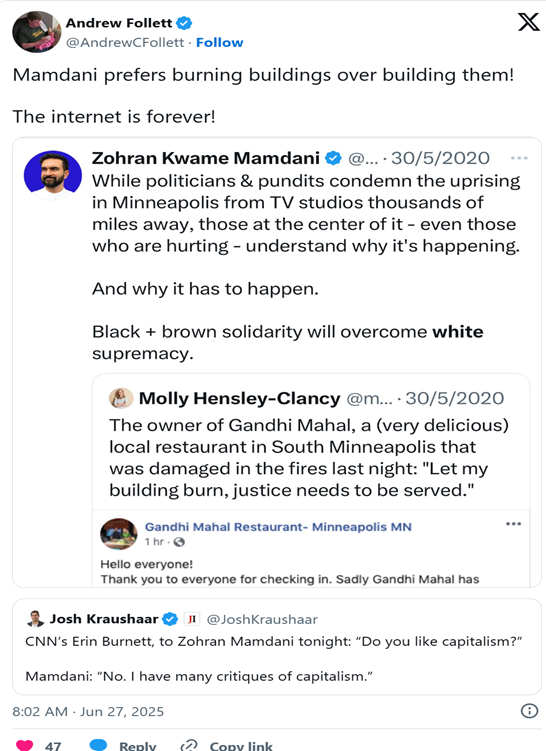
Zohran Mamdani wants to “globalize the intifada” – a slogan used by pro-Palestinian activists that calls for worldwide support for Palestinian resistance against Israel and Jews involving violence. Mamdani does this with the handwashing tact of standing up for Palestinian human rights.

Mamdani supports the Boycott, Divestment and Sanctions movement.

The hook for NYC’s wealthy champagne socialists who need to virtue signal eyes away from their wealth and for the young and restless urbanites who can’t afford rent in NYC: Mamdani is a 33-year-old member of the Democratic Socialists of America.

Andrew Cuomo dominated the voting among those making under $50K, but Mamdani beat Cuomo by 20 points among voters earning more than $100,000 a year.

Why did New Yorkers vote this way? Sean Ring at https://www.rudeawakening.info/ had this to say:

Mamdani’s campaign was a symbolic war against the status quo. Today’s left doesn’t organize labor. It organizes narratives.

And that’s why wealthy, well-fed urbanites feel perfectly comfortable voting for a candidate whose policies might, in theory, hurt their pocketbooks.

Because in 2025, feeling good beats doing good. . .

Welcome to the revolution, brought to you by people who can afford it

See also Karl Marx Moving Into Gracie Mansion and

Zohran Mamdani Admits He Hates Capitalism… Allied With Socialist Operative Linked To Marxist Terror Group:

Americans were stunned last week when foreign-born, self-proclaimed socialist Zohran Mamdani used CNN as a platform to denounce capitalism—the very system that transformed this country from frontier towns into a global superpower. Capitalism has lifted hundreds of millions out of poverty, built a middle class, and fueled rapid technological innovation—outcomes impossible under socialist regimes, as evidenced by an imploding Europe adopting welfare-state models or failed communist states like Cuba. 

Like all communist organizers (cf. Obama), the 33-year-old progressive democratic socialist promises an anticapitalism world (with no rising seas or costs) if you just give up all common sense and any understanding of free-market economics (I, Pencil provides understanding) and vote (and pay dearly later) for the revolution. (It’s no secret that capitalism’s profits pay for socialism’s follies.)

Mandani, in order to control costs (read seize the means of production and central planning), says that he wants to freeze rents and provide free transportation and universal childcare, create city-owned grocery stores and construct 200,00 affordable housing units.

He also wants to raise New York City’s minimum wage to $30 by 2030, thereby pricing people out of jobs.

How will Mandani fill the coffers of socialism? With racism:  NYC’s Mamdani Wants Higher Taxes for ‘Whiter Neighborhoods.’

“Shift the tax burden from overtaxed homeowners in the outer boroughs to more expensive homes in richer and whiter neighborhoods.” – Zohran for New York City policy memo.

Mamdani, using the narrative of the left, wants to defund the NYPD and abolish prisons.

NYC’s new Marxist messiah wants to empty the jails and crown criminals as victims…

He promises to work against U.S. laws to continue Welcoming the Stranger/Fellow Traveler from other failed socialist countries. He will double down on sanctuary city protections for illegals and end cooperation with Immigration and Customs Enforcement (ICE). Welcome to the revolution.

Like fellow travelers Tim Waltz and Kamala Harris, Mamdani defended the Black Lives Matter riots in Minneapolis, Minnesota, in 2020. He described the violence (read intifada struggle) as necessary and grounded in racial justice solidarity.

Not only will Mamdani work against U.S. laws, he will also work against nature itself. He’s Pledging $65 Million for Trans Health Care.

Did NYC Democrats not see the destruction of the palisades and LA by the incompetent leadership of California’s Governor Gavin Newsom and inclusion’s DEI hire Mayor Karen Bass? With this recent vote, do NYC Democrats also approve of the wholesale destruction of their blue city?

Do Democrats in NYC not remember Gavin Newsom eating without mask or social distancing at the French Laundry during the COVID lockdowns? With this recent vote, do NYC Democrats also approve of the hypocrisy of a society that claims to promote equality while allowing a ruling class to dominate?

Mamdani was born in Uganda and briefly lived in South Africa. He became a U.S. citizen in 2018. He earned a bachelor’s degree in Africana studies from Bowdoin College. 

No doubt the 33-year-old has been steeped in the anti-American anti-Capitalism rhetoric and Islamic Jihad teaching. It appears that he knows nothing of American history or of Communism’s deadly and destructive track record.

“Progress, far from consisting in change, depends on retentiveness. When change is absolute there remains no being to improve and no direction is set for possible improvement: and when experience is not retained, as among savages, infancy is perpetual. Those who cannot remember the past are condemned to repeat it.” -George Santayana

Welcome to the revolution. Welcome To Crazy Town – New York Commits Political Suicide

Welcome to Jihad.

From Welcoming Jihad in NYC to Globalized Intifada – The Holy War Against Christians in Nigeria

I’m sure you’ve heard the following reported in the main stream media.

But then again, the reactionary MSM is busy defending the globalist Jihad of the “Welcoming the Stranger” open borders narrative and dissing the law-and-order activity of the Trump administration done to secure the integrity of the United States and the wellbeing of its citizens.

(No doubt some, including some Christians, believe that the morally relativistic “social justice” is a permissive that allows them moral authority to break laws created by representatives of our Republic’s Democracy to maintain order and the common good.)

What’s happening and been happening in Nigeria is Jihad. But it’s not the ghetto-uprising kind of a NYC socialist Jihadist. Here are five articles describing the horrors of Islamist Jihad:

Beneath the silence of the Western press, a genocide is unfolding — one that has claimed the lives of over 3,100 Christians in Nigeria this year alone. And yet, for all the blood spilled, for all the churches burned and children slain, one would be hard-pressed to find even a whisper of coverage from CNN, the BBC, or The New York Times. The slaughter of Christians, it seems, is not newsworthy in today’s media economy. (Emphasis mine.)

Western Media Silent As Slaughter of Christians Intensifies in Nigeria

In a horrifying escalation of violence, between 100 and 200 Christians were murdered by Fulani jihadist herdsmen in Nigeria’s Benue State, according to multiple sources. (Emphasis mine.)

Jihadis butcher 200 Nigerian Christians in fresh massacre

Jihadist violence continues to escalate in Nigeria, and Christians are particularly at risk from targeted attacks by Islamist militants, including Fulani fighters, Boko Haram and ISWAP (Islamic State West Africa Province). These increased under the rule of former president Muhammadu Buhari, putting Nigeria at the epicentre of targeted violence against the church. The government’s failure to protect Christians and punish perpetrators has only strengthened the militants’ influence. (Emphasis mine.)

Nigeria  · Serving Persecuted Christians Worldwide

Nigeria, the most populated country in Africa, faces a harsh reality for its Christian population. Since the early 2000s, over 62,000 Christians have lost their lives to violence driven by extremist groups like Boko Haram, Islamic State West Africa Province (ISWAP), and Fulani militias. (Emphasis mine.)

The Silent Slaughter: Christian Persecution in Nigeria and Central Africa

[Bishop Wilfred Anagbe] added that for his people, their experience today “can be summed up as that of a Church under Islamist extermination.” (Emphasis mine.)

‘This is genocide,’ charity says as ‘barbaric massacres’ target Christians in Nigeria

Nigerian martyrs cry out in a loud voice, “Holy and true Master! How much longer are you going to put off giving judgement, and avenging our blood on the earth-dwellers?” -Revelation 6:10

~~~

No more word games. How are we to understand intifada and jihad? As merely a personal struggle against, say, cigarette smoking? As a struggle against an oppressor? As a non-violent ghetto uprising involving work stoppages, boycotts and demonstrations that might involve small weapons such as rocks or Molotov cocktails, and on some occasions firearms or grenades?

Are we to understand intifada as the October 7th attack on Israel when Gaza militants fired thousands of rockets towards Israeli towns killing more than 1,400 people, including civilians and soldiers, and took up to 150 hostages.

Some, like Daniel Lefkowitz, consider “intifada and genocide” in the same sentence to be “an unreasonable stretch.” But looking at what happened on October 7th and at what has been happening in Nigeria, is it a stretch?

“Globalize the intifada” is a call for a Muslim holy war or spiritual struggle for the propagation or defense of Islam that involves genocide and now wants to employ the unholy terror of Communism.

The New York mayoral Democratic primary candidate defends “Globalize the intifada.”

(I don’t hear pro-Israel war hawk “Tel Aviv Levin” decrying the violence done to Christians in Nigeria by Jihadists.)

~~~~~

AI – Act Now Before the Bill Passes!

Email your senators and ask them to remove a 10-year moratorium on enforcing state and local artificial intelligence laws from the GOP’s megabill. The moratorium infringes on states’ rights.

Removing the 10-year moratorium on enforcing state and local artificial intelligence laws

-will protect citizens from the harm the technology could cause, and the lack of “thoughtful” public debate over the measure.

-will protect our citizens from the misuse of artificial intelligence.

17 republican governors tell Thune to cancel AI rule

~~~~~

Now Playing:

Takemitsu_ Paths (In Memoriam Witold Lutoslawski)

Toru Takemitsu (1931-1996) was a self-taught Japanese composer who combined elements of Eastern and Western music and philosophy to create a unique sound world. 

(I played the trumpet for many years. My ears perked up when I heard Paths.)

Witold Roman Lutosławski was a Polish composer and conductor. He was one of the major composers of 20th-century classical music.

~~~~~

Iran Abandoned, and Blue Cities, Too

Learning to See

He took the blind man by the hand and led him out of the village, and when he had put saliva on his eyes and laid his hands on him, he asked him, “Can you see anything?” And the man looked up and said, “I can see people, but they look like trees, walking.” Then Jesus laid his hands on his eyes again, and he looked intently, and his sight was restored, and he saw everything clearly. -The gospel of Mark, 8: 23-25

In the account above, Jesus amplified the blind man’s ability to see so that he could view physical reality with clarity. Now seeing, the man could function in the world. He no longer had to sit under the shade of a tree begging for assistance.

After Jesus announced the arrival of the kingdom of God on earth, he sought to increase the depth perception of his followers. He wanted them to be able to observe and perceive what that kingdom was about so that they could, with new insight, function in the kingdom.

Jesus acted and spoke for those with “eyes that see, ears that hear.” Others, conditioned by the world, would not see and hear what was going on. They remained blind and begging.

To amplify understanding, Jesus used allegorical short stories to create vivid pictures of reality as he saw it. He used parables when he taught and when he was tested.

When teaching on the cultivation of the kingdom of God he used the parable of the Sower.

When tested by an expert of religious law, he used the parable of the Good Samaritan. This encounter is recorded in Luke’s gospel account:

A religion scholar stood up with a question to test Jesus.

“Teacher, what do I need to do to get eternal life?”

Jesus responded with a question: “What’s written in God’s Law? How do you interpret it?”

The scholar gave a Torah answer: “Love the Lord your God with all your heart and with all your soul and with all your strength and with all your mind and love your neighbor as yourself.”

“Good answer!” said Jesus. “Do it and you’ll live.”

Looking for a loophole, the scholar then asked “And just how would you define ‘neighbor’?”

Jesus answered by telling the story of the Good Samaritan. He then asked, “What do you think? Which of the three – the priest, the Levite or the Samaritan – became a neighbor to the man attacked by robbers?”

“The one who treated him kindly,” the religion scholar responded.

Jesus said, “Go and do the same.”

In response to the initial test question, Jesus uses the Socratic method. He asked the scholar to give his own response to the eternal life question. Jesus acknowledges the scholar’s correct answer.

But then the scholar wished to justify his “neighbor” position in front of the crowd.

(You don’t do this, of course, unless you hold a well-known exclusionary stance such as associating with fellow Jews but not associating with Samaritans (viewed by Jews as a mixed race who practiced an impure, half-pagan religion), Romans, and other foreigners.)

The scholar’s question revealed what Jewish religious leaders, like those named in Jesus’ parable, thought about those who didn’t see the world like they did – ‘others’ should be excluded from their concern and left to die. This way of ‘seeing’ would lead to Jesus being (so they thought) permanently excluded, i.e., crucified.

Jesus doesn’t answer the scholar’s “neighbor” question. Instead, he exposes the insular blindness of the questioner with a short story.

Jesus shows, not tells, his answer so that the scholar and those listening may experience the answer through actions, words, subtext, thoughts, senses, and feelings rather than through exposition, summarization, and description. Jesus puts the scholar in the room, so to speak, with the Samaritan.

With the parable, Jesus wanted the scholar to see the world as he sees it, that of “God so loves the world” and not just a chosen few.

Note that in his response to the question “Who became a neighbor? the scholar refuses to name the ’other.’ He refuses to say “Samaritan.” He protected his standing in the community and his insular blindness.

Going on his way, the religious scholar now had an image to reflect on. He could see himself like the priest and the Levite and mind his own business and walk off, ignoring the one who is of no value to him. He could abandon the ‘other’ before any claim is made on him.

Or he could see beyond himself and exclusion and be a Samaritan and love his neighbor like himself. That would be kingdom ‘seeing.’

~~~~~

Man’s ability to see is in decline. Those who nowadays concern themselves with culture and education will experience this fact again and again. We do not mean here, of course, the phys­iological sensitivity of the human eye. We mean the spiritual capacity to perceive the visible reality as it truly is.

To be sure, no human being has ever really seen everything that lies visibly in front of his eyes. The world, including its tangible side, is unfathomable. Who would ever have perfectly per­ceived the countless shapes and shades of just one wave swelling and ebbing in the ocean! And yet, there are degrees of perception. Going below a certain bottom line quite obviously will endanger the integrity of man as a spiritual being. It seems that nowadays we have arrived at this bottom line. (Emphasis mine.)
—Josef Pieper, Only the Lover Sings, “Learning How to See Again”

The concept of contemplation also contains this special intensified way of seeing. A twofold meaning is hereby intended: the gift of retaining and preserving in one’s own memory whatever has been visually perceived. How meticulously, how intensively—with the heart, as it were—must a sculptor have gazed on a human face before being able, as is our friend here, to render a portrait, as if by magic, entirely from memory! And this is our second point: to see in contemplation, moreover, is not limited only to the tangible surface of reality; it certainly perceives more than mere appearances. Art flowing from contemplation does not so much attempt to copy reality as rather to capture the archetypes of all that is. Such art does not want to depict what everybody already sees but to make visible what not everybody sees. (Emphasis mine.)
—Josef Pieper, Only the Lover Sings, “Three Talks in a Sculptor’s Studio: Vita Contemplativa”

I first came across the writings of Josef Pieper, a 20th century Catholic German philosopher, reading The Four Cardinal Virtues: Human Agency, Intellectual Traditions, and Responsible Knowledge. About the Author:

“Josef Pieper (1904-1997) was a distinguished twentieth-century Thomist philosopher. Schooled in the Greek classics and in the writings of St. Thomas Aquinas, he studied philosophy, law, and sociology, and taught for many years at the University of Münster, Germany.”

Donald DeMarco writes in Josef Pieper… Truth And Timeliness that

Pieper is most noted for his many books on virtue. In fact, he is commonly known as the “Philosopher of Virtue.” Virtue for Pieper, following Aristotle and Aquinas, is perfective of the person. But the person is real and has an identifiable and intelligible nature. Wherever this nature is denied, totalitarianism gains a foothold. For, if there is no human nature, then there can be no crimes against it.

Pieper wrote while drafted into Germany’s army during World War II and is credited for translating C.S Lewis’s Problem of Pain into German. Because he criticized the Nazis regime, his works were not published until later.

It is said that “While many philosophers in his time focused on politics, Pieper was concerned with the great tradition of Western Culture. He spent his entire life reflecting on the value of culture in modern society and the necessity of the creative arts for the nourishment of the human soul.”

Josef Pieper’s short essay Learning How to See Again begins: “Man’s ability to see is in decline.” Even in the 1950s when he wrote the essay, he suggested that there was too much to see. How much more are we distracted today by screens.

Pieper recommended an artistic vision – visual, musical or literary – as a conduit for the contemplative life. He proposed participating in the arts as a remedy for seeing anew, to see reality as it truly is.

We must learn to see again.

~~~~~

Teaching ‘Tales From Shakespeare’

Benedict Whalen, associate professor of English at Hillsdale College, delivers a lecture on how to teach Tales From Shakespeare by Charles and Mary Lamb to young children. 

This lecture was given at the Hoogland Center for Teacher Excellence seminar, “The Art of Teaching: Children’s Literature” in September 2024. The Hoogland Center for Teacher Excellence, an outreach of the Hillsdale College K-12 Education Office, offers educators the opportunity to deepen their content knowledge and refine their skills in the classroom.

Teaching ‘Tales From Shakespeare’

Teaching ‘Tales From Shakespeare’ – Hillsdale College K-12 Classical Education Podcast – Omny.fm

~~~~~

A House Divided

A case study of Mike (not his real name) from the archives of Primrose Path Behavioral Health Center. This session took place when Mike was 55. . .

Mike recalled that as a ten-year old he had gone out exploring the undeveloped area behind the new subdivision where his family had bought a house. He came across a page torn out of a magazine. It was almost hidden in tall grass. He described what he found.

On the glossy page were two barely dressed women. One was seated and bound with rope and another was standing over her holding a whip.

He thought about folding the page up and putting it in his pocket. But after five minutes he put the page down and walked away.

He related that a month before he had given his testimony and was baptized before a full church. He thought the world would somehow look different after that. He was given a baptismal certificate and was considered “saved and going to heaven.”

Mike reflected on that event. He said that after he was baptized no one prayed that he would receive the Holy Spirit. No one discipled or mentored him. No one came alongside. He was on his own. He felt “abandoned to his own devices and the osmosis of Sunday preaching and teaching about salvation, heaven and hell, and not being shameful.”

Mike shared that what he saw in the field that day affected him. He felt guilt and shame. He tried to put the image out of his mind but it kept coming back into his imagination.

To deal with this he said that he began mentally separating himself. On the one side was the good Mike –his baptized self-image that he could present to the world. On the other side– the desire for images that brought him pleasure – Mike would keep to himself.

He did this, he said, to avoid the conflicting thoughts and emotions brought on by the tremendous battle going on inside. He said that this compartmentalization carried on throughout his life. It was defense mechanism. He feared being found out.

By the age of twelve his parents had given him the “birds and bees” talk. But his sexual development had already formed with symbols far from what his parents presented.

He recalled looking for more and more images of the opposite sex. He had neighborhood friends who shared the porn magazines of their older brothers and fathers.

Mike began to tear out images from magazines. He would then take them somewhere to be alone – the bedroom, the bathroom, or the basement – and masturbate to them. He had a great fear of being discovered.

Mike felt that if anyone knew about his addiction to images, he would be considered a horrible sinner. The church denounced fornication but no one he knew in church or in life talked about this addiction. He did not view the church as a healing community. The church was there to scold. So, he continued to hide.

He felt that castigation was not enough to rid him of the addiction. He already carried shame and the fear of being outside rather than “a part of” a community. The scolding would only push him toward the comfort of more sexual release.

Mike felt that if anyone knew who he truly was, they would never accept him. He never accepted himself in this state. His self-hatred at being weak and fleshy grew.

Mike related that his seeing the first image was in the 1960s. When the internet came around, he began spending his time looking at porn on the computer. His sexual addiction escalated. Whenever he was alone, he’d be looking at porn.

Mike’s job had him traveling about sixty percent of the time. He was alone a lot.

He began going to strip clubs and was involved with women there. Women at this point, he said, were objects to comfort him in his loneliness, loneliness that he admitted had been brought on by his need to be alone with his addiction.

Mike’s porn sources included in-room-pay-for-view, VHS videos, adult magazines, the internet, and human interaction involving visits to strip clubs. The men he worked with would go to strip clubs. He said that he felt the need to fit in to keep up a persona of being a man and that persona, he felt, was needed for the job.

It was easy, he said, to convince himself to look at women as objects, as women were posing and what man doesn’t look at a woman?

His sexual addiction affected his marriages. They ended in divorce. He described being unable to be intimate with his wives. He said that porn was like another presence in the room and his conscience was another. The back and forth of the two kept him from intimacy with his wives.

Mike stated that in his fifties he came to the bitter realization after failed marriages and the financial and spiritual costs of his addiction, that the out-of-control sexual behaviors he engaged in were destroying him and hurting those around him. He said that his compulsive sexual thoughts, desires, and behaviors wreaked havoc on his self-image as a man, on his relationships with women, on his finances, on his body, and on his soul. All aspects of his life, he said, suffered.

He said that it was easy to feel misunderstood and on his own throughout his life because no one he knew had issues like his. The guys he worked with acted like it was a natural thing to go to a strip club and view porn. Nobody in the church ever talked about sexual addiction.

Mike learned through reading that the reason he kept coming back to porn was the pleasure derived from dopamine released during masturbation.

The loss of self-control and the negative consequences, Mike said, had him experiencing guilt, shame, hopelessness, powerless over his addiction, depressed, lonely, fearful, and anxious.

When asked if he was ever suicidal, Mike said “No. But something had to give. I was going crazy.”

Mike said he reviewed his options to deal with his sexual addiction. He could become a monk or hermit. He could move to Alaska and go off the grid and avoid all contact with porn.

He could, as Jesus taught, lose one part of his body so his whole body wouldn’t be thrown into hell. He then could, as Jesus said about breaking the bonds of marriage, become a eunuch for the kingdom of heaven’s sake as others had done.

These options, he admitted, were severe but his compulsive sexual behavior was severe. He had repeatedly tried to abstain only to fall again and again. The repeated failures caused more self-hatred and more unresolved anger.

Everything he cared about – marriage, family, being a Christian, his soul – everything hung in the balance. He knew that the next relapse may be what took it all down. Every choice he made was “either the ascent of the soul or the descent of the soul.”

Mike told a previous counselor that he carried around a “hurt locker.” This was a term he borrowed from the 2008 film. It described the deep pain and psychological distress that he held on to and carried throughout his life.

He said that he never considered himself a victim in the Me Too sense except in that first instance of sexual abuse in the field at ten-years old. Seeing that first image was traumatizing. After that he came back to porn on his own.

~~~~~

01:55:36 Pornography

Controlling Your Dopamine For Motivation, Focus & Satisfaction

~~~~~

Resources for Combating porn:

Dealing with a porn addiction: Integrity Restored
Internet filter: Covenant Eyes
A book for junior high and high school level: Plunging Pornography
A book for the very young: Good Pictures Bad Pictures

Porn’s Effects on the Brain, Body, and Culture

With the invention of the internet, porn ceased being a back-alley issue and became easily accessible by anyone with a computer, smartphone, or tablet. Learn who uses porn and why it’s not merely a personal sexual choice, but a physiological, emotional, and even cultural problem.

https://www.covenanteyes.com/e-books/

Book: The Healing Church: What Churches Get Wrong about Pornography and How to Fix It

Porn is rewiring your brain.

Learn the top five ways porn rewires your brain and what you can do about it in Your Brain on Porn.

Download free copy: https://learn.covenanteyes.com/your-brain-on-porn-1/

https://www.ascensioncounselingutah.com/

~~~~~

Fr. Meyer: Why We Must Talk About Pornography in the Church

By Road to Purity

In this episode of the Road to Purity podcast, we sit down with Fr. Meyer from the Archdiocese of Illinois for a candid and compelling conversation about one of the most pressing spiritual battles of our time: pornography. Fr. Meyer shares how he addresses this issue both within the Church and in the wider culture, offering powerful insights, pastoral wisdom, and hope for those struggling.

Whether you’re in ministry, in the fight yourself, or walking with someone who is, this episode offers clarity, truth, and encouragement in the battle for purity.

Tell Them For Me – Catholic Sexual Integrity Podcast | Road to Purity

~~~~~

Instead of serving the devilish insanity of the lawless “Welcoming the Stranger” illegal immigration crisis created and financed by George Soros, do something to change lives. Support Prison Fellowship.

Prison Fellowship Founded in 1976, Prison Fellowship® is the nation’s largest Christian nonprofit equipping the Church to serve currently and formerly incarcerated people and their families, and to advocate for justice and human dignity both inside and outside of prison.

Because I support Prison Fellowship, I recently received a copy of I surrender: A 14-day Devotional Written by Prisoners. It is a blessing.

The Prison Fellowship Academy is “an intensive long-term, biblically based discipleship program that targets and address the issues at root in criminal behavior.”

“It’s statistically proven that the Academy dramatically reduces recidivism.”

I urge to you walk away from “Welcoming the Stranger,” the psyop conditioning that invites in more criminals and criminal activity (and chaos) and is a perversion of love such that a person values a “cause” more than his proper duty to himself or his neighbor. 

Instead, support Prison Fellowship and the men and women who are incarcerated.

Right now, as the recent literature stated, there are 24,716 prisoners in Indiana.

“I was in prison and you came to visit me.” – Jesus, Matthew 25:36

~~~~~

Edward Hopper – room interior in New York -1932

Snakes Alive!

A countryman returning home one winter’s day found a snake by the hedge-side, half dead with cold. Taking compassion on the creature, he laid it in his bosom and brought it home to his fireside to revive it. No sooner had the warmth restored it, than it began to attack the children of the cottage. Upon this the countryman, whose compassion had saved its life, took up a club and laid the snake dead at his feet.

Aesop’s The Countryman and The Snake

~~~~~

The foolish take pity on snakes. Thinking to help creatures out in the cold cruel world, they bring them home and the creature’s true nature is revealed. Suffering follows.

The foolish do not take care to bestow their benevolence upon proper objects. And so, not having yet been bitten, the foolish continue to empathize with snakes.

Snakes on the Brain

The foolish take pity on and work to bring home MS-13 gang members, wife abusers, and human traffickers e.g., Abrego Garcia.

The foolish bring home a false premise of multiculturalism believing that all cultures are equal in some undefinable sense.

The foolish bring home DEI creatures and their true nature is revealed in the sorry outcomes.

The foolish bring home, with ad-hoc justice and zero-bail policies, criminals who are not fit to live in a community. Repeat offenders reveal their true nature.

The foolish take pity on unvetted (legally and health wise) invaders and bring them home by creating “sanctuary cities” and alerting them to the approach of the countryman, and by hiding them.

The foolish take home Hamas sympathizers and warm them by the fires of Marxist/critical theory/anticolonialism ‘higher education’. Thus embraced, their true nature is revealed. Their “freedom of expression” is to bite those empathizing with them.

The foolish take pity on invaders and rally behind rogue district court judges appointed by Biden and Obama who act unconstitutionally to block deportation of the invaders.

The foolish take pity on CCP snakes by letting them purchase U.S. farmland where they can breed.

The foolish take pity on and want to hold on to government programs of waste, fraud, and abuse that produce more snakes and snake bites, including “sex changes, LGBT activism, a “DEI musical,” a transgender opera, and birth control,” and terrorism, e.g., USAID.

I have known some as bad as the Snake.

Those with no sense will not only take a snake to their bosom, they will also take fire to their bosom, as Proverbs 6:27-35 tells us.

Disorder in the House

The foolish order their Mr. Rogers neighborly affections with Progressivism’s morally-relativistic calculus that breeds chaos, injustice and societal harm.

In the current cultural milieu given to Marxist victim-oppressor ideology, taking pity on a snake, a lowly creature, can provide a feeling of dominance and power. It can also make the snake-pitier feel virtuous. Benevolence upon improper objects follows: take pity on snakes, say nothing of their bite, and virtue signal your empathy to the world.

It helps Progressive sensibilities that the deep state media doesn’t show the consequences of snake-pity and holds snake-pitiers innocent of any biting consequences and that social media “Likes” flow with snake-pity empathy, and there are handshakes after sermons that wrangle scripture to have it mean that bringing a snake home is a loving thing.

And why not. Doesn’t the Good Book tell us to love? Isn’t that the Jesus way? And isn’t that the Woodstock way e.g., “Love the one you’re with?” Isn’t that the abstract universalist platitude way, e.g., “All You Need is Love?” Isn’t that the sentimentalist way, e.g., “love is love?” Isn’t that the social justice way, e.g., “Love is picking winners and losers?”

Prudent people bestow their benevolence upon proper objects. Prudent people focus on ordering their loves and not on joining fools who take snakes to their bosom. Here, I address the latter group, Progressive Christians who misplace empathy and disorder their love.

Empathy that cedes wisdom and objective reality for acts of trendy “social justice”, love so disordered will come back to bite them and the ones they love and those who go on to live with the consequences of their ‘empathy’!

Should we prioritize the foreigner above our family, our community, and our church? Isn’t the well-being of those closest to us more important than the migrant pursuing opportunism by crossing the border illegally? (Many illegals wave the flag of the country they left behind.)

Oh, I forgot. Many SJWs ‘exist’ on social media and in pulpits but don’t live in the communities affected. Snake bites – the raping and killing and stealing and fentanyl deaths and the zapping of community resources – Deep State Media doesn’t mention consequences of snake pity. Instead, Deep State Media is focused on vilifying snake deportations. (No pearl-clutching, please.)

A state government using taxpayer dollars to pay for housing, medical, legal and other expenses for the invaders is not on your radar – yet. Empathy that results in rape, murder, harm, and loss to your family, your community, your church, and your country – that snake hasn’t bitten you yet.

The Progressive snake preys on the naïve, on the sentimental, on those lacking wisdom and discernment. Figures in Christianity have brought home that snake and its dangerous nature. The result: moral relativity; prioritizing political correctness over truth; prioritizing the foreign over the familiar, the stranger over kin; abstract humanitarianism over the concrete needs of one’s community; disordered ordo amoris.

Disordered love is the basis of much confusion and chaos and corruption today. Disordered love can result in political disarray, protests, cultural demise, and a moral relativity that abstracts reality to gain social credit.

The breakdown of ordo amoris (order of love) explains benevolence upon improper objects It explains bringing home a snake. You cannot claim to love “the world” if you harm those closest to you in the process. And closing one’s eyes to the consequences of mis-placed empathy isn’t loving.

Order in the House

Imagine you are invited to a symphony orchestra concert. The program features atonal music.

 The music lacks a tonal center or key. It sounds off, as it does not conform to the ordered system of tonal hierarchies and harmonious structures that characterize classical music.

The vagueness and generality of the sound is annoying. Dissonant and jarring, it is characterized by disorder – pitches in new combinations and familiar pitch combinations in unfamiliar settings.

By the end of the first movement, you’ve heard enough and walk out.

~~~

The new pope Leo XIV, the first Augustinian Pope, criticized J.D. Vance’s views on the Catholic teachings on caring for others, as well as President Trump’s immigration policies.

This past February, then-Cardinal Prevost challenged Vice President JD Vance on X, repeating a headline from The National Catholic Reporter: “JD Vance is wrong: Jesus doesn’t ask us to rank our love for others.”

I find such criticism rather strange and out of touch with the Order of St. Augustine that Prevost joined in 1977. The criticism sounds like Progressive politics that appropriates Jesus because it has no moral authority its own.

St. Augustine and Thomas Aquinas said that love must be ordered. One must love God first, then family, then nation. (The following summaries are from The Order of Love by Sean Ring. Document below.)

Augustine’s hierarchy of love can be summarized as:

God above all – The highest love is due to God, as He is the source of all good.

Self properly ordered – We must love ourselves rightly, seeking salvation and holiness rather than selfish pleasure.

Family and kin – Natural obligations to parents, spouses, and children take precedence over others.

Community and nation – A just love of one’s people and homeland follows from natural bonds.

Strangers and humanity at large – Charity extends to all, but not at the expense of higher obligations.

St. Thomas Aquinas in his Summa Theologica says that love should be given according to moral proximity, explaining that natural law thru justice and governance dictates a preference for those closest to us:

We owe special care to our families because they are an extension of ourselves.

The common good of a nation is more relevant than abstract global concerns.

Charity is universal, but obligations are graded, meaning the duty to kin and community is stronger than to distant strangers.

Ordo Amoris

Put God first – Moral order flows from divine truth.

Prioritize family and community – Nations and families are not arbitrary constructs but natural hierarchies of love.

Exercise prudent charity – Helping others should not come at the expense of justice or the destruction of one’s people.

Reject false universalism – Love for all does not mean an equal obligation to all.

~~~~

Today’s education system is focused on a Marxist victim-oppressor ordering.

Christian education should focus on Ordo Amoris, the order of affections. Children must be taught the order of priorities: what is most important and what is least important. This isn’t to say a given item is bad, but that it’s not as high in our affection (or priority list) as something else.

Teaching that involves such wisdom and discernment would be a guide to relationships and moral obligations and a protection against the modern sentimentality that distorts true love.

C. S. Lewis, The Abolition of Man:

“St Augustine defines virtue as ordo amoris, the ordinate condition of the affections in which every object is accorded that kind of degree of love which is appropriate to it. Aristotle says that the aim of education is to make the pupil like and dislike what he ought. When the age for reflective thought comes, the pupil who has been thus trained in ‘ordinate affections’ or ‘just sentiments’ will easily find the first principles in Ethics; but to the corrupt man they will never be visible at all and he can make no progress in that science. Plato before him had said the same. The little human animal will not at first have the right responses. It must be trained to feel pleasure, liking, disgust, and hatred at those things which really are pleasant, likeable, disgusting and hateful.”

The apostle Paul: “So then, whenever we have an opportunity, let us work for the good of all and especially for those of the family of faith.” Gal. 6:10

Charity begins at home. Societies thrive when love is ordered correctly. ​ But fools bring snakes home.

In pity he brought the poor Snake
To be warmed at his fire. A mistake!
For the ungrateful thing
Wife & children would sting.
I have known some as bad as the Snake.

Aesop’s The Farmer and The Snake

The apostle Paul: “So then, whenever we have an opportunity, let us work for the good of all and especially for those of the family of faith.” Gal. 6:10

~~~~~

The Budget Savvy Travelers@thebstravelers

A Danish man—just a regular guy—gets confronted in his own country by a group of migrants who flat-out tell him: “This isn’t Denmark anymore. We’re taking over.”

That’s not integration or assimilation. That’s demographic conquest. These aren’t whispers in the back alleys—these are bold, open declarations: “We have 5 children, you have 1. In ten years, you’ll be gone.”

You’re not going to hear this story on CNN, MSNBC, or from the latte-sipping globalists at the UN—but this is what’s REALLY going on in Denmark right now.

While the mainstream media distracts you with puff pieces about Trump trying to “buy Greenland”—like that’s some kind of planetary emergency—the REAL crisis is happening on the streets of Europe. The globalist experiment is unraveling, and the social engineers want you asleep at the wheel.

Let me break this down for you—this is not immigration, this is replacement. It’s part of a globalist plan, and they’ve been cooking this up for decades: flood sovereign nations with unvetted mass migration, break down cultural identity, dilute national pride, and then centralize power in unelected bureaucracies like the EU and the World Economic Forum.

And yet—what’s the big scandal on the evening news? “Trump wanted to buy Greenland!” Give me a break! That’s not a scandal, that’s strategic resource acquisition! But they don’t want you thinking strategically. They want you guilty, distracted, docile, and outbred.

This is a warning. This is a five-alarm fire for Western civilization, and they’re telling you it’s a candle flickering in the wind. Denmark is the canary in the coal mine. What happens there will echo across Europe and the West if people don’t wake up, reclaim their identity, protect their borders, and stand up for truth, sovereignty, and survival.

WAKE UP, BEFORE YOU’RE ERASED.

~~~~~

Why, in a land that prides itself on welcoming migrants, are so many gang members from migrant communities? And is it Swedish society that is the ultimate culprit, or the migrant communities themselves?

How Sweden’s multicultural dream went fatally wrong

~~~~~

Added 5-14-2025:

THE MATT GAETZ SHOW EXCLUSIVE: FIRST LOOK INSIDE CECOT’S TREN DE ARAGUA WARD

~~~~~~

At The Still Point

Scientific, philosophical, and theological inquiries have their limits. Each pursuit provides head knowledge, but the interior life requires more – to understand with the heart spiritual reality beyond the habitual binary thinking that feels safe but limits our ability to see the truth of things in the wholeness of reality.

The continual practice of prayerful contemplation at a still point will support the interior life. A passionate pursuit of the Real will involve our imagination which is more important than knowledge. For, our imagination can take us on a journey beyond the pedantic to places of mystery, wonder, suffering, truth, and beauty.

Do you want a faith that sees beyond terrible reality? A faith that takes on a Giant named Despair[i]? Practice prayerful contemplation continually.

Poetry can help us contemplate the Passion of Christ – what I call, using T.S. Eliot’s words, “the still point of the turning world”[ii]

 The Agony by George Herbert invites us to a garden and then a cross to fathom the depths of sin and of love.

The Agony

Philosophers have measur’d mountains,
Fathom’d the depths of the seas, of states, and kings,
Walk’d with a staff to heav’n, and traced fountains:
But there are two vast, spacious things,
The which to measure it doth more behove:
Yet few there are that sound them; Sin and Love.

Who would know Sin, let him repair
Unto mount Olivet; there shall he see
A man so wrung with pains, that all his hair,
His skin, his garments bloody be.
Sin is that press and vice, which forceth pain
To hunt his cruel food through ev’ry vein.

Who knows not Love, let him assay
And taste that juice, which on the cross a pike
Did set again abroach, then let him say
If ever he did taste the like.
Love is that liquor sweet and most divine,
Which my God feels as blood; but I, as wine.

Crucifixion – Nicolai Ge

[i] The Pilgrim’s Progress: Part 1: Giant Despair and Doubting Castle

[ii]  “At the still point of the turning world, there the dance is… Except for the point, the still point, there would be no dance, and there is only the dance.” – T. S. Eliot (Burnt Norton). https://www.themarginalian.org/2015/11/18/t-s-eliot-reads-burnt-norton/


~~~~~

A selection from the chapter Gethsemane, in the “The Lord” by Romano Guardini:

After saying these things, Jesus went forth with his disciples beyond the torrent of Cedron, where there was a garden…” (John 18:1) “According to his custom” adds Luke.

And they came to a place called Gethsemane, and he said to his disciples, ‘Sit here, while I pray.’ And he took with him Peter James and John, and began to feel dread and to be exceedingly troubled. And he said to them, ‘My soul is sad, even unto death. Wait here and watch.’ . . .

Jesus’ consciousness of the world’s corruption is not grounded in the world and therefore the prisoner of existence. It springs from above, from God, and enfolds the whole globe, seeing as God sees: around existence, through existence, outwards from existence.  Moreover, Jesus’ divine consciousness, before which everything is stripped and lucid, is not extrinsic, but intrinsic, realized in his living self.  He knows with his human intellect, feels the world’s forlornness with his human heart. And, the sorrow of it, incapable of ripping the eternal God from his bliss, becomes in Christ’s human soul unutterable agony. From this knowledge comes a terrible and unrelenting earnestness, knowledge that underlies every word he speaks and everything he does. It pulses through his whole being and proclaims itself in the least detail of his fate. Here lies the root of Christ’s inapproachable loneliness. What human understanding and sympathy could possibly reach into this realm in which the Savior shoulders alone the yoke of the world? From this point of view Jesus was always a sufferer, and would have been one even if men had accepted his message of faith and love; even if salvation had been accomplished and the kingdom established alone by proclamation and acceptance, sparing him the bitter way of the cross. Even then, his whole life would have been inconceivably painful, for he would have been constantly aware of the world sin in the sight of a God he knew to be holy and all love; and he would have borne this terrible and inaccessible knowledge alone. In the hour of Gethsemane its ever-present pain swells to a paroxysm.

*****

Do you have Empathy for Real Victims? Or, has your “empathy” become toxic – aligned with the lawlessness and ‘anything goes’ morality of Progressivism? Are your loves disordered? Are lesser things loved above greater things (e.g., strangers over kin), leading to personal and societal decay?

The mother of Rachel Morin, the Maryland mom of five brutally raped and murdered by an illegal alien in August of 2023, on Wednesday joined a White House briefing to urge the media to share her daughter’s story.

“Tell the truth,” Patty Morin said. “Tell like how violent it really is.”

Press Secretary Karoline Leavitt Briefs Members of the Media with a Special Guest, Apr. 16, 2025

‘Tell the truth’: Mother of Maryland woman slain by illegal alien urges media to share her story

~~~

As Democrats work themselves into hysterics over Kilmar Abrego Garcia, a now-deported El Salvadoran man (aka, ‘Maryland Man’) at the center of an intense court battle, several new details about ‘St. Abrego’ have surfaced in the last several days – most recently that the Biden administration flagged him as a ‘suspect alien’ who was potentially involved in “human smuggling/trafficking” following a traffic stop hundreds of miles away from his Maryland home, according to DHS records reviewed by Just the News.

Human Trafficking Too? Biden Admin Flagged Deported El Salvadoran As ‘Suspect Alien’ | ZeroHedge

What deep state media (MSNBC, CNN, NYT, WaPo, The Atlantic, et al) won’t tell you:

Wife of Abrego Garcia in court documents — My husband beat me many times.

Violent restraining order filed against Garcia.