Deliver Us From Evil

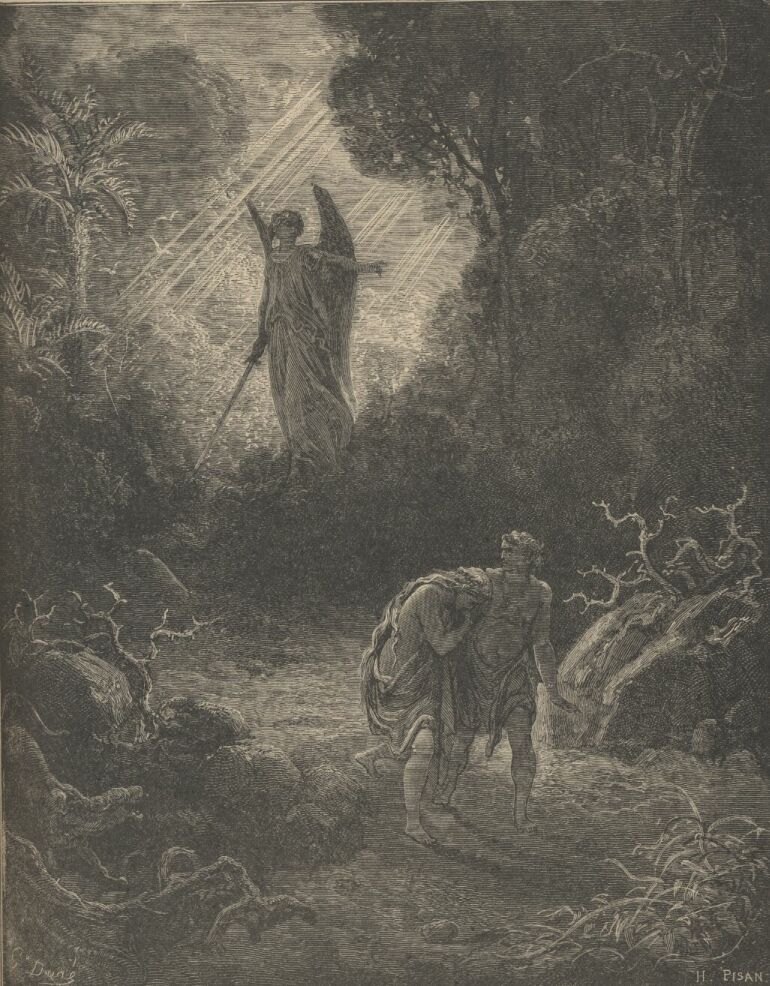
The Expulsion from the Garden of Eden - by Gustave DoreIn previous posts I alerted my readers to the nefarious aspects and fallout from those who embrace evil:

From reading each of these posts you will have noticed that the Evil One will use small amounts of good mixed with a large doses of evil to accomplish his purposes. His ultimate purpose is to steal you away from the “enemy” ~ the one true God.

 This enticement to do evil is sardonically portrayed in a portion of C.S. Lewis’ The Screwtape Letters. Here Screwtape lectures Wormwood (Screwtape’s disciple of evil) on how to be a competent tempter:

 “[The enemy] has filled His world full of pleasures . . . Everything has to be twisted before it is any use to us. We fight under cruel disadvantages. Nothing is naturally on our side. (Not that that excuses you…)” ―C.S. Lewis, The Screwtape Letters

The previous posts (listed below) are interspersed with quotes from C.S. Lewis’ The Screwtape Letters:  Screwtape book



A Brave New World or Evil Will Make One Lose Their Head

 In this post we learn of evil’s “fundamentally transforming” power. Wicked counsel using the contrivances of moral relativism, pride and grandiosity feeds the darkened imaginations of Macbeth and Lady Macbeth. A short review of Shakespeare’s tragedy reveals that breathing the “Fog and filthy air” is toxic.”

“Courage is not simply one of the virtues but the form of every virtue at the testing point, which means at the point of highest reality. ” ―C.S. Lewis, The Screwtape Letters

 Worker Bees, Outcome Based Education and Our Little Ones

Here, evil is disguised as a consensus building which “fundamentally transforms” our children via the public school system. We read that consensus building can be used to synthesize good with evil.

“By the very act of arguing, you awake the patient’s reason; and once it is awake, who can foresee the result? Even if a particular train of thought can be twisted so as to end in our favour, you will find that you have been strengthening in your patient the fatal habit of attending to universal issues and withdrawing his attention from the stream of immediate sense experiences. Your business is to fix his attention on the stream. Teach him to call it “real life” and don’t let him ask what he means by “real.” “―C.S. Lewis, The Screwtape Letters

 Label Me “In Christ”

  The use of labels and political correctness become roadblocks to any conversation that would reveal truth or opinions that would differ from the demanded conformity. The Progressive Left’s political intolerance is shown for what it is: “Free speech for me, but not for thee.”

“Whatever their bodies do affects their souls. It is funny how mortals always picture us as putting things into their minds: in reality our best work is done by keeping things out…” ―C.S. Lewis, The Screwtape Letters

“All is summed up in the prayer which a young female human is said to have uttered recently: “O God, make me a normal twentieth-century girl!” Thanks to our labors, this will mean increasingly: “Make me a minx, a moron, and a parasite.” ―C.S. Lewis, The Screwtape Letters

 The People of the “White Privilege” Lie

 A White Privilege Conference is held annually in Madison Wisconsin. The conference of hive minded collectivists tell the lie of being born on the wrong ‘side’ of the melanin tracks. We learn of how evil is used to re-label, redefine, classify and ‘inform’ public school teaching.

 “Suspicion often creates what it suspects.” ―C.S. Lewis, The Screwtape Letters

 “The claim to equality, outside of the strictly political field, is made only by those who feel themselves to be in some way inferior.” ―C.S. Lewis, The Screwtape Letters

 “Doubly Dead and Uprooted”

 In this post Jude (and I) write about false teachers, teachers that synthesize good with evil to create a cheap grace. This cheap ‘grace’ is embraced by many churches, churches which acquiesce to the pressure of the LGBT ‘community for the sake of vacuous “diversity”.

 “Indeed the safest road to Hell is the gradual one–the gentle slope, soft underfoot, without sudden turnings, without milestones, without signposts,…Your affectionate uncle, Screwtape.”  ―C.S. Lewis, The Screwtape Letters

 “A moderated religion is as good for us as no religion at all—and more amusing.”―C.S. Lewis, The Screwtape Letters

 Tear Down That Anthropocentricity

 We learn about evil in its many socio-political forms: humanism, Marxism, collectivism, Progressivism and murderous tyranny ~ each one centered around man’s material needs.

 “Prosperity knits a man to the world. He feels that he is finding his place in it, while really it is finding its place in him.” ―C.S. Lewis, The Screwtape Letters

 “[M]an has been accustomed, ever since he was a boy, to having a dozen incompatible philosophies dancing about together inside his head. He doesn’t think of doctrines as primarily “true” or “false,” but as “academic” or “practical,” “outworn” or “contemporary,” “conventional” or “ruthless.” Jargon, not argument, is your best ally in keeping him from the Church. Don’t waste time trying to make him think that materialism is true! Make him think it is strong or stark or courageous—that it is the philosophy of the future. That’s the sort of thing he cares about.” ―C.S. Lewis, The Screwtape Letters

 “Schemes of thought such as Creative Evolution, Scientific Humanism, or Communism, fix men’s affections on the future ─ on the very core of temporality. Hence nearly all vices are rooted in the future. Gratitude looks to the past, and love to the present; fear, avarice, and ambition look ahead.” ―C.S. Lewis, The Screwtape Letters

 “Pilate was merciful till it became risky.” ―C.S. Lewis, The Screwtape Letters

 “Whenever all men are…hastening to be slaves or tyrants we make Liberalism the prime bogey.” ―C.S. Lewis, The Screwtape Letters

 Fear and Loathing in America

 Allan Bloom, relates, “We have come back to the point where we began, where values take the place of good and evil.”

 “If we promoted justice and charity among men, we should be playing directly into the Enemy’s hands; but if we guide them to the opposite behaviour, this sooner or later produces (for He permits it to produce) a war or a revolution, and the undisguisable issue of cowardice or courage awakes thousands of men from moral stupor. This, indeed, is probably one of the Enemy’s motives for creating a dangerous world—a world in which moral issues really come to the point. He sees as well as you do that courage is not simply one of the virtues, but the form of every virtue at the testing point, which means, at the point of highest reality. A chastity or honesty, or mercy, which yields to danger will be chaste or honest or merciful only on conditions.” ―C.S. Lewis, The Screwtape Letters

 Exclusion & Embrace in the Garden of Good & Evil

“To triumph fully, evil needs two victories, not one. The first victory happens when an evil deed is perpetrated; the second victory, when evil is returned. After the first victory, evil would die if the second victory did not infuse it with new life.”

  • Miroslav Volf
    The End of Memory, Remembering Rightly In A Violent World

“We must picture hell as a state where everyone is perpetually concerned about his own dignity and advancement, where everyone has a grievance, and where everyone lives with the deadly serious passions of envy, self-importance, and resentment.” ―C.S. Lewis, The Screwtape Letters

 Check Your Motives At The Door

 In this post are quotes from M. Scott Peck, Psychiatrist & author. He defines evil and antilove.

 “All mortals tend to turn into the thing they are pretending to be. This is elementary―C.S. Lewis, The Screwtape Letters


Then, evil as religiously practiced by Islam’s Jihadists, by Hamas and under the demented Sharia Law is discussed in

 Truth Be Told – Chloé Simone Valdary

…or as revealed by this tweet reply:

https://twitter.com/mushtaqahmed111/status/494472488928428034

 “…a whole race perpetually in pursuit of the rainbow’s end, never honest, nor kind, nor happy now, but always using as mere fuel wherewith to heap the altar of the future every real gift which is offered them in the Present.” ―C.S. Lewis, The Screwtape Letters


Lord, deliver us from evil.


Be encouraged; from the Gospel according to Luke 10: 17-20, the report of the seventy disciples sent out by Jesus:


“The seventy came back exhilarated.

“Master,” they said, “even the demons obey us in your name!”

“I saw the satan fall like lightening from heaven,” he replied. “Look: I’ve given you authority to tread on snakes and scorpions, and every power of the enemy. Nothing will ever be able to harm you. But-don’t celebrate having spirits under your authority. Celebrate this, that your names are written in heaven.”


“Do not be deceived, Wormwood. Our cause is never more in danger than when a human, no longer desiring, but still intending, to do our Enemy’s will, looks round upon a universe from which every trace of Him seems to have vanished, and asks why he has been forsaken, and still obeys.”

―C.S. Lewis, The Screwtape Letters


My next post will uncover more evil, as practiced by Anonymous.

the evil one at computer


***

Picture attributions:

Above Illustration: The Expulsion from the Garden of Eden – by Gustave Dore

Wormwood picture: The Screwtape Letters Cover: Read by John Cleese

 Satan at the computer:  http://screwtapefiles.blogspot.com/2011/02/detail-is-in-devil.html
A Brave New World or Evil Will Make One Lose Their Head

  Macbeth

“Fair is foul and foul is fair

Hover through the fog and filthy air.”


If like me you are a follower of The Way then I don’t have to tell you that we live in an age of ever encroaching evil. The effects:  man’s inhumanity to man is shown daily on the nightly news along with the moral relativism which justifies it all. We now “Hover through the fog and filthy air.”

 In the U.S. we now are governed and adjudicated by those who want to “fundamentally transform” the world around them. For these morally adrift flotsam and jetsam of embattled truth, the ends justify the means. For them, right or wrong considerations are the millstones which keep them from reaching the distant shores of their island utopias called ‘Freedom’ and ‘Rights’.

 Our world in almost every aspect has been turned upside down by moral relativism. One prime example: criminals (and illegal aliens this very day, too) are now considered the victims by many judges.

 Unconstrained judges will often base their final decisions on the fatuous reasoning of rationalism’s data merchants, the social scientists ~ ‘scientists’ who paint family background and poverty scenarios with a blind eye to the true victim. The resultant formulation: a sliding scale of ad hoc “social justice” created with a calculus of personal ambition by a judge who is being watched by the attention-seeking liberal media, the ‘acclaimed’ ‘social’ ‘scientists’ and his/her cocktail party sycophants.

 Personal responsibility for one’s behavior has been thrown out the window. Such a ‘weight’ would incur too much shame and guilt on the part of the perpetrators of evil. Psychologists, social workers and their ilk want to avoid shame and guilt. And if Rousseau were here today he would say that institutions and authorities are the problem, that man is inherently good. You know better.

 Willfully the social do-gooders replace personal responsibility and consequences with an “I’m OK Your Ok” “fog and filthy air” therapy. Mind altering anxiety killing pills are prescribed to deal with guilt. Heaven forbid that a person encounter and understand the consequences of their actions.

 Shakespeare’s The Tragedy of Macbeth is an excellent example of the very human tragedy that is the result of good people crossing a line to make evil choices. And, after having read several of Shakespeare’s plays, it would seem that Shakespeare knew more about humanity than any ‘social scientist’ who has ever published. The Bible being unquestionably the authority, The Book, about mankind.

 Another writer who understood man’s capacity for evil was Alexander Solzhenitsyn. A Russian novelist, historian, dissident and documentarian Solzhenitsyn had first-hand knowledge of evil as he and others experienced it under the murderous tyrant Stalin. From under the clouds of evil, as well as introspectively, Solzhenitsyn observed:

 “The battle line of good and evil runs through the heart of every man.”

 Moral relativism, a synthesis of good and evil, makes the line dividing good and evil murky. And, in these days of Progressivism’s Pontius Pilate-like questioning, “What is truth?” it has become increasingly difficult to see the delineation between good and evil. The “fog and filthy air” of moral relativism must be seen for what it is ~ the admixture of good and evil.


The opening quote, spoken in unison by three witches, is from the opening of Shakespeare’s play The Tragedy of Macbeth, Act One, Scene 1.

 The foreboding first scene takes place on the heather moors of Scotland under a stage setting of “Thunder and lightening.” The imagery throughout the play is of night, of darkness, of man’s dark nature, of blood, of distortion. In other words, the play brings to ‘light’ the evil overcast in men’s souls.

 Macbeth, a Scottish General and the thane (a noble) of the village of Glamis in Scotland, is the main character.

 In the play’s opening scene Macbeth is the subject of a plot by three witches. He is to be encountered by them in an open field after he has completed a battle. Their reason: the witches want to give Macbeth their ‘prophecies’ right after his victory while the won battle is fresh in his mind and his pride is stoked.

 At the end of the brief opening scene that the witch’s animal ‘spirit lords’ call to them and they fly away. Act One, Scene 1 ends portentously. Evil is in the air. The witches are the harbingers.

 The play is a tragedy about its eponymous main character facing the battle line within his heart. He begins as a noble and valiant warrior for Scotland. He starts out as good. He knows right from wrong; He fights for the good of all Scotland with all his might. But things begin to change after he returns victorious from a recent battle for Scotland. Macbeth walks into the aforementioned open field with his battlefield companion Banquo. The open field context could appear to them as a broad daylight moment and therefore any ‘truth’ would be clear to see. Yet it is not.

 For the three witches this is perfect timing to speak their prophecy. Its appeal goes directly Macbeth’s pride and to his grandiosity after having gained victory on another field.

 By telling Macbeth and his companion that they will rule Scotland each in their own way their imaginations begin to run wild. Reason also begins to plot as to how to ‘cross the line’ into royalty. The two men, warriors and servants of the King of Scotland, having just come from battle for their current regent Duncan now hear that they, too, will be regents. They begin to imagine that they are ‘meant’ to have what others have. So, they are told.

 After the witches relay their prophecies, Banquo counsels Macbeth (from the No fear translation, Act One, scene 3):

 If you trust what they say, you might be on your way to becoming king, as well as thane of Cawdor. But this whole thing is strange. The agents of evil often tell us part of the truth in order to lead us to our destruction. They earn our trust by telling us the truth about little things, but then they betray us when it will damage us the most

 What a perfect description of the enticement of moral relativism that leads us to ruin!

 To speed up the process of becoming a regent (no time line was given by the witches) Macbeth crosses a line and chooses a path of evil. The evil compounds quickly into greater evil when Macbeth sends a letter to Lady Macbeth.

 Lady Macbeth quickly embraces evil after reading the letter from her husband reciting the witch’s prophecies. (She, obviously, like Macbeth, doesn’t consider the source. Moral relativism has a penchant for this.). Lady Macbeth is stricken by the idea of being royalty and invites evil in, desiring to enable her husband to become king of Scotland. In doing so, Lady Macbeth becomes the very image of subjecting one’s self to evil in hopes of achieving ‘gain.’ She embraced the lie that evil brings right to your door step.

 Shortly afterward, when she hears that King Duncan will be coming to the Macbeth house, she plots his murder. Her words, again from No Fear Shakespeare, Act One scene 5:

 “So the messenger is short of breath, like a hoarse raven, as he announces Duncan’s entrance into my fortress, where he will die. Come, you spirits that assist murderous thoughts, make less like a woman and more like a man, and fill me from head to toe with deadly cruelty! Thicken my blood and clog my veins so I won’t feel remorse, so that no human compassion can stop my evil plan or prevent me from accomplishing it! Come to my female breasts and turn my mother’s milk into poisonous acid, you murdering demons, wherever you hide, invisible and waiting to do evil! Come, thick night and cover the world in the darkest smoke of hell, so that my sharp knife can’t see the wound it cuts open, and so heaven can’t peep through the darkness and cry, No! Stop!”

 Lady Macbeth, consumed by evil, question’s Macbeth’s manhood when he waffles considering what must take place for his ‘prophetic’ rule to occur.

 The play stages many of the elements and images of evil. Macbeth’s machismo, his masculinity is questioned by an evil embracing wife. There is guilt and paranoia, blood shed, ghosts, complicity in doing evil, delusional thinking leading to madness, remorse leading to suicide, darkness – all the time. Let it be known: evil hates the light of day.


At this juncture in the post I do not want to reveal and dissect the whole storyline or make this post longer than the play itself. I suggest reading the whole play in one sitting. It is a short, fast paced tragedy.

And, I suggest, if you haven’t read Shakespeare’s plays then do what I have done: read the plays from the very accessible, inexpensive series of books called No Fear Shakespeare. As the cover relates: “The Play Plus A Translation Anyone Can Understand”.


Can man remake himself with pills, through better institutions, by labeling himself a “deserving” person or by removing a psychopathic bent from the DSM?

 Can man rule in life by crossing the line in his heart from good over to evil? Progressivism, materialism and evil itself would suggest it is possible. Yet, in doing so one is radically and “Fundamentally Transformed” as are the lives of those around them.

 Was not Christ tempted by Satan in the same way as we are?

Satan took Jesus to a high pinnacle and showed him the world. Satan said to Christ, “You can have all of this if you give your allegiance to me.” In other words, “Cross the Line. Believe the lie.”

 There is no namby-pamby Jesus or cheap Unitarian grace where good is mixed with evil.

 When describing the Kingdom of Heaven to his disciples Jesus spoke in parables or similes of real life experiences they would have had. The passage below is from just such a discourse. It is from the Gospel according to Matthew 13: 44-53:

 “…Again, the kingdom of heaven is like a net that was thrown into the sea, and collected every type of fish. When it was full, the fishermen brought it to shore. They sat down and selected the good ones, which they put into a bucket; but they threw out the bad ones. That’s what it will be like at the close of an age. The angels will go off and separate the wicked from the righteous, and they will throw them into the fiery furnace, where there will be weeping and gnashing of teeth.

“Have you understood this?” asked Jesus

“Yes, “they answered….”

You have a choice. Don’t let anyone conjure up excuses for you. You have a choice.


 ***

A short description of Shakespeare’s tragedy Macbeth from Wikipedia:

Macbeth is a play written by William Shakespeare. It is considered one of his darkest and most powerful tragedies. Set in Scotland, the play dramatizes the corroding psychological and political effects produced when its protagonist, the Scottish lord Macbeth, chooses evil as the way to fulfill his ambition for power.


****

Macbeth picture courtesy of :

http://www.thelowry.com/event/Macbeth-February2010

The People of the “White Privilege” Lie

What do you want? The Truth or a Lie? 

I am a Christian parent of four children. I post this because…

The new/old Jeremiah Wright preachers of hate and exclusion want you to join them in bashing Whites, Jews, Christians, Tea Party members, Capitalism, language and… the First Amendment:

The Annual White Privilege Conference in Madison, Wisconsin 2014.

As you listen to the video below you will hear the devotees of this ‘white guilt’ cult parsing language to reprogram your mind.

 “Some things are believed because they are demonstrably true. But many other things are believed simply because they have been asserted repeatedly,” Thomas Sowell

 …These are the people who will teach your children in public schools.

No Christian should take part in this evil. Christians, rather, must be alerted to the evil crouching at their child’s school door.

 As you will see and hear the White Privilege Conference gives meaning to Hannah Arendt’s once used phrase “the banality of evil.” ‘Normal’ everyday people within these conference walls are invoked to participate in acts of evil against humanity, even against their own humanity and against God-given human rights, human rights not based on the melanin content of your skin.

 All parents with school children must be informed as to the evil going on right under their noses in the class room.

 Here is part 2 of a 4 part series, “White Privilege Conference 2014 Part 2 of 4: Rape Is Not Intrinsically Bad” provided by the website Progressives Today (see below).

Much of what you are hearing today began years ago on college campuses:  “Unlearning Liberty: Campus Censorship and the End American Debate” by Greg Lukianoff.  Buy this book and read the specifics of how this type of reprogramming of student’ minds with white guilt/white privilege propaganda could grow into a White Privilege Conference

 Here is a post offering quotes from the book:

 Closing the American Mind: Censorship

For more information on the Progressive’s “white privilege” movement, read these posts:

 Shelby Steele: Poetic truths work by moral intimidation – not reason

 Legal Insurrection (H/T for making me aware of this evil)

 Progressives Today

 The book by Shelby Steele:

“White Guilt: How Blacks and Whites Together Destroyed the Promise of the Civil Rights Era”

Para-Steele: white liberals and their black enablers unleash moral relativism that is corrupting America.

 Save your children: Home School, Home School, Home School!!!!!!!!!!!!!!!

What do you want? The Truth or a Lie?

added 5-18-2014:

Group think, collectivist hive mindedness:

“When present, these antecedent conditions are hypothesized to foster the extreme consensus-seeking characteristic of groupthink. This in turn is predicted to lead to two categories of undesirable decision-making processes. The first, traditionally labeled symptoms of groupthink, include illusion of invulnerability, collective rationalization, stereotypes of outgroups, self-censorship, mindguards, and belief in the inherent morality of the group. The second, typically identified as symptoms of defective decision-making, involve the incomplete survey of alternatives and objectives, poor information search, failure to appraise the risks of the preferred solution, and selective information processing. Not surprisingly, these combined forces are predicted to result in extremely defective decision making performance by the group.”
(Marlene E. Turner & Anthony R. Pratkanis, Twenty-Five Years of Groupthink Theory and Research: Lessons from the Evaluation of a Theory, 1998, Organizational Behavior and Human Decision Processes, 73, 105–115.)

 Hannah Arendt’s Warning: the Violence of Hive-Mindedness, Groupthink


Exclusion & Embrace in the Garden of Good & Evil

Tomorrow, before I receive the Body and Blood of the Lord I will again kneel and pray the Lord’ s Prayer:

Our Father, which art in heaven,
Hallowed be thy Name.
Thy Kingdom come.
Thy will be done in earth,
As it is in heaven.
Give us this day our daily bread.
And forgive us our trespasses,
As we forgive them that trespass against us.
And lead us not into temptation,
But deliver us from evil.
For thine is the kingdom,

The power, and the glory,

For ever and ever.

Amen.

(Traditional, taken from the Anglican Book of Common Prayer, 1662).

And forgive us our trespasses,
As we forgive them that trespass against us.

Wow, Lord, you want me to forgive that person or that group who has done me so much harm and who even now shows so much hatred towards me?!

When someone wrongs us often our first thought is to retaliate, to lash out and to return to the ‘other’ the same pain caused to us. But, then, at other times, our response may be to become silent and later, perturbable to others. We will constantly gripe and complain, projecting onto others the self-justifying anger and resentment that we bear from the original hurt. The inception of unreality quickly takes shape. It’s not the reality from above.

The story of revenge is as old as the Scriptures but Jesus put an end to this cycle of anger born out of an unforgiving spirit.

Think about the following words in the context of personal relationships and also in the unfolding drama of human relationships across the globe.  Global warming, as a public ‘issue’, is silly compared to the rage, hate and evil which turns brother against brother in a continuing cycle of violence.

Quotes from Miroslav Volf, Exclusion & Embrace: A Theological Exploration of Identity, Otherness, and Reconciliation

“Forgiveness flounders because I exclude the enemy from the community of humans even as I exclude myself from the community of sinners. But no one can be in the presence of the God of the crucified Messiah for long without overcoming this double exclusion ~ without transposing the enemy from the sphere of monstrous inhumanity into the sphere of shared humanity and herself from the sphere of proud innocence into the sphere of common sinfulness. When one knows that the torturer will not eternally triumph over the victim, one is free to rediscover that person’s humanity and imitate God’s love for him. And when one knows that God’s love is greater than all sin, one is free to see oneself in the light of God’s justice and so rediscover one’s own sinfulness.” (p.124)

“Only those who are forgiven and who are willing to forgive will be capable of relentlessly pursuing justice without falling into the temptation to pervert it into injustice.” (p.123)

“When God sets out to embrace the enemy, the result is the cross. On the cross the dancing circle of self-giving and mutually indwelling divine persons opens up for the enemy; in the agony of the passion the movement stops for a brief moment and a fissure appears so that sinful humanity can join in (see John 17:21). We, the others ~ we, the enemies – are embraced by the divine persons who love us with the same love with which they love each other and therefore make space for us within their own eternal embrace.” (p.129)

Volf on the Parable of the Prodigal Son:  “relationship has priority over all [moral] rules” that reconciliation ~ the ultimate goal of justice – could be made complete.” (p.164)

“Without entrusting oneself to the God who judges justly, it will hardly be possible to follow the crucified Messiah and refuse to retaliate when abused. The certainty of God’s just judgment at the end of history is the presupposition for the renunciation of violence in the middle of it. The divine system of judgment is not the flip side of the human reign of terror, but a necessary correlate of human nonviolence. (p.302) (emphasis mine)

Also consider forgiveness as practiced…

Cornelia “Corrie” ten Boom (April 15, 1892 ~- April 15, 1983) was a Dutch Christian Holocaust survivor who helped many Jews escape the Nazis during World War II. Listen to her story here and this short video about her forgiveness.

How to stop evil:

“To triumph fully, evil needs two victories, not one. The first victory happens when an evil deed is perpetrated; the second victory, when evil is returned. After the first victory, evil would die if the second victory did not infuse it with new life.”

– Miroslav Volf
The End of Memory, Remembering Rightly In A Violent World

 *****

Romans 12:21: “Do not be overcome by evil, but overcome evil with good.”

*****

“The only way to overcome evil is to let it run itself to a standstill because it does not find the resistance it is looking for. Resistance merely creates further evil and adds fuel to the flames. But when evil meets no opposition and encounters no obstacle but only patient endurance, its sting is drawn, and at last it meets an opponent which is more than its match.”

–Dietrich Bonhoeffer, The Cost of Discipleship

Check Your Motives At The Door

Consider the following when you listen to the media, read the news and formulate the motives behind your actions:

Evil & Antilove

“There really are people and institutions made up of people, who respond with hatred in the presence of goodness and would destroy the good insofar as it is in their power to do so. They do this not with conscious malice but blindly, lacking awareness of their own evil — indeed, seeking to avoid any such awareness. As has been described of the devil in religious literature, they hate the light and instinctively will do anything to avoid it, including attempting to extinguish it. They will destroy the light in their own children and in all other beings subject to their power.

Evil people hate the light because it reveals themselves to themselves. They hate goodness because it reveals their badness; they hate love because it reveals their laziness. They will destroy the light, the goodness, the love in order to avoid the pain of such self-awareness. My second conclusion, then, is that evil is laziness carried to its ultimate, extraordinary extreme. As I have defined it, love is the antithesis of laziness. Ordinary laziness is a passive failure to love. Some ordinarily lazy people may not lift a finger to extend themselves unless they are compelled to do so. Their being is a manifestation of nonlove; still, they are not evil.

Truly evil people, on the other hand, actively rather than passively avoid extending themselves. They will take any action in their power to protect their own laziness, to preserve the integrity of their sick self. Rather than nurturing others, they will actually destroy others in this cause. If necessary, they will even kill to escape the pain of their own spiritual growth. As the integrity of their sick self is threatened by the spiritual health of those around them, they will seek by all manner of means to crush and demolish the spiritual health that may exist near them.

I define evil, then, as the exercise of political power — that is, the imposition of one’s will upon others by overt or covert coercion — in order to avoid extending one’s self for the purpose of nurturing spiritual growth. Ordinary laziness is nonlove; evil is antilove. (emphasis mine)

M. Scott Peck, Psychiatrist & author

The Road Less Travelled 


  • Evil is not simply the absence of goodness ~ it is actively hateful and destructive.
  • “Evil” is “live” spelled backwards ~ likewise, evil is in opposition to life.
  • Evil people are to be pitied, not hated.

 “Since [narcissists] deep down, feel themselves to be faultless, it is inevitable that when they are in conflict with the world they will invariably perceive the conflict as the world’s fault. Since they must deny their own badness, they must perceive others as bad. They project their own evil onto the world. They never think of themselves as evil, on the other hand, they consequently see much evil in others.”

“The difficulty we have in accepting responsibility for our behavior lies in the desire to avoid the pain of the consequences of that behavior.”

“I shall, however, break with tradition and use the neuter for Satan. While I know Satan to be lustful to penetrate us, I have not in the least experienced this desire as sexual or creative—only hateful and destructive. It is hard to determine the sex of a snake.”
from People of the Lie

“Since the primary motive of the evil is disguise, one of the places evil people are most likely to be found is within the church. What better way to conceal one’s evil from oneself as well as from others than to be a deacon or some other highly visible form of Christian within our culture”

Consider these variations of antilove:

Freed Palestinian “Hero” Terrorist Boasts of his Murders

Pinkwashing, Redwashing, Greenwashing ~ the multi-colored world of anti-Israel hate

Shooter targeting Family Research Council wanted to “smear Chick-fil-A in their faces” after murders

SPLC’s hatewatch gives cover to hate

More confrontation outside Chicago Chick-fil-A

Chicago Chick-fil-A Kiss-In protesters “chalk” homeless street preacher

Has the Dark Night Risen in You?

The recent massacre of innocent lives at the movie theatre should shock everyone back into reality.  Sadly, I doubt this will happen. Entertainment violence must go on for the sake of masses.  Liberal causes must be funded with the proceeds.

 As a kid I paid 25 cents for a Batman or Superman comic. I understood these illustrated ‘funny’ papers as fantasy narratives. The bad guys appeared as a weird assortment of surreal characters that seemed to be annoyances more than anything. I stopped buying comic books when I grew up.

 The Batman cult has evolved from fantasy comic books to serial spoofs (TV’s Adam West) to abstracted violence (Tim Burton and Joel Schumacher) to evil and chaos personified – Heath Ledger’s Joker (Christopher Nolan).  None of this is lost on the ravenous crowds who lust for more bloody entertainment.

 Teens, adults, even parents with young children come to the theatre to watch the gladiator sport of murder on the big screen. No age is immune to an addiction to violence. And the addiction is gladly reinforced by the profiteers of Hollywood.

 The Dark Knight Rises. Christopher Nolan. Auteurial vision. I see nothing but decadence from the bottom up. I will not go to see this movie out of respect for the victims. I don’t need Batman.

 Something to think about:  you know how a TV jingle or ad gets in your head and stays there?  What is lurking in your head, crouching, waiting to come out?  Will a psychotic break push you to unload the burned-in images of your anger, discontent, loneliness and rage onto others in the form of a cold-calculated bullet?

You are responsible for what you load into your heart, mind and soul. And, for what comes out.

Added:  https://sallyparadise.wordpress.com/2011/01/14/the-trajectory-of-jared-lee-loughner/

In memoriam, from Henryk Gorecki’s Symphony #3 “Sorrowful Songs”:

Pretense, Part 1: A Look at Evil, Pretense and Suffering

In his book People of the Lie:  The Hope for Healing Human Evil, Dr. M. Scott Peck writes in the chapter The Encounter with Evil in Everyday Life that

 “The issue of naming (evil) is a theme of this work. It has already been touched on in diverse instances: science has failed to name evil as a subject for scrutiny; the name evil does not appear in the psychiatric lexicon; we have been reluctant to label specific individuals with the name evil; in their presence, therefore, we may experience a nameless dread or revulsion; yet the naming of evil is not without danger.

To name something correctly gives us a certain amount of power over it. Through its name we identify it.  We are powerless over a disease until we can accurately name it…The treatment begins with its diagnosis.  But is evil an illness? Many would not consider it so.  There are a number of reasons why one might be reluctant to classify evil as a disease.  Some are emotional. For instance, we are accustomed to feel pity and sympathy for those who are ill, but the emotions that evil invoke in us are anger and disgust, if not actual hate…

Beyond our emotional reactions, there are three rational reasons that make us hesitate to regard evil as an illness…I shall nonetheless take the position that evil should indeed be regarded as a mental illness.”

Dr. Peck goes on to discuss the three reasons. I will use summary quotes.

 “The first holds that people should not be considered ill unless they are suffering pain or disability – that there is no such thing as an illness without suffering….it is characteristic of the evil that, in their narcissism, they believe that there is nothing wrong with them, that they are psychologically perfect human specimens…For we realize that their inability to define themselves as ill in the face of overwhelming evidence to the contrary is actually part of the illness itself…The use of the concept of emotional suffering to define disease is also faulty in several other respects. As I noted in The Road Less Traveled, it is often the most spiritually healthy and advanced among us who are called on to suffer in ways more agonizing than anything experienced by the more ordinary.  Great leaders, when wise and well, are likely to endure degrees of anguish unknown to the common man. Conversely, it is the unwillingness to suffer emotional pain that usually lies at the root of emotional illness.  Those who fully experience depression, doubt, confusion and despair may be infinitely more healthy than those who are generally certain, complacent and self satisfied.  The denial of suffering is, in fact, a better definition of illness than its acceptance.

The evil deny the suffering of their guilt – the painful awareness of their sin, inadequacy and imperfection – by casting their pain onto others through projection and scapegoating.  They themselves may not suffer, but those around them do.  They cause suffering.  The evil create for those under their dominion a miniature sick society.”…

 Finally, who is to say what the evil suffer? It is consistently true that the evil do not appear to suffer deeply.  Because they cannot admit to weakness or imperfection in themselves, they must appear this way.  They must appear to themselves to be continually on top of things, continually in command.  Their narcissism demands it…

Think of the psychic energy required for the continued maintenance of the pretense so characteristic of the evil!…”

“I said that there are two other reasons one might hesitate to label evil as an illness…One is the notion that someone who is ill must be a victim….One way or another, to some extent, all these people (the evil) and a host of others victimize themselves. Their motives, failures and choices are deeply and intimately involved in the creation of their injuries and diseases….

The final argument against labeling evil an illness is the belief that evil is a seemingly untreatable condition…It is the central proposition of this book that evil can and should be subjected to scientific scrutiny…It would, I believe, be quite appropriate to classify evil people as constituting a specific variant of the narcissistic personality disorder.”

Dr. Peck goes on to describe this variant of personality disorder:

“In addition to the abrogation of responsibility that characterizes all personality disorders, this one would specifically be distinguished by:

(a)    consistent destructive, scapegoating behavior, which may often be quite subtle.

(b)    excessive, albeit usually covert, intolerance to criticism and other forms of narcissistic injury.

(c)    Pronounced concern with a public injury and self-image of respectability, contributing to a stability of life-style but also to pretentiousness and denial of hateful feelings or vengeful motives.

(d)   Intellectual deviousness, with an increased likelihood of a mild schizophrenic-like disturbance of thinking at time of stress.

But there is another vital reason to correctly name evil:  the healing of its victims.”

 *****************

 I have encountered some distinctly evil people during my life.  The common characteristic of their personality is the veneer of pretense with which they surround their lives.  They see themselves in a role, a grandiose, high-minded role.  There is nothing within themselves or outside themselves that will keep them from holding that image up before themselves or others. They will deny, blame and ignore what every one else can clearly see.  Their motivation, as Dr. Peck describes in the above chapter, is fear. 

Jesus said, “If the light in you is darkness how great is that darkness.”

Jesus’ perfect love can cast out fear…and evil.

The Dragon Lady: Lisbeth Salander

I don’t normally read popular fiction. I’m usually affixed to books that contain older and more weathered fiction like Chekov, O’Connor, Hemingway, etc. or to science books such as “The Best American Science Writing of 2010”, “Once Upon Einstein” or” Calculus for Dummies”.

While reading “The Best American Science Writing of 2010” a fellow passenger on a daily commute suggested strongly that I read the Steig Larsson books: “The Girl With The Dragon Tattoo”. “The Girl Who Played With Fire” and “The Girl Who Kicked the Hornet’s Nest”. I could tell that this gentleman was deeply engrossed in the books as were other passengers. The book covers showed up everywhere I looked. So, I decided to take a departure from my everyday route and read the books.

In short, I found the books story-telling engrossing.  Larsson is a good at weaving a multiplicity of detailed character threads to fashion an intriguing tale about a young woman, Lisbeth Salander, the story’s protagonist. The story basically tells how a diminutive tech savvy girl deals with overwhelming evil. Sadly, though, the story is not redemptive for any one, not for Lisbeth or the reader. 

The three books which make up  the Millennium Trilogy deal with evil using a cast of horrendous characters: unfeeling, misogynistic and murderous white men. This diabolical group includes Lisbeth’s monster of a father, her ‘Super-Race’ machine of a brother (literally unfeeling), an even more monstrous uncle and nephew, a state imposed guardian, an evil system hidden within the government and a horde of eastern European sex traders. Lisbeth, the super-hacker, is able to outsmart, outwit and out punch her opponents until she is free to live her life. That’s the best she can hope for in this story.

The Lisbeth character is a ‘modern’ woman in charge of her body. She has multiple piercings in a hardened outer shell. Her anti-social demeanor,possibly Asperger syndrome her former guardian speculates, keeps her aloof and people guessing as to what she is up to. She is a mysterious force to reckon with. A mystifying dragon lady with all odds stacked against her.

Yet, Lisbeth has feelings. There is a hard-drive of detached emotions operating under the cover of a hook-up sexuality. This dragon lady woman acts out with women because, we are lead to suppose, men have treated her so badly. We are led to feel sympathy for her ‘situation’ and to accept her choices whenever she beds down with women. Near the end of story, after she has dealt serious blows to the white men who have abused her she casually and discriminately hooks up with a married man who’s staying in the same hotel as she is. They have meaningless sex over several nights. Apparently, she has now taken charge of her sex life after the brutal rapes that incurred in her past. We learn of her excessive drinking and her own unchaste behavior to mollify her pain. She uses men like they have used her. This is not feminism. Rather it is unresolved anger, returning evil for evil. She is a woman disconnected from herself and her pain. Shes operates out of an existential ethic, creating her own values and meaning to life as she goes along.

How the books deal with evil shows the out working of the postmodern mind: intelligence wins the day; knowing how to ‘hack’ the system can be your salvation; evil is to be redirected any way it can; learn to outsmart evil and you’ll come out on top; don’t even bring God into the picture; we can save ourselves if we are smart enough, if we stay one step ahead of evil. (Think of the presumptive Wikileakers and Wikihackers.)

We also see a synthesis of good and evil in these books. The ends justify the means. The ‘good’ victim girl, Lisbeth, uses evil to deal with the evil doers. I won’t describe the details here.

Throughout the Millennium Trilogy there is a baseline desire to get to the bottom of the evil that has occurred and to expose it. Henrik Vanger, a retired industrialist begins the process. I do like the fact that along with a journalist and friend of Lisbeth, Mikael Bloomkist Henrik sought to ‘out’ the evil that’s been done to Lisbeth. That is a necessary step in dealing with evil. In our world during a recent televised newscast it is told that in the trial of Elizabeth Smart’s kidnapper and rapist, Elizabeth Smart takes the stand, faces her accuser and speaks out the evil that has been done to her. This confronting of evil is an absolute necessity for the victim, for the perpetrator and for those who have become aware of this horrible crime. It is absolutely necessary to bring to justice all of the evil doers. These acts, granted by God in the present, of bringing those to justice who have perpetrated evil are a precursor to the Final Judgement awaiting evil. Without giving away too much of the story, in the case of Lisbeth there is a trial where she faces those who have acted unjustly towards her. The truth about the crimes done to Lisbeth is revealed. Outing the information is not enough, though, for any type of redemptive closure. It is a good beginning, though.

The revelation of evil as perpetrated, in and of iteslf, is not enough to deal with the systemic evil that is inherent in man and man’s societies since Adam’s Fall. Neither is sheer will power, as Nietzsche would have us believe is necessary for survival. Evil has been dealt a death blow by the cross of Jesus Christ. Because of the cross, man can confront evil, name it for what it is, forgive the perpetrators and seek reconciliation and restoration. There is no mention of the cross in these books. One only sees man’s attempt to do battle with it in his own terms.

For the person who embraces the cross there is hope, whereas, the person who continues to battle evil with wile and strength may become stronger but, it will certainly bring them to the breaking point and to despair. In Lisbeth’s case, a large amount of money she had stolen from a ‘bad guys’ account became the restoration and succor for the evil that’s been done to her. In reality, though, money does not destroy the effects of evil. Money can become another master that controls us, perhaps to the point of doing evil. There is no solution to the problem of evil with a redistribution of wealth, despite what these books convey.

The art of story telling is excellent in Larsson’s books. But the story’s worldview is only worth the price of admission to view the postmodern mind trying to deal with evil using its form of “higher morality”.

Nietzsche: “That which does not kill me makes me stronger.” Lisbeth’s confrontation with evil throughout the books is met with her ever more wily approach to evil. Sadly, at the end of the story there is no message of hope or redemption. Evil is not overcome by good. There only remains the ‘inked’ vestige of a dragon – the Biblical symbol of the evil one.

(A note about the movies based on these books: The stories are based in Sweden. The movies are in Swedish. You can watch them with sub-titles. Also, the movies fast forward through the book. You would have to read the books to understand the myriad details supporting the story to make sense of it all. Finally, the story repeatedly deals with elements of evil:  brutal violence, rape, perverse sexuality and more.)

******

“To triumph fully, evil needs two victories, not one. The first victory happens when an evil deed is perpetrated; the second victory, when evil is returned. After the first victory, evil would die if the second victory did not infuse it with new life.”

– Miroslav Volf
The End of Memory, Remembering Rightly In A Violent World

 *****

Romans 12:21: “Do not be overcome by evil, but overcome evil with good.”

*****

“The only way to overcome evil is to let it run itself to a standstill because it does not find the resistance it is looking for. Resistance merely creates further evil and adds fuel to the flames. But when evil meets no opposition and encounters no obstacle but only patient endurance, its sting is drawn, and at last it meets an opponent which is more than its match.”

–Dietrich Bonhoeffer, The Cost of Discipleship

Worker Bees, Education Reform and Our Little Ones

The US education reform system creates…”Worker bees—cooperative, collaborative, team players, not too well educated but willing to work for a pittance for the good of the collective whole (ie, the state). Knowledge is power! A culturally illiterate nation will not long remain free. William Pearson Tolley, Chancelor of Syracuse University, wrote, in 1943,

“In a slave state, vocational training may be education enough. For the education of free men, much more is required. “”

“As parents look at education reform, little do they realize that education and the purpose of education are being transformed. No longer is education to produce an innovative, creative, intelligent child, who has a broad but intensive liberal arts background such that he or she can reach for the star of stars of his or her choice. The purpose of education, under this transformation, this paradigm shift, is to mold the child to meet the needs of the global economy of the 21st Century, to produce a world class worker with the attitudes, values and beliefs wanted by big business.” Lynn Stuter

Quotes from: http://www.learn-usa.com/education_transformation/~education.htm

“Lest we forget at least an over-the-shoulder acknowledgment to the very first radical: from all our legends, mythology, and history… the first radical known to man who rebelled against the establishment and did it so effectively that he at least won his own kingdom — Lucifer.” (Saul Alinsky’s dedication of his book “Rules for Radicals “)
*****

The Psychology of Becoming

Some might look at this title and think, “This sounds like something from Abraham Maslow or Carl Rogers.”

The world view of systems governance is humanism, a religion immersed in the concept that “no deity will save us, we must save ourselves” (Humanist Manifesto, 1973). To that end, systems governance has been developed and fine tuned over a period of several decades, the purpose being to “create the future;” to decide what the world is to look like at a designated future time, then design and align everything to achieve that vision. The ultimate goal is to attain and maintain the global sustainable environment.

The concept that we must save ourselves finds basis in the humanist principle that man has no spirituality or self-determinism, that man is merely a product of his environment and must, therefore, be “conditioned” to the perceived environment of the “created future” as one system of many systems.

Conditioning necessarily requires the change of one’s existing world view — one’s existing attitudes, values, and beliefs, one’s existing behaviors. In book after book written by those advocating systems education, that it is the behavior of the individual that must be changed is apparent:

“… a large part of what we call ‘good teaching’ is the teacher’s ability to attain affective objectives through challenging the students’ fixed beliefs and getting them to discuss issues.” (Bloom, 1964)

“The individual acts consistently in accordance with the values he has internalized at this level, and our concern is to indicate two things: (a) the generalization of this control to so much of the individual’s behavior that he is described and characterized as a person by these pervasive controlling tendencies, and (b) the integration of these beliefs, ideas, and attitudes into a total philosophy or world view.” (Bloom, 1964)

“Since the real purpose of education is not to have the instructor perform certain activities but to bring about significant changes in the students’ patterns of behavior, it becomes important to recognize that any statement of the objectives … should be a statement of changes to take place in the student.” (Tyler, 1949)

“… education, as now conceived, leads to demonstrable changes in student behaviors, changes that can be assessed using agreed-upon standards.” (Conley, 1993)
The question becomes how to achieve the change in behaviors … world view … attitudes, values and beliefs.

George Wilhelm Friedrich Hegel developed a process known as the Hegelian Dialectic in which opposites (thesis and antithesis) are brought together in compromise (synthesis) to form a new thesis which becomes the view of the group participants, individually and as a whole. Hegel theorized that through a continual use of this process, small groups would evolve to a “higher plane” signified by their becoming part of an ever larger group, until “oneness of mind” in a society theoretically would occur.

Today, this process is known by at least three other names: the Delphi Technique, the Alinsky Method, and the facilitated process of consensus building. It is also the process of the “guide on the side, not the sage on the stage” — the teacher (now called a facilitator) in the classroom. It is the process of critical thinking, conflict resolution, peer mediation, focus groups, consensus circles … The process has the effect of forcing the individual, in order to be a member of the group (which is aggressively encouraged and pursued), to give up his individual beliefs for the beliefs of the group.

Building on Hegel’s theory, Marx came to the conclusion that religion, with its authoritarian principles and higher authority, caused alienation of the individual from the group. As such, Marx wrote, religion is antithetical to the cohesion of the group and must be eradicated.

The Hegelian Dialectic is about compromise — the bringing together of opposites, and from those opposites, theoretically, a new truth emerges. In this environment, there is no right or wrong answer, only differences of opinion — how people “feel” about an issue. In this setting right and wrong stand on equal footing.

What happens when you synthesize right (good) and wrong (evil)? Which will prevail, right or wrong?

If you believe that man is inherently good (humanist world view), you will say that man will choose right over wrong, good over evil. But if you believe that man has a sin nature (Christian world view), then you will say that man will, unless he has been instilled with a moral compass of right and wrong in obedience to the teachings of a higher authority, choose wrong or evil.

Man, under a higher authority, will aspire to climb the mountain to better himself. Those who believe that man is inherently good will go down the mountain believing that good is whatever they perceive or rationalize it to be.  It is of note, at this point, that the compromise of the two world views is the New Age world view concept of self-divination. No higher authority, but all authority coming from within man himself, self-divination, inner wisdom leading to the concept that “perception is reality.”

Before he died, Dr Abraham H Maslow stated that his theories — what became known as Third Force Psychology — failed because they were built upon the false premise that man is inherently good, that they failed to recognize or take into account the sin nature of man. The theories of Maslow and those of Dr Carl Rogers, furthering the theories and philosophy of Hegel and Marx, are the basis of the non-directive, feelings-based education system now in schools under the moniker of education reform.

Returning, for a moment, to good and evil, and the synthesis of the two, when you compromise the authoritarian principles that inspire man to climb the mountain to better himself, man loses the will to aspire, and evil prevails.

Some may recognize this concept in a Chinese symbol that has been around for many a century, but became a more universal symbol when it was adopted by the “hippy movement” of the 1960s. The symbol is the yin and yang symbol.

Some will also recognize it as the New Age symbol. The white represents good, the black evil. Within the circle of compromise, white, when mixed with black, is no longer white. This is symbolic of the compromise of Satan and Christ in which Satan prevails and the resulting synthesis of good and evil is said to be good even though it has taken on the vestiges of evil.

Another symbol that resulted from this concept, also emanating from the hippy generation, is the “peace symbol.” The lines within the circle represent what is known as an upside down “broken cross.” Within the circle, the peace symbol represents the victory of Satan over Christ when Christ died on the cross for the sins of man. The symbol is a statement that if we accept evil on an equal basis with good, harmony will result. This finds basis in the concept that man is inherently good, a concept that Maslow, himself, admitted was a false premise.

So it is, in consensus building, that right does not prevail, but wrong does prevail in the name of synthesis. As stated in one conflict resolution curriculum, “conflict resolution is rarely about honesty or establishing truth—it is more about unifying perceptions.” (Bodine, 1994) If you have a bully and his victim in conflict resolution or peer mediation to achieve consensus (compromise), who will prevail in such an environment? Obviously, the bully will prevail.

Returning to the concept that man must be conditioned to the perceived environment, one proponent of the New Age world view wrote:
“You can only have a new society, the visionaries have said, if you change the education of the younger generation. … Of the Aquarian Conspirators surveyed, more were involved in education than in any other single category of work. … Marion Fantini, former Ford consultant on education, now at the State University of New York, said bluntly, ‘The psychology of becoming has to be smuggled into the schools.'” (Ferguson, 1980)
When Ferguson’s book, The Aquarian Conspiracy, was published, people scoffed at the very idea of it. After all, it was really too bizarre to be taken seriously! Little did people know that it was being implemented right under their noses and they had no idea it was happening.

At this point, it is imperative that we remember what the new basics are: “team work, critical thinking, making decisions, communication, adapting to change and understanding whole systems” (WTECB, 1994)
As noted above, in book after book, advocating systems education, it is made very clear that behavior must be changed to achieve the wanted outcomes or exit outcomes defined at the state level, benchmarked to the national goals for workforce development, and implemented at the local level. Assessments are the tool used to determine if the wanted behaviors are being achieved.

This is occurring in the classroom via teachers (facilitators) and paraprofessionals (facilitator aides); in the counselor’s office; in the school psychologist’s office; on the playground and in the hallways via social workers who watch students and note their observations (called “profiling”). Some schools even have what are called “buddies,” small hand-held computers in which the bar code that serves as the unique identifier of the student and the bar code of the observed behavior can be scanned much as a scanner in a store registers the bar code of a product when swiped over it. The data entered into the hand held scanner is later downloaded to the student’s school file.

Do any of these individuals have the training, clinical experience, or license to use psychological practices and techniques on children on school premises to change their belief systems? No, they don’t. Not even a school psychologist. And lest we have forgotten, the psychological techniques and theories of Maslow and Rogers were originally intended to be used on people with mental disorders.

What is happening in the classroom, in the name of education reform, amounts to medical malpractice. What is even worse is that the created future cannot be achieved unless a majority of children in the government school acquire the wanted belief system. That psychological manipulation is the only route (because the philosophy is not normal or natural to the human condition) from present to future should serve as a wake-up call to parents and citizens.

But many parents are going along with this, believing their child(ren) actually needs psychological help. Very few children really need psychological help, and those who do certainly do not need the type of psychological help they are getting in the government school.

The name that has been given this non-directive, feelings based education system is “psycho-education.” Psycho is right. It is destroying or badly damaging young lives and leaving children ill-equipped to meet the realities of the world beyond the classroom.

Some Christian parents send their child(ren) to the government schools, believing that in so doing, they are following the commandment of God to “go forth and witness.” The bible also says, in three consecutive chapters;
“But whoever causes one of these little ones who believe in Me to sin … to stumble … to be offended, it would be better for him if a millstone were hung about his neck, and he were drowned in the depth of the sea.” (KJV)
Can we surmise that Christ commanded us to protect these “little ones” from harms way? Most adults could not withstand what these children are being subjected to on a daily basis in the closed environment of the government school. How could any Christian parent believe their child(ren) could withstand the same?

In closing, remember the song from the hippy generation of the sixties, “The Age of Aquarius” by the Fifth Dimension (May, 1969) in which the group proudly proclaimed the sixties to be “… the dawning of the age of Aquarius?” The age of Aquarius, the psychology of becoming, has arrived.

© 2003 Lynn M. Stuter – All Rights Reserved
Sources:
Bodine, Richard J, Donna K Crawford, Fred Schrumpf; Creating the Peaceable School; Champaign (IL): Research Press; 1994.
Conley, David T; Roadmap to Restructuring; Salem: ERIC Clearinghouse on Educational Management, University of Oregon; 1993.
Ferguson, Marilyn; The Aquarian Conspiracy; New York: G.P. Putnam’s Sons; 1980.
“High Skills, High Wages;” Workforce Training and Education Coordinating Board (WTECB); Washington State; 1994.
“Holy Bible;” Matthew 18:6, Mark 9:42, Luke 17:2, King James Version.
Krathwohl, David R, Benjamin S Bloom, Bertram B Masia; Taxonomy of Educational Objectives; Book 2 Affective Domain; New York: Longman; 1964.
Kurtz, Paul and Edwin H Wilson; Humanist Manifesto II; 1973.
Tyler, Ralph; Basic Principles of Curriculum and Instruction; Chicago: University of Chicago Press; 1949.

From: http://www.learn-usa.com/of_assistance/Stuter21.htm

Naming Evil

From The People of the Lie: The Hope for Healing Human Evil, a look at malignant narcissism as described by Dr. M. Scott Peck

Malignant Narcissism:

Refusal to acknowledge sin
Self image of perfection
Excessive intolerance of criticism
Scapegoating
Disguise and pretense
Intellectual Deviousness
Greed
Unsubmitted will
Coercion and control of others
Lack of Empathy
Symbiotic relationships
Evil in families

Refusal to acknowledge sin

It is necessary that we first draw the distinction between evil and ordinary sin. It is not their sins per se that characterize evil people…The central defect of the evil is not the sin but the refusal to acknowledge it.(page 69)
If evil people cannot be defined by the illegality of their deeds or the magnitude of their sins, then how are we to define them? The answer is by the consistency of their sins. While usually subtle, their destructiveness is remarkably consistent. This is because those who have “crossed over the line” are characterized by their absolute refusal to tolerate the sense of their own sinfulness.(page 71)
The evil hate the light–the light of goodness that shows them up, the light of scrutiny that exposes them, the light of truth that penetrates their deception.(page 179) Rather than blissfully lacking a sense of morality, like the sociopath, they are continually engaged in sweeping the evidence of their evil under the rug of their own consciousness.(page 76)
The poor in spirit do not commit evil. Evil is not committed by people who feel uncertain about their righteousness, who question their own motives, who worry about betraying themselves. The evil in this world is committed by the spiritual fat cats, by the Pharisees of our own day, the self-righteous who think they are without sin because they are unwilling to suffer the discomfort of significant self-examination.
Unpleasant though it may be, the sense of personal sin is precisely that which keeps our sin from getting out of hand. It is quite painful at times, but it is a very great blessing because it is our one and only effective safeguard against our own proclivity for evil. (pages 71-72)

Self Image of Perfection

Utterly dedicated to preserving their self-image of perfection, [the evil] are unceasingly engaged in the effort to maintain the appearance of moral purity. They worry about this a great deal. They are acutely sensitive to social norms and what others might think of them. Outwardly [they] seem to live lives that are above reproach. The words “image.” “appearance,” and “outwardly” are crucial to understanding the morality of the evil.(page 75)

Excessive intolerance of criticism

In Martin Buber’s words, the malignantly narcissistic insist upon “affirmation independent of all findings.” (page 80) Self-criticism is a call to personality change…The evil are pathologically attached to the status quo of their personalities, which in their narcissism they consciously regard as perfect. I think it is quite possible that the evil may perceive even a small degree of change in their beloved selves as representing total annihilation. (page 74 )

Scapegoating

[Evil is] the use of power to destroy the spiritual growth of others for the purpose of defending and preserving the integrity of our own sick selves. In short, it is scapegoating. A predominant characteristic…of the behavior of those I call evil is scapegoating. Because in their hearts they consider themselves above reproach, they must lash out at any one who does reproach them. They sacrifice others to preserve their self-image of perfection. (page 73)
Since the evil, deep down, feel themselves to be faultless, it is inevitable that when they are in conflict with the world they will invariably perceive the conflict as the world’s fault. Since they must deny their own badness, they must perceive others as bad.
They project their own evil onto the world. They never think of themselves as evil; on the other hand, they consequently see much evil in others…Evil, then, is most often committed in order to scapegoat, and the people I label as evil are chronic scapegoaters….The evil attack others instead of facing their own failures. (pages 73-74)

Disguise and pretense

While they seem to lack any motivation to be good, they intensely desire to appear good. Their “goodness” is all on a level of pretense. It is, in effect, a lie. That is why they are the “people of the lie”. The wickedness of the evil is not committed directly, but indirectly as a part of this cover-up process. (page 76)
Those who are evil are masters of disguise; they are not apt to wittingly disclose their true colors–either to others or to themselves. (page 104) Because they are such experts at disguise, it is seldom possible to pinpoint the maliciousness of the evil. The disguise is usually impenetrable (page 76)….Naturally, since it is designed to hide its opposite, the pretense chosen by the evil is most commonly the pretense of love. (page 106)

Intellectual deviousness

[A] reaction that the evil frequently engender in us is confusion. Describing an encounter with an evil person, one woman wrote, it was “as if I’d suddenly lost my ability to think”….This reaction is quite appropriate. Lies confuse. The evil are “the people of the lie”, deceiving others as they also build layer upon layer of self-deception.
I know now that one of the characteristics of evil is its desire to confuse. (page 179)

Greed

[The evil] are, in my experience, remarkably greedy people. Thus, they are cheap. (page 72)

Unsubmitted will

If the central defect of the evil is not one of conscience, then where does it reside? The essential psychological problem of human evil, I believe is a particular variety of narcissism….The particular brand of narcissism that characterizes evil people seems to be one that particularly afflicts the will. (page 80 )
Malignant narcissism is characterized by an unsubmitted will. All adults who are mentally healthy submit themselves one way or another to something higher than themselves, be it God or truth or love or some other ideal….They believe in what is true rather than what they would like to be true.
In summary, to a greater or lesser degree, all mentally healthy individuals submit themselves to the demands of their own conscience. Not so the evil, however….They are men and women of obviously strong will, determined to have their own way. (page 78) Such people literally live “in a world of their own” in which the self reigns supreme. (page 162)

Coercion and control of others

[Evil is] the exercise of political power–that is, the imposition of one’s will upon others by overt or covert coercion–in order to avoid…spiritual growth…Because their willfulness is so extraordinary–and always accompanied by a lust for power–I suspect that the evil are more likely than most to politically aggrandize themselves…..There is a remarkable power in the manner in which they attempt to control others. (page 78)
[In describing one of his patients, Peck says] Charlene’s desire to make a conquest of me….to utterly control our relationship, knew no bounds. It seemed to be a desire for power purely for its own sake. (page 176) She wanted the reigns in her hands every moment. (page 158)

Lack of empathy

Theirs is a brand of narcissism so total that they seem to lack, in whole or in part, the capacity for empathy…Their narcissism makes the evil dangerous not only because it motivates them to scapegoat others but also because it deprives them of the restraint that results from empathy and respect for others.
In addition to the fact that the evil need victims to sacrifice to their narcissism, their narcissism permits them to ignore the humanity of their victims as well….The blindness of the narcissist to others can extend even beyond a lack of empathy; narcissists may not “see” others at all.
There are boundaries to the individual soul. And in our dealings with each other we generally respect these boundaries. It is characteristic of–and prerequisite for–mental health both that our own ego boundaries should be clear and that we should clearly recognize the boundaries of others. We must know where we end and others begin. )pages 136-137)

Symbiotic relationship

Another form of devastation that narcissistic intrusiveness can create is the symbiotic relationship. “Symbiosis”–as we use the term in psychiatry–is not a mutually beneficial state of interdependence. Instead it refers to a mutually parasitic and destructive coupling. In the symbiotic relationship neither partner will separate from the other even though it would obviously be beneficial to each if they could. (page 137)
I doubt that it is possible for two utterly evil people to live together in the close quarters of a sustained marriage. They would be too destructive for the necessary cooperation….In every evil couple, if we could examine them closely enough, I image we would find one partner at least slightly in thrall to the other. (page 119) For adults to be the victims of evil, they too must be powerless to escape….They may be powerless by virtue of their own failure of courage….bound by chains of laziness and dependency. (pages 119-120)

Evil in families

It is my experience that evil seems to run in families. (page 80) If evil were easy to recognize, identify and manage, there would be no need for this book. But the fact of the matter is that it is the most difficult of all things with which to cope. (page 130) [Evil] will contaminate or otherwise destroy a person who remains too long in its presence. (page 65)
The evil deny the suffering of their guilt–the painful awareness of their sin, inadequacy, and imperfection–by casting their pain onto the other through projection and scapegoating. They themselves may not suffer, but those around them do. The evil cause suffering. The evil create for those under their dominion a miniature sick society. (page 123-124)
It happens then, that the children of evil parents enter adulthood with very significant psychiatric disturbances. ….It is doubtful that some can be wholly healed of their scars from having had to live in close quarters with evil without correctly naming the source of their problems.
To come to terms with evil in one’s parentage is perhaps the most difficult and painful psychological task a human being can be called on to face. Most fail and so remain its victims. Those who fully succeed in developing the necessary searing vision are those who are able to name it. (page 130)