Uncharted Understanding

Hadn’t things already been mapped out? Most thought they knew the system of cosmic order and justice in a world of evil, suffering, and chaos. But the course they followed, was it determined by superstitious and romantic assumptions?

Someone had a novel idea: write a prose tale of events and characters employing an extreme case to exemplify, expand, and examine common notions at the time. What was created is similar to a parable.

The conventional wisdom was that you take care of the gods through ritual and they take care of you. You forget the gods and the gods got angry. And then one had to work to appease the gods to regain favor and benefits. This quid pro quo piety-for-prosperity symbiosis between contingent and capricious gods and mankind was considered the foundational principle in the cosmos. It was thought to represent order and justice in the cosmos.

Two particular issues were scrutinized by the author. (1) Was the Retribution Principle (RP) – the righteous will prosper and the wicked will suffer – the foundational principle of the cosmos? (2) Does anyone serve God for nothing?

The characters or figures in the fictional account:

The Arbiter – a character representing God

The Challenger. His function was adversarial: to point out issues with people and policies and to present arguments against a person or policy.

Job, a ritually pious man and the subject of the problem posed.

Eliphaz, Bildad, Zophar, and Elihu. They are Job’s friends, counselors, advice givers, and challengers.

An unnamed friend of the heavenly court. He offers supplemental material.

The following is a brief summary of the account:

One day the Arbiter was holding court. Heavenly beings were there to report on what was going on in the cosmos. Among them was the Challenger.

The Arbiter pointed out Job to the Challenger. There was no on quite like him, he said. He considered Job to be honest through and through, a man of his word, totally devoted to him, and someone who hated evil with a passion. Job even made sacrificial atonement to the Arbiter for his children just in case they sinned during their partying.

Knowing that Job was incredibly wealthy and the most influential man in all the East, the Challenger alleged that a self-interest symbiosis with the Arbiter motivated Job. Righteous people like Job behaved righteously, he contended, because of the expectation of a reward from the Arbiter.

Was this true? Was the Retribution Principle the Arbiter’s policy? Was reward Job’s motivation to be righteous? Does Job serve God for nothing? The Challenger wanted to find out. He picked Job to be the unwitting focus of his posed problematic policy:

“So do you think Job does all that out of the sheer goodness of his heart? Why, no one ever had it so good! You pamper him like a pet, make sure nothing bad ever happens to him or his family or his possessions, bless everything he does—he can’t lose!

“But what do you think would happen if you reached down and took away everything that is his? He’d curse you right to your face, that’s what.”

With the Arbiter’s go ahead, Job, a blameless and upright man was exposed to devastating loss. Yet, in spite of losing everything including his sons and daughters, Job maintained his integrity. And, he didn’t blame the Arbiter.

Seeing the failed result of this trial, the Challenger wanted to further test his proposition – that righteous behavior is based on physical blessing:

“A human would do anything to save his life. But what do you think would happen if you reached down and took away his health? He’d curse you to your face, that’s what.”

The Arbiter once again gave the go ahead but with the condition that Job does not lose his life in the process. Job was then struck with terrible sores. He had ulcers and scabs from head to foot. He used pottery shards to scrape himself. He went and sat on a trash heap among the ashes. Job was in extremis.
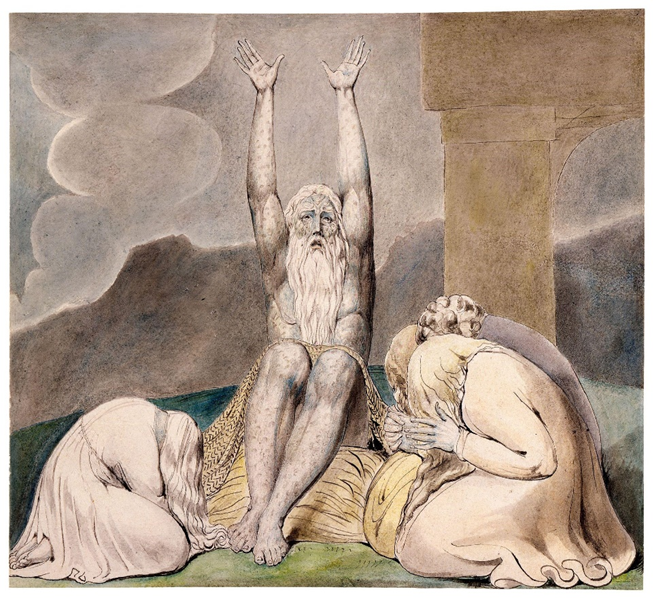
Job’s despair – William Blake

And it was there, among the ashes, that Job gets his first feedback into the horrendous situation that he finds himself and has had no control of:

 His wife said, “Still holding on to your precious integrity, are you? Curse God and be done with it!”

Job’s wife responded with imperatives to her husband: accept the tragic situation, curse God, and accept the fate of death – in effect, “life is not worth living Job”. It should be noted that if Job does what she says, the Challenger’s claim would be proven true: benefits had motivated him all along. But Job tells her that she is out of line:

“You’re talking like an empty-headed fool. We take the good days from God—why not also the bad days?”

The study records that after all that had been inflicted on Job, he remained blameless and said nothing against the Arbiter.

Included in this tale are three cycles of dialogs that Job had with his three friends Eliphaz, Bildad, and Zophar. These three heard of Job’s situation and came to console him. When they saw him, it was written, they sat quietly mourning. They thought Job was on the way out.

Later, after days of silence, they each in turn offer Job their worldly wisdom about his dire state. They believed there was something off about him and his thinking. So, they each try to find fault with Job and they each reaffirm the Retribution Principle in the process.

The Arbiter, they tell Job, protects the righteous and punishes the wicked. Regarding the reason for his suffering, they tell Job that no mortal is righteous and how can mortals understand what the Arbiter demands.

Their advice to Job: put away sin, restore your righteousness, plead your case before the Arbiter, and regain benefits. Notably, their counsel was contrary to Job’s wife’s directive when she told her husband to just be done with the RP and die. The friends, like Job’s wife, do tell Job to accept the tragic situation but they want him to revise his thinking and his life and then he will find that life is worth living through restored benefits.

Job Rebuked by His Friends – William Blake

The three friends counsel was in line with the Challenger’s claim: there’s a symbiotic relationship between piety and prosperity. To defend this principle, they reject any notion of Job’s righteousness. For them, the end game was material reward.

If Job acted in accord to what his three friends said, he would validate the Challenger’s claim. But Job has not been swayed by their words directing him back to benefits. He has shown that his righteousness stands apart from benefits. And so, the three friends are silenced.

Job does question the Arbiter’s justice:

“Does it seem good to you to oppress, to despise the work of your hands and favor the schemes of the wicked?”

In saying his suffering is undeserved, Job claims that what has happened to him cannot be justified by his behavior. He thinks the RP system of justice is broken and the Arbiter is being petty.

The dialog with the three friends ends with them not finding fault with Job’s behavior. Job maintained his innocence all along. He had done nothing wrong and admitted to no wrong doing. And Job does not expect any benefit or reward. He does serve the Arbiter for nothing. As such, he refutes the Challenger’s claim.

In standing by his righteousness, Job believed there was an advocate or mediator (a redeemer) who would show up and vindicate him. This seems to be Job pointing a finger at the Arbiter and wanting the Arbiter to justify his actions to Job. The Arbiter remained silent throughout the dialogs.

After the dialogs, supplemental material is inserted. Someone who has not been involved (an unnamed friend of the heavenly court?) offers poetic insight that speaks to the cosmic issues raised. He provides perspective from territory not explored in the dialogs.

He asks “Where do mortals find wisdom? and “Where does insight hide?” And he answers: “Mortals don’t have a clue, haven’t the slightest idea where to look.”

With what’s been dug up so far in the dialogs, these questions raise issues: what man has found- the Retribution Principle – is this the foundational principle of order in the cosmos? Is justice the foundational principle of the cosmos? If neither is true, then what is?

The supplemental material would have us understand that the foundational principle of the cosmos is wisdom and not justice. And, that the Arbiter alone knows the exact place to find wisdom. For the Arbiter is the only source of wisdom and its only evaluator.

The poem states that the Arbiter, after focusing on wisdom and making sure it was all set and tested and ready, created with wisdom thereby bringing order and coherence to the cosmos. What’s man to do? Totally respect the wisdom of the Arbiter. Insight into that wisdom means shunning evil

After this poetic insert there are three speeches.

Job begins by pining for the past: “Oh, how I long for the good old days, when God took such very good care of me.” The RP was working and things seemed coherent. He was in a good place then and in good standing socially.

“People who knew me spoke well of me; my reputation went ahead of me. I was known for helping people in trouble and standing up for those who were down on their luck.”

But now, Job says, things are not good. His role and status in society has reversed – from honor to dishonor. He’s the butt of jokes in the public square. He’s mistreated, taunted and mocked. And the Arbiter has remained silent. He laments:

“People take one look at me and gasp.
    Contemptuous, they slap me around
    and gang up against me.
And the Arbiter just stands there and lets them do it,
    lets wicked people do what they want with me.
I was contentedly minding my business when the Arbiter beat me up.
    He grabbed me by the neck and threw me around.

For Job, things are incoherent. It’s a dark night for Job’s soul. He feels abandoned, empty, and desolate along with enduring extreme physical agony.

The trauma he is experiencing may have scrambled his senses. He lashes out at the Arbiter:

“I shout for help, you, and get nothing, no answer! I stand to face you in protest, and you give me a blank stare!”

“What did I do to deserve this?” he says. “Haven’t you seen how I have lived and every step I take?”

Job tries to restore coherence with an oath of innocence. He lists forty-two things that he is innocent of and then pleads for a vindication scenario: “Oh, if only someone would give me a hearing! I’m prepared to account for every move I’ve ever made – to anyone and everyone, prince or pauper.”

As things seem to be out of control, Job considers the Arbiter something of a wild card, an unknown or unpredictable factor. He’s being capricious like all the other gods.

After Job speaks, another friend enters the conversation. Elihu, younger than the others, has been waiting and listening to the conversation. He’s somewhat brash in addressing the group. Elihu, in a somewhat superior way, wants Job and the others to know that he is speaking on behalf of the Arbiter.

“Stay with me a little longer. I’ll convince you.
    There’s still more to be said on God’s side.
I learned all this firsthand from the Source;
    everything I know about justice I owe to my Maker himself.”

Elihu is angry with the older three friends. They had condemned Job and yet were stymied because Job wouldn’t budge an inch—wouldn’t admit to an ounce of guilt. And they ran out of arguments. He contends that the wisdom of their many years – the conventional thinking about the self-interest symbiosis and the carrot sticks of the Retribution Principle – did nothing to refute Job.

Elihu presents another accusation angle and it’s not the motivation claim of the Challenger. He starts by repeating Job’s words:

“Here’s what you said.
    I heard you say it with my own ears.
You said, ‘I’m pure—I’ve done nothing wrong.
    Believe me, I’m clean—my conscience is clear.
But the Arbiter keeps picking on me;
    he treats me like I’m his enemy.
He’s thrown me in jail;
    he keeps me under constant surveillance.’”

Job thought that he was being scrutinized way too much by the Arbiter. He was being excessively attentive and petty.

Elihu is angry at Job for justifying himself rather than God. Job, he claims, regards his own righteousness more than the Arbiter’s and is therefore self-righteous and proud. That is why he is suffering. And, his suffering, Elihu claims, may not be for past sins but as a means to reveal things now to keep him from sinning later.

Elihu heard Job questioning the Arbiter’s justice: Job was not happy about a policy where the righteous suffer; something was off with the RP system or its execution. Job thought that the Arbiter could do a better job of things. Job, claims Elihu, doesn’t know what he is talking about and speaks nonsense.

He comes at Job with a defense of the transcendence of the Arbiter.

“The Arbiter is far greater than any human.
So how dare you haul him into court,
    and then complain that he won’t answer your charges?
The Arbiter always answers, one way or another,
    even when people don’t recognize his presence.”

And,

“Take a long, hard look. See how great he is—infinite,
    greater than anything you could ever imagine or figure out!

Against Job’s “senseless” claims, Elihu says that the Arbiter is not accountable to us. The Arbiter is not contingent and not bound to our scrutiny. In a break with the conventional wisdom – the quid pro quo piety-for-prosperity symbiosis with the gods – Elihu says that neither righteousness and wickedness have an effect on the Arbiter.

The Arbiter, he says, “is great in power and justice.” He uses nature to explain:

“It’s the Arbiter who fills clouds with rainwater
    and hurls lightning from them every which way.
He puts them through their paces—first this way, then that—
    commands them to do what he says all over the world.
Whether for discipline or grace or extravagant love,
    he makes sure they make their mark.”

Elihu wants Job to know that no one can out-Arbiter the Arbiter. He poses a theodical reason for Job’s suffering –the Arbiter’s justice. And that is how he tries to introduce coherence to Job’s situation. He thinks justice is the foundational principle of the cosmos.

Elihu’s justice and cosmic order also includes the RP. At one point he tells Job that if people listen and serve the Arbiter, they will complete their days in prosperity and their years in pleasantness.

Finally, from out of a whirlwind, the Arbiter speaks. He remains silent about Job’s oath of innocence.

Starting with “Who is this that darkens counsel by words without knowledge?” the Arbiter asks Job rhetorical questions which reveal the utter lack of understanding of those who thought they knew how the complex cosmos was ordered.

“Where were you when I laid the foundation of the earth?”

“Have you ever in your days commanded the morning light?”

“Where does light live, or where does darkness reside?”

“Can you lead out a constellation in its season?”

Job and friends had reduced cosmic order to be a mechanical system of automatic justice: the Retribution Principle. The Arbiter would have Job know that he and his friends don’t know all the ins and outs of how the cosmos is ordered including why there is suffering. And that he is not to be defined and held accountable by their systems of thought.

After detailing some of the knowledge and intricate design that went into the ordered cosmos, a cosmos that encompasses the yet-to-be ordered, the disordered, and wild things, the Arbiter then corners Job: “Now what do you have to say for yourself? Are you going to haul me, the Mighty One, into court and press charges?” The Arbiter agrees with Eliphaz’s assessment of Job: Job is self-righteous.

Job responds: “I’m speechless, in awe—words fail me. I should never have opened my mouth! I’ve talked too much, way too much. I’m ready to shut up and listen.”

The Arbiter challenges Job: “Do you presume to tell me what I’m doing wrong? Are you calling me a sinner so you can be a saint? Go ahead, show your stuff. Let’s see what you’re made of, what you can do. I’ll gladly step aside and hand things over to you—you can surely save yourself with no help from me!”

To exemplify their differences and respective roles, the Arbiter instructs Job with examples of imaginative creatures seemingly both natural and mythical: Behemoth and Leviathan

Job is compared to Behemoth: “Look at the land beast, Behemoth. I created him as well as you. Grazing on grass, docile as a cow . . .”

Behemoth – William Blake

Behemoth is content and well-fed, strong, first of its kind, cared for, sheltered, not alarmed by turbulence. Behemoth is an example of stability and trust: “And when the river rages, he doesn’t budge, stolid and unperturbed even when the Jordan goes wild.”

The Arbiter is compared to Leviathan, the sea beast with enormous bulk and beautiful shape.

“Who would even dream of piercing that tough skin or putting those jaws into bit and bridle?”

Leviathan can’t be tamed or controlled and should not be challenged or messed with. “There’s nothing on this earth quite like him, not an ounce of fear in that creature!”

The Arbiter has drawn a vast distinction between himself and Job.

Job had been speaking about his own righteousness and God’s justice. Behemoth is not an example of righteousness or of a questioning attitude. Rather, Behemoth is an example of stability amidst turbulence (crisis). Behemoth symbolizes creaturely trust.

Leviathan, not an example of justice, is the image of a rather terrifying creature. There is nothing wilder than the Leviathan. Leviathan cannot be domesticated. It would be utter folly to tangle with such a creature.
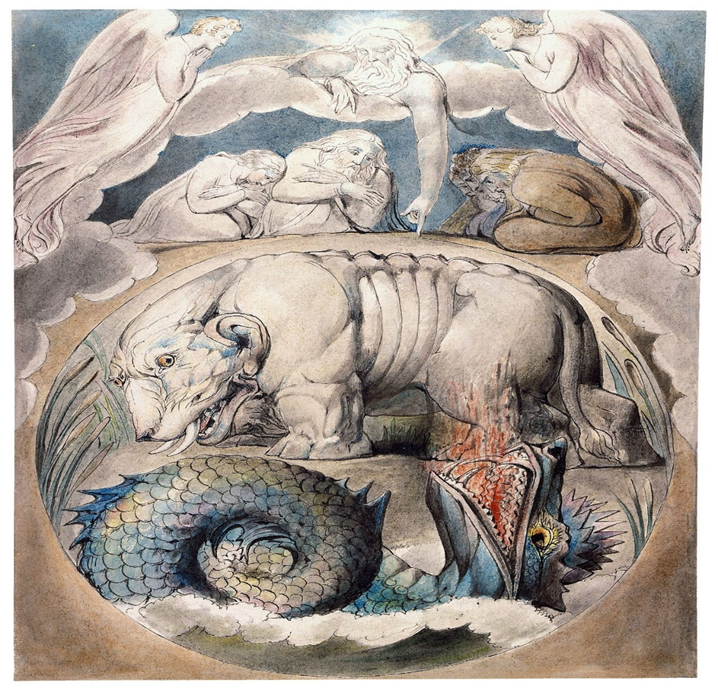
Behemoth and Leviathan – William Blake

After the Arbiter finishes his description of Leviathan, Job answers:

You asked, ‘Who is this muddying the water,
    ignorantly confusing the issue, second-guessing my purposes?’
I admit it. I was the one. I babbled on about things far beyond me,
    made small talk about wonders way over my head.
You told me, ‘Listen, and let me do the talking.
    Let me ask the questions. You give the answers.’
I admit I once lived by rumors of you;
    now I have it all firsthand—from my own eyes and ears!
I’m sorry—forgive me. I’ll never do that again, I promise!
    I’ll never again live on crusts of hearsay, crumbs of rumor.”

The Arbiter accepts Job’s admission that he was both ignorant and wrong about the Arbiter. Job has grown in his understanding: justice is not automatic – good is not rewarded and evil punished mechanically. The Arbiter is not a contingent being. He is not beholden to Job. He is not accountable to Job. Job cannot force the Arbiter to act.

The Arbiter, who heard Elihu say true things about the Arbiter, addresses Eliphaz:

“I’ve had it with you and your two friends. I’m fed up! You haven’t been honest either with me or about me—not the way my friend Job has!”

The Arbiter tells them to go to Job and sacrifice a burnt offering on their own behalf and Job will pray on their behalf – just as Job did for his own children just in case they’d sinned. The Arbiter accepts Job’s prayer.

After Job had interceded for his friends, God restored his fortune—and then doubled it! Job’s later life was blessed by the Arbiter even more than his earlier life. He lived on another 140 years, living to see his children and grandchildren—four generations of them! Then he died—an old man, a full life.

Job’s restoration at the end does not make up for the losses he incurred. The restoration seems to reset the stage for Job to bring the understanding he gained during his suffering to a new generation. He will tell his daughters to have Behemoth-like trust in the Arbiter and not in a mechanical system of justice.

He may even tell them that prayer is not a cause-and-effect mechanism. Prayer is listening to God.

~~~

As we find out, this fictional tale is not an answer as to why there is suffering or benefit, for that matter. The author’s narrative was meant to educate and expand the reader’s understanding of Yahweh in a world where there are things that make people suffer. Its purpose was to challenge conventional thinking about order, justice, and Yahweh.

The narrative asked questions: Is the Retribution Principle (RP) – the righteous will prosper and the wicked will suffer – the foundational principle in the cosmos? And, does anyone serve the Arbiter for nothing?

The first question is answered through two contrasted views of reality: the old-time religion of piety-for-prosperity as order and justice in the cosmos and the Arbiter’s Wisdom as being the foundational principle in the cosmos. The second question is resolved by Job.

He continued to serve the Arbiter (and did not curse him as the Challenger supposed would happen) during his suffering. He did so without expectation of reward thereby rejecting the piety-for-prosperity symbiosis that was thought to exist between the gods and man.

We find out that the Arbiter, not Job, is put on trial. Under great suffering, Job questioned the Arbiter’s policies. He wondered if the Arbiter was petty and unjust.

The Arbiter, with no need to defend himself, corrects Job. For, Job did not begin to understand what’s involved in the mysteries of creation nor about cosmic order and justice. Job and his friends were not the source of Wisdom.

The Arbiter, along with the supplemental “wisdom” poetry, raised Job’s and the reader’s focus on suffering – the “raging waters” – up to great heights – the uncharted territory of creation beyond man’s comprehension where one would find a Leviathan-like being beyond our control.

This brief summary does not begin to extract the wealth of wisdom and understanding found in Dr. John Walton’s study of the book of Job:

Job (The NIV Application Commentary): Walton, John H.: 9780310214427: Amazon.com: Books

Dr. John Walton, Job (30 mini-lectures) – YouTube

How should we understand our world?

Session 25: The World in the Book of Job: Order, Non-order, and Disorder by John Walton from Dr. John Walton, Job (30 mini-lectures) – YouTube

John H. Walton (Ph.D., Hebrew Union College) is professor of Old Testament at Wheaton College. Previously he was professor of Old Testament at Moody Bible Institute in Chicago, Illinois.

Bibliography: Block, Daniel I., ed. Israel: Ancient Kingdom or Late Invention? Nashville: Broadman & Holman, 2008; Longman, Tremper III, and John H. Walton. The Lost World of the Flood: Mythology, Theology, and the Deluge Debate. Downers Grove: InterVarsity, 2018; Walton, John H. Ancient Near Eastern Thought and the Old Testament: Introducing the Conceptual World of the Hebrew Bible. Second edition. Grand Rapids: Baker, 2018; idem. Genesis 1 as Ancient Cosmology. Winona Lake: Eisenbrauns, 2011; idem. Old Testament Theology for Christians: From Ancient Context to Enduring Belief. Downers Grove: InterVarsity, 2017; idem. The Lost World of the Israelite Conquest: Covenant, Retribution, and the Fate of the Canaanites. Downers Grove: InterVarsity, 2017; idem. The Lost World of the Torah: Law as Covenant and Wisdom in Ancient Context. Downers Grove: InterVarsity, 2019.

~~~~~

“The suffering and evil of the world are not due to weakness, oversight, or callousness on God’s part. But rather, are the inescapable costs of a creation allowed to be other than God.” – John Polkinghorne

~~~~~

In light of the severe suffering and trauma that Job is exposed to, some may see the Arbiter’s response as cold and clinical, unfeeling and even autistic. Some in this day and age may hold that feelings and victimhood are core principles for understanding the world and may bad mouth the Arbiter for not being empathetic. Some might assert that his response is not their version of the RP’s justice and order- social justice. They may want an Arbiter to express himself like they do. Finding out that the Arbiter is beyond all reckoning unsettles them.

~~~~~

The Uncertainty Specialist with Sunita Puri

Pain is like a geography—one that isn’t foreign to palliative care physician, Dr. Sunita Puri. Kate and Sunita speak about needing new language for walking the borderlands and how we all might learn to live—and die—with a bit more courage.

In this conversation, Kate Bowler and Sunita discuss:

How to walk with one another through life’s ups and downs—especially health ups and downs

What “palliative care” means (and how it is distinct from hospice)

The difference between what medicine can do and what medicine should do

Sunita’s script for how to talk to patients facing difficult diagnoses

Sunita Puri:The Uncertainty Specialist – Kate Bowler

~~~~~

“Here be dragons” (Latin: hic sunt dracones) means dangerous or unexplored territories

“Here be Dragons” was a phrase frequently used in the 1700s and earlier by cartographers (map makers) on faraway, uncharted corners of the map. It was meant to warn people away from dangerous areas where sea monsters were believed to exist. It’s now used metaphorically to warn people away from unexplored areas or untried actions. There are no actual dragons, but it is still dangerous.

The Psalter world map with dragons at the base:

Fear and Loathing in Ward No 6

“In the hospital yard there stands a small lodge surrounded by a perfect forest of burdocks, nettles, and wild hemp. Its roof is rusty, the chimney is tumbling down, the steps at the front-door are rotting away and overgrown with grass, and there are only traces left of the stucco. The front of the lodge faces the hospital; at the back it looks out into the open country, from which it is separated by the grey hospital fence with nails on it. These nails, with their points upwards, and the fence, and the lodge itself, have that peculiar, desolate, God-forsaken look which is only found in our hospital and prison buildings.”

Ward No. 6., a story by Anton Chekov, opens with this description of an outpost hospital 150 miles from a train station. This provincial hospital with a lunatic asylum annex, worlds apart from “sane” society, is the setting for the reader to examine the disturbing dehumanization taking place in Russia and, perhaps, everywhere else.

Chekhov wrote the story with reformist concerns after he visited a far east penal colony of the Russian Empire – Sakhalin Island.[1] Chekhov’s aim was to survey the prisoners and publicize their conditions. His compiled notes became the book Sakhalin Island.

Chekov, as guide, invites us onto the premises of the provincial hospital and into its mental ward. He would have us understand suffering in the presence of it and not in the abstract. So, he has us listen in on conversations between Dr. Andrei Yefimich Ragin, who is in charge of the hospital and asylum, and inmate Ivan Dmitrich Gromov.

With a phrase similar to Dante’s opening of the Divine Comedy – “abandon all hope, ye who enter here” – Chekhov forewarns us about our entry into Ward No. 6: “If you are not afraid of being stung by nettles, let us go along the narrow path.”

As we follow our tour guide, he shows us the hospital’s neglected and unsanitary conditions and then introduces us to the brutish Nikita, who I consider one of the “nettles”.

“The porter, Nikita, an old soldier wearing rusty good-conduct stripes, is always lying on the litter with a pipe between his teeth. He has a grim, surly, battered-looking face, overhanging eyebrows which give him the expression of a sheep-dog of the steppes, and a red nose; he is short and looks thin and scraggy, but he is of imposing deportment and his fists are vigorous. He belongs to the class of simple-hearted, practical, and dull-witted people, prompt in carrying out orders, who like discipline better than anything in the world, and so are convinced that it is their duty to beat people. He showers blows on the face, on the chest, on the back, on whatever comes first, and is convinced that there would be no order in the place if he did not.”

After walking past the cluttered pitiful state of the entry-way conditions and the fearful porter, we enter the annex.

Here, the “walls are painted dirty blue, the ceiling is as sooty as in a hut without out a chimney . . .The wooden floor is gray and full of splinters.  There is a stench of sour cabbage, smoldering wicks, bugs, and ammonia, and for the first minute this stench gives you the impression of having walked into a menagerie.

“The beds in the room are bolted to the floor. Sitting and lying on them are men in blue hospital dressing gowns, wearing nightcaps in the old style. These are the lunatics.

There are five of them in all.”

Chekhov describes the inmates and then begins to focus on the two protagonists, inmate Ivan Dmitrich Gromov and doctor Andrei Yefimich Ragin. We learn about both from their dialog. As we listen in, we soon begin to wonder who the patient is and who is the doctor.

Early in life Ivan Dmitrich Gromov was severely flogged by his father. His mental state became more unstable with personal misfortunes. Later in life he sees convicts being led away by armed guards. This was not an uncommon sight for Gromov to witness. But this time he reacts with pity and unease and transference. He begins to conceptualize that like the convicts, it is also his lot in life to be clamped in chains and punished for some crime. This inordinate thinking, a persecution complex that becomes a paralyzing fear of some random moment someone will come down on him for something, lands Gromov in Ward No. 6. He tells Dr. Ragin that he has “persecution mania.”

Though he’s an inmate because he’s out of touch with reality, Gromov is very much in touch with the mental anguish caused by his fixation and the physical pain delivered by the blows of Nikita. Ward No. 6 reinforces Gromov’s cycle of fear and pity.

Dr. Andrei Yefimich Ragin, on the other hand, is not in touch with the human condition. Passive and cynical, he is unable to bring reforms to the hospital.

In conversations with Gromov, Ragin justifies his indifference to others’ plight by suggesting that everything is subject to chance. For instance, he posits that there is no difference between wearing a doctor’s smock and an inmate’s smock.

To further justify his coolness to the human condition he references Ecclesiastes – “it is all futile, senseless” – and quotes Marcus Aurelius: “Pain is just the idea of pain: make an effort of will to change that idea, reject it, cease to complain, and the pain will disappear.” The inner self should dictate one’s experience according to Ragin.[2]

The doctor’s inner self has him ignoring the unsanitary and detrimental conditions of Ward No. 6 and the plight of his patients. Dr. Ragin “knows such surroundings are torture to feverish, consumptive, and impressionable patients, but what can be done?” His stoic outlook of mind over matter is, in practice, one of heartless neglect toward others.

He increases suffering, instead of relieving it, by remaining aloof and disconnected from it. He has intellectualized reality to justify his inaction and seeks further intellectualization to relieve him of his post’s boredom and purposelessness.

Adding to the doctor’s disinterest is what our guide tells us: “probably in no other place is life so monotonous as in this annex.” As one day is no different than another in this outpost hospital, Dr. Ragin becomes disenchanted with his doctor routine.

When he first came to the hospital, Dr. Ragin “worked very diligently. He saw patients every morning till dinnertime, performed operations, and even practiced obstetrics. . ..  But in the course of time the work unmistakably wearied him by its monotony and obvious uselessness.”

The doctor extrapolates from his daily routine and reasons “why interfere with people dying if death is the normal and prescribed end for everyone?” and “If the aim of medicine is to utilize drugs to alleviate suffering, the question necessarily arises: why alleviate it?” With similar thoughts, he reasons away the need for himself to be involved in the lives of suffering people. Why should anyone be spared pain when “their lives have nothing of importance in them and would be entirely empty, like the life of an amoeba, were it not for suffering?

“Oppressed by such reflections, Andrey Yefimich let things go and gave up going to the hospital every day.”

To avoid the messy, tedious, and nonsensical reality around him, Dr. Ragin leaves work early and goes home to his books and beer. He withdraws from the physical world to seek mental stimulation. As he reads he is wowed by recent medical discoveries and yet makes not one application to his own hospital. He blames society for the mess he has to deal with.

Evenings consist of conversations with his postmaster friend Mikhail, the only one in town who doesn’t bore the doctor. (Is Ragin more Epicurean in practice than Stoic?)

This routine changes when one day Dr. Ragin follows an inmate, the Jew Moiseika, returning to the annex from his daily wandering in the town. The doctor notices that Moiseika is walking around with bare feet in the winter. Inside, he tells Nikita to give Moiseika some boots for the cold weather. Dr. Ragin, we learn, is not unaware of what’s around him.

From his bed Gromov hears the doctor’s voice, jumps up and reacts with loud vitriol at his presence. The doctor goes in to see who is making the fuss about him. After Gromov calms down, the two begin a dialog that Dr. Ragin finds pleasurable: “What an agreeable young man!” The doctor, breaking with routine, visits Gromov again the next day.

The doctor encounters Gromov lying in bed holding his head in terrible pain. Gromov is suffering with a splitting headache. He reasoned over and over again since the day before that Dr. Ragin was a “spy or doctor who has been charged to test me – it’s all the same -.” Gromov’s persecution mania was triggered.

Dr. Ragin responds, reasoning that if true and Gromov is arrested and sent to prison then he is no worse off being right where he is. This response frees Gromov up a bit and the two have a bit of relaxed conversation. Gromov wishes to be in a better place – outside in “the country somewhere” and “to have a decent doctor to cure one’s headache.”

“It’s so long since I have lived like a human being. It’s vile here. Insufferably vile!”

The doctor responds, not with an antidote for Ivan’s headache, not with a ride in the country, but with a philosophical take on how to think about things – with simple equivalency.

“There’s no difference between a warm and comfortable study and this ward” and “Peace and contentment do not lie outside a man, but within him.”

Gromov questions this. The doctor continues.

“The ordinary man expects the good and the bad from external things – from an open carriage and a study – but a thinking man derives them from within himself.”

Gromov rejects the doctor’s philosophical reasoning. The doctor responds, telling Gromov that “One must strive for the comprehension of life, and therein lies true happiness.”

Gromov understands nothing of what the doctor has been saying and inferring: Comprehension? External, internal? Life is just a mental exercise, a thought experiment, detached from the tragic dimension of human existence? Gromov gets up, looks angrily at the doctor and speaks:

“I only know that God has created me of warm blood and nerves, yes, indeed! If organic tissue is capable of life it must react to every irritant. And I do react! I respond to pain with tears and outcries, to baseness with indignation, to filth with loathing. To my mind, that is precisely what is called life.  . . . How is it that you don’t know that?”

Gromov continues, commenting perceptively about the Stoics. He then asks why Dr. Ragin why he preaches Stoicism. “Are you a sage? A philosopher?” The doctor responds “No …. but everyone ought to preach it because it is reasonable.”

Gromov, the inmate, then wants to know how the doctor considers himself to be “competent to judge comprehension and contempt for suffering”.

“Have you ever suffered? Have you any idea of what suffering is? Allow me to ask you, were you ever thrashed as a child?”

“No, responds the doctor, “my parents had an aversion to corporal punishment?”

Gromov tells the doctor that his own father, “a harsh, hemorrhoidal government clerk with along nose and a yellow neck” flogged him cruelly. Sizing the doctor up, Gromov then proceeds with his analysis of the doctor, excoriating his competency to understand anything about Gromov’s life or life itself.

“No one has laid a finger on you all your life, no one has terrorized you nor beaten you; you are as strong as an ox. . .. You are by nature a lazy, flaccid man, and so you have tried to arrange your life in such a way that nothing should disturb you or force you to budge.”

I’ll stop here and leave you with Gromov’s cri de coeur and Dr. Ragin’s inability to come to terms with suffering. Even when the doctor does act to relieve suffering, he thinks that he will be paid back for his trouble. He lends his postmaster friend money after his friend suffers gambling loses. But the doctor is never repaid and soon becomes destitute. It appears from all that happens to the doctor as the story unfolds, that the doctor’s friends and associates also hold to “It’s all the same” thinking.

This story is rich with insight and worth a read. And though one may not be interested in reading a story in a Russian setting, consider that cultures change but human nature doesn’t change much from place to place or age to age.

“It’s all the same!”, first spoken by Gromov when he encounters Dr. Ragin (“a spy or a doctor”) is oft repeated and inferred by Dr. Ragin as he explains his philosophy to Gromov. You’ll have to read the story to see how the doctor’s “It’s all the same” philosophy works out. He holds on to it to the end of the story.

““Ward Six” is affective and effective largely because Chekhov makes proper, judicious, and artistic use of the very faculty that is impaired in his two heroes, Gromov and Ragin, the faculty for contemplating similarities. Their respective disorders, which are two extremes of the same continuum, prevent them from experiencing fear and pity in a healthy, moderate, cathartic fashion.”[3]

As you read Ward No. 6, ask yourself these questions:

Is “society” at fault and therefore responsible for the ills and disorder of society or are individuals responsible?

If one assigns “society” as the cause for “systemic” failures, is the individual therefore absolved of any personal responsibility?

Is detachment from reality a sign of mental illness?

Do you spend your time in the laboratory of thought and have never played baseball or wrestled with another human being?

Does lying to oneself promote mental health?

Is it healthy to be being disconnected from physical reality via drugs or the TV and the internet – supposed mental stimulants that will lessen our boredom?

“It’s all the same!”:  Is that a motto for your life? How has that worked out for you?

If we say chance or fate determines things, do we give up believing we can make a difference?

Do false equivalencies, such as occur in Ward No. 6 and that also operate in our culture, lead to mental illness?

A momentary transposition of one’s reality into another through imagination is healthy.  Day dreaming is healthy. But what about the permeant transpositions into unreality that is occurring around us today?

Have you ever asked God to heal your imagination?

(As mentioned before, Chekhov is my favorite writer. His stories (and plays) show rather than tell. Chekhov doesn’t moralize or preach. As with Ward No. 6, he lets readers see and hear for themselves and make their own judgements. I appreciate this way of writing. For one thing, I am not a fan of preaching. I had my fill growing up. I attended churches where preaching, and not the Eucharist, is the pinnacle of the service. I’ve moved on to an Anglican church.)


[1] Chekhov spent three months at Sakhalin Island interviewing thousands of convicts and settlers under the ruse of taking a census. For more details of his trip see Anton Chekhov and the Sakhalin Penal Colony – Hektoen International (hekint.org).

[2] When Chekhov wrote Ward No. 6, he was reading Marcus Aurelius’ Meditations. A couple of quotes from that journal apply to Dr. Ragin’s disposition: “Our life is what our thoughts make it.”; “You have power over your mind – not outside events. Realize this, and you will find strength.”

[3] Liza Knapp, “The Suffering of Others: Fear and Pity in “Ward Six,” in Anton Chekhov’s Selected Stories, ed. Cathy Popkin (W.W. Norton & Company, Inc., 2014), 629

*****

Audio: Ward No. 6 : Anton Chekhov : Free Download, Borrow, and Streaming : Internet Archive

*****

“We need everyone who suffers to be a victim because only thus can we maintain our pretense to universal understanding and experience the warm glow of our own compassion, so akin to the warmth that a strong, stiff drink imparts in the cold.”

“Psychology is not a key to self-understanding, but a cultural barrier to such understanding as we can achieve…” from the Preface of Admirable Evasions, How Psychology Undermines Morality by Theodore Dalrymple, 2015.

Theodore Dalyrymple is a pen name used by retired prison psychiatrist Dr. Anthony Daniels.

Admirable Evasions: How Psychology Undermines Morality by Theodore Dalrymple | Goodreads

*****

Dr. Ragin – “superfluous man”

“The name ‘superfluous man’ refers to an important and recurrent character type in 19th c. Russian literature. It denotes an idealistic but inactive hero who is aware of and sensitive to moral and social problems but who does not take action; in part because of personal weakness and lassitude, in part because of social and political restraints to freedom of action.”

A short note on the term ‘superfluous man’ and its examples – Literary Ocean

– “usually an aristocrat, intelligent, well-educated, and informed by idealism and goodwill but incapable, for reasons as complex as Hamlet’s, of engaging in effective action. Although he is aware of the stupidity and injustice surrounding him, he remains a bystander.”

Superfluous man | literature | Britannica

*****

Killing “Certificate of Need” Laws

“This episode of Health Care News focuses on the recent repeal of the Certificate of Need and financial credentialing in the healthcare industry . . .  and how it will enhance competition in the healthcare market, ultimately leading to reduced prices.”

Killing “Certificate of Need” Laws (Guest: Marcello Hochman, M.D.) – The Heartland Institute

*****

*****

World Economic Forum’s Ward No. 6:

The World Economic Forum has declared that by 2030 fashion will become completely obsolete and all humans will be vegan, whether they like it or not.

12ft | WEF Says Fashion Will Be Abolished by 2030: “Humans Will All Wear a Uniform”

Informed Dissent:

God help us . . .

The World Health Organization and its partner organization, the Bill Gates-controlled GAVI, announced Wednesday that they will be flooding Africa with 18 million doses of malaria vaccines.

WHO & Gates Inc announce plans to flood Africa with ultra dangerous malaria “vaccines” (dossier.today)

“More pandemics are coming” – bioweapons expert Dr Francis Boyle (biznews.com)

Ozempic, Hormone Mimicking Drugs & Their Side Effects (rumble.com)

Lancet Study on Covid Vaccine Autopsies Finds 74% Were Caused by Vaccine – Study is Removed Within 24 Hours – The Daily Sceptic

U.N. To Seize Global ‘Emergency’ Powers With Biden’s Support (thefederalist.com)

‘What Is the Sin Committed by Christians?’: The Persecution of Christians, May 2023 :: Gatestone Institute

“. . . multiple federal laws were broken to change the recording metrics for COVID-19-deaths. There is also evidence of multiple acts of what appears to be willful misconduct by the Centers for Disease Control (CDC), Food and Drug Administration (FDA) and other agencies throughout the COVID-19 crisis.”

Call to Action>>>>

Sign The Petition To Investigate The CDC! (standforhealthfreedom.com)

The Biden Crime family:

‘Missing’ Biden corruption case witness Dr. Gal Luft details allegations against president’s family – YouTube

New video suggests Jill Biden knows exactly what is going on in her family… – Revolver News

Electronic message from Hunter Biden demanded payment from Chinese businessman: ‘I am sitting here with my father’ – NaturalNews.com

Climate Alarmism vs. Climate Reality:

Greenpeace Founder: Anti-Carbon Dioxide Agenda Is a Hoax – Slay News

2015 Annual GWPF Lecture – Patrick Moore – Should We Celebrate Carbon Dioxide? – YouTube

Baseball-Sized Hail Smashing Into Panels At 150 MPH Destroys Scottsbluff Solar Farm | Your Wyoming News Source (cowboystatedaily.com)

Obamas complained about being black and oppressed from luxury yacht in Greek islands – Disclose.tv

Coming to America – as a result of open borders:

A group of young musicians who hail from homeschooling backgrounds have crossed states and blended musical styles to form a unique band with a mission: to keep the classics alive.

Listen To Our New Single! (ffm.to)

L-O-V-E – YouTube

Man Caught Drinking Bud Light Insists He’s Not Gay – YouTube

Lent in the Time of Coronavirus

“I’m telling you a solemn truth: unless a grain of wheat falls into the earth and dies, it remains all by itself. If it dies, though, it will produce lots of fruit. If you love your life, you’ll lose it. If you hate your life in this world, you’ll keep it for the life of the coming age.” -the gospel according to John, 12: 24-25

These words of Jesus were in response to Andrew and Philip. They came to Jesus saying that some Greeks would like to meet him. It seems to be a strange response for a simple request. But Jesus, noting that the “world” was coming to him for answers and for salvation, speaks of his coming death and the means to a resurrected life by following the same vocation. His words define the essence of Lent.

From the earliest days of the church, times of self-examination and self-denial have been observed. The origin of this practice may have been for the preparation of new Christians for Baptism and a reset of their lives. 2020 and the Lenten season is upon us and with it the government recommended “Stay in Place” until April 30th. Easter (April 12th), resurrection day, is the celebratory end of Lent and a restart to new life dependent on what takes place during Lent.

In the midst of the coronavirus pandemic, there is a worldwide intense focus on physical and financial well-being, As we each hunker down and remain sequestered away from the coronavirus, anxiety is compounded: we want to know if we’ll be OK; we want to know where all of this is going and how it will end. The Greeks who wanted to meet Jesus and first-century Jews with their age-old anticipation for a Messiah to set the world to rights had similar concerns.

It is said that Luke, writer of a gospel account and the Acts of the Apostles, was a Greek physician. This being the case, he would testify, if present today, to the infirmities leading to vast numbers of death in the first century. He would recount that there were all manner of infectious diseases, smallpox, parasitic infections, malaria, anthrax, pneumonia, tuberculosis, polio, skin diseases including leprosy, head lice and scabies and, more. Dr. Luke would be the first to tell you that first-century remedies were ineffectual against the afflictions mentioned.

Paul, the apostle to the Gentiles, would tell us how Stoic and Epicurean philosophers dealt with grim reality surrounding them.

The Stoics, around the same time as Epicurus, posited a grim fatalist outlook. Considering themselves cogs in life’s machinery, their response was to lead a virtuous life in spite of “it all”. Materialism and passions were of no interest to them. “No Fear” and apathy towards life’s randomness were the attitudes they wore on their shoulder to appear non-self-pitying. They also advocated for suicide -the ultimate form of self-pity.

The philosophy of Epicureanism, posited by the Greek philosopher Epicurus (341-270 BC) a few centuries before the birth of Christ, offered mankind self-pity with license. Per Epicurus, there was no God or the gods were uninvolved with men. And, for him, there was no life after death. So, mankind had to make the best of the atoms he was dealt. Man was to do so by avoiding pain and seeking pleasure in the company of like-minded friends. Self-pity could be dealt with in intimate and safe surroundings.

Around the first century Epicureanism and Stoicism were evident in Greek, Roman and Pagan life. These philosophies gave words to what was inherent in man from his days in the Garden – a narrative of mis-trust in God. During the first century these philosophies were already fused with pantheism and the zeal to worship pagan deities.

To seek relief, paganism, an early form of Progressivism, enjoined pagans to offer the distant gods sacrifices to secure their well-being. Israel, called to be the people of God, chose to lament – asking God to respond to dire circumstances according to revealed His nature. Many of the Psalms are worship-infused petitions invoking remembrances of God’s ability to save and vows to praise Him as he does so again.

Psalm 13

How long, O Lord? Will you forget me forever?
    How long will you hide your face from me?
 How long must I take counsel in my soul
    and have sorrow in my heart all the day?
How long shall my enemy be exalted over me?

Consider and answer me, O Lord my God;
    light up my eyes, lest I sleep the sleep of death,
 lest my enemy say, “I have prevailed over him,”
    lest my foes rejoice because I am shaken.

 But I have trusted in your steadfast love;
    my heart shall rejoice in your salvation.
I will sing to the Lord,
    because he has dealt bountifully with me

In the news reports we hear “unprecedented” many times over. Yet, this pandemic is no Black Swan event. History records pandemics, plagues, earthquakes, famines and, all manner of tragedies affecting mankind. In my previous post I mentioned weathering last century’s Asian flu pandemic. And though our response to the current pandemic is “unprecedented” mankind will continue to suffer from unexpected devastating events. Mankind will continue to ask, as did the psalmist (Psalm 22), “My God, my God, why have you forsaken me? Why are you so far from saving me, so far from my cries of anguish?” We read above that the psalmist has put his trust in God’s unfailing love. He awaits God’s salvation knowing that God has acted to save a remnant of the faithful before.

Lent, this Lent in particular, is a time to lament. We want to know if we’ll be OK; we want to know where all of this is going and how it will end. Asking God to consider the dire circumstances and to answer according to his nature, is a conversation to foster during Lent. It is a time to consider that there is an advocate – the Word Incarnate – who pleads for us before the throne of God. He does so with ‘real-world’ experience.

The Son of God entered the unsanitary disease-filled world described above. He is fully aware of the pain, suffering and groaning of his creation and of man’s philosophies, with its grains of thought which produce no fruit. He did not come to give us social justice platitudes. He did not come to create a Progressive party and overthrow the establishment. If, as God-man, he had not made the sacrifice to redeem his creation, then he would have “remained alone” as a philosopher with platitudes. He came instead, as he stated to Andrew and Philip, to be a grain of wheat that falls into the earth and dies in order to bring forth much fruit in his creation.

Per Jesus’ example, Lent is a time to become a grain of wheat that falls into the earth and dies, dies to the flesh on the world’s self-preservation life-support. It is a time to cultivate healthy spiritual habits, habits that produce the fruits that Jesus spoke about when his time of sacrifice was approaching.

As a season for Christians to mark time and to “Stay in Place”, apart for a time from the world’s pervasive influence, Lent is a time for Christians to hunker down, revise routines, and to focus on what matters. It is a time of reflection, repentance and, renewal. It is a time for fasting, growth and, a return to silence and simplicity.

As we do so, we may find that the silver lining we had purchased in the moment, in the midst of dark days of stress and difficulty, was in exchange for thirty pieces of silver. We may learn that the investments we have made – time-wise, financially and morally – are insufficient to carry us forward. We may find that we have greatly leveraged ourselves to control larger and larger positions in life, positions that are more than we can handle. We may have done so to gain acceptance and security from the world. But now there are margin calls we are unable to pay. This may cause us to look to for more security from the world or to God. During this time, we may also learn that our God-given discernment has been used to criticize others and their “sins” and not for intercession on behalf of them.

In the midst of the coronavirus pandemic ‘exile’, we may be wishing “If only someone would push RESET and we could get on with our lives as before”. A RESET button has been pushed. Jesus of Nazareth, very God of very God and the Word made flesh, came into the world to reset all narratives, including the historical Judaic narrative, by keeping his covenant promises. The epigraph, words to both Greeks and Jews, tells us how.

The resurrection of Jesus is the greatest RESET and the only one that really matters. With it, the power of death had been defeated. Remember Jesus telling Martha at the time of Lazarus’s death, “I am the resurrection and the life. And anyone who believes in me will live, even if they die.” (John 11: 25-26) Yes, Jesus wept at the overwhelming sorrow caused by Lazarus’ death. But he knew that he would overcome death and that there would be rejoicing in the new-life fruit his death and resurrection would produce.

Lent in the Time of the Coronavirus is a time for Christians to plant the grain-of-wheat RESET and to be ready to go on with their lives as never before.

The Letters


September, 2019

My Dear Agnus,

I may be among the last of those who write letters. Handwriting is personal and so I hope my words will be received not as the words of a deacon, but as your brother.

The last time I saw you Agnus, at the funeral for Nicholas, I perceived bitterness behind your grief as we spoke that day. You asked “Where is God in all of this?”

The tragedy that took your son was compounded by his claiming to be an atheist before his death. Together, these events must have caused you considerable anguish.

What succor can any observer give to the one who has suffered such a loss and heartbreak? What comparison of those who have also suffered loss can one make to lessen your grief when your sorrow and pain are profoundly yours, and yours alone? And, imagine, what support a spouse gives to her husband who has suffered profound losses when she says to him that he is better off dead?

Job’s wife, knowing where God ‘was’ in all that had happened, ‘comforted’ her boil-encrusted ash heap-seated husband with “Curse God and die!” In effect she said “Why maintain your notions of God and your devotion to Him when He does this to you?”

Job, also knowing where God ‘was’ in all that he suffered, responded to the “foolish” words with his own reckoning of the situation: “Should we accept from God only good and not adversity?” I wonder at the reckoning of Job, after suffering devasting losses: “the LORD gave, and the LORD hath taken away; blessed be the name of the LORD.” Job wasn’t putting a positive spin on his situation. Rather, he was letting God be God.

And what of value are clichés like “time heals all wounds”? The wounds may heal, but the scars remain, as they do for our Lord and Savior. Pain, loss and suffering make their marks, as you well know.

As I write this I have before me the photograph of you and Nicholas at his fourteenth birthday. What joy and promise I see in both of your eyes. How will you remember him on his eighteenth birthday this Saturday?

Do you blame yourself for Nicholas saying he became an atheist? Don’t. I have mentored many such young men. Approaching adulthood, they are dynamic. They believe they know all they need to know and what they don’t know you can’t tell them. They begin to reject familial authority and the fixed rules and identity imposed on them. They will chose a path opposite of what they know. When they receive a driver’s license or go off to college, they believe they can drive off without limits.

Your Nicholas didn’t have time to harden his heart against God. Had he gone on to the university he may have begun to harden his heart, as immature Christian faith is often weaned on the religion of ideology.

The picture I have in my mind as I mentor these young men: they are like the lost wandering sheep that the Shepherd goes looking for. You committed Nicholas to the Good Shepherd as an infant. When he declared himself to be an atheist, the Good Shepherd went looking for him asking “Where are you Nicholas?” The Good Shepherd did not give up on him.

Most likely Nicholas, not yet understanding the nature of God, saw something in the nature of life. The world offers many shiny objects to lure a young man away from the fold.

Be assured, Agnus, that you are continually in my thoughts and prayers. Help me to see through your eyes.

Love,

Tom


September 2019

Dear Tom,

Forgive my email reply. My stationery, which I used to thank those who gave flowers in remembrance of Nicholas, has run out except for a mismatched envelope.

Thank you for writing. This past year have been a blur. The loss of my only child and the loss of my marriage the year before has drained life out of me and filled me with wormwood and gall. That is what my new friend Ann calls it.

I saw Nicholas change after the divorce. He became moody and distant. It didn’t help that Bill and I often fought the months before we separated. I was crushed when Nicholas asked both of us “Where is God in all of this?”

I will remember Nick’s birthday with a few friends. They are folk from the church I now attend. They are giving me a memorial tree to plant in my yard.

Agnus


October, 2019

Dear Agnus,

A memorial tree is a symbolic and an enduring way to remember Nicholas. What kind of tree did you plant?

You mentioned in your last email that Nicholas was affected by what was going on in his homelife. Changing aspects at home would intensify the growing dynamics in his young life. It would spur him to look elsewhere for greener pastures. But the Good Shepherd knows his sheep and cares for them wherever they run off to.

All that has happened has changed you, as well. Our sister tells me that you are now attending a Universalist Church. This concerns me, as I know of their pluralist beliefs.

How is your health? I worry about you.

Love,

Tom


October, 2019

Dear Tom,

I planted a redbud tree in my front yard. I can see it from my chair by the window. My friends from church helped me plant it. They say it will produce rose-colored flowers.

You mentioned the church I now attend. At the church I attended for many years, the one where Nicholas was baptized as an infant, after the divorce no ever one ever invited Nicholas and me over for a meal. I felt judged, unclean and worthless because of a failed marriage. I felt isolated, like I didn’t exist. I felt like a leper.

There was one old woman at that church, I won’t mention her name, who rankled me. She had the gall to imply that what happened to Nicholas was a judgment for my divorce. “These things happen for a reason” is what she said. Why on God’s green earth would someone say this? At that point I had had enough of that can of wormwood. I wasn’t about to lose my sanity and so I looked elsewhere.

Nicholas refused to go to church. He was spending time with his father who also didn’t attend church. Bill said that he has more fellowship on a golf course on Sunday mornings than in church. I don’t even know what fellowship means at this point. My old church had become a valued-members only country club of sorts.

I met the folks from the new church at a rummage sale. They invited me over for coffee. So, I took my baggage and started going to their church.

My health? I don’t sleep. I wake up from dreams so real I begin to cry. I see the old woman and Nicholas standing at the end of my bed. They are turned away and Bill is walking away.

Food and a glass of wine and a few new friends are my only comforts.

Agnus


November, 2019

Dear Agnus,

I understand your reaction and your desire to walk away. That woman had no business saying those things. The church, where the lost and lonely and broken should find hope and fellowship and healing, is often the place where the most rejection and hurt is incurred. There are, as you may have encountered, broken people who believe they know the mind of God and can diagnose other’s lives through their own distorted lens. I am reminded of Job’s friends and their counsel.

Now, it may be that this woman had also experienced loss or hardship or heartache and assumed that God was chastening her and that became her frame of reference to project onto others. It may be that, like many in the church, she gets involved with people only viscerally and never enters into a deeper relationship with them. There are those who are not solicitous about a person’s spiritual and emotional well-being as it would involve having to get involved. I don’t want to project any of this onto her or impugn her character, as I only know of her. I don’t know her. One cannot know the mind or intentions of another or the mind of Christ, for that matter, unless they are intimately acquainted with the person. Still, that woman had no business saying those things.

I think many see the church not as a Mash unit where the wounded are cared for and nursed back to wholeness. Rather, they see it as a soapbox for their views. Years ago I left a church where the congregation voted on church matters. That was a nightmare. Many who voted had already converted their political commitments into moral principles. As such, they had become conduits of the world and not of the Holy Spirit.

My main concern is you. How are you holding up? I am glad you found some folks who invited you in. I hope this letter finds you well and in better spirits.

Love,

Tom


November 2019

Tom,

I received your letter. The church isn’t all it’s cracked up to be and neither am I for that matter. Maybe the old woman just woke up on the wrong side of the bed that day. I know I did.

These days all my focus has narrowed to getting by day to day. I try to make sense of it all. It seems life is one of those patternless crossword puzzles in the newspaper. There are clues and no structure or a place to start. There are answers that connect at one point but after I work on it the puzzle ends up being a disconnected mismatched jumble. And the solution is a Want Ad.

Now that Christmas is approaching and I will be without Nick, I have a question for you Deacon. Why would God send his son into the world when he knew that his son would brutally die? That is a world of hurt that I know all too well. Why all the suffering? What does it accomplish?

I may get around to buying stationery someday. Right now, email is what I can handle.

Agnus


November 2019

Dear Agnus,

I can relate to the crossword puzzle example you gave. More than once I have a puzzle almost completed but there are a few clues that confound me. I have to search to find the word suggested.

You ask a deep theological question that is much like the patternless puzzle. Both begin on a template as a mystery that bids the partaker to search for answers, as you are doing. Mysteries cannot and should not be assessed on their face and be rejected outright as too difficult or pointless.

I have long wondered why Jesus didn’t just come down to earth and feed everyone and heal everyone and keep people from suffering and death. Why did he have to suffer to make things right for the world and then allow suffering to continue?

I have been reading Russian authors for a while now – Chekov, Dostoevsky, Tolstoy and Solzhenitsyn. What I like about these Russian authors is that they were not afraid to pose deep questions in their works. The things of the spirit were of great importance to them. Their writings depict the torment of the Russian soul especially as it is affected by suffering and loss and evil.

My favorite is Chekov. His writings depict the prosaic side of Russian life and the hopelessness pervasive in the lives of his characters. His stories are not of the Hallmark/Disney sentimentalist twaddle so popular today. He writes the about the way life is without moralizing.

Here, as an example of their writings, I will quote Ivan, one of the brothers in Dostoevsky’s The Brothers Karamazov:

“And if the suffering of children goes to make up the sum of suffering needed to buy truth, then I assert beforehand that the whole of truth is not worth such a price.” (5.4.21)

Ivan Karamazov, a deep thinker, poses suffering as a theological problem: if sweet innocent children suffer, how can there be a just God? With this conundrum he reveals what is behind Russian nihilism and atheism he sees all around him – sentimentality and a false sense of sympathy for mankind.

The Russian nihilists and atheists he speaks of see children suffering, so they assume that if there is a God that he is unjust and not worth their time. They walk away from God bearing a hatred towards Him and his divine purpose for life. They take on a false moralism which denies all values including the sacred. They will hold an abstracted God accountable but not themselves. They will not stomach the tears of children nor will they stomach the sacrifice required of them to alleviate the tears in this world. In fact, as history shows, they go on to sanction Progressivist revolutions that create untold sufferings and tears.

Have I answered your questions? No. Not yet. I am relating that the patternless puzzle, the mystery, has troubled mankind since the days of Job. The Psalmists and the wisdom literature authors in Scripture reflect on the meaning of life amidst suffering and hardship and loss. These writings offer clues that suffering can be redemptive as they turn to God for healing and justice instead of indicting him. Maybe the old woman spoke from this perspective.

Each individual puzzle, yours included, can be redemptive as one seeks the Source for answers. The church should be a resource of redemption, of grace and a healing balm. But it is often the resource of sentimentality and a false sense of sympathy for mankind as I mentioned above. There are those in the church who see themselves as prophets, as arbiters of who is right and who is wrong and of the mind of God, like Job’s friends. They think they have the answers to the patternless puzzle.

I’ll briefly mention that along with the problem of suffering there is also the problem of evil. Of the Christian view you are already aware. Jesus suffered death on the cross to defeat evil. His resurrection means new creation. That sin and evil continue is a matter of human’s free will. That suffering continues, Jesus’ resurrection tells us that things are not as they seem – that suffering can be redemptive and that death can be overturned so that new creation can take place. The return of Jesus is when he will put things to right.

I’ll just mention a non-Christian view.

An atheist will revere cause and effect science as the tree of life, as the impersonal source of life. This ‘relieves’ them of accountability. Yet, as mentioned above, the atheist will not see human agency as the mechanism behind the cause and effects of evil. Rather they see themselves as the tormented and not as the tormentors. This is more to say on this subject but would be of no comfort for you now.

How are you spending Christmas? Will you be alone? If so, I will come out. Let me know right away so that I can book a flight. I should have asked sooner.

For your sleep I recommend exercise. It will alleviate your mood and help you sleep at night.

Love,

Tom


December 2019

Tom,

I received your letter and your Christmas card. The card is beautiful. Thank you.

Of the things you wrote, that whole ball of wax, I can barely take it in. The church has been both a blessing and a bane to me. Now I see myself as part of the bane. My focus has been on myself and words spoken and not spoken to me.

You and I were raised in a church with petty rules. No dancing, no movies, no talking in church. Remember the sign that hung over the choir loft? Be still and know that I am God. How can anyone be still when so much suffering is going on?

Later I attended a free church where I thought I would be free from judgment. I think it is called grace. No way. I traded the Be Still church for the Shut Up about your problems put on a smiley face and carry on church. I came home depressed and crying so I went elsewhere. I told you about my last church. My last straw is the church I attend now. They accept anyone and anything. They teach universal reconciliation – that all humans will eventually be saved. I want to believe this for Nicholas’ sake but I can’t. Why wasn’t everyone saved and suffering stopped right after Jesus died on the cross? Why is there still evil and trouble in the world. It seems that people must still make a choice to be saved or not. You mentioned free will. It seems that universal salvation would mean that there is no difference between good and evil. Alls well that ends well, I guess is what they think.

They also teach about finding yourself within yourself. I found enough in myself I don’t like. If God thinks like me and the rest of these people, we’re all in trouble. Your letters got me thinking about all this.

Anyway, I sit by the window looking at the memorial tree covered in snow and wonder when the redemption part kicks in. I sit here with this feeling of something gushing up inside me like a flare was set off inside me and I can’t contain it. What could this be?

The church does give me the chance to work at a local homeless shelter. I brought in some of Nicholas’ clothes. I was so happy when I saw a boy wearing the shirt I bought for Nicholas.

Rose said that she is coming out for Christmas. She is bringing her kids. That will be a blessing. There will be noise and life in my home again. I will have to clean the house. This is no vale of roses.

How are you spending Christmas?

Agnus


December 2019

Dear Agnus.

Your email was a great encouragement to me. My concerns for you have greatly diminished. I don’t see you being taken in by your church’s pluralism. As you have stated, the church accepts anyone and everything. It teaches all religions as emanating from a divine origin and therefore all religions are true and therefore worthy of toleration and respect and considered on equal footing. As such, the church synthesizes universal principles of many religions to form a universal truth. The church wants to be known for being inclusive. You will encounter all manner of false teaching to make inclusion and toleration possible.

The Universalist church will teach about God and Jesus and immortality and, as you mentioned, that things will work out at the end, that no one will suffer eternal torment. The church implies with their teaching that evil and sin make people victims and therefore no one should have to suffer eternal punishment. Their teaching questions how the redeemed can enjoy heaven while even one soul suffers in hell. The sympathy card is played.

The Universalists are like the prodigal son’s older brother. He deems himself on higher moral ground than his father as he witnesses his brother repenting and returning to their father of his own volition. He believes he deserves the sympathy of his father for just being himself.

Like the atheists I have mentioned in a previous letter, the Universalists have taken on sentimentality and a false sense of sympathy for mankind and imbue it with false moralism and cheap grace. They do not let God be God. Rather, they let a god of their own making, as synthesized from the world’s religions, be their graven image.

But there will be no synthesis of good and evil. There will be no marriage of heaven and hell. In fact, there will be The Great Divorce. If you get a chance, read C. S. Lewis’ book by the same name. As Lewis depicts, the choices we make take us down divergent pathways.  We either choose a path of good that becomes an even greater good as we continue to make good choices and stay on its narrow way or we choose a broad path that leads towards ever greater evil.

In the story you will read of the proud, the stubborn, the willful and the angry.  There are those who demand their rights.  There will be those whose feet hurt them as they walk on solid ground for the first time and there will also be the “bright solid people” who move about the “High Country” without effort.  And finally, there will be those who reject Joy and solid Reality to return to “grey town” on the same bus.

Universal salvation teaching reckons the ‘victim’, the ‘tormented’, as having power over God, as being able to hold God hostage and being able to force God’s hand to enact salvation from eternal punishment regardless of the choices made. This implication is mere sentimentality and nothing more. God gives each what they have desired with their free-will. I’ll quote Lewis from that same book:

“There are only two kinds of people in the end: those who say to God, “Thy will be done,” and those to whom God says, in the end, “Thy will be done.” All that are in Hell, choose it. Without that self-choice there could be no Hell. No soul that seriously and constantly desires joy will ever miss it. Those who seek find. Those who knock it is opened.”


Now, enough of this talk. My pipe just went out.

It appears that redemption is already “kicking in”. The shirt you provided that boy is an act of redemption and re-creation. You gave new life to the shirt and to the boy, so it is also an act of resurrection. Resurrection is the hope of Christians. You will see Nicholas again. In the meantime, keep doing what you are doing.

What you are experiencing as you sit in that chair by window is what Paul wrote about in Romans. The entire creation, not just you and I and the Russians I mentioned, but “the entire of creation is groaning together and going through labor pains together, with groaning too deep for words. The Searcher of Hearts knows what the spirit is thinking, because the spirits pleads for God’s people according to God’s will.” God knows what is going on inside you by his spirit which indwells you. The spirit is pleading on your behalf so that God will work all things together for good. The Comforter is with you.

Rose will bring the gift I have for you. I hope you receive this letter before Christmas. I am spending Christmas Eve and Christmas day at church to receive the Eucharist. After church on Christmas Day I will be having dinner with a couple my age. Then I will go home and watch Alistair Sim in A Christmas Carol with my parrolet Henry. He’s good company.

Love,

Tom


Christmas Eve 2019

Tom,

I received your letter just today. Thank you! Still smoking that old pipe?

And thank you for the wonderful gift. It gave me a spark of joy. Rose says it is a copy of the Return of the Prodigal Son by Rembrandt. Isn’t this the same painting that hangs behind your desk?

I am sorry this will be a short email. I have a houseful right now. We’ll talk soon. Maybe you should stop smoking that pipe. You’re 82.

Merry Christmas Tom.

Love,

Agnus


January 2020

Dear Agnus,

I see in that painting Father Christmas and the greatest gifts being reconciliation and redemption.

I see myself, as I was a prodigal who returned to the father. The suffering caused by my waywardness to myself and to others, including a loss of dignity and relationship, was redemptive in that I saw myself as I was and in need of the father and his love to put things to rights. My Father in heaven suffered being un-fathered by me for a time but he never changed Who He was in my absence. He never said to me “do this and be that” and then I will accept you back. He did not become like the older brother with his strict moral order as the parable relates. Our relationship, not rules, was his priority.

I see Nicholas being comforted and back home. I see you beholding that scene and being filled with joy.

I will come out to see you in February. At 82 this will be my last trip. My age ‘kicked in’ a while ago, so my travel days will be over after this trip

If you’ll be asking me questions, I will have to bring my pipe.

Love,

Tom


© Jennifer A. Johnson, 2019, All Rights Reserved

The Inkwell and the Writer

a vignette  DSCN0742

Laurel moved into a two-bedroom apartment on Joy St. with her children.  The divorce meant selling the house and saying goodbye to the neighborhood where her kids played and where their skittish sheltie nervously barked at passers-by.

Now living in an apartment with young kids and no support money– Laurel’s ex could not work – Laurel composed her resume.  She began to seek out work wherever she could.  But the economy was hobbling along.  The positions she could fill were limited and usually far from home.  When an employment agency finally found job openings Laurel was told that employers were afraid to hire long term employees.  So, Laurel became a temp.

Temping, as Laurel would find out, meant that she would likely hear on a Friday afternoon that the manager didn’t need her anymore. And so on Mondays, as had become her routine over several years, Laurel would call the temp agency and see what else they had for her.

Outside of work Laurel took care of her kids and paid the bills. And when there was a small amount of extra cash Laurel purchased cut flowers.  She would put them in vase for the center of the kitchen table.  And when there was extra time Laurel composed poems, short stories and articles.  The ones she liked she would post on her blog.  Her motivation for her writing came from what she took in.  She also read when time allowed.

As such, Laurel never called herself a writer.  That was unthinkable to her. Besides, her time reading and writing had become for her a home away from home that her former church friends used to provide when she was married.  Since the divorce, though, those friends no longer came around. She felt being single kept her from being invited to the couple’s gatherings. But after the move new friends came along.

Laurel attended a different church after the divorce, a church closer to her apartment.   One friend, Margaret, helped Laurel when she needed to go in for a medical procedure.  The anesthesiologist required Laurel to have someone drive her home after the procedure.  Margaret was happy to do so. Once the procedure was completed and Laurel was awake, Margaret drove Laurel home and brought her lunch.  Laurel was grateful.  She wrote a thank you note to Margaret.

As was her habit, Laurel would bath and dress her kids and take them to church each Sunday.  And each Sunday morning, as was her habit, Laurel would write a check.  In the memo field she’d pen “of Thine own have we given Thee.” It was her way.  And she thought God had His. One time she heard the rector say that “the Lord gives and the Lord takes away.”  Laurel couldn’t argue with that.

It was only a few years before that Laurel had learned that her 18-year-old son had been killed in a freak car accident. His car had flipped over on a dry frontage road in Texas.  There would be no answer as to why. Laurel took in the crushing news.  And when she did she felt as if the ground she had been standing on all her life also collapsed. But her grief did not give way. Sorrow was added onto sorrow.

Years before Laurel’s college roommate had died in a car accident on the way to her roommate’s wedding rehearsal dinner.  Laurel was shaken by the news. The loss of her close friend and roommate was devastating.  Nothing before had so affected Laurel.  As such, Laurel wrote a note of consolation to her roommate’s parents, recalling her roommate’s friendship and kindness. But the loss of her son would affect her like nothing before.

It wasn’t long after Laurel’s son’s death that her marriage fell apart.  Their son’s death was more than each could handle. The loss compounded the problems in the marriage.  The marriage gave way to divorce. Laurel had to take this in and move on.


One day in her new life something happened.  Laurel would hear about that day later from her rector.

As her rector recounted, Laurel had been in a car accident.  She had been stopped at red light when a large truck plowed into the rear of her car. Laurel went unconscious after her head hit the steering wheel and then whipped back to the headrest.

Laurel could recall little of that day.  As ER nurses pumped fluids into Laurel she would go in and out of consciousness: “my kids? …how…? … there is so much pressure inside my head! … I feel sick to my stomach… my neck hurts so bad …How am I paying for this? …Death? …Ohhh…I just want to sleep forever.”

After that day and months of excruciating pain that Laurel could never begin to describe to her doctors, Laurel would receive several steroid shots.  She wanted to stop the stabbing nerve pain that shot down from her neck and down her right arm and created tingling in her index finger.  And when the shots didn’t relieve the acute pain she chose surgery.  It would take two surgeries to fuse vertebra in her neck.  Then finally the severe nerve pain had been stopped.  But, chronic neck pain and relentless headaches continued. And when someone she loved declared himself, at that time, to be an atheist she thought the stabbing pain had now reached her soul.  “Life, you’re killing me!” she would say to herself.

Now the thought of her death had never occurred to Laurel until those wavering sentient moments in the ER. She later told the rector what had gone through her mind that day. And she also told him, “there is such a deep well of pain inside me that if I ever were to draw from that well I may not make it.” The rector winced and nodded and remained silent. Then Laurel laughed, “At least with pain, I know I am alive. And I can’t write when I am dead. Oh life, you are killing me!”


© Cindy Wity, 2016, All Rights Reserved

The Problem of Evil, a Good God and a Different Way to Be Human

Recently, on my daily train ride into the city, I had, for me, a ‘typical’ conversation with those standing in the vestibule. The subject:  going to church.

A fellow passenger brought up the fact that he attends to a certain church. Another passenger then mentioned that she attends a Catholic Church. I mentioned that I attended church near my town. A fourth passenger, a young woman carrying a black bag decorated with astrological and satanic symbols and the word “Spirituality” written boldly across the bag, looked up from her hand-held device and said, “I don’t go to church…Too much hypocrisy.” She said this looking directly at the woman who mentioned her attendance at a Catholic Church. The young woman went on to mention the priests and young boy abuse scandals.

I regrettably glibly said, “We are all hypocrites. Some people realize this and attend church to change their ways.” We then went on to discuss other things.

A deeper and honest and loving discussion on my part would have brought up the truth about God and the hard questions that she and I and all of us face in our daily lives. There are certainly questions of man’s brokenness, his hypocrisy and profound questions about evil, suffering and… a good God?

If you have read the ancient Book of Job then you would have come across man’s earliest known and hardest life question as the basis of Job’s story: Why does a good God allow suffering and evil?

And, if you have read Fyodor Dostoevsky’s (a Russian novelist (1821-1881)) “The Brothers Karamazov” you will have come across thought-provoking questions of the problem of suffering and evil. There, one would find man’s most pressing concerns in story form; concerns about God, good, evil, suffering, doubt and faith.

The Veritas Forum video below presents an insightful conversation at Duke University. Issues of war, pacifism, suffering, evil, moral ambiguity, hate crimes, death, the UN, International law, forgiveness and the Kingdom of God are broached by N.T. Wright, a well-known New Testament Scholar and author. He provides answers to many universal questions and places the answers in the context of the Kingdom of God and not the society at hand. The video introduces N.T. Wright and his book “Evil and the Justice of God”.

A conversation with Professor N.T. Wright at Duke University:

Looking Evil in the Eye: Pretense

In my series of posts regarding aspects of evil found in our culture, I want to add this post due to its relevance to our current cultural and political makeup. I’m using the word “makeup “on purpose. Beyond it denoting a milieu or environment the word also connotes the topic of this post ~ pretense.

In his book People of the Lie:  The Hope for Healing Human Evil, Dr. M. Scott Peck writes in the chapter titled “The Encounter with Evil in Everyday Life” that

 “The issue of naming (evil) is a theme of this work. It has already been touched on in diverse instances: science has failed to name evil as a subject for scrutiny; the name evil does not appear in the psychiatric lexicon; we have been reluctant to label specific individuals with the name evil; in their presence, therefore, we may experience a nameless dread or revulsion; yet the naming of evil is not without danger.

To name something correctly gives us a certain amount of power over it. Through its name we identify it.  We are powerless over a disease until we can accurately name it…The treatment begins with its diagnosis.  But is evil an illness? Many would not consider it so.  There are a number of reasons why one might be reluctant to classify evil as a disease.  Some are emotional. For instance, we are accustomed to feel pity and sympathy for those who are ill, but the emotions that evil invoke in us are anger and disgust, if not actual hate…

Beyond our emotional reactions, there are three rational reasons that make us hesitate to regard evil as an illness…I shall nonetheless take the position that evil should indeed be regarded as a mental illness.”

Dr. Peck goes on to discuss the three reasons. I will use summary quotes.

 “The first holds that people should not be considered ill unless they are suffering pain or disability – that there is no such thing as an illness without suffering….it is characteristic of the evil that, in their narcissism, they believe that there is nothing wrong with them, that they are psychologically perfect human specimens…For we realize that their inability to define themselves as ill in the face of overwhelming evidence to the contrary is actually part of the illness itself…The use of the concept of emotional suffering to define disease is also faulty in several other respects. As I noted in The Road Less Traveled, it is often the most spiritually healthy and advanced among us who are called on to suffer in ways more agonizing than anything experienced by the more ordinary.  Great leaders, when wise and well, are likely to endure degrees of anguish unknown to the common man. Conversely, it is the unwillingness to suffer emotional pain that usually lies at the root of emotional illness.  Those who fully experience depression, doubt, confusion and despair may be infinitely more healthy than those who are generally certain, complacent and self satisfied.  The denial of suffering is, in fact, a better definition of illness than its acceptance.

The evil deny the suffering of their guilt – the painful awareness of their sin, inadequacy and imperfection – by casting their pain onto others through projection and scapegoating.  They themselves may not suffer, but those around them do.  They cause suffering.  The evil create for those under their dominion a miniature sick society.”…

 Finally, who is to say what the evil suffer? It is consistently true that the evil do not appear to suffer deeply.  Because they cannot admit to weakness or imperfection in themselves, they must appear this way.  They must appear to themselves to be continually on top of things, continually in command.  Their narcissism demands it…

Think of the psychic energy required for the continued maintenance of the pretense so characteristic of the evil!…”

“I said that there are two other reasons one might hesitate to label evil as an illness…One is the notion that someone who is ill must be a victim….One way or another, to some extent, all these people (the evil) and a host of others victimize themselves. Their motives, failures and choices are deeply and intimately involved in the creation of their injuries and diseases….

The final argument against labeling evil an illness is the belief that evil is a seemingly untreatable condition…It is the central proposition of this book that evil can and should be subjected to scientific scrutiny…It would, I believe, be quite appropriate to classify evil people as constituting a specific variant of the narcissistic personality disorder.”

Dr. Peck goes on to describe this variant of personality disorder:

“In addition to the abrogation of responsibility that characterizes all personality disorders, this one would specifically be distinguished by:

(a)    consistent destructive, scapegoating behavior, which may often be quite subtle.

(b)    excessive, albeit usually covert, intolerance to criticism and other forms of narcissistic injury.

(c)    Pronounced concern with a public injury and self-image of respectability, contributing to a stability of life-style but also to pretentiousness and denial of hateful feelings or vengeful motives.

(d)   Intellectual deviousness, with an increased likelihood of a mild schizophrenic-like disturbance of thinking at time of stress.

But there is another vital reason to correctly name evil:  the healing of its victims.”

(all emphasis -bold type- mine) 

*****************

 Over the course of some sixty years I have encountered some distinctly evil people.  The common characteristic of their personality is the veneer of pretense with which they surround their lives.  Perhaps, instead of the word “veneer” the word “mirror” would better convey the 360 degree reflection of themselves they so desire.

In their mind’s eye they see themselves in a grandiose role, a self-assessed worthy role (remember Shakespeare’s Macbeth and Lady Macbeth?). To support their ‘self-thesis’ the pretentious will seek out others who will regard them in the same way ~ a Super Pac to fund a super ego (the three witches met Macbeth; his ego chose to ‘believe’ their words). Pretentious people will demand to be seen in their ‘light’ only. You become to them only a speck in their shadow.

Those, of course, who can rightly see what every one else can see will disagree. And, if they make any statement contrary to the ‘fairy tale’ narrative imposed they will be called deniers and ignorant or worse. 

Today our nation has a President who fits all of the above characteristics of pretense. God help us.

Jesus said, “If the light in you is darkness how great is that darkness.”

Jesus’ perfect love can cast out fear…and evil.

~~~~~

I liken the characteristic of pretense to the walls of Jericho:   The huge stone walls of Jericho looked invincible. Yet, after seven days of marching around the façade with God’s presence (the Ark) in the lead and with ram’s horns blowing on the seventh day, the walls fell down; the city of Jericho became indefensible. My how the mighty façades have fallen over the years.

Unwrapping Up

This past year has been an incredibly agonizing one for me due to unexpected family events and the subsequent heartrending trauma that accompanies such a trajectory.  At the same time, though, I’ve become increasingly aware of a fundamental shift going on in my own nature – the shedding of my flimsy oft pretentious human nature to reveal Substantial Reality.  The nexus between these two versions of my person has been continued prayer for others and a regular partaking of the Eucharist.

 The whole divestment process has not been easy. In fact, it has been acutely painful, its unpleasantness much like what Eustace described to Edmund in C.S. Lewis’ The Voyage of the Dawntreader.  Here Eustace relates his dragon skin being torn off by Aslan.

 “The water was as clear as anything and I thought if I could get in there and bathe it would ease the pain in my leg. but the lion told me I must undress first. Mind you, I don’t know if he said any words out loud or not.

I was just going to say that I couldn’t undress because I hadn’t any clothes on when I suddenly thought that dragons are snaky sort of things and snakes can cast their skins. Oh, of course, thought I, that’s what the lion means. So I started scratching myself and my scales began coming off all over the place. And then I scratched a little deeper and, instead of just scales coming off here and there, my whole skin started peeling off beautifully, like it does after an illness, or as if I was a banana. In a minute or two I just stepped out of it. I could see it lying there beside me, looking rather nasty. It was a most lovely feeling. So I started to go down into the well for my bathe.

But just as I was going to put my feet into the water I looked down and saw that they were all hard and rough and wrinkled and scaly just as they had been before. Oh, that’s all right, said I, it only means I had another smaller suit on underneath the first one, and I’ll have to get out of it too. So I scratched and tore again and this underskin peeled off beautifully and out I stepped and left it lying beside the other one and went down to the well for my bathe.

Well, exactly the same thing happened again. And I thought to myself, oh dear, however many skins have I got to take off? For I was longing to bathe my leg. So I scratched away for the third time and got off a third skin, just like the two others, and stepped out of it. But as soon as I looked at myself in the water I knew it had been no good.

Then the lion said – but I don’t know if it spoke – ‘You will have to let me undress you.’ I was afraid of his claws, I can tell you, but I was pretty nearly desperate now. So I just lay flat down on my back to let him do it.

The very first tear he made was do deep that I thought it had gone right into my heart. And when he began pulling the skin off, it hurt worse than anything I’ve ever felt. The only thing that made me able to bear it was just the pleasure of feeling the stuff peel off. You know – if you’ve ever picked the scab of a sore place. It hurts like billy-oh but it is such fun to see it coming away.

Well, he peeled the beastly stuff right off – just as I thought I’d done it myself the other three times, only they hadn’t hurt – and there it was lying on the grass: only ever so much thicker, and darker, and more knobbly-looking than the others had been. And there I was as smooth and soft as a peeled switch and smaller than I had been. Then he caught hold of me – I didn’t like that much for I was very tender underneath now that I’d no skin on – and threw me into the water. It smarted like anything but only for a moment. After that it became perfectly delicious and as soon as I started swimming and splashing I found that all the pain had gone from my arm. And then I saw why. I’d turned into a boy again. You’d think me simply phoney if I told you how I felt about my own arms. I know they’ve no muscle and are pretty mouldy compared with Caspian’s, but I was so glad to see them.

After a bit the lion took me out and dressed me – (with his paws?) – Well, I don’t exactly remember that bit. But he did somehow or other: in new clothes – the same I’ve got on now, as a matter of fact. and then suddenly I was back here. Which is what makes me think it must have been a dream.”

Here’s what is being peeled away from me (not for the queasy!):

 – A sentimentality of the kind that keeps my soul inbred, subservient to its self-rationalizing self-pity.

 – The desire to control a situation or someone to obtain a pleasant outcome, to soften reality’s blow and effectively deny its painful truth. 

 – Pretense.

 – The need to look good so as to impress others with my abilities, the need to compete for another’s attention hoping to gain the pride of place.

 – The impulse to take action when waiting would be the most prudent – not easy, but prudent.

– The lack of acceptance at face-value of knowledge presented as feminine – intuitive, passive, receptive.

 – The lack of acceptance of wisdom as a gift from God and therefore not derived as a human accomplishment.

The list, the shedding, goes on…

 As this painful process continues I am beginning to see my Real self emerging. This in turn has invoked in me a need to return to my baptismal vows and to those baptismal waters that I at one time had thought only help serve to moisten and seal the earnest of one’s inheritance in Christ.  Little attention did I pay to my rapidly developing dragon skin. 

 Today, by fire and trial and Aslan’s claws, I am being freed of the hardened outer layer of self-protection and I am submersing myself in the waters of my baptism.  In doing so, I, the vulnerable suppliant I, has become alive to the REAL – the “perfectly delicious” Real.

 This peeling away is all about knowing Christ and the fellowship of His sufferings. That is True Reality.

The Tree of Life Envisioned

Recently I viewed Terence Malick’s The Tree of Life. It would be difficult for me to adequately describe the effect this movie had on me, the emotion and reflection evoked from me as a Christian parent who has lost a child.  This movie operates, more than any I have ever seen, on an intimate meaning-of-life level while the breadth of its vision enables us to direct our eyes away from ourselves and out into the vast cosmos. And in doing so, synchronicity with creation is summoned.

 Life’s deepest and most pressing questions, the universal “whys” behind all of life are posed using the simple narrative of the lives of the O’Brien family of five. Underlying the film’s basic premises of wonder and questioning is the ancient wisdom book of Job, for me the touchstone of the film.  I believe that each viewer’s prior contemplation of life’s deepest questions would certainly individualize the film’s impression on the viewer.  Without individuation, though, the movie is just an amalgam of exceptional pictures and music – a mood piece. I see The Tree of Life as being a spiritual movie and not a religious documentary and therefore I believe it will affect each viewer differently.

 Without going into too much of the narrative detail, detail which may deprive you of the movie’s impact, here is my initial impression of Terrence Malick’s The Tree of Life:

 Though I was ready for the usual exceptional visual imagery – Stanley Kubrick’s movies come to mind – that is part and parcel of Malick’s cinematic talent (see also his Days of Heaven) I was blown away by the large scope of the movie:  creation, the meaning of life, the existence of suffering, nature and grace and the Creator. 

One of the visual and emotional pleasures of this movie is that the images are offered to us in prolonged time frames – there are no frenetic montages matched to every blink of the eye. The absence of the modern movie restlessness allows us to contemplate the force of those images. We are then able to react with deeply held authentic feelings and at the same time not feel the need to immediately dispose of those feelings so as to be ready for the next emotional roller coaster ride of images. In this way the movie parallels life:  creation and real life takes place over time.  I believe the movie honors the fact that God takes time to accomplish His purposes – in the universe and in the saga of our lives. And, as the movie depicts, we do not understand God’s ways but, as I have seen, God, who is outside of time, uses time to reveal His Nature and His Grace to us.

 Malick rolls out before us a grand sweeping chromatic scroll of the universe. The visual imagery, often shown in natural lighting is enhanced with beautifully evocative musical selections including works by Bach, Mozart, Brahms, Smetana’s The Moldau River, Preisner’s Lacrimosa, Cassidy’s The Funeral March and Górecki’s Sorrowful Songs Symphony. Such music invokes us to come present to the spiritual within our souls.

 The awe-inspiring and overwhelming dynamic universe centers around and is grounded by a tree in the backyard of a family’s home in Waco Texas, circa 1950s. Using a minimalist script this family of five provides creation’s human narrative: father (emblematic of nature), mother (emblematic of grace) and their three young sons.  The father, the mother and Jack O’brien, the eldest son and main character give us our viewpoints. Later on in the movie Jack’s character is played as an adult by Sean Penn. The adult Jack becomes an architect who creates buildings derivative of his own hard-edged “nature”.

 Within this family life narrative we see birth, growth, maturation, anger, relational distance, death, sorrow, loss, envy, survival, strife and sin. Along the way the ever pressing questions of life are whispered to our ears using voiceovers.

 As I mentioned the display of the immensity and dynamism of the created universe provides the backdrop for these most important issues of life, questions that this family of five and certainly any sane person on earth ponders at some point in their life:  Where is God?; Does God see what is happening?; Does God care? Are we left on our own? What about evil? What about the loss of a child? Why is there suffering?

 After the death of her son Mrs. O’Brien asks, “He was in God’s hands the whole time, wasn’t he?” “If God is good and cares about us, why does he make us suffer?”  Throughout the movie we are engaged to ponder these hard questions and to once again look through a glass darkly for the answers.

 Watching this film I was also reminded of Dostoevsky’s The Brothers Karamazov and the philosophical lessons Smerdyakov learned from Ivan, regarding the impossibility of evil in a world without a God.

 In depicting some of the range of God’s creation we see vast spatial distances which hold myriad galaxies and we also see, looking through other end of the telescope, intricate microcosmic details.  We are reminded that the Creator God is ever beyond our finite comprehension. For this reason I am thankful that Malick chose to countenance theism and not a Woody Allen-type nihilism that turns its back on God and mocks Him every time.

 The movie begins by referencing the oldest piece of wisdom literature in the world, the book of Job. The stage is set with God responding to Job who had cursed the day he was born after being overwhelmed with trouble, suffering and loss.  From Job 38:4, 7:

 “Where were you when I laid the earth’s foundation … while the morning stars sang together and all the sons of God shouted for joy?”

 Throughout the movie there are other paraphrased Scripture references including Job 13:15, “I will be true to you whatever comes.”

 I believe I also heard a paraphrased reference to Paul’s letter to the Roman church during a scene where Jack is praying: “I know what I want to do but I can’t do it.”  Also, there is an oblique reference to Paul’s letter to the Corinthian church regarding the character of love:

  “There are two ways through life:  the way of nature and the way of grace. You have to choose which one you’ll follow. Grace doesn’t try to please itself. Accepts being slighted, forgotten, disliked. Accepts insults and injuries. Nature only wants to please itself. Get others to please it too. Likes to lord it over them. To have its own way. It finds reasons to be unhappy when all the world is shining around it. And love is smiling through all things. The nuns taught us that no one who loves the way of grace ever comes to a bad end.” Mrs. O’Brien, The Tree of Life

 Beyond the infusions of Scripture, I saw revealed man’s unconscious need to bump up against someone bigger and stronger than life itself. And though we are infinitesimally small compared to the enormous universe we matter to God.  In another wisdom book of the Bible, the Psalms, the shepherd boy David speaks in awe of God’s intimate knowledge of His creatures,

“When I consider your heavens, the work of your fingers, the moon and the stars, which you have set in place, what is man that you are mindful of him, the son of man that you care for him?”

  The film doesn’t seek to answer the questions of life but only poses them offering up grace as the consummate reconciler. As a believer in Jesus Christ I am transformed daily by God’s grace.  Just as important, I am forgiven and reconciled with God because Jesus Christ was nailed to another tree – the cross. His resurrection now provides me access to the Tree of Eternal Life. I know the One Who is the Answer.

A tree of life was planted in the garden long ago…

  “Now the Lord God had planted a garden in the east, in Eden; and there he put the man he had formed. And the Lord God made all kinds of trees grow out of the ground—trees that were pleasing to the eye and good for food. In the middle of the garden were the tree of life and the tree of the knowledge of good and evil.”…

 Now the serpent was more crafty than any of the wild animals the Lord God had made. He said to the woman, “Did God really say, ‘You must not eat from any tree in the garden’?”

The woman said to the serpent, “We may eat fruit from the trees in the garden, but God did say, ‘You must not eat fruit from the tree that is in the middle of the garden, and you must not touch it, or you will die.’”

 “You will not surely die,” the serpent said to the woman. “For God knows that when you eat of it your eyes will be opened, and you will be like God, knowing good and evil.”

When the woman saw that the fruit of the tree was good for food and pleasing to the eye, and also desirable for gaining wisdom, she took some and ate it. She also gave some to her husband, who was with her, and he ate it. Then the eyes of both of them were opened, and they realized they were naked; so they sewed fig leaves together and made coverings for themselves.

Then the man and his wife heard the sound of the Lord God as he was walking in the garden in the cool of the day, and they hid from the Lord God among the trees of the garden. But the Lord God called to the man, “Where are you?”


While we ask God “Where are You in all of this?”, God is asking us “Where are you?”

Held

http://www.youtube.com/watch?v=TlTZYS3-DIA&feature=related