2025. Those of us striving to maintain the good, the true, the beautiful, and our precious homeland felt a hard-to-name force displacing us from the “past, people, place, and prayer” (Kingsnorth).
That force, soon to be coupled to Deterministic AI, is moving us in the direction of History deemed as an evolutionary process called Progress, as if later was better. Paul Kingsnorth, in his book Against the Machine, calls the force “The Machine.”
This year, The Machine’s red in tooth and gear displacement process included Charlie Kirk being shot in the neck and killed in front of the whole country in daylight. Kirk, as everyone knows, was a Christian and spoke in terms of the “past, people, place, and prayer.” Since the murder, the growing response is the rejection of what The Machine did to Kirk and is doing to them – the Process of Dehumanization.
People want the values Kirk spoke about and represented. They want to invest in precious lasting values – the good, the true and the beautiful – and they no longer want a modern Machine culture that generates everything the way central banks generate money: fiat morality, fiat identity, fiat community, fiat justice, fiat politics.
It is no surprise that in 2025, people and countries, sensing a constant state of flux, uncertainty, and manipulation in the fiat USD, were buying precious metals. The go-to values of physical commodities such as gold or silver increased in 2025.
At the beginning of 2025, gold was $2,640/oz. Recently, it was $4,550. Gold will likely hit $10k/oz. in 2026.
Silver, at the beginning of 2025, was $29/oz. Now, it’s over $77/oz.
Going Forward, a Few Recommendations:
The U.S. needs to uncouple from any involvement with the corrupt money-laundering country of Ukraine. We should not provide any security agreements to Ukraine. We should walk away and let Europe deal with Europe. Ukraine can become part of the EU (money-laundering system).
The U.S. needs to uncouple from its involvement with Israel. Israel can go off and do its own thing.
There should not be one-size-fits-all federal AI regulations. Better, keep AI out of our lives.
Americans should resist all attempts in their state to build energy-hoarding data centers and more 5G (spy on us) towers.
At a minimum and no more, the U.S. should establish, by law, one day voting on paper ballots with a secure chain of custody.
Americans should resist all attempts to ID them digitally.
Americans should resist all attempts to go cashless and converting to a digital currency that will track all of purchases and decide who’s in and who’s out.
The U.S. should deport all illegal invaders. They are not refugees. They are economic and criminal opportunists. The open borders “compassion” behind “Welcoming the stranger” is exactly like a judge applying ad hoc justice to multiple offence criminals because they are minorities and because of their “circumstances.”
A Few Obvious Predictions:
Democrats will continue presenting themselves as saving the world while doing everything they can to tear it down using massive fraud, abortion, assisted suicide, anarchy, and more. The Left will continue with its Trump Derangement Syndrome (TDS). The deep-state media tells them what to think about everything.
Globalists will continue to globalize. They will continue to try to amass power over people and make them worker bees with a hive mind. Unless Kingdom Christians say “No More!”
The Islamification of the West will continue its takeover of U.S. communities and states unless Kingdom Christians say “No More!” Why repeat “Thy will be done on earth as it is on heaven” if it has no meaning here and now? Mamdani to use Quran for swearing in ceremony.
Trans-cultists, Islamists and the mentally ill will continue to kill. The media will continue to say that guns kill.
Humans will continue to lose their humanity with associations and applications of things that move them away from the good, the true, and the beautiful in the name of novelty and efficiency.
Literary life:
This year, beside the books shown on the side bar under Goodreads, I read:
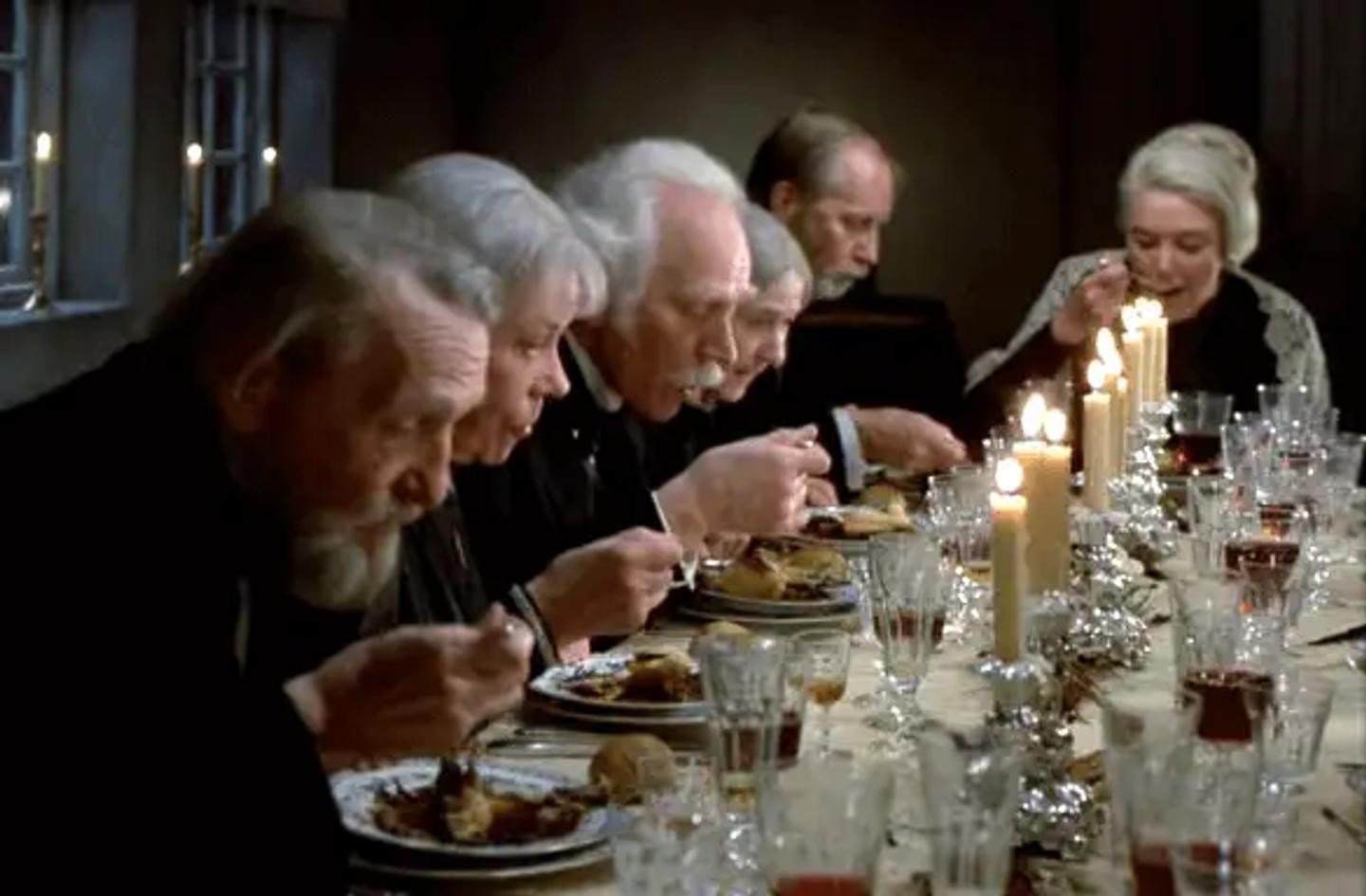
I recently purchased the Criterion Collection DVD of Babette’s Feast. I watched this last weekend. What a blessing!
Babette’s Feast, based on a Karen Blixen story, is a delightful tale of generosity in 19th century Denmark. A lavish feast evokes the transformative power of God’s grace. “Mercy and truth have kissed.”
~~~~
The Right Brain Needs Your Support
Dr Iain McGilchrist is a psychiatrist, neuroscientist, philosopher and literary scholar is the author of The Master and His Emissary and The Matter with Things. His work on the divided brain has helped millions of people find wisdom, meaning, and guidance for living in the modern world.
Iain and Demetri [Kofinas] begin their conversation exploring McGilchrist’s core thesis about the divided brain, how the left and right hemispheres attend to the world in fundamentally different ways, where we see evidence of an increased preponderance in left-brain thinking, and how this has impacted the way we conduct science, reason through problems, use our imagination, and apply wisdom to the world.
Iain believes that our civilization is caught in what some have described as a metacrisis, exacerbated by the encroachment of the left hemisphere onto more and more areas of lived experience. We see it in the procedurally abysmal manner in which modern medicine goes about formulating diagnoses, the ever-increasing obsession with process over outcomes, the commodification of writing, the rise in depression, the policing of language, and the reverence for machine-like efficiency and profit maximization at the expense of almost everything else.
The Metacrisis: Finding Reality & Meaning | Iain McGilchrist
One time of the year the new-born child is everywhere, planted in madonnas’ arms hay mows, stables in palaces or farms, or quaintly, under snowed gables, gothic angular or baroque plump, naked or elaborately swathed, encircled by Della Robia wreaths, garnished with whimsical partridges and pears, drummers and drums, lit by oversize stars, partnered with lambs, peace doves, sugar plums, bells, plastic camels in sets of three as if these were what we need for eternity.
But Jesus the Man is not to be seen. We are too wary, these days, of beards and sandalled feet.
Yet if we celebrate, let it be that he has invaded our lives with purpose, striding over our picturesque traditions, our shallow sentiment, overturning our cash registers, wielding his peace like a sword, rescuing us into reality demanding much more than the milk and the softness and the mothers warmth of the baby in the storefront creche, (only the Man would ask all, of each of us) reaching out always, urgently, with strong effective love (only the Man would give his life and live again for love of us).
Oh come, let us adore him- Christ–the Lord.
~~~
Kenosis
In sleep his infant mouth works in and out. He is so new, his silk skin has not yet been roughed by plane and wooden beam nor, so far, has he had to deal with human doubt.
He is in a dream of nipple found, of blue-white milk, of curving skin and, pulsing in his ear, the inner throb of a warm heart’s repeated sound.
His only memories float from fluid space. So new he has not pounded nails, hung a door, broken bread, felt rebuff, bent to the lash, wept for the sad heart of the human race.
~~~
Mary’s Song
Blue homespun and the bend of my breast keep warm this small hot naked star fallen to my arms. (Rest… you who have had so far to come.) Now nearness satisfies the body of God sweetly. Quiet he lies whose vigor hurled a universe. He sleeps whose eyelids have not closed before.
His breath (so slight it seems no breath at all) once ruffled the dark deeps to sprout a world. Charmed by dove’s voices, the whisper of straw, he dreams, hearing no music from his other spheres. Breath, mouth, ears, eyes he is curtailed who overflowed all skies, all years. Older than eternity, now he is new. Now native to earth as I am, nailed to my poor planet, caught that I might be free, blind in my womb to know my darkness ended, brought to this birth for me to be new-born, and for him to see me mended I must see him torn.
At ten o’clock on a dark September evening six-year-old Andrey, the only son of Dr. Kirilov, a Zemstvo physician, died from diphtheria. The doctor’s wife had just thrown herself upon her knees at the bedside of her dead child, and was giving way to the first ecstasy of despair, when the hall-doorbell rang loudly.
The death of a child is one of the most difficult and traumatic events a husband and wife can experience. Coping and getting on with life after the loss of a child seems almost impossible. The death of a spouse is also tragic.
Anton Chekhov, in his short story Enemies, brings together both tragedies and their effects on the two main characters.
The epigraph is the opening to the story. Husband and wife are devasted by the loss of their only son. Reeling from the loss of his son, Dr. Kirilov can barely function:
. . . in this moment he had no intentions, no wishes, thought of nothing; and probably had even forgotten that in the anteroom a stranger was waiting. The twilight and silence of the hall apparently intensified his stupor. Walking from the hall into his study, he raised his right leg high, and sought with his hands the doorpost. All his figure showed a strange uncertainty, as if he were in another’s house, or for the first time in life were intoxicated, and were surrendering himself questioningly to the new sensation.
The narrator describes the deathplace:
In the bedroom reigned the silence of the grave. All, to the smallest trifle, spoke eloquently of a struggle just lived through, of exhaustion, and of final rest. A candle standing on the stool among phials, boxes, and jars, and a large lamp upon the dressing-table lighted the room. On the bed beside the window lay a boy with open eyes and an expression of surprise upon his face. He did not move, but his eyes, it seemed, every second grew darker and darker, and vanished into his skull.
But in the anteroom a stranger was waiting. Dr. Kirilov’s deathplace is soon invaded by another’s cry for help.
Can one’s all-consuming grief cross over into emotional conflict and animus? Can the egoism of the unhappy shut down dialog and be the alibi for the poison of resentment? The story ends with another loss, another tragedy.
Before reading further, please take a few minutes to read the short story. As you do, see how Chekhov mirrors inner turmoil with nature, as at the beginning (above) and at the end:
It was dark, much darker than it had been an hour before. The red half-moon had sunk behind the hill and the clouds that had been guarding it lay in dark patches near the stars.
What draws me to the writers of Russian realism (Tolstoy, Dostoevsky, Turgenev, Solzhenitsyn, Chekhov) is how they reveal human nature in everyday situations and under the relentless oppression of totalitarian regimes. You can hear a thousand sermons about human nature in theologically abstract terms but in a story like “Enemies,” the characters are straightforward you-and-me.
Chekhov, a doctor, had many opportunities to observe human nature. His description of the effects of a tragic loss is true to life. (I experienced the death of a step-son – his car crashed. That was 25 years ago. And though life goes on, his deathplace remains in my heart.)
Chekhov’s description of using one’s suffering, unhappiness, and perceived victimhood as an alibi for treating others unjustly as justice is also accurate.
Once Abogin, the one who was knocking on Dr. Krilov’s door At ten o’clock on a dark September evening, finds out the trick played on him by his wife, he tells Dr. Krililov, who was rushed to Abogin’s house to revive his wife. Reeling in his emotions from his own loss, Abogin, tells the doctor that he is “deeply unhappy” about the loss of his wife.
The miserable Dr. Krilov cannot relate at all to Abogin’s unhappiness.
While Abogin spoke, the insulted doctor changed. The indifference and surprise on his face gave way little by little to an expression of bitter offence, indignation, and wrath. His features became sharper, harder, and more disagreeable.
Dr. Krilov, in the midst of his own grief, feels insulted and extremely put out by the well-to-do Abogin. “Be so good as to tell me … where is the patient?”
Soon after, Dr. Krilov says Am I a lackey who will bear insults without retaliation?
The narrator:
The two men stood face to face, and in their anger flung insults at one another. It is certain that never in their lives had they uttered so many unjust, inhuman, and ridiculous words. In each was fully expressed the egoism of the unfortunate. And men who are unfortunate, egoistical, angry, unjust, and heartless are even less than stupid men capable of understanding one another. For misfortune does not unite, but severs; and those who should be bound by community of sorrow are much more unjust and heartless than the happy and contented.
A tragedy of poisonous resentment plays out one night between the two men, each with a tragedy of their own.
Egotism that says “Your loss and your grief are nothing compared to mine. I’m the victim here” can lead to resentment, revenge, misplaced anger, exclusion and not embrace.
~~~~
Professor Gary Saul Morson cites Chekhov’s Enemies story in Wonder Confront Certainty, Russian Writers on the Timeless Questions and Why Their Answers Matter. (See my previous post for information regarding Morson and his book.) He does so in Chapter 8 of Part Three Who is not to Blame? The Search for an Alibi, in the subsection titled The Consolation of Suffering.
Morson writes[i] “The Russian experience demonstrates the danger of ideologically based alibis.”
“The appeal of moral dualism represents a still greater danger for those who class themselves as belonging to the good group of oppressed people endowed with the right to attack their oppressors. Victim psychology, indeed, constitutes another of the great themes of Russian literature.”
The moral dualism he refers to is that which divides the world into two groups: the good belong to one group and evil in another. This, he says, “absolves people of individual responsibility. It also offers the heady feeling of moral superiority.”
Morson again: “Here then is another reason Dostoevsky, and Dostoevsky alone, foresaw in detail what we have come to call totalitarianism. He detected in intelligentsia ideology a systemization of victimhood psychology which licenses unlimited harm and provides a preface alibi for those who inflict it.”
While “lying on rotting straw in prison,” Solzhenitsyn “realized the moral truth that precludes spurious alibis: “Gradually it was disclosed to me that the line separating good from evil passes not through states, nor between classes, nor between political parties either – but right through every human heart – and through all human hearts.”
~~~~~
Can our suffering, real or imagined, turn into hostility and then murder? Can a devastating loss and the ensuing grief make us both egotistical and cruel, incapable of understanding another’s suffering? Can legitimate suffering lead to crossing the line of good and evil in the human heart?
Jesus: “You’re familiar with the command to the ancients, ‘Do not murder.’ I’m telling you that anyone who is so much as angry with a brother or sister is guilty of murder. Carelessly call a brother ‘idiot!’ and you just might find yourself hauled into court. Thoughtlessly yell ‘stupid!’ at a sister and you are on the brink of hellfire. The simple moral fact is that words kill. –Mt. 5:21-22
When we hear someone say crazy things, we might say “Yeah, right” and shrug it off. But when a group of people say crazy things and a group of people agree with said crazy things, we wonder “What in the world is going on?”
Objective reality – the existence of things as they are – is obvious to everyone. And so are the values, accumulated over several millennia, of what is true and of what works and what hasn’t. But not everyone accepts the obvious and the values based on time proven objective reality. Some see themselves as Progressive in rejecting both.
Today’s academic, artistic, media, and political elites, a vanguard of Progressive Groupthink, reject the existence of things as they are and do so within the safe space of their ranks thereby creating an illusion of invulnerability and inherent morality. Members of this vanguard suppress dissenting opinions and avoid critically evaluated alternatives so as to maintain the group’s shared illusion of unanimity.
The vanguard’s conformity is maintained with mind guards – the media reports “right thinking” about a matter – and with self-censorship of deviations from shared beliefs and with shared views of the enemy – those who present a reality contrary to the groups’ notion of reality.
When we hear the vanguard’s irrational take on what is going on in the world, its roiling Doublethink, its name calling and shunning of voices outside its collective choir, and its dysfunctional decision-making which objective reality tells us will result in disastrous, dehumanizing, and even deadly outcomes, we ask “Where is this coming from and where is this going?
Those of us who keep an ear to the ground in order to hear what is approaching will answer “History is repeating itself.”
The objective reality of the murderous totalitarian regimes of the last century, which Progressives willfully ignore to promote their glorious future of equality via the same means, will help us understand the denial-of-reality collaboration of today’s intelligentsia – those who hold to one way of thinking – and their quest for total domination of the body, mind, and soul with Progressive Groupthink.
Specifically, Russian Soviet history will help us understand the conformity dynamic behind today’s intelligentsia. For this understanding I turn to one of the most informed scholars of the Russian history of ideas as communicated in its literature: Northwestern Professor Gary Saul Morson.
He describes Soviet thinking that rejected the realism and the real people depicted in nineteenth-century Russian fiction and required that reality be written to include “not only of the observable present but also the inevitable future in the making” and with Socialist Realist heroes – utopianism made flesh.
Writers of Russian realism – Tolstoy, Dostoevsky, Chekhov, Solzhenitsyn, and others – wrote about what they saw and experienced. They are the “wonder” in the title. They represented the world as it was in their writings about the Gulag, mass starvation, torture, unspeakable violence, about how people thought about and dealt with what was going on, and about how many succumbed to the imposed Soviet mindset.
Russian realist authors confronted those of the “certainty,” those who wrote redefined reality in terms of the “observable present and the inevitable future in the making” and in terms of “positive heroes.”
The “positive hero” was to set an example for the reader’s behavior. A Soviet cosmonaut, for one example, became a “positive hero.” A cosmonaut’s space trip was seen as science, materialism, and atheism triumphing over the transcendent values held in the U.S., the enemy of the Soviet Union.
The “certainty” writers followed the lead of the embodiment of “certainty” – Vladimir Lenin. Lenin mocked his opponents’ self-characterization as ‘seekers’ of truth. He held that dialectical materialists do not seek truth; they already possess it. And so, the party-minded “positive hero” refused dialogue, refused to see any alternatives to the Marxist-Leninist-materialist-atheistic “truth” espoused by the party, the representatives of Karl Marx’s class-struggling proletariat.
From Wonder Confronts Certainty:
“The Soviets would label fidelity to present facts “bourgeois objectivism.” It was the best that could be expected from the age of realism, but must give way to socialist realism, which shows the ideal world inevitably coming. The socialist realist author was expected to focus on the people of the future, “positive heroes” exhibiting complete “Party-mindedness.” True positive heroes do not have bring their thinking into accord with the party, a process requiring effort; they exhibit Party-mindedness so thorough that no effort is required”
“Party-mindedness”, we learn from the writings of Russian realist authors, was propagated through the means of propaganda, show trials, random arrests, and the constant terror that there might be any hint, any innuendo, any false statement that would convict one of not being party-minded.
The “party-mindedness” of the 20th century Russian intelligentsia, its conformity to only one way of thinking, is replicated today.
“I happened to witness two professors waiting for an elevator. To make conversation, one voiced an opinion on some political question to see if the other agreed. When she did, they chattered away on a dozen other topics with perfect assurance that they agreed on those, too. Evidently, their beliefs came as a package. Subsequently I noticed this way of thinking many times, as I imagine many of my readers have.
The process works something like this: a person first chooses the group with whom he wishes to identify and then adopts its opinions. He believes as strongly in gun control, let us say, as he does in supporting Planned Parenthood, defunding the police, and banning fossil fuels. It is evident that no arguments or evidence can shake his opinions on any of these topics because arguments or evidence had nothing to do with why they were adopted.
To be sure, a person who thinks this way can cite facts and reasons to justify his opinion, but they have been acquired in the same way as the opinion itself. They are the same reasons others in the group have learned to give. I used to find it eerie to hear repeatedly the same arguments expressed in the same phrases, as if I were listening to a recording rather than to highly educated people who imagined that, unlike their intellectual inferiors, they had arrived at opinions rationally and would change them as evidence warranted. I thought of Jonathan Swift’s observation that no one was ever talked out of an opinion he was not first talked into.”
***
Reading Morson’s article, I was reminded of the easy-going liberal mindset of the Stiva Oblonsky character in Tolstoy’s Russian realism novel Anna Karenina.
Behind Stiva’s smile, his self-possessed mannerisms and hedonism is what Tolstoy described as “the liberalism of the blood.”
From the novel:
“Stepan Arkadyevitch took and read a liberal newspaper, not a radical one, but one advocating the viewpoint maintained by the majority. And even though neither science, nor art or politics held any particular interest for him, he firmly maintained the same views on all these subjects that were maintained by the majority and by his paper, and he changed them only when the majority changed them, or, better put, he did not change them at all; they imperceptibly changed within him . . .
“And so liberalism had become a habit of Stepan Arkadyevitch’s, and he liked his newspaper, as he did his cigar after dinner, for the slight fog it diffused in his brain.”
Stiva, we learn in in the novel, does not recognize his conscious when it speaks to him. And that is aided by his living-in-the-moment forgetting. He did not want to remember any unpleasant thing.
Self-deception and romantic ideology play key roles in Anna’s life.
***
Czeslaw Milosz, Polish American poet, novelist, translator, critic, and diplomat, is best known for The Captive Mind (1953). His essay collection focuses on intellectuals, specifically poets and other writers.
As Charles Haywood writes in his 2019 article The Captive Mind (Czeslaw Milosz), [Milosz’s] “book shows how mental gymnastics, rather than coercion, caused writers under Communism to adhere to Communism. Thereby, indirectly, it congratulates writers who believe their minds free from such, or other, contortions.
“The West incorrectly sees “might and coercion” as the reasons those in Eastern Europe submit to Communism. But, rather, unwilling to face either physical or spiritual death, many choose instead to be “reborn” through taking these metaphorical pills, because “[t]here is an internal longing for harmony and happiness that lies deeper than ordinary fear or the desire to escape misery or physical destruction.” Intellectuals, and artists especially,do not want to be “internal exiles, irreconcilable, non-participating, eroded by hatred.” So they swallow the pills and adopt the “New Faith” (a term Milosz uses throughout the book) which offers the intellectual the certainty he is both correct and virtuous, and therefore gives him a sense of belonging, gives him a feeling of being “warm-hearted and good . . . a friend of mankind—not mankind as it is, but as it should be.”” (Emphasis mine.)
Returning to Morson’s article about package thinking, Morson relates
“What really matters, [Czeslaw} Milosz explains, is “the intellectual’s feeling of belonging.” His defining “characteristic is his fear of thinking for himself.” For this reason, as well as to prosper, he must root out all the old ways of thinking. Milosz describes a phenomenon with which university people are all too familiar, the always incomplete process of teaching oneself to say the right things (in the right words), and avoid saying the wrong ones, so that one never makes a slip entailing ostracism or worse. Of course, the best way to do this is to get oneself actually to share the prescribed views. Milosz describes how
after long acquaintance with his role, a man grows into it so closely that he can no longer differentiate his true self from the self he simulates, so that even the most intimate of individuals speak to each other in Party slogans. To identify self with the role one is obliged to play . . . permits a relaxation of one’s vigilance. Proper reflexes at the proper time become truly automatic.”
***
One obvious feature of our culture’s downward trend toward mindless conformity is critical thinking’s easy alternative: clicking on a machine to receive packaged thoughts.
Why think when packaged thoughts are there for the clicking? And why expand one’s personal bandwidth when you can reaffirm your tribal identity with a click?
Why research and consider a range of ideas and thoughts when clicking on machine AI is ready to do away with mystery and your curiosity, wonder, and impatience? And why think outside package thinking when life is short – shortened by every minute clicking on a machine.
Why read classic literature to gain wisdom, insight, and understanding from other people in other places and in other times, when you can click on a remote for package thinking entertainment.
Have you bought into the globalist, academic, secular and progressive (GASP) package (a feature of Wikipedia) that censors alternative views as “extremist” or “fringe theories” or “conspiracy theories” or “racist?”
Did you buy into the globalist open borders “welcoming the stranger” package where millions of unvetted illegal invaders entered the country as simple or criminal or terrorism opportunists? Did you accept the package thinking that allows third world invaders into our country to replace American workers and American values and do all manner of harm to its citizens as empathy, as what Jesus would do? Take a look at the strangers welcomed: Arrested: Worst of the Worst | Homeland Security And, there’s this: They Called It ‘Compassion’ — But it was Child Trafficking – American Thinker
Are you buying into the central planning democratic socialism package where everyone, except certain individuals who hold more power and privilege, must be made equal no matter the human cost? Are you buying into the central planning democratic socialism package and willfully forgetting the objective reality of the horrors of socialism/communism? Are you willfully handing over your life, your thoughts, to “Party-mindedness”?
Did you accept the “don’t question the science” COVID package thinking of mandates, masking, social distancing, vaccine passports, isolation camps, vaccine efficacy, and of COVID’s origin lies? America’s COVID Response Was Based on Lies
Likewise, did you not question the package thinking of “climate experts” who announced their verdict that the world would end if we didn’t act now. Not long ago, woven into almost every weather report on local and mainstream media when major weather events (floods, tornadoes, hurricanes, droughts, and wildfires) occurred was the narrative that climate change was behind them – without ever mentioning large-scale natural phenomena such as solar cycles, ocean currents and volcanoes that have been affecting weather for many millennia.
Do you go along with the package thinking of the [John] Rawlsian theory of ad hoc justice that, for example, releases someone arrested 40 times, is not considered a “criminal” because of their minority status, and is released by a judge back onto the street where he sets a woman on fire?
Do you buy philosopher Jean-Jacques Rousseau’s notion that “Man is born free, and everywhere he is in chains” – the package thinking that says that people are entirely products of their environment, of their society, of their age, and that’s why they do what they do. Therefore, they are not responsible for what they do because of external influence. That’s the package thinking behind the Rawlsian theory of justice and behind the executions and horrors of the French revolution working to change social environment.
Have you agreed with the insurrection thought package being espoused by The Seditious Six imploring military service members to “refuse illegal orders” thereby implying that orders coming out of the Trump administration are considered illegal by them and therefore military service members should disobey their commanding officer and join the club of the “Party-minded.” Remember, package thinking has only one train of thought – gaining and maintaining power over reality.
Have you agreed with the insurrection package thinking espoused previously by NYT’s op-ed columnist David Brooks? Do the values of your party-minded package thinking allow you to hamstring a DEMOCRACY! elected president with the rulings of party-minded federal court judges that will be overturned. Do the values of your party-minded package thinking justify the deep state, in the labyrinth of government, to sabotage the efforts of a Democratically elected President?
Do the values of your package thinking allow you to call for uprisings by any means necessary, to burn down buildings, to destroy property, to destroy businesses, to steal, do violence on others, to defund the police, to create pipe bombs, to assassinate? To ignore your conscience?
Did you accept the “Danger to our Democracy” thought package the media delivered during the last presidential election cycle? It should be obvious from the likes of David Brooks, that the “guardians of democracy” are the ones who want to tear it down.
Have bought into the diversity, equity, and inclusion (DEI) playbook that conforms and coerces everyone to identify with Soviet style party-mindedness package thinking?
Have bought into viewing everything including humans through the lens of materialism?
Have you bought into package thinking so as to not be considered an outsider? Have you bought into conformity for conformity’s sake?
Is censorship the worst thing that can happen to a people? Or, is it “Party-mindedness?”
When we hear someone say crazy things, we might say “Yeah, right” and shrug it off. But when a group of people say crazy things with the smug air of certainty and people agree with said crazy things, we wonder “What in the world is going on?” and “Where is this coming from and where is it going?”
What happened in Russia didn’t stay in Russia. And a mind is still a terrible thing to hand over.
You can put your ear to the road and hear what is quickly approaching. Download and listen to the following podcasts:
London is falling – or has it fallen already?
Liz Truss, the 56th prime minister of the United Kingdom, in her very first episode of The Liz Truss Show discusses how bad things are in Britain with a mass migration and economic doom loop – and how to defeat the deep state who have let this happen
Interview with Professor Gary Saul Morson on Tolstoy, Faith, Package Thinking, and The Importance of Critical Thinking
Professor Gary Saul Morson shares his thought-provoking definition of an intellectual—someone who seeks truth independently, values ideas for their own sake, and stands apart from identity-driven thinking. Whether discussing classic Russian Literature or analyzing modern society, Professor Morson is one of the most insightful and consequential scholars of our time. Discover how this interview, and its exploration of timeless topics, can inspire bold, principled leadership and innovation within today’s business environment.
Gary Saul Morson on Tolstoy, Faith, Package Thinking, and The Importance of Critical Thinking
Vladimir Lenin’s ideas are alive and well today: Party-ness, politics as win-lose, zero-sum game, Who-Whom, rejection of truth, ideology, violence, philosophical materialism, adherence to lying.
Is Hope Naïve in a World Like Ours? | Esau McCaulley & Gary Saul Morson at Northwestern
~~~~~
Quotes:
In the long run my observations have convinced me that some men, reasoning preposterously, first establish some conclusion in their minds which, either because of its being their own or because of their having received it from some person who has their entire confidence, impresses them so deeply that one finds it impossible ever to get it out of their heads. Such arguments in support of their fixed idea … gain their instant acceptance and applause. On the other hand whatever is brought forward against it, however ingenious and conclusive, they receive with disdain or with hot rage – if indeed it does not make them ill. Beside themselves with passion, some of them would not be backward even about scheming to suppress and silence their adversaries. I have had some experience of this myself. … No good can come of dealing with such people, especially to the extent that their company may be not only unpleasant but dangerous. Galileo Galilei
If the Brave New World cannot insert a square peg into a round hole, it will redefine “roundness” until a perfect fit results.
-Jerome Meckier, from Aldous Huxley: Satire and Structure
…a sense of unity is opposite of a sense of uniformity. Uniformity, where everyone “belongs”, uses the same cliches, thinks alike and behaves alike, produces a society which seems comfortable at first but is totally lacking in human dignity. Real unity tolerates dissent and rejoices in variety of outlook and tradition, realizes that it is man’s destiny to unite and not divide… Unity, so understood, is the extra dimension that raises the sense of belonging into genuine human life.
-Northrop Frye, from The Bush Garden
Wise men speak because they have something to say; fools because they have to say something. -Plato
“The past is our always-available counterculture, and it’s a rich one. Every minute you spend attending to something not-immediately-present, you are helping to build a counterculture.” ― Alan Jacobs
~~~~~
Links:
Why are intellectuals — those whose thinking is supposed to be most refined — so susceptible to totalitarianism? Gary Saul Morson offers three explanations from the treasury of Russian literature.
Anti-Communism Week has been marked for November 2025. Writer-producer Julie Behling’s documentary “Beneath Sheep’s Clothing” warns of communism’s devastation: “Globally, communism claimed the lives of approximately 150 million people in the 20th century.”
Totalitarian governments cannot afford that its citizens remain autonomous persons. This poses a threat to their quest to consolidate power. Individual liberty threatens the theoretical, utopian foundations of promising the re-distribution of goods, and equality; communism ultimately fails to re-distribute the essence of human nature.
“We have entered, as I see it, a spiritual limbo. Our educational institutions are no longer the bearers of high culture, and public life has been deliberately moronised. But here and there, sheltered from the noise and glare of the media, the old spiritual forces are at work” Roger Scruton
*****
“When a common culture declines, the ethical life can be sustained and renewed only by a work of the imagination.”-Roger Scruton
*****
“Jesus prayed, “This is eternal life, that they may know You . . .” (John 17:3). The real meaning of eternal life is a life that can face anything it has to face without wavering. If we will take this view, life will become one great romance— a glorious opportunity of seeing wonderful things all the time. God is disciplining us to get us into this central place of power.” Oswald Chambers
*****
“No power on earth or in hell can conquer the Spirit of God in a human spirit, it is an inner unconquerableness.” Oswald Chambers
*****
To those who have had no agony Jesus says, “I have nothing for you; stand on your own feet, square your own shoulders. I have come for the man who knows he has a bigger handful than he can cope with, who knows there are forces he cannot touch; I will do everything for him if he will let Me. Only let a man grant he needs it, and I will do it for him.” The Shadow of an Agony,Oswald Chambers
*****
“If we wish to erect new structures, we must have a definite knowledge of the old foundations.” John Calvin Coolidge
*****
Atheism is a post-Christian phenomenon.
*****
If social justice looks like your hand in someone else’s pocket then you are stealing.
*****
“In Sweden, giving to charity, absurdly, came to be considered a lack of solidarity, since it undermined the need for the welfare state.” – Roland Martinsson
*****
“…to love democracy well, it is necessary to love it moderately.” Alexis de Tocqueville
*****
Capitalism seeks to help others through a servce or product it provides. Free Market Capitalism is the most moral and fair economic system available to man. Capitalism augments personal growth, responsibility and ownership. Charity flourishes under capitalism. Charity dies under subjective “fair share” government confiscatory policies. Socialism redistributes ambivalence and greed.
*****
“We are to regard existence as a raid or great adventure; it is to be judged, therefore, not by what calamities it encounters, but by what flag it follows and what high town it assaults. The most dangerous thing in the world is to be alive; one is always in danger of one’s life. But anyone who shrinks from that is a traitor to the great scheme and experiment of being.” G.K. Chesterton
*****
Any intelligent fool can make things bigger, more complex, and more violent.
It takes a touch of genius – and a lot of courage – to move in the opposite direction. Albert Einstein
*****
“You shall know the truth and the truth shall make you odd.” Flannery O’Connor
*****
“There is but one good; that is God. Everything else is good when it looks to Him and bad when it turns from Him.” C.S. Lewis, The Great Divorce
*****
“Though He slay me, yet will I trust Him” (Job 13:15).
*****
God’s grace is not about the allowance for sin. God’s grace is about the conversation God allows regarding sin.
*****
From the book of Proverbs: We are not to favor the rich or the poor. We are to pursue justice.
*****
“Always keep in contact with those books and those people that enlarge your horizon and make it possible for you to stretch yourself mentally.” Oswald Chambers
*****
One goldfish says to another, “If there is no God who keeps changing the water?”
*****
“The truth is always there in the morning.”
From Cat On A Hot Tin Roof script – playwright Tennessee Williams
*****
God blesses those who hunger and thirst for justice, for they will be satisfied.
*****
“America’s greatness has been the greatness of a free people who shared certain moral commitments. Freedom without moral commitment is aimless and promptly self-destructive.” John W. Gardner
**
“Men of integrity, by their very existence, rekindle the belief that as a people we can live above the level of moral squalor. We need that belief; a cynical community is a corrupt community.” John W. Gardner
*****
“In the world it is called Tolerance, but in hell it is called Despair, the sin that believes in nothing, cares for nothing, seeks to know nothing, interferes with nothing, enjoys nothing, hates nothing, finds purpose in nothing, lives for nothing, and remains alive because there is nothing for which it will die.” Dorothy L. Sayers
*****
“Art, like morality, consists of drawing the line somewhere.”
G. K. Chesterton
*****
“The battle line between good and evil runs through the heart of every man.” Alexander Solzhenitsyn
*****
This is what the LORD says:
“Stand at the crossroads and look;
ask for the ancient paths,
ask where the good way is, and walk in it,
and you will find rest for your souls.
But you said, ‘We will not walk in it.’
-The prophet Jeremiah, 6:16
*****
“…our common task is not so much discovering a truth hiding among contrary viewpoints as it is coming to possess a selfhood that no longer evades and eludes the truth with which it is importunately confronted.” James McClendon, Ethics: Systematic Theology, Vol. 1
*****







 Cindy Wity
A Mind is a Terrible Thing to Hand Over
December 8, 2025 Leave a comment
When we hear someone say crazy things, we might say “Yeah, right” and shrug it off. But when a group of people say crazy things and a group of people agree with said crazy things, we wonder “What in the world is going on?”
Objective reality – the existence of things as they are – is obvious to everyone. And so are the values, accumulated over several millennia, of what is true and of what works and what hasn’t. But not everyone accepts the obvious and the values based on time proven objective reality. Some see themselves as Progressive in rejecting both.
Today’s academic, artistic, media, and political elites, a vanguard of Progressive Groupthink, reject the existence of things as they are and do so within the safe space of their ranks thereby creating an illusion of invulnerability and inherent morality. Members of this vanguard suppress dissenting opinions and avoid critically evaluated alternatives so as to maintain the group’s shared illusion of unanimity.
The vanguard’s conformity is maintained with mind guards – the media reports “right thinking” about a matter – and with self-censorship of deviations from shared beliefs and with shared views of the enemy – those who present a reality contrary to the groups’ notion of reality.
When we hear the vanguard’s irrational take on what is going on in the world, its roiling Doublethink, its name calling and shunning of voices outside its collective choir, and its dysfunctional decision-making which objective reality tells us will result in disastrous, dehumanizing, and even deadly outcomes, we ask “Where is this coming from and where is this going?
Those of us who keep an ear to the ground in order to hear what is approaching will answer “History is repeating itself.”
The objective reality of the murderous totalitarian regimes of the last century, which Progressives willfully ignore to promote their glorious future of equality via the same means, will help us understand the denial-of-reality collaboration of today’s intelligentsia – those who hold to one way of thinking – and their quest for total domination of the body, mind, and soul with Progressive Groupthink.
Specifically, Russian Soviet history will help us understand the conformity dynamic behind today’s intelligentsia. For this understanding I turn to one of the most informed scholars of the Russian history of ideas as communicated in its literature: Northwestern Professor Gary Saul Morson.
***
In Morson’s magnum opus Wonder Confronts Certainty: Russian Writers on the Timeless Questions and Why Their Answers Matter Morson details how politics and literature, in the writings of realists, idealists, and revolutionaries, played against each other during the Soviet period.
He describes Soviet thinking that rejected the realism and the real people depicted in nineteenth-century Russian fiction and required that reality be written to include “not only of the observable present but also the inevitable future in the making” and with Socialist Realist heroes – utopianism made flesh.
Writers of Russian realism – Tolstoy, Dostoevsky, Chekhov, Solzhenitsyn, and others – wrote about what they saw and experienced. They are the “wonder” in the title. They represented the world as it was in their writings about the Gulag, mass starvation, torture, unspeakable violence, about how people thought about and dealt with what was going on, and about how many succumbed to the imposed Soviet mindset.
Russian realist authors confronted those of the “certainty,” those who wrote redefined reality in terms of the “observable present and the inevitable future in the making” and in terms of “positive heroes.”
The “positive hero” was to set an example for the reader’s behavior. A Soviet cosmonaut, for one example, became a “positive hero.” A cosmonaut’s space trip was seen as science, materialism, and atheism triumphing over the transcendent values held in the U.S., the enemy of the Soviet Union.
The “certainty” writers followed the lead of the embodiment of “certainty” – Vladimir Lenin. Lenin mocked his opponents’ self-characterization as ‘seekers’ of truth. He held that dialectical materialists do not seek truth; they already possess it. And so, the party-minded “positive hero” refused dialogue, refused to see any alternatives to the Marxist-Leninist-materialist-atheistic “truth” espoused by the party, the representatives of Karl Marx’s class-struggling proletariat.
From Wonder Confronts Certainty:
“The Soviets would label fidelity to present facts “bourgeois objectivism.” It was the best that could be expected from the age of realism, but must give way to socialist realism, which shows the ideal world inevitably coming. The socialist realist author was expected to focus on the people of the future, “positive heroes” exhibiting complete “Party-mindedness.” True positive heroes do not have bring their thinking into accord with the party, a process requiring effort; they exhibit Party-mindedness so thorough that no effort is required”
“Party-mindedness”, we learn from the writings of Russian realist authors, was propagated through the means of propaganda, show trials, random arrests, and the constant terror that there might be any hint, any innuendo, any false statement that would convict one of not being party-minded.
The “party-mindedness” of the 20th century Russian intelligentsia, its conformity to only one way of thinking, is replicated today.
***
Here’s Morson in his Touchtone article Beyond Belief: Literary Reflections on Thoughtless Conformity:
“I happened to witness two professors waiting for an elevator. To make conversation, one voiced an opinion on some political question to see if the other agreed. When she did, they chattered away on a dozen other topics with perfect assurance that they agreed on those, too. Evidently, their beliefs came as a package. Subsequently I noticed this way of thinking many times, as I imagine many of my readers have.
The process works something like this: a person first chooses the group with whom he wishes to identify and then adopts its opinions. He believes as strongly in gun control, let us say, as he does in supporting Planned Parenthood, defunding the police, and banning fossil fuels. It is evident that no arguments or evidence can shake his opinions on any of these topics because arguments or evidence had nothing to do with why they were adopted.
To be sure, a person who thinks this way can cite facts and reasons to justify his opinion, but they have been acquired in the same way as the opinion itself. They are the same reasons others in the group have learned to give. I used to find it eerie to hear repeatedly the same arguments expressed in the same phrases, as if I were listening to a recording rather than to highly educated people who imagined that, unlike their intellectual inferiors, they had arrived at opinions rationally and would change them as evidence warranted. I thought of Jonathan Swift’s observation that no one was ever talked out of an opinion he was not first talked into.”
***
Reading Morson’s article, I was reminded of the easy-going liberal mindset of the Stiva Oblonsky character in Tolstoy’s Russian realism novel Anna Karenina.
Behind Stiva’s smile, his self-possessed mannerisms and hedonism is what Tolstoy described as “the liberalism of the blood.”
From the novel:
“Stepan Arkadyevitch took and read a liberal newspaper, not a radical one, but one advocating the viewpoint maintained by the majority. And even though neither science, nor art or politics held any particular interest for him, he firmly maintained the same views on all these subjects that were maintained by the majority and by his paper, and he changed them only when the majority changed them, or, better put, he did not change them at all; they imperceptibly changed within him . . .
“And so liberalism had become a habit of Stepan Arkadyevitch’s, and he liked his newspaper, as he did his cigar after dinner, for the slight fog it diffused in his brain.”
Stiva, we learn in in the novel, does not recognize his conscious when it speaks to him. And that is aided by his living-in-the-moment forgetting. He did not want to remember any unpleasant thing.
Self-deception and romantic ideology play key roles in Anna’s life.
***
Czeslaw Milosz, Polish American poet, novelist, translator, critic, and diplomat, is best known for The Captive Mind (1953). His essay collection focuses on intellectuals, specifically poets and other writers.
As Charles Haywood writes in his 2019 article The Captive Mind (Czeslaw Milosz), [Milosz’s] “book shows how mental gymnastics, rather than coercion, caused writers under Communism to adhere to Communism. Thereby, indirectly, it congratulates writers who believe their minds free from such, or other, contortions.
“The West incorrectly sees “might and coercion” as the reasons those in Eastern Europe submit to Communism. But, rather, unwilling to face either physical or spiritual death, many choose instead to be “reborn” through taking these metaphorical pills, because “[t]here is an internal longing for harmony and happiness that lies deeper than ordinary fear or the desire to escape misery or physical destruction.” Intellectuals, and artists especially, do not want to be “internal exiles, irreconcilable, non-participating, eroded by hatred.” So they swallow the pills and adopt the “New Faith” (a term Milosz uses throughout the book) which offers the intellectual the certainty he is both correct and virtuous, and therefore gives him a sense of belonging, gives him a feeling of being “warm-hearted and good . . . a friend of mankind—not mankind as it is, but as it should be.”” (Emphasis mine.)
Returning to Morson’s article about package thinking, Morson relates
“What really matters, [Czeslaw} Milosz explains, is “the intellectual’s feeling of belonging.” His defining “characteristic is his fear of thinking for himself.” For this reason, as well as to prosper, he must root out all the old ways of thinking. Milosz describes a phenomenon with which university people are all too familiar, the always incomplete process of teaching oneself to say the right things (in the right words), and avoid saying the wrong ones, so that one never makes a slip entailing ostracism or worse. Of course, the best way to do this is to get oneself actually to share the prescribed views. Milosz describes how
after long acquaintance with his role, a man grows into it so closely that he can no longer differentiate his true self from the self he simulates, so that even the most intimate of individuals speak to each other in Party slogans. To identify self with the role one is obliged to play . . . permits a relaxation of one’s vigilance. Proper reflexes at the proper time become truly automatic.”
***
One obvious feature of our culture’s downward trend toward mindless conformity is critical thinking’s easy alternative: clicking on a machine to receive packaged thoughts.
Why think when packaged thoughts are there for the clicking? And why expand one’s personal bandwidth when you can reaffirm your tribal identity with a click?
Why research and consider a range of ideas and thoughts when clicking on machine AI is ready to do away with mystery and your curiosity, wonder, and impatience? And why think outside package thinking when life is short – shortened by every minute clicking on a machine.
Why read classic literature to gain wisdom, insight, and understanding from other people in other places and in other times, when you can click on a remote for package thinking entertainment.
Have you bought into the globalist, academic, secular and progressive (GASP) package (a feature of Wikipedia) that censors alternative views as “extremist” or “fringe theories” or “conspiracy theories” or “racist?”
Did you buy into the globalist open borders “welcoming the stranger” package where millions of unvetted illegal invaders entered the country as simple or criminal or terrorism opportunists? Did you accept the package thinking that allows third world invaders into our country to replace American workers and American values and do all manner of harm to its citizens as empathy, as what Jesus would do? Take a look at the strangers welcomed: Arrested: Worst of the Worst | Homeland Security And, there’s this: They Called It ‘Compassion’ — But it was Child Trafficking – American Thinker
Are you buying into the central planning democratic socialism package where everyone, except certain individuals who hold more power and privilege, must be made equal no matter the human cost? Are you buying into the central planning democratic socialism package and willfully forgetting the objective reality of the horrors of socialism/communism? Are you willfully handing over your life, your thoughts, to “Party-mindedness”?
Did you accept the “don’t question the science” COVID package thinking of mandates, masking, social distancing, vaccine passports, isolation camps, vaccine efficacy, and of COVID’s origin lies? America’s COVID Response Was Based on Lies
Likewise, did you not question the package thinking of “climate experts” who announced their verdict that the world would end if we didn’t act now. Not long ago, woven into almost every weather report on local and mainstream media when major weather events (floods, tornadoes, hurricanes, droughts, and wildfires) occurred was the narrative that climate change was behind them – without ever mentioning large-scale natural phenomena such as solar cycles, ocean currents and volcanoes that have been affecting weather for many millennia.
The Green New scam was behind Biden’s $93 Billion Crony Climate Heist. Will declassifying carbon dioxide (necessary for all of life) as a pollutant and the end of carbon dioxide regulation mean the end of the Green New scam? Are we now seeing The End of the Green New Scam? | The Rude Awakening? Matt Ridely thinks so: The end of the climate cult – The Spectator World
(A climate expert I trust: https://judithcurry.com/about/)
Do you go along with the package thinking of the [John] Rawlsian theory of ad hoc justice that, for example, releases someone arrested 40 times, is not considered a “criminal” because of their minority status, and is released by a judge back onto the street where he sets a woman on fire?
Do you buy philosopher Jean-Jacques Rousseau’s notion that “Man is born free, and everywhere he is in chains” – the package thinking that says that people are entirely products of their environment, of their society, of their age, and that’s why they do what they do. Therefore, they are not responsible for what they do because of external influence. That’s the package thinking behind the Rawlsian theory of justice and behind the executions and horrors of the French revolution working to change social environment.
Have you agreed with the insurrection thought package being espoused by The Seditious Six imploring military service members to “refuse illegal orders” thereby implying that orders coming out of the Trump administration are considered illegal by them and therefore military service members should disobey their commanding officer and join the club of the “Party-minded.” Remember, package thinking has only one train of thought – gaining and maintaining power over reality.
Have you agreed with the insurrection package thinking espoused previously by NYT’s op-ed columnist David Brooks? Do the values of your party-minded package thinking allow you to hamstring a DEMOCRACY! elected president with the rulings of party-minded federal court judges that will be overturned. Do the values of your party-minded package thinking justify the deep state, in the labyrinth of government, to sabotage the efforts of a Democratically elected President?
Do the values of your package thinking allow you to call for uprisings by any means necessary, to burn down buildings, to destroy property, to destroy businesses, to steal, do violence on others, to defund the police, to create pipe bombs, to assassinate? To ignore your conscience?
Did you accept the “Danger to our Democracy” thought package the media delivered during the last presidential election cycle? It should be obvious from the likes of David Brooks, that the “guardians of democracy” are the ones who want to tear it down.
Have bought into the diversity, equity, and inclusion (DEI) playbook that conforms and coerces everyone to identify with Soviet style party-mindedness package thinking?
Have bought into viewing everything including humans through the lens of materialism?
Have you bought into package thinking so as to not be considered an outsider? Have you bought into conformity for conformity’s sake?
Is censorship the worst thing that can happen to a people? Or, is it “Party-mindedness?”
When we hear someone say crazy things, we might say “Yeah, right” and shrug it off. But when a group of people say crazy things with the smug air of certainty and people agree with said crazy things, we wonder “What in the world is going on?” and “Where is this coming from and where is it going?”
What happened in Russia didn’t stay in Russia. And a mind is still a terrible thing to hand over.
What happened in Russia didn’t stay in Russia . . . Britain Is Lost | ZeroHedge
~~~~~
You can put your ear to the road and hear what is quickly approaching. Download and listen to the following podcasts:
London is falling – or has it fallen already?
Liz Truss, the 56th prime minister of the United Kingdom, in her very first episode of The Liz Truss Show discusses how bad things are in Britain with a mass migration and economic doom loop – and how to defeat the deep state who have let this happen
https://justthenews.com/podcasts/liz-truss-show/london-falling-or-has-it-fallen-already
~~~
Interview with Professor Gary Saul Morson on Tolstoy, Faith, Package Thinking, and The Importance of Critical Thinking
Professor Gary Saul Morson shares his thought-provoking definition of an intellectual—someone who seeks truth independently, values ideas for their own sake, and stands apart from identity-driven thinking. Whether discussing classic Russian Literature or analyzing modern society, Professor Morson is one of the most insightful and consequential scholars of our time. Discover how this interview, and its exploration of timeless topics, can inspire bold, principled leadership and innovation within today’s business environment.
Interview with Professor Gary Saul Morson on Tolstoy, Faith, and The Importance of Critical Thinking – The Profitable Table Fed by Woolco Foods | Acast
~~~
The Moral Imagination – Michael Matheson Miller
Gary Saul Morson Ph.D.: Thinking Like Lenin
Vladimir Lenin’s ideas are alive and well today: Party-ness, politics as win-lose, zero-sum game, Who-Whom, rejection of truth, ideology, violence, philosophical materialism, adherence to lying.
Ep. 15: Thinking Like Lenin, with Gary Saul Morson
Is Hope Naïve in a World Like Ours? | Esau McCaulley & Gary Saul Morson at Northwestern
~~~~~
Quotes:
In the long run my observations have convinced me that some men, reasoning preposterously, first establish some conclusion in their minds which, either because of its being their own or because of their having received it from some person who has their entire confidence, impresses them so deeply that one finds it impossible ever to get it out of their heads. Such arguments in support of their fixed idea … gain their instant acceptance and applause. On the other hand whatever is brought forward against it, however ingenious and conclusive, they receive with disdain or with hot rage – if indeed it does not make them ill. Beside themselves with passion, some of them would not be backward even about scheming to suppress and silence their adversaries. I have had some experience of this myself. … No good can come of dealing with such people, especially to the extent that their company may be not only unpleasant but dangerous. Galileo Galilei
If the Brave New World cannot insert a square peg into a round hole, it will redefine “roundness” until a perfect fit results.
-Jerome Meckier, from Aldous Huxley: Satire and Structure
…a sense of unity is opposite of a sense of uniformity. Uniformity, where everyone “belongs”, uses the same cliches, thinks alike and behaves alike, produces a society which seems comfortable at first but is totally lacking in human dignity. Real unity tolerates dissent and rejoices in variety of outlook and tradition, realizes that it is man’s destiny to unite and not divide… Unity, so understood, is the extra dimension that raises the sense of belonging into genuine human life.
-Northrop Frye, from The Bush Garden
Wise men speak because they have something to say; fools because they have to say something. -Plato
“The past is our always-available counterculture, and it’s a rich one. Every minute you spend attending to something not-immediately-present, you are helping to build a counterculture.” ― Alan Jacobs
~~~~~
Links:
Why are intellectuals — those whose thinking is supposed to be most refined — so susceptible to totalitarianism? Gary Saul Morson offers three explanations from the treasury of Russian literature.
https://tomklingenstein.com/mind-forgd-manacles-why-intellectuals-conform/
The greatest depiction of woke totalitarianism was written 150 years ago in Russia
Anti-Communism Week has been marked for November 2025. Writer-producer Julie Behling’s documentary “Beneath Sheep’s Clothing” warns of communism’s devastation: “Globally, communism claimed the lives of approximately 150 million people in the 20th century.”
‘Beneath Sheep’s Clothing’: Communism’s Capture Of America | ZeroHedge
Totalitarian governments cannot afford that its citizens remain autonomous persons. This poses a threat to their quest to consolidate power. Individual liberty threatens the theoretical, utopian foundations of promising the re-distribution of goods, and equality; communism ultimately fails to re-distribute the essence of human nature.
10 Habits of Mind to Avoid Ideological Thinking
Everyday Habits That Reveal a Low IQ (Backed by Psychology)
Everyday Habits That Reveal a Low IQ (Backed by Psychology) – YouTube
~~~~~
Added 12-15-2025:
Sam Faddis (formerly with the CIA) sits down to talk about the reality of the ongoing Marxist revolution in America.
The Revolution Right Here At Home – by Sam Faddis
Rate this:
Filed under 2025 Current Events, Communism, cultural Marxism, Culture, Democracy, History, Political Commentary, Politics, social commentary, totalitarianism Tagged with Communism, Democracy, groupthink, history, Marxism, mind control, package thinking, party-mindedness, politics, progressivism, russia, Soviet Union, totalitarianism, Valdimir Lenin