So one day, as Plato conveyed to me over a glass of ruby-red Greek wine, he goes back into the claustrophobic cave where he once had the courage to flee. He excitedly tells his former neighbors-the self-shackled cave dwellers-that there is brilliant light outside. Everything can be seen clearly. Truth and beauty await them outside the cave.
He tells them that the large fire at the back of the cave is casting the shadowy flickering images on the walls of their cave. This is what is scaring them. He tells them that their understanding of life, their vision is veiled and distorted. “Come and see”, he tells them.
Most of the cave dwellers respond apathetically. Some had tried to read the shapes on the wall and to discern their meaning but to no avail. (The images are the cave dwellers themselves as distorted silhouettes projected onto the walls by the firelight. They cannot figure this out. Besides, they tell themselves, “Truth is what our cave dwelling friends let us get away with saying.”)
After Plato’s pleading the cave dwellers tell him that they do want anyone to stop the picture show. They know what to expect day after day. They look forward to the same known foggy reality.
Plato, my friend, was then denounced as part of a lunatic fringe element for his Ideas. He was ridiculed and banished from the cave. If the cave dwellers had been not shackled they would have killed the ‘prophet’ of a new and illuminated world. Instead they invented trigger warnings to fend off intruders.
The end.
Plato’s Cave
The video link at the bottom of this post sheds some light on the scary shadow developed skepticism of many people hunkered down in their trigger warning guarded thought caves.
Tim Keller, introduced in the video, is also a contributor to the Christian-based theistic evolution science blog Biologos.org.
After Keller’s presentation, about 44 minutes into the video, there is a question and answer period.
Several students question Keller including two philosophy students who ramble on trying to form a question that Keller can answer. It is an interesting discourse, to be sure. Kant is brought out and dusted off.
It was Kant and the thinkers of Enlightenment that brought out and dusted off the “Upper” and “Lower” storybooks stashed away on the shelves of philosophy for centuries – basically, the ‘atomistic’ philosophy promoted by the Greek philosopher Epicurus.
Once Darwin came on the scene the thought-value split quickly became the Western mindset. Man, we were told, had evolved out of his unenlightened cave to live in his new cave of Scientism. Religion was dismissed as only flickering sentimental shadows of the past. Truth had been divided into Continental and Analytical thinking, with no middle ground between.
Once I built an ivory tower
so I could worship from above
when I climb down to be set free
she took me in again
from “Hard Sun”, written by Gordon Peterson
Francis Schaeffer, the founder of L’Abri Fellowship in Switzerland, used the following diagram to describe modern man’s dualistic thinking to those who studied at L’Abri.
The Two-Story Concept of Truth
Values
Private, subjective, relative
Facts
Public, objective, universal
This dichotomy has grown so pervasive that most people do not even recognize they hold it. It has become part of the cultural air we breathe. Consider two prominent examples:
Martin Luther King Jr.: “Science deals mainly with facts; religion deals with mainly values.”
Albert Einstein: “Science yields facts but not “value judgments”; religion expresses values but cannot “speak of facts.”
Modern man, hiding behind easily tripped trigger warnings inside his cave, shackled to soulless hand-held materialism denies the existence of the whole outside world, a world brightly illuminated. It was a medievalist poet, Gerard Manley Hopkins, who understood the magnitude of the illuminated whole: “The world is charged with the grandeur of God.”
Once out of the cave, reality for man is the Hard Sun. Yet, Man will see and then, if willing, embrace both Continental and Analytical thinking. He can embrace both nature and grace, both facts and values, both Truth and Beauty.
And Man can also walk in the eternal light of God’s Son, for he said, “I am the light of the world. Whoever follows me will never walk in darkness, but will have the light of life.”
Recently, on my daily train ride into the city, I had, for me, a ‘typical’ conversation with those standing in the vestibule. The subject: going to church.
A fellow passenger brought up the fact that he attends to a certain church. Another passenger then mentioned that she attends a Catholic Church. I mentioned that I attended church near my town. A fourth passenger, a young woman carrying a black bag decorated with astrological and satanic symbols and the word “Spirituality” written boldly across the bag, looked up from her hand-held device and said, “I don’t go to church…Too much hypocrisy.” She said this looking directly at the woman who mentioned her attendance at a Catholic Church. The young woman went on to mention the priests and young boy abuse scandals.
I regrettably glibly said, “We are all hypocrites. Some people realize this and attend church to change their ways.” We then went on to discuss other things.
A deeper and honest and loving discussion on my part would have brought up the truth about God and the hard questions that she and I and all of us face in our daily lives. There are certainly questions of man’s brokenness, his hypocrisy and profound questions about evil, suffering and… a good God?
If you have read the ancient Book of Job then you would have come across man’s earliest known and hardest life question as the basis of Job’s story: Why does a good God allow suffering and evil?
And, if you have read Fyodor Dostoevsky’s (a Russian novelist (1821-1881)) “The Brothers Karamazov” you will have come across thought-provoking questions of the problem of suffering and evil. There, one would find man’s most pressing concerns in story form; concerns about God, good, evil, suffering, doubt and faith.
The Veritas Forum video below presents an insightful conversation at Duke University. Issues of war, pacifism, suffering, evil, moral ambiguity, hate crimes, death, the UN, International law, forgiveness and the Kingdom of God are broached by N.T. Wright, a well-known New Testament Scholar and author. He provides answers to many universal questions and places the answers in the context of the Kingdom of God and not the society at hand. The video introduces N.T. Wright and his book “Evil and the Justice of God”.
A conversation with Professor N.T. Wright at Duke University:
In response to the collectivist ideologies of Barack Obama and Elizabeth Warren and their proposed free market epitaph “You didn’t build that…” I offer two videos that provide insights about our humanity, creation, transcendence and economics. Epicurus, by the way (see previous posts regarding Epicurus), knew about humanity at a base level. Epicurus withdrew from transcendent.
The first video includes an interview with Rev. Robert A. Sirico of the Acton Institute. I first heard this interview while watching Fox Business’ Varney & Company. It contains a surprise ending.
In the second video Rev. Robert A. Sirico speaks at Creighton University about his conversion from Marxism and socialism and his reckoning of justice with a God-given humanity and transcendence. He speaks of going on to embrace a morals-directed free market economics which in the act of creation produces a bigger pie for all to share in.
Transcendence takes acknowledgement and submission to the Sublime. It takes one to be faithful in small things. .And, what you create-“build”-transcends all the output of man-made ideologies and political jingoisms. Grab some coffee first before you sit back and enjoy truth.
The account of a courageous woman named Esther as recorded in the Old Testament book by the same name, brings together the elements of anti-Semitism, ethnic ‘cleansing’, an assassination plot, of sexism, of civil disobedience, of speaking truth to power, of actions one woman takes to save her people, the Jews, from total annihilation. Most importantly, it is an account of a sovereign God keeping His covenant promise to Abraham-that His descendants would number as many as the stars.
We see in this story that God would not nor will He ever let His people be wiped from the face of the earth. God keeping His promises is God’s righteousness. And, even though we are unfaithful, God is faithful. His righteousness is ours for the beholding…
The Book of Esther never mentions God but God’s overarching sovereignty and His covenant promises for His chosen people inform, I believe, Mordecai’s motives and Esther’s actions. Esther does question her courage but God’s faithfulness is not questioned.
The Book of Esther recalls the events which occurred during the reign of Xerxes I, known as Ahasuerus in Hebrew. It covers a ten year span, 483-473 B.C.
Geography: The Book of Esther, Chapter One, verses 1 and 2 give us the details.
Xerxes “ruled over 127 provinces stretching from India and Pakistan to Cush (North Sudan). At that time King Xerxes reigned from his royal throne in the citadel of Susa (150 miles north of the Persian Gulf)…”
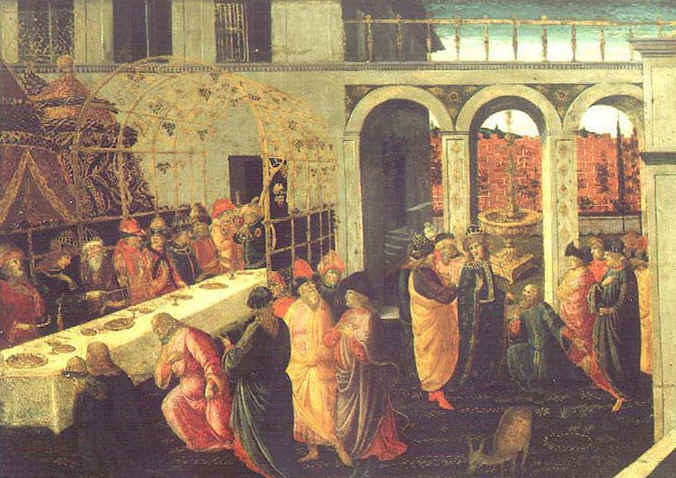
The Banquet of Ahasuerus’ by Jacopo del Sellaio (1442-1493)
If you’ve got it flaunt it…
In the third year of his reign Xerxes decided to throw a whooper of a house party. His banquet was meant to show off his fine china and his collection of bling to the whole world. 180 days worth of his vast wealth was put on display. But that wasn’t all. Xerxes also wanted to display another ‘possession’-his Queen, Vashti.
The account does not give the reason for Queen Vashti’s refusal to appear before Xerxes. Maybe she was having a bad hair day or maybe she didn’t like being put on display during the chattel call. Or, maybe, things between the king and queen went down just like they did on a certain Honeymooner’s episode. I’ll paraphrase:
Ralph (Xerxes) to Alice: “Remember Alice. I am the King of this household and you are nuttin’.
Alice (Queen Vashti): “Well, if you are the king, then you are the king of nuttin’”
In any case the Queen’s reply to the king’s emasculated seven (eunuchs that is) was, “No”. As you can imagine this answer did not go over well with Xerxes and did not bode well for the queen. Xerxes felt dissed before his previously wowed guests.
The wise men and nobles of his Xerxes’ court were summoned to court and asked “What response should be given to a Queen who refuses her king? Their reply: if this spousal refusal was found out by Xerxes’ subjects then all women would openly disobey their husbands-all hell would break loose (a KV paraphrase):
“This very day the Persian and Median women of the nobility who have heard about the queen’s conduct will respond to all the king’s nobles in the same way. There will be no end of disrespect and discord.”
The ‘wise’ men, those who were not physically eunuchs, decided that they would not be ‘emasculated’ by their own ‘disrespectful’ wives. So, using words that sounded like good political sense-keeping Xerxes kingdom under ‘proper’ social order and control-the wise men counseled Xerxes: Queen Vashti would be banished from his presence and then some.
These wise men also advised the king that a royal decree must be sent out, one that puts a finger in the dam of rebellion control. The king liked this advice and issued the edict: “every man should be ruler of his own household.”
Now, before all this falderal I would have recommended a little one on one communication with Queen Vashti before listening to the “yes”-men’ wise guys. I would also have recommended that king and queen read the original Love Language book, Solomon’s The Song of Songs. But that is not what happened. Protocol and paltry patriarchy gave way to punitive separation.
As you know, one bad decision easily leads to another. The queen was banished from Xerxes presence forever-a new law written into the books for Persia and Media. Then,
Esther Chapter 2 tells us that the king’s personal attendants suggested a beauty pageant of virgins to ‘assuage’ the King’s rueful heart. You see, Xerxes later regretted his decision. Men!
Here’s the good part: God’s sovereignty, regardless of bad men, bad advice and bad decisions does not affect God’s righteous purposes. They are rerouted through the king’s heart.
“In the LORD’s hand the king’s heart is a stream of water that he channels toward all who please him.” Proverbs 21:1. Wisdom always trumps folly.
Once again, Esther Chapter Two: Under the king’s command the chief eunuch, Hegai, was told to assemble beautiful virgins from every province into a harem at the citadel of Susa. These women were given an exclusive salon and spa treatment. It was figured that one of these select beauties women would replace the banished Queen Vashti. It is at this juncture that we meet another main character, Mordecai, a Jew of the tribe of Benjamin or, rather, wisdom and love personified.
“Mordecai had a cousin named Hadassah, whom he had had brought up because she had neither father nor mother. This girl, who was also known as (Hashtag) Esther, was lovely in form and features, and Mordecai had taken her as his own daughter when her father and mother died.” (The Book of Esther Chapter 2, vs. 7)
“I’m in heaven.” Esther quickly got Hegai’s attention She pleased him, winning his “favor”. Immediately she was put on a very short list of one contender. To channel things in the King’s direction, Hegai assigned to Esther seven select maids. He also gave her the royal salon treatment and put Esther and the seven maids into the best place in the harem.
Now the story and the “stream of water” begin to flow down a unexpected course, a fast-tracked one of God’s veiled purpose, the ramifications of which lead to a crisis of conscious for everyone involved including Esther.
Esther had not revealed to anyone her family background-she was Jewish. Mordecai had forbidden her to do so. In the days ahead Mordecai would keep close tabs on Esther, his beloved foster ‘daughter’. I believe Mordecai knew that Esther would fill a position in history that he as a man could not.
Esther was now neck (and face) deep into it. Court protocol demanded that any ‘girl’ who would appear before the king must beforehand undergo twelve months of beauty treatments-six months with oil of myrrh and six months of with perfumes and cosmetics. Henna for Hadassah? Probably.
The Match dot-Harem protocol of separating the sheep from the goats:
“And this is how she was to go to the king. Anything she wanted was given her to take with her from the harem to the king’s palace. In the evening she would go there and in the morning return to another part of the harem to the care of Shaashgaz, the king’s eunuch who was in charge of the concubines. She would not return to the king unless he was pleased with her and summoned her by name.” (The Book of Esther Chapter two, vs. 13-14)
LEFANEICHA ANI MISHTA-CHAVEI, AL BIRKAI
NOTEN LECHA SAMCHUT
AL KOL YAMAI
AHALEL OTCHA LE-NETZACH KI ATAH ADONAI
ATAH LE-VADCHA YESHUA, SIMCHAT CHAIYAI
KADOSH, KADOSH, KADOSH ATAH
(HOLY, HOLY, HOLY ARE YOU, LORD)
KADOSH, KADOSH ATAH
(HOLY, HOLY ARE YOU, LORD)
I WORSHIP BEFORE YOU, LORD
I’M DOWN ON MY KNEES
I’M GIVING YOU ALL MY DAYS, MY GOD, MY KING
I WILL PRAISE YOU FOREVER LORD, FOR YOU ARE ADONAI
YOU ALONE YESHUA, ARE THE JOY OF MY LIFE
Previous posts attempted to expose the Epicurean influence on modernity: the exclusion of God from the garden of good and evil and replaced with Darwinian materialism under the influence of man-made reasoning: “cogito ergo sum”.
The posts also revealed the inclusion of ‘reasoned’ or ‘rational’ people into the high-horse club of scientism. This exclusive club is governed by those who have the power, perhaps the raison d’état, to control the inputs and outputs of desired ‘truth’. “What is truth?” Pilate asked (when he thought he had the force of the whole Roman empire to define it.)
As I wryly mentioned in my previous posts the above either/or, God/science dichotomy came, at first, philosophically, from what I call Epicurus’ “High-Horse” Mal-ware. This mal-ware has since been downloaded over the centuries into each century’s modern man’s psyche. The devastating effect of the Mal-ware was to disable the AND gate of your truth tables. It was not to be used in queries.
Now, like the historically recorded scene of two thieves each hanging on cross with Jesus hanging between them, I offer a similar juxtaposition of two end results, two disparate “Imagines”.
One “Imagine” is Epicurean, God dismissed, materialistic, nihilistic and personified in the likes of former atheist Christopher Hitchens, materialist Barack Obama and fatalist Beatle John Lennon:
The other “Imagine” is God-inclusive. Here, God is the nucleus, the epicenter of being and meaning. Here, God and science coexist as Lion and lamb, creation being the sublime work of His hands, His signature found in the molded clay.
God’s Kingdom, now begun on earth, has become a dwelling place for all who see His light and follow it. True reality is made known to His followers by the Holy Spirit. The earthly spectrum of sodium street lights, of tungsten lights, of neon lights, of mercury lights, of halogen lights, of xenon lights, lights all of which enable us to see our way on earth are sourced from the Prism of Eternal Light.
“I believe in Christianity as I believe that the sun has risen: not only because I see it, but because by it I see everything else.” C.S. Lewis
At His appearance we will then know Him as He knows us. That Eternal Light you see is Love, not short-lived Epicurean fireworks and party favors.
Footnote: The above song by MercyMe was played during my son’s funeral service, about fourteen years ago. Justin was eighteen when the Lord took him home in a freak car accident. The police reported that it was a clear, sunny and dry day in Texas as Justin drove down a frontage road and lost control of the car. No other cars were involved. No drugs or alcohol were involved according to the Police report.
Justin had recently graduated from high school. The afternoon of his death he was driving back from his girlfriend’s house. We don’t know why this happened. We just know that we will see him again and this is not final. The Joy that only God’s True Love can give replaced the deepest loss I have ever experienced. Physics caused the physical death. But, Justin lives on.
Sure there is pain, loss and evil in the world. But God is greater than any of these, if you let Him be God in your life.
Previous posts have exposed the false either/or thinking of Epicurean philosophy and its now universally subverting High-Horse Mal-ware, a mal-ware that bifurcates mankind’s worldview.
At ‘ground level’ there is science, scientism, facts and secularism. In the attic are God, religion, values and meaning. Richard Dawkins and other angry atheists such as the former Christopher Hitchens, both keenly Epicurean, would opine “There’s probably is no god. Now stop worrying and enjoy life. Here is your ground game: avoid pain, seek pleasure and BTW there is evil in the world therefore God must be AWOL.”
The “Great Divorce” bus? vide C.S. Lewis
The Epicurus “High-Horse” Mal-ware landed on the shores of the New World ready to create a new saeculum- a new age. Thomas Jefferson declared himself to be Epicurean. Look at your dollar bill: ANNUIT CŒPTIS NOVUS ORDO SECLORUM=“Initiate the new world order”. The new world order of America was to become the Enlightenment’s gift to the world-Governor John Winthrop’s “city upon a hill” (1630).
Mankind in this New-Age-New-World, already exposed to “High-Horse” mal-ware, was thought by many to be made of random atoms which materially evolved without any help from above. Ergo, mankind would just as ‘freely’ determine its fate via scientism using a co-opted and modified European/Westphalian system of order (17th century) while keeping God at attic’s length. The pilgrims did inject a belief in an Epicurus defined fear-mongering God but their distant “Sinners in the Hands of an Angry God” Deist God would later only be mentioned at funerals and never mentioned on resumes. (I realize that I am summing up at lot in a short post.)
Now that you have heard about the Epicurus “High-Horse” Mal-ware you will begin to see its effects in every day life. For instance…
Recently Wisconsin Governor Scott Walker, a potential 2016 POTUS candidate, was asked if he believed in evolution.
“Wisconsin Governor Scott Walker, a potential U.S. presidential candidate, on Wednesday declined to say whether he believed that humans evolved from other life forms, a theory widely supported by scientists but rejected by many American voters.
“That’s a question a politician shouldn’t be involved in one way or the other,” Walker said during a question-and-answer session at Chatham House, a London think tank…
…When asked by the moderator whether he accepted the theory of evolution, Walker also declined to answer.
“I’m here to talk about trade, not to pontificate,” he said. “I love the evolution of trade in Wisconsin.”
Scientists widely agree that humans have evolved from other life forms over the course of millions of years, as English naturalist Charles Darwin first proposed in 1859.
But the theory of evolution is rejected by many evangelical Christians, who view it as conflicting with the Bible’s story that the universe was created in seven days.
More than four in 10 Americans reject evolutionary theory and believe that God created humans in their present form, according to a Gallup opinion poll conducted last June. Creationism runs strongest among older, more religious and less educated voters, the survey found”
Wow! “less educated voters”!! Talk about pompous “High-Horse” Mal-ware social manipulating scripting!
The intent of this line of questioning reported here and by other high-horse trolls was to expose Walker as intellectually weak: “Are you a “down-to-earth rational being who believes in science and evolution or are you another one of those silly Christians who believes in Creationism created by an AWOL god?”
The interviewer was hoping Walker would click on the “High-Horse” mal-ware message, make a fool of himself with a reply and then get spammed by the media. The question (Obviously I can’t read the interviewer’s mind but the question itself in this context was meant, I believe, to divide ‘rational’ believers in Darwinian evolution and materialism from the silly ‘superficial’ believers in a Creationist God.) The intent also, as I see it, was meant to contrast those who consider themselves really really smart, proud of their belief in scientism, Epicurean in their default cynicism against those who (in the interviewer’s mind) hold ‘silly’ religious “God is not dead” views. And, this question was posed to divide Walker’s base constituency of Christians. There are those who still hold to a young earth literalist Creation and there are those who have moved on with science and accept theistic evolution. These latter Christians accept that the first two chapters of Genesis are poetic in nature and are not to be interpreted as literal. These latter Christians also accept that these two chapters most definitely give us God’s perspective on mankind’s origin and purpose–Humanities 101.
Here’s another similar post ‘taken over’ by “High-Horse” mal-ware:
“Scott Walker Humiliates Himself On The World Stage By Dodging A Question About Evolution”
Walker was asked if he was comfortable with, and believed in evolution. It was a simple question that made the Wisconsin governor look like a fool, “For me, I’m going to punt on that one as well. That’s question a politician shouldn’t be involved in.”
Moderator Justin Webb of BBC Radio4 took Walker to task, “That is a question any British politician right or left wing would laugh and say, “Of course, evolution’s true.”
Gov. Walker replied by digging himself in deeper, “To me, I’m here to talk about trade, not to pontificate about other issues. I love the evolution of trade in Wisconsin. It’s going really well, and I’d like to see it even bigger.”
The implication being here, if I may, that “you are way too stupid to govern you silly little man, Scott Walker, if you don’t agree that science is the court of last resort and far superior to any irrational belief in a god.” “High-Horse” mal-ware defaces truth once again.
The interviewer’s question not only echoes Epicurus but also a Garden of Eden questioner. Remember the Genesis account of a ‘serpent’ speaking to Eve in the Garden? “Did God really say that you could not eat the fruit of that tree?” This could be taken as, “Does God really get involved or care or even know about your daily life? He shows up now and then. And what about that rule “don’t eat the fruit of that tree”? Would a ‘good’ God deprive you of the pleasure of ‘that’ fruit?
Epicurus would later answer (supposedly), “No, don’t deprive yourself. In my opinion even if there was a god he wouldn’t mind if you took your pleasure in the fruit of that tree. And is there a god? Men do evil and no good god would allow it. Let go of your fears. Go on Eve “Let It Go”, eat it. Any more questions?”
Now, if I were Scott Walker in that situation, my response would be, “Yes, I accept theistic evolution-a finely tuned theistic universe, a personal cause of the universe and a theistic objective morality. Science is only one of several tools for understanding the material world we live in and it won’t supply meaning. Science does not prove or disprove whether there is a god but it most assuredly hints at there being an Omnipotent Outsider. And.…(deep breath) I also accept the historical facts of the birth of God Incarnate–Jesus Christ, His “Sermon on the Mount” life among us for thirty years, Christ’s death on a cross, and his bodily resurrection. I accept the historicity of each of these facts. And, (another deep breath) I accept that all of this was done so that God could set up his Kingdom here on earth among men in order that He could make the earth righteous as he is righteous by redeeming and reconciling His eagerly awaiting creation to Himself. There will be no more bifurcation of heaven and earth. Any more questions?”
As I write this the U.S. is one nation under Epicurus, but not for long. The kingdoms and rulers of this world will soon be under submission to the One True God-The Lord Jesus Christ. This King of Kings and Lord of Lords shall reign for ever and ever.
“Worthy is the Lamb…”
Adoration of the lamb Jan van Eyck (circa 1390-1441) Ghent altarpiece
For further theistic evolution information see the Biologos website.
As my last post noted Greece, the home of the ancient philosopher Epicurus, rejected fiscal restraint and austerity in exchange for “Hope is coming” debt finagling.
Epicurus sans hammock
“Syriza” or “Let the Good Times Roll Without Repercussions Party” has won a short-lived victory in Epicurean Greece: “Avoid pain or at least spread it around. Give it to someone else. Let us work a few hours a week and then let us seek our pleasures. Let us surround ourselves with good friends and good drink. Forget the creditors. Those fools believed we would pay them back”. And so it goes in ancient modern Greece.
Well, back in the day Epicurus had an even bigger dilemma than a fiscal crisis. But it was a problem that he was able to philosophize or finagle away with even bigger denial than today’s Greeks. I am talking about the problem of evil.
The problem of evil–whether viewed as a man being burned alive or as a Roman crucifixion or as someone stealing cigars from a mini-mart or as one neighbor lying to another neighbor-is in our face daily. This enormous topic can only be glanced at in this post. I will give you a perspective to consider. First, let’s see what Epicurus foisted on his followers from his hammock ‘high horse’.
The originator of the logical problem of evil has been cited as the Greek philosopher Epicurus and this argument may be schematized as follows:
If an omnipotent, omniscient, and omnibenevolent god exists, then evil does not.
There is evil in the world.
Therefore, an omnipotent, omniscient, and omnibenevolent God does not exist.
This perspective of the problem of evil is held by many in the world. It is a perspective which atheism willing points to and one that bothers agnostics. It is a perspective that lends itself to the myopic religion of scientism where everything can only be validated through scientific proofs or, basically, through one’s senses (a more refined Epicurean philosophy). Yet, the above logical problem of evil is self-defeating. It assumes knowledge of good and evil.
One has to ask, how did Epicurus determine good and evil and the truth that defines them? Did he feel their effects via his physical senses? Did he and his friends determine what is good and what is evil via their collective senses? Did Epicurus make up ‘truth’ about good and evil by what his friends let him get away with saying? Or did Epicurus as a proto-Foucault define ‘regimes of truth’ as “the historically specific mechanisms which produce discourses which function as true in particular times and places”? Or, did Epicurus, as President Obama has recently done at the 2015 National Prayer Breakfast, use moral equivalency or relativism (in this case, high horse lecturing Christians with historical error) as a basis to decide what is a good and what is a bad by comparison (with God as a rubber stamp). It should be noted that none of these premises and perspectives is based on a perspective outside ones’ self or on an Absolute reference point. At the epicenter of these premises is self-serving man, ergo the likes of the American Humanist Association and their motto: “Good Without God“.
If you believe as pre-Darwin-pre-Enlightenment-pre-scientism Epicurus believed-that humans are just randomized atoms (as he called them) that “swerved” and collided to form the materialistic world-then how did a rational concept of good and evil enter our gardens of random atoms? Remember, in Epicurus’ worldview god had been expelled from the garden of good and evil.
This early formulation of the logical problem of evil, as I see it and now describe it, is when the Epicurus “High-Horse” Mal-ware began its download hactivism into the software of our networked psyche creating a down-through-the-centuries botnet. This Mal-ware put God in the “Recycle Bin” and made Him inaccessible. It also redirected our boot up executable file to scientism, making it our default root drive. Social manipulation by amoral hactivists and humanists keeps the botnet going.
The Epicurus “High-Horse” Mal-ware searches for any thought of God and seeks to delete it from your consciousness. It causes doubt spam and creates a zombie-like effect with regard to outside-your-senses thinking. You are made subservient to a ‘regime of truth’, to those who now have the power to control truth. And, there are many who would desire to do so in this present age. And remember, Pontius Pilate asked Jesus “What is truth?” as if Pilate could willy-nilly define truth through his earthly power.
For the sake of brevity I think you will agree with me that the logical problem of evil comes down to premises and perspectives. You may also agree with me that there is a need to wipe clean the hard drives of our minds of all Epicurus “High-Horse” Mal-ware.
Here is a proper perspective from Dr. Ron Rhodes regarding the existence of evil:
…it is impossible to distinguish evil from good unless one has an infinite reference point which is absolutely good. Otherwise one is like a boat at sea on a cloudy night without a compass (i.e., there would be no way to distinguish north from south without the absolute reference point of the compass needle).
The infinite reference point for distinguishing good from evil can only be found in the person of God, for God alone can exhaust the definition of “absolutely good.” If God does not exist, then there are no moral absolutes by which one has the right to judge something (or someone) as being evil. More specifically, if God does not exist, there is no ultimate basis to judge the crimes of Hitler. Seen in this light, the reality of evil actually requires the existence of God, rather than disproving it.
If Epicurus had read the even more ancient book of Job perhaps he would not have been so clueless and the “High-Horse” Mal-ware would never have been downloaded with its intent on hacking into our truth files.
One more perspective regarding truth, good and evil and moral equivalency:
C.S. Lewis has a few words to say about the matter, too:
“If the whole universe has no meaning, we should never have found out that it has no meaning: just as, if there were no light in the universe and therefore no creatures with eyes, we should never know it was dark. Dark would be without meaning.”
“Reason is the natural order of truth; but imagination is the organ of meaning.”
“There is but one good; that is God. Everything else is good when it looks to Him and bad when it turns from Him.”
My last post “Aren’t You a Bit Epicurious?” acquainted you with the ancient Greek philosopher Epicurus. I presented also several of his main theories, three of which in particular bring us to today’s post” Aren’t You a Bit Solipsistic?”
Epicurus believed that you could learn everything you needed to know through your senses, a form of solipsism but with his close friends at hand just in case he was wrong, I suppose.
Epicurus also promoted Demetrius’ proposition of Atomism-random, unguided ‘atoms’ (as he called them) smashing and swerving into each other, creating the world and life around him.
And, Epicurus also believed that the gods were distant and uninvolved and therefore unrelated to‘thinking’ and ‘sensing’ man’s life. Today, Epicurus’ philosophy is found, mutated, in the DNA of our zeitgeist. This post deals with the Epicurean presupposed philosophical divide between science and religion. So put on your thinking cap, Sherman.
Critical thinkers now that you have your thinking cap on and a pot of coffee brewing sit back and listen to Alvin Plantinga, Christian philosopher, discuss the topic at hand before students at Biola University Center For Christian Thought. (Note: Just after the one hour mark there is a Q &A session. The video upload is dated 2012.)
Suffice it to say, ‘n’ & ‘e’, is self-defeating and can’t rationally be accepted; evolution is compatible with “mere Christianity”.
And, solipsism is inherent in Darwinian materialism, narcissistic identity politics and predestinational behavioral social science.
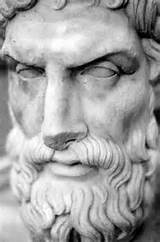
Little did he know at the time (341-270 B.C.) that he, Epicurus, a Greek philosopher, would be a founding father of the atheism sect, a sect which began its angry resistance movement when Jesus Christ appeared on the scene claiming to be God incarnate. Or, that he, Epicurus would be the gardener who would plant the seeds of the Enlightenment’s now perennial social Darwinism, seeds embedded with the DNA of Democritus’ dictum of random Atomism. Or, that he would be considered an ancient agnostic theologian who preached that the gods were out-of-the picture and the Roman gods were way too bossy. Or, that his philosophy would become an eponymous link with shameless pleasures.
An allegory of five senses. Still Life by Pieter Claesz, 1623. The painting illustrates the senses through musical instruments, a compass, a book, food and drink, a mirror, incense and an open perfume bottle. (via Wikipedia)
Epicurus had concluded that any idea of the ‘gods’ had to be put upstairs in the ‘attic’-out of sight, out of mind. Not seen. Not heard from. They should be not be given any consideration much less be feared. Epicurus had an alternative universe to offer his disciples.
Epicurus lived and taught a moderate lifestyle, keeping to himself and to his close friends. He believed and taught that one could learn everything through one’s senses. He counted the senses as trustworthy.
Epicurus spoke of natural desires in life such as food and shelter which one could not live without (a no-brainer). And, he spoke of the natural desire for sex which one could live without (a no-boner). In practice, unlike today’s hedonistic Epicureans, Epicurus was pleasure-passive but not in the sense that he would waste away his time in Margaritaville.
Epicurus also taught that wealth and fame should be avoided because they are intrinsically narcissistic and appeal only to vanity. These things were to be considered ephemeral. (Al Sharpton and a host of politicians and Hollywood stars would not be examples of true Epicureanism.)
As Epicurus was a proponent of living a quiet and peaceful life, unnoticed by the world I am reminded of the Apostle Paul’s missive to the church in Thessalonica (circa Ad 52). Paul’s letter was likely written from Corinth the home of Aphrodite’s temple-a hedonist hangout. He encouraged the Christians in Thessalonica to “… make it your ambition to lead a quiet life: You should mind your own business and work with your hands, just as we told you,” (I Thess. 4:11 )
Epicurean philosophy, detached from its sedate founder’s teaching, would later become associated with extreme pleasure seeking. Per Wikipedia, a “hedonist strives to maximize net pleasure (pleasure minus pain)”. And, with the angry ‘gods thought of as remote, unconcerned and out of the picture a hedonist could unleash and unlock the Animal House within him. But, Epicurus was not a Caligula in pursuit of untold ‘pleasures’. There were no toga parties at Epicurus’ home.
“Seek pleasure in peace and pursue it” was his cart’s bumper sticker-right next to his “COEXIST” bumper sticker.
Due to his compartmentalizing, putting god upstairs and putting earthly pleasure as a priority, Epicurus can also be considered as one of the founding fathers of the fact/value split, a split where science and religion and politics and religion are deemed to have no common ground-in heaven nor on earth. This Epicurean dichotomy would eventually cause Americans to exile God from their thinking. To fill the vacancy America would welcome all manner of European philosophical and psychoanalytical nonsense as well as all manifestations of statistical ‘science’. (See my post “How Shall I Then Live” regarding the fact/value split.)
Sadly it was with an Epicurean mindset already in place that America’s founding fathers including Thomas Jefferson wrote the U.S. Constitution as the divorce papers to be served on God –God was not to be part of our nation’s public’ life: And though our currency reads “In God We Trust”, that has come to mean “God is our fall back position”. “You may worship God up there but just don’t bring him down from the attic into our Novus ordo seclorum” (see your after tax currency of the New World for both mottos).
It probably could be said that the Epicurean philosophy was the origin of Freud’s Pleasure Principle. The Principle simply stated, is that man’s default modus operandi is to pursue pleasure and avoid pain. Here it would appear that neo-Epicurean philosophy influenced at least Christopher Hitchens, a well-known provocateur atheist given to well-documented habits of smoking, strong drink and other ravishing appetites, a raison d’etre for a pleasure seeker like Hitchens-but only in his previous life.
Mr. Epicurus, on the other hand, took his afternoon delight in hammock contemplation of Atomism, the dictum of his day: life is reducible to invisible atoms which swerve and smash randomly into each other without a defining purpose. This dictum could well define the “angry atheists” Atomistic arguments against the existence of God. (During Epicurus time you had to walk by faith to believe in invisible atoms and no God. Later quantum physics via the LHC and other nuclear colliders would provide us with the silhouettes of nuclear particles including bosons but many scientists chose not to see God as Creator of this “Atomism”)
Today, “angry atheists,” one such is Richard Dawkins, continue to swerve and smash their Atomistc-like arguments against God’s apologists but their pro-atheistic arguments never coalesce into anti-God anti-matter. And, when everything else they have said fails to discharge God from the universe these angry fellows and their devoted followers resort to ad hominem and strong drink.
Epicurus is the man for all reasons today. Here is someone who can say it better than I.
N.T. Wright, a New Testament scholar, notes Epicurus’ influence on modern man in his recent book “Surprised by Scripture.” Here are some quotes from Chapter One “Healing the Divide Between Science and Religion”.
“You could sum up Epicurus’ philosophy, at least in its desired effects, with the slogan Richard Dawkins and his associates put as an advertisement on London buses two or three years ago: “There’s probably no god. Now stop worrying and enjoy your life….
So, for Epicurus, there was nothing to worry about. Draw a direct line from him to John Lennon: imagine there’s no heaven, no hell beneath us; now get on and live for today. The image of Epicurus as a hedonist is true, but it was a very refined hedonism, since he taught that the more obviously bodily pleasures didn’t last and produced less pleasurable effects.”
Wright goes on to say that
“The philosophy of Epicurus was given a major new lease on life by the Roman poet Lucretius, who lived about seventy years before Jesus….In Lucretius it all become clear and straightforward. The world is what is it is because of (what he called) atoms, which, free-falling through space, collide with one another, sometimes combining and sometimes bouncing off…major changes are caused by the inexplicable “swerve” that sometime happens to atoms so that they veer off in new directions and produce different results. But the main point is essentially what we would today call the evolutionary thesis: life in the world has developed under its own steam as the random by-product of chance collisions and combinations of atoms and the more complex life-forms they produce….
The second point I want to make about the rise of Epicureanism at the dawn of modernity, and particularly in the origins of the Enlightenment, is that it was seized upon not least because of it political implications. That is clear already in Machiavelli and Hobbes, but it comes to fore in the eighteenth century.”
The Epicurean endorsed idea that random free-floating atoms made the world what it is ‘swerved’ into the mix of political ideologies which rejected monarchy and a ‘bossy-guy-upstairs’ rule. “Vox populi vox Dei is the cry-but then Deus himself disappears off into the far beyond, and vox populi is all we’re left with.” N. T. Wright, and again:
“…Democracy can generate new forms of tyranny, and once we have sold our souls to a particular voting process there no way back. We need to return to the drawing board and think more clearly about whether the natural and proper human passion for freedom and the natural and proper need for order and stability are best served by the kinds of democracy we have developed, without the aid of the divine or monarchial intervention from above, on the model of the Epicureanism that has proved so popular and influential.” (I would add that it appears that radicalized Islam seeks to place their false god Allah on the world’s throne. N. T. Wright is referring to the One True God-YHVH-“I Am That I Am”.)
The threads of Epicurus philosophy are woven throughout our life’s fabric. As Wright notes, “Basically, the American dream is that if you get up and go, you’ll succeed; the egalitarian hope is that the fittest will survive the economic jungle”. And, as I noted above Epicurean philosophy began the fact value split that modern man uses as his template for all of life’s questions, whether personal or political.
Do I look to God or to some form of science for life’s contextual meaning? Am I a random mix of atoms evolved into a human form? Is life only meant for pleasure seeking and pain avoidance and at any cost to me and to my fellow man. Should I vote to obtain pleasure? And so on…
For Christians (for all, really) what does it mean that the Kingdom of God has been established on earth? N.T. Wright, in his book referenced above, goes on to explore the current thinking and a Christian response to an Epicurean worldview. For now, there is way too much of Wright’s insight to post today. Except to say that sadly the world now divides science and religion into separate rooms –one downstairs and one upstairs. This should not be. I am convinced that science and properly tuned philosophy support God’s existence, Scripture and the work of His hands. As Francis Schaeffer of L’ Abri once wrote, “He is there and He is not silent.” I’ll save that for other posts.
Final thoughts. As mentioned above Epicurus treasured his close friends. They were very important to him. And I would imagine they would be.
In a universe where god is perceived as remote, uninterested, detached and at best considered as always-looking-down-on you angry and bossy it feels good to have close like-minded friends to commiserate with: “Dionysus my friend, pass the wine and let us sing ”Don’t Worry, Be Happy””.
Now, you should know from previous posts that I accept the theory of theistic evolution with its old earth creationism. (BTW: after learning about Epicurus you should know that the Atomism dictum that he promoted well preceded any Darwinian theory of evolution.) Having said this I would offer the following friendly apologia.
Each of us as God formed evolved humans can ‘recognize’ another person, the ‘other,’ via our evolved senses. Can we agree that this was done at a prehistoric man level? And, when one cave man was hungry and another cave man was also hungry they may have then formed a hunter/gatherer tribe to fulfill their basic need for food. Again, this was done at a prehistoric man level.
Now fast forward millions of years and hold on. Epicurus understood his friends at a basic human level-through his basic five senses. The fact the he held them dear meant that he looked outside of himself and considered the ‘other’ as worthy, perhaps starting from a place of tribalism. (I hope I’ve made you epicurious.)
Certainly myriad mutations have made our basic senses ‘alive’ and aware that another being in our presence is either friend or foe. But it is only God’s likeness incarnated into the once primate-now human form that can bring about an embrace, a love for the ‘other’. Human friendship and human love was born out of a different tribe, a tribe not of the Epicurean worldview-the Dancing Embrace of the Trinity Tribe.
“Joy to the World, the Lord has come, Let earth receive her King”: The Kingdom of God is heaven and earth, science and religion and you and me in one eternal embrace with the Trinity.
At the beginning of Kingdom of God on earth and during his Sermon on the Mount, Jesus-I AM That I Am-reminds us that we are being watched over with love and care. Jesus nullifies Epicurean philosophy, if we let Him.
“We have entered, as I see it, a spiritual limbo. Our educational institutions are no longer the bearers of high culture, and public life has been deliberately moronised. But here and there, sheltered from the noise and glare of the media, the old spiritual forces are at work” Roger Scruton
*****
“When a common culture declines, the ethical life can be sustained and renewed only by a work of the imagination.”-Roger Scruton
*****
“Jesus prayed, “This is eternal life, that they may know You . . .” (John 17:3). The real meaning of eternal life is a life that can face anything it has to face without wavering. If we will take this view, life will become one great romance— a glorious opportunity of seeing wonderful things all the time. God is disciplining us to get us into this central place of power.” Oswald Chambers
*****
“No power on earth or in hell can conquer the Spirit of God in a human spirit, it is an inner unconquerableness.” Oswald Chambers
*****
To those who have had no agony Jesus says, “I have nothing for you; stand on your own feet, square your own shoulders. I have come for the man who knows he has a bigger handful than he can cope with, who knows there are forces he cannot touch; I will do everything for him if he will let Me. Only let a man grant he needs it, and I will do it for him.” The Shadow of an Agony,Oswald Chambers
*****
“If we wish to erect new structures, we must have a definite knowledge of the old foundations.” John Calvin Coolidge
*****
Atheism is a post-Christian phenomenon.
*****
If social justice looks like your hand in someone else’s pocket then you are stealing.
*****
“In Sweden, giving to charity, absurdly, came to be considered a lack of solidarity, since it undermined the need for the welfare state.” – Roland Martinsson
*****
“…to love democracy well, it is necessary to love it moderately.” Alexis de Tocqueville
*****
Capitalism seeks to help others through a servce or product it provides. Free Market Capitalism is the most moral and fair economic system available to man. Capitalism augments personal growth, responsibility and ownership. Charity flourishes under capitalism. Charity dies under subjective “fair share” government confiscatory policies. Socialism redistributes ambivalence and greed.
*****
“We are to regard existence as a raid or great adventure; it is to be judged, therefore, not by what calamities it encounters, but by what flag it follows and what high town it assaults. The most dangerous thing in the world is to be alive; one is always in danger of one’s life. But anyone who shrinks from that is a traitor to the great scheme and experiment of being.” G.K. Chesterton
*****
Any intelligent fool can make things bigger, more complex, and more violent.
It takes a touch of genius – and a lot of courage – to move in the opposite direction. Albert Einstein
*****
“You shall know the truth and the truth shall make you odd.” Flannery O’Connor
*****
“There is but one good; that is God. Everything else is good when it looks to Him and bad when it turns from Him.” C.S. Lewis, The Great Divorce
*****
“Though He slay me, yet will I trust Him” (Job 13:15).
*****
God’s grace is not about the allowance for sin. God’s grace is about the conversation God allows regarding sin.
*****
From the book of Proverbs: We are not to favor the rich or the poor. We are to pursue justice.
*****
“Always keep in contact with those books and those people that enlarge your horizon and make it possible for you to stretch yourself mentally.” Oswald Chambers
*****
One goldfish says to another, “If there is no God who keeps changing the water?”
*****
“The truth is always there in the morning.”
From Cat On A Hot Tin Roof script – playwright Tennessee Williams
*****
God blesses those who hunger and thirst for justice, for they will be satisfied.
*****
“America’s greatness has been the greatness of a free people who shared certain moral commitments. Freedom without moral commitment is aimless and promptly self-destructive.” John W. Gardner
**
“Men of integrity, by their very existence, rekindle the belief that as a people we can live above the level of moral squalor. We need that belief; a cynical community is a corrupt community.” John W. Gardner
*****
“In the world it is called Tolerance, but in hell it is called Despair, the sin that believes in nothing, cares for nothing, seeks to know nothing, interferes with nothing, enjoys nothing, hates nothing, finds purpose in nothing, lives for nothing, and remains alive because there is nothing for which it will die.” Dorothy L. Sayers
*****
“Art, like morality, consists of drawing the line somewhere.”
G. K. Chesterton
*****
“The battle line between good and evil runs through the heart of every man.” Alexander Solzhenitsyn
*****
This is what the LORD says:
“Stand at the crossroads and look;
ask for the ancient paths,
ask where the good way is, and walk in it,
and you will find rest for your souls.
But you said, ‘We will not walk in it.’
-The prophet Jeremiah, 6:16
*****
“…our common task is not so much discovering a truth hiding among contrary viewpoints as it is coming to possess a selfhood that no longer evades and eludes the truth with which it is importunately confronted.” James McClendon, Ethics: Systematic Theology, Vol. 1
*****






 Cindy Wity
One Nation Under Epicurus?
February 14, 2015 Leave a comment
Previous posts have exposed the false either/or thinking of Epicurean philosophy and its now universally subverting High-Horse Mal-ware, a mal-ware that bifurcates mankind’s worldview.
At ‘ground level’ there is science, scientism, facts and secularism. In the attic are God, religion, values and meaning. Richard Dawkins and other angry atheists such as the former Christopher Hitchens, both keenly Epicurean, would opine “There’s probably is no god. Now stop worrying and enjoy life. Here is your ground game: avoid pain, seek pleasure and BTW there is evil in the world therefore God must be AWOL.”
The “Great Divorce” bus? vide C.S. Lewis
The Epicurus “High-Horse” Mal-ware landed on the shores of the New World ready to create a new saeculum- a new age. Thomas Jefferson declared himself to be Epicurean. Look at your dollar bill: ANNUIT CŒPTIS NOVUS ORDO SECLORUM=“Initiate the new world order”. The new world order of America was to become the Enlightenment’s gift to the world-Governor John Winthrop’s “city upon a hill” (1630).
Mankind in this New-Age-New-World, already exposed to “High-Horse” mal-ware, was thought by many to be made of random atoms which materially evolved without any help from above. Ergo, mankind would just as ‘freely’ determine its fate via scientism using a co-opted and modified European/Westphalian system of order (17th century) while keeping God at attic’s length. The pilgrims did inject a belief in an Epicurus defined fear-mongering God but their distant “Sinners in the Hands of an Angry God” Deist God would later only be mentioned at funerals and never mentioned on resumes. (I realize that I am summing up at lot in a short post.)
Now that you have heard about the Epicurus “High-Horse” Mal-ware you will begin to see its effects in every day life. For instance…
Recently Wisconsin Governor Scott Walker, a potential 2016 POTUS candidate, was asked if he believed in evolution.
Wow! “less educated voters”!! Talk about pompous “High-Horse” Mal-ware social manipulating scripting!
The intent of this line of questioning reported here and by other high-horse trolls was to expose Walker as intellectually weak: “Are you a “down-to-earth rational being who believes in science and evolution or are you another one of those silly Christians who believes in Creationism created by an AWOL god?”
The interviewer was hoping Walker would click on the “High-Horse” mal-ware message, make a fool of himself with a reply and then get spammed by the media. The question (Obviously I can’t read the interviewer’s mind but the question itself in this context was meant, I believe, to divide ‘rational’ believers in Darwinian evolution and materialism from the silly ‘superficial’ believers in a Creationist God.) The intent also, as I see it, was meant to contrast those who consider themselves really really smart, proud of their belief in scientism, Epicurean in their default cynicism against those who (in the interviewer’s mind) hold ‘silly’ religious “God is not dead” views. And, this question was posed to divide Walker’s base constituency of Christians. There are those who still hold to a young earth literalist Creation and there are those who have moved on with science and accept theistic evolution. These latter Christians accept that the first two chapters of Genesis are poetic in nature and are not to be interpreted as literal. These latter Christians also accept that these two chapters most definitely give us God’s perspective on mankind’s origin and purpose–Humanities 101.
Here’s another similar post ‘taken over’ by “High-Horse” mal-ware:
“Scott Walker Humiliates Himself On The World Stage By Dodging A Question About Evolution”
The implication being here, if I may, that “you are way too stupid to govern you silly little man, Scott Walker, if you don’t agree that science is the court of last resort and far superior to any irrational belief in a god.” “High-Horse” mal-ware defaces truth once again.
The interviewer’s question not only echoes Epicurus but also a Garden of Eden questioner. Remember the Genesis account of a ‘serpent’ speaking to Eve in the Garden? “Did God really say that you could not eat the fruit of that tree?” This could be taken as, “Does God really get involved or care or even know about your daily life? He shows up now and then. And what about that rule “don’t eat the fruit of that tree”? Would a ‘good’ God deprive you of the pleasure of ‘that’ fruit?
Epicurus would later answer (supposedly), “No, don’t deprive yourself. In my opinion even if there was a god he wouldn’t mind if you took your pleasure in the fruit of that tree. And is there a god? Men do evil and no good god would allow it. Let go of your fears. Go on Eve “Let It Go”, eat it. Any more questions?”
Now, if I were Scott Walker in that situation, my response would be, “Yes, I accept theistic evolution-a finely tuned theistic universe, a personal cause of the universe and a theistic objective morality. Science is only one of several tools for understanding the material world we live in and it won’t supply meaning. Science does not prove or disprove whether there is a god but it most assuredly hints at there being an Omnipotent Outsider. And.…(deep breath) I also accept the historical facts of the birth of God Incarnate–Jesus Christ, His “Sermon on the Mount” life among us for thirty years, Christ’s death on a cross, and his bodily resurrection. I accept the historicity of each of these facts. And, (another deep breath) I accept that all of this was done so that God could set up his Kingdom here on earth among men in order that He could make the earth righteous as he is righteous by redeeming and reconciling His eagerly awaiting creation to Himself. There will be no more bifurcation of heaven and earth. Any more questions?”
As I write this the U.S. is one nation under Epicurus, but not for long. The kingdoms and rulers of this world will soon be under submission to the One True God-The Lord Jesus Christ. This King of Kings and Lord of Lords shall reign for ever and ever.
“Worthy is the Lamb…”
Adoration of the lamb
Jan van Eyck (circa 1390-1441)
Ghent altarpiece
For further theistic evolution information see the Biologos website.
Rate this:
Filed under Christianity, Creationism, Culture, evolution, Political Commentary, Science, theistic evolution Tagged with Christopher Hitchens, Epicurean philosophy, Kingdom of God, philosophy, politics, scientism, Scott Walker, theistic evolution, Wisconsin Governor Scott Walker