And Nothing but the Whole Elephant
October 1, 2017 Leave a comment
Jesus said to them, “If the world hates you, know that it hated me before you. If you were from this world, the world would be fond of its own. But the world hates you for this reason: that you’re not from the world. No: I chose you out of the world.” John’s gospel account 15: 18-19
~~~
From the many conversations I have had on Twitter, the word on the street is that “God is love and is all about love. We love, so we are doing what God accepts.” So, where does the world’s hate come in?
The hate spoken of in John’s gospel is generated by a protection of one’s place in the world against “outsiders”. Over and over again I have had that hatred and vitriol directed at me on Twitter. I cannot show you the Tweet replies. They are vulgar and pernicious. The replies come from a place beneath this world.
The hate-filled replies occur when I say something other than what is considered loving by those protecting their place in the world. Replies are derived from a worldview. And, one’s worldview depends on whether you accept being called out of this world knowing that that those in the world will hate you or if you are in this world for its approbation:
Called-Out Ones worldview: “For God so loved the world, that He gave…”
Social Justice Warrior (SJW) worldview: “For the world so loved me, when I…”
In order to make the world-accepted SJW worldview sustainable, mainstream churches create a Jesus who is palatable, marketable, consumable and renewable. The ministers do this by parsing Scripture into love notes. Their resultant Scripture messages, whether in a sermon or in a blog or on Twitter, remind me of a bag Valentine Sweethearts – candy hearts.
These churches promote “inclusion” because in a consumer-driven society, choice of how you live, choice of what you accept and who you accept, choice of right and wrong-choice becomes the ultimate approbation in this world.
~~~
Coming to a church near you: a populist theology which promotes the acceptance of the gay lifestyle, universal health care and illegal immigration all as works of Christian charity from the pulpits of body-of-Christ-divisive politics (race, gender, class, sexuality, etc.). This populist theology uses the high-sounding term “social justice” so as to neutralize detractor’s objections and to force a consensus, a groupthink around the premise of political correctness redefined as God’s love.
I encounter this populist theology every day now. If you are on Twitter “fighting the good fight”, you may receive the same replies from Catholics that I did. They go something like this:
1. “God is love. I know many committed gay couples who love each other.”
2. “Jesus never talked about sexuality or homosexuality, therefore it is a non-issue. If Jesus was concerned about homosexuality he would have said something.”
3. “Jesus is about loving your neighbor. Jesus is not judgmental. Jesus is fully accepting, inclusive. He’s about loving the homosexual. Who are we to judge?” (from Pope Francis’, “Who am I to judge?”).
4. “Loving your neighbor means universal healthcare. You are not charitable if you are against universal healthcare. You must be a Conservative who hates people.”
5. “Jesus and Paul are not the same. Jesus is love and Paul is rules. Jesus is universal love. Paul, on the other hand, is a picayune fundamentalist and fundamentalists are authoritarians. Jesus would say “Live, love, eat, pray and let live.”
6. “Jesus is social justice. He talked about helping the poor. Dorothy Day is a hero. Many of our heroes are beatified saints, saints who did good deeds while alive. Jesus demands good works from us. “Faith without works is dead”.”
7. “Women are talking in church. Women are being ordained. Scripture is being updated and should be inclusive of homosexuality, as well.”
My first thought when I encountered these replies: “The Catholic church has done great harm to its charges by not teaching the whole of Scripture, the whole council of God.” Scripture has been defined down to a constructed abstraction of Jesus’ words.
One of the main reasons the populist theology has taken root in the Catholic and all (yes, all) of the mainline churches, I believe, is the lack of Scripture knowledge coupled with a deficit of personal faith-history. Deism is pervasive in the church: “God and His Word are far away from reality and not relevant to what I am experiencing”; “You don’t understand same-sex attraction. You can’t change me so, accept me for what I am.”
Post-modernist pop-theologians rightly question history and what has been passed down through millennia but without a sufficient regard for and knowledge of the discipline of the study of history – factual non-repeatable events. Their pick-and-choose history approach leads to utter confusion about who Jesus is, what happened the first century and to whether or not Jesus even existed. I have witnessed such dissociative history making on Twitter. Such groping at history and at Scripture reminds me of the Indian parable of the blind men and the elephant: each of the blind men encounter a different part of the elephant (trunk, tail, etc.) and then return home and proceed to project their ‘understanding’ of the elephant as the elephant while claiming the other five blind men must be mistaken. 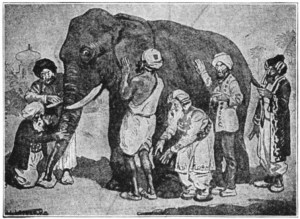
Populist theology also has historical Leftist ties (“Unconstrained vision” is the term used by Economist Thomas Sowell to define the philosophy of the Left). Political philosopher Jean-Jacque Rousseau wrote, “man is born free, but is everywhere in chains.” Another philosopher, Marquis de Condorcet, believed that men in their natural state with a “natural inclination” would seek out the social good. For them, man’s nature was not the problem. Rather, institutions needed to be reformed so that man’s better nature would come out. Hence, pop-theology presses for reforms: the church must be reformed to help men to realize their better nature. “We are so much smarter now,” is the inference.
Enter the church’s “social justice” moment. And the “social justice” proffered is done under the guise of the common good but it is in reality a narrowing of focus down to subjective individual rights and individual happiness, in parallel with what is happening politically in Europe and the U.S. currently. The “common” part of their “common good” are those who share the same self-directed interests. Others must conform to their self-interests for the common good.
My second thought after reading the above replies: “It is time for another reformation – putting the Bible (again) into people’s hands and teaching them how to read it for themselves.”
It would seem that many of the above respondents view Scripture through the lens of a post-modern Epicurean Catholic world view, a worldview which replaces historical narrative (in this case, derived from the “faith once delivered”) with a relevant “social gospel” or populist theology promulgated as authentic Christianity. And with little knowledge of Scripture many Catholics are ‘falling’ for what they have been taught by the top-down government and media of the Catholic church and its social justice-primed priesthood.
When they do (see replies above) they end up with a Jesus who is fantasy blend of Dorothy Day, Ghandi, Mr. Rogers and a Democrat with a Jesus bleeding heart – an ends-justifies-the-means person. In other words, they end up not with a literal historical Jesus, but rather a figurative Jesus and one disposed to making you and your world feel good about doting on yourself. And, if you can get other people to dish out love and charity and “understanding” and, most importantly, cash, then you have done right by pseudo-Jesus.
Every self-designated Catholic I have encountered on Twitter appears to know little or nothing of Scripture. For them, it seems, raw Scripture, ‘unrefined’ by the Catholic priesthood, seems to be tied to evangelicals who are considered fundamentalists and therefore, presumptively, not connected with their Jesus’ all-assuming love. What they know and repeat is what a priest or Jesuit tells them, and their reply is usually about social justice, a catch-all for not being judged but for being loved.
Without making this post too long, here are some of my quick replies to the above points. Feel welcome to add yours in the comment section below.
1. The plea bargaining “God is Love” defense is foiled when you define love, not in terms of codependence and sexuality, but as desiring the ultimate good for another. This of course leads to a definition of what is good. I reply with Jesus’s request of the Father, “Set them apart for yourself in the truth; your word is truth.” (John 17:17)
2. When someone says that Jesus never talked about homosexuality I remind them that Jesus’s mission was to the lost sheep of Israel, the ones who were supposed to be “a light to the Gentiles”. The Israelites knew the law, the Torah. The law forbids homosexuality. This was common knowledge in the first century. Jesus did not need to repeat it. Paul, on the other hand, an apostle to the Gentiles did need to speak about the matter (e.g., Rome, Ephesus, etc. had temples to pagan gods which involved all manner of sexual immorality.)
3. Here we have justification by plea bargain. Jesus prays for his own that they will be sanctified, separate – taken “out of the world” worldview.
4. If you know Scripture then you know that Jesus did not heal everyone in the world during his earthly time. He told us that we can do the same and greater things than he has done when filled with the spirit. Beyond the fact of outright healing, there is the matter of personal healthcare. Universal healthcare replaces a person’s personal responsibility for their health with a non-caring impersonal government bureaucracy. This costly tax-payer bureaucracy will need to control your behavior, your paycheck and the doctor’s practice to control costs. As such, it is loving to not desire socialized coverage.
5. When I hear someone say that Jesus is Gospel and Paul is not relevant I remind them that Jesus met Paul on the road to Damascus. In the fullness of time Jesus encountered Paul. I remind them that Paul right then and there became an eyewitness of Jesus and therefore an apostle. I remind them that Jesus sent Paul to be Jesus to the Gentiles – the heathen, the pagans, the unclean. I tell them that Paul wrote the theology of the newly established Kingdom of God on earth in his letters to the infant churches.
6. I remind them that the gospel is “Jesus is Lord”. All else falls in line and in order under this proviso: salvation, sanctification (called out of the world) and then social gospel (to affect the world under the direction of the Kingdom’s Lord.)
When Jesus tells the rich man “Sell all you have and give it to the poor” we understand the means to the rich man’s salvation: renunciation of his coveting relationship of wealth- a relationship which came between Jesus and the rich man, sanctification (separation from the love of his money and the hold it had on him) and then faith with works – a complete detachment from self-preservation- giving his wealth to the poor, a product of the new Kingdom focus.
7. Women vs. gay acceptance and Scripture: I remind them that there is a difference between culturally defined and morally defined. There is a difference between cultural practice and culturally-imposed taboos and doctrinal principles and God-directed temperantia-God’s ordered structure for the being of man. Paul wrote about the former in his letters to the church at Corinth. Anything perceived as ambiguous was directed back to a person’s Holy-Spirit directed conscious.
It is no secret that the Evil One’s mission from the very beginning is to ask, “Did God really say you couldn’t…?”
Pop-theology proposes to modernize and conform the church to be a welcoming inclusive place for whatever the prevailing winds of PC doctrine bring to the church’s door step. Be it known: the called-out ones – the ecclesia – will remain faithful under the Lordship of Jesus. The churches that wallow in the world will have their candlestick taken away. In the dark their mutual admiration society will be left grappling with elephant parts.
Added 10-4-17:



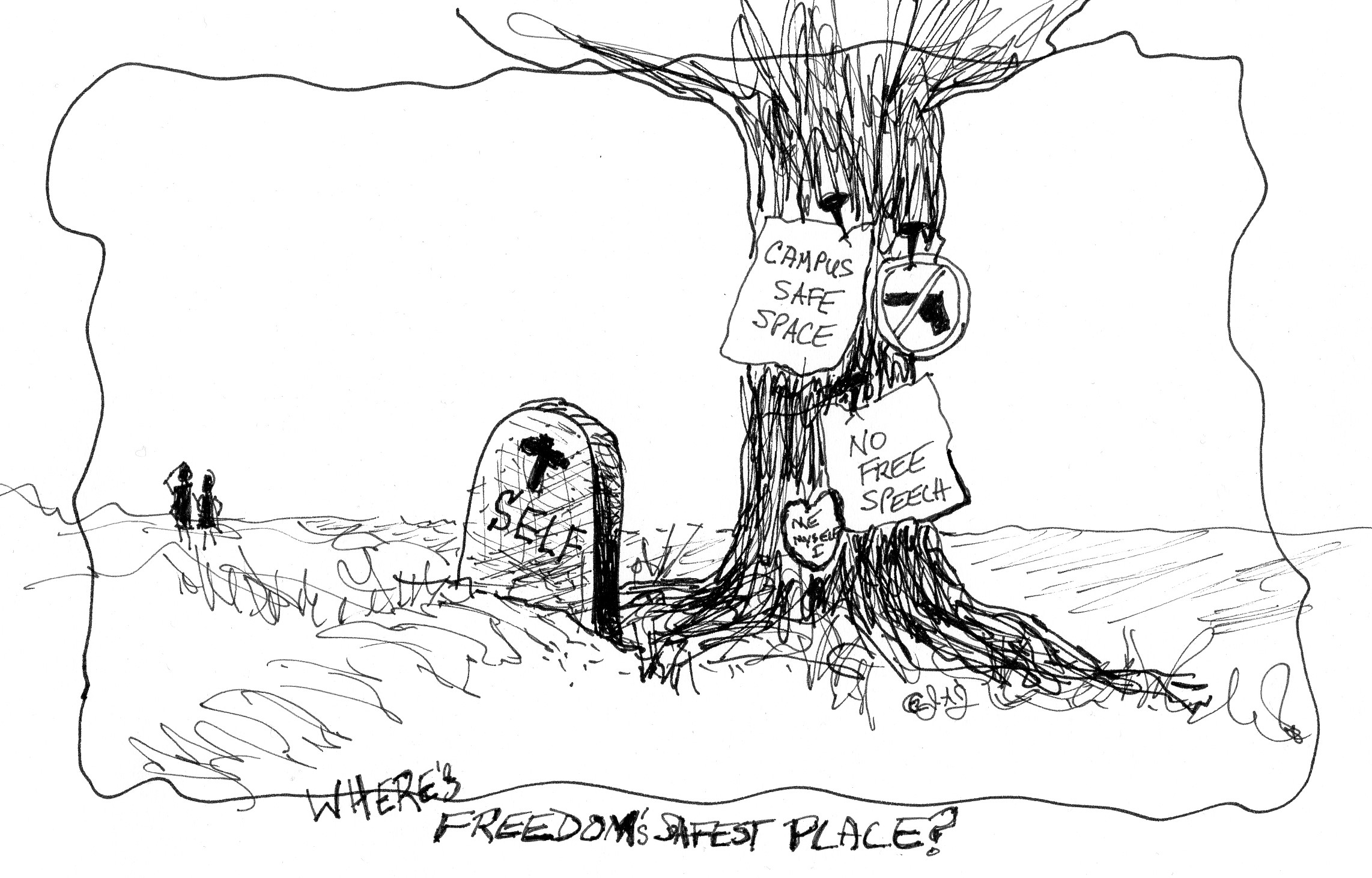




 Cindy Wity
Radical Secularism Won’t See Us Through
January 14, 2018 Leave a comment
“If we are so troubled and perplexed, if we search for the right words and bite our tongues, this is because these three elements are constitutive parts of our situation and the great fact of Islam that is at the center of our struggles, for Muslims and for non-Muslims, together or separately.” Pierre Manent, Beyond Radical Secularism
~~
Manent, in his book Beyond Radical Secularism, suggests that the Islamic phenomenon presents three distinct and yet interdependent elements which must be addressed by Europe and, I suggest, ultimately by the U.S.: Muslim immigration, Muslim settlement and mosques financed by Gulf States, and Islamic terrorism.
How do we as a nation begin to address the three elements? Do we call others “Islamaphobic” or “Xenophobic” and content ourselves with pointed fingers and huffing? Do we act like a Jesuit I know and parse out isolated Scripture from the Bible to push the Progressive notion that to be a good country one must have Open Borders and welcome all comers with no conditions placed on refugees/immigrants while hoping things will all work out, while not taking into account the unintended consequences for both parties and without accruing any personal cost? Or, do we as a people living within the Kingdom of God on earth address the complex issue at hand? Do we acknowledge who we are as a nation and our Christian heritage and also acknowledge Muslims?
I suggest Manent’s Beyond Radical Secularism is a good place to begin looking at the matter before us.
Several months have passed since I read though Pierre Manet’s twenty essays, essays encapsulated in his book Beyond Radical Secularism. Before too much more time passes I wanted to record what I learned from the essays along with my reflections.
This is not a book review. Rather, this post is me trying to understand the Islam situation facing the U.S. and doing so through the eyes of French academic and political scientist Pierre Manent whose own country of France is having to come to terms with the Muslims. My thoughts are interspersed with Manent’s words.
From the book’s Introduction by Daniel J. Mahoney:
“In this, his latest book (originally published in France as Situation de la France), Manent brings together his considerable theoretical and practical concerns with rare spiritual depth. He reveals the failure of Europe’s humanitarian civil religion and pleads for a restoration of prudent judgment, rooted in a searching exploration of the theological-political problem. He reveals just where the de-politicization and de-Christianization of Europe has led the continent and his native France. Refusing to despair, and not content with literary politics and facile criticism, Manent lays out a practical philosophy that shows Europe and the West that deliberation and action remain as available to us as they were to Pericles and St. Paul.” (Emphasis mine)
As noted above, Manent writes from a French perspective. Yet, his home turf insights can provide significant direction for U. S. immigration policies addressing the “three elements” noted above.
In Manent’s assessment of the current political situation, he sees both France and the West looking weak:
“As rich as we still are in material and intellectual resources, we are politically without strength. Doubtless this has not escaped the attention of those who now attack us.” (From the Preface)
France and the West, Manent points out, are capitulating to radical secularism–a stripping of the national landscape of political and Christian milestones, earmarks and boundaries. Both are refusing to either fight their enemies or to love their enemies. Both are handing out subjective rights which further divide the nation state into individuals against one another. In so doing, the political regime
“…makes every constraint appear to be useless and arbitrary, in a word vexing, whether civic or in private life. As each letting go justifies and calls forth the next, governments are motivated to tout themselves no longer by the guidance and the energy they give to common life, but by the “new rights” they grant to individuals and to groups.” (From the Preface)
Though not mentioned by Manent in his book, it seems to me that the French philosopher Foucalt’s deconstructionism has gone a long way in educational circles toward emptying words and historical narratives of the meaning they once held. This vacating of meaning has led to intellectual and moral paralysis. We no longer know what to do because we no longer know what to think, Manent posits.
At the end of his Preface, Manent elaborates:
“Our irritated and vacant souls are full of a jumble of historical references, positive or negative, which our experience no longer shifts or orders, and of which we make use in the most frivolous or self-interested manner.”
Later, in essay seven, he writes about France,
“The major fact of our situation, one that has important consequences in all domains that concern us, is the radical loss of authority by the main and decisive instrument of modern politics, that is, the State, or if you will, in the specifically French context, the Republic. One might say, in the language of political physics that the republican State no longer has the power either to reduce the constituent groups of France to citizen-individuals, those primordial elements of modern politics, nor to offer these individuals something to hold in common substantial enough to allow them to be true citizens, that is, members of a larger whole…we tend to return to the pre-modern situation… One of the distinctive features of the situation was the absence of any border between the interior and the exterior.”
Here in the U.S. Barack Obama’s “fundamental transformation” of America was by many accounts a proclaimed and implied look-down-his-nose disdain for America’s history, its Constitution and its ways of life. Obama even apologized to other nations for America’s ‘faults’ as he saw them. As we are finding out, Obama’s administration didn’t just disparage America it also colluded against America and its ally Israel with a South American drug cartel to help Iran advance their nuclear program. Obama along with the likes of Noam Chomsky and a host of “intelligentsia” sought to shame and deconstruct America and to remake it in their own Progressive promise-of-the-future image. Enter a carnival mirror reflection.
Donald Trump comes along and promotes an uber-nationalist fundamental retransformation after his own ribald image. But neither administration has addressed the Muslim situation other than making polarizing comments.
Manent, as he views France, sees their common life dissipating from the loss of State authority due to the people’s lack of faith in government’s trustworthiness and also a loss in faith in Providence, a special concern for a nation with a Christian mark. Add to these weakening influences globalization–the absence of borders within and without, the purposeful loss of historical meaning and context, the placation of individuals and groups with subjective rights by the government, and the neutralizing of the mark of Christianity on a nation. All such effects of degeneration on the common life undermine “a stable and coherent disposition” toward Muslim immigration. You shouldn’t welcome someone into your common life if your common life is on life support. More degeneration occurs.
Our own common political life is being redefined as the ‘indeterminate and limitlessness of individual rights” and interests, just as Manent described France’s political life. Our nation, already fragile, is questioning its identity as it sees itself through the media lens of “fundamental transformation” pushed by Progressives. Our education systems, Progressivism’s training grounds, focus on identity politics and refuse to reinforce a national common life, seeing it as a formulation of power structures from the past that must be done away with.
We are weak and getting weaker and we are inviting in a people, some of whom are at war with us.
Manent talks about the effects of the transformative “equality”, values” and “secularism” criteria in his own country:
“I have emphasized repeatedly… — that our political regime has progressively brought about its own paralysis by the ever narrower and more unilateral way it has understood its principles. The rights of man have been separated radically from the rights of the citizen and, instead of freeing members of society in order to make them capable and desirous of participating in what is common, they are now supposed to suffice to themselves, and public institutions are nothing more than their docile instrument. We are probably the first, and we will surely remain the only people in history to give over all elements of social life and all contents of human life to the unlimited sovereignty of the individual.”
A solution and warning;
Manent writes that France has the tools to deal with the influx of Islam: a history of a neutral secular State coupled with a people with a “Christian mark.” Yet, France and the Europe Union are in depoliticizing mode with their eager acceptance of globalization and open borders. Even more debilitating, they are negating, via radical secularization, all religion from public life and particularly Christianity. Manent warns that these divesting actions will cripple and paralyze any proper response France must take in accepting Islam into the common life of France.
Manent talks of a “politics of the possible” between French Muslims and the civic body. Two principles would apply. First, Muslims are to be accepted “as they are” without seeking to modernizing them or conforming them to others in the society.
Second, preserve and defend the sanctuary of secular government and the characteristics of its regime which holds them as citizens first, Muslims second.
For a shared life Manent suggests that acceptance of Muslims into French society would need to be balanced by elements of France’s “ancient constitution” in order to prevent a Muslim transformation of France. And this acceptance must not advance as “secularism.”
There is a need to address who we are when speaking to those who a seeking to live with us. There is also a need to address Muslims as who they are and then to go forward together, each recognizing the other.
Beyond the foundation and bulwarks of an “ancient constitution” Manent suggests that France (rightfully) impose two restrictions on entering Muslims: no polygamy and no burqa. Such parameters, he posits, would protect the social fabric of the nation and the political freedoms in place.
For the U.S. I would impose the same restrictions along with not allowing sharia law to become law. Muslims immigrants must submit to the laws of our republic. They must not ‘rule’ themselves separately in opposition to a common life. They also must understand that we are a nation with a Christian mark and one which does not impose its Christian beliefs onto others via the government. Here, the individual is self-governing within the full extent of the law. Here the Christian influences government but is not authoritarian, despite Leftist characterizations to the contrary.
As I see it, we must define our relationships beyond individual rights. We must define who we are in common. A neutral secular State will support groups which support the common life of the State. It will respect each group and allow each group to function on its own without imposing laws specific to a particular group.
A Radicalized secular state, on the other hand, will, by its vacuous nature, delegitimize its people and their religion. But don’t expect Muslims to become secular and that tensions will float away. They won’t (though many Progressive Christians have) and the tensions won’t magically dissolve because you opened your borders. Radical secularism pretends that we are just citizen-individuals with nothing to offer but our individuated ‘diverse’ presence. The State only has authority and powers we give it. If we give it nothing but demand only rights we suck the life out of our common life.
An open border de-politicized nation will continue to splinter off. A de-Christianized nation will have no means to influence and support the neutral State. And, Christianity has for centuries fostered and supported secular authority. But Islam, as you know, is theocratic in its politics. To live in common, Islam must separate political and religious life in its citizen contract with the State.
And that State? I see the government’s primary responsibility as promoting the common good by maintaining the rule of law, and preserving basic duties and rights. A neutral secular government offers protection, security and the motivation for the common good. A radicalized secular nation has nothing but individual ‘rights’ to offer a people who then become increasingly alienated.
With more than just rights to offer, a shared life in the U.S. is possible–and desirable–if we remember and “they” learn who we are and why we are – a nation with a Christian mark seeking a common and secure life. It is within this context that the Islamic phenomenon’s three distinct and yet interdependent elements must be addressed.
I recommend Manent’s book, Beyond Radical Secualrism to you.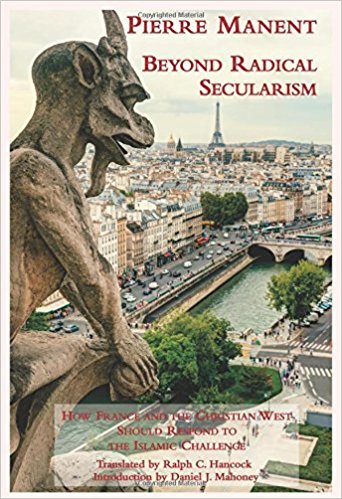
Pierre Manent is a French political scientist. Or, as they say in France…
Pierre Manent est directeur d’ etudes a l’ Ecole des Hautes Etudes en Science Sociales, membre fondateur de la revue Commentaire.
~~~
English philosopher Sir Roger Scruton also has something to say about the above:
https://twitter.com/Scruton_Quotes/status/942682334209478658
https://twitter.com/Scruton_Quotes/status/942683659500425216
https://twitter.com/Scruton_Quotes/status/942681842834202625
https://twitter.com/Scruton_Quotes/status/942687422252449792
Rate this:
Filed under Current events 2017, Islam, Political Commentary, Politics Tagged with current-events, Immigration, Islam, Pierre Manent, political