Culture Considered: A conversation between Roger Scruton,a philosopher, and Terry Eagleton, a Marxist, about culture and the best way to infuse its value, whether as Scruton would have it-as of traditional worth or as Eagleton would have it-as a radicalized deconstructed whatever?
Capitalism tends to overtake high culture with base consumption. Marxism tends to come up lazy and empty handed as its namesake, with little to add to culture except ad hoc criticism.
“Most people who read “The Communist Manifesto” probably have no idea that it was written by a couple of young men who had never worked a day in their lives, and who nevertheless spoke boldly in the name of “the workers”.” Thomas Sowell, economist
As my last post noted Greece, the home of the ancient philosopher Epicurus, rejected fiscal restraint and austerity in exchange for “Hope is coming” debt finagling.
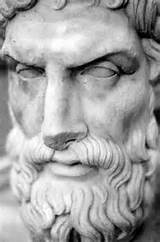
Epicurus sans hammock
“Syriza” or “Let the Good Times Roll Without Repercussions Party” has won a short-lived victory in Epicurean Greece: “Avoid pain or at least spread it around. Give it to someone else. Let us work a few hours a week and then let us seek our pleasures. Let us surround ourselves with good friends and good drink. Forget the creditors. Those fools believed we would pay them back”. And so it goes in ancient modern Greece.
Well, back in the day Epicurus had an even bigger dilemma than a fiscal crisis. But it was a problem that he was able to philosophize or finagle away with even bigger denial than today’s Greeks. I am talking about the problem of evil.
The problem of evil–whether viewed as a man being burned alive or as a Roman crucifixion or as someone stealing cigars from a mini-mart or as one neighbor lying to another neighbor-is in our face daily. This enormous topic can only be glanced at in this post. I will give you a perspective to consider. First, let’s see what Epicurus foisted on his followers from his hammock ‘high horse’.
The originator of the logical problem of evil has been cited as the Greek philosopher Epicurus and this argument may be schematized as follows:
If an omnipotent, omniscient, and omnibenevolent god exists, then evil does not.
There is evil in the world.
Therefore, an omnipotent, omniscient, and omnibenevolent God does not exist.
This perspective of the problem of evil is held by many in the world. It is a perspective which atheism willing points to and one that bothers agnostics. It is a perspective that lends itself to the myopic religion of scientism where everything can only be validated through scientific proofs or, basically, through one’s senses (a more refined Epicurean philosophy). Yet, the above logical problem of evil is self-defeating. It assumes knowledge of good and evil.
One has to ask, how did Epicurus determine good and evil and the truth that defines them? Did he feel their effects via his physical senses? Did he and his friends determine what is good and what is evil via their collective senses? Did Epicurus make up ‘truth’ about good and evil by what his friends let him get away with saying? Or did Epicurus as a proto-Foucault define ‘regimes of truth’ as “the historically specific mechanisms which produce discourses which function as true in particular times and places”? Or, did Epicurus, as President Obama has recently done at the 2015 National Prayer Breakfast, use moral equivalency or relativism (in this case, high horse lecturing Christians with historical error) as a basis to decide what is a good and what is a bad by comparison (with God as a rubber stamp). It should be noted that none of these premises and perspectives is based on a perspective outside ones’ self or on an Absolute reference point. At the epicenter of these premises is self-serving man, ergo the likes of the American Humanist Association and their motto: “Good Without God“.
If you believe as pre-Darwin-pre-Enlightenment-pre-scientism Epicurus believed-that humans are just randomized atoms (as he called them) that “swerved” and collided to form the materialistic world-then how did a rational concept of good and evil enter our gardens of random atoms? Remember, in Epicurus’ worldview god had been expelled from the garden of good and evil.
This early formulation of the logical problem of evil, as I see it and now describe it, is when the Epicurus “High-Horse” Mal-ware began its download hactivism into the software of our networked psyche creating a down-through-the-centuries botnet. This Mal-ware put God in the “Recycle Bin” and made Him inaccessible. It also redirected our boot up executable file to scientism, making it our default root drive. Social manipulation by amoral hactivists and humanists keeps the botnet going.
The Epicurus “High-Horse” Mal-ware searches for any thought of God and seeks to delete it from your consciousness. It causes doubt spam and creates a zombie-like effect with regard to outside-your-senses thinking. You are made subservient to a ‘regime of truth’, to those who now have the power to control truth. And, there are many who would desire to do so in this present age. And remember, Pontius Pilate asked Jesus “What is truth?” as if Pilate could willy-nilly define truth through his earthly power.
For the sake of brevity I think you will agree with me that the logical problem of evil comes down to premises and perspectives. You may also agree with me that there is a need to wipe clean the hard drives of our minds of all Epicurus “High-Horse” Mal-ware.
Here is a proper perspective from Dr. Ron Rhodes regarding the existence of evil:
…it is impossible to distinguish evil from good unless one has an infinite reference point which is absolutely good. Otherwise one is like a boat at sea on a cloudy night without a compass (i.e., there would be no way to distinguish north from south without the absolute reference point of the compass needle).
The infinite reference point for distinguishing good from evil can only be found in the person of God, for God alone can exhaust the definition of “absolutely good.” If God does not exist, then there are no moral absolutes by which one has the right to judge something (or someone) as being evil. More specifically, if God does not exist, there is no ultimate basis to judge the crimes of Hitler. Seen in this light, the reality of evil actually requires the existence of God, rather than disproving it.
If Epicurus had read the even more ancient book of Job perhaps he would not have been so clueless and the “High-Horse” Mal-ware would never have been downloaded with its intent on hacking into our truth files.
One more perspective regarding truth, good and evil and moral equivalency:
C.S. Lewis has a few words to say about the matter, too:
“If the whole universe has no meaning, we should never have found out that it has no meaning: just as, if there were no light in the universe and therefore no creatures with eyes, we should never know it was dark. Dark would be without meaning.”
“Reason is the natural order of truth; but imagination is the organ of meaning.”
“There is but one good; that is God. Everything else is good when it looks to Him and bad when it turns from Him.”
My last two posts took you for a ride in the “Wayback Machine”. The ride, with no cost to you and minimal effort on your part, took you back to the time of Epicurus, the Greek philosopher. Then I forwarded the machine to our present time, the age of the Angry Atheists. Today’s post will take you for a ride in the “Lean Forward” Machine.
The “Lean Forward” Machine is not like the “Wayback Machine”. Whereas the “Wayback Machine” records and regards history in its travels as an annotated time line worthy of informing present decision-making regarding morals, social concerns, spirituality, politics and economics the “Lean Forward” Machine says “phooey with all of that”:
“Let’s go full steam ahead to the future. “We have the omniscient and omnipresent being-‘perfected’-as-we-speak-with-your-tax-dollars Government (of Titanic proportions mind you) to pilot us (in ad hoc fashion mind you) to the Elysian Fields of the Brave New World.”
At this point you should know that the “Lean Forward” Machine is regarded by some as a religious temple. Some even call it by the sacred name of its goddess-“Progress”.
But, before we “Lean Forward” into unreality let us take at quick look at Epicurus’ homeland today to get a reality check on effects of his philosophy:
ATHENS — Greece’s left-wing Syriza appeared on course to trounce the ruling conservatives in Sunday’s snap election and could win the absolute majority it wants to fight international creditors’ insistence on painful austerity measures.
Tsipras’ campaign slogan “Hope is coming!” resonated with voters, weary of austerity after six years of constant crisis that has sent unemployment over 25 percent and threatened millions with poverty.
“Hope is coming!” Wait! Where have I heard that before?
Anyway, Greece, the land of the ancient philosopher Epicurus, has rejected austerity and forsaken posterity!: “My friends, let us make Epicurean lifestyle the epicenter of things! Eat, drink and be merry with impunity! Run up the tab! The gods don’t care. Why should we?”
There you have it my friends. Sorry to say but it appears that the ticket for the “Lean Forward” Machine return trip would cost you everything. And, if you did go, you would not see your children and grandchildren flourishing. Rather, you would not find them at all, having vanquished in the Farmworkers’ Grape Pickers Camp; having been cast into the great winepress of the wrath of Progress.
I’m not going with you to look for my future in the “Lean Forward” Machine. I have not lost the Spirit or my faith in God. I have the Kingdom of God here on earth to tend to whether or not my belly is full. The Kingdom of God is my vocation, my calling, my camp.
“Instead, make your top priority God’s kingdom and his way of life, and all these things will be given to you as well.” Matthew’s Gospel 6, verse 33
Little did he know at the time (341-270 B.C.) that he, Epicurus, a Greek philosopher, would be a founding father of the atheism sect, a sect which began its angry resistance movement when Jesus Christ appeared on the scene claiming to be God incarnate. Or, that he, Epicurus would be the gardener who would plant the seeds of the Enlightenment’s now perennial social Darwinism, seeds embedded with the DNA of Democritus’ dictum of random Atomism. Or, that he would be considered an ancient agnostic theologian who preached that the gods were out-of-the picture and the Roman gods were way too bossy. Or, that his philosophy would become an eponymous link with shameless pleasures.
An allegory of five senses. Still Life by Pieter Claesz, 1623. The painting illustrates the senses through musical instruments, a compass, a book, food and drink, a mirror, incense and an open perfume bottle. (via Wikipedia)
Epicurus had concluded that any idea of the ‘gods’ had to be put upstairs in the ‘attic’-out of sight, out of mind. Not seen. Not heard from. They should be not be given any consideration much less be feared. Epicurus had an alternative universe to offer his disciples.
Epicurus lived and taught a moderate lifestyle, keeping to himself and to his close friends. He believed and taught that one could learn everything through one’s senses. He counted the senses as trustworthy.
Epicurus spoke of natural desires in life such as food and shelter which one could not live without (a no-brainer). And, he spoke of the natural desire for sex which one could live without (a no-boner). In practice, unlike today’s hedonistic Epicureans, Epicurus was pleasure-passive but not in the sense that he would waste away his time in Margaritaville.
Epicurus also taught that wealth and fame should be avoided because they are intrinsically narcissistic and appeal only to vanity. These things were to be considered ephemeral. (Al Sharpton and a host of politicians and Hollywood stars would not be examples of true Epicureanism.)
As Epicurus was a proponent of living a quiet and peaceful life, unnoticed by the world I am reminded of the Apostle Paul’s missive to the church in Thessalonica (circa Ad 52). Paul’s letter was likely written from Corinth the home of Aphrodite’s temple-a hedonist hangout. He encouraged the Christians in Thessalonica to “… make it your ambition to lead a quiet life: You should mind your own business and work with your hands, just as we told you,” (I Thess. 4:11 )
Epicurean philosophy, detached from its sedate founder’s teaching, would later become associated with extreme pleasure seeking. Per Wikipedia, a “hedonist strives to maximize net pleasure (pleasure minus pain)”. And, with the angry ‘gods thought of as remote, unconcerned and out of the picture a hedonist could unleash and unlock the Animal House within him. But, Epicurus was not a Caligula in pursuit of untold ‘pleasures’. There were no toga parties at Epicurus’ home.
“Seek pleasure in peace and pursue it” was his cart’s bumper sticker-right next to his “COEXIST” bumper sticker.
Due to his compartmentalizing, putting god upstairs and putting earthly pleasure as a priority, Epicurus can also be considered as one of the founding fathers of the fact/value split, a split where science and religion and politics and religion are deemed to have no common ground-in heaven nor on earth. This Epicurean dichotomy would eventually cause Americans to exile God from their thinking. To fill the vacancy America would welcome all manner of European philosophical and psychoanalytical nonsense as well as all manifestations of statistical ‘science’. (See my post “How Shall I Then Live” regarding the fact/value split.)
Sadly it was with an Epicurean mindset already in place that America’s founding fathers including Thomas Jefferson wrote the U.S. Constitution as the divorce papers to be served on God –God was not to be part of our nation’s public’ life: And though our currency reads “In God We Trust”, that has come to mean “God is our fall back position”. “You may worship God up there but just don’t bring him down from the attic into our Novus ordo seclorum” (see your after tax currency of the New World for both mottos).
It probably could be said that the Epicurean philosophy was the origin of Freud’s Pleasure Principle. The Principle simply stated, is that man’s default modus operandi is to pursue pleasure and avoid pain. Here it would appear that neo-Epicurean philosophy influenced at least Christopher Hitchens, a well-known provocateur atheist given to well-documented habits of smoking, strong drink and other ravishing appetites, a raison d’etre for a pleasure seeker like Hitchens-but only in his previous life.
Mr. Epicurus, on the other hand, took his afternoon delight in hammock contemplation of Atomism, the dictum of his day: life is reducible to invisible atoms which swerve and smash randomly into each other without a defining purpose. This dictum could well define the “angry atheists” Atomistic arguments against the existence of God. (During Epicurus time you had to walk by faith to believe in invisible atoms and no God. Later quantum physics via the LHC and other nuclear colliders would provide us with the silhouettes of nuclear particles including bosons but many scientists chose not to see God as Creator of this “Atomism”)
Today, “angry atheists,” one such is Richard Dawkins, continue to swerve and smash their Atomistc-like arguments against God’s apologists but their pro-atheistic arguments never coalesce into anti-God anti-matter. And, when everything else they have said fails to discharge God from the universe these angry fellows and their devoted followers resort to ad hominem and strong drink.
Epicurus is the man for all reasons today. Here is someone who can say it better than I.
N.T. Wright, a New Testament scholar, notes Epicurus’ influence on modern man in his recent book “Surprised by Scripture.” Here are some quotes from Chapter One “Healing the Divide Between Science and Religion”.
“You could sum up Epicurus’ philosophy, at least in its desired effects, with the slogan Richard Dawkins and his associates put as an advertisement on London buses two or three years ago: “There’s probably no god. Now stop worrying and enjoy your life….
So, for Epicurus, there was nothing to worry about. Draw a direct line from him to John Lennon: imagine there’s no heaven, no hell beneath us; now get on and live for today. The image of Epicurus as a hedonist is true, but it was a very refined hedonism, since he taught that the more obviously bodily pleasures didn’t last and produced less pleasurable effects.”
Wright goes on to say that
“The philosophy of Epicurus was given a major new lease on life by the Roman poet Lucretius, who lived about seventy years before Jesus….In Lucretius it all become clear and straightforward. The world is what is it is because of (what he called) atoms, which, free-falling through space, collide with one another, sometimes combining and sometimes bouncing off…major changes are caused by the inexplicable “swerve” that sometime happens to atoms so that they veer off in new directions and produce different results. But the main point is essentially what we would today call the evolutionary thesis: life in the world has developed under its own steam as the random by-product of chance collisions and combinations of atoms and the more complex life-forms they produce….
The second point I want to make about the rise of Epicureanism at the dawn of modernity, and particularly in the origins of the Enlightenment, is that it was seized upon not least because of it political implications. That is clear already in Machiavelli and Hobbes, but it comes to fore in the eighteenth century.”
The Epicurean endorsed idea that random free-floating atoms made the world what it is ‘swerved’ into the mix of political ideologies which rejected monarchy and a ‘bossy-guy-upstairs’ rule. “Vox populi vox Dei is the cry-but then Deus himself disappears off into the far beyond, and vox populi is all we’re left with.” N. T. Wright, and again:
“…Democracy can generate new forms of tyranny, and once we have sold our souls to a particular voting process there no way back. We need to return to the drawing board and think more clearly about whether the natural and proper human passion for freedom and the natural and proper need for order and stability are best served by the kinds of democracy we have developed, without the aid of the divine or monarchial intervention from above, on the model of the Epicureanism that has proved so popular and influential.” (I would add that it appears that radicalized Islam seeks to place their false god Allah on the world’s throne. N. T. Wright is referring to the One True God-YHVH-“I Am That I Am”.)
The threads of Epicurus philosophy are woven throughout our life’s fabric. As Wright notes, “Basically, the American dream is that if you get up and go, you’ll succeed; the egalitarian hope is that the fittest will survive the economic jungle”. And, as I noted above Epicurean philosophy began the fact value split that modern man uses as his template for all of life’s questions, whether personal or political.
Do I look to God or to some form of science for life’s contextual meaning? Am I a random mix of atoms evolved into a human form? Is life only meant for pleasure seeking and pain avoidance and at any cost to me and to my fellow man. Should I vote to obtain pleasure? And so on…
For Christians (for all, really) what does it mean that the Kingdom of God has been established on earth? N.T. Wright, in his book referenced above, goes on to explore the current thinking and a Christian response to an Epicurean worldview. For now, there is way too much of Wright’s insight to post today. Except to say that sadly the world now divides science and religion into separate rooms –one downstairs and one upstairs. This should not be. I am convinced that science and properly tuned philosophy support God’s existence, Scripture and the work of His hands. As Francis Schaeffer of L’ Abri once wrote, “He is there and He is not silent.” I’ll save that for other posts.
Final thoughts. As mentioned above Epicurus treasured his close friends. They were very important to him. And I would imagine they would be.
In a universe where god is perceived as remote, uninterested, detached and at best considered as always-looking-down-on you angry and bossy it feels good to have close like-minded friends to commiserate with: “Dionysus my friend, pass the wine and let us sing ”Don’t Worry, Be Happy””.
Now, you should know from previous posts that I accept the theory of theistic evolution with its old earth creationism. (BTW: after learning about Epicurus you should know that the Atomism dictum that he promoted well preceded any Darwinian theory of evolution.) Having said this I would offer the following friendly apologia.
Each of us as God formed evolved humans can ‘recognize’ another person, the ‘other,’ via our evolved senses. Can we agree that this was done at a prehistoric man level? And, when one cave man was hungry and another cave man was also hungry they may have then formed a hunter/gatherer tribe to fulfill their basic need for food. Again, this was done at a prehistoric man level.
Now fast forward millions of years and hold on. Epicurus understood his friends at a basic human level-through his basic five senses. The fact the he held them dear meant that he looked outside of himself and considered the ‘other’ as worthy, perhaps starting from a place of tribalism. (I hope I’ve made you epicurious.)
Certainly myriad mutations have made our basic senses ‘alive’ and aware that another being in our presence is either friend or foe. But it is only God’s likeness incarnated into the once primate-now human form that can bring about an embrace, a love for the ‘other’. Human friendship and human love was born out of a different tribe, a tribe not of the Epicurean worldview-the Dancing Embrace of the Trinity Tribe.
“Joy to the World, the Lord has come, Let earth receive her King”: The Kingdom of God is heaven and earth, science and religion and you and me in one eternal embrace with the Trinity.
At the beginning of Kingdom of God on earth and during his Sermon on the Mount, Jesus-I AM That I Am-reminds us that we are being watched over with love and care. Jesus nullifies Epicurean philosophy, if we let Him.
As we head into the New Year let’s take a moment to not look back…
Ah, yes.
Sentimentality is that taskmaster which keeps us longing for the leeks and garlic of Egypt, the known-knowns of past life, up to and including slavery.
Sentimentality is gate keeper to the past, fending off reality to preserve sugar-plum memories.
Sentimentality serves as wooer, policy maker and candlestick maker, ergo, The Great Society (aka “Let’s help the little people and feel good about ourselves in the process”, affirmative action (see The Great Society for further social science mishaps), education (aka job-security for union workers), amnesty (aka imported votes for Progressive Democrats) and multiculturalism (aka “We promote “Diversity” here, just stay off my lawn and don’t get near my rights, you fools.”)
Sentimentality, the emo that keeps on giving, will keep an angry woman ever angry; never forgiving. For her the past will be kept stewing, waiting for the next victim to be boiled alive.
Sentimentality will fight fires by removing the oxygen from the room: “This is the way we have always done it.”
Sentimentality is not tradition. It is more like unclaimed baggage that keeps going around on the airport turnstile day after day. You watch it to see if anyone claims it. If not it’s yours to drag around forever.
Sentimentality chooses the moldy and crusty bread of the past over the fresh gluten free, sugar-free crackers of the present ala “This white bread reminds me of mom.”
Sentimentality can be good wine turned into vinegar; old wineskins never replaced.
Sentimentality is the troll who guards the bridge to the New Year. The troll demands a toll. (Just tell the little bugger, ”I paid years ago, be off with you or I’ll call my Father Time. He’ll kick your little troll butt!”)
Sentimentality calls up past fears and dreams for advertised future benefits, benefits created at any cost to reality. See the Social Security trust fund. See the Barney Frank everyone-needs-a-house bubble machine that unleashed the Kraken upon world finances when the bubbles burst.
Sentimentality wants to relive the civil rights and war protests of the sixties and invoke the depression era bindle-bums of the thirties. OWS Millennials ‘must’ ‘re-live’, record and recreate a diorama of those events from a BA degree in Identity Politics perspective. The grapes of wrath must be re-trampled. Social justice must be served with an order of the freshest iPhones.
Sentimentality “keeps me hanging on” by a thread of delusion. “Marriage is secular, a right, a ‘love-in’.” Sentimentality says “I do” to whatever makes me feel… sentimental. And, sentimental makes me feel all gooey inside like…cable TV lovers.
Sentimentality demands that Mother Earth be saved from manmade people while avoiding fact-see leftist Pope Francis for further encyclical faldera. Does the Pope realize that the Green Movement believes that overpopulation of the world is the problem? Does the Pope realize that he is actually promoting abortion, assisted-suicide and humanist population control? (BTW: does the Pope even understand that capitalism fills the coffers of DisneyVatican?) And, forget “Seasons in the Sun”. We may be facing an Inferno or an Ice Age depending on which way the inverted dated is put up on the overhead. ALGore Rhythm has predicted inverted hockey stick apocalyptic weather conditions to occur at any second now. And this, my friends, despite the fact that CO2 makes growing things…green! We are told by dogged Gaia loving-tenure-loving-paycheck-loving scientists that CO2 is not green ‘making’ ‘stuff’ when man is involved. Mankind only creates off-green “problems,” “problems” that are only resolvable with enormous sums of green taxpayer money. And, to increase our awareness of the right uses for CO2 the greenie bible Mother Earth News reportedly reports “green is god, dude, especially when rolled and smoked.” Anyway “It’s hard to die when all the birds are singing in the sky.”
Sentimentality: a Disney movie replaying your childhood over and over. You know, the time you spent fantasizing about being princess as a young boy. Animated cels have always portrayed our deepest feelings, the best of our culture and the highest aspirations of our humanity-remember? Who needs reality when you have “Frost”?
Sentimentality is that trampoline you keep in your back yard just in case you need to jump up and down endlessly to walk away from the back and forth of everyday life.
Sentimentality gets an Enlightened Epicurean Scientism big bang out of a singular boson appearance but considers God’s silhouette passé.
“A sentimentalist“, Oscar Wilde wrote, “is one who desires to have the luxury of an emotion without paying for it”.
Use “Sentimentality” in a sentence/s: “I prefer my sentimentality over tradition, dudes. Tradition is so predictable whereas ad hoc sentimentality ushers in a new age of Progress as well as a proto-social justice that protests everything that isn’t sentimental.”
Sentimentality as cultural entrenchment, as socio-political-economic-education policy-see Spoilt Rotten: The Toxic Cult of Sentimentality (subtitle in US editions: How Britain is Ruined by Its Children) by Theodore Dalrymple. Who could resist this book with chapter titles like these: Chapter Three: “The Family Impact Statement”, Chapter Four: “The Demand for Public Emotion”, Chapter Five: “The Cult of the Victim”, Chapter Six: “Make Poverty History!”
Sentimentality-I could go on but, at this point, if I look back, I just might become sentimental. I won’t look back. Yes, there were good times but I keep those memories like a locket around my neck. And, don’t worry. Good memories have a way of making themselves known and sustaining you at the right time-that is if you create them first. (The Israelites used to create stone monuments as a place of remembrance where Jehovah had intervened. They did not carry the monument around with them. The thought that God is Infinite-Personal became a fixed place in their memory.)
Looking back, as one who was told not to look back, did not work out well for Lot’s wife. She may have very well thought that God was like her-sentimental about what someone holds dear, in this case her life in Sodom. She may have very well thought that God would not destroy a place she called home. She got it wrong.
A pillar of salt goes nowhere in life.
A pillar of the community!
~~~~~
Who needs the shallowness of sentimentality when you can have full-bodied hope! And, I’m not talking about “Hope” as found in the “Hope and Change” campaign come-on that was used to lull Millennial lemmings to follow Obama over the cliffs of insanity.
I am talking real hope. And, real hope includes distancing yourself from sentimentality and going forward with God into sublime reality, as the Apostle Paul described here in his letter to the Church at Rome (Chapter 4-5):
“…since we believe in the one who raised from the dead Jesus our Lord, who was handed over because of our trespasses and raised because of our justification.
The result is this: since we have been declared “in the right” on the basis of faith, we have peace with God through our Lord Jesus the Messiah. Through him we have been allowed to approach, by faith, into this grace in which we stand; and we celebrate the hope of the glory of God.
That’s not all. We also celebrate in our sufferings, because we know that suffering produces patience, patience produces a well-formed character, and a character like that produces hope.
Hope, in its turn, does not make us ashamed, because the love of God has been poured out in our hearts through the holy spirit who has been given to us.” (emphasis mine)
If you have read previous posts you would know that I travel to work-a Chicago Loop location-on the METRA train. After so many stops several of us gather in the vestibule, antsy to get off the train. It is in the vestibule, on a daily basis, that we share the events of our daily lives, the latest front page news, TV programs watched, political viewpoints and so on.
It came as a surprise to me the other day when I learned that three of us four ‘regulars’-a married man in his early sixties, a married man in his late forties to early fifties and a woman also in her late forties to early fifties were each without children. I am the only one of the four who has children.
Another surprise: the three of them along with their spouses-each couple-owned two dogs. They call their pets their four legged children! I had to wonder “Why pets?” and no children, but I don’t ask such questions. Maybe it is a matter of fertility. Or, a matter of fear?
The only clue I gathered was when another woman, a mother, joined us one day. She talked about her kids and her dog. She asked the man of sixty years if he had kids. He replied that he didn’t. “I was afraid for my wife.”
What he meant, I could not tell you. I was left to conjecture: was he afraid for her physical health? Her mental health?
Now, all three train companions have highly positioned jobs. One man is a CPA for a major bank. The other man is a health care manager for employees of a major area hospital. The woman is a VP of an insurance company. She travels over 60% of the time.
So, again, conjecture. Did they choose to be childless to fulfill career paths? Or?
I can not judge their decision but I am curious as to their decision’s formulation and their lack of formula (I had to spit that up, didn’t I?).
Like me you may have seen bumper stickers of the sort “I love my (fill in the blank pet version), it is humans I can’t stand.”
When I see this uncivil declaration renouncing mankind I feel a little rebuffed BUT not to the extent that I would riot or loot or cancel any exam to wallow in shameless emo. I wouldn’t even call Al Sharpton or Eric Holder in to intercede for the black folks included in this public denunciation.
It now seems that anti-human humanism is society’s soup of the day philosophy. What’s important is that animals be anthropomorphized into four legged children.
If you were to listen to my three train companions you would hear that they treat these dogs as children and better. They take their beloved pooches to doggie spas and to doggie festivals where special organic dog food is sampled. I am not mentioning half the luxuries bestowed to the beasts. (“Higher taxes for the 1% will help the poor. So I needn’t go out of my way. Besides, I give when the sad dogs on TV look me in the eye.”)
Don’t growl at me. I am not an animal hater. I have a Parrolet named Henry.
Henry the Parrolet
I have had dogs, cats, chameleons… AND, I have four kids who are human (though there were times when I thought they regressed to being four-legged animals).
The pet over children choice fits in nicely with environmentalists. They seek to stomp out the fires of human passion:“Only you can prevent human existence.”
The ‘’greenies’ spread their irrational fears liberally (e.g., the greenie-propaganda movie “Noah”.). They invoke population control-Malthusian-metric-hockey-stick spreadsheets. They generate CO2 free angst and so bloody on.
And, why, why have kids when life is so hard and so terrible and so there is so much bad in the world and so much work to do to stop climate change (“So many CO2 offenders, so little time”) that will kill us all if we don’t give ALL of our time and ALL of our money to stop it right now and lions and tigers and bears… Let’s let fear itself give us something to fear-a dictum not worthy of you or any generation.
Besides all of the above manmade direness there is the inconvenience of children. You have to feed them, change them, follow them, correct them when they mis-behave (Oh, yes.), take them to Wal-Mart for a Christmas picture, introduce them to the morals you flirt with now and then. And, there is just too much of yourself you would have to give up to have a child.
“I have my studies, my books, my Facebook, my career path to the seventh floor. I have my dreams. I have my “Me, My, I” to look after. First person singular comes first.
This is where pets (and their owner’s bumper stickers) come into view. This is where I am told “Dogs”, on the other paw, “give me their unconditional love”. Yeah, that’s right. You have heard the same thing. Dogs love. Roll the Disney movie. Throw them an organic vegan Milkbone. Walk them with a proud humane cadence. Care for them when ill or itchy. Cuddle with them on your bed…but they are not kids.
Kids? YES have kids! I’ll tell you why but not in smothering detail. You will figure it out.
Here is hint #1: the reason to have kids is connected to the reason for the season-the Christmas season-in case the shelf-elf didn’t remind you what time of the year it is. And hint #2, the reason will involve a new vocabulary word: “kenosis”.
Per Wikipedia, “The New Testament does not use the actual noun kénōsis but the verb form kenóō occurs five times (Ro.4:14, 1Co.1:17, 9:15, 2Co.9:3, Phil.2:7). Of these five times it is Phil 2:7, in which Jesus is said to have “emptied himself,” which is the starting point of Christian ideas of kenosis.”
The word ἐκένωσεν (ekénōsen) is used in the Apostle Paul’s letter to the church at Philippi, chapter 2 verses 6 through 8. It is part of an early church hymn that is quoted by Paul:
Who, though in God’s form, did not
Regard his equality with God
As something he ought to exploit.
Instead, he emptied himself,
And received the form of a slave,
Being born in the likeness of humans.
And then, having human appearance,
He humbled himself, and became
Obedient even to death,
Yes, even the death of the cross.
To insure historical usage I unearthed my Greek New Testament and also “THE ANALYTICAL GREEK LEXICON: Consisting of AN ALPHABETICAL ARRANGEMENT OF EVERY OCCURING INFLEXION OF EVERY WORD CONTAINED IN THE GREEK NEW TESTAMENT SCRIPTURE with a GRAMMATICAL ANALYSIS OF EACH WORD.… I looked up the word transliterated as kenos. As used in Phil. 2:7–”to divest one’s self of ones prerogatives, abase one’s self”
Wow!
Jesus, Very God, divested himself of his prerogative as God and abased himself to become incarnate.
We have heard it said that “God is love”. We have also heard that “God is eternal”. For love to be love there needs to be an object of love. For eternal God to be Love there must be an eternal object of his love. This means that within the dancing embrace of the Triune God are the eternal objects of each other’s love -the Father, the Son and the Holy Spirit. (JWs, the Trinity is.)
Now, imagine that the Godhead decided to include us humans in their dancing embrace of love. To do so, Jesus, as promised in prophecies of redemption, emptied himself of all his prerogatives as God (an overwhelming surprise for any orthodox Jew) and put on the vestment (the diapers) of created humanity.
The simplest comparison that comes to my mind would be the following: There is a father who is the CEO of a multibillion dollar corporation which employs 3000+ workers. The company owns several private jets.
The father comes home, takes off his suit coat and throws it on a chair. He takes off his tie and does the same with it. He then gets down on the floor on all fours to play Legos with his four year-old son-all prerogatives put aside because of love for his son. His ‘position’ is laid aside to be taken up later.
There is something about kids and about divesting one’s self of one’s prerogatives that enables one to be in a relationship and to love another. No one is saying this is easy but it is worth more than what you laid aside.
Christmas, a celebration of the birth of Christ is also a celebration of our humanity, of kids and babies. Imagine God Very God incarnated into our evolved human form and doing so right at the fullness, the bar mitzvah of time! And, come to think of it there is no celebration of Roe v. Wade Day unless, of course, you are Wiccan.
The cross is the nexus of man’s inhumanity to man and man’s sinfulness with a Holy God. Man’s redemption from sin was the outcome. God kept his word to redeem and He imputes his promise keeping righteousness to those, by faith, who believe.
The resurrection of the Son of Man is a celebration of Mankind’s new humanity within the Kingdom of God.
~~~
Yesterday as I was jumping off the train onto my home station platform the METRA conductor, a large friendly black man who looks like he could play defense for the Chicago Bears said “Have a great evening everyone. Fifteen days till Christmas! ”We all smiled looking back at his glowing face.
Christmas is the dancing embrace of God with man and man with man and man with himself.
“What Child is This? The slack-jawed shepherds will tell you that a birth announcement proclaiming humanity’s promised Messiah had arrived via Angelic Express. They will tell you that they found the baby who would one day become King lying in a manger. How un-Godlike? Not for the God who laid aside everything to get on all fours and meet you where you are.
Let the miracle of the incarnation inform your decision to have children, whether naturally, adopted and/or fostered in your home. And then let those children become the objects of your love.
Michael Brown’s strong arm robbery of cigars has led to hundreds of victims. These would include his parents, Officer Wilson and his family, the community of Ferguson including a young Christian woman who owned a store named Hidden Treasures (store demolished in flames by rioters) and the hundreds who have been injured physically, financially and emotionally. It takes a lawless child to raze a community.
Hidden Treasures on South Florissant in Ferguson on Tuesday, Nov. 25, the night after the grand jury decision. Image: Samuel Corum/Anadolu Agency/Getty Images
The Ferguson rioters and looters, BTW, are just like the North Koreans threatening nuclear war to defend their human rights record. The distributive injustice of the rioters and looters is the flagrant opposite of true Social Justice: “Love your neighbor as your self.” More Scripture later.
Black America as a whole is victim to a significant deficit of leadership from the WH and AG Holder. Black America is also being used by Al Shaprton, Jesse ‘PUSH” Jackson and the race industry, an ‘industry’ which strives to diminish knowledge about black neighborhood violence for the sake of the increased reimbursable victim ‘hood.’ Throw money at the problem.
Here is another example of black-on-black crime coexistence, this time from the Milwaukee Police Chief:
An indisputably good and prayerful Black American, Dr. Alveda King, who has spoken up so many times in public, would never tacitly encourage the barbarian acts of the rioters while the above mentioned culprits are in serious and silent denial.
Truth is another victim.
Several ‘eyewitnesses’ perjured themselves when they gave testimony to the grand jury, apparently so that the fires of outrage could “burn, baby, burn.” But self-immolation will never be the pathway to society’s success.
Thank god we have a gigantic redistributive Progressive government that has created a booming economic milieu in Ferguson! Not! “Consume , baby, consume and at all costs” is a similar war cry but coming from Keynesian economists. But that is not going to happen in Ferguson for a long while. Oops! Another ‘fixit’ diversion is required!
And here it comes, and, of course, it does nothing for the Ferguson human crisis unless you are worried about the after-riot ozone levels.
While tempers flare and torch the town of Ferguson even now Obama and Bureaucratic Czar #1, EPA Administrator Gina McCarthy, seek to control the Kulturesmog via new regulations. As I write this they are planning ways to burn billions of taxpayer dollars in their war against SMOG. They seek to save our lawless society from itself by snuffing out non-existent man-made global warming (GW)!! No doubt the next concocted report out of the UN regarding GW will presume that human anger is directly correlated to GW!!
Michael Brown. We need a folk song to sing the praises of your cigar-stealing-pot-smoking-“f**k-the-man-“f**k you” ways. Al Sharpton, you can buy the rights to help finance the race industry’s fight with itself.
“Like a dog that returns to its vomit, so a fool repeats his folly.” Proverbs 26:11
“Keep away from angry, short-tempered men, lest you learn to be like them and endanger your soul.” Proverbs 22: 24-25
“Don’t rob the poor and sick! For the Lord is their defender. If you injure them, he will punish you.” Proverbs 22: 22-23
A painting that was for sale in Hidden Treasures, Andrews’s store, before it was burned on Nov. 24, 2014. Image: Amanda Wills, Mashable
~~
Is this post too sardonic? Perhaps. But Americans need a cup of cold water splashed on their over heated zeitgeist. People in this country, people who ride the train to work with me seem to be clueless about the incident and the relevant evidence regarding the Michael Brown case.
It was in a previous post that I made note of one such person (And no, he does not know that I write a blog.). I wrote,
“About two weeks ago I was riding the Chicago Metra train to my downtown workplace. After a stop near the city several passengers boarded from what many consider an ‘uppity’ neighborhood near Chicago. Before we reach that stop I put my away my book, knowing that I will be standing in the train vestibule discussing whatever topic is broached among the three or four of us heading to Chicago.
One day, right the out of the beautiful climate change blue, a forty-ish Oak Park man, a ‘regular’, says that there are ad companies who will not do ad work for any company that is a “climate change” denier. He proudly let me know that he was all was for this sanctioning of companies based on “climate change” theory (acceptance). I rolled my eyes but held my tongue.”
Well, this same guy this past Tuesday wondered out loud why Michael Brown wasn’t just tasered by Officer Wilson instead of being shot. He was incredulous. He was also absurdly concerned. He went on to say, “That could happen to anyone of us.”
I replied “No! Of course not! Not unless you are going to rob a store and will not stop when a peace officer asks you to stop and you are holding stolen property in your hands and you decide to charge at the officer and take his service revolver from its holster because you are caught red-handed and you feel you can take him by brute force.””
He: “Shouldn’t we have a reasonable expectation that an officer will not use a gun to stop someone? ”Why didn’t he wait for backup?”
Me: “Shouldn’t a police officer have a reasonable expectation that a person will stop when asked to stop (while waiting for backup!). If Michael Brown had done nothing wrong then why would he charge at Officer Wilson?”
At this point I went through the physical evidence. I also mentioned that several African American eye-witnesses confirmed that Michael did not have his hands raised and that he was not shot in the back. In other words they negated the false testimony of other witnesses. I then went through what I knew about the shooting. –H/T Andrew Branca at LegalInsurrection.Com
The ‘train’ guy appeared to be clueless about the facts. It was as if he believed and accepted the Ferguson lynch mob’s narrative carte blanche.
He went on to say, in a way dismissive of what I was saying, “We will never know.”
I answered that “the record of the grand jury will be released. We will know who perjured themselves and get some idea how the grand jury came to decide as they did. Police officers are trained for aggressive situations. An officer has a right to defend himself in a life or death situation.”
Michael Brown apparently didn’t care about Officer Wilson or the law or his parents or care enough even to defend his own life from folly.
And, sentimentality is no Savior. Sentimentality is a stolen Swisher Sweet wrapped in the Progressive “COEXIST” label-a real slow burner.
Remember when your parents said, “Eat your supper, eat your peas or go to your room without supper.”?
That is the Eat-Your-Supper-Fiat. Whether you liked the food or not your were required to eat whatever was set before you because, “I said so.” You were offered two choices: “accept what I am demanding of you or face the consequences of not obeying me.”
As adults, as voting adults, as voting adults with representatives we are now told by Dear Leader Obama that we must swallow his Executive Fiat without representation. And, we must also accept the consequences of not loving him with supine obedience: a renunciation of the U.S. Constitution and a negation of our elected representatives.
And here’s the excuse for just such a demand: there are “poor little children from other countries torn from their families, who do not have a regular meal to eat.” Sob. Sob. Sniffle. Sniffle. “Shame on you, taxpayers! You did not obey my commands!”
How these children were torn from their families and became hungry is another story involving crossing our sovereign border and avoiding immigration authorities. They snuck into our country illegally in hopes of demanding to be fed and taken care of by U.S. taxpayer money as in “Illegal immigrants to be eligible for Social Security, Medicare” BTW: They areillegal immigrants and not ‘undocumented” travelers on the road of life.
Now that the ‘dinner’ has been served sitting in front of us is a smorgasbord multinational characters, some who may be Jihadists, felons, drug dealers, gang members, diseased and most certainly impoverished. Yet, we are informed by IL-Rep Luis Gutierrez that we the voters are uninformed children in need of Dear Leader’s guidance. Remember, we are the “stupid voters” ala Jon Gruber. We are not supposed to care what we are fed as long as “Change” is on the menu.
The Dear Reverend Hussein Obama has also blessed the meal. He used Holy Scripture to endorse his lawlessness and to promote his legacy of “Me, Myself and I”. The spirit of anti-Christ is crouching, ready to devour.
The Gospel-according-to-Progressive George Soros funded Illinois Voices For Immigration Deformity has also blessed the meal with their alliterative babble” “Bibles, Badges, Business.” They forgot to add “and Balkanization to boot.” Their “Call to Action” is the new Evangelical Gospel of antinomianism.
Now that Dear Leader has served us his self made whipped up fiat fondue we are told to eat and like it: “If you don’t eat what I am serving, you can’t have any pudding, how can you have any pudding if you don’t eat what I am serving!” But there is more to this fiat force feeding than meets the throat.
Multiculturalism and Immigration Fiat now meet face to face-a few million times over.
Forced multiculturalism, whether as found in England or Germany or France hasn’t worked out well. Many immigrants do not share the same values as their host country. In fact, the immigrants often isolate themselves into their own cultural collectives. And, the radical Islamists currently crossing our border make no distinction between church and state. They want us to be under their Sharia law. They will kill us to make this happen.
“Who Are We? The Challenges to America’s National Identity” (2004), Kimball writes:
“Does it,” Huntington asks, “take an Osama bin Laden … to make us realize that we are Americans? If we do not experience recurring destructive attacks, will we return to the fragmentation and eroded Americanism before September 11?”…
Multiculturalism is a moral intoxicant; its thrill centers around the emotion of superior virtue; its hangover subsists on a diet of nescience and blighted “good intentions.”
Wherever the imperatives of multiculturalism have touched the curriculum, they have left broad swaths of anti-Western attitudinizing competing for attention with quite astonishing historical blindness. Courses on minorities, women’s issues, the Third World proliferate; the teaching of mainstream history slides into oblivion. “The mood,” Arthur Schlesinger wrote in The Disuniting of America (1992), his excellent book on the depredations of multiculturalism, “is one of divesting Americans of the sinful European inheritance and seeking redemptive infusions from non-Western cultures.”
A profound ignorance of the milestones of American culture is one predictable result of this mood.”
Let it be known that Our Dear Leader, Supreme Professor of Cultural-Legal-Social-Economic-Self-Aggrandizement Studies, has enslaved us to Multiculturalism. His doting bureaucrats will feed his new slaves from the fiat fondue melting pot, a pot laced with every form of human depravity known to man.
Dear Leader, in his great wisdom, has purposely created this ad hoc toxic milieu so as to dilute America’s melting pot with third world values. Progressive dictatorships feed off of this pot.
Equally as important to Dear Leader is creating millions of worshippers of Progressivism’s cult combine of language, morally relative values, lowest common denominator culture, Gaia-incensed global-warming and the rule of ad hoc law.
Dear Leader wants to amass voters who are submissive, “stupid” and obedient. And, like him, they must not care that there are laws to obey or boundaries to be wary of, or red lines to never cross. The illegal immigrants are to be his hapless ‘victims,’ Dear Leader is to be their Savior and America (always the oppressor in his anti-colonialism zeitgeist) will now submit to him. We are to be his colony of worker bees.
For the ‘victims’ there is to be the 1%’s pot of gold to be had and a third world free-for-all party to attend. “Go ahead. Break the law. Just don’t get caught. But if you do, we have liberal–minded judges who will ‘figure’ it out for you at the time. Remember, laws are meaningless under ‘social justice.”
How else can the Democrat/Progressive party survive? Only by mandating desperate, “stupid” and lawless voters out from shadowy existence and thrusting them into ‘daylight’ of the voting booth. That is how the Progressive Party survives. That is how illegal immigrants will be used. And, that is why Hillary Clinton nods her approval while awaiting her throne.
Here, the Rev. Robert A. Sirico speaks to the issue of Multiculturalism and the fact that all cultures are not equal:
And, Thomas Sowell, as well, about multiculturalism, affirmative action and the minimum wage, all of which comes into play with millions more people entering the country willy-nilly:
~~~~
Lest anyone think that I am not being Christian enough, insensitive to the plight of others and a bigot in my opinion post above, let me summarize my own situation and realign your thinking.
I am a Christian woman who lives in an apartment building, not an ivory tower. Above me lives a Hispanic family. Below me lives another Hispanic family. Across the hall from me is a single black woman with her son.
The apartment buildings surrounding me are filled with a majority of Hispanics, some black Americans and some white Americans.
The apartment building complex south of me is occupied mostly with Hispanics, with some black Americans and some white Americans.
Reader, can you say that about where you live?
Mi amiga, Veronica, works in the food service cafeteria where I work.
“We have entered, as I see it, a spiritual limbo. Our educational institutions are no longer the bearers of high culture, and public life has been deliberately moronised. But here and there, sheltered from the noise and glare of the media, the old spiritual forces are at work” Roger Scruton
*****
“When a common culture declines, the ethical life can be sustained and renewed only by a work of the imagination.”-Roger Scruton
*****
“Jesus prayed, “This is eternal life, that they may know You . . .” (John 17:3). The real meaning of eternal life is a life that can face anything it has to face without wavering. If we will take this view, life will become one great romance— a glorious opportunity of seeing wonderful things all the time. God is disciplining us to get us into this central place of power.” Oswald Chambers
*****
“No power on earth or in hell can conquer the Spirit of God in a human spirit, it is an inner unconquerableness.” Oswald Chambers
*****
To those who have had no agony Jesus says, “I have nothing for you; stand on your own feet, square your own shoulders. I have come for the man who knows he has a bigger handful than he can cope with, who knows there are forces he cannot touch; I will do everything for him if he will let Me. Only let a man grant he needs it, and I will do it for him.” The Shadow of an Agony,Oswald Chambers
*****
“If we wish to erect new structures, we must have a definite knowledge of the old foundations.” John Calvin Coolidge
*****
Atheism is a post-Christian phenomenon.
*****
If social justice looks like your hand in someone else’s pocket then you are stealing.
*****
“In Sweden, giving to charity, absurdly, came to be considered a lack of solidarity, since it undermined the need for the welfare state.” – Roland Martinsson
*****
“…to love democracy well, it is necessary to love it moderately.” Alexis de Tocqueville
*****
Capitalism seeks to help others through a servce or product it provides. Free Market Capitalism is the most moral and fair economic system available to man. Capitalism augments personal growth, responsibility and ownership. Charity flourishes under capitalism. Charity dies under subjective “fair share” government confiscatory policies. Socialism redistributes ambivalence and greed.
*****
“We are to regard existence as a raid or great adventure; it is to be judged, therefore, not by what calamities it encounters, but by what flag it follows and what high town it assaults. The most dangerous thing in the world is to be alive; one is always in danger of one’s life. But anyone who shrinks from that is a traitor to the great scheme and experiment of being.” G.K. Chesterton
*****
Any intelligent fool can make things bigger, more complex, and more violent.
It takes a touch of genius – and a lot of courage – to move in the opposite direction. Albert Einstein
*****
“You shall know the truth and the truth shall make you odd.” Flannery O’Connor
*****
“There is but one good; that is God. Everything else is good when it looks to Him and bad when it turns from Him.” C.S. Lewis, The Great Divorce
*****
“Though He slay me, yet will I trust Him” (Job 13:15).
*****
God’s grace is not about the allowance for sin. God’s grace is about the conversation God allows regarding sin.
*****
From the book of Proverbs: We are not to favor the rich or the poor. We are to pursue justice.
*****
“Always keep in contact with those books and those people that enlarge your horizon and make it possible for you to stretch yourself mentally.” Oswald Chambers
*****
One goldfish says to another, “If there is no God who keeps changing the water?”
*****
“The truth is always there in the morning.”
From Cat On A Hot Tin Roof script – playwright Tennessee Williams
*****
God blesses those who hunger and thirst for justice, for they will be satisfied.
*****
“America’s greatness has been the greatness of a free people who shared certain moral commitments. Freedom without moral commitment is aimless and promptly self-destructive.” John W. Gardner
**
“Men of integrity, by their very existence, rekindle the belief that as a people we can live above the level of moral squalor. We need that belief; a cynical community is a corrupt community.” John W. Gardner
*****
“In the world it is called Tolerance, but in hell it is called Despair, the sin that believes in nothing, cares for nothing, seeks to know nothing, interferes with nothing, enjoys nothing, hates nothing, finds purpose in nothing, lives for nothing, and remains alive because there is nothing for which it will die.” Dorothy L. Sayers
*****
“Art, like morality, consists of drawing the line somewhere.”
G. K. Chesterton
*****
“The battle line between good and evil runs through the heart of every man.” Alexander Solzhenitsyn
*****
This is what the LORD says:
“Stand at the crossroads and look;
ask for the ancient paths,
ask where the good way is, and walk in it,
and you will find rest for your souls.
But you said, ‘We will not walk in it.’
-The prophet Jeremiah, 6:16
*****
“…our common task is not so much discovering a truth hiding among contrary viewpoints as it is coming to possess a selfhood that no longer evades and eludes the truth with which it is importunately confronted.” James McClendon, Ethics: Systematic Theology, Vol. 1
*****
















 Cindy Wity
Aren’t You A Bit Epicurious?
January 18, 2015 Leave a comment
Little did he know at the time (341-270 B.C.) that he, Epicurus, a Greek philosopher, would be a founding father of the atheism sect, a sect which began its angry resistance movement when Jesus Christ appeared on the scene claiming to be God incarnate. Or, that he, Epicurus would be the gardener who would plant the seeds of the Enlightenment’s now perennial social Darwinism, seeds embedded with the DNA of Democritus’ dictum of random Atomism. Or, that he would be considered an ancient agnostic theologian who preached that the gods were out-of-the picture and the Roman gods were way too bossy. Or, that his philosophy would become an eponymous link with shameless pleasures.
An allegory of five senses. Still Life by Pieter Claesz, 1623. The painting illustrates the senses through musical instruments, a compass, a book, food and drink, a mirror, incense and an open perfume bottle. (via Wikipedia)
Epicurus had concluded that any idea of the ‘gods’ had to be put upstairs in the ‘attic’-out of sight, out of mind. Not seen. Not heard from. They should be not be given any consideration much less be feared. Epicurus had an alternative universe to offer his disciples.
Epicurus lived and taught a moderate lifestyle, keeping to himself and to his close friends. He believed and taught that one could learn everything through one’s senses. He counted the senses as trustworthy.
Epicurus spoke of natural desires in life such as food and shelter which one could not live without (a no-brainer). And, he spoke of the natural desire for sex which one could live without (a no-boner). In practice, unlike today’s hedonistic Epicureans, Epicurus was pleasure-passive but not in the sense that he would waste away his time in Margaritaville.
Epicurus also taught that wealth and fame should be avoided because they are intrinsically narcissistic and appeal only to vanity. These things were to be considered ephemeral. (Al Sharpton and a host of politicians and Hollywood stars would not be examples of true Epicureanism.)
As Epicurus was a proponent of living a quiet and peaceful life, unnoticed by the world I am reminded of the Apostle Paul’s missive to the church in Thessalonica (circa Ad 52). Paul’s letter was likely written from Corinth the home of Aphrodite’s temple-a hedonist hangout. He encouraged the Christians in Thessalonica to “… make it your ambition to lead a quiet life: You should mind your own business and work with your hands, just as we told you,” (I Thess. 4:11 )
Epicurean philosophy, detached from its sedate founder’s teaching, would later become associated with extreme pleasure seeking. Per Wikipedia, a “hedonist strives to maximize net pleasure (pleasure minus pain)”. And, with the angry ‘gods thought of as remote, unconcerned and out of the picture a hedonist could unleash and unlock the Animal House within him. But, Epicurus was not a Caligula in pursuit of untold ‘pleasures’. There were no toga parties at Epicurus’ home.
“Seek pleasure in peace and pursue it” was his cart’s bumper sticker-right next to his “COEXIST” bumper sticker.
Due to his compartmentalizing, putting god upstairs and putting earthly pleasure as a priority, Epicurus can also be considered as one of the founding fathers of the fact/value split, a split where science and religion and politics and religion are deemed to have no common ground-in heaven nor on earth. This Epicurean dichotomy would eventually cause Americans to exile God from their thinking. To fill the vacancy America would welcome all manner of European philosophical and psychoanalytical nonsense as well as all manifestations of statistical ‘science’. (See my post “How Shall I Then Live” regarding the fact/value split.)
Sadly it was with an Epicurean mindset already in place that America’s founding fathers including Thomas Jefferson wrote the U.S. Constitution as the divorce papers to be served on God –God was not to be part of our nation’s public’ life: And though our currency reads “In God We Trust”, that has come to mean “God is our fall back position”. “You may worship God up there but just don’t bring him down from the attic into our Novus ordo seclorum” (see your after tax currency of the New World for both mottos).
It probably could be said that the Epicurean philosophy was the origin of Freud’s Pleasure Principle. The Principle simply stated, is that man’s default modus operandi is to pursue pleasure and avoid pain. Here it would appear that neo-Epicurean philosophy influenced at least Christopher Hitchens, a well-known provocateur atheist given to well-documented habits of smoking, strong drink and other ravishing appetites, a raison d’etre for a pleasure seeker like Hitchens-but only in his previous life.
Mr. Epicurus, on the other hand, took his afternoon delight in hammock contemplation of Atomism, the dictum of his day: life is reducible to invisible atoms which swerve and smash randomly into each other without a defining purpose. This dictum could well define the “angry atheists” Atomistic arguments against the existence of God. (During Epicurus time you had to walk by faith to believe in invisible atoms and no God. Later quantum physics via the LHC and other nuclear colliders would provide us with the silhouettes of nuclear particles including bosons but many scientists chose not to see God as Creator of this “Atomism”)
Today, “angry atheists,” one such is Richard Dawkins, continue to swerve and smash their Atomistc-like arguments against God’s apologists but their pro-atheistic arguments never coalesce into anti-God anti-matter. And, when everything else they have said fails to discharge God from the universe these angry fellows and their devoted followers resort to ad hominem and strong drink.
Epicurus is the man for all reasons today. Here is someone who can say it better than I.
N.T. Wright, a New Testament scholar, notes Epicurus’ influence on modern man in his recent book “Surprised by Scripture.” Here are some quotes from Chapter One “Healing the Divide Between Science and Religion”.
Wright goes on to say that
The Epicurean endorsed idea that random free-floating atoms made the world what it is ‘swerved’ into the mix of political ideologies which rejected monarchy and a ‘bossy-guy-upstairs’ rule. “Vox populi vox Dei is the cry-but then Deus himself disappears off into the far beyond, and vox populi is all we’re left with.” N. T. Wright, and again:
The threads of Epicurus philosophy are woven throughout our life’s fabric. As Wright notes, “Basically, the American dream is that if you get up and go, you’ll succeed; the egalitarian hope is that the fittest will survive the economic jungle”. And, as I noted above Epicurean philosophy began the fact value split that modern man uses as his template for all of life’s questions, whether personal or political.
Do I look to God or to some form of science for life’s contextual meaning? Am I a random mix of atoms evolved into a human form? Is life only meant for pleasure seeking and pain avoidance and at any cost to me and to my fellow man. Should I vote to obtain pleasure? And so on…
For Christians (for all, really) what does it mean that the Kingdom of God has been established on earth? N.T. Wright, in his book referenced above, goes on to explore the current thinking and a Christian response to an Epicurean worldview. For now, there is way too much of Wright’s insight to post today. Except to say that sadly the world now divides science and religion into separate rooms –one downstairs and one upstairs. This should not be. I am convinced that science and properly tuned philosophy support God’s existence, Scripture and the work of His hands. As Francis Schaeffer of L’ Abri once wrote, “He is there and He is not silent.” I’ll save that for other posts.
Final thoughts. As mentioned above Epicurus treasured his close friends. They were very important to him. And I would imagine they would be.
In a universe where god is perceived as remote, uninterested, detached and at best considered as always-looking-down-on you angry and bossy it feels good to have close like-minded friends to commiserate with: “Dionysus my friend, pass the wine and let us sing ”Don’t Worry, Be Happy””.
Now, you should know from previous posts that I accept the theory of theistic evolution with its old earth creationism. (BTW: after learning about Epicurus you should know that the Atomism dictum that he promoted well preceded any Darwinian theory of evolution.) Having said this I would offer the following friendly apologia.
Each of us as God formed evolved humans can ‘recognize’ another person, the ‘other,’ via our evolved senses. Can we agree that this was done at a prehistoric man level? And, when one cave man was hungry and another cave man was also hungry they may have then formed a hunter/gatherer tribe to fulfill their basic need for food. Again, this was done at a prehistoric man level.
Now fast forward millions of years and hold on. Epicurus understood his friends at a basic human level-through his basic five senses. The fact the he held them dear meant that he looked outside of himself and considered the ‘other’ as worthy, perhaps starting from a place of tribalism. (I hope I’ve made you epicurious.)
Certainly myriad mutations have made our basic senses ‘alive’ and aware that another being in our presence is either friend or foe. But it is only God’s likeness incarnated into the once primate-now human form that can bring about an embrace, a love for the ‘other’. Human friendship and human love was born out of a different tribe, a tribe not of the Epicurean worldview-the Dancing Embrace of the Trinity Tribe.
“Joy to the World, the Lord has come, Let earth receive her King”: The Kingdom of God is heaven and earth, science and religion and you and me in one eternal embrace with the Trinity.
At the beginning of Kingdom of God on earth and during his Sermon on the Mount, Jesus-I AM That I Am-reminds us that we are being watched over with love and care. Jesus nullifies Epicurean philosophy, if we let Him.
~~~~
Here’s an interesting recent snapshot of modern Epicurean thought: Raising Kids Without God (But Maybe Not Without Religion)
~~~~~
Added 1-25-2015. Epicurean science dismissing fact becomes a fanatical ‘faith’ to avoid fantasy-future owies:
MIT Climate Scientist: Global Warming Believers a ‘Cult’
Rate this:
Filed under Christianity, Culture, Political Commentary Tagged with culture, Epicurean philosophy, Epicurus, fact/value split, N.T. Wright, politics, religion, Richard Dawkins, Science, science and religion, the pleasure principle