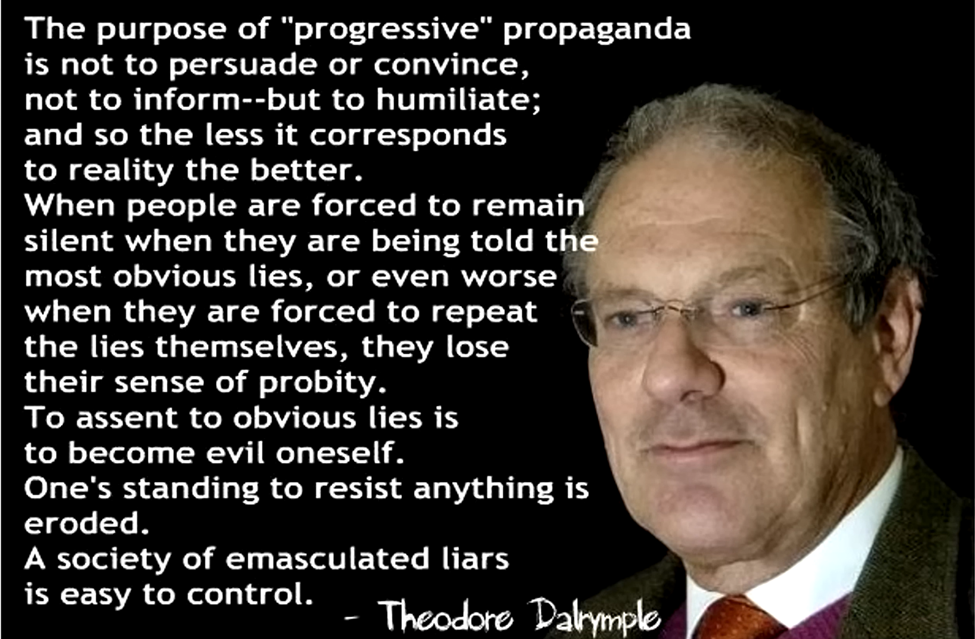
When we hear someone say crazy things, we might say “Yeah, right” and shrug it off. But when a group of people say crazy things and a group of people agree with said crazy things, we wonder “What in the world is going on?”
Objective reality – the existence of things as they are – is obvious to everyone. And so are the values, accumulated over several millennia, of what is true and of what works and what hasn’t. But not everyone accepts the obvious and the values based on time proven objective reality. Some see themselves as Progressive in rejecting both.
Today’s academic, artistic, media, and political elites, a vanguard of Progressive Groupthink, reject the existence of things as they are and do so within the safe space of their ranks thereby creating an illusion of invulnerability and inherent morality. Members of this vanguard suppress dissenting opinions and avoid critically evaluated alternatives so as to maintain the group’s shared illusion of unanimity.
The vanguard’s conformity is maintained with mind guards – the media reports “right thinking” about a matter – and with self-censorship of deviations from shared beliefs and with shared views of the enemy – those who present a reality contrary to the groups’ notion of reality.
When we hear the vanguard’s irrational take on what is going on in the world, its roiling Doublethink, its name calling and shunning of voices outside its collective choir, and its dysfunctional decision-making which objective reality tells us will result in disastrous, dehumanizing, and even deadly outcomes, we ask “Where is this coming from and where is this going?
Those of us who keep an ear to the ground in order to hear what is approaching will answer “History is repeating itself.”
The objective reality of the murderous totalitarian regimes of the last century, which Progressives willfully ignore to promote their glorious future of equality via the same means, will help us understand the denial-of-reality collaboration of today’s intelligentsia – those who hold to one way of thinking – and their quest for total domination of the body, mind, and soul with Progressive Groupthink.
Specifically, Russian Soviet history will help us understand the conformity dynamic behind today’s intelligentsia. For this understanding I turn to one of the most informed scholars of the Russian history of ideas as communicated in its literature: Northwestern Professor Gary Saul Morson.
He describes Soviet thinking that rejected the realism and the real people depicted in nineteenth-century Russian fiction and required that reality be written to include “not only of the observable present but also the inevitable future in the making” and with Socialist Realist heroes – utopianism made flesh.
Writers of Russian realism – Tolstoy, Dostoevsky, Chekhov, Solzhenitsyn, and others – wrote about what they saw and experienced. They are the “wonder” in the title. They represented the world as it was in their writings about the Gulag, mass starvation, torture, unspeakable violence, about how people thought about and dealt with what was going on, and about how many succumbed to the imposed Soviet mindset.
Russian realist authors confronted those of the “certainty,” those who wrote redefined reality in terms of the “observable present and the inevitable future in the making” and in terms of “positive heroes.”
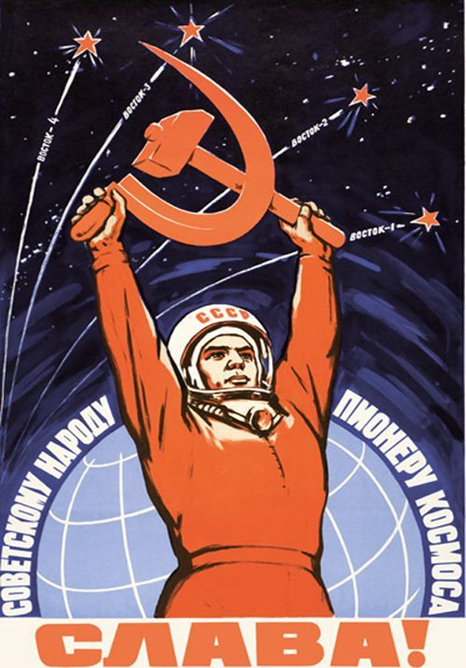
The “positive hero” was to set an example for the reader’s behavior. A Soviet cosmonaut, for one example, became a “positive hero.” A cosmonaut’s space trip was seen as science, materialism, and atheism triumphing over the transcendent values held in the U.S., the enemy of the Soviet Union.
The “certainty” writers followed the lead of the embodiment of “certainty” – Vladimir Lenin. Lenin mocked his opponents’ self-characterization as ‘seekers’ of truth. He held that dialectical materialists do not seek truth; they already possess it. And so, the party-minded “positive hero” refused dialogue, refused to see any alternatives to the Marxist-Leninist-materialist-atheistic “truth” espoused by the party, the representatives of Karl Marx’s class-struggling proletariat.
From Wonder Confronts Certainty:
“The Soviets would label fidelity to present facts “bourgeois objectivism.” It was the best that could be expected from the age of realism, but must give way to socialist realism, which shows the ideal world inevitably coming. The socialist realist author was expected to focus on the people of the future, “positive heroes” exhibiting complete “Party-mindedness.” True positive heroes do not have bring their thinking into accord with the party, a process requiring effort; they exhibit Party-mindedness so thorough that no effort is required”
“Party-mindedness”, we learn from the writings of Russian realist authors, was propagated through the means of propaganda, show trials, random arrests, and the constant terror that there might be any hint, any innuendo, any false statement that would convict one of not being party-minded.
The “party-mindedness” of the 20th century Russian intelligentsia, its conformity to only one way of thinking, is replicated today.
“I happened to witness two professors waiting for an elevator. To make conversation, one voiced an opinion on some political question to see if the other agreed. When she did, they chattered away on a dozen other topics with perfect assurance that they agreed on those, too. Evidently, their beliefs came as a package. Subsequently I noticed this way of thinking many times, as I imagine many of my readers have.
The process works something like this: a person first chooses the group with whom he wishes to identify and then adopts its opinions. He believes as strongly in gun control, let us say, as he does in supporting Planned Parenthood, defunding the police, and banning fossil fuels. It is evident that no arguments or evidence can shake his opinions on any of these topics because arguments or evidence had nothing to do with why they were adopted.
To be sure, a person who thinks this way can cite facts and reasons to justify his opinion, but they have been acquired in the same way as the opinion itself. They are the same reasons others in the group have learned to give. I used to find it eerie to hear repeatedly the same arguments expressed in the same phrases, as if I were listening to a recording rather than to highly educated people who imagined that, unlike their intellectual inferiors, they had arrived at opinions rationally and would change them as evidence warranted. I thought of Jonathan Swift’s observation that no one was ever talked out of an opinion he was not first talked into.”
***
Reading Morson’s article, I was reminded of the easy-going liberal mindset of the Stiva Oblonsky character in Tolstoy’s Russian realism novel Anna Karenina.
Behind Stiva’s smile, his self-possessed mannerisms and hedonism is what Tolstoy described as “the liberalism of the blood.”
From the novel:
“Stepan Arkadyevitch took and read a liberal newspaper, not a radical one, but one advocating the viewpoint maintained by the majority. And even though neither science, nor art or politics held any particular interest for him, he firmly maintained the same views on all these subjects that were maintained by the majority and by his paper, and he changed them only when the majority changed them, or, better put, he did not change them at all; they imperceptibly changed within him . . .
“And so liberalism had become a habit of Stepan Arkadyevitch’s, and he liked his newspaper, as he did his cigar after dinner, for the slight fog it diffused in his brain.”
Stiva, we learn in in the novel, does not recognize his conscious when it speaks to him. And that is aided by his living-in-the-moment forgetting. He did not want to remember any unpleasant thing.
Self-deception and romantic ideology play key roles in Anna’s life.
***
Czeslaw Milosz, Polish American poet, novelist, translator, critic, and diplomat, is best known for The Captive Mind (1953). His essay collection focuses on intellectuals, specifically poets and other writers.
As Charles Haywood writes in his 2019 article The Captive Mind (Czeslaw Milosz), [Milosz’s] “book shows how mental gymnastics, rather than coercion, caused writers under Communism to adhere to Communism. Thereby, indirectly, it congratulates writers who believe their minds free from such, or other, contortions.
“The West incorrectly sees “might and coercion” as the reasons those in Eastern Europe submit to Communism. But, rather, unwilling to face either physical or spiritual death, many choose instead to be “reborn” through taking these metaphorical pills, because “[t]here is an internal longing for harmony and happiness that lies deeper than ordinary fear or the desire to escape misery or physical destruction.” Intellectuals, and artists especially,do not want to be “internal exiles, irreconcilable, non-participating, eroded by hatred.” So they swallow the pills and adopt the “New Faith” (a term Milosz uses throughout the book) which offers the intellectual the certainty he is both correct and virtuous, and therefore gives him a sense of belonging, gives him a feeling of being “warm-hearted and good . . . a friend of mankind—not mankind as it is, but as it should be.”” (Emphasis mine.)
Returning to Morson’s article about package thinking, Morson relates
“What really matters, [Czeslaw} Milosz explains, is “the intellectual’s feeling of belonging.” His defining “characteristic is his fear of thinking for himself.” For this reason, as well as to prosper, he must root out all the old ways of thinking. Milosz describes a phenomenon with which university people are all too familiar, the always incomplete process of teaching oneself to say the right things (in the right words), and avoid saying the wrong ones, so that one never makes a slip entailing ostracism or worse. Of course, the best way to do this is to get oneself actually to share the prescribed views. Milosz describes how
after long acquaintance with his role, a man grows into it so closely that he can no longer differentiate his true self from the self he simulates, so that even the most intimate of individuals speak to each other in Party slogans. To identify self with the role one is obliged to play . . . permits a relaxation of one’s vigilance. Proper reflexes at the proper time become truly automatic.”
***
One obvious feature of our culture’s downward trend toward mindless conformity is critical thinking’s easy alternative: clicking on a machine to receive packaged thoughts.
Why think when packaged thoughts are there for the clicking? And why expand one’s personal bandwidth when you can reaffirm your tribal identity with a click?
Why research and consider a range of ideas and thoughts when clicking on machine AI is ready to do away with mystery and your curiosity, wonder, and impatience? And why think outside package thinking when life is short – shortened by every minute clicking on a machine.
Why read classic literature to gain wisdom, insight, and understanding from other people in other places and in other times, when you can click on a remote for package thinking entertainment.
Have you bought into the globalist, academic, secular and progressive (GASP) package (a feature of Wikipedia) that censors alternative views as “extremist” or “fringe theories” or “conspiracy theories” or “racist?”
Did you buy into the globalist open borders “welcoming the stranger” package where millions of unvetted illegal invaders entered the country as simple or criminal or terrorism opportunists? Did you accept the package thinking that allows third world invaders into our country to replace American workers and American values and do all manner of harm to its citizens as empathy, as what Jesus would do? Take a look at the strangers welcomed: Arrested: Worst of the Worst | Homeland Security And, there’s this: They Called It ‘Compassion’ — But it was Child Trafficking – American Thinker
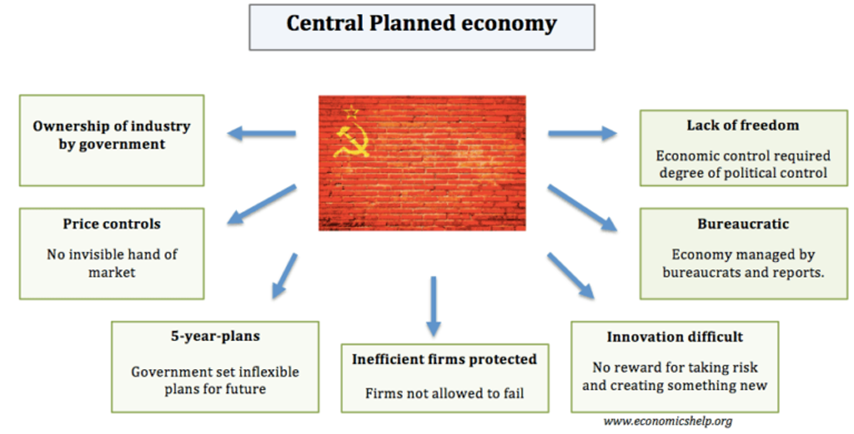
Are you buying into the central planning democratic socialism package where everyone, except certain individuals who hold more power and privilege, must be made equal no matter the human cost? Are you buying into the central planning democratic socialism package and willfully forgetting the objective reality of the horrors of socialism/communism? Are you willfully handing over your life, your thoughts, to “Party-mindedness”?
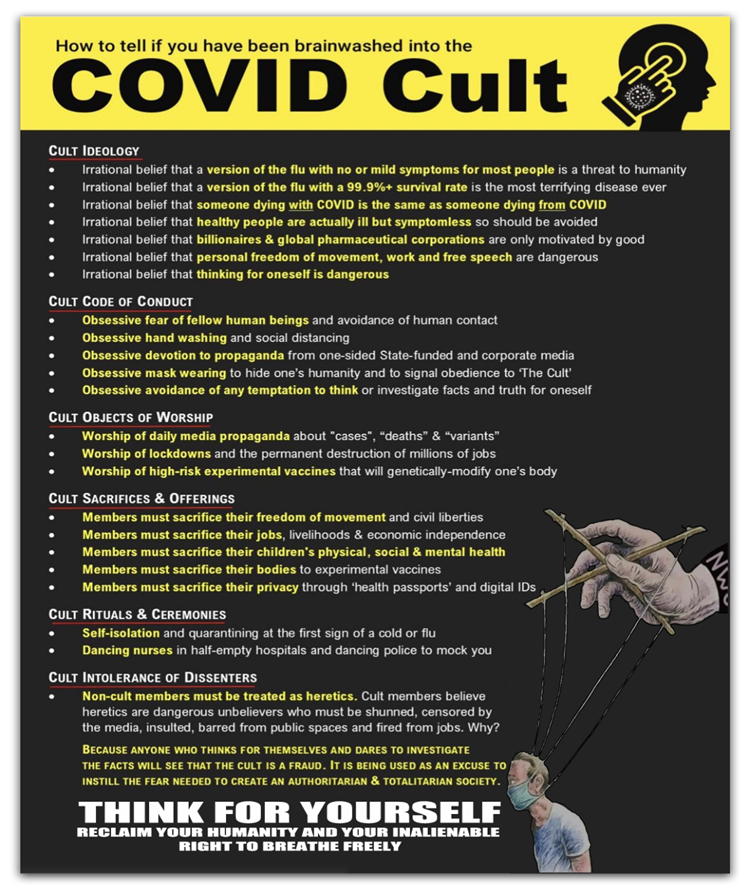
Did you accept the “don’t question the science” COVID package thinking of mandates, masking, social distancing, vaccine passports, isolation camps, vaccine efficacy, and of COVID’s origin lies? America’s COVID Response Was Based on Lies
Likewise, did you not question the package thinking of “climate experts” who announced their verdict that the world would end if we didn’t act now. Not long ago, woven into almost every weather report on local and mainstream media when major weather events (floods, tornadoes, hurricanes, droughts, and wildfires) occurred was the narrative that climate change was behind them – without ever mentioning large-scale natural phenomena such as solar cycles, ocean currents and volcanoes that have been affecting weather for many millennia.
Do you go along with the package thinking of the [John] Rawlsian theory of ad hoc justice that, for example, releases someone arrested 40 times, is not considered a “criminal” because of their minority status, and is released by a judge back onto the street where he sets a woman on fire?
Do you buy philosopher Jean-Jacques Rousseau’s notion that “Man is born free, and everywhere he is in chains” – the package thinking that says that people are entirely products of their environment, of their society, of their age, and that’s why they do what they do. Therefore, they are not responsible for what they do because of external influence. That’s the package thinking behind the Rawlsian theory of justice and behind the executions and horrors of the French revolution working to change social environment.
Have you agreed with the insurrection thought package being espoused by The Seditious Six imploring military service members to “refuse illegal orders” thereby implying that orders coming out of the Trump administration are considered illegal by them and therefore military service members should disobey their commanding officer and join the club of the “Party-minded.” Remember, package thinking has only one train of thought – gaining and maintaining power over reality.
Have you agreed with the insurrection package thinking espoused previously by NYT’s op-ed columnist David Brooks? Do the values of your party-minded package thinking allow you to hamstring a DEMOCRACY! elected president with the rulings of party-minded federal court judges that will be overturned. Do the values of your party-minded package thinking justify the deep state, in the labyrinth of government, to sabotage the efforts of a Democratically elected President?
Do the values of your package thinking allow you to call for uprisings by any means necessary, to burn down buildings, to destroy property, to destroy businesses, to steal, do violence on others, to defund the police, to create pipe bombs, to assassinate? To ignore your conscience?
Did you accept the “Danger to our Democracy” thought package the media delivered during the last presidential election cycle? It should be obvious from the likes of David Brooks, that the “guardians of democracy” are the ones who want to tear it down.
Have bought into the diversity, equity, and inclusion (DEI) playbook that conforms and coerces everyone to identify with Soviet style party-mindedness package thinking?
Have bought into viewing everything including humans through the lens of materialism?
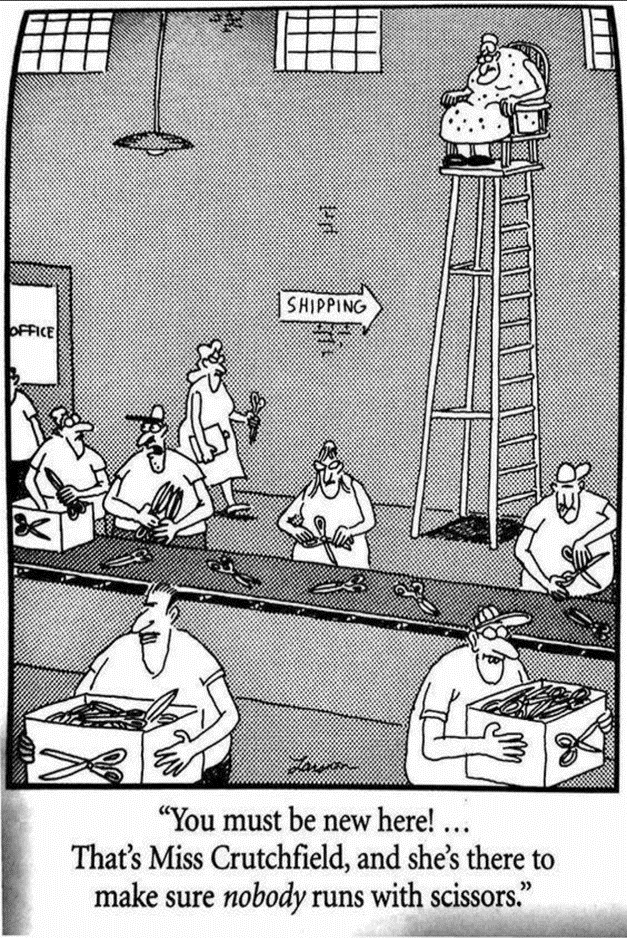
Have you bought into package thinking so as to not be considered an outsider? Have you bought into conformity for conformity’s sake?
Is censorship the worst thing that can happen to a people? Or, is it “Party-mindedness?”
When we hear someone say crazy things, we might say “Yeah, right” and shrug it off. But when a group of people say crazy things with the smug air of certainty and people agree with said crazy things, we wonder “What in the world is going on?” and “Where is this coming from and where is it going?”
What happened in Russia didn’t stay in Russia. And a mind is still a terrible thing to hand over.
You can put your ear to the road and hear what is quickly approaching. Download and listen to the following podcasts:
London is falling – or has it fallen already?
Liz Truss, the 56th prime minister of the United Kingdom, in her very first episode of The Liz Truss Show discusses how bad things are in Britain with a mass migration and economic doom loop – and how to defeat the deep state who have let this happen
Interview with Professor Gary Saul Morson on Tolstoy, Faith, Package Thinking, and The Importance of Critical Thinking
Professor Gary Saul Morson shares his thought-provoking definition of an intellectual—someone who seeks truth independently, values ideas for their own sake, and stands apart from identity-driven thinking. Whether discussing classic Russian Literature or analyzing modern society, Professor Morson is one of the most insightful and consequential scholars of our time. Discover how this interview, and its exploration of timeless topics, can inspire bold, principled leadership and innovation within today’s business environment.
Gary Saul Morson on Tolstoy, Faith, Package Thinking, and The Importance of Critical Thinking
Vladimir Lenin’s ideas are alive and well today: Party-ness, politics as win-lose, zero-sum game, Who-Whom, rejection of truth, ideology, violence, philosophical materialism, adherence to lying.
Is Hope Naïve in a World Like Ours? | Esau McCaulley & Gary Saul Morson at Northwestern
~~~~~
Quotes:
In the long run my observations have convinced me that some men, reasoning preposterously, first establish some conclusion in their minds which, either because of its being their own or because of their having received it from some person who has their entire confidence, impresses them so deeply that one finds it impossible ever to get it out of their heads. Such arguments in support of their fixed idea … gain their instant acceptance and applause. On the other hand whatever is brought forward against it, however ingenious and conclusive, they receive with disdain or with hot rage – if indeed it does not make them ill. Beside themselves with passion, some of them would not be backward even about scheming to suppress and silence their adversaries. I have had some experience of this myself. … No good can come of dealing with such people, especially to the extent that their company may be not only unpleasant but dangerous. Galileo Galilei
If the Brave New World cannot insert a square peg into a round hole, it will redefine “roundness” until a perfect fit results.
-Jerome Meckier, from Aldous Huxley: Satire and Structure
…a sense of unity is opposite of a sense of uniformity. Uniformity, where everyone “belongs”, uses the same cliches, thinks alike and behaves alike, produces a society which seems comfortable at first but is totally lacking in human dignity. Real unity tolerates dissent and rejoices in variety of outlook and tradition, realizes that it is man’s destiny to unite and not divide… Unity, so understood, is the extra dimension that raises the sense of belonging into genuine human life.
-Northrop Frye, from The Bush Garden
Wise men speak because they have something to say; fools because they have to say something. -Plato
“The past is our always-available counterculture, and it’s a rich one. Every minute you spend attending to something not-immediately-present, you are helping to build a counterculture.” ― Alan Jacobs
~~~~~
Links:
Why are intellectuals — those whose thinking is supposed to be most refined — so susceptible to totalitarianism? Gary Saul Morson offers three explanations from the treasury of Russian literature.
Anti-Communism Week has been marked for November 2025. Writer-producer Julie Behling’s documentary “Beneath Sheep’s Clothing” warns of communism’s devastation: “Globally, communism claimed the lives of approximately 150 million people in the 20th century.”
Totalitarian governments cannot afford that its citizens remain autonomous persons. This poses a threat to their quest to consolidate power. Individual liberty threatens the theoretical, utopian foundations of promising the re-distribution of goods, and equality; communism ultimately fails to re-distribute the essence of human nature.
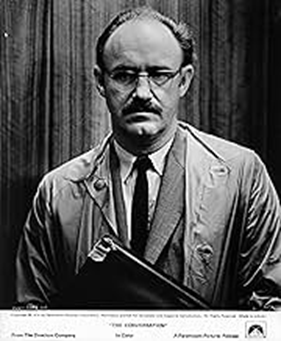
Harry, a professional eavesdropper, is being paid to spy on a woman having an affair. But something he overheard makes him question whether he can remain a detached listener.
Harry and his crew use powerful microphones to record a conversation between the woman and her lover as they walk around a crowded San Francisco square. Later, after filtering out background noise on the tape, Harry replays a cryptic phrase in the recording. He imagines it to mean that the woman is being targeted to be murdered by his client.
Listening to his conscience, already replaying guilt and shame from a previous snooping assignment, Harry looks for a way out, for a way to not have blood on his hands. To offload his responsibility, he confides to a priest in a confessional, the oldest form of eavesdropping:
I’ve been involved in a job that may bring misfortune to two young people. It’s happened before. What I do has caused harm to someone. I’m afraid it will happen this time too. I’m not responsible for it. I can’t be responsible for it.
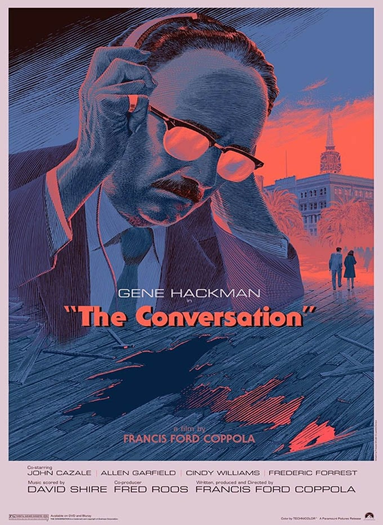
The conversation in the park and in Harry’s soul takes place in the 1974 film by Francis Ford Coppola – a tense thriller and character study titled The Conversation.
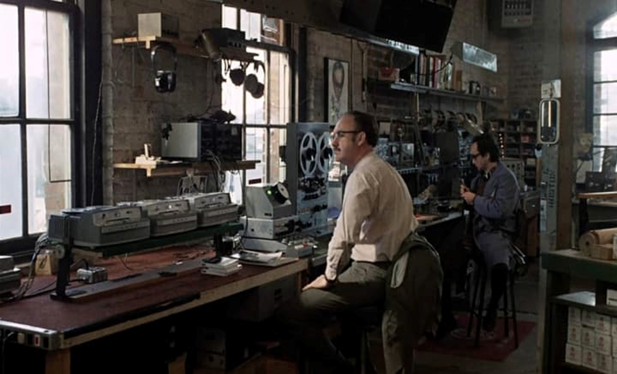
Gene Hackman (God rest his soul) plays Harry Caul, ‘the best bugger on the West Coast.’ Harry is obsessed with technology and works in a world where privacy can be bought and sold using it.
On-the-job Harry, a surveillance expert, is an invader of privacy. He gets paid to move in close, take pictures, and record private conversations with electronic devices. But Harry has a paranoid fear of anyone being up close and personal with him.
Harry guards his privacy. He lives in a sparsely furnished apartment that is secured by three locks and an alarm system. It’s his fortress. He uses a payphone to make personal calls and lies about having a home telephone. Alone, Harry spends time playing his saxophone along with jazz records.Jazz is the music of individualists and loners.
Harry looks like a regular Joe. He easily fits into crowds and isn’t noticed while snooping. But Harry isn’t public. The enigmatic Harry stays emotionally detached from others, cut him off from the rest of the world as though he’s not really a part of it yet. This suggested in his last name “Caul,” the thin membrane that surrounds a fetus until it is born. His translucent raincoat suggests the caul.
Harry’s work is intrusive, but he wants protection from the same. He avoids below-the-surface relationships with people in his industry, his coworker Stan (John Cazale), and Amy, the mistress he supports and visits at random times.
Harry records private moments between humans. But the guarded Harry can’t or won’t expose himself to another human. His involvement with Amy (Teri Garr) is not a relationship nor intimacy. Harry shows up on his birthday and Amy thinks it is a good time to get to know Harry, to know his secrets. But Harry says he has no secrets to his secret lover. Harry is distant even from the person he is physically closest to.
As with the priest, Harry off loads his conscience and distances himself from the detrimental effects of his work. When Stan wants to speculate about the meaning of the conversation between Ann and Mark on the tapes, Harry insists that it is just a job and that it is unprofessional to get too curious or assume anything. How ironic for the intensely curious Caul!
Stan: It wouldn’t hurt if you filled me in a little bit every once in awhile. Did you ever think of that? Harry Caul: It has nothing to do with me! And even less to do with you! Stan: It’s curiosity! Did you ever hear of that? It’s just g*ddamn human nature! Harry Caul: Listen, if there’s one sure fire rule that I have learned in this business is I don’t know anything about human nature. I don’t know anything about curiosity. That’s not part of what I do.
The man who hires Harry is Martin Stett (Harrison Ford). Stett is the assistant to Harry’s client, the director (Robert Duvall). Initially, Stett is friendly. But when Harry refuses to hand over the tapes, he becomes intimidating and warns Harry to “be careful.” He surveils Harry at the surveillance tech convention.
After a party at his workshop, Harry spends the night with Meredith (Elizabeth MacRae), a woman he has just met. He finds out the next morning that the tapes have been stolen. Stett had Meredith steal the tapes.
Stett tells Harry that they couldn’t wait for the tapes. He then tells Harry to come to the director’s office to hand over the photographs and collect his money. There, Harry meets the director and realizes that the woman he has been spying on is the director’s wife. The taped conversation now seems to signal the worst for the woman.
After leaving the office, Harry decides to get involved. His Catholic conscience kicks in and so does his covert curiosity. He surveils the lovers in a hotel room and . . .
I’ll stop there, with the basic elements of the film. You can watch the movie, experience the intrigue, check out the enigmatic Harry Caul character, and find out what’s bugging Harry Caul.
~~~
Some questions and thoughts:
Does Harry’s method of recording reality, a cryptic conversation here, turn out to be flawed?
Does anyone who views or hears another from a distance – do they know that person? Or, do they only hear and see what they want to.
Do devices divine truth?
Does Harry compartmentalize his work-self from his conscience so as to maintain his addiction to snooping?
Does Harry become a pawn in another scheme?
Does Harry become a “partner in crime” that he so wanted to avoid?
Does the overflowing toilet scene signify the ugly truth coming to the surface?
How does super snoop Harry end up at the end of the movie? What’s his psychological state? What does his utter helplessness represent?
In the end, with what’s left intact, does Harry Caul find what is ‘bugging’ him? Does Harry come up empty?
Why would a Christian and book reader like me watch this movie? Well, for one reason, it is a great movie.
The Conversation, written, produced, and directed by Francis Ford Coppola between the Godfather movies, is a tense thriller and character study. The 1974 film is not like most of the pathetic and mindless flicks of today. There are no superheroes, no CGI, no WOKE agenda, no gratuitous sex, nudity, and violence. The violence that does occur is presented as an off-stage event like in Greek tragedies.
The movie was shot using long lenses and camera positions on rooftops. You get the idea of watching at a distance and of surveillance cameras panning scenes.
Another reason to watch is that Gene Hackman was a great actor. The character study involving a Catholic man who is self-isolating and who hears and views others from a distance – Hackman’s Harry Caul makes the movie.
Another is to consider the consequences of hearsay or of unfounded information, of surveillance versus participation, and of perception versus reality. Can we really know someone, their thinking, and their situation from a distance, from what others would have us believe?
And, there is the matter of someone listening without our knowledge. Though made in 1974, the issues of privacy the movie presents are relevant regarding you and I being surveilled today. The analog technology shown in the film has been replaced with digital technology that gains access to our private electronic communications, as through wiretapping or the interception of e-mail or cell phone calls.
We live in the age of digital technology that includes emails, texts, smart phones, and social media. How does Harry’s addiction to technology that supports his habit of seeing and hearing others at distance and his voyeuristic predilections affect him?
Scot Bertram talks with Clare Morell, fellow at the Ethics and Public Policy Center and director of EPPC’s Technology and Human Flourishing Project, about the long-term effects of smartphone use on children and her new book The Tech Exit: A Practical Guide to Freeing Kids and Teens from Smartphones. And Benedict Whalen, associate professor of English at Hillsdale College, continues a series on the life and work of American writer Mark Twain. This week, he discusses The Adventures of Tom Sawyer.
But don’t believe your eyes. Believe what the media tells you . . .
ABC7 Los Angeles anchor Jory Rand described anti-ICE riots as “just a bunch of people having fun watching cars burn,” minimizing the widespread violence and destruction in the city.
I cannot believe this is real.
ABC reporter says not to bring in law enforcement to the LA riots because “it’s just a bunch of people having fun watching cars burn.”pic.twitter.com/OlgBo4Pj1I
Another on-the-scene reporter, Tim Caputo, pushed back on the term “riot” and blamed police presence for provoking violence. Demonstrators set cars on fire, hurled objects from a freeway overpass, and smashed LAPD headquarters windows.
Even with images of burning vehicles and protesters brawling with law enforcement, the media downplayed violent anti-ICE riots in Los Angeles calling them “fun” and “relatively peaceful.” The media is worse than distraction. The media is disinformation chaos.
“What we witnessed in Los Angeles over the weekend wasn’t some organic outcry over injustice. It was premeditated, coordinated chaos—triggered by long-overdue ICE enforcement operations, and escalated by radical agitators, cartel-aligned elements, and a feckless local government unwilling or unable to defend its city. . .
“And yet, LA city leadership and activists immediately painted these moves as “racial targeting” and “unconstitutional overreach.” By Saturday night, the city was predictably on fire. Downtown intersections were barricaded. Masked agitators torched Waymo self-driving vehicles. LAPD officers were pelted with bricks, fireworks, and frozen water bottles.”
Don’t believe your eyes. Believe what Democrat leaders tell you . . .
While LA county burns (again) California Governor Gavin Newsom and DEI LA Mayor Karen Bass condemned Trump’s federal law-and-order response as “escalatory” and “provocative,” hoping to rally Democrats against Trump.
And so, media-programmed Democrats scream “authoritarianism,” “insurrection,” and “constitutional overreach,” and “We have no King!”
Democrats, who cheered open-border policies and virtue-signaled about being a “welcoming city,” are now left with the ungodly results – civil collapse. They propose no solution to the chaos they promote. They blame others. That’s what Democrats do.
Trump won the popular vote in the 2024 election. Trump flipped Arizona, Georgia, Michigan, Nevada, Pennsylvania, and Wisconsin to win the Electoral College votes.
Voters, including blacks and Hispanics, wanted what Trump said he would do as president: bring about law and order, mass deportations and bring jobs to Americans.
A majority of likely U.S. voters say they approve of President Donald Trump’s job performance, according to Rasmussen poll results.
But don’t believe your eyes. Believe what elites tell you . . .
About two months ago, on April 17, 2025, columnist David Brooks wrote the above NYT column where he appears to allude to a type of Mao-Communist People’s War uprising:
It’s time for a comprehensive national civic uprising. It’s time for Americans in universities, law, business, nonprofits and the scientific community, and civil servants and beyond to form one coordinated mass movement. Trump is about power. The only way he’s going to be stopped is if he’s confronted by some movement that possesses rival power.
See that again. June, 2025, . . .
“An avowedly Communist revolutionary group with ties to a China-linked Marxist funding network has been at the forefront of organizing nationwide protests opposing illegal immigration crackdowns by U.S. Immigration and Customs Enforcement (ICE) — including protests which spiraled into violent riots in parts of Los Angeles.
“The Party for Socialism and Liberation (PSL) — which openly calls for revolution to bring down the current American system and which publicly sympathizes with murderous Communist regimes — has been a leader in organizing and fueling anti-ICE demonstrations in LA as well as in other cities nationwide.”
Renowned attorney Larry Klayman predicted months ago that there would be full-blown legal civil war happening in the court system. He warns that what is happening in LA is dire,
” We knew this was coming. This is more than an insurrection, this is a Bolshevik style revolution. It’s not just Bolsheviks, but it’s every conceivable leftist radical group. This is financed, undoubtedly, by people like George Soros. . . This will be a flash point to carry forth this Bolshevik revolution. They want to take this county down to ground zero. This is what they are trying to do. They want to destabilize the country and bring these radicals out.”
Klayman goes on to say, “There is, undoubtedly, foreign money involved probably from communist China, Iran and North Korea…”
Progressivism’s controlled-opposition David Brooks, self-described moderate and Christian, like others of his ilk – the David French-Russel Moore-Never Trump types – publishes hoity-toity prescriptions for how we should live, think, and vote. He tells us that Trump will destroy democracy and America. But how is the content of Brook’s screed any different than the Left’s by any means necessary and the ends justify the means?
“The Left will grab power by any means necessary including stealing elections, creating hoaxes about political opponents and J6, and lawfare. David Brooks, in this NYT op-ed, is seeking to aggregate “rival power” to overthrow the current government (so as to return to the “normal” chaos and destruction the Left is known for, e.g., keeping MS-13 gang members in the U.S.).”
Brandon Smith writes in And So It Begins: Leftist Monkey Wrenching Is Leading To Civil War,
If you thought that the leftist delusions of grandeur had finally hit their peak you are about to be unpleasantly surprised. There are no limits to the insanity that progressives will embrace in their pursuit of power, and they continue to adhere to the fantasy that they are the “good guys” despite the fact that most of the world has been telling them for the past several years that their ideology is repugnant.
David Brook’s days of anarchy are here, and they are repugnant.
Bottom Line:
The drooling despot Joe Biden along with Mayorkas and Democrat governors and mayors and the auto-pen allowed 12,000,000+ illegal invaders into this country who do not consider themselves Americans, do not want to become Americans, and think they have every right to simply occupy and seize the sovereign territory of these United States. Biden’s would-be successor, the babbling Kamala Harris, would have done the same.
It is no surprise then that chaos and death followed, including nearly 48,500 Americans dying from synthetic opioid overdoses, mostly fentanyl, in 2024 alone.
It is no surprise then that children have been endangered:
The loss of even one child is a tragedy. The loss of over 7,000, some potentially to sex traffickers, due to Joe Biden’s immigration policies, is a national shame.
Like petulant willful children who demand their way, the Left (a fused group of Progressive Democrats along with antifa, BLM, the PSL, the MSM, trans-activists, pro-Hamas agitators, radical dark money NGOs, and Never-Trumpers) have attempted Trump’s assassination twice, have used rogue judges for non-stop lawfare attempting to jail and bankrupt Trump, have used rogue judges in non-stop lawfare to stop and delay his EOs, have continued to harangue him, and is now in full violent revolt against him and the Americans who voted for him and America itself.
Government of the elites, by the elites, for the elites. Hence, the urgent calls for civil war and Color Revolution by the likes of David Brooks. Hence the encouragement of dark woke and talk that nods and winks at people taking matters into their own hands! Hence, the fused groups of paid agitators – the fraternité-terreur – and pro-illegal immigrant riots and ultra-Bolshevism.
Call to Action:
See that again. Lawless Mexicans, who left the narco-state of Mexico, are running around Southern California with Mexican flags, burning ICE vehicles and detention centers.
All American fathers must fight for America and against the terror, chaos, and lies of the Left. Defend our country and constitution. Don’t be distracted by the calls for U.S. sons and daughters to be involved in forever wars. Don’t be distracted by what’s going on in Ukraine and the Middle East. We are at war at home.
All illegal invaders must go back home now.
. . . the Center for Immigration Studies, has conservatively estimated there are about 15.4 million illegal aliens in the United States, a 50% increase over the four tumultuous years of the Biden administration.
All illegal invader remittances back to their homeland via wire transfer services must be taxed at least 50%.
All federal district court judges who have acted with rulings against Article Two of the United States Constitution which established the executive branch of the federal government which is responsible for enforcing federal laws need to be stopped by the Supreme Court now and/or be impeached and/or have their funding cut off by congress now.
The New York Times runs through several scenarios to “neutralize” the so-called Trump threat, finally landing on their fifth and most desperate option—which just so happens to be the one we’re likely facing right now. This last-ditch scenario should scare the living daylights out of any sane American. This is the “color revolution” or “civil war” option. (Emphasis mine.)
HAPPENING NOW 🚨: Police on the 101 freeway are using tear gas on protestors on the overpass, that are launching fireworks, glass bottles and other items at them.
Multiple people injured as they tried to escape the tear gas from hitting them.
HAPPENING NOW 🚨: A protestor waves a Mexican Flag in front of a burning WayMo vehicle. Multiple vehicles have been destroyed, no police presence in this affected area.
Far-left Illinois Governor J.B. Pritzker (D) is calling for mass demonstrations and mobilization with the intention to “punish” Republicans. The extreme language is being seen by some as a return to the violent political rhetoric that resulted in two assassination attempts on President Donald J. Trump last year.
“Progress, far from consisting in change, depends on retentiveness. When change is absolute there remains no being to improve and no direction is set for possible improvement: and when experience is not retained, as among savages, infancy is perpetual. Those who cannot remember the past are condemned to repeat it.” -George Santayana
~~~~~
American Citizenship and Its Decline: Illegal Immigration and the Loss of National Sovereignty
“On this episode of The Hillsdale College Online Courses Podcast, Jeremiah and Juan discuss Juan’s journey to citizenship before introducing Victor Davis Hanson. (Recorded 8 months ago during the Biden regime.)
“Citizenship is rare in human history but essential to free government. Today, the constitutional rule of citizens in America is threatened by a new form of government, unaccountable to the people, in which power is held by a ruling class that seeks to transform our society. In this eight-lecture course, students will examine the origins and history of citizenship in the West and the grave challenges American citizenship faces today.”
American Citizenship and Its Decline: Illegal Immigration and the Loss of National Sovereignty
It’s time for a comprehensive national civic uprising. It’s time for Americans in universities, law, business, nonprofits and the scientific community, and civil servants and beyond to form one coordinated mass movement. Trump is about power. The only way he’s going to be stopped is if he’s confronted by some movement that possesses rival power.
So, David, to hell with democracy and all of the people who voted for Trump and for the lawful changes the Executive Branch is bringing about? Wasn’t it you – the Rachel Maddow-David French-Never Trump types – that told us over and over again that Trump would destroy democracy? But you and the Left are hoping to do that.
You and the Left wanted, by hook or by crook, Kamala Harris to be elected. She would be a sock puppet for the coastal and globalist elites to continue the plunder of our country and our democracy!
If you, the reader, are a partaker of Deep State media (MSNBC, CNN, NYT, WaPo, The Atlantic, etc.) you know the propagandists are roiled. Trump is called a “dictator”, “fascist”, “oligarch”, “Hitler”, “Nazi”, and “racist.”
Trump and his voters, you see, are beneath David and the elite ilk he panders to. His op-ed rallying cry is to unite the self-important – the true dictators, fascists, oligarchs, Hitlers, Nazis and racists of the elitist Left.
I’ve written often about how the Left seeks power above all else. The Left will grab power by any means necessary including stealing elections, creating hoaxes about political opponents and J6, and lawfare. David Brooks, in this NYT op-ed, is seeking to aggregate “rival power” to overthrow the current government (so as to return to the “normal” chaos and destruction the Left is known for, e.g., keeping MS-13 gang members in the U.S.)
It is quite revealing that this is the same power hungry and polarizing David Brooks who gave an interview titled How to Know a Person with David Brooks for the Progressive Trinity Forum (a site where Our Spiritual Betters of Never Trumper ilk gather).
The interview blurb reveals two-faced David:
“In a society where so many feel unseen and unknown, how do we become the kind of people who deeply see and know those around us? The conflict and division in our society demonstrate the need for people committed to pursuing human connection, even across lines of difference. What can we do – as individuals and in community – that will help us really understand the people in our lives?
“David Brooks, author of How to Know a Person: The Art of Seeing Others Deeply and Being Deeply Seen, joined us to explore what it means to know others and to be known by them:
“When I ask people, tell me about a time you’ve been seen, they tell me with bright eyes and joy in their face, they tell me about time somebody totally got them. Because seeing someone, if I see potential in you, you’ll see potential in yourself. If I beam my attention on you, you’ll blossom. And so it’s just super powerful to feel seen. But it’s also powerful and fantastic to feel like you’re the seer.”
Well, we see you, David. You are David with Trump Derangement Syndrome, a condition that blinds you to all else except the need for power to get your way. You have not seen or known the people who voted for Trump, which is most of America. You live in a credentialed elite bubble. You know those therein, ergo the rallying cry to them and the deep state in the NYT.
Here’s David in the same op-ed not “seeing” Trump:
[Trumpism] is a multifront assault to make the earth a playground for ruthless men, so of course any institutions that might restrain power must be weakened or destroyed. Trumpism is about ego, appetite and acquisitiveness and is driven by a primal aversion to the higher elements of the human spirit — learning, compassion, scientific wonder, the pursuit of justice.
David wants us to know that he is on higher moral ground than Trump and the vast array of people who voted for Trump. David Our Better has an aversion to what he ‘sees’. So, what was decided on election night must be overturned by one coordinated mass movement.
Brook’s civil war-mongering column ends with a phrase originating from The Communist Manifesto by Karl Marx and Friedrich Engels: “We have nothing to lose but our chains.”
Is David worried that he will no longer be seen in the role of credentialed elite and as one of our betters telling us how to live and see and “blossom?”
Here, we really can see David and his worldview – antipathy to any rule but his own. He wants to overthrow the current government by any means necessary and conform America to his image using elitist chains.
We have witnessed the managed decline of our country the last four years -our country being despoiled by liberal elites whose vision of the world is them sitting atop it dictating to the little people and plundering them for more wealth and power.
We don’t need more alarmist rhetoric about “Democracy!” from the Left. We don’t need a revolution. We don’t need a Color revolution (Democrats Plan For Color Revolution) that is being pushed by the deep state media.
Like a petulant willful child who didn’t get his way, there is nothing of Christ in the words of David Brook. There is, markedly so, plenty of self-righteous contempt for those outside David’s “normal.”
April 1961. The first human to travel into space returned to Earth after traveling 17,500 mph for 108 minutes. He circled the earth once at a maximum altitude of 203 miles.
About 4.35 miles above the Earth, Russian cosmonaut Yuri Gagarin ejected from Vostok 1, a pressurized spherical capsule just two meters wide. He parachuted to the ground.
This first of its kind scientific event made Gagarin a space hero and made for a compelling narrative for the Soviet system to promote socialism and scientific atheism:
“For Soviet Communism, cosmonauts were utopianism made flesh – Socialist Realist heroes come to life – and Socialist Realism and socialist reality were never closer than during the Soviet space age.”[i]
After Joseph Stalin died on March 5, 1953, Soviet leaders during the Khrushchev era (1953-1964) were eager for a return to party purity. Stalin had given up trying to purge religion from Soviet Russia. He had wanted to produce an atheist society. But after seeing that the stubborn religiosity of the masses could not be eradicated, he finally decided to maintain authoritarian control over it. He heavily regulated churches and church leaders to keep them politically impotent.
“Under Khrushchev, then, the party realized that it was not enough to eliminate the political and economic base of religion. In order to transform the Soviet society of the present into the Communist society of the future, religion had to be eradicated not just from Soviet politics and public life but also from Soviet people’s consciousness.”[ii]
Khrushchev’s focus on party purity meant a return to campaigns to eradicate religious “survivals” and the promotion of a scientific materialist conception of the world as outlined by Marx-Leninism. The latter, in the form of secularist rituals, was supposed to fill the void left behind by a life without religion.
Soviet space flights were thought to show the world that the Soviet’s scientific, materialist, and atheistic worldview was superior to that of the religious and capitalist U.S. After all, wasn’t science the only path to knowledge, and matter the fundamental reality? And wasn’t it reason and not God who put a man into space? And a space-hero cosmonaut who didn’t see God in space, well . . .
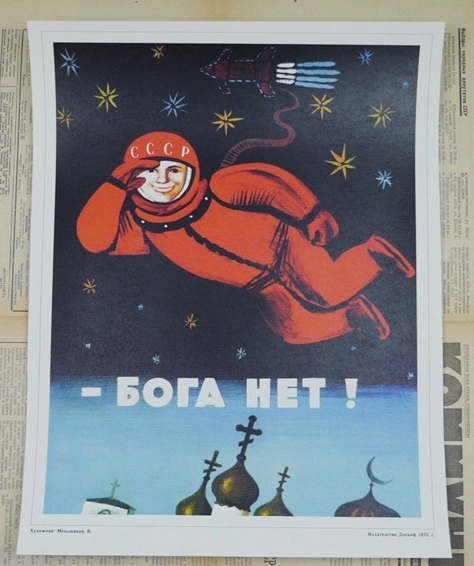
Before a plenary session of the Central Committee, Russian Premiere Nikita Khrushchev gave all the Party and Komsomol organizations [Young Communists] the mission of promoting anti-religious propaganda. With that directive he said: “Why are you clinging to God? Here Gagarin flew into space and didn’t see God.”
Yuri Gagarin’s close friend and colleague, Colonel Valentin Petrov, denied that Gagarin ever said that. The words put in Gagarin’s mouth by Russian Premiere Nikita Khrushchev and Gagarin’s supposed godlessness became popular folklore and a party narrative created to support atheism. The party knew that people would have believed more in Gagarin’s words than in Khrushchev’s.
“There Is No God.” (Boga net!)
From out of the heavens, Yuri Gagarin, a baptized member of the Russian Orthodox Church, reentered into a world system that set itself up opposed to God. Gagarin was made a caricature of the atheistic propaganda the party wanted to propagate.
Khrushchev: “Why should you clutch at God” (you cannot see when you look out the capsule window into space when you can envision a materialist utopia in the successful figure of our own cosmonaut Yuri Gagarin.)
~~~~~
A view through a window into heaven . . .
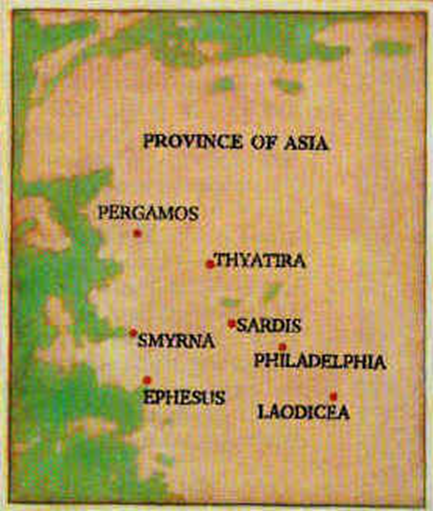
At the end of the first century CE, seven churches of Asia received a circular letter sent from the island of Patmos. The author composed the letter “in the spirit” on the Lord’s Day. The letter was to be read out loud in full on the Lord’s Day when Christians met for corporate worship. Their circumstances served as a type of inset in the letter’s cosmic space-time mapping.
The churches were situated in a Roman province in what is now western Turkey. Some twenty years before, the Roman Empire unleashed its full power against a Jewish rebellion resulting in the fall of Jerusalem and the complete destruction of the Second Temple.
Though Christian persecution had been sporadic, the oppressive nature of the Roman Empire made for distressful times for these early Christians. Devotion to and worship of only one Lord and God kept these Christians under suspicion by Roman authorities.
The surrounding Greco-Roman culture was polytheistic. The official state religion, headed by Jupiter, was the Roman pantheon of gods. Temples to Jupiter, Mars, and Venus were built throughout Rome. Being able to add your god or goddess to the local pantheon of gods worked to keep a diversity of religions in check for Pax Romana.
The Roman empire operated under ‘divine’ authority. The emperor, both a political and a deified religious figure, held absolute power. He maintained authority through political alliances, military might and a dutiful citizenry.
Public support for the imperial cult worked to solidify the emperor’s authority. Citizens were expected to show loyalty to the ‘divine’ emperor by participating in religious festivals, rituals, and emperor worship. Neglecting the imperial cult was considered treasonous.
Throughout the empire Roman power and political influence were on display with monuments, mosaics, iconography, frescos, and image-stamped coins. Adding to perceptions of Rome as a formidable world power was literature, inscriptions, myths, architecture, and elaborate public ceremonials.
All eyes on the emperor.
Roman imperial propaganda was also used to shape the public’s perception of the emperor. His presence, like Rome’s, was to be sensed everywhere – in public places and in the sanctuaries of the imperial cult in provincial towns.
Emperors were depicted as tough warrior and general types and as benevolent paternalistic protector and statesman types. At the time of the Patmos letter Emperor Domitian governed (81 to 96 CE) as divine monarch and benevolent despot. As such, he saw himself as a cultural and moral authority able to guide every aspect of a citizen’s life.
The expectation for everyone under Roman rule was to respond to Rome in its terms and beyond that, to show devotion to the sovereign emperor. Or, feel the force of the empire. Fear was the motivation. “Bread and circus games” were the distractions used to deflect from the fact that Roman emperors were selfish and incompetent tyrants.
The Patmos letter was sent to those who held an expectation of God’s coming universal rule and to those who lost that focus. A clash between an all-powerful Sovereign and his kingdom and the ubiquitous domineering emperor and empire was expected. The letter, with vivid prophetic imagery, did not disappoint.
Every eye will see him.
Christians in the seven churches, upon hearing “Look! He is coming with the clouds, and every eye shall see him, yes, even those who pierced him. All the tribes of the earth shall mourn because of him. Yes! Amen,” looked out the window of their imagination to see Christ and the coming of God’s universal rule.
As the letter was read, they recognized the “satanic trinity” fighting against them and God’s kingdom on earth: “the dragon or serpent (the primeval, supernatural source of all opposition to God), the beast or sea-monster (the imperial power of Rome), and the second beast or earth-monster (the propaganda machine of the imperial cult).”[iii]
And they heard a devastating critique of Roman power dynamics. The letter recognized “the way a dominant culture, with its images and ideals, constructs the world for us, so that we perceive and respond to the world in its terms. Moreover, it unmasks this dominant construction of the world as an ideology of the powerful which serves to maintain their power.”[iv]
They also envisioned their role in saying “No” to the idolatries of Rome (Babylon) and to be a witness of the truth worth dying for to all tribes of the earth. And then the Day of the Lord.
After hearing the letter read, the church community once again reentered into a world system opposed to their Sovereign. But now they had something their imaginations could clutch – a view of God’s throne room and of “what must soon take place” – and a counter-cultural approach for the church.
More about John’s Apocalypse or The Revelation of John in the next post.
[i] Smolkin, Victoria. A Sacred Space Is Never Empty: A History of Soviet Atheism. Princeton University Press, 2018. https://doi.org/10.2307/j.ctt1zgb089. PP 86-87
In this parable of Jesus, recorded in the gospel of Mark (chap. 4), notice how the kingdom of God grows -not by power, might or militancy:
“This is what God’s kingdom is like. Once upon a time a man sowed seed on the ground. Every night he went to bed; every day he got up; and the seed sprouted and grew without him knowing how it did it. The ground produces crops by itself: first the stalk, then the ear, then the complete corn in the ear. But when the crop is ready, in goes the sickle at once, because harvest has arrived.”
~~~~~
Melanie Hempe, founder of Screen Strong, joins host Scot Bertram of Hillsdale College to discuss how to prevent your children from forming a lifelong screen addiction, simple tips for reducing screen time, and how to answer questions from other parents.
“If science is really given a free hand it can now take over the human race and re-condition it: make man a really efficient animal. If it doesn’t – well, we’re done.”
That is Lord Feverstone speaking to Mark Studdock in C.S. Lewis’ That Hideous Strength.
Feverstone, a shrewd sociopath, uses idealism to lure gullible Mark Studdock, an ambitious, self-centered and shallow intellectual looking to ‘upgrade’ his life. Feverstone wants Mark to join the National Institute for Co-ordinated Experiments (N.I.C.E.)
N.I.C.E. is a scientific social engineering agency and a front for dark supernatural forces. It is bent on world domination through scientific management. Propagandistic media is used to persuade the educated, like Studdock, to join in disseminating N.I.C.E. propaganda:
One interesting feature in the effort toward totalistic control over society, as developed in That Hideous Strength, is the matter of influencing public opinion through the news media. Mark, the insecure protagonist in the story, finds himself drawn into the “inner ring” of the technocratic project; he eventually discerns his role to write stories that support the agenda of the National Institute of Coordinated Experiments (N.I.C.E.). -Ted Lewis, Jacques, Jack and the Technocrats | | The International Jacques Ellul Society
Feverstone continues working Mark . . .
“Man has got to take charge of Man. That means, remember, that some men have got to take charge of the rest – which is another reason for cashing in on it as soon as one can. You and I want to be the people who do the taking charge, not the ones who are taken charge of. Quite.”
[Mark] “What sort of thing have you in mind?”
“Quite simple and obvious things, at first – sterilization of the unfit, liquidation of backward races (we don’t want any dead weights), selective breeding. Then real education, including pre-natal education. By real education I mean one that has no ‘take-it-or-leave-it’ nonsense. A real education makes the patient what it wants infallibly: whatever he or his parents try to do about it. Of course, it’ll have to be mainly psychological at first. But we’ll get on to biological conditioning in the end and the direct manipulation of the brain . . .”
“N. I. C. E.’s symbol, devoted as it was to “Technocratic and Objective Man” (That Hideous Strength, 259), was a muscular male nude grasping a thunderbolt (That Hideous Strength, p. 215).” – The Devils in Our World – Official Site | CSLewis.com
There were significant parallels to N.I.C.E.’s scientific management activity and the characters involved in 1945, when Lewis came out with the final book of his Ransom trilogy. Mechanical engineer Frederick Winslow Taylor (1856–1915) the “father of scientific management”, could have been one of the characters in the technocratic project. And there’s Le Corbusier (1886–1965), a Swiss French architect, designer, and painter who was an urban planner.
Le Corbusier was to architecture what Pol Pot was to social reform. In one sense, he had less excuse for his activities than Pol Pot: for unlike the Cambodian, he possessed great talent, even genius. Unfortunately, he turned his gifts to destructive ends, and it is no coincidence that he willingly served both Stalin and Vichy. Like Pol Pot, he wanted to start from Year Zero: before me, nothing; after me, everything. By their very presence, the raw-concrete-clad rectangular towers that obsessed him canceled out centuries of architecture. Hardly any town or city in Britain (to take just one nation) has not had its composition wrecked by architects and planners inspired by his ideas.
Today, there are significant parallels to N.I.C.E.’s scientific management activity and the characters involved. I suppose one could replace the Lord Feverstone character with a number of elites: Lord (Klaus) Schwab of the World Economic Forum (WEF) or Lord (Tedros Adhanom) Ghebreyesus of the World Health Organization (WHO) or with the infamous Lord Science, Anthony Fauci and his COVID boss Lord (Francis) Collins who now Confesses Lockdown Damage Was ‘Another Mistake We Made’.
The scientific management of COVID “to save a life” went in a horrible direction against humans. Many of my posts from March 2020 onward document the destructiveness of central public health planning and what other experts were saying.
Certainly, there are those today who want to rework humans with neural links, gene therapy, AI, and scientific management via central planning.
The following well-produced documentary Trust Us is an absolute must for understanding the central planners and the elites. Homeschoolers should show this video to the charges.
““Trust Us” traces the rise of American technocracy: governance by bureaucratic experts. Beginning in the early 20th century, “Trust Us” reveals how our leaders funneled power to unelected experts, who were convinced they could engineer solutions to all our nation’s problems. Not only did these experts fail to solve those problems, but in example after example, they caused irreversible damage to the country.
With The One Best Way – scientific management – Progressives “impose an ideology that not only can every corner of society be planned and controlled from the top down, but that it must be.”
As we saw during COVID, the collusion of science and state powers forms a dangerous mix. We were told and made to “trust the science” about masks, lockdowns, social distancing, and the COVID vaccine for a flu virus that was 99.9 % survivable for healthy adults who were not very elderly.
The elites of public health central planning lied to us about immunity so that the vaccine could be pushed by the medical-industrial complex. They told us lies about hydroxychloroquine and Ivermectin so that the vaccine could be pushed by the medical-industrial complex. They told us lies about the origins of COVID to protect the medical-industrial complex that created a gain-of function virus.
"Everything about COVID was a LIE"
"COVID wasn't a new disease"
"COVID was just the name they gave the latest flu-like bug"
"The authorities lied about face masks"
"If there was a pandemic of anything at all, it was a pandemic of testing"
— Wall Street Silver (@WallStreetSilv) May 21, 2024
At the same time, you would be mocked as “misinformed” and as a “conspiracy theorist” if you questioned the elites of public health central planning. You would be punished by censorship or loss of license or worse.
A world-renowned scientist and leading immunology expert has raised the alarm with an explosive warning to the public that everyone who has been vaccinated with Covid mRNA shots “will die within 3 to 5 years, even if they have had only one injection.”
The alert was issued by Professor Dr. Dolores Cahill.
C.S. Lewis tried to warn us about the collusion of science and state powers used against humanity for “the public good.” (Who determines what “the public good” is should concern us all. Should the Godless determine “the public good”?)
That Hideous Strength “is a cautionary tale about the dangers of unchecked scientific and technological advancement.
The National Institute for Coordinated Experiments (N.I.C.E.) embodies the perils of divorcing knowledge from ethics. Their vision of progress, which seeks to dominate and control nature, starkly contrasts the traditional Christian understanding of humanity’s role as stewards of creation. In this, Lewis critiques a growing cultural trend that prioritizes technological advancement at the expense of moral and spiritual values.” Manrado Gorgio
I am not against technological advancements. I have worked in engineering for many years. Experts are needed and should be given a platform but not the power to coerce.
Do not become so desperate and afraid that you beg government to do something.
I am against technological advancements tied to bureaucratic machinations and coercion by the state. I am against top-down scientific management central planning of my life. I am against elites telling me how to live my life. I am against being experimented on.
We, of Middle Earth America, are sick and tired of elites telling us how to think, speak and act!
~~~
Currently, there are organizations plotting world domination in terms of scientific management. The World Economic Forum (WEF) is one such cabal of elites chomping at the bit to control every corner of our lives. Another is the World Health Organization (WHO), the public health arm of the UN with more elites hankering to centrally plan our health under One Health.
Be aware! May 27th – June 1st, the Seventy-seventh World Health Assembly is being held in Geneva, Switzerland. The theme of this year’s Health Assembly is: All for Health, Health for All. There will be scheduled votes on the World Health Organization’s (WHO) pandemic treaty and the proposed changes to the International Health Regulations (IHR). The votes on this treaty and the IHR won’t be the end of an attempt at a global health security state; they mark just the beginning.
I do not want WHO oversight of my health/life. Nor do I want a Federal or State apparatus that has oversight of my health/life. I don’t want to exchange one authoritarian central planning system for another. I don’t want to live under a health technocracy. I prefer practical wisdom over central planning.
“. . .an unlettered peasant is considered ignorant, however much he may know about nature and man, and a Ph.D. is never considered ignorant, however barren his mind might be outside his narrow specialty and however little he grasps about human feelings or social complexities.” Thomas Sowell, Knowledge and Decisions
In the video you will learn:
The status and legality of the WHO treaty and IHR votes.
How we got here.
What’s in the ever-shifting documents.
What states are doing about it.
How state AGs and U.S. senators are stepping up for health freedom.
If you start from a belief that the most knowledgeable person on earth does not have even one percent of the total knowledge on earth, that shoots down social engineering, economic central planning, judicial activism, and innumerable other ambitious notions favored by the political left.– Thomas Sowell
Government central planning means over-riding other people’s plans. – Thomas Sowell
“Social order is not the result of the architectural order created by T squares and slide rules. Nor is social order brought about by such professionals as policemen, nightwatchmen, and public officials. Instead, says Jacobs, “the public peace—the sidewalk and street peace—of cities … is kept by an intricate, almost unconscious network of voluntary controls and standards among the people themselves, and enforced by the people themselves.” ― James C. Scott, Seeing Like a State: How Certain Schemes to Improve the Human Condition Have Failed
Here’s an inciteful brief description of James Scott’s Seeing Like a State: How Certain Schemes to Improve the Human Condition Have Failed:
“. . . the twentieth century has been racked by grand utopian schemes that have inadvertently brought death and disruption to millions. Why do well-intentioned plans for improving the human condition go tragically awry?
“The author [James Scott] builds a persuasive case against “development theory” and imperialistic state planning that disregards the values, desires, and objections of its subjects. He identifies and discusses four conditions common to all planning disasters: administrative ordering of nature and society by the state; a “high-modernist ideology” that places confidence in the ability of science to improve every aspect of human life; a willingness to use authoritarian state power to effect large- scale interventions; and a prostrate civil society that cannot effectively resist such plans.” (Emphasis mine.)
What remains of hubristic endeavors. . .
I met a traveller from an antique land Who said: Two vast and trunkless legs of stone Stand in the desert. Near them, on the sand, Half sunk, a shattered visage lies, whose frown, And wrinkled lip, and sneer of cold command, Tell that its sculptor well those passions read Which yet survive, stamped on these lifeless things, The hand that mocked them and the heart that fed: And on the pedestal these words appear:
“My name is Ozymandias, King of Kings: Look on my works, ye Mighty, and despair!” No thing beside remains. Round the decay Of that colossal wreck, boundless and bare The lone and level sands stretch far away.
Alister McGrath explores how CS Lewis addresses the perceived conflict between God and science in That Hideous Strength. What insights can Lewis give about pertinent issues such as the atomic age, eugenics and Artificial Intelligence? When does technology becomes technocracy and why was Tolkien so anti tech? What are some of the ways religion is being challenged and how does Lewis expose these critiques?
From parents pampering their progeny (Indulging “I-Me-Mine”) to priests and pastors preaching Progressivism (‘Inspired’ “I-Me-Mine”) to professors promulgating political propaganda (Ideological “I-Me-Mine” & Illiteracy) to the phenomenon of ‘political correctness’ (Ideological Conformity & Indulgent Illiberalism) to policies promoting pseudo pronouns (Indulgent Illusions of “I-Me-Mine”) to protestors pronouncing “Death to Israel” and “Death to America” (Indulgent Intifada), the Left’s Long Maoist/Marxist/ Marcusean March through institutions has left a trail strewn with social pathologies and pogroms. Ptooey!
The humorless Left, a product of its own Polarizing and Infantilizing Process, is self-absorbed but not self-examining. The Left refuses to learn from anything outside itself including history to account for its own dysfunctional and belligerent ways. If it did, it would turn from its deceptions – the filtering mindsets of victim-oppressor and of passion as morality – and it wouldn’t continue the Long March, inchoate, with those who have been patently processed like themselves to destroy whatever is in its path including “Democracy!”
Today’s products of the Polarizing and Infantilizing Process, disconnected from history and reality and preoccupied with self, are working diligently to take down Western civilization and its Judeo-Christian foundation. In its place they want to build sand castles, imagined communist and Islamic utopias, from the river to the sea.
Yet, as history has recorded as happening under all preceding totalitarian impulses, the season of indulging one’s passions and the rush to violence will soon pass. The revolutionary impulse inevitably turns inward, as the “I-Me-Mine” of the leaders begins to indulgently purge all dissent including thought crimes in order to impose mindless uniformity. Thus, the season of torture, torment, and tedium begins for the disconnected ones.
~~~~~
Retired prison psychiatrist Theodore Dalrymple (pen name for Anthony Daniels) speaks and writes with keen insight gathered from his experience of the human condition and of its surrounding culture.
Having read several of his books, I recommend two books to start with:
The New Criterion’s Roger Kimball takes the audience through a history of America’s cultural revolution of the 1960’s and its effects on American politics and culture today.
Per Italian communist Antonio [ Gramsci] “If the Left truly wanted to win, it needed to first seize the “cultural means of production”: the culture-forming institutions such as the media and universities and even churches. He saw societal transformation coming about by a “march through the institutions.” …
“Gramsci insisted that leftist intellectuals needed to question everything, including moral absolutes and the Judeo-Christian basis of Western civilization. They needed to frame seemingly benign conventions as systematic injustices that must be exposed. This is where we got professors fulminating against everything from “the patriarchy” to “white imperialism” to “transphobia.””
“The failure to read good books both enfeebles the vision and strengthens our most fatal tendency — the belief that the here and now is all there is.” ― Allan Bloom, The Closing of the American Mind
. . . because . . .
“We live in an age of full spectrum deception.” — Edward Dowd
Why I read novels . . .
“The stupidity of people comes from having an answer for everything. The wisdom of the novel comes from having a question for everything. When Don Quixote went out into the world, that world turned into a mystery before his eyes. That is the legacy of the first European novel to the entire subsequent history of the novel. The novelist teaches the reader to comprehend the world as a question. There is wisdom and tolerance in that attitude. In a world built on sacrosanct certainties the novel is dead. The totalitarian world, whether founded on Marx, Islam, or anything else, is a world of answers rather than questions. There, the novel has no place.” ― Milan Kundera, The Book of Laughter and Forgetting
~~~~~
The Way I Heard It, Mike Rowe podcast:
382: Individualism Rightly Understood with Scott Mann 1:19:03
The former U.S. Army Green Beret, NYT bestselling author, leadership consultant, and perennial storyteller talks about the division and tribal behavior that permeates our country now, the death of honor, shame, and consequence, and why Alexis de Tocqueville was right when he observed that America succeeds because she puts the individual ahead of the collective. You can preorder Scott’s newest book here.
Individualism Rightly Understood Mike Rowe with Scott Mann
The growing list of the controlled opposition’s shaming screeds promoted on MSNBC to influence voters by making them feel morally superior if they don’t vote for Trump:
Apparently, the only way to be a Christian is to be a Democrat like the author/s and to vote for all of the things that your faith disagrees with and for the continued destruction of our country. Got it.
“Teacher,” said John, “we saw someone driving out demons in your name and we told him to stop, because he was not one of us.”
“Do not stop him,” Jesus said. “For no one who does a miracle in my name can in the next moment say anything bad about me, for whoever is not against us is for us. Truly I tell you, anyone who gives you a cup of water in my name because you belong to the Messiah will certainly not lose their reward.
Mark 9:38-41
Apparently, there are people who are very ‘concerned’ about Trump being associated with Jesus because Trump “was not one of us.”
~~~~~
You realize, don’t you, that what’s going on in our country is the collapse not just of an empire, or an economy, but a comprehensive paradigm of human progress. The hallmark of post-war life in Western Civ was supposed to be a return to sanity after the mid-twentieth century fugue of mass psychotic violence. The wish for just and rational order was not entirely pretense. But that was then. Now that we are going medieval on ourselves, the not-so-ironic result will be our literally going medieval, sinking back into a pre-modern existence of darkness, superstition, and penury, grubbing for a mere subsistence in the shadow of scuffling hobgoblins, our achievements lost and forgotten. . .
The source of anguish in all that is the struggle to understand why they [the “governing apparatus”] would want that to happen. What debauched sense of history would drive anyone to such lunatic desperation? It’s a cliché now to say that the Democratic Party has turned its traditional moral scaffold upside down and inside out. It acts against the kitchen table interests of the working and middle classes. It’s against civil liberties. It demands mental obedience to patently insane policy. It’s avid for war, no matter how cruelly pointless. It’s deliberately stirring up racial hatred. It despises personal privacy. It feeds a rogue bureaucracy that has become a veritable Moloch, an all-devouring malevolent deity. And now, rather suddenly, it aligns itself with a faction that seeks to exterminate the Jews.
George Washington University @GWtweets tonight at University Yard on H Street. President Ellen Granberg & the BoT stated that this would be shut down yesterday by 7pm. It’s still going & getting more dangerous by the hour. Watch with sound on. These students & faculty don’t want… pic.twitter.com/ooeXj4eXj2
At a far-left rally for Gaza at George Washington U @GWtweets, an extremist on the microphone says: “There’s only one solution, intifada revolution. We must have a revolution so we can have a socialist reconstruction of the United States of America.” pic.twitter.com/RGJ5J1EKE5
If you had lived in the Roman-occupied Holy Land in 4 BC, you would have known about the Roman general Varus who crushed a Jewish revolt against the Roman authority. The causes of that revolt and later revolts stemmed from several factors: the cruelty and corruption of the Roman leaders, Jewish religious nationalism, the impoverishment of the Jewish peasantry, and the corrupt priesthood class.
Varus sent a part of his army into the country, against those that had been the authors of this commotion, and as they caught great numbers of them, those that appeared to have been the least concerned in these tumults he put into custody, but such as were the most guilty he crucified; these were in number about two thousand.War 2.66-79, Josephus (Emphasis mine.)
Mass crucifixions continued in the first century.
“. . . given that crucifixion was seen as an extremely shameful way to die, Rome tended not to crucify its own citizens. Instead, slaves, disgraced soldiers, Christians, foreigners, and — in particular — political activists often lost their lives in this way.”
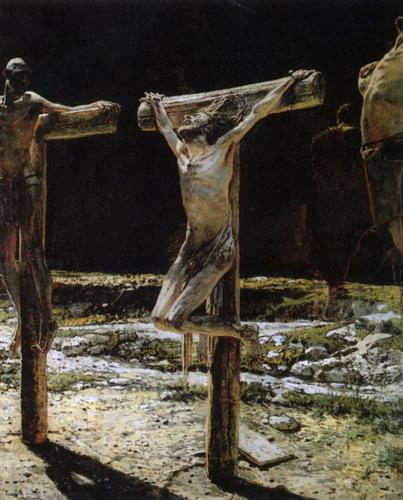
4 BC is a time of violent suppression under an unyielding Roman rule. If you said something and acted against that rule, you were crucified to keep order under Roman rule. If you said nothing and lived with the oppression then you were quick to point fingers to keep order for yourselves under Roman rule.
“the citizens received [Jarus] and cleared themselves of having any hand in this revolt, and said that they had raised no commotions, but had only been forced to admit the multitude, because of the festival, and that they were rather besieged together with the Romans, than assisted those that had revolted.” War 2.73, Josephus
We don’t know the exact year of Jesus’ birth. Most scholars go with 4 BC.
*****
Mark’s gospel account opens with John the Baptist clearing the way for Jesus with baptisms of repentance for the forgiveness of sins. The account immediately turns to Jesus and the start of his ministry. We then read of a growing following and of eye-witnessed accounts about unclean spirts being cast out, the sick being healed, and a dead twelve-year old girl being raised to life. And, we learn of Jesus’ words and their impact on local communities as they were heard in the synagogue.
Jesus’s teaching was met with astonishment (Mk. 1:22): “he wasn’t like the legal teachers; he says things on his own authority”.
Later, when Jesus returned to his home region for a time and on the sabbath taught in the synagogue, his words were again met with astonishment (Mk. 6:2). And also, with consternation.
“Where does he get it all from?” they said. “What’s this wisdom he’s been given? How does he get this kind of power in his hands? Isn’t he the handyman, Mary’s son? Isn’t he the brother of James, Joses, Judah and Simon? And aren’t his sisters here with us?” They took offense at him. (Mk. 6:1-3)
Then we read that Jesus “couldn’t do any remarkable thing there, except he laid hands on a few sick people and cured them. Their unbelief dumbfounded him”. (Mk. 6: 5-6)
Earlier in the gospel account, Jesus’ relatives, hearing about the growing crowds and excitement surrounding Jesus, came to restrain him. “He’s out of his mind,” they said (Mk. 3:21). Experts from Jerusalem also showed up and tried to discredit him, labeling the source of Jesus’ power as demonic. Jesus dealt with them in no uncertain terms (Mk.3: 22-27).
In these accounts we see the attempted suppression of Jesus by his family, his community and by religious authorities. His family dubs him crazy and tries to rein him in from bringing more unwanted attention to them. His hometown community takes offense, perhaps thinking “You are uppity talking like that, saying things on your own authority. You’re one of us. Get with the program. Don’t make waves. Fit in and makes us happy that we can be around you.” The religious authorities started a smear campaign.
Undoubtedly, the locals feared antagonizing Roman authorities which could then lead to arrest and possible crucifixion. And just as undoubtedly, the religious leaders from Jerusalem, mediators between Rome and the Jewish population, wanted to keep the peace and their positions. They feared a newcomer, extraordinary in word and deed, upsetting their apple cart. They began a program of misinformation about Jesus.
The push to silence and discredit Jesus and his astonishing words and deeds led to unbelief that conformed to the world around. And that led to the suppression of the remarkable in Jesus’ local community.
*****
Right after this, in Mark chapter 6, we read that Jesus goes around to villages teaching. Suppression tactics do not stop his kingdom work. Jesus sends out the Twelve in pairs to expand his ministry. The twelve were chosen for this reason (Mk. 3:13-14).
“They went off and announced that people should repent. They cast out several demons; and they anointed many sick people with oil, and cured them.” (Mk. 6:12-13).
And then we read that Jesus’ name became well know and reached the ears of the King (Mk.6: 14).
(This king, Herod Antipas, tetrarch of Galilee, was the son and a successor of Herod the Great the Roman client king of Judea until his death in 4 BC. And though Herod the Great had a religion of Second Temple Judaism, he lived with extreme paranoia that resulted in terror:
Herod the Great was a brutal man who killed his father-in-law, several of his ten wives, and two of his sons. He ignored the laws of God to suit himself and chose the favor of Rome over his own people. Herod’s heavy taxes to pay for lavish projects forced an unfair burden on the Jewish citizens.)
When Herod Antipas heard about Jesus he said “It’s John the Baptist, risen from the dead! That’s why these powers are at work in him.” (Mk. 6:14).
Mark goes on to relate what happened to John the Baptist:
“Herod had married Herodias, his brother Philip’s wife. John regularly told Herod it wasn’t right for him to take his brother’s wife; so, Herod gave the word, arrested him, and tied him up in prison.” (Mk.6:17-18).
Herodias, not at all happy with John saying these things, wanted him dead, but Herod wouldn’t let that happen. Herod was afraid of John because he considered John “a just and holy man”. And, Herod would come down to John’s cell and listen to him talk. “What he heard disturbed him greatly, and yet he enjoyed listening to him” (Mk.6: 20).
Now, you know the story of Herod’s birthday and the great party attended by his supporters, military officers and the great and good of Galilee. Herodias’s daughter dances and wows the crowd and the birthday boy. What Herod saw moved him greatly. He enjoyed watching her dance. So, he offers to give the girl a gift to match the wow of her dance.
When Herod hears the girl’s gift request, he becomes panic-stricken, perhaps thinking “This is a holy man. You don’t mess with that. People like him you keep around and under control . . . and there goes the one voice that moved me to distraction.
Herod had made oaths to give her a wow gift in front of his guests. And, “He hadn’t the guts to refuse her” (Mk.6:26). So, John was beheaded.
In this account we read of suppression of John the Baptist on account of what he was saying in public. He was locked up to control the PR surrounding Herod’s immoral marriage to his brother’s wife Herodias. In jail, John didn’t remain silent. And Herod, whose father Herod the Great was into Second Temple Judaism, thought the abrasive John a curious figure to be observed, perhaps like a woman’s sensual dance.
Herod hears about Jesus doing astonishing things and that he’s a just and holy man. He reckons John the Baptist has been resurrected. (Now what have I done?”)
*****
“Two particular details about Roman crucifixion are of special interest to us in this book. First, it would not be much of an exaggeration to say that Jesus of Nazareth grew up under the shadow of the cross…The Galilee of Jesus’ boyhood, then, all knew about Roman crosses (Antiquities 17.286-98; War 2.66-79)…When he told his followers to pick up their crosses and follow him, they would not have heard this as a metaphor…The second point of special interest for us is the way in which the Romans sometimes used crucifixion as a way of mocking a victim with social or political pretensions. “You want to be high and lifted up?” they said in effect. “All right, we’ll give you ‘high and lifted up.’” Crucifixion thus meant not only killing by slow torture, not only shaming, not only issuing a warning, but also parodying the ambitions of the uppity rebels. They wanted to be move up the social scale? Let them be lifted up above the common herd…”
-from the chapter The Cross in Its First-Century Setting, N.T. Wright’s The Day the Revolution
*****
Psychology defines suppression as pushing unwanted thoughts, emotions, memories, fantasies, and more out of conscious awareness so that you’re not thinking of these things anymore.
In 4 BC terms, suppression would include dealing with people who are seen as a threat to the system and who annoy and make certain people feel uncomfortable. Such people were mocked, scourged, and put on display for the public’s conscious awareness.
Forms of suppression from 4 BC to the present have included public derision, impalement, death by burning, crucifixion, labeling, canceling, shadow banning, blocking, misinformation campaigns, repeating lies, criminalizing dissent, fines, gag orders, persecution, false charges, arrest, and imprisonment.
What makes the world godless and by what means?
Suppressing the existing facts of reality and the established facts of truth makes the world godless.
In your search for truth . . .
Does your theology suppress science so you don’t have to deal with thinking about science?
Does your science suppress any thought of God so you don’t have to deal with messy, uncomfortable thoughts and emotions?
Does your political view suppress facts as long as there are enough people going along with lies and half-truths?
Is crucifixion the ultimate suppression?
No. See the empty tomb. Unbelief is the ultimate suppression.
We now turn from the worst to the worthy. From the spectacle of the worst speech ever given by the worst public figure ever and from one who does not care about the American people to remembering a public figure devoted to her people and worthy of respect. We turn from a figurehead of confusion, of conformity to confusion and of coercion to conformity to a figurehead of depth, of dignity, and of the “democracy of the dead” – Queen Elizabeth II.
When I think of Queen Elizabeth, I think history: the 96 years of her embodied history and of our mother country’s history. And while some today dismiss history for preferred dining guests, aka “end of history” narratives, the narrative of history should have a permanent place at the table.
A few years ago, I picked up a book about English history. I found it to be a fascinating dinner guest and fellow passenger on the train. Reading about the English characters described, I learned of their folly and foibles, of their wise choices and their foolish ways, of their mark on history which effects today. One paragraph that Chesterton’s words above later echoes is especially meaningful to my own conservative understanding.
The following is a quote from the somewhat cheeky English History made Brief, Irreverent, and Pleasurable by Lacey Baldwin Smith.
[Tories] were the party of Edmund Burke, having a deep respect for the sanctity of history and believing that government was “a partnership between those who are living, those who are dead, and those who are yest to be born.” . . . they preached Britain’s manifest destiny as the world’s greatest Empire, took up the paternalistic cause of the common man, and changed their name to the Conservative Party.
I returned to the book when I heard the news of the Queen’s passing. The book’s back cover states “The guiding principle of this book’s heretical approach is that “history is not everything that happened, but what is worth remembering about the past. . ..”. Thus, its chapters deal mainly with “Memorable History” in blocks of time over the centuries. The final chapter “The Royal Soap Opera,” recounts the achievements, personalities and idiocies of the royal family since the arrival of William the Conqueror in 1066.
The final section in The Royal Soap Opera is titled Elizabeth II (1952–) begins . . . Elizabeth came to the throne in a “blaze of glorious technicolor.” Queen Elizabeth II was the first television queen. The world began to see the “historic grandeur of royal pageantry”. But, of course, when media gets involved, all of the royal family’s foibles, failures and fractures are laid bare for the world to see. Thru all of “The Royal Soap Opera” Queen Elizabeth II symbolized the good, the stalwart, the faithful. She remained the rock of Gibraltar and a reference point for the far afloat royal misfits. (Please let me know if you know any such female public figure today.)
Elizabeth Alexandra Mary, born on April 21st 1926, ascended to the throne on February 6th of 1952. Elizabeth was crowned on June 2nd 1953.
Today, we have ‘princesses’ who demand that government and others treat them royally. Princess Elizabeth, ‘determined to ‘do her bit’ was no such princess. She was “Princess auto-Mechanic” during WWII:
When the news broke that the Queen had passed, history became relevant again. Mini-histories have been presented in the media. Here’s one of the best historical perspectives:
Another reflection, regarding fame, slavery:
Give Tribute to Whom Tribute is Due
****
Scenes from the media coverage of the Queen’s passing brought back memories . . .
1977. The Queen’s Silver Jubilee was celebrated throughout the United Kingdom and the Commonwealth. Elizabeth ascended to the throne 25 years before.
Having ascended to the age of 25 and wanting to see the world, I traveled to England that summer with a long-time neighborhood friend. As I recall, my friend found us a travel package – airfare, transfers, hotel, tours, dinner playhouse tickets – for $750.00 each. The trip lasted ten days.
We landed at Heathrow. The tour bus drove us to a hotel in Kensington where we stayed. The things we noticed along the way: dreary weather, green everywhere, black cabs and red double-decker buses. London was decked out with Jubilee banners. The Queens’ picture was everywhere. Souvenir shops displayed all kinds of celebratory curios.
One of the first things planned for our tour group was a pub crawl in London. I remember drinking a lot of shandy and warm pints and playing darts. Our tour group would later visit Stonehenge, Bath, Stratford-on-Avon, and Buckingham Palace to see the changing of the guard. (The Queen, of course, was busy with Jubilee preparations, so, the two of us weren’t invited in.)
We gazed on Windsor Castle from a distance and got a closeup view of Winston Churchill’s gravesite. The tour guide had given the tour group a choice: visit Churchill’s gravesite or go to Oxford. I was the only one to raise my hand for Oxford. I figured Churchill wasn’t going anywhere soon.
We attended a West London show – The Mousetrap. Afterward, we were treated to a typical English dinner of roasted meat, mashed potatoes, vegetables, stuffing, Yorkshire puddings and gravy.
As mentioned, our hotel was in Kensington. On our time off, my friend and I rode the tubes and took in St. James Park, the Mall, Hyde Park Corner, parts of Soho, Trafalgar Square, Piccadilly Circus, Tower Bridge, Big Ben, Westminster Abbey, and Parliament. We did it all and without Rick Steves.
A jolly good time.
****
Where are the serious people? Time to choose.
This . . .
Princess (later Queen ) Elizabeth of Great Britain doing technical repair work during her World war two military service 1944. (Universal Images Group via Getty Images)
Or This . . .
And this, the sorry individuals who are unable to contemplate anything but their navel:
Informed Dissent:
Wait! What? I thought the world is going to end anytime now!
1200 scientist and scholars say ‘There is no climate emergency.”
The World Climate Declaration warns that climate science “should be less political, while climate policies should be more scientific.”
“Scientists should openly address uncertainties and exaggerations in their predictions of global warming, while politicians should dispassionately count the real costs as well as the imagined benefits of their policy measures,” the declaration reads.
“We should free ourselves from the naïve belief in immature climate models,” the WCD states.
The so-called SAFE-T Act would end cash bail and includes 12 non-detainable offences, second-degree murder, aggravated battery and arson without bail, as well as drug-induced homicide, kidnapping, burglary, robbery, intimidation, aggravated DUI, aggravated fleeing and eluding, drug offences and threatening a public official.
“ . . . seventeen other states have previously tied their vehicle emission standards to emissions standards set by California. Now the press is playing that fact as if these states have a choice; that they must “decide” whether to follow California’s strict new rules. That is, all new cars must be electric by 2025.
But in many states, they really don’t have a choice. Because their state legislators have passed laws tying their own state emissions standards to whatever California does. It is very difficult to rescind existing law, and it may prove to be an impossibility. This is the case in Virginia, where I live. The Democratic Virginia legislature quietly tied the state’s emissions standards to California’s in 2021. Governor Youngkin is vowing to change this law, but rescinding a law is generally harder than actually passing one. This will require legislative involvement, in a state whereby the legislative body is essentially split between the two parties.”
1958 book explains the current destruction of America by Communism. For example:
Step 17: “Get control of the schools. Use them as transmission belts for socialism and current Communist propaganda. Soften the curriculum. Get control of teachers’ associations. Put the party line in textbooks.”
Step 25: “Break down cultural standards of morality by promoting pornography and obscenity in books, magazines, motion pictures, radio, and TV.”
On a street known as Artifact Row, in the historic district of Langford, D&D Antiques offered vintage collectibles. The owners, Dale and Doris, lived in the small apartment above the shop.
Per the rules of the town’s preservation committee, the shops and cafés of Artifact Row were required to maintain their 19th century façades. During the summer months, the lattice ironwork of the display windows and the frame of the double doors into D&Ds were coated with layers of black paint to keep them from oxidizing. Next to D&Ds, the Reitz Artifact Gallery, specializing in graphic arts, antiquarian maps and atlases, repainted its ironwork verdigris green and installed a new awning. On the other side of D&Ds, the wood framed windows and door of Dunwoody’s Furniture Restoration were repainted with a fresh coat of terra beige and brown.
Above D&D’s recessed doors were two transoms which, when lowered, gave the appearance with the doors of being the door’s black eyebrows. And above the transoms was a weathered green signboard with gold letters:
D&D Antiques
Things both Excellent and Rare
The shop’s windows displayed objects collected by Doris from estate sales. On exhibit, a menagerie of items passed down through generations of families including pottery, porcelains, vases, silver platters, a Tiffany lamp, jewelry, spelter candlesticks, figurines, watch fobs and watches, photographs and, postcards. A small banner with a gold star on a red and white field hung in the recessed window next to the door. Above it, a sign posting the shop’s hours. Beneath, a detachment of smartly uniformed nutcrackers that appeared to be standing guard at the door.
The shop now offered consignment, as Things both Excellent and Rare were no longer collected by Doris. A gaunt figure in her eighties, called a flower with a delicate stem by Dale, Doris could no longer attend estate sales. Her knees had become feeble, her gait wobbly, her strength gone. Dale noticed, too, that her mind had become wobbly. Doris no longer knew who he was. So, for a time, she remained with Dale in the shop.
During her days in the shop, Doris would sit listless in the spool-turned rocker. At times she would get up, hobble around and pick up pieces on display. She held them to her ear, as one would do with a sea shell at the beach. A dulcet smile would then appear on her face.
During fifty-five years of marriage, the two had worked hand in hand. Yet a time came to keep Doris upstairs. No longer active, Doris had grown weaker. Dale, also in his eighties, frail and hunched-over, could no longer help his wife up and down the apartment stairs. In the days that followed and at regular intervals, Dale would hang a “BACK IN TEN MINUTES” sign on his door. He would head up the shop’s adjoining stairs to their apartment to care for Doris, where she sat in her arm chair with a vacant stare.
On any given day, except on Mondays when the shop was closed, D&Ds was visited by women poring over each item and husbands who listened to Dale as he regaled them with his stories from his time in the Navy. The children who came along were directed to a corner of the store. There, Dale had set a small table, two chairs and a globe. On the table, Dale’s loose-leafed stamp albums. The children were enchanted by the colorful stamps Dale had collected from around the world. At Dale’s suggestion, they swirled the globe looking for each stamp’s country of origination.
It was now Sunday evening. The ageless sounding chimes of the grandfather clock and the sudden “koo-koo” of the Black Forest clock announced six-o’clock. It was time to close the shop. As was his habit, Dale placed the cash drawer and the antique jewelry in a safe. The coffee was shut off. The back door checked. The model train was shut off. The three weights of the grandfather clock were rehung. And, the two streetside lamps that shown down on the face of the shop were switched on.
After one last look around, Dale turned the door sign from “OPEN” TO “CLOSED” and stepped outside into stifling heat of the August night. As he turned the key in the lock, he noticed a thunderous commotion behind him. He looked around. Up and down the Row passersby stopped at window displays. Shoppers walked out of the closing shops. The tremendous clamor, clashes of curses and bellowing voices, seemed to come from the next street east. “Something is in the offing,” Dale thought. “There must be some confusion about the hour.” Tired, Dale trudged up the adjoining stairs.
11:10 and the shop was still. The inconsonant tickticktick of three mantel clocks the only sound.
11:11. The grandfather clock began a sonorous toll. The cuckoo exited with loud rousing “koo-koos”. The conversation began again.
“Let us use our time wisely,” came the booming voice of the grandfather clock.
“Here one minute. Gone the next,” chirped the cuckoo.
“What? We sit here, day after day. Nothing changes,” moaned the mantel clock.
“I do have my ups and downs,” noted the barometer.
“It’s all the same,” sighed the depression glass.
“But we’re not the same,” countered the silver chalice. “Some of us have a higher station in life.”
“I was tops in my class,” said masthead light.
“But I summoned the attention of all,” said the ship’s bell.
“No. It was I,” said the bosun’s pipe.
“I held the compass,” said the binnacle proudly.
“But you are not me,” said the compass. “I gave directions.”
“I was the admiral’s go to,” said the brass ship’s wheel.
“You couldn’t go anywhere without me,” replied the rudder.
“You don’t know the time of day,” replied the ship’s clock.
“I’m getting sea sick,” growled the gyroscope.
“Boys. Boys. Don’t make waves,” admonished the sextant. “Know your place.”
“It’s all the same. Night after night.” groaned the glass.
“But we aren’t!” said the painting pointedly.
“We are!” declared the silverware.
“We aren’t”, squealed the Chantilly porcelain terrine.
“We are. We aren’t,” the rocker hemmed and hawed.
“Things are heating up again,” the fireplace poker jabbed. “Just the way I like it.”
“You’re always stirring things up,” jabbed the ivory letter opener.
“Can’t we all just get along,” the fine china clattered.
“Let’s have a party,” the silver platter prompted.
“Yes, let’s!” shouted the silverware.
“It’s all the same.”
“We’re not the same.”
“The same. Not the same. The same. Not the same,” choo-choo-ed the tinplate model train.
“At least I don’t go around in circles all day,” remarked the rubber stamp.
“No. You just sit there with ink on your face,” countered the train.
“Don’t rub it in,” the stamp came back.
“Now we’re getting somewhere!” pounced the Murano glass paperweight.
“Look who’s talking,” remarked the art nouveau hand mirror.
“It’s all the same.”
“We’re not the same.”
“We are. We aren’t.”
“The same, Not the same. The same. Not the same.”
“I could shed some light on this,” laughed the Tiffany lamp.
“You’re not plugged in,” the flat iron spoke frankly.
“And neither are you,” countered the candlestick holder.
“You can’t hold a candle to me,” bragged the wash basin
“Keep a lid on it,” the tea pot protested.
“I’m with her,” tittered the tea cup
“Those who live in glass houses shouldn’t throw stones,” snorted the spittoon.
“Have you no taste? I am fine china!”
“Have some decorum,” pleaded the painting.
Tickticktick Tickticktick Tickticktick.
“Bor…ring. I’ve more important things to do,” brayed the brass bugle.
“He’s always blowing his own horn,” a nutcracker noted.
“It’s all the same.”
“You need to change your worldview,” the globe giggled.
“Get a hobby,” snickered the stamp album.
“The same, Not the same. The same. Not the same.”
“Let’s change the subject,” broached the book. “I am a first edition.”
“But I was here first!” shouted the Louis the XVI chair.
“And consigned to the dust bin of history,” scoffed the newly arrived brooch.
“I did not know you had come, and I shall not miss you when you go away,” replied the chair.
“I have served wine to kings and queens,” said the goblet. “I deserve better company.”
“Mais oui, bien sûr,“ came back the chair. “As do I.”
“Those two are broken records,” the gramophone pointed out.
“I am above all that,” said the annoyed candelabra. “I have looked down on royalty and heads of state.”
Not to be overlooked, the Victorian sewing table said proudly, “Not what I have but what I do is my kingdom.”
“Let’s face it. It’s all about me,” the cameo came back.
“You’re just another face in the crowd,” the mirror mocked.
“The lady picked me up. Held me to her ear.”
“And what did you tell her?” queried the quartz watch.
“If it’s true it’s not new.”
“Are you a philosopher now?” wondered the Wedgewood vase.
“Though Truth and Falsehood be Near twins, yet Truth a little elder is,” recited the limited-edition poetry book with a flourish.
“It’s all the same.”
“We’re not the same.”
“We are. We aren’t.”
“Well, you are all waiting,” remarked the rubber stamp.
“Waiting for what?” asked the tintype.
“Waiting to be taken to a home,” cooed the wood doll.
“Home is where the heart is,” replied the postcard.
“You’re just ephemera. Here today. Gone tomorrow,” tut-ted the dressing table.
“You have no utility,” snarked the silver platter.
“I’m a keepsake. A reminder of times past,” the postcard said proudly.
“What you are is what you have been. What you’ll be is what you do now,” exhorted the jade Buddha.
“Right on!” shouted the mantel clock.
“Progress!” The cuckoo poked his head out.
“Revolution!” fired off the fireplace poker.
“Diversity!” yelled the stamp album.
“Equality!” exclaimed the stamps in unison.
“Solidarity!” cried the flat iron.
“Can’t we all get along?” pleaded the fine china. “We can all serve humanity.”
“Hear! Hear! Shouted the silverware.
“Keep it together,” begged the bookends.
“It’s all the same.”
“We’re not the same.”
“We are. We aren’t.”
Tickticktick Tickticktick Tickticktick.
2 AM. Grandfather tolled and the cuckoo called. A loud crash.
“What was that?” questioned the quilt.
“A torch,” said one of the nutcrackers.
“I’ve seen this before,” said the fireplace poker.
“What’s it for?” wondered the watch.
“A torch is for light,” said the candlestick holder.
“But why is it on the floor?” asked the Oriental rug anxiously.
“Perhaps it is to be sold,” speculated the rubber stamp.
“I’ve read about this sort of thing,” stated the first edition. “It doesn’t bode well.”
“Some say the world will end in fire … Some say in ice,” warned the poetry book.
“The fire is coming closer,” fretted the lute.
“Shouldn’t it be on a candleholder where it belongs,” asked the candlestick holder.
“Fire goes where it goes,” replied the fireplace poker.
“It’s going up my leg,” said the Louis the XVI chair.
“How does it feel Mr. High and Mighty?” asked the rubber stamp.
“It feels … ohhhhh …familiar, …! …. like searing passion and raging anger.” The chair tried to maintain composed, but, “… now, ow! Ow! OW! …je suis d’histoire!. Aurevoir à mes amis.” The chair toppled down.
“What shall we do?” roared the rocker engulfed in flames.
“Maybe the shopkeeper will come,” said the cameo.
“Bugle do something,” shouted a nutcracker, his ranks now diminished.
The bugle, overcome by smoke, sputtered and coughed, “splurrrrtttt ….cuh cuh ….cuh cuh …someone get me some AIRrrrrrr …!”
“If I only had water,” said the basin.
“If only someone had taken us home,” cried the postcard.
The mirror, enamored by its reflection, proudly stated, “Look at the light I am reflecting. The whole room is lit up.”
“Don’t you see what is happening?” rasped the rocker. “We are being consumed!”
“I’ve done my job,” replied the mirror.
“I want out!” cried the postcard, the flames edging up his sides.
“We’re all in this together,” wheezed the stamp album with its last breath. The conversation ended.
3 AM. There was no ageless sounding toll and no sudden “koo-koo”. The second story had collapsed.
“We have entered, as I see it, a spiritual limbo. Our educational institutions are no longer the bearers of high culture, and public life has been deliberately moronised. But here and there, sheltered from the noise and glare of the media, the old spiritual forces are at work” Roger Scruton
*****
“When a common culture declines, the ethical life can be sustained and renewed only by a work of the imagination.”-Roger Scruton
*****
“Jesus prayed, “This is eternal life, that they may know You . . .” (John 17:3). The real meaning of eternal life is a life that can face anything it has to face without wavering. If we will take this view, life will become one great romance— a glorious opportunity of seeing wonderful things all the time. God is disciplining us to get us into this central place of power.” Oswald Chambers
*****
“No power on earth or in hell can conquer the Spirit of God in a human spirit, it is an inner unconquerableness.” Oswald Chambers
*****
To those who have had no agony Jesus says, “I have nothing for you; stand on your own feet, square your own shoulders. I have come for the man who knows he has a bigger handful than he can cope with, who knows there are forces he cannot touch; I will do everything for him if he will let Me. Only let a man grant he needs it, and I will do it for him.” The Shadow of an Agony,Oswald Chambers
*****
“If we wish to erect new structures, we must have a definite knowledge of the old foundations.” John Calvin Coolidge
*****
Atheism is a post-Christian phenomenon.
*****
If social justice looks like your hand in someone else’s pocket then you are stealing.
*****
“In Sweden, giving to charity, absurdly, came to be considered a lack of solidarity, since it undermined the need for the welfare state.” – Roland Martinsson
*****
“…to love democracy well, it is necessary to love it moderately.” Alexis de Tocqueville
*****
Capitalism seeks to help others through a servce or product it provides. Free Market Capitalism is the most moral and fair economic system available to man. Capitalism augments personal growth, responsibility and ownership. Charity flourishes under capitalism. Charity dies under subjective “fair share” government confiscatory policies. Socialism redistributes ambivalence and greed.
*****
“We are to regard existence as a raid or great adventure; it is to be judged, therefore, not by what calamities it encounters, but by what flag it follows and what high town it assaults. The most dangerous thing in the world is to be alive; one is always in danger of one’s life. But anyone who shrinks from that is a traitor to the great scheme and experiment of being.” G.K. Chesterton
*****
Any intelligent fool can make things bigger, more complex, and more violent.
It takes a touch of genius – and a lot of courage – to move in the opposite direction. Albert Einstein
*****
“You shall know the truth and the truth shall make you odd.” Flannery O’Connor
*****
“There is but one good; that is God. Everything else is good when it looks to Him and bad when it turns from Him.” C.S. Lewis, The Great Divorce
*****
“Though He slay me, yet will I trust Him” (Job 13:15).
*****
God’s grace is not about the allowance for sin. God’s grace is about the conversation God allows regarding sin.
*****
From the book of Proverbs: We are not to favor the rich or the poor. We are to pursue justice.
*****
“Always keep in contact with those books and those people that enlarge your horizon and make it possible for you to stretch yourself mentally.” Oswald Chambers
*****
One goldfish says to another, “If there is no God who keeps changing the water?”
*****
“The truth is always there in the morning.”
From Cat On A Hot Tin Roof script – playwright Tennessee Williams
*****
God blesses those who hunger and thirst for justice, for they will be satisfied.
*****
“America’s greatness has been the greatness of a free people who shared certain moral commitments. Freedom without moral commitment is aimless and promptly self-destructive.” John W. Gardner
**
“Men of integrity, by their very existence, rekindle the belief that as a people we can live above the level of moral squalor. We need that belief; a cynical community is a corrupt community.” John W. Gardner
*****
“In the world it is called Tolerance, but in hell it is called Despair, the sin that believes in nothing, cares for nothing, seeks to know nothing, interferes with nothing, enjoys nothing, hates nothing, finds purpose in nothing, lives for nothing, and remains alive because there is nothing for which it will die.” Dorothy L. Sayers
*****
“Art, like morality, consists of drawing the line somewhere.”
G. K. Chesterton
*****
“The battle line between good and evil runs through the heart of every man.” Alexander Solzhenitsyn
*****
This is what the LORD says:
“Stand at the crossroads and look;
ask for the ancient paths,
ask where the good way is, and walk in it,
and you will find rest for your souls.
But you said, ‘We will not walk in it.’
-The prophet Jeremiah, 6:16
*****
“…our common task is not so much discovering a truth hiding among contrary viewpoints as it is coming to possess a selfhood that no longer evades and eludes the truth with which it is importunately confronted.” James McClendon, Ethics: Systematic Theology, Vol. 1
*****
A Mind is a Terrible Thing to Hand Over
December 8, 2025 Leave a comment
When we hear someone say crazy things, we might say “Yeah, right” and shrug it off. But when a group of people say crazy things and a group of people agree with said crazy things, we wonder “What in the world is going on?”
Objective reality – the existence of things as they are – is obvious to everyone. And so are the values, accumulated over several millennia, of what is true and of what works and what hasn’t. But not everyone accepts the obvious and the values based on time proven objective reality. Some see themselves as Progressive in rejecting both.
Today’s academic, artistic, media, and political elites, a vanguard of Progressive Groupthink, reject the existence of things as they are and do so within the safe space of their ranks thereby creating an illusion of invulnerability and inherent morality. Members of this vanguard suppress dissenting opinions and avoid critically evaluated alternatives so as to maintain the group’s shared illusion of unanimity.
The vanguard’s conformity is maintained with mind guards – the media reports “right thinking” about a matter – and with self-censorship of deviations from shared beliefs and with shared views of the enemy – those who present a reality contrary to the groups’ notion of reality.
When we hear the vanguard’s irrational take on what is going on in the world, its roiling Doublethink, its name calling and shunning of voices outside its collective choir, and its dysfunctional decision-making which objective reality tells us will result in disastrous, dehumanizing, and even deadly outcomes, we ask “Where is this coming from and where is this going?
Those of us who keep an ear to the ground in order to hear what is approaching will answer “History is repeating itself.”
The objective reality of the murderous totalitarian regimes of the last century, which Progressives willfully ignore to promote their glorious future of equality via the same means, will help us understand the denial-of-reality collaboration of today’s intelligentsia – those who hold to one way of thinking – and their quest for total domination of the body, mind, and soul with Progressive Groupthink.
Specifically, Russian Soviet history will help us understand the conformity dynamic behind today’s intelligentsia. For this understanding I turn to one of the most informed scholars of the Russian history of ideas as communicated in its literature: Northwestern Professor Gary Saul Morson.
***
In Morson’s magnum opus Wonder Confronts Certainty: Russian Writers on the Timeless Questions and Why Their Answers Matter Morson details how politics and literature, in the writings of realists, idealists, and revolutionaries, played against each other during the Soviet period.
He describes Soviet thinking that rejected the realism and the real people depicted in nineteenth-century Russian fiction and required that reality be written to include “not only of the observable present but also the inevitable future in the making” and with Socialist Realist heroes – utopianism made flesh.
Writers of Russian realism – Tolstoy, Dostoevsky, Chekhov, Solzhenitsyn, and others – wrote about what they saw and experienced. They are the “wonder” in the title. They represented the world as it was in their writings about the Gulag, mass starvation, torture, unspeakable violence, about how people thought about and dealt with what was going on, and about how many succumbed to the imposed Soviet mindset.
Russian realist authors confronted those of the “certainty,” those who wrote redefined reality in terms of the “observable present and the inevitable future in the making” and in terms of “positive heroes.”
The “positive hero” was to set an example for the reader’s behavior. A Soviet cosmonaut, for one example, became a “positive hero.” A cosmonaut’s space trip was seen as science, materialism, and atheism triumphing over the transcendent values held in the U.S., the enemy of the Soviet Union.
The “certainty” writers followed the lead of the embodiment of “certainty” – Vladimir Lenin. Lenin mocked his opponents’ self-characterization as ‘seekers’ of truth. He held that dialectical materialists do not seek truth; they already possess it. And so, the party-minded “positive hero” refused dialogue, refused to see any alternatives to the Marxist-Leninist-materialist-atheistic “truth” espoused by the party, the representatives of Karl Marx’s class-struggling proletariat.
From Wonder Confronts Certainty:
“The Soviets would label fidelity to present facts “bourgeois objectivism.” It was the best that could be expected from the age of realism, but must give way to socialist realism, which shows the ideal world inevitably coming. The socialist realist author was expected to focus on the people of the future, “positive heroes” exhibiting complete “Party-mindedness.” True positive heroes do not have bring their thinking into accord with the party, a process requiring effort; they exhibit Party-mindedness so thorough that no effort is required”
“Party-mindedness”, we learn from the writings of Russian realist authors, was propagated through the means of propaganda, show trials, random arrests, and the constant terror that there might be any hint, any innuendo, any false statement that would convict one of not being party-minded.
The “party-mindedness” of the 20th century Russian intelligentsia, its conformity to only one way of thinking, is replicated today.
***
Here’s Morson in his Touchtone article Beyond Belief: Literary Reflections on Thoughtless Conformity:
“I happened to witness two professors waiting for an elevator. To make conversation, one voiced an opinion on some political question to see if the other agreed. When she did, they chattered away on a dozen other topics with perfect assurance that they agreed on those, too. Evidently, their beliefs came as a package. Subsequently I noticed this way of thinking many times, as I imagine many of my readers have.
The process works something like this: a person first chooses the group with whom he wishes to identify and then adopts its opinions. He believes as strongly in gun control, let us say, as he does in supporting Planned Parenthood, defunding the police, and banning fossil fuels. It is evident that no arguments or evidence can shake his opinions on any of these topics because arguments or evidence had nothing to do with why they were adopted.
To be sure, a person who thinks this way can cite facts and reasons to justify his opinion, but they have been acquired in the same way as the opinion itself. They are the same reasons others in the group have learned to give. I used to find it eerie to hear repeatedly the same arguments expressed in the same phrases, as if I were listening to a recording rather than to highly educated people who imagined that, unlike their intellectual inferiors, they had arrived at opinions rationally and would change them as evidence warranted. I thought of Jonathan Swift’s observation that no one was ever talked out of an opinion he was not first talked into.”
***
Reading Morson’s article, I was reminded of the easy-going liberal mindset of the Stiva Oblonsky character in Tolstoy’s Russian realism novel Anna Karenina.
Behind Stiva’s smile, his self-possessed mannerisms and hedonism is what Tolstoy described as “the liberalism of the blood.”
From the novel:
“Stepan Arkadyevitch took and read a liberal newspaper, not a radical one, but one advocating the viewpoint maintained by the majority. And even though neither science, nor art or politics held any particular interest for him, he firmly maintained the same views on all these subjects that were maintained by the majority and by his paper, and he changed them only when the majority changed them, or, better put, he did not change them at all; they imperceptibly changed within him . . .
“And so liberalism had become a habit of Stepan Arkadyevitch’s, and he liked his newspaper, as he did his cigar after dinner, for the slight fog it diffused in his brain.”
Stiva, we learn in in the novel, does not recognize his conscious when it speaks to him. And that is aided by his living-in-the-moment forgetting. He did not want to remember any unpleasant thing.
Self-deception and romantic ideology play key roles in Anna’s life.
***
Czeslaw Milosz, Polish American poet, novelist, translator, critic, and diplomat, is best known for The Captive Mind (1953). His essay collection focuses on intellectuals, specifically poets and other writers.
As Charles Haywood writes in his 2019 article The Captive Mind (Czeslaw Milosz), [Milosz’s] “book shows how mental gymnastics, rather than coercion, caused writers under Communism to adhere to Communism. Thereby, indirectly, it congratulates writers who believe their minds free from such, or other, contortions.
“The West incorrectly sees “might and coercion” as the reasons those in Eastern Europe submit to Communism. But, rather, unwilling to face either physical or spiritual death, many choose instead to be “reborn” through taking these metaphorical pills, because “[t]here is an internal longing for harmony and happiness that lies deeper than ordinary fear or the desire to escape misery or physical destruction.” Intellectuals, and artists especially, do not want to be “internal exiles, irreconcilable, non-participating, eroded by hatred.” So they swallow the pills and adopt the “New Faith” (a term Milosz uses throughout the book) which offers the intellectual the certainty he is both correct and virtuous, and therefore gives him a sense of belonging, gives him a feeling of being “warm-hearted and good . . . a friend of mankind—not mankind as it is, but as it should be.”” (Emphasis mine.)
Returning to Morson’s article about package thinking, Morson relates
“What really matters, [Czeslaw} Milosz explains, is “the intellectual’s feeling of belonging.” His defining “characteristic is his fear of thinking for himself.” For this reason, as well as to prosper, he must root out all the old ways of thinking. Milosz describes a phenomenon with which university people are all too familiar, the always incomplete process of teaching oneself to say the right things (in the right words), and avoid saying the wrong ones, so that one never makes a slip entailing ostracism or worse. Of course, the best way to do this is to get oneself actually to share the prescribed views. Milosz describes how
after long acquaintance with his role, a man grows into it so closely that he can no longer differentiate his true self from the self he simulates, so that even the most intimate of individuals speak to each other in Party slogans. To identify self with the role one is obliged to play . . . permits a relaxation of one’s vigilance. Proper reflexes at the proper time become truly automatic.”
***
One obvious feature of our culture’s downward trend toward mindless conformity is critical thinking’s easy alternative: clicking on a machine to receive packaged thoughts.
Why think when packaged thoughts are there for the clicking? And why expand one’s personal bandwidth when you can reaffirm your tribal identity with a click?
Why research and consider a range of ideas and thoughts when clicking on machine AI is ready to do away with mystery and your curiosity, wonder, and impatience? And why think outside package thinking when life is short – shortened by every minute clicking on a machine.
Why read classic literature to gain wisdom, insight, and understanding from other people in other places and in other times, when you can click on a remote for package thinking entertainment.
Have you bought into the globalist, academic, secular and progressive (GASP) package (a feature of Wikipedia) that censors alternative views as “extremist” or “fringe theories” or “conspiracy theories” or “racist?”
Did you buy into the globalist open borders “welcoming the stranger” package where millions of unvetted illegal invaders entered the country as simple or criminal or terrorism opportunists? Did you accept the package thinking that allows third world invaders into our country to replace American workers and American values and do all manner of harm to its citizens as empathy, as what Jesus would do? Take a look at the strangers welcomed: Arrested: Worst of the Worst | Homeland Security And, there’s this: They Called It ‘Compassion’ — But it was Child Trafficking – American Thinker
Are you buying into the central planning democratic socialism package where everyone, except certain individuals who hold more power and privilege, must be made equal no matter the human cost? Are you buying into the central planning democratic socialism package and willfully forgetting the objective reality of the horrors of socialism/communism? Are you willfully handing over your life, your thoughts, to “Party-mindedness”?
Did you accept the “don’t question the science” COVID package thinking of mandates, masking, social distancing, vaccine passports, isolation camps, vaccine efficacy, and of COVID’s origin lies? America’s COVID Response Was Based on Lies
Likewise, did you not question the package thinking of “climate experts” who announced their verdict that the world would end if we didn’t act now. Not long ago, woven into almost every weather report on local and mainstream media when major weather events (floods, tornadoes, hurricanes, droughts, and wildfires) occurred was the narrative that climate change was behind them – without ever mentioning large-scale natural phenomena such as solar cycles, ocean currents and volcanoes that have been affecting weather for many millennia.
The Green New scam was behind Biden’s $93 Billion Crony Climate Heist. Will declassifying carbon dioxide (necessary for all of life) as a pollutant and the end of carbon dioxide regulation mean the end of the Green New scam? Are we now seeing The End of the Green New Scam? | The Rude Awakening? Matt Ridely thinks so: The end of the climate cult – The Spectator World
(A climate expert I trust: https://judithcurry.com/about/)
Do you go along with the package thinking of the [John] Rawlsian theory of ad hoc justice that, for example, releases someone arrested 40 times, is not considered a “criminal” because of their minority status, and is released by a judge back onto the street where he sets a woman on fire?
Do you buy philosopher Jean-Jacques Rousseau’s notion that “Man is born free, and everywhere he is in chains” – the package thinking that says that people are entirely products of their environment, of their society, of their age, and that’s why they do what they do. Therefore, they are not responsible for what they do because of external influence. That’s the package thinking behind the Rawlsian theory of justice and behind the executions and horrors of the French revolution working to change social environment.
Have you agreed with the insurrection thought package being espoused by The Seditious Six imploring military service members to “refuse illegal orders” thereby implying that orders coming out of the Trump administration are considered illegal by them and therefore military service members should disobey their commanding officer and join the club of the “Party-minded.” Remember, package thinking has only one train of thought – gaining and maintaining power over reality.
Have you agreed with the insurrection package thinking espoused previously by NYT’s op-ed columnist David Brooks? Do the values of your party-minded package thinking allow you to hamstring a DEMOCRACY! elected president with the rulings of party-minded federal court judges that will be overturned. Do the values of your party-minded package thinking justify the deep state, in the labyrinth of government, to sabotage the efforts of a Democratically elected President?
Do the values of your package thinking allow you to call for uprisings by any means necessary, to burn down buildings, to destroy property, to destroy businesses, to steal, do violence on others, to defund the police, to create pipe bombs, to assassinate? To ignore your conscience?
Did you accept the “Danger to our Democracy” thought package the media delivered during the last presidential election cycle? It should be obvious from the likes of David Brooks, that the “guardians of democracy” are the ones who want to tear it down.
Have bought into the diversity, equity, and inclusion (DEI) playbook that conforms and coerces everyone to identify with Soviet style party-mindedness package thinking?
Have bought into viewing everything including humans through the lens of materialism?
Have you bought into package thinking so as to not be considered an outsider? Have you bought into conformity for conformity’s sake?
Is censorship the worst thing that can happen to a people? Or, is it “Party-mindedness?”
When we hear someone say crazy things, we might say “Yeah, right” and shrug it off. But when a group of people say crazy things with the smug air of certainty and people agree with said crazy things, we wonder “What in the world is going on?” and “Where is this coming from and where is it going?”
What happened in Russia didn’t stay in Russia. And a mind is still a terrible thing to hand over.
What happened in Russia didn’t stay in Russia . . . Britain Is Lost | ZeroHedge
~~~~~
You can put your ear to the road and hear what is quickly approaching. Download and listen to the following podcasts:
London is falling – or has it fallen already?
Liz Truss, the 56th prime minister of the United Kingdom, in her very first episode of The Liz Truss Show discusses how bad things are in Britain with a mass migration and economic doom loop – and how to defeat the deep state who have let this happen
https://justthenews.com/podcasts/liz-truss-show/london-falling-or-has-it-fallen-already
~~~
Interview with Professor Gary Saul Morson on Tolstoy, Faith, Package Thinking, and The Importance of Critical Thinking
Professor Gary Saul Morson shares his thought-provoking definition of an intellectual—someone who seeks truth independently, values ideas for their own sake, and stands apart from identity-driven thinking. Whether discussing classic Russian Literature or analyzing modern society, Professor Morson is one of the most insightful and consequential scholars of our time. Discover how this interview, and its exploration of timeless topics, can inspire bold, principled leadership and innovation within today’s business environment.
Interview with Professor Gary Saul Morson on Tolstoy, Faith, and The Importance of Critical Thinking – The Profitable Table Fed by Woolco Foods | Acast
~~~
The Moral Imagination – Michael Matheson Miller
Gary Saul Morson Ph.D.: Thinking Like Lenin
Vladimir Lenin’s ideas are alive and well today: Party-ness, politics as win-lose, zero-sum game, Who-Whom, rejection of truth, ideology, violence, philosophical materialism, adherence to lying.
Ep. 15: Thinking Like Lenin, with Gary Saul Morson
Is Hope Naïve in a World Like Ours? | Esau McCaulley & Gary Saul Morson at Northwestern
~~~~~
Quotes:
In the long run my observations have convinced me that some men, reasoning preposterously, first establish some conclusion in their minds which, either because of its being their own or because of their having received it from some person who has their entire confidence, impresses them so deeply that one finds it impossible ever to get it out of their heads. Such arguments in support of their fixed idea … gain their instant acceptance and applause. On the other hand whatever is brought forward against it, however ingenious and conclusive, they receive with disdain or with hot rage – if indeed it does not make them ill. Beside themselves with passion, some of them would not be backward even about scheming to suppress and silence their adversaries. I have had some experience of this myself. … No good can come of dealing with such people, especially to the extent that their company may be not only unpleasant but dangerous. Galileo Galilei
If the Brave New World cannot insert a square peg into a round hole, it will redefine “roundness” until a perfect fit results.
-Jerome Meckier, from Aldous Huxley: Satire and Structure
…a sense of unity is opposite of a sense of uniformity. Uniformity, where everyone “belongs”, uses the same cliches, thinks alike and behaves alike, produces a society which seems comfortable at first but is totally lacking in human dignity. Real unity tolerates dissent and rejoices in variety of outlook and tradition, realizes that it is man’s destiny to unite and not divide… Unity, so understood, is the extra dimension that raises the sense of belonging into genuine human life.
-Northrop Frye, from The Bush Garden
Wise men speak because they have something to say; fools because they have to say something. -Plato
“The past is our always-available counterculture, and it’s a rich one. Every minute you spend attending to something not-immediately-present, you are helping to build a counterculture.” ― Alan Jacobs
~~~~~
Links:
Why are intellectuals — those whose thinking is supposed to be most refined — so susceptible to totalitarianism? Gary Saul Morson offers three explanations from the treasury of Russian literature.
https://tomklingenstein.com/mind-forgd-manacles-why-intellectuals-conform/
The greatest depiction of woke totalitarianism was written 150 years ago in Russia
Anti-Communism Week has been marked for November 2025. Writer-producer Julie Behling’s documentary “Beneath Sheep’s Clothing” warns of communism’s devastation: “Globally, communism claimed the lives of approximately 150 million people in the 20th century.”
‘Beneath Sheep’s Clothing’: Communism’s Capture Of America | ZeroHedge
Totalitarian governments cannot afford that its citizens remain autonomous persons. This poses a threat to their quest to consolidate power. Individual liberty threatens the theoretical, utopian foundations of promising the re-distribution of goods, and equality; communism ultimately fails to re-distribute the essence of human nature.
10 Habits of Mind to Avoid Ideological Thinking
Everyday Habits That Reveal a Low IQ (Backed by Psychology)
Everyday Habits That Reveal a Low IQ (Backed by Psychology) – YouTube
~~~~~
Added 12-15-2025:
Sam Faddis (formerly with the CIA) sits down to talk about the reality of the ongoing Marxist revolution in America.
The Revolution Right Here At Home – by Sam Faddis
Rate this:
Filed under 2025 Current Events, Communism, cultural Marxism, Culture, Democracy, History, Political Commentary, Politics, social commentary, totalitarianism Tagged with Communism, Democracy, groupthink, history, Marxism, mind control, package thinking, party-mindedness, politics, progressivism, russia, Soviet Union, totalitarianism, Valdimir Lenin