“You still don’t get it?”
March 21, 2021 Leave a comment

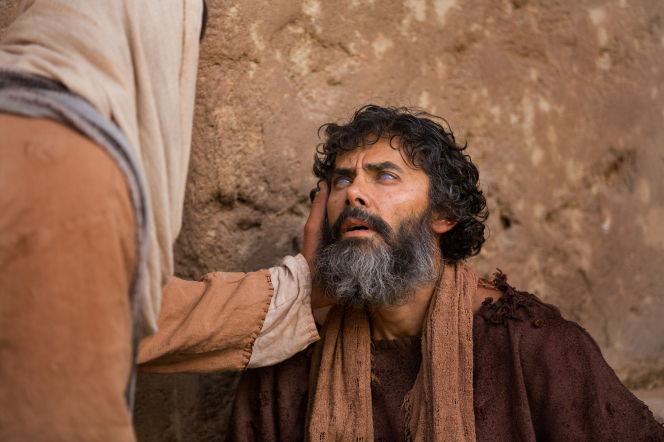
“I can see people,” said the man, peering around, “but they look like trees walking about.”
A blind man gains partial sight. He interprets the forms he sees via his prior limited understanding. Did he know at this stage that his perception was off?
The gospel according to Mark is composed of short narratives that could be easily visualized by those who heard its oral performance. Mark would have the listener hear, see and perceive who Jesus is. He would have the listener understand that seeing and hearing alone are not sufficient for the followers of Jesus. Understanding is what is required. At a mission critical point in the gospel account -Mark chapter 8 – Jesus reproaches his disciples for their lack of understanding.
The disciples had been mumbling about not having brought enough bread for their boat crossing. Yet twice before they had seen with their own two good eyes Jesus multiplying loaves to feed thousands. They had picked up the leftovers! And now they are mumbling about not having enough bread!
“Don’t you get it? Don’t you understand? Have your hearts gone hard? Can’t you see with your two good eyes? Can’t you hear with your two good ears?”
“You still don’t get it?”
Right after this rebuke is the narrative of the blind man who receives a two-stage healing of his eyesight (Mk. 8:22-26). The man’s depth of field is made whole. He could see everything clearly. Men were no longer like walking trees. His perception was growing.
Mark then increases the depth of field for those visualizing the account of the blind man’s healing:
Jesus and his disciples came to the villages of Caesarea Philippi. On the way he asked his disciples, “Who are the people saying that I am?
(I suppose in this setting that Jesus’ question could also be stated as “What do people perceive about me?”)
He gets feedback.
John the Baptist,” they said, or, some say, Elijah. Or, some say, one of the prophets.
Like the blind man whose initial vision is without depth of field and lacking clarity, people are reporting that they are seeing a form that they were vaguely familiar with.
What about you? asked Jesus. Who do you say that I am?
Peter, recently admonished about the bread incident, doesn’t hesitate to declare “You’re the Messiah.”
The people perceived Jesus to be one of several polemical figures: Elijah, John the Baptist or a prophet. The people were looking for just such a figure to re-enter into their times and bring about God’s judgement on the wicked.
Peter, like many Jews during the second temple period, looked for a new emergent figure: the messiah.
Hearing Peter’s reply, Jesus gave his disciples strict orders to not disclose this to anyone. It would appear that Jesus had more to teach the disciples and he didn’t want them to go public without them seeing/understanding what he sees. Mk. 8:31:
Jesus now began to teach them something new.
Jesus tells the disciples that the son of man must suffer and die at the hands of those who reject him.
Peter is clearly rattled with this new teaching. Clinging to the vague figure of a messiah and projecting onto Jesus that image, Peter rebukes Jesus for saying things that would alter his own view of things.
Jesus sternly rebukes Peter for rebuking him.
Get behind me, Accuser! he said. You’re thinking human thoughts, not God’s thoughts.
Even after all that he had witnessed, including an unclean spirt that identified Jesus as “God’s Holy One”, Peter still did not perceive who Jesus is. Peter still didn’t understand. Peter, with his “human thoughts”, was still in “men as trees walking” mode.
Jesus does not hold back. Jesus goes on to describe what is required of those who follow him. He talks about life altering choices. He talks about accountability. (I think Peter, at this point, wanted to go back to passing out bread.)
Having taught them something new, Jesus, his mind set like flint towards Jerusalem, brings his closest disciples on a field trip. Peter, James and John go with Jesus up atop a high mountain. There, Jesus is transfigured into heavenly splendor right before their eyes. Moses and Elijah, the Law and the Prophets, are standing with Jesus.
Peter, again using human thoughts, didn’t know what to say but he said it anyway . . .
I tell you what – we’ll make three shelters, one for you, one for Moses and one for Elijah!
Peter (“You still don’t get it?” Peter) gets another stern rebuke:
Then a cloud overshadowed them, and a voice came out of the cloud: This is my son, the one I love. LISTEN TO HIM!
This same Peter declares to bystanders who are questioning his relationship to Jesus, “I don’t know this man you’re talking about.”
A Roman centurion who stood before the cross, saw how Jesus died. He declared “This fellow really was God’s son.”
Seeing, hearing and perceiving. “You still don’t get it?”
****
Mark’s skillfully structured biography uses a literary device (inclusio) to emphasize that seeing, hearing and perceiving things from God’s perspective are absolutely essential traits for followers of Jesus. Between healing-of-blind-man narrative brackets, Jesus takes his disciples aside and talks mission detail. He relates what His father has told them. He wants the disciples to take this in. This information will prepare them for what is coming.
Beginning Bracket: Mark 8:22-26. We read of a blind man receiving a two-stage healing. Then, in Mark 8:31-32
There’s big trouble in store for the son of man, he said. The elders, the chief priests, and the scribes are going to reject him. He will be will be killed – and after three days he’ll be raised. He said this all quite explicitly.
And, again in Mark 9:31-32:
The son of man is going to be given over into human hands. They will kill him; and when he’s been killed, after three days he will rise again.
They didn’t understand the saying, and they were afraid to ask him.
And, again in Mark 10:32-34:
“Look, he said, “we’re going up to Jerusalem. The son of man will be handed over to the chief priests and the legal experts, and they will condemn him and hand him over to the pagans. They will taunt him and spit at him and flog him and kill him – after three days he will rise again.
End Bracket: Mark.10:46-52. A blind beggar named Bartimaeus receives his sight after calling out loudly to Jesus “Son of David! Jesus! Take Pity on Me! … Son of David take pity on me! . . . Teacher, let me see again.”
****
Both hardness of hard (Mk. 3:5) and the leaven of the Pharisees and of Herod (Mk. 8:15) can keep one from seeing and perceiving who Jesus is and what he is about. Jesus warned against both.
When the disciples asked about his use of parables (Mk4:10-13), Jesus’ response included words from Isaiah 6: 9-10:
The mystery of the kingdom is given to you, but for the people outside it’s all in parable, so that ‘they may look and look but never see, and hear and hear but never understand; otherwise they would turn and be forgiven.’
Don’t you understand the parable? He said to them. How are you going to understand all the parables?
When Jesus confronts the disciple’s mumbling about not bringing enough bread (Mk.8:17-18) he questions them as to whether they are just like the outsiders he talked about in his response to parable use:
Can’t you see with your two good eyes?
Can’t you hear with your two good ears?
Many today do not perceive who Jesus is. They, like Peter, readily associate themselves with Jesus, as Jesus appears to them as being “on the right side of history”. But they remain clueless as to who he is. Instead, they project onto Jesus a form they are familiar (and comfortable) with.
Some are not comfortable with a Jewish Jesus. Some project onto Jesus a Catholic or Evangelical image. Some project onto Jesus an image of a Progressive social justice warrior. Some say he is Elijah, some say John the Baptist and others . . . Oprah, for instance, projects a Pluralist-Pantheist-Playdough image onto “the Son of God”.
***
Why was Jesus pressing so hard for his disciples to gain understanding? Human thoughts deny the reality of Jesus every time. With God’s thoughts, God’s perspectives, we can see beyond our present circumstances and our present suffering and grab ahold of God’s resources.
The apostle Paul, who wrote of unwise hearts growing dark (Rm. 1:21) and teachers possessing an outline of knowledge and truth (Rm. 2:20) prayed for the church at Ephesus. He desired that the church receive the spirit of wisdom and revelation in the knowledge of Jesus.
I personalized Paul’s prayer, found in Ephesians 1: 17-19, so that those of us who follow the Lord can pray and grow in the wisdom, knowledge and understanding of our Lord.
I pray that the God of King Jesus, our lord, the father of glory, would give me, in my spirit, the gift of being wise, of seeing things people can’t normally see, because I am coming to know him and to have the eyes of my inner most self opened to God’s light. Then I will know exactly what the hope is that goes with God’s call; I will know the wealth of the glory of his inheritance in his holy people; and I will know the outstanding greatness of his power toward those who are loyal to him in faith, according to the working of his strength and power.
****























 Cindy Wity
A Plain Reading of the Times
March 28, 2021 Leave a comment
The brainwashing techniques of the tortuous past year – the state’s coercion to make us obey irrational and inhuman restrictions, the sensory-depriving mask mandates, the social isolation, the state-instigated shaming and punishment of those not conforming, the 24/7 fear-peddling of the media, the forced subjugation to pseudo-science, the unrelenting “get-the” vaccine goading – reminded me of the O’Brien-Winston Smith struggle session in George Orwell’s 1984:
I tell you, Winston, that reality is not external. Reality exists in the human mind, and nowhere else. Not in the individual mind, which can make mistakes, and in any case soon perishes: only in the mind of the Party, which is collective and immortal. Whatever the Party holds to be the truth, is truth. It is impossible to see reality except by looking through the eyes of the Party.
O’Brien later questions Winston as to Winston’s understanding of why people are brought to Room 101. Winston replies “To make them confess”. O’Brien replies “No, that is not the reason. Try again”. Winston answers “To punish them.” “No!” exclaimed O’Brien.
“Shall I tell you why we brought you here? “To make you sane! . . . The Party is not interested in the overt act: the thought is all we care about. We do not merely destroy our enemies; we change them.”
What has taken place the past year is also eerily similar to the mind-control techniques used on Korean War prisoners detained by communists in North Korea and China. The Biderman Report of 1956, details techniques used on prisoners (see chart below).
What has taken place the past year -the quashing of dissent – is also eerily similar to the destabilization techniques (“decomposition”) that was used in Stasi psychological and political warfare.
“The aim of decomposition is the fragmentation, paralysis, disorganization and isolation of hostile-negative forces, thereby providing a differentiated political-ideological recovery.”
You can read about the methods of The Stasi Decomposition here.
The 20th century handed us blood-stained receipts for the purchase of ideological conformity. These should have served as warning signs. But these signs are being taken down. History, with its own voice of dissent, is being “decomposed” by those who are taking control of the past (e.g., the 1619 Project). For . . .
Those who control the present, control the past and those who control the past control the future. ― George Orwell, 1984
2021 and the “PARTY” continues. Over my 68 years I’ve witnessed the American psyche transformed from an attitude akin to that of fiercely independent frontier folk to that of the emasculated, passive and childlike Eloi. In the process Americans have become fodder for the ruthless dark army of the “PARTY”, aka Globalists.
It is the Progressives – “PARTY” useful idiots – who use coercion and control, as documented above, to demoralize, degrade, and dispatch Americans. It was the much-ballyhooed Progressive FDR who ordered Japanese-Americans into internment camps. FDR created a milieu of fear to perpetrate this crime against a portion of humanity.
Have you noticed? For Progressives, being a U.S. citizen means doing nothing more or less than what they say. And, Progressives do not stop with removing freedom and rights of Americans. They desire the exorcism of the human spirit so that you and I may only be possessed by their collectivist ideology.
Human agency is a problem for Progressives. Your claim to be made in the image of God is a major problem for them. Your heart, mind and soul must be purged of anything that is God-resident. We do not merely destroy our enemies; we change them.
Over the past year we’ve witnessed how they “change them”. We’ve seen people forced to submit to the indoctrination of Critical Race Theory. We learned of the dark army’s passage of the For the People Act of 2021 (H.R. 1) – the act works to keep the dark army in control Of We the People.
We’ve learned of Megan Markle’s childish “me-me-me” worldview that was meant to be replicated worldwide. And, we’ve seen the entire population locked down when only those at risk – a small segment of the population – should have been quarantined.
We’ve seen the normalcy “goal post” moved over and over the past year (a destabilization technique). We’ve been forced to follow the (pseudo-)science of COVID pronouncements.
In truth, leftists and Democrats have become the purveyors of superstition. Their creation of a fantasy world is not because they do not believe in science per se, but because they believe more in the primacy of ideology that should shape and warp science in the proper fashion for the greater good. What prompted Paul Ehrlich, Al Gore, or Representative Alexandra Ocasio-Cortez (D-N.Y.) hysterically and wrongly to forecast widespread demographic or climatological catastrophe in just a few years was not ignorance of science per se, but a desire to massage science for our own good.
. . . Fauci has rejected science, as he knew it, to mislead the public. . . he adopted the Platonic “noble lie” on occasion. – Victor Davis Hanson, Follow The ‘Science’ They Said
In this post I presented some analogies from history of what the intelligentsia – those who think they know better than you; today these are the Globalists of Davos – will do to make sure you are controlled to the nth degree so as to produce the outcomes they desire.
Now come the questions: Since we have the blood-soaked receipts of the evil that occurred in the 20th century are people now allowing it to happen again?
Where are people’s heads at right now? Are people running around in a make-believe Where the Wild Things Are world created for them by the thought-control Globalists? Is political correctness and the “cancel culture” about people preferring a make-believe world as found in children’s books? Do people relate to Megan-Markle spewing her WOKE pablum?
(What should be deeply concerning: history and now literature, which also takes us beyond our finite self-world, are now being discarded as not being relevant to one’s own “me-me-me” experience.)
Do people like being treated like children? Are there people who are perfectly content being juvenile in their thinking and playing the Eloi? A plain reading of the times would indicate this to be so.
“Take your medicine and we’ll give you a cookie (or a Krispy Kreme Donut).”
****
Below are some links, videos, and podcasts – basically, a plain reading of the times:
“…reports of injuries and deaths following the experimental COVID-19 “vaccines.”
3,964 DEAD 162,610 Injuries: European Database of Adverse Drug Reactions for COVID-19 “Vaccines” (healthimpactnews.com)
Doctors Around the World Issue Dire WARNING: DO NOT GET THE COVID VACCINE!! (healthimpactnews.com)
The vaccine – “an experiment on humanity.”
Wait Until You Find Out What They’re Not Telling You About Covid-19 – Revolver
Man’s skin ‘peeled off’ in reaction to Johnson & Johnson COVID shot (nypost.com)
Transhumanism, (Nano) Technology, and the New you!
Transhumanism Is The New Religion Of Technocracy
Here’s someone fighting the dark army with Light:
Deconstructing “Wokethink” – Mark Jeftovic (02/25/2021) – WallStreetWindow.com
Dr. Gad Saad: How Infectious Ideas are killing Common Sense; Idea Pathogens
EXCLUSIVE: Cigna’s critical race theory training: Don’t say ‘brown bag lunch’ and be mindful of ‘religious privilege’ (washingtonexaminer.com)
Added 3-31-2021: Here’s an interesting talk by an interesting character. Brand gives us a plain reading of the times. He comments on the Davos’ elitist view of things (us) and their takeover of the world via technology. He talks about the COVID Pandemic Shock Doctrine, The Great Reset, and the disturbing trends of technology.
(You will want to read the thread.)
Rate this:
Filed under 2021 current events, Christianity, cultural Marxism, Culture, social commentary, social science, Technocracy, The Great Reset Tagged with CCP, Communism, COVID-19, COVID-19 vaccine, Critical Race Theory, Davos, Globalism, politics, social engineering, Stasi, The Great Reset