Rejection and Revenge, A Breath Apart
July 7, 2019 Leave a comment
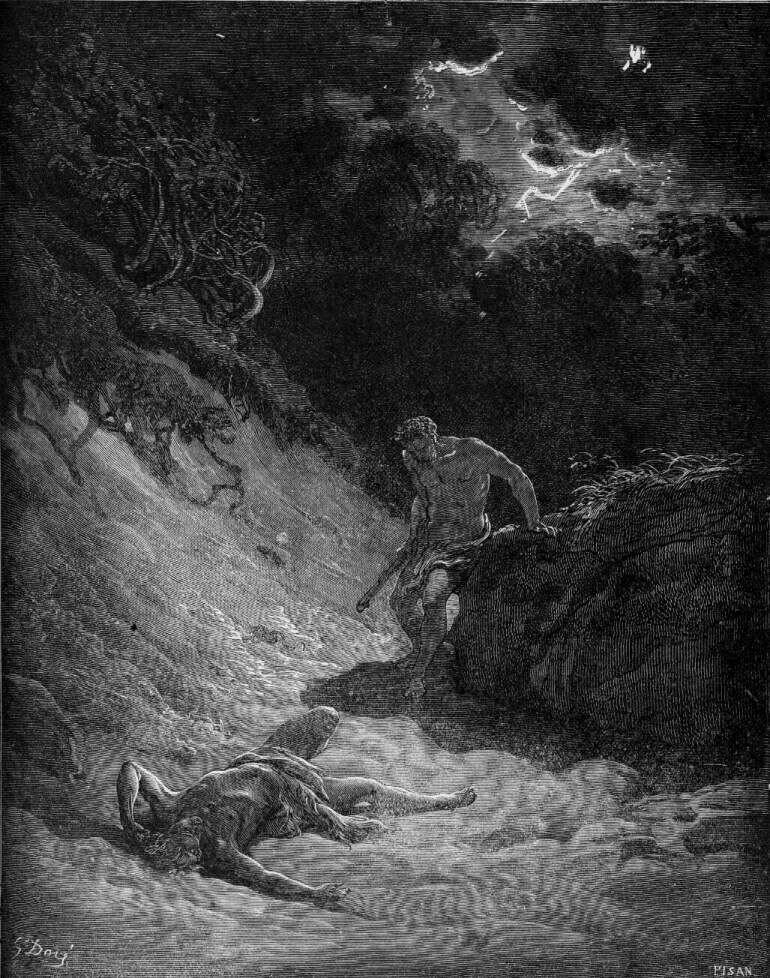
The Murder of Abel – Gustave Dore
There is a well-known account in Scripture (Gen. 4) that on its face seems simple and straightforward. Yet, the Hebrew writer presents a scenario with enormous ramifications. We must dig deep to understand its meaning for us.
Now Adam had sexual relations with his wife, Eve, and she became pregnant. When she gave birth to Cain, she said, “I have acquired a man with God’s help!” Later she gave birth to his brother and named him Abel.
When they grew up, Abel became a shepherd, while Cain cultivated the ground. When it was time for the harvest, Cain presented some of his crops as a gift to the Lord. Abel also brought a gift—the best portions of the firstborn lambs from his flock. The Lord accepted Abel and his gift, but he did not accept Cain and his gift. This made Cain very angry, and he looked dejected.
“Why are you so angry?” the Lord asked Cain. “Why do you look so dejected? You will be accepted if you do what is right. But if you refuse to do what is right, then watch out! Sin is crouching at the door, eager to control you. But you must subdue it and be its master.”
Early in Hebrew Scripture we learn of pairs and contrast: light and dark, human and animals, Adam and Eve and Cain and Abel. The pairings and contrast are meant to be instructive, as are the names of Cain and Abel.
Although Cain’s name has the primary meaning of “acquire,” the word that his name comes from (קָנָה kanah) also means “to erect, to found,” and “to create.” In Genesis 14:19 we see various translations describe God as either the “Possessor of heaven and earth” (King James Bible, New American Standard Bible, Webster‘s Bible Translation), or “Creator of heaven and earth (New Living Translation, New International Version). Both words “Possessor” and “Creator” are translations of the same word קֹנֵה konay, a cognate of Cain’s name Kayin. What’s In A Name: A Secret About Cain and Abel
In the context of contrasting the brothers Cain and Abel, “Cain!”, an exclamation from mom and the name for her son, connotes “Possessor” and “Creator”. It’s possible that Eve’s new found God-likeness had gone to her head, perhaps claiming co-creation with God. The name signals Eve’s bending in toward self-divination and for her son to project himself in the same way – as self-sufficient creator and possessor of all before him – in contrast to the “Creator and Possessor of heaven and earth”. The pairing of the two names – Cain and Abel – tends toward this interpretation.
Abel as noun הבל (hebel) means vapor, breath, or something very close to nothing. Abel could have been nicknamed Whiff.
I wonder. Did Eve feel exhausted and out of breath chasing after little Cain? Naming her second son Abel implies a here-one-minute-gone-the-next tracking of a little life. Abel’s name is further contexed in Ecclesiastes: Everything is breath (not “vanity”, a current mistranslation). And, in Ps. 39:5, 144:4; Prov. 31:30.
We get the impression from their names that Cain is a rooted of-the-earth man and that Abel is a reed in the winds of heaven. Their vocations tell us more about them..
We learn from the narrative that both brothers are fulfilling the human vocation given earlier in Genesis: dominion and care of animals and the land. They are doing so successfully under God’s blessing and in communion with God. At the end of the year, harvest time, the brothers bring an offering to God. Cain brought only some of the fruits of the soil. Abel brought the fat portions from the firstborn of his flock.
God makes a distinction between the two offerings. God looks with favor on Abel’s offering – the best of what he has. And, God rejects Cain’s token offering. The prophet Malachi gives us some understanding as to what offering the “Possessor of heaven and earth” – the Landowner – desires:
“When you bring injured, lame or diseased animals and offer them as sacrifices, should I accept them from your hands?” says the Lord. “Cursed is the cheat who has an acceptable male in his flock and vows to give it, but then sacrifices a blemished animal to the Lord. For I am a great king,” says the Lord Almighty, “and my name is to be feared among the nations.
-Malachi 1:13-14
God’s response does not go over well with Cain. Farmer Cain, “Possessor” and “Creator” of his own domain, grows an attitude. God notices and issues a warning.
“Why are you so angry?” the Lord asked Cain. “Why do you look so dejected? You will be accepted if you do what is right. But if you refuse to do what is right, then watch out! Sin is crouching at the door, eager to control you. But you must subdue it and be its master.”
God gives Cain a choice. He could repent and do right. Then his fallen countenance would be lifted up. He would know joy. Or, if he refuses to what is right sin will have dominion over him. His fallen countenance will remain. Sin’s chaos will rule his life and the lives of his descendants. We learn that Cain, his own man, chooses pathway number two which takes him away from home and out of God’s sight (does he think this?):
Cain said to Abel his brother, “Let us go out to the field.” And when they were in the field, Cain rose up against his brother Abel, and killed him. -Gen. 4:8
The advent of civilization (Gen. 4:17-26) is stained by a wrong choice, one made out of anger and of a desire for revenge. The horrific ramifications of the wrong choice are the pollution of the land, blood guilt and curses (as opposed to God’s blessing). The Land Owner had warned the tenant and now asks Cain the same question posed to Adam (Gen. 3: 9):
Then the Lord said to Cain, “Where is Abel your brother?” He said, “I do not know; am I my brother’s keeper?” And the Lord said, “What have you done? The voice of your brother’s blood is crying to me from the ground. And now you are cursed from the ground, which has opened its mouth to receive your brother’s blood from your hand. When you till the ground, it shall no longer yield to you its strength; you shall be a fugitive and a wanderer on the earth.” Cain said to the Lord, “My punishment is greater than I can bear. Behold, thou hast driven me this day away from the ground; and from thy face I shall be hidden; and I shall be a fugitive and a wanderer on the earth, and whoever finds me will slay me.” Then the Lord said to him, “Not so! If anyone slays Cain, vengeance shall be taken on him sevenfold.” And the Lord put a mark on Cain, lest any who came upon him should kill him. Then Cain went away from the presence of the Lord, and dwelt in the land of Nod, east of Eden. -Gen. 4:9-16
Cain lies and evades responsibility for his actions. The sin in his heart is growing rapidly. It is taking dominion over him, the self-made dominionist. Cain’s domain, his farm land, is now working against him and Cain has become more cursed than the land. The once solid self-defined man is to become a wanderer through life– fleeting, ephemeral, mortal, transient, without strength, a passing wind, …a breath.
Cain, beginning to feel the weight of his actions, balks at his punishment. But murder is no small thing. Murder brings about a greater punishment, as we learn in Numbers 35:33:
Do not pollute the land where you are. Bloodshed pollutes the land, and atonement cannot be made for the land on which blood has been shed, except by the blood of the one who shed it.
But in the Cain and Abel account God does not take a life for a life. Rather, as an act of mercy, God exiles Cain from his home, from others and from the land, his source of strength. Cain is removed from out of the context of God’s blessing. Exiled, Cain still has a chance to repent and return to the Land Owner.
As Cain finds out, man’s sin affects the land that we are to have dominion over. Hosea wrote about it (Hos. 4: 2-3):
There is only cursing, lying and murder,
stealing and adultery;
they break all bounds,
and bloodshed follows bloodshed.
Because of this the land dries up,
and all who live in it waste away;
the beasts of the field, the birds in the sky
and the fish in the sea are swept away
This early account in Scripture is a study of contrasts. It reveals two ways of being and two distinct personalities. There are the Abels who acknowledge the transient and dependent nature of their being, as in the words of the Psalmist (39:5)
You have made my days a mere handbreadth;
the span of my years is as nothing before you.
Everyone is but a breath,
even those who seem secure.
And, there are the Cains who deem themselves god-like Creators and Possessors and thereby mocking the One True Creator and Possessor, as described in Prov. 21:24:
The proud and arrogant person— “Mocker” is his name—
behaves with insolent fury.
There is an offering of the best portion and there is an offering of a token. Clearly from this account and from many more, our offerings reveal what we think about God. Do we view God as Creator and Possessor? Do we view God as the Land Owner under Whom we work as faithful stewards and return the best of our stewardship? Or, do we see God as an obligation that needs to be dealt with on our terms? (See the Parable of the Ten Talents, Matt. 25: 14-30) (See also the account of Ananias’ and Sapphira’s token offering in Acts chapter 5. It doesn’t end well!)
The Cain and Abel account reveals that there is God’s view of things and man’s. God’s warning to Cain makes His view clear beyond a doubt. And though a victim is entitled to revenge in the Old testament God does not take revenge. Rather, God lets Cain live with the consequences of his actions. “You want to live outside my blessing – Go for it!”
This account reveals that Biblical ethics are not the same as Biblical Law. God does not take a life for a life. God does not seek monetary compensation (2 Sam. 21). The Law should be read in a larger context. Jesus tried to get the Scribes and Pharisees to understand the bigger context, the Big Picture, of His work of Redemption.
One final contrast. Abel – “breath” or “breeze” – dies in accordance with the transient nature of human existence. Cain, who saw himself as the rooted “Creator” and “Possessor” is to wander the earth like a breeze. As a fugitive he has to keep moving. He’s not tied to the land (a symbol of his strength) as he once was. What Cain had refused to accept of God and of his brother Whiff he now has to accept as his existence “east of Eden”.





The Case of Mistaken Identity
June 9, 2019 Leave a comment
Recently, I went to my state’s DMV to obtain a Real ID. Starting Oct. 1, 2020, this ID will be required for all domestic commercial flights and to enter Federal facilities requiring identification to enter, such as military bases or nuclear power facilities. The REAL ID Act passed in 2005 establishes minimum security standards for state-issued driver’s licenses and ID cards. The Act refers to federal anti-terrorism laws and regulations that control access. To obtain the Real ID I had to submit several documents that verified my identity and my relationship to the state and federal government and my address.
As important as it is to our federal authority to know who you are to identify any threats to its citizenry, it is vastly more important for us to know who we are in space and time. It is to which authority we submit to that matters with regard to the verification of our identity and to the rights granted to us by that authority. Therein lies the case for mistaken identity.
Modern man has placed himself at the center of the universe as the anthropic cause and reason for existence. Modern man sees himself as the final authority. As such, his identity as self-creator becomes the reference point for all matters of life. What came before, what has been handed down through millennia is of no concern to modern man. Religion, science, family – nothing is as important to modern man as his present tense self-created identity. Enter Identity Politics.
Identity Politics and its, as philosopher Roger Scruton has described it, “culture of repudiation”, are at the forefront of modern man’s renunciation of the past – inherited values, cultural identifications and namesakes. As modern man shakes off the past and its ties to his identity, the need to belong remains.
Here is an excerpt from Scruton’s address, How identity politics destroys freedom, during the Acton Institute’s “Crisis of Liberty in the West” conference :
…we have a craving for membership, which is a deep adaptation of the species, and which presses us always towards the group and the conformity that will protect us. Many young people, under the impulse of this feeling, search for a “conformity in defiance,” a belonging which is also a rejection, that will provide a new identity in place of the old.
As a result, the pursuit of freedom has taken on an entirely new character. The new activist on behalf of freedom does not stop at affirming the right to choose a course of action or a way of life. He or she builds around this right a rival identity, an identity that defies the one that was traditionally on offer. This search for identity claims a space in the public world, and claims it from and against the unspoken conventions that have, over the years, made our free society possible. In this way, the pursuit of individual freedom, detached from inherited obedience, leads to a new denial of freedom.
It is worth examining how this comes about. Every freedom creates a difference – the difference between those who exercise it and those who do not. When you use this freedom to define your identity, you are in a certain measure differentiating yourself from those who receive their identity by inheritance. It is then a small move to the claim that the inherited forms of membership discriminate against the new identities, since they exert an unfair pressure to conform. There arises a new and virulent condemnation of our old identity and an attempt to suppress it.
The culture wars confirm the last statement. Social media accounts are silenced and suppressed when any voice counters the identity politics narrative. Swarms of cultural repudiators descend on anyone who doesn’t affirm their chosen reality bombarding them with vitriol. At a minimum the voices of cultural avowal are upbraided by SJWs who, appropriating the words of Jesus, condemn the voices for “judging” and “not loving”. But often, the cultural war is taken to a heightened level.
“Attack and destroy!” is the battle cry against anyone who veers from the political narrative sanctioned by their political overlords. And so, there is character assassination and doxing and worse meant to hamstring, cripple and harm the ‘enemies’ of the “culture of repudiation” warriors. The self-created with self-endowed authority demand that you affirm their creation and their authority. There is a price to pay if you don’t.
What is not taken into account by the cultural repudiators is that the human race has been paying another price, an enormous price, for its descent into self-creation and self-affirmation. Identity Politics, in the form of the Serpent, was right there at the beginning of the human race. The offer on the table: if you eat this you can be like God and own your identity; you can be your own person and not be tied to some outside authority; you can become self-logos. Once the ‘apple’ of self-realization was taken from the hand of the Identity Politics purveyor, problems and misery began for mankind. Self-creation and self-authority would go on to create vulnerability, isolation, and a denigration of the image of God. The quest for power and the search for group identity and dignity also began in the Garden. The product of Garden-variety Identity Politics can be seen today in the Pride Parade – the in-your-face anti-God perpetuated rite of cultural repudiation.
Since the Garden, Identity Politics went on to crawl its way down through the centuries to affirm all takers in their narcissism and to get them to crawl on their bellies for affirmation and fostering a brood of snakes. These snakes offered mistaken identities in the form of self-realization.
Consider this passage from Polish philosopher and historian Leszek Kolakowski’s essay On the So-Called Crisis of Christianity:
Christianity is thus the awareness of our weakness and misery, and it useless to argue that there exists or could exist a “Promethean Christianity,” that is that Christian faith could be reconciled with hope for self-salvation. Two great ideas of the nineteenth century which, despite all that separates them, perfectly embodied this Promethean expectation –those of Marx and of Nietzsche – were anti-Christian in their roots, and not as a result of accidental historic circumstance. Nietzsche’s’ hatred of Christianity and of Jesus was a natural consequence of his belief in the unlimited possibility of mankind’s self-creation. Nietzsche knew that Christianity is the awareness of our weakness, and he was right. Marx knew this too, and from the Hegelians, he took over and transformed the philosophy (more Fictean than Hegelian) of self-creation and futuristic orientation. He came to believe that the collective Prometheus of the future would reach a state which his thought and action would be indistinguishable and in which even “atheism” would lose its reason for existence, since people’s self-affirmation would be entirely “positive”, not negatively dependent on the negation of God.
The Progressive Element, those with Promethean Expectation, do not embrace God. The Democrat party, its enabler, booed God at the 2016 convention. Together they embrace the ideologies espoused by Nietzsche and Marx. The words of Jesus are used by the Progressive Element as a tagline for behaviors they want justified for someone they deem marginalized.
Man, as the principle cause and logos of the universe, creates his own values. Thus, the religion of humanity. Secular humanitarianism is the tie that binds the Progressive Element: atheists, agnostics, deists, social Darwinists and those who buy into sentimental Christianity for the sake of progress. The creation of man-as-logos values produces a querulous society of competing values, hence the culture wars. Amorphous and relativistic values are promoted under the high-sounding and ambiguous rubric of “social justice”. Individualism is turned inward toward self-centered anodyne interest to be protected by “rights”. Progressivism inverts The Second Commandment: “love me as you love yourself”. Lost in Self-Logos
The Progressive Element promotes another authority: the self as authorized, ID’d and dispensed by them. It is dedicated to the proposition that all behaviors are equal, that the ends justify the means, and that power is truth. It lambasts authoritarianism while acting in full authoritarian manner against anyone who wants to see the ring of power destroyed under their all-seeing eye.
If you want to read about the nefarious characteristics of the Progressive Element, I recommend reading C.S. Lewis’ Space Trilogy. The antagonist Weston (representing Western Civilization?) is a rationalist, scientist and secular humanist, who rejects God and any other form of knowledge outside science. He plots to create a Nietzschean-type super man race. His machinations turn him into a beast. Later, as becomes ever more possessed by the devil, he is identified in the story as the “Un-Man”. The Progressive Element aligned with dark forces is That Hideous Strength.
Or, for a historical take of the Progressive Element’s characteristics, one could read the Book of Daniel. The scribe Daniel records accounts of beastly kingdoms that were opposed to God and to His authority. The rulers self-ID’d as gods.
Or, you can watch the Pride Parade and witness the “dignity” of degeneracy and dehumanization of those making the case of mistaken identity. God does not ID his created beings as homosexual, perverse creatures. God IDs them – all of us – in His own image.
As with obtaining a Real ID, one has to submit their identity to a higher authority to obtain the rights and privileges the authority grants. Submitting a false ID is against the law. And, one could not submit their documented identification to the federal and state government and claim to feel like someone else. Emotional identity is not who you are. It is only a part of who of you are. One’s identity is a composite of the whole person and affirmed by an outside reference point. But the world rejects outside reference points as authoritarian and God-like. The Progressive Element has a significant problem with authority.
My identity is referenced or ‘sync’d’ with my relationship to the Highest Authority and with my relationships of those who also submit to the Highest Authority. I was reminded of this again today, Pentecost Sunday. The Holy Spirt was sent to indwell all believers of all nations, stamping their IDs “in Christ” and “located in the Kingdom of God”. The Holy Spirit was and is given as a pledge or seal (Eph. 1:14) of an inheritance – another reminder of my ID in as a child of God. Those in the world want to stamp their IDs with “self-appointed authority”.
Because of the coming inheritance I want to make sure all my documents are in order.
Rate this:
Filed under Christianity, cultural Marxism, Culture, Political Commentary, Politics, Progressivism Tagged with Christianity, cultural Marxism, culture, identity politics, politics, progressivism