Exactly!

Here is Father Robert A. Sirico making it perfectly clear why capitalism is GOOD.  (There is a surprise at the end of the video, too.)

Fear and Loathing in America

I know, I know, I am polemical.  I polarize people with my words.  I piss people off because I am ever seeking to destroy pretense.  And yet at this juncture in my life I understand this irksome gift as a God-given trait that must be used.  This does not mean that I am perfect, of course, or exempt.  It does mean though that just like the prophets recorded in the Old Testament I cannot remain silent. I am will ever be forthright and forth telling…

 *****

Pervasive throughout our land is the avoidance of asking the hard questions.  We shun the real questions about life and death, about God, about good and evil, about the body and soul, about reason and revelation and about eternity and time. 

 Yesterday I happened to watch The Lord of the Rings (LTR):  The Return of the King.  Putting the above statement into LTR terms, we want to live peaceably in the shire with never having to venture out and deal with the Ring which has consequential power over us. We may say to ourselves, “Why destroy the ring when we can pretend it doesn’t exist? We may have doubts that all that the shire presents to us is all there is to life but we will ignore those doubts in order to avoid conflict and to live peaceably. We choose the immediate surroundings to avoid the dangerous quest that truth demands. We fear what it might take to make the journey.  We fear we will lose ourselves on the way and never return to the shire. We fear what it might take to fight the good fight.

 We fear conflict. Conflict is the evil we most want to avoid.  Our “dialectics” begin with opposites and end in synthesis.  We seek conflict resolution, bargaining, harmony and therapy, no-fault divorce, etc.  Because of this we find it easier to believe nothing of import so that we do not have to fear disagreement, ostracism or even death for what one believes. And because we do not believe in anything then we cannot be responsible for outcomes.

 To choose to believe nothing means that absolute truth is discharged from our lives.  Its voice is no longer heeded.  In fact its voice is now being drowned out.  The commotion that you hear daily is man’s raucous resistance to leaving the shire ~ his tweeting and texting of empty words, the ever streaming pop/rock music filling the void, the Surround sound of ubiquitous blaring entertainment.  It is as if men and women were walking around in the dark calling out to each other and never finding the light switch. They have chosen to stay in the purgatory of their fears.

 The avoidance of pain and conflict has become our primary goal in life.  This is seen in the young voter’s desire for Obamacare.  The health care reform is seen by them as in line with their “values”.  The reform is also seen as providing a sense of self-esteem in that it affirms the young voters wish to avoid pain and insecurity at all costs. On the surface Obamacare appears to provide security for themselves and for others while in truth it is a compromise of what is good and what is evil – the good being the desire for your well-being and the well-being of others and the evil which is the lie that Obama and the government will somehow provide self-esteem and security for you and others and do it with altruism. Remember, God has now been replaced by social science, social science based on rationalism and egalitarianism (think John Rawls, Laurence Tribe, etc.) all under the banner of “Social Justice.”  Rationalism’s,’ “Social Justice” trumps God every time.  Social science is now becoming the creator of society’s values, e.g., God is not to be talked about in public but homosexuality must be.  All of this in spite of the fact that rationalism without revelation could never create value. As Benedict XVI said in 1969:

“What is essential is that reason shut in on itself does not remain reasonable or rational, just as the state that aims at being perfect becomes tyrannical. Reason needs revelation in order to be able to be effective as reason.”

 The avoidance of truth with its inherent conflicts with other than the truth affects our relationships, our sexuality, our creativity, our culture. In place of absolute truth Americans, as mentioned, have latched on to “values.” And our new “value” system has a new way of talking:  “lifestyle”, “Be Yourself;” “Be original;” “Let go and be;”  diversity;” “I have my rights.” But now “rights” are no longer the natural inalienable God-given rights “of life, liberty and the pursuit of happiness.”  Now “rights” have morphed into feelings worn on our sleeve.  We demand that others accept what we feel and that others be open and tolerant. This is what we value above all else. Right and wrong (and love (read not sex)) no longer have a place in our psyche. “Values” – a synthesis of good and evil dominates our diseased culture. And when we ignore serious questions we create words with synthetic meanings to describe our lives.

 “Charisma” is one of those words often heard today. Charisma was once considered a God-given grace but has been used as cover for the “banality of evil” as Hannah Arendt, political philosopher, notes when talking about Hitler’s appeal.

  Allan Bloom, another political philosopher, notes in his 1987 book The Closing of the American Mind:  How Higher Education Has failed Democracy and Impoverished the Souls of Today’s Students, “Charisma both justifies leaders and excuses followers.  The very word gives a positive twist to rabble-rousing qualities and activities treated as negative in our constitutional tradition.  And it s vagueness makes it a tool for frauds and advertising men adept at manipulating images.” Consider that both Bill Clinton and Barack Obama have both been called charismatic leaders.

 In the introduction to his book, Bloom writes about what he sees in the classrooms of higher education: 

“There is one thing a professor can be absolutely certain of:  almost every student entering the university believes, or says he believes that truth is relative….They are unified only in their relativism and their allegiance to equality….They have been equipped with this framework early on, and it is the modern replacement for the inalienable rights that used to be the traditional American grounds for a free society…The danger they have been taught to fear from absolutism is not error but intolerance.  Relativism is necessary to openness; and this is virtue, the only virtue, which all primary education for more than fifty years has dedicated itself to inculcating.  Openness ~ and the relativism that makes it only plausible stance in the face of various claims to truth and various ways of life and kinds of human beings ~ is the great insight of our times. The true believer is the real danger.  The study of history and culture teaches that all the world was mad in the past; men always thought they were right, and that led to wars, persecutions, slavery, xenophobia, racism, and chauvinism.  The point (now) is not to correct the mistakes and really be right; rather it is not to think you are right at all.”  (emphasis mine)

  In a later chapter titled The German Connection, Bloom relates how Nietzsche, Heidegger, Hegel, Weber, Freud have influenced American thinking.  Americans, within a “pro-choice” democracy, have assimilated this German thinking sometimes turning it on its head.   Bloom writes, 

“…there is now an entirely new language of good and evil, originating in an attempt to get “beyond good and evil” and preventing us from talking with any conviction about good and evil anymore.  Even those who deplore our current moral condition do so in the very language that exemplifies that condition.”

“The new language is that of value relativism and it constitutes a change in our view of things moral and political as great as the one that took place when Christianity replaced Greek and Roman paganism.”

“Value relativism can be taken to be a great release from the perpetual tyranny of good and evil, with its cargo and shame and guilt, and the endless efforts that the pursuit of the one and the avoidance of the other enjoin. Intractable good and evil cause infinite distress – like war and sexual repression – which is almost instantly relieved when more flexible values are introduced.  One need not feel bad about or uncomfortable with oneself when just a little value adjustment is necessary.  And this longing to shuck off constraints and have one peaceful, happy world is the first of the affinities between our real American world and that of German philosophy in its most advanced form, given expression by the critics of the President’s speech.”

 Here Bloom is referring to the clamor arising when President Reagan referred to the Soviet Union as the “evil empire.”  When yet at another time Reagan said that the Soviets had “different values,” this statement was met “at worst with silence and frequently with approval,” thus revealing our loathing of absolutism in the former statement.

 At the beginning of the chapter Values, Bloom, relates, “We have come back to the point where we began (in the book), where values take the place of good and evil.” (emphasis mine)

And so like Gollum we place the utmost value on the ring of power, becoming blind to its tyranny over us. Along with the ring we call our values “My Precious.”  Under the yolk of temporal “values” and without facing the serious questions of life we lose ourselves, we lose the real.  We lose love, romance, culture, art ~ everything meaningful to us.

 Love or charity, a virtue which must be constantly worked at, is replaced with easy sex. Consider that in our culture sexual activity is not to be repressed or disciplined but rather it is to be given preeminent unrestrained “value.” Think Sandra Fluke and contraception. Think in-your-face homosexuality. Does America “confirm her soul in self-control” or not?

 Romance, apart from truth is portrayed in movie after movie as just a response to nihilism. Nowhere to be found is the expectation, the unrequited desire and the hoped-for revelation of real romance. Without absolutes there can be no true romance.

 We are a culture that seeks therapeutic counseling.  Yet modern psychology, the sworn enemy of shame and guilt, refuses to talk about good and evil and therefore offers nothing for the soul. Freudian psychology only brings the patient back to repressed sex.

 Modern art has nothing of consequence to offer. Consider the pop art of Andy Warhol and Roy Lichtenstein.

 Deafening music, pop or rock, pummels our ear drums daily evoking barbaric passions and depriving the soul of its senses.

 Tattoos deface our bodies so as to reveal our disdain for the discipline that purity of mind and body requires. Inking is given the (non-)value of counter-culture and rabble-rousing.

 Religion, wherein serious questions are faced, is being replaced by positive thinking as preached from the temples of TV.

 In view of the fact that our nation is becoming increasingly devoid  of absolutes and truth while at the same time becoming  increasingly laced with relativism and sliding scale “values” consider this:

 Jesus, the Son of the Living God, says, “You shall know the truth and the truth will set you free.” Free from what? Free from fear.  All fear:  the fear of the unknown, the fear of facing accountability, the fear of death, the fear of loss and personal suffering, the fear of evil.  Jesus’ perfect love casts out all fear. Because of this we can face the serious questions of life head-on knowing that He loves us, that He stands with us and that He has gone before us through the same difficult places. Seek Him and He will be found.

 Going back to the LTR analogy do you remember how Frodo and Sam and the rest rejoiced that the ring had been destroyed, that their arduous life and death journey had been accomplished? Their courage and resoluteness saved the shire, themselves and Middle Earth even while the others in the shire had no clue as to what was going on.  You and I are about to do the same.

Just, Fair and Equal: the Stooges of Progressivism

“Creating a world that is just, fair and equal.”  This Progressive mantra was recited again yesterday. I heard it during a television interview of two historians at a history writer’s convention in Milwaukee, Wisconsin. The black historian’s words sounded so right, so full of righteous human endeavor but in reality his words were the sounds of empty utopian piety deficit of any moral context.

 A world that is just is a world where every man gives the other his due.  Yet government’s redistribution of wealth does the opposite. It takes away from the taxpayer what is due him, his earnings and property and gives to someone else that which is not due him. This confiscation and redistribution of personal property is for no other reason than to turn unequal incomes into equal outcomes.  This highway robbery is currently termed “social justice” by progressives today who were yesterday’s socialists. 

Here is Josef Stalin, a murderous dictator, talking about his desire to see socialism dominate the world (meaning you and me):

“…Uneven economic and political development is an absolute law of capitalism. Hence, the victory of socialism is possible first in several or even in one capitalist country alone. After expropriating the capitalists and organising their own socialist production, the victorious proletariat of that country will arise against the rest of the world …”

St.Thomas Aquinas in his On the Book of Job (8,1) said:

 “Justice is destroyed in twofold fashion:  by false prudence of the sage and by the violent act of the man who possess power.” 

 As we see our nation become increasingly secular we see its structure being pulled away from its Judeo-Christian cornerstone.  And in so doing we the ‘homeowners’ are becoming displaced and disordered much like furniture during a house relocation.  Without realizing it we are becoming objects devoid of human nature, becoming the un-created or the walking dead.  Removed from life’s foundation man is devoid of God-given inalienable rights as well. And with out individual inalienable rights there is only left to mankind the justification of totalitarian power, a totalitarian power that promises a “just, fair and equal world.” This secular utopian promise is not new to mankind:  Hitler and Stalin among others promoted such ‘worlds’.

 Justice can rightly be discussed only within a complete moral context that includes prudence, temperance, fortitude, charity and a host of other God-derived virtues.  To replace that moral context with a secular humanism is to presume that God did not create humans.  It presumes that God did not create man as a person, as a whole unto himself as a spiritual being that exists for itself and of itself and that wills its own proper perfection.  On these grounds secular humanism denies individual God-given inalienable rights in favor of the general ‘good.’ This denial is imposed on us today in our democracy by majority rule – voters enthralled by the secular humanism advocated by the main stream media, by our president and by Democrats in particular are voting to empty man of his individual nature through law and fiat.  They are doing so in the name of communal “social justice.” No one seems to notice except a few on the right.

 Because of human nature there will always be those in a small camp who think to themselves “every man for himself” and “screw the other guy so I can get ahead.”  And likewise, on the other hand, there will always be those who believe that each of us should give up our person, our property and our individualism for the good of the whole. Neither of these political philosophies should ever be put in power.  And yet with high-sounding, pious jingoism pumped out by the main stream media propaganda machine the left is now succeeding into promoting the latter.  We already know who the willing recepient is:   “a sucker is born every day.”

 As individuals each of us should act with justice toward our neighbor giving him his due.  What is his due?  My neighbor is due his inalienable God-given right to life, liberty and the pursuit of happiness.  I owe him truth.  I owe him the same love I give myself.  I owe him freedom from coercion. Beyond that the mantras of “social justice,” fairness and egalitarianism become the Godless mind control pumping the ever marching jackboots of rank and file humanism.  Once a sufficient numbers of useful idiots and stooges have succumbed to humanism’s opiate effect a sure and complete enslavement of our nation under a totalitarian regime will occur. Welcome to the world of the godless if Obama’s regime is re-elected in 2012.

 For a world to be “fair” someone in power has to determine what is fair.  Do you really want to use your vote for that kind of self-subjugation?  Certainly there is no Biblical a priori for demanding that life must be fair. Where does this understanding of the need for fairness come from?  Is there a philosophical argument for fairness?  A moral one?

My guess would be that much of the “fairness” allure comes from popular psychology and socialist rhetoric both which absolve people of personal responsibility and seeks to rectify a person’s losses and hardships by pointing blame at others.  Class warfare rhetoric is a prime example, as it defines others as being the reason for your lack.  More devastating to our culture and its preoccupation with fairness is our nation’s increasingly secular nature, a secular nature of envy and jealousy actively promoted by president Obama in his many “fair share” speeches.  Obama is a secularist wolf in Soros’ bought sheep’s clothing.

  A world that is “equal” is a world that removes difference for the sake of bringing every one down to the same low common denominator and nothing more.  Imagine our government choosing your husband or wife, your doctor, your food, your home and your words based on what is thought to be equal for everyone. Equal-outcome based thinking destroys incentive, destroys each man’s uniqueness, his God-given differences, his inalienable rights and eats away at civic life-like a flesh-eating disease feeding on its host. 

According to Allan Bloom in his book The Closing of the American Mind: How Higher education Has Failed Democracy and Impoverished the Soul’s of Today’s Students in the chapter entitled Values “Egalitarianism is conformism…Egalitarianism is founded on reason, which denies creativity”

 Imagine a world where there is no creativity and no aspirations only sameness.  Imagine being a citizen of North Korea.

Without moral-based justice as an inoculation against greed and envy people would constantly be looking at others to compare themselves with their neighbor. Forget contentment in a world that is egalitarian.

 Finally both fairness and egalitarianism, as laws enacted via secular humanist congressmen and presidents voted for, remove individual moral choice (justice) along with charity, fortitude and temperance from life. If the government does your thinking and makes your choices for you then you as an individual are absolved from any moral duty whatsoever.  What than is the purpose of the individual?  Without you the state becomes the all-powerful meat grinder and you along with everyone else become the human sausage extruded into the casings of humanism. Digest that if you will.

“A government big enough to give you everything you need, is a government big enough to take away everything that you have….” President Gerald Ford

No Way But Up

What’s at the core of America’s problems today? Is it partisan politics or is there a greater rift in the American people?

 Alexander Solzhenitsyn, Soviet and Russian novelist, dramatist, and historian during his commencement address delivered at Harvard University, June 8, 1978, gave us his diagnosis.  His speech is a stinging indictment of the West –  its materialism, its enabling of the abuse of individual freedom, its self-serving inbred media and its disavowal of its spiritual roots:

 However, in early democracies, as in the American democracy at the time of its birth, all individual human rights were granted because man is God’s creature. That is, freedom was given to the individual conditionally, in the assumption of his constant religious responsibility. Such was the heritage of the preceding thousand years. Two hundred or even fifty years ago, it would have seemed quite impossible, in America, that an individual could be granted boundless freedom simply for the satisfaction of his instincts or whims. Subsequently, however, all such limitations were discarded everywhere in the West; a total liberation occurred from the moral heritage of Christian centuries with their great reserves of mercy and sacrifice. … State systems were becoming increasingly and totally materialistic. The West ended up by truly enforcing human rights, sometimes even excessively, but man’s sense of responsibility to God and society grew dimmer and dimmer.

 And…

“If humanism were right in declaring that man is born only to be happy, he would not be born to die. Since his body is doomed to die, his task on earth evidently must be of a more spiritual nature. It cannot be unrestrained enjoyment of everyday life. It cannot be the search for the best ways to obtain material goods and then cheerfully get the most of them. It has to be the fulfillment of a permanent, earnest duty so that one’s life journey may become an experience of moral growth, so that one may leave life a better human being than one started it. It is imperative to review the table of widespread human values. Its present incorrectness is astounding. It is not possible that assessment of the President’s performance be reduced to the question how much money one makes or of unlimited availability of gasoline. Only voluntary, inspired self-restraint can raise man above the world stream of materialism.” (emphasis mine)

And…

“It would be retrogression to attach oneself today to the ossified formulas of the Enlightenment. Social dogmatism leaves us completely helpless in front of the trials of our times. Even if we are spared destruction by war, our lives will have to change if we want to save life from self-destruction. We cannot avoid revising the fundamental definitions of human life and human society. Is it true that man is above everything? Is there no Superior Spirit above him? Is it right that man’s life and society’s activities have to be determined by material expansion in the first place? Is it permissible to promote such expansion to the detriment of our spiritual integrity?”

Take a look at what drives you and perhaps you will see why America is no longer a nation under God, no longer a nation of civil courage, of moral decency.  Perhaps you will see why people would vote for a president who uses class warfare rhetoric to promote the sands of material security as foundational to life and not the rock of spiritual fortitude.

God Saw That It Was Good and So Do I

This past week I read an engaging book by scientist Francis S. Collins:  The Language of God: A Scientist Presents Evidence for Belief.  As someone who works in the engineering field and as a believer in God the book’s discussion of science and faith being compatible piqued my interest.

 Before reading this book I did have the innate understanding that science and faith were compatible and that each discipline reinforced the other with their respective insights and revelations but prior to reading this book I hadn’t seen much credible literature discussing this premise.  Currently there appears to be plenty of antipathy between the church and science. So as one might imagine I was excited to purchase the book and evaluate a scientist’s take on the connection. I was not disappointed.

Francis S. Collins, as the back cover bio reads, headed the Human Genome Project and is one of the world’s leading scientists. “He works at the cutting edge of the study of DNA, the code of life.  Yet he is also a man of unshakable faith in God and Scripture.

Dr. Collins believes that faith in God and faith in science can coexist within a person and be harmonious. In The Language of God he makes his case for God and Science.”

 Of special interest to me is the fact that Collins (as I do) accepts theistic evolution.  In Chapter Ten he writes: 

 “This view is entirely compatible with everything that science teaches us about the natural world.  It is also entirely compatible with the great monotheistic religions of the world.  The theistic evolution perspective cannot, of course, prove that God is real, as no logical argument can fully achieve that. Belief in God will always require a leap in faith.”

 The book lays out for the reader in very accessible terms how Collins who was not raised in a Christian home came to his belief in God as a budding scientist in his twenties.  The book goes on to discuss why Collins fully accepts theistic evolution as opposed to literal Creationism and Intelligent Design.  Based on his own research Collins says the evidence is overwhelming in favor of natural evolution as God’s creative methodology.  I would agree. 

 He then further encourages the church to endorse scientific research as a resource for understanding God’s creation, therefore offering a better understanding of God.  In concert with his plea I believe every church leader should purchase this book and read its message.  There is, sadly, too much bad information being preached and taught by the Christian Evangelical church regarding creation.  This bad information makes the church look rather foolish.  Remember Galileo’s row with the church? Being raised an Evangelical I was taught that the earth was created about 6-8000 years ago and that the seven days described in Genesis Chapter One were literal days:  Poof, we just showed up on the scene.

 As an adult, though, I became skeptical of the Creationist theology but I clung to it because I had heard of no other plausible evidence to the contrary.  Evolution was routinely discounted in the Evangelical church.  In fact everything I had heard in church told me that evolution was the atheist’s version of the Christian creation. Evolution was also described as a slippery slope which would carry people away from God toward unbelief.  And worse, the church seemed opposed to science and science was something I truly enjoyed being involved with.  I would later look into Intelligent Design (ID) and had wondered if ID might be the catch-all for my belief in God’s creative act. But I was to learn that ID was flawed theory that did not take into account the nature of God.

 My change in thinking occurred a few years ago when I came across the writings of Christian philosopher Alvin Plantinga from the University of Notre Dame.  Spending two and a half hours on a train five days a week over the course of several years I had been able to read and research many different science and philosophy topics. And I did this precisely because I wanted to know more about God, the nature of His being and the world around me.  This excited me no end.  I don’t read romance novels.  I find my excitement by romancing the truth.

  Through reading Plantinga’s papers, though sometimes written in difficult philosophical terms, the door of my understanding was opened wide and I accepted theistic evolution as a valid creation methodology.  I would encourage anyone to read Plantinga’s papers.

 The basics of theistic evolution are clearly delineated in Francis Collins’ book and on the Biologos website.  Biologos is the name given to theistic evolution by scientist Collins.  Here are the Biologos premises/beliefs from that website:

 We believe that God created the universe, the earth, and all life over billions of years. God continues to providentially sustain the natural world, and the cosmos continues to declare the glory of God.

  • We believe that all people have sinned against God and are in need of salvation.
  • We believe in the historical incarnation of Jesus Christ as fully God and fully man. We believe in the historical death and resurrection of Jesus Christ, by which we are saved and reconciled to God.
  • We believe that God continues to be directly involved in human history in acts of salvation, personal transformation, and answers to prayer.
  • We believe the Bible is the inspired and authoritative word of God. By the Holy Spirit it is the “living and active” means though which God speaks to the church today, bearing witness to God’s Son, Jesus, as the divine Logos, or Word of God.
  • We believe that God also reveals himself in and through the natural world he created, which displays his glory, eternal power, and divine nature. Properly interpreted, scripture and nature are complementary and faithful witnesses to their common Author.
  • We believe that the methods of science are an important and reliable means to investigate and describe the world God has made. In this, we stand with a long tradition of Christians for whom Christian faith and science are mutually hospitable.
  • We believe that the diversity and interrelation of all life on earth are best explained by the God-ordained process of evolution and common descent. Thus, evolution is not in opposition to God, but a means by which God providentially achieves his purposes.
  • We believe that God created humans in biological continuity with all life on earth, but also as spiritual beings. God established a unique relationship with humanity by endowing us with his image and calling us to an elevated position within the created order.
  • We believe that conversations among Christians about controversial issues of science and faith can and must be conducted with humility, grace, honesty, and compassion as a visible sign of the Spirit’s presence in Christ’s body, the Church.
  • We reject ideologies such as Deism that claim the universe is self-sustaining, that God is no longer active in the natural world, or that God is not active in human history.
  • We reject ideologies such as Darwinism and Evolutionism that claim that evolution is a purposeless process or that evolution replaces God.
  • We reject ideologies such as Materialism and Scientism that claim science is the sole source of knowledge and truth, that science has debunked God and religion, or that the physical world constitutes the whole of reality.

 As a follower of Christ and as someone who seeks to bring people to faith in Him I see it as imperative that Evangelical church leaders (John Paul II accepted theistic evolution) come to grips with science (natural science, quantum physics, genetics, etc.) and to avail themselves of all empirical data and evidences coming out of science research.  As I see it the church and science are completely compatible.  Therefore, the church must not seek to restrain the hand of God, an evolved-incarnated hand that was once nailed to a tree, a resurrected hand that now reaches out to all of us.

 For more information about theism and theistic evolution:

 http://biologos.org/

Philosopher Sticks up for God

Alvin Plantinga

*****

Recommended Books about science and faith:

The Language of Faith:  Straight Answers to Genuine Questions by Karl Giberson and Francis Collins, Intervarsity Press, 2011

The Wonder of the Universe:  Hints of God in Our Fine-Tuned World by Karl W. Giberson, Intervarsity Press, 2012

What’s the Unitarian?

It is little wonder that the well-known ‘angry’ atheist Richard Dawkins wrote the anti-thesim book The God Delusion.  It is easily understandable especially after one reads the interview (excerpted and linked below) between a Unitarian Minister Marilyn Sewell and another anti-theist atheist the former Christopher Hitchens (Hitch).

 As evident from the interview, Marilyn Sewell, a minister, is utterly delusional in her understanding of God and Christianity.  And it is blatantly obvious that Hitch has a better understanding of Christianity than this Unitarian minister.

 Apparently from her bio Sewell has studied theology but I contend it is not Biblical theology.  Her questions and remarks as interviewer reveal her embrace of syncretism – a diversity of false beliefs and humanism blended with the truth of Christianity. Unitarian could be another term for syncretism.

 From her eponymous blog we are told that liberal believer and retired minister of the First Unitarian Church of Portland Marilyn Sewell is a former teacher and psychotherapist.  She has authored numerous books. Over a period of 17 years Sewell helped grow Portland’s downtown Unitarian congregation into one of the largest in the United States. At this point I must say that the fact that this woman and the Unitarian Church are misleading many is of serious concern to me. I must contend for the truth of Gospel of Jesus Christ.

 It troubles my spirit greatly when people like this liberal Unitarian minister use the name of Jesus Christ to preach “another gospel” and not the Gospel of Jesus Christ. Her message is a mish-mash of new age religion, liberal theology, social justice and cheap grace.  The ultimate message becomes half lie half truth:  “It’s not what you believe but how you live.” Ergo an embrace of diverse beliefs and social justice activism are at the forefront of Unitarian creeds.  As you’ll read, for Sewell just like the Episcopalian minister ghost in C.S. Lewis’, “The Great Divorce” all is metaphor, and therefore, cannot be taken seriously

 The deity of Christ, His death on the cross, His atonement for sins, judgement, heaven and hell, all are dismissed as being metaphorical, as not relevant to present human need and too exclusive a message to preach and teach.   Clearly this is syncretistic thinking and delusional with regard to the truth.  And because of its soft, socially acceptable version of theology the tentacles of Unitarian tenets are quickly creeping into evangelical churches across the nation.

 As a follower of Christ I am posting this information expressly to note the deception hidden in Sewell’s misguided words.  I have no problem talking about this interview in no uncertain terms. From the public record it can be noted that Sewell is a social activist and polemicist as was Hitch. They are/were each able to dish out pious platitudes at will and certainly, as their backgrounds would support, are/were able to hold their own in conversations regarding issues of faith and God.  So here goes.

 The interview took place prior to Christopher Hitchen’s January 5th, 2010 appearance as part of the Literary Arts’ Portland art and lecture series at the Arlene Schnitzer Concert Hall.  Hitch was political columnist for Vanity Fair, Slate, and other magazines, and known for his frequent contributions on the political TV circuit.  Hitchens’ pointed attacks against all religion has earned him regular debates across the country, often with the very fundamentalist believers his book, “God is Not Great”, attacks. Sewell, the interviewer, though, knows nothing about the fundamentals of Christianity. It would seem that Hitch is in a joust with Jello.

 Here are excerpts from that interview,  linked here

 Marilyn Sewell: In the book you write that, at age nine, you experienced the ignorance of your scripture teacher Mrs. Watts and, then later at 12, your headmaster tried to justify religion as a comfort when facing death. It seems you were an intuitive atheist. But did you ever try religion again?

Christopher Hitchens: I belong to what is a significant minority of human beings: Those who are-as Pascal puts it in his Pensées, his great apology for Christianity-“so made that they cannot believe.” As many as 10 percent of is just never can bring themselves to take religion seriously. And since people often defend religion as natural to humans (which I wouldn’t say it wasn’t, by the way), the corollary holds too: there must be respect for those who simply can’t bring themselves to find meaning in phrases like “the Holy Spirit.”

Well, could it be that some people are “so made” for faith. and you are so made for the intellectual life?

I don’t have whatever it takes to say things like “the grace of God.” All that’s white noise to me, not because I’m an intellectual. For many people, it’s gibberish. Likewise, the idea that the Koran was dictated by an archaic illiterate is a fantasy. As so far the most highly evolved of the primates, we do seem in the majority to have a tendency to worship, and to look for patterns that lead to supernatural conclusions. Whereas, I think that there is no supernatural dimension whatever. The natural world is quite wonderful enough. The more we know about it, the much more wonderful it is than any supernatural proposition.

The religion you cite in your book is generally the fundamentalist faith of various kinds. I’m a liberal Christian, and I don’t take the stories from the scripture literally. I don’t believe in the doctrine of atonement (that Jesus died for our sins, for example). Do you make and distinction between fundamentalist faith and liberal religion?

I would say that if you don’t believe that Jesus of Nazareth was the Christ and Messiah, and that he rose again from the dead and by his sacrifice our sins are forgiven, you’re really not in any meaningful sense a Christian.

Let me go someplace else. When I was in seminary I was particularly drawn to the work of theologian Paul Tillich. He shocked people by describing the traditional God-as you might as a matter of fact-as, “an invincible tyrant.” For Tillich, God is “the ground of being.” It’s his response to, say, Freud’s belief that religion is mere wish-fulfillment and comes from the humans’ fear of death. What do you think of Tillich’s concept of God?”

I would classify that under the heading of “statements that have no meaning-at all.” Christianity, remember, is really founded by St. Paul, not by Jesus. Paul says, very clearly, that if it is not true that Jesus Christ rose from the dead, then we the Christians are of all people the most unhappy. If none of that’s true, and you seem to say it isn’t, I have no quarrel with you. You’re not going to come to my door trying convince me either. Nor are you trying to get a tax break from the government. Nor are you trying to have it taught to my children in school. If all Christians were like you I wouldn’t have to write the book.

Well, probably not, because I agree with almost everything that you say. But I still consider myself a Christian and a person of faith.

Do you mind if I ask you a question? Faith in what? Faith in the resurrection?

The way I believe in the resurrection is I believe that one can go from a death in this life, in the sense of being dead to the world and dead to other people, and can be resurrected to new life. When I preach about Easter and the resurrection, it’s in a metaphorical sense.

I hate to say it-we’ve hardly been introduced-but maybe you are simply living on the inheritance of a monstrous fraud that was preached to millions of people as the literal truth-as you put it, “the ground of being.”

Times change and, you know, people’s beliefs change. I don’t believe that you have to be fundamentalist and literalist to be a Christian. You do: You’re something of a fundamentalist, actually.

Well, I’m sorry, fundamentalist simply means those who think that the Bible is a serious book and should be taken seriously.

If you would like for me to talk a little bit about what I believe . . .

Well I would actually.

I don’t know whether or not God exists in the first place, let me just say that. I certainly don’t think that God is an old man in the sky, I don’t believe that God intervenes to give me goodies if I ask for them.

You don’t believe he’s an interventionist of any kind?

I’m kind of an agnostic on that one. God is a mystery to me. I choose to believe because-and this is a very practical thing for me-I seem to live with more integrity when I find myself accountable to something larger than myself. That thing larger than myself, I call God, but it’s a metaphor. That God is an emptiness out of which everything comes. Perhaps I would say ” reality” or “what is” because we’re trying to describe the infinite with language of the finite. My faith is that I put all that I am and all that I have on the line for that which I do not know.

Fine. But I think that’s a slight waste of what could honestly be in your case a very valuable time. I don’t want you to go away with the impression that I’m just a vulgar materialist. I do know that humans are also so made even though we are an evolved species whose closest cousins are chimpanzees. I know it’s not enough for us to eat and so forth. We know how to think. We know how to laugh. We know we’re going to die, which gives us a lot to think about, and we have a need for, what I would call, “the transcendent” or “the numinous” or even “the ecstatic” that comes out in love and music, poetry, and landscape. I wouldn’t trust anyone who didn’t respond to things of that sort. But I think the cultural task is to separate those impulses and those needs and desires from the supernatural and, above all, from the superstitious.

Could you talk about these two words that you just used, “transcendent” and “numinous”? Those are two words are favorites of mine.

Well, this would probably be very embarrassing, if you knew me. I can’t compose or play music; I’m not that fortunate. But I can write and I can talk and sometimes when I’m doing either of these things I realize that I’ve written a sentence or uttered a thought that I didn’t absolutely know I had in me… until I saw it on the page or heard myself say it. It was a sense that it wasn’t all done by hand.

A gift?

But, to me, that’s the nearest I’m going to get to being an artist, which is the occupation I’d most like to have and the one, at last, I’m the most denied. But I, think everybody has had the experience at some point when they feel that there’s more to life than just matter. But I think it’s very important to keep that under control and not to hand it over to be exploited by priests and shamans and rabbis and other riffraff.

You know, I think that that might be a religious impulse that you’re talking about there.

Well, it’s absolutely not. It’s a human one. It’s part of the melancholy that we have in which we know that happiness is fleeting, and we know that life is brief, but we know that, nonetheless, life can be savored and that happiness, even of the ecstatic kind, is available to us. But we know that our life is essentially tragic as well. I’m absolutely not for handing over that very important department of our psyche to those who say, “Well, ah. Why didn’t you say so before? God has a plan for you in mind.” I have no time to waste on this planet being told what to do by those who think that God has given them instructions.

You write, “Literature, not scripture, sustains the mind and the soul.” You use the word “soul” there as metaphor. What is a soul for you?

It’s what you might call “the x-factor”-I don’t have a satisfactory term for it-it’s what I mean by the element of us that isn’t entirely materialistic: the numinous, the transcendent, the innocence of children (even though we know from Freud that childhood isn’t as innocent as all that), the existence of love (which is, likewise, unquantifiable but that anyone would be a fool who said it wasn’t a powerful force), and so forth. I don’t think the soul is immortal, or at least not immortal in individuals, but it may be immortal as an aspect of the human personality because when I talk about what literature nourishes, it would be silly of me or reductionist to say that it nourishes the brain.

I wouldn’t argue with you about the immortality of the soul. Were I back in a church again, I would love to have you in my church because you’re so eloquent and I believe that some of your impulses-and, excuse me for saying so-are religious in the way I am religious. You may call it something else, but we agree in a lot of our thinking.

I’m touched that you say, as some people have also said to me, that I’ve missed my vocation. But I actually don’t think that I have. I would not be able to be this way if I was wearing robes or claiming authority that was other than human. that’s a distinction that matters to me very much.

You have your role and it’s a valuable one, so thank you for what you give to us.

Well, thank you for asking. It’s very good of you to be my hostess.

[end of interview]

 Note above that after Sewell’s reference to theologian Paul Tillich’s take on God as “an invincible tyrant” and after mentioning Freud’s dismissive take on faith (also well-known to Hitch), she wants to hear from Hitch about Tillich’s concept of God.  Listen closely to Hitch’s response:

I would classify that under the heading of “statements that have no meaning-at all.” Christianity, remember, is really founded by St. Paul, not by Jesus. Paul says, very clearly, that if it is not true that Jesus Christ rose from the dead, then we the Christians are of all people the most unhappy. If none of that’s true, and you seem to say it isn’t, I have no quarrel with you. You’re not going to come to my door trying convince me either. Nor are you trying to get a tax break from the government. Nor are you trying to have it taught to my children in school. If all Christians were like you I wouldn’t have to write the book.

 Wow!  The money line: “If all Christians were like you I wouldn’t have to write the book.”

 Even Hitch knows that this woman is way off the mark in her ‘theology’.  In this case Hitch doesn’t drop famous names from history like Sewell.  Hitch cuts to the quick with the truth of the Gospel as he knows it.  He quotes from Scripture:  “If only for this life we have hope in Christ, we are to be pitied more than all men.” (I Cor. 15:19). 

 Hitch has known Christianity from standing outside looking in while.  He does not like Christianity’s authority and the abuse of that authority (as I do not).

 Sewell, on the other hand, knows the hodge-podge Unitarian philosophy from inside out.  She knows all of its labyrinthine pathways leading to the utopian fields of humanism, new age philosophy and God is love-ism. The irony:  Unitarian ‘theology’ clearly advocates the contention of atheists that religion is about wish-fulfillment and fear of the unknown.

Here is Marilyn’s take on the conversation from her blog:

“The man is brilliant, but not wise; clever, but not deep; and a fundamentalist, in regard to religion, rejecting any form of liberal Christianity as bogus religion, not to be respected

Hitchens clearly has never studied theology, (This is rich.  See my comments above) and most of the comments he made concerning the Bible, Jesus, salvation, etc., were shockingly naïve (Hitch’s knowledge of Christianity trumped yours, Marilyn).  Where he has something to offer, of course, is his critique of religion and society, and all of the horrors and nonsense done in the name of religion, which I have no argument with.  It’s not exactly news that the Inquisition was a bad thing.  And that Catholic priests shouldn’t abuse altar boys.  And (his particular nemesis) jihadists shouldn’t blow up innocent civilians. 

Hitchens is the ultimate intellectual “bad boy.”  He performs.  He “debates.”  He entertains. All of which he does very well.   But this should not be confused with thoughtful discourse. “(I agree with this last paragraph of Marilyn’s)

 I would certainly argue from the details of the interview that Hitch knows Christianity well enough to be convicted by its message – but he rejects it outright.  Sewell, on the other hand, doesn’t know the truths of Christianity and appears to only embrace the parts of the Gospel that fit with the Unitarian belief in humanism – a theology of a coddling, benevolent and indulgent God who accepts you no matter what.

 Gospel truth convicts people of their sin and their separation from God whereas the tepid mollycoddling theology of Unitarianism destroys lives with its abandonment of truth and its good intentions. And as we all have heard, the road to hell is paved with good intentions. Or, hell is full of good wishes and desires.  In the end Truth matters.

Are you seeking the truth?

 To find the truth about the Gospel of Jesus Christ read the four gospel accounts that record the life and death of Jesus Christ:  Matthew, Mark, Luke and John.  These historical eye-witness accounts are not metaphors as liberal theologians (Sewell, Elaine Pagels and others) would have us accept.

 Follow the Truth wherever it leads you and it will eventually lead you to Jesus Christ.  He is The Way, The Truth and the Life. I have been on the road of truth with Jesus for many years now.  I know Him and he knows me. 

 Truth and Love go hand-in-hand or not at all.

You’re the Best Particle of Me

Did you know that Intelligently Designed quantum physics provides matchmaking services? You didn’t?  Well, recently, I read…

”…that in reality two electrons can really fit into the same energy level because they can have opposite spins.  This means that they can both fit into the lowest (symmetric) energy level and, crucially, this level decreases in energy as the atoms get closer together.  This means that it is energetically favorable for two distant atoms to move closer. And this is what happens in nature.”

 And God saw that it was not good for atom to be alone.

 (Two electrons, opposite spins?  The atoms get closer together?  Yin and Yang, Matter and anti-matter. Grace and nature. Male and female. This fundamental symmetry makes sense at the atomic level and also at the nuclear family level.  Hence the mating song “I’ve Got You Under My Spectrascope.”)

 “…This preference for two atoms to stick together as a result of sharing their electrons between them is known as a covalent bond.”…

 And the preference for two humans (Mr. Spin up and Ms. Spin down) to stick together as a result of sharing their lives in the molecule of marriage is known as intimate bonding.

 “…covalent bonding is the reason that you are not a bunch of atoms sloshing around in a featureless blob.”

 This explains a lot about my love life!  I’ve got your atomic number, buddy.

 Matchmaker, Matchmaker make me a match. A little covalence bonding is all I ask.

 The above quotes from Chapter Eight, Interconnected, from:

The Quantum Universe (And Why Anything That Can Happen Does) by Brian Cox & Jeff Forshaw, Da Capo Press, copyright 2011

 You should know that…

Covalent bonding is universal:

“I Am Thirsty”

“I am thirsty.” These words spoken just before Jesus gave up His spirit on the cross reveal the need for life’s most basic requirement:  life-sustaining water for the body and the soul.

 The crucifixion’s slow and agonizing death with its depletion of bodily fluids would cause a human body to dehydrate to the point of suffocation.  The blood pouring from the Lord’s hands and feet and from His lash wounds would deprive His body of its normal blood flow, blood flow which carried necessary oxygen to all of the body’s organs. Water was desperately needed. Instead, Jesus was mockingly offered a sponge soaked with wine which had turned. After tasting it he rejected the old wine and its numbing effects.

 “I am thirsty” indicates the Lord’s need for water but more importantly these words also reveal that the Living Water, God the Holy Spirit, was also leaving the Lord at this point in time.  Because Jesus bore the sins of the world He could not have fellowship with His Father and the Holy Spirit until His work of atonement was complete.  Until then The Trinitarian Well of eternal fellowship was cut off from the Son of God.  In place of this Well, Jesus chose to drink from the bitter cup of God’s will.

 King David prophesied about the relational and physical torment that the Messiah was to suffer on the cross.  From Psalm 22:

 My God, my God, why have you forsaken me?
   Why are you so far from saving me,
   so far from my cries of anguish?
 My God, I cry out by day, but you do not answer,
   by night, but I find no rest….

I am poured out like water,
   and all my bones are out of joint.
My heart has turned to wax;
   it has melted within me.
 My mouth is dried up like a potsherd,
   and my tongue sticks to the roof of my mouth;
   you lay me in the dust of death.

 In this act of substitutionary atonement the Lord’s body bore all the sin of all men for all time.  On the cross Jesus rapidly became depleted from loss of fluid and, as Psalm 22 tells us, from the loss of Living Water –  Jesus was forsaken by the Father and the Spirit.  “Because he poured out Himself to death” Jesus became as a barren desert, a desolate place with no water.  He was made sin for us. 

John’s Gospel account offers the Creator’s context for the words “I am thirsty.”

 In the gospel narrative the apostle John relates the true story of Jesus meeting a woman of Samaria at Jacob’s well. 

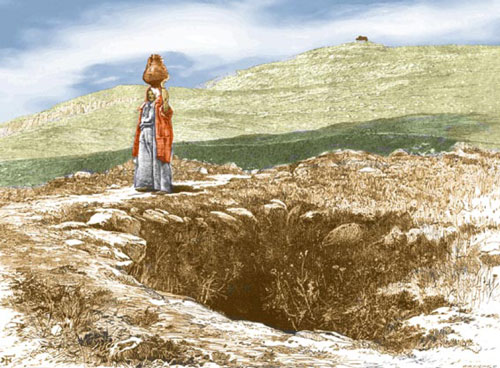
 The well and the field surrounding it were gifts from Jacob to Joseph.  And you will remember Joseph. He is the one who received good gifts from his father (the coat) and bad treatment from his brothers. I have no doubt that the well was, well, well-known to many who traveled though the area.  I’m sure it was on the map of those seeking to quench their thirst, thirst brought about by the day’s relentless heat.  John’s account tells us that as Jesus was traveling from one place to another he became tired and thirsty. He stopped outside the town of Sychar at the well to rest.

 As Jesus sat down near the edge of the well he told his disciples to go and get some food in the nearby town. It is midday. The sun is directly overhead and the heat is stifling. Jesus had no means of retrieving the water from the well. You can imagine someone being thirstier when they know that water is just out of reach.

 As Jesus sits resting a woman from the town of Sychar approaches the well carrying her clay jar (I am assuming some things here.).  The woman comes to the well in the middle of the day because, I believe, no one else will be there during the hottest part of the day. She has her reasons for not wanting to be around the other women of the town:  she sleeps around.

 Jesus, thirsty, asks the woman for a drink:  “Will you give me a drink?”

 The woman was at a loss as to what to think:

 The Samaritan woman said to him, “You are a Jew and I am a Samaritan woman. How can you ask me for a drink?” (For Jews do not associate with Samaritans.)

From the gospel account:

Jesus answered her, “If you knew the gift of God and who it is that asks you for a drink, you would have asked him and he would have given you living water.”

 “Sir,” the woman said, “you have nothing to draw with and the well is deep. Where can you get this living water? Are you greater than our father Jacob, who gave us the well and drank from it himself, as did also his sons and his livestock?”

  Jesus answered, “Everyone who drinks this water will be thirsty again, but whoever drinks the water I give them will never thirst. Indeed, the water I give them will become in them a spring of water welling up to eternal life.” (emphasis mine)

  The woman said to him, “Sir, give me this water so that I won’t get thirsty and have to keep coming here to draw water.”

  He told her, “Go, call your husband and come back.”

  “I have no husband,” she replied.

   Jesus said to her, “You are right when you say you have no husband. The fact is, you have had five husbands, and the man you now have is not your husband. What you have just said is quite true.”

  “Sir,” the woman said, “I can see that you are a prophet.  Our ancestors worshiped on this mountain, but you Jews claim that the place where we must worship is in Jerusalem.”

(Note:  The woman, like most of us, wanted to deflect the accounting of her sinful life.  Becoming polemical the woman quickly changed the subject and pressed Jesus about a heated religious and geopolitical issue of the day.)

Jesus, having already gotten the woman’s attention by recounting intimate details of her life, responded to her question about true and valid worship as the Source, the well-spring of Truth.

    “Woman,” Jesus replied, “believe me, a time is coming when you will worship the Father neither on this mountain nor in Jerusalem.  You Samaritans worship what you do not know; we worship what we do know, for salvation is from the Jews.  Yet a time is coming and has now come when the true worshipers will worship the Father in the Spirit and in truth, for they are the kind of worshipers the Father seeks.  God is spirit, and his worshipers must worship in the Spirit and in truth.”

  The woman said, “I know that Messiah” (called Christ) “is coming. When he comes, he will explain everything to us.”

  Then Jesus declared, “I, the one speaking to you—I am he.”

Water flows through John’s gospel.  John the Baptist baptized “with water so that He (Jesus) might be revealed by Israel.  In the above passage we learn about Jesus chatting with a woman as he sits next to a well. There He talks about the everlasting living water which wells up inside you if you accept it.  In a previous passage John recorded Jesus’s first sign:  turning water into wine at a wedding in Cana.  In the passage after the Jacob’s well story John tells us about a lame man who had been trying for thirty years to enter the healing pool in Bethesda.  The water of the pool would bubble up with curative power whenever the Spirit stirred it. But the man had his excuses for not being well. In a later passage John recounts Jesus walking on the water to meet the disciples in the middle of a lake.

Then one time …

On the last and greatest day of the festival, Jesus stood and said in a loud voice, “Let anyone who is thirsty come to me and drink.  Whoever believes in me, as Scripture has said, rivers of living water will flow from within them.” By this he meant the Spirit, whom those who believed in him were later to receive. Up to that time the Spirit had not been given, since Jesus had not yet been glorified. (emphasis mine)

Are you thirsty? Are you trying to quench your deepest thirst with the things of this world, things that quickly run ‘dry’ from everyday use?  Do more clothes, more electronic gadgets, more Facebook friends, more entertainments, more tattoos, more tipping points, more of anything this world has to offer satisfy your deepest thirst?

The woman at the well had her life of men.  She had her connections.  She also had her water bucket.  She brought this bucket to the well everyday to get the water she needed to survive.  The woman could argue religion and politics with the best of them but she was thirsting for something more.  She may have wondered “is that all there is?”  Is that all that life has to offer someone like me, a woman of Samaria marginalized by my own community and holding on to an unsure belief in an object of worship others are telling me to believe in.

Unknowingly, it was of the True Well of Life that she made her request:  “Sir, give me this water so that I won’t get thirsty and have to keep coming here to draw water.” Jesus responded:  If you knew the gift of God and who it is that asks you for a drink, you would have asked him and he would have given you living water.”

We know that drinking water is necessary for life.  We listen closely to health programs that tell us to drink several glasses of water a day to sustain our bodies, to help them function properly and to replenish the oxygen our systems need. As you would imagine the quality of water that you drink is critical.  Undoubtedly, water that contains filth would do more harm than good.  Is the well water you are drinking clean and pure, refreshing and restorative?  Or, is it filthy with parasites making you weak and sick?

The water that Jesus offers to you and me is greater and purer than the most abundant compound found on earth:  H2O.  It is the Living Water of the Holy Spirit.  This water teems with Abundant Life, the very oxygen of heaven. Once received its Spirit-life effervescence bubbles up within a person.  It then overflows your spirit and converges with the rivers of Living Water that have never stopped flowing throughout all of eternity except for that dark hour when the Gift of God Himself was poured out as a drink offering and He cried, “I am thirsty.”

*****

Shechem’s Archaeology

Looking Out for Number One and Finding Zero

 This past week, while riding the commuter home I sat down on an upper row seat not far from a young Indian woman. Her head was covered so I believed her to be a devoutly religious person. On her lap was Ayn Rand’s Atlas Shrugged. I wondered about her interest in Rand’s lengthy novel.

As you know much has been said in the media recently about corporate greed and fairness. OWS protests, though largely unfocused and self-trivializing, seem to want to generate a discussion about what is ethically the “right thing to do” in the world of money and specifically money as power or a force to use for “good” and not for selfish pleasure. It should be noted, though, that the message of the OWS protestors is certainly compromised by their own envy and greed. Their desire (and demand) to have the same things that someone else has stands as witness to their hypocrisy. But, let’s get back to the woman reading Atlas Shrugged.  Briefly, let’s look at the philosophy behind the book.

Ayn Rand’s (1905-1982) novels portray the philosophy of Objectivism. The (paper) weighty Atlas Shrugged and The Fountainhead clearly identify the key tenets of Objectivism: objective reality, reason, self-interest, capitalism.

Ayn Rand’s Objectivism:

Objective reality: a tree falls in the forest. The sound of the falling tree occurs whether you are there to hear it or not. There is no spiritual realm. When you are dead you are dead.

Reason: direct stimuli from nature; there is no God, no soul, no intuition, nothing beyond what we determine though reason.

Self-interest: your own self-interest and happiness is what life is all about. You take care of number one.

Capitalism: Objectivism’s ideal political expression. Capitalism for the Objectivist is all about individual rights and private property; self-reliance, free trade, entrepreneurship and initiative all operate freely and without coercion within capitalism and the free market system.

Ayn Rand’s Objectivism is atheistic, rejecting faith and religion. It believes only in reason and what the self can determine. This viewpoint is born out of a godless evolutionary view of life, the Enlightenment era and philosophical naturalism. Objectivism is blind faith in your self.

Rugged individualism, for Rand, was a force like other forces of nature and something to be reckoned with. As you might imagine this type of thinking would certainly feed the ego and especially if the person who embraces Objectivism is successful in life. For these people pride of place means you’ve made it to the top of the heap. Your self-esteem is rewarded. You are recognized by your peers as having objectively “made it.” (BTW: OWS protestors want to make it, too.)

Ayn Rand’s extreme philosophy is most likely a reaction to her early life in Russia during the Communist Revolution. As a child she learned to despise coercion, government intrusion and totalitarianism. She came to oppose statism and collectivism while she promoted social systems which protected individual rights and personal initiatives. As a romantic realist she hated the dystopian effects created by those seeking to create a man-made utopia. Though a polemic, Rand never insisted that others be made to accept her philosophy. She was “laissez faire” with respect to others.

Before Rand another voice of philosophical naturalism and the evolutionary world view had chosen a different atheistic force with which to respond to “the law of life.: Jack London (1876 – 1916).

London, the author of The Call of The Wild wrote about the rugged individualist in a Darwinian world where and at a time when man was being considered as just another evolved animal. London wrote about animal instincts (the dog Buck) including survival of the species. For the philosophical naturalist life was essentially a matter of staying alive. This meant a primordial existence: eating, having sex, avoiding pain, etc. There was no higher purpose.

Over time, though, London drifted into materialism as most atheistic evolutionists do. He became a member of the Socialist Party of America. He embraced materialist thinkers such as Karl Marx and Friedrich Nietzsche. It may be that because London, as depicted in his writings, saw humans at the mercy of nature’s massive forces that he decided that the best thing to do was to fight back by joining forces with other human animals via collectivism.

It could be said that both philosophical novelists, London and Rand, saw life as a Darwinian atheist did: having no divine purpose; first matter emerges then mind and then will-supplying force. And force, per Jack London and Karl Marx (and even these days, Obama) may be pooled into a collective. Or, force in the hands of Ayn Rand’s character Howard Roark in The Fountainhead, can be the individual who does it “My Way.” Either way, force is the means to an end: the “survival of the fittest,” a now-common phrase given to us by Herbert Spencer, nineteenth-century British philosopher who was huge proponent of evolution (and a significant influence on Jack London and it seems also of the OWS protestors).

As a Christian I believe that there is a lot about the basic wording of Rand’s philosophy of Objectivism that rings true while at the same time Rand’s self-directed fleshing out of the philosophy has nothing in common with Christianity.

To be sure there is objective reality but for the Christian it is the True Reality of the Kingdom of God. And those who have “ears to hear and eyes to see” can detect this Kingdom. It is spiritual and at the same time more real than this present world. Christians have wide-eyed belief in God.

Being created in the image of God a Christian also understands that reason is not an end in itself but a means to be in relationship with God and to work together with God to bring about His kingdom on earth.

Christian self-interest is the model for how we are to take care of others: “Love your neighbor as yourself”; “Husbands love your wives as yourself.” Our self-interest is not an end in itself. It is not bent inward. Remember, the Good Samaritan cared for the wounded man as he would have wanted to be cared for in the same situation. He wasn’t the rugged individualist who walked on by. Instead, he was the rugged individualist who cared for others.

Christian capitalism, man’s free, voluntary and individual exchange with others, is to be guided and tempered by a Christian’s self-governing virtue of justice – giving every man his due, of temperance, of prudence and of charity and not by government fiat. Remember, we are told in Scripture to “Pray for those in authority over you.” We pray for those in authority so that we can live in peace – a peace which means no government authority interfering in our lives. This allows for the free exchange of God’s goodness.

Collectivism, on the other hand, finds no place in Scripture apart from a brief mention of the early New Testament church. Yet, there are social engineers and social gospel advocates who build vast socialist ideologies around snippets of this New Testament history.  The U.S. Government is not the church of Jesus Christ. The world and the church are two separate entities. Governments are impersonal and do not have virtues. Governments are coercive and make demands.  In a democratic republic like the U.S. we must not elect leaders who create ever more egregious and imposing laws in hopes of creating the virtues we want to have around us. Be the virtue instead.

The Indian woman on the train woman reading Ayn Rand’s Atlas Shrugged may find that “the survival of the fittest” individual means that she cuts herself off from God and others to obtain it all. And, those with a humanistic-collective bent may find that they will lose themselves and God in the mix.

Jesus – The Way, The Truth and The Life.  Let The Way Occupy you.

****

Shakespeare had it right when Hamlet says. ‘And therefore as a stranger give it welcome. There are more things in heaven and earth, Horatio, than are dreamt of in your philosophy.’

Here are some related posts:

Wrestling With God

Just Say No

What’s Left. To Be Decided.

tête-à-tête

How Shall I Then Live?

What’s “Biblical” About It?

Whenever I see the word “Biblical” in front of a title or a statement I pause as anyone should who cares about what the Bible really does or does not say. 

Recently this word caught my eye:  a local Evangelical church, a church of great size, advertised a Biblical Masculinity and Femininity Conference.  I thought this rather odd since the Bible does not tell men how to behave as men or women how to behave as women.  I thought that stereotyping had gone out with analogical thinking (if a, then b follows).

 Regarding male and female behavior I’ve come to the conclusion that masculinity and femininity are social contrivances or social regulators which help us navigate our relationships.  Again, the Bible does not tell men how to behave like a man or a woman how to behave like a woman.  The Bible does tell us in very simple general statements how we as men and women are to relate to the opposite sex and to each other.  The Bible also provides us with examples of what men find attractive in a woman (e.g., the Shulammite woman of The Song of Solomon & the industrious woman in Proverbs 31) and what women find attractive in men (the Ruth/Boaz story). Masculine or feminine qualities, if there are such things, are worked out between each man and woman in the give and take of relationship. They certainly are not the rubber stamping of contrived gender roles promoted by such Conferences.

 Without a whole lot of fanfare the Bible commands men to love their wives and women to respect their husbands. Beyond this the Bible only gives us some storied examples of men and women in action. Masculinity and femininity if Biblically revealed at all is the plain and simple romantic dance of the male and female psyches within the narrative of relationship.  As mentioned above we can see this dance in the lives of the Bible’s men and women.  Another example:  the love story of Jacob and Rachel.

 So, the impetus of this post is to hopefully negate the misinformation doled out by those who feel the need to conform everyone to certain gender defined roles and who also seek to make others abide by the same gender templates, templates created extra-Biblically and more decidedly culturally derived. Hopefully, I can set the record straight.  You decide.

 Raised in a Baptist/Evangelical church I understand that the word “Biblical” connotes a God-given standard that you are expected to honor, to follow and to conform to. Over the years, though, I have had to disentangle my understanding of what the Bible really says from the “Biblical” fishing nets tossed out by commercial fishers-of-men who believe they have captured what the Bible says and then can sell it back to you in the market place of ideas as truth.

 Let’s look at one of their “marketable Biblical items”.  A common passage of Scripture used to define Biblical Womanhood is Proverbs 31

In this passage the writer Lemuel or Anonymous describes the attributes he likes in a woman.  Proverbs 31 is the writer’s description of what he thinks is noble character for a woman.  Now, if women want to aspire to these same traits they may find similar recognition. The word “Biblical”, though, as in “Proverbs 31 is an example of Biblical Womanhood” often implies a kind of warrant of a personal guarantee of outcome (if a, then b follows). If you do these same things then you are Biblically feminine.  But is that true?

 The industrious “woman” in Proverbs 31 works to fulfill the needs of her family as do men.  But, as you know, men and women do different things to maintain the household and will often overlap in the household duties required.  Does the example of this woman’s qualities and behavior mean Biblical femininity? If you as a woman do not do all the things listed in Proverbs 31 are you less feminine? Or, if a man did the same things is he being feminine? Or worse, are you being less Biblical if you are not matching up to these same traits?  I hope you can see where this type of “Biblical womanhood” typecasting leads.

 In the Song of Solomon, a lyric poem in dialogue form, King Solomon describes marked physical attributes of the woman he loves. Is what he describing Biblical femininity? Or, is what he describing what he likes about the woman he loves, the Shulammite?

 Now most Christian scholars, most trusted Christian scholars, would tell you that the biblical canon is closed – there is no further written revelation from God. Yet, we are told that there is Biblical Masculinity and Biblical Femininity – a continuum of a more codified and concise version of the Bible which informs us as to how a twenty-first century man or woman behaves. To me, though, this extra-biblical and apocryphal “decoded” addition of Scripture’s text sounds a lot more like a Pharisee’s laundry list of dos and don’ts than the Bible’s simple and direct statements:  “Husband love your wives. Wives see to it that you respect your husbands.”

 The church conference I am talking about was directed at the youth – junior and senior high school kids.  I have no doubt that the parents are concerned about what the LGBT community is doing to affect gender “norms” in the local public schools.  To be sure the LGBT community is misguided and has no concern whatsoever about what God says.  I, like these parents, am concerned about the LGBT lies and the nonsense being promulgated in our schools as normative. At the same time I do not want the church to overreact to the same degree by narrowly defining gender into masculine and feminine stereotypes, supplying false “Biblical” alternatives to the LGBT community’s errors.

 Gender confusion has become an issue recently because of the LGB community.  It is the members of the LGB community who want to take control of masculinity and femininity in order to receivec acceptance and codification of their behavior. They seek to use homosexuality as a subsitute for what God had created as good – a male and female relationship.  The LGB community depises the Christian community for wanting to maintain what God created.  Homosexuality, the centerpiece of the LGB community then is the ego’s defiance of God and stands in direct contrast to what God created and said was good – a male and female relationship. Hence, gender confusion, anger and pride exists wherever the LGB community is. For most people, though, gender confusion does not exist apart from the false narratives promoted by the LGB community.

Gender dysphoria, though,  does exist in some individuals and should be met with differently than the individual simple searching for culturally accepted masculinity or femininity.

 For most people gender confusion is not an issue.  The searching for where you fit in comes and goes naturally during youth.  The rub usually comes from culture.  Scripture has nothing to say about it even though people create sermons and seminars about it.  During this adapting process  we as parents need to know what the LGBT community is saying about gender and then discount any of their false notions about gender along with false “Biblical” ones. The individual will eventually define him or herself by their sexed body and will respond according to what those around them are telling them about their gender.

The parents who are very concerned about the LGBT community’s activism should be careful to not define masculine and feminine as having “Biblical” attributes and as exsiting apart from relationship with the opposite gender.  Masculine and feminine are culturally defined romantic notions of male and female attributes within relationship. The Bible has only a few things to say specifically about man’s behavior or a woman’s behavior and it is in the context of relationships.

In the beginning God saw that it was not good for man to be alone so God created woman and human relationship.  Within that relationship God let men and women work out their masculine and feminine qualities. God did not prescribe what masculinity and femininity meant before or after the fall.  God only mentioned pragmatic matters:  what men and women will do as a result of their fall and what relationships they should absolutely stay away from.

As a result of Adam and Eve’s fall God said that men would work hard to make a living from the earth and that women will labor hard to give birth to a child.  And later, in the Old Testament book of Leviticus, God provided some practical laws or boundaries regarding men and women and their physical relationships.  These Levitical issues in particular dealt with the exchange of bodily fluids (do not commit incest or homosexuality or bestiality, avoid sex during a woman’s menstrual flow, etc.).  In the New Testament the Apostle Paul, in a strongly worded letter to the members of the church in Corinth, told them to “Flee from sexual immorality.  All other sins a man commits are outside his body, but he who sins sexually sins against his own body…your body is a temple of the Holy Spirit…”  What defiles (and confuses) your personhood and the context for working out “masculinity” or “femininity”  are sinful relationships which quench the Spirit.

Now can one boy be more masculine than another?  No.  (Now, you may think that a boy who hangs around with his mother is more feminine than a boy who hangs around with his father.  In reality, each boy is sharing things they enjoy in common with the respective parent. Should it be demanded of the boy to act more like his father? Culture might demand it but Scripture doesn’t. The answer is No.) I would have little doubt that shaming a child into submitting to a gender stereotype is part of the personality pathology of homosexuality. 

Parent’s desirous of fitting their kids into society’s norms and into their own idealization of gender will restrict a child to a certain prescribed behavior and manner of presentation.  This need to conform their child to a certain delineation of a gender role may lead to post traumatic stress disorder in the child. (See this recent article:  Gender nonconformity linked to child abuse:  Uncomfortable adults often compel strict role presentation)

 A boy is more masculine than a girl,  of course. Just as in the garden of Eden before Eve came along, masculine and feminine were meaningless terms (The conference gods will strike me down, now.) They were meaningless until Eve stood in contrast to Eve as a separate gender.    Masculinity and femininity basically are the features in the opposite sex that we are attracted to.  This sounds rather unspiritual, too down to earth, but is what God had intended  – the simple elemental attraction of opposites.

 Within a male and female relationship you are drawn to the other gender.  You are attracted to gender-derived differences, to those features that are reciprocal (the roller-skate-and-key principle, if you will).  I realize that this may sound more like fuzzy math, more like the probability nature of quantum physics and not at all like rock-solid classical Newtonian physics that people more readily grasp but solid marriages prove the point.  An example would be my parents.

My parents have been married for over 60 years.  To my knowledge there has never been any talk between my mother and father about who was masculine and who was feminine.  They simply followed Christ and let gender find its way within in the context of their relationship to each other and to Christ.  They attended no seminars about “Biblical Masculinity or Biblical Femininity.”

Now regarding binary gender, the analogy may apply:  men are from Mars and women are from Venus.  As two distinct sexes we relate to each other differently, the differences being derived from basic biology (physical sexed body and hormonal) and cultural adaptations. Beyond this, there are no such things as the True Masculine or the True Feminine

 In fact, when we elevate certain aspects or attributes of men or women that we perceive to be quality masculine or feminine specimens to the position of the “True Masculine” or the True Feminine” we make idols of man-made aspirations (and, perhaps,  of Freudian psychology).  The church, as shown by the conference ad, wants to package masculinity and femininity and resell certain accepted features of it as “Biblical”.  They will even supersize the issue with book sales, heated sermons and biopic posts giving us what they see as the jot and tittle of masculine and feminine as viewed through their myopic lense of socially acceptable Biblical “truth.”

Concerning this topic, the book Exclusion and Embrace by Miroslav Volf was of special interest to me, especially the chapter titled Gender Identity. The primary focus of the chapter as I read it was to rightly describe the basis of gender identity and to show how the ideas about masculinity and femininity, described in “essence” forms, are often used to exclusion rather than embrace of the other.

 In this chapter Miroslav Volf says regarding his argument about gender identity:  “I have claimed that (1) the content of gender identity is rooted in the sexed body and negotiated in the social exchange between men and women within a given cultural context, and that (2) the portrayals of God in no way provide models of what it means to be male or female. I suggested, instead, that the relations between the Trinitarian persons serve as a model for how the content of “masculinity” and “femininity” ought to be negotiated in the social process.” (emphasis mine)

 He further states neutrally:

 “The content of gender identity is left unspecified; anything seems to go.”

 Also:

 “Biblical “woman” and “manhood” – if there are such things at all, given the diversity of male and female characters and roles that we encounter in the Bible – are not divinely sanctioned models but culturally situated examples.” (emphasis mine)

 And:

 “If neither models of God nor the explicit statements of the Bible about femininity and masculinity are normative for the content of gender identities, what is?  Does anything really go?  My proposal is that we locate the normativity in the formal features of identity and the character of relations of divine person. Instead of setting up ideals of femininity and masculinity, we should root each in the sexed body and let the social construction of gender play itself out guided by the vision of the identity of and relations between divine persons. What is normative is not some ‘essence” of femininity and masculinity, but the procedures, modeled on the life of the triune God, through which women and men in specific cultural settings should negotiate.” (emphasis mine)

 Further thoughts from the chapter:

  •  Father figure imagery has become sacrosanct in Christian circles.
  •  Psychology attempts to use the father figure imagery to decipher…
  •  Freud: we create god as a need for a father figure or oedipal complex
  •  Man’s projection of a father figure into the heavens due to an oedipal complex

If you as a man or you as a woman want to be all that you can be (to borrow an advertising phrase from the Army) then be in relationship with Christ.  Period. Don’t fashion your life around the drivel described as “Biblical” masculinity and femininity.  Put on Christ and walk in the Spirit instead. (I realize that many people want self-help books, tweets and conferences to tell them what to think.  Forget these things. Put on Christ and get walking.)

Now, you can always parse or stretch Scripture to make it mean what you want to say regarding masculine and feminine attributes.  Instead,  it would be better to not focus on these things, on whether you or someone else is more or less masculine or feminine. The Evil One will always stir up comparisons.  Just look at the media and you can, hopefully, see that the Evil One’s world view is one of comparing yourself to celebs, to physical attributes, to images of macho men and sexy babes,  to myriads of false idols. Walk in the Spirit and you will not fill up the flesh with a pretense of the masculine or feminine.

 And by far the best antidote to the cloying gender confusion issue that the LGB community brings with it is the solid mutually beneficial relationship of a man and a woman.  The spectrums of masculine and feminine can be fully explored within a committed relationship. In such a relationship there should be no threat to your perceived masculinity or femininity.  These things just co-exist.  And as such, the two will become one with no thought or time given to someone’s canonized version of “Biblical Masculinity or Femininity.”