Truest Grit
January 28, 2024 Leave a comment
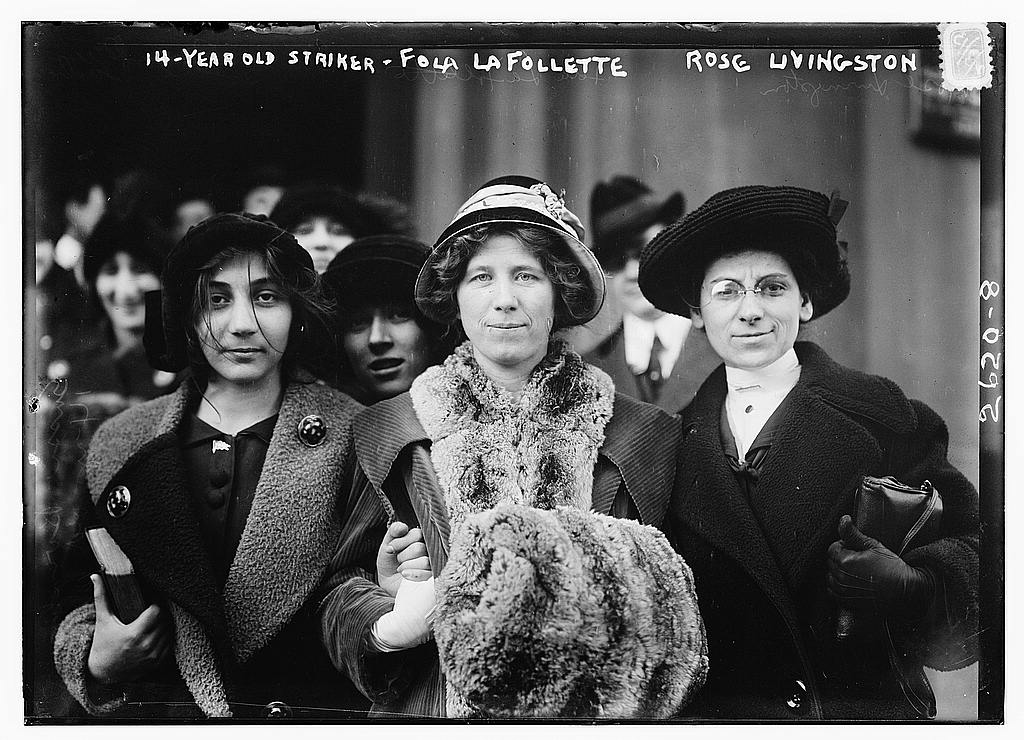
The life of Rose E. Livingston is something to behold. The rescued becomes the rescuer. The restored becomes the restorer. And the wronged becomes redeemer. Do not doubt the resolve of the battered and broken-jawed Rose. And do not dismiss the value she placed on the lives of young women even as a price was put on her head. Please read on.
Anyone calling this diminutive woman (about five feet tall and weighing about 90 pounds) “a force to be reckoned with” would sound daft. But this phrase matches the description of Rose in the numerous newspaper clippings of her time. The “Angel of Chinatown” intervened in the coercion of White females into prostitution rings in New York City’s Chinatown during the Progressive Era (1890–1920).
Read about Rose, “the battling freelance missionary of Chinatown”, in the New York Times Dec. 3rd, 1912 article[i]:

How Rose works – a quote from the above article:
“I don’t go in to visit these girls and give them a tract and say ‘God bless you,’ and invite them around to take tea with me. That’s not my kind of work. There are some girls that it’s mighty hard to help, but there are some little, fresh young things that have just been brought to Chinatown, and that you can sometimes reach in time to save them. Sometimes you can get there before the harm is done. There are 350 white girls in Chinatown now, by friends. I got thirty-seven of them out last year. I once rescued a little bit of a girl who was only 10 years old. That’s the sort of work it is. I don’t get much help. It seems as though as soon as a cop in Chinatown shows himself to be honest they move him to some other part of town. They don’t want honest cops down there. I don’t know whose fault it is — Gaynor‘s or Waldo‘s or whose — but it makes it mighty hard sometimes. Sometimes they tell me these are bad girls and there’s nothing I can do for them. They try to tell me that these girls could escape if they wanted to, but that they don’t want to. I tell you it isn’t true. I saw a girl running away from a cadet, and she ran almost into a policeman’s arms. I was over there in a jiffy. ‘Officer,’ I said, ‘won’t you protect this poor girl from this fellow?’ and, would you believe it. that policeman just knocked her back into the cadet’s arms and watched while he beat her up.”
The following are various accounts of Rose’s life primarily sourced from early 1900s newspaper articles:
“It’s believed Rose was only ten years of age when she was taken from her home and transported to New York City’s notorious Chinatown, an area known for prostitution and opium dens. There, she would become forcibly hooked on opium. The man who held her captive sexually abused her, and by the time Rose was sixteen, she’d given birth to two children.” [ii]
~~~~
“Rose Livingston was an American suffrage activist and social reformer. She was abducted as a young girl and forced to work as a prostitute in New York’s Chinatown. Livingston developed a drug problem, but managed to escape. She then devoted her life to helping prostitutes and victims of human trafficking, teaching them about Christianity, gaining the nickname the “Angel of Chinatown.” In 1910, she helped pass the Mann Act, which made interstate sex trafficking a federal crime. Livingston was attacked in 1912, while trying to rescue a prostitute, suffering permanent damage to her jaw. In 1914, her life was threatened after a gang offered a $500 reward for her death. Livingston supported woman suffrage, believing that if women could vote they might not be driven to prostitution. She was well-known for her work for suffrage and against human trafficking; in 1929 she received a gold medal from the National Institute of Social Science, and in 1937 she received a silver cup from Edith Claire Bryce of the Peace House. Livingston lived in poverty most of her life, but in 1934 the public raised a retirement fund for her. By this point, she had worked for three decades and rescued over 5,000 young women and children. She retired in 1936.”[iii]
~~~~
“In 1909, Rose Livingston, a reform worker, was working to intervene in the coercion of White females into prostitution rings in New York City’s Chinatown (“Save Young Girls from Chinatown,” 1909, p. 7). In 1912, she was brutally beaten when she attempted to save a girl from her procurer (“How Rose Livingston Works in Chinatown,” 1912, p. 5). Livingston, who was supported by several suffrage organizations, toured the country lecturing on white slavery in Chinatown. Moreover, women’s organizations were active in the anti-prostitution movement’s efforts; for example, the Woman Suffrage Party of New York listed the “abolition not regulation of the White Slave traffic” (p. 46) as a chief component of its social reform agenda (Laidlaw, 1914). Livingston routinely criticized the police for turning a blind eye to prostitution. Her efforts brought public pressure on Mayor Gaynor to seriously address the issue of the prostitution rings (“How Rose Livingston Works in Chinatown,” 1912, p. 5). Livingston was all too familiar with white slavery in Chinatown. She herself had been held captive and abused from the age of 10 to 17. At the ages of 12 and 15 she gave birth to her captor’s children. Eventually she was rescued by a missionary worker and underwent a religious conversion (Lui, 2009).”[iv]
~~~~
The following is sourced from multiple newspaper clippings referenced below [v]:
Rose Livingston (1876 – December 26, 1975), known as the Angel of Chinatown, was a suffragist who worked to free prostitutes and victims of sexual slavery. With financial and social support from Harriet Burton Laidlaw and other noted suffragettes, as well as the Rose Livingston Prudential Committee, she worked in New York City‘s Chinatown and in other cities to rescue girls from forced prostitution, and helped pass the Mann Act to make interstate sex trafficking a federal crime.
Livingston initially thought that she wanted to work overseas as a missionary. She realized, though, that there was much good that she could do in New York. She referred to herself as a missionary and worked nights looking for pre-teen and teenage girls who were forced into sexual slavery. A small and thin woman, she was beaten and shot, sometimes spending months in the hospital recovering from her injuries. Once she rescued girls, she helped them transition into a life of freedom. She lectured about the dangers of children and young women being forced into sex work. She also advocated for women’s right to vote.
Early life
Rose Livingston was born in New York in 1876. Her parents were born in New York. Livingston was reportedly raised in Ohio and Texas in the Methodist faith. Livingston came to New York City at age 12.
Livingston was initially interested in becoming a foreign missionary, but decided she could be an independent missionary in New York City after she saw a drug-crazed girl being rescued.
Life’s work
Initially, about 1903, Livingstone worked at Sunshine Settlement, a settlement house on Baxter and at 106 Bayard Street in New York City. Established in 1900, Sunshine Settlement helped mothers and poor children by providing health services, education, and “healthful” visits to the seaside beaches. Gospel services and lectures were performed there. It offered a kindergarten, sewing school, and a library. Clients could request medical and legal advice. It operated through ca. 1911.
Background
Girls and women became sexual slaves by being physically kidnapped, drugged, or unknowingly lured into the industry with a promise of a job or an adventure. In 1934, the New York City police department statistics showed that 4,000 females disappeared from that city each year, and many more disappeared without being reported missing. Their captors often got the girls addicted to drugs to better contain and control them. Ultimately, some girls were rescued and did well, some were rescued but were so broken they had to be institutionalized, some died early, and others remained as captive sex workers.
Many girls that Livingston rescued said something like, “I met him and he was nice to me. Then he invited me to go for a ride.” Then the girls were handed off to another person who would drug, poison, beat, or otherwise mistreat them. Girls were often transported across state lines. Livingston found that there was an auction on the Lower East Side of New York where girls and women were sold.
Rescues
Focusing on girls that were nine to seventeen years of age, Livingston made it her life’s work to free thousands of girls and women from sexual slavery beginning on March 4, 1903 or about 1904. Her modus operandi was to follow men that were sexual slavers, figure out what females were held captive, make friends with them, and encourage them to escape. She looked for enslaved girls in opium dens, dance halls, and bars, particularly in New York City’s Chinatown and the Brooklyn Navy Yard. Sometimes she ventured out of the city to Boston, Newark, Bridgeport, New Haven, and Chicago. In 1907, there were 300 girls younger than 18 in Chinatown that were sex workers, out of a total of 800 white slaves. Six years later, she could not find any girls under age 18 there.

She had a masculine looking face and she wore short hair and men’s clothing, which allowed her to blend in at dance halls and other night spots when she went in search of girls to rescue.
Once freed, she offered the girls and young women rehabilitation and ministered to them in accordance with her Christian faith. Called the “Angel of Chinatown”, she considered herself a missionary and an independent social worker. She saved an eight-year-old girl who had been kidnapped and taken to Philadelphia, after being asked by her father to find his daughter. There were times when bravery and quick thinking helped her rescue girls, like the time that she saved a girl who was being kidnapped by three men. She motioned that she had a gun in her pocket and waited for the police, who arrested the men. She went on high-speed chases in taxis to save girls. When she rescued girls, she took them to her apartment, rather than the police or the children’s society, and contacted the girls’ families. She was aware of the fact that it was a difficult process to transition back into a family, so she did not believe in rushing girls back to their parents’ homes. Livingston described her brand of missionary work:
“I don’t go in to visit these girls and give them a tract and say ‘God bless you’, and invite them around to take tea with me. That’s not my kind of work. There are some girls that it might hard to help, but there are some little, fresh young things that have just been brought to Chinatown, and that you can sometimes reach in time to save them. Sometimes you can get there before the harm is done.”
— Rose Livingston, speaking at the Metropolitan Temple, 1912
By 1934, with over 30 years of experience, the number of young women Livingston had reportedly rescued varied: 800, 4,000, or 5,000 girls or young women. Of the girls that she rescued, only two returned to life as a sex worker. If the girl had a baby, in her experience, not one of the girls’ families took the baby into the family. Many of the girls she rescued looked on her as a mother, and brought potential husbands to her for approval. The League of Nations identified her as a noted figure in the fight against sexual slavery around the world. She found that there was a world-wide network of trafficking sexual slaves. In a report by the League,
“Miss Livingston sets forth the diabolical tactics of white slave rings in this country as she has seen them. She suggests a remedy and sounds a warning to mothers and fathers.”
She offered solutions to the sexual slavery problem, particularly regarding girls and young women. She asked all women to be more understanding of children, so that they did not want to run away from home. She suggested that cities hire plain-clothed police women to patrol vice-ridden districts to prevent girls from being led into slavery. She asked parents to talk to their daughters about the danger of being taken, without terrorizing them. Livingston stated that she believed that this would dramatically reduce the likelihood of girls being kidnapped by avoiding the first false, reckless step—like getting into the car of a stranger.
Financial support
Before the Rose Livingston Committee was established, she received support from Miss Elizabeth Voss, whose father had been the city’s District Attorney. The Committee of Fourteen women from Brooklyn supported her. At some point a church in Brooklyn, New York provided for her maintenance. About 1911, she became affiliated with suffragettes who offered her support. A few women met her when she was trying to save a girl from killing herself. They introduced Livingston to Harriet Burton Laidlaw whose husband, James Laidlaw, created the Committee of Three with Rev. M. Sanderson and Lawrence Chamberlain.
In the late 1920s or early 1930, her work was sponsored by the Rose Livingston Committee, also called the Rose Livingston Prudential Committee, who paid her $600 (~$10,511 in 2022) a year. She used part of her salary to pay for clothes and food for the girls she rescued. The members of the committee included women, several ministers, and a former assistant district attorney. Livingston was supported, financially and socially, by Harriet Burton Laidlaw, as well as other noted suffragettes across the country, and James Lees Laidlaw. She lectured across the country about the prevalence of white slavery. The Rose Livingston Committee issued an annual report of the freed girls and convicted people who were the slaveholders.
Danger
As she rescued women, she put herself in danger. About five feet tall and weighing about 90 pounds, she faced male procurers, or cadets, as she tried to rescue girls and women. She was severely beaten, shot, wounded, and thrown out windows. In 1912, she was severely beaten, resulting in permanent damage. She had severe neuritis and persistent neuralgic pain due to a fracture of the alveolar process of the upper jaw bone. On one side of her face, she lost all of the teeth of the upper jaw.
In 1914, a contract was taken out on her life for $500 (equivalent to $14,610 in 2022). Once, a few years before 1934, she was hurt so badly trying to save a girl from Boston that she was in the hospital for five months and on crutches for two years. She was pushed from a roof of the red-light district in Brooklyn. By 1933, she had 22 beatings, one of which caused severe injury of her eyes. After a number of operations, her eyesight continued to fail her in the 1930s. She carried a gun with her, but was never known to have shot at anyone.
Mann Act
Before 1910, it was not illegal to engage in sex trafficking across state lines. Livingston helped pass the Mann Act, that made interstate sex trafficking a federal crime in 1910.
Awards
A week of testimonial dinners were conducted in 1927 to celebrate the 24 years that she helped girls attain freedom. In 1929, she was awarded a gold medal by the National Institute of Social Sciences, for her “unique work and indefatigable faithfulness for almost 30 years.” In 1937 she was awarded a silver cup by Mrs. J. Sergeant Cram (Edith Claire Bryce) of the Peace House for her “deeds of courage without violence”.
Personal life
In 1914, she participated in one of the Suffrage Hikes from Manhattan to Albany, New York and over the years, she lectured about women’s suffrage. In 1914, she conducted lectures throughout 40 counties of Ohio for the Ohio Woman Suffrage Association to explain to girls the dangers of being led into a life as a sexual worker.
In order to search for girls at night, Livingston slept during the day for about three hours. To protect her safety, only her best friends knew her address. She lived in cold water flats and had a very frugal lifestyle. For instance, she lived in a three-room flat on E. 49th Street in New York City for 46 years, beginning about 1929. It was near the East River. By 1928, she wore masculine clothing. In 1934, she was found living in poverty, and a retirement fund was established for her.
Although she read the Bible and a book on Christian Science, she did not attend church services, unless she had agreed to speak at the church. She did not consider herself a Christian Scientist.
Although she was quoted as saying that she was still involved helping girls in 1950, she retired after 1937 and received a pension of $100 per month. She was cared for by neighbors who helped her obtain a supplemental Social Security pension and did chores for her. She particularly needed help once she started to lose her sight. She died on December 26, 1975, at 99 years of age. A rabbi conducted a Jewish service for her, and her friend, Mike Supple, a Catholic, arranged for a Mass in her memory.
References
- Fields, Sydney (January 19, 1976). “Only Human”. New York Daily News. p. 43. Retrieved March 12, 2020 – via newspapers.com (clipping).
- “Rose Livingston, lived at E. 49th Street, NYC. 50 years of age, born in New York”, Manhattan, New York, New York, Enumeration District: 0628, United States of America, Bureau of the Census. Fifteenth Census of the United States, 1930., Washington, D.C.: National Archives and Records Administration
- “The Free-Lance Soul Saver of New York’s Slums”. Salt Lake Telegram. January 28, 1917. p. 26. Retrieved March 13, 2020.
- “‘Angel’ Braves Dens of Vice to Rescue Girls”. Brooklyn Daily Eagle. March 4, 1934. p. 6. Retrieved March 13, 2020 – via newspapers.com (clipping).
- “Suffrage Speakers to Come Next Week”. News-Journal. October 7, 1914. p. 4. Retrieved March 13, 2020.
- “Finds Mission Work at Home” (PDF), The New York Sun, March 21, 1934
- Dutka, Alan F. (2014). AsiaTown Cleveland: From Tong Wars to Dim Sum. Arcadia Publishing. p. 29. ISBN 9781625850867.
- “22 Beatings and Medal Reward Angel of Chinatown – Rose Livingston”. El Paso Herald-Post. March 17, 1933. p. 9. Retrieved March 12, 2020 – via newspapers.com (clipping).
- “Gets Cup for Lone Fight Against Vice – Rose Livingston”. The Evening Sun. November 4, 1937. p. 15. Retrieved March 12, 2020 – via newspapers.com (clipping).
- Bibliography of College, Social, University and Church Settlements. Blakely Press. 1905.
- “Sunshine Settlement of New York City records”. New York Public Library Archives. Retrieved March 12, 2020.
- Church, Douglas (September 16, 1934). “White Slave Racket, America’s Growing Curse: Rose Livingston, “Angel of Chinatown”, Warns Mothers to Be on Their Guard”. St. Joseph Gazette. p. 19. Retrieved March 12, 2020 – via newspapers.com (clipping).
- “The American Truth – Rose Livingston”. The Times. March 25, 1928. p. 48. Retrieved March 12, 2020 – via newspapers.com (clipping).
- “The American Truth, part 2 – Rose Livingston”. The Times. March 25, 1928. p. 49. Retrieved March 12, 2020 – via newspapers.com (clipping).
- “Rev. Hopkins Tells of Wart to White Slavery Traffic”. The Akron Beacon Journal. March 11, 1913. p. 5. Retrieved March 12, 2020 – via newspapers.com (clipping).
- “Suffragists Give Talk In The Park. Miss Rose Livingston and Mrs. Myron Vorce Give Address”, Mansfield Shield, October 13, 1914
- United Press (August 17, 1934), “Chinatown Angel Found Destitute”, Berkeley Daily Gazette – via newspapers.com (clipping)
- “‘Angel of Chinatown’ Holds Her Anniversary”. Bridgeport Telegram. March 5, 1927. p. 19. Retrieved March 13, 2020 – via newspapers.com (clipping).
- “Rose E. Livingston”. Jane Addams Digital Edition. Retrieved September 11, 2019.
- Rosen, Ruth (1983), The Lost Sisterhood: Prostitution in America, 1900-1918, JHU Press, p. 57, ISBN 9780801826658
- Lui, Mary Ting Yi (September 1, 2009), “Saving Young Girls from Chinatown: White Slavery and Woman Suffrage, 1910–1920”, Journal of the History of Sexuality, 18 (3): 393–417, doi:10.1353/sex.0.0069, PMID 19739340, S2CID 27886467
- “How Rose Livingston Works In Chinatown. Free Lance Missionary’s Worst Enemy Is Mayor Gaynor, Metropolitan Temple Audience Hears” (PDF), The New York Times, December 3, 1912
- Landsberg, Brian K. (2004). Major Acts of Congress. Macmillan Reference USA: The Gale Group. pp. 251–253.
- Kinkead, Eugene; Harold Wallace Ross (October 2, 1937). “Peace House”. The New Yorker. Retrieved December 2, 2013.
- “Fears Gang Will Kill Her. Miss Livingston Says $500 Has Been Offered for Her Death”, The New York Times, January 8, 1914
- “Chinatown is Still Oriental, Haunting”. The Post-Crescent. November 21, 1950. p. 13. Retrieved March 12, 2020 – via newspapers.com (clipping).
~~~~
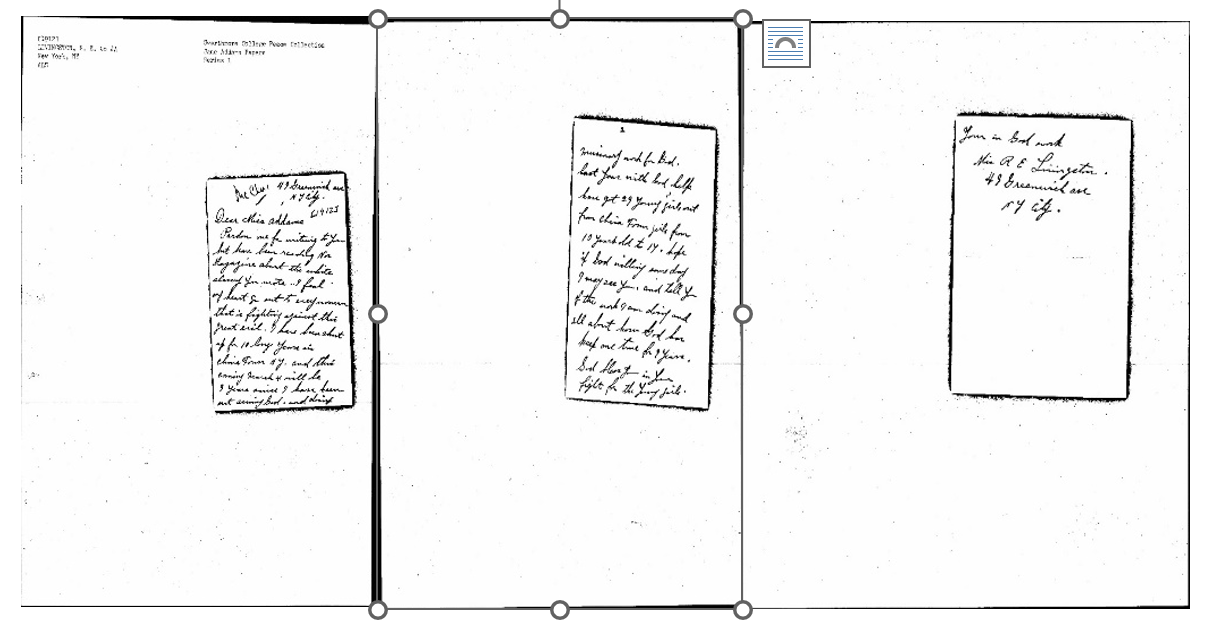
ROSE E. LIVINGSTON TO JANE ADDAMS, 1912[vi]
Rose writes to Jane Addams about her article on white slavery, because she herself is working in the Chinatown area of New York City working to help women get out of prostitution.
Dear Miss Addams
Pardon me for writing to you but have been reading Nov Magazine about the white slavery you wrote. I feel my heart go out to every woman that is fighting against this great evil. I have been shut up for 10 long years in China Town NY, and this coming March 4 will be 9 years since I have been out serving God, and doing [page 2] missionary work for God. last year with God help have got 29 young girls out from China Town girls from 10 years old to 17. hope if God willing someday I may see you, and tell you of the work I am doing and all about how God has keep me true for 9 years.
God bless you in your fight for the young girls. [page 3]
Yours in God work.
Miss R E Livingston.
49 Greenwich Ave
NY City.
“In the United States during the 19th and early 20th centuries, “white slavery” was the term used for sexual slavery. It was not a phrase indicative of race, but simply referred to the practice of organized coercion of unwilling persons into prostitution. Any race could be forced into white slavery, although of main concern were White women. Any race could also be a “white slaver” (i.e., slave holder or master); however, Eastern European Jews and Chinese immigrants were often singled out to be the most likely suspects.”[vii]
For the “historical context of interventions with sex workers in New York City during the Progressive Era (1890–1920)” read Saving Young Girls from Chinatown: White Slavery and Woman Suffrage, 1910-1920
~~~~
If one is “severely beaten, shot, wounded, and thrown out windows” as happened to Rose during her rescues, the natural inclination would be to return evil with evil. Isn’t that the premise of all revenge movies and of most so-called “social justice”? But Rose took on the challenge to not allow herself to be overcome by evil and become evil. She responded to evil as a force of good, as the “Angel of Chinatown”.
Take care not to despise one of these little ones. I tell you this: in heaven, their angels are always gazing on the face of my father who lives there.
Jesus, Matthew 18: 10
I considered writing a condensed version of Rose’s life. But would readers skim through and move on to the next thing? Her life and times deserve our full attention, especially in light of Biden’s open-border invasion of our country and the human-trafficking it enables via the cartels, coyotes, and on-the- government-dole NGOs. Democrats and globalists have a demand for trafficked humans.
Please consider reading the newspaper clippings referenced in the links above. With them you’ll get a sense of the times and of Rose – her dealings with the denizens of darkness, her valiant rescues, and her self-sacrifice to save young women from hell on earth. Hers is not a Hallmark made-for-TV life.
Likewise, what was depicted in the Sound of Freedom was not about providing a short-term emotional ride and then release. It was about joining the fight to stop child trafficking and children being sold into sex slavery.
For disciples of Jesus, Rose’s Christ-like nature deserves the greatest attention. Hers is a life not only to behold but as an example to follow. For, it is the way of life in Christ Jesus as the Apostle Paul states:
We are under all kinds of pressure, but we are not crushed completely; we are at a loss, but not at our wit’s end; we are persecuted, but not abandoned; we are cast down, but not destroyed. We always carry the deadness of Jesus about in the body, so that the life of Jesus may be revealed in our body. Although we are still alive, you see, we are always being given over to death because of Jesus, so that the life of Jesus may be revealed in our mortal humanity. So this is how it is: death is at work in us – but life in you!
The apostle Paul, 2 Corinthians 4:8-12
~~~~~
Do not be deceived. There is no climate crisis. There IS a child trafficking crisis. The open border is a human trafficking situation.
Unaccompanied minors crossing the U.S. border each year present among the most worrying challenges in America’s response to [illegal] migration, with reports showing a recent rise in apprehensions of children, and criticism that the White House has violated providing legal protections for them.
Under Joe Biden, Have 85,000 Undocumented Children Gone ‘Missing’? (newsweek.com)
Who are the sponsors? Are they background checked?
As record numbers of migrants continue to enter the United States from Mexico, border authorities are also seeing higher numbers of minors traveling without a legal guardian. In response to the surge in unaccompanied youth, the Biden administration is releasing children to sponsors in an average of 28 days. Prospective hosts can fill out their paperwork remotely and case workers rarely visit their home. Officials are required to follow up with the child via a phone call one month later.
Between 2021 and 2022, 85,000 unaccompanied children—one third of children released to sponsors in the United States—didn’t pick up the phone. The government is unable to account for their whereabouts or welfare. Following a congressional hearing last April, Sen. Josh Hawley, R-Mo., demanded the FBI locate the “missing children.”
Are thousands of immigrant children missing in the United… | WORLD (wng.org)
The Supreme Court’s recent unconstitutional response to states protecting themselves shows the direction this country is headed – towards lawlessness, anarchy, and civil war.
Behind The Rescue in The Sound of Freedom, Paul’s Mission to Eradicate Child Trafficking.
In this special episode of Liberating Humanity, host Paul Hutchinson takes us behind the scenes of the movie “The Sound of Freedom.” Join him as he shares the real-life story behind the film, recounting his firsthand experiences on a daring undercover mission to rescue children from human traffickers in Colombia. As an expert in investigative journalism and true crime, Paul sheds light on the shocking reality of child trafficking, emphasizing the importance of combatting this global crisis through organizations like the Child Liberation Foundation and the Sentinel Foundation. Discover the inspiring journey of hope, bravery, and the relentless pursuit of justice in the fight against child exploitation. Let’s unite to make a difference and protect the most vulnerable among us.
~~~~~
Sound of Freedom [Official Trailer] (youtube.com)
[i] https://commons.wikimedia.org/wiki/File:How_Rose_Livingston_Works_In_Chinatown.png
[ii] Michelle Shocklee, https://www.hhhistory.com/2021/04/rose-livingston-angel-of-chinatown.html
[iii] Livingston, Rose E. (1876?-1975) · Jane Addams Digital Edition (ramapo.edu)
[iv] Smolak A. White slavery, whorehouse riots, venereal disease, and saving women: historical context of prostitution interventions and harm reduction in New York City during the Progressive Era. Soc Work Public Health. 2013;28(5):496-508. doi: 10.1080/19371918.2011.592083. PMID: 23805804; PMCID: PMC3703872.; https://www.ncbi.nlm.nih.gov/pmc/articles/PMC3703872/
[v] https://www.wikiwand.com/en/Rose_Livingston
[vi] https://www.digital.janeaddams.ramapo.edu/items/show/3741
[vii] Saving Young Girls from Chinatown: White Slavery and Woman Suffrage, 1910-1920








 Cindy Wity

A Mind is a Terrible Thing to Hand Over
December 8, 2025 Leave a comment
When we hear someone say crazy things, we might say “Yeah, right” and shrug it off. But when a group of people say crazy things and a group of people agree with said crazy things, we wonder “What in the world is going on?”
Objective reality – the existence of things as they are – is obvious to everyone. And so are the values, accumulated over several millennia, of what is true and of what works and what hasn’t. But not everyone accepts the obvious and the values based on time proven objective reality. Some see themselves as Progressive in rejecting both.
Today’s academic, artistic, media, and political elites, a vanguard of Progressive Groupthink, reject the existence of things as they are and do so within the safe space of their ranks thereby creating an illusion of invulnerability and inherent morality. Members of this vanguard suppress dissenting opinions and avoid critically evaluated alternatives so as to maintain the group’s shared illusion of unanimity.
The vanguard’s conformity is maintained with mind guards – the media reports “right thinking” about a matter – and with self-censorship of deviations from shared beliefs and with shared views of the enemy – those who present a reality contrary to the groups’ notion of reality.
When we hear the vanguard’s irrational take on what is going on in the world, its roiling Doublethink, its name calling and shunning of voices outside its collective choir, and its dysfunctional decision-making which objective reality tells us will result in disastrous, dehumanizing, and even deadly outcomes, we ask “Where is this coming from and where is this going?
Those of us who keep an ear to the ground in order to hear what is approaching will answer “History is repeating itself.”
The objective reality of the murderous totalitarian regimes of the last century, which Progressives willfully ignore to promote their glorious future of equality via the same means, will help us understand the denial-of-reality collaboration of today’s intelligentsia – those who hold to one way of thinking – and their quest for total domination of the body, mind, and soul with Progressive Groupthink.
Specifically, Russian Soviet history will help us understand the conformity dynamic behind today’s intelligentsia. For this understanding I turn to one of the most informed scholars of the Russian history of ideas as communicated in its literature: Northwestern Professor Gary Saul Morson.
***
In Morson’s magnum opus Wonder Confronts Certainty: Russian Writers on the Timeless Questions and Why Their Answers Matter Morson details how politics and literature, in the writings of realists, idealists, and revolutionaries, played against each other during the Soviet period.
He describes Soviet thinking that rejected the realism and the real people depicted in nineteenth-century Russian fiction and required that reality be written to include “not only of the observable present but also the inevitable future in the making” and with Socialist Realist heroes – utopianism made flesh.
Writers of Russian realism – Tolstoy, Dostoevsky, Chekhov, Solzhenitsyn, and others – wrote about what they saw and experienced. They are the “wonder” in the title. They represented the world as it was in their writings about the Gulag, mass starvation, torture, unspeakable violence, about how people thought about and dealt with what was going on, and about how many succumbed to the imposed Soviet mindset.
Russian realist authors confronted those of the “certainty,” those who wrote redefined reality in terms of the “observable present and the inevitable future in the making” and in terms of “positive heroes.”
The “positive hero” was to set an example for the reader’s behavior. A Soviet cosmonaut, for one example, became a “positive hero.” A cosmonaut’s space trip was seen as science, materialism, and atheism triumphing over the transcendent values held in the U.S., the enemy of the Soviet Union.
The “certainty” writers followed the lead of the embodiment of “certainty” – Vladimir Lenin. Lenin mocked his opponents’ self-characterization as ‘seekers’ of truth. He held that dialectical materialists do not seek truth; they already possess it. And so, the party-minded “positive hero” refused dialogue, refused to see any alternatives to the Marxist-Leninist-materialist-atheistic “truth” espoused by the party, the representatives of Karl Marx’s class-struggling proletariat.
From Wonder Confronts Certainty:
“The Soviets would label fidelity to present facts “bourgeois objectivism.” It was the best that could be expected from the age of realism, but must give way to socialist realism, which shows the ideal world inevitably coming. The socialist realist author was expected to focus on the people of the future, “positive heroes” exhibiting complete “Party-mindedness.” True positive heroes do not have bring their thinking into accord with the party, a process requiring effort; they exhibit Party-mindedness so thorough that no effort is required”
“Party-mindedness”, we learn from the writings of Russian realist authors, was propagated through the means of propaganda, show trials, random arrests, and the constant terror that there might be any hint, any innuendo, any false statement that would convict one of not being party-minded.
The “party-mindedness” of the 20th century Russian intelligentsia, its conformity to only one way of thinking, is replicated today.
***
Here’s Morson in his Touchtone article Beyond Belief: Literary Reflections on Thoughtless Conformity:
“I happened to witness two professors waiting for an elevator. To make conversation, one voiced an opinion on some political question to see if the other agreed. When she did, they chattered away on a dozen other topics with perfect assurance that they agreed on those, too. Evidently, their beliefs came as a package. Subsequently I noticed this way of thinking many times, as I imagine many of my readers have.
The process works something like this: a person first chooses the group with whom he wishes to identify and then adopts its opinions. He believes as strongly in gun control, let us say, as he does in supporting Planned Parenthood, defunding the police, and banning fossil fuels. It is evident that no arguments or evidence can shake his opinions on any of these topics because arguments or evidence had nothing to do with why they were adopted.
To be sure, a person who thinks this way can cite facts and reasons to justify his opinion, but they have been acquired in the same way as the opinion itself. They are the same reasons others in the group have learned to give. I used to find it eerie to hear repeatedly the same arguments expressed in the same phrases, as if I were listening to a recording rather than to highly educated people who imagined that, unlike their intellectual inferiors, they had arrived at opinions rationally and would change them as evidence warranted. I thought of Jonathan Swift’s observation that no one was ever talked out of an opinion he was not first talked into.”
***
Reading Morson’s article, I was reminded of the easy-going liberal mindset of the Stiva Oblonsky character in Tolstoy’s Russian realism novel Anna Karenina.
Behind Stiva’s smile, his self-possessed mannerisms and hedonism is what Tolstoy described as “the liberalism of the blood.”
From the novel:
“Stepan Arkadyevitch took and read a liberal newspaper, not a radical one, but one advocating the viewpoint maintained by the majority. And even though neither science, nor art or politics held any particular interest for him, he firmly maintained the same views on all these subjects that were maintained by the majority and by his paper, and he changed them only when the majority changed them, or, better put, he did not change them at all; they imperceptibly changed within him . . .
“And so liberalism had become a habit of Stepan Arkadyevitch’s, and he liked his newspaper, as he did his cigar after dinner, for the slight fog it diffused in his brain.”
Stiva, we learn in in the novel, does not recognize his conscious when it speaks to him. And that is aided by his living-in-the-moment forgetting. He did not want to remember any unpleasant thing.
Self-deception and romantic ideology play key roles in Anna’s life.
***
Czeslaw Milosz, Polish American poet, novelist, translator, critic, and diplomat, is best known for The Captive Mind (1953). His essay collection focuses on intellectuals, specifically poets and other writers.
As Charles Haywood writes in his 2019 article The Captive Mind (Czeslaw Milosz), [Milosz’s] “book shows how mental gymnastics, rather than coercion, caused writers under Communism to adhere to Communism. Thereby, indirectly, it congratulates writers who believe their minds free from such, or other, contortions.
“The West incorrectly sees “might and coercion” as the reasons those in Eastern Europe submit to Communism. But, rather, unwilling to face either physical or spiritual death, many choose instead to be “reborn” through taking these metaphorical pills, because “[t]here is an internal longing for harmony and happiness that lies deeper than ordinary fear or the desire to escape misery or physical destruction.” Intellectuals, and artists especially, do not want to be “internal exiles, irreconcilable, non-participating, eroded by hatred.” So they swallow the pills and adopt the “New Faith” (a term Milosz uses throughout the book) which offers the intellectual the certainty he is both correct and virtuous, and therefore gives him a sense of belonging, gives him a feeling of being “warm-hearted and good . . . a friend of mankind—not mankind as it is, but as it should be.”” (Emphasis mine.)
Returning to Morson’s article about package thinking, Morson relates
“What really matters, [Czeslaw} Milosz explains, is “the intellectual’s feeling of belonging.” His defining “characteristic is his fear of thinking for himself.” For this reason, as well as to prosper, he must root out all the old ways of thinking. Milosz describes a phenomenon with which university people are all too familiar, the always incomplete process of teaching oneself to say the right things (in the right words), and avoid saying the wrong ones, so that one never makes a slip entailing ostracism or worse. Of course, the best way to do this is to get oneself actually to share the prescribed views. Milosz describes how
after long acquaintance with his role, a man grows into it so closely that he can no longer differentiate his true self from the self he simulates, so that even the most intimate of individuals speak to each other in Party slogans. To identify self with the role one is obliged to play . . . permits a relaxation of one’s vigilance. Proper reflexes at the proper time become truly automatic.”
***
One obvious feature of our culture’s downward trend toward mindless conformity is critical thinking’s easy alternative: clicking on a machine to receive packaged thoughts.
Why think when packaged thoughts are there for the clicking? And why expand one’s personal bandwidth when you can reaffirm your tribal identity with a click?
Why research and consider a range of ideas and thoughts when clicking on machine AI is ready to do away with mystery and your curiosity, wonder, and impatience? And why think outside package thinking when life is short – shortened by every minute clicking on a machine.
Why read classic literature to gain wisdom, insight, and understanding from other people in other places and in other times, when you can click on a remote for package thinking entertainment.
Have you bought into the globalist, academic, secular and progressive (GASP) package (a feature of Wikipedia) that censors alternative views as “extremist” or “fringe theories” or “conspiracy theories” or “racist?”
Did you buy into the globalist open borders “welcoming the stranger” package where millions of unvetted illegal invaders entered the country as simple or criminal or terrorism opportunists? Did you accept the package thinking that allows third world invaders into our country to replace American workers and American values and do all manner of harm to its citizens as empathy, as what Jesus would do? Take a look at the strangers welcomed: Arrested: Worst of the Worst | Homeland Security And, there’s this: They Called It ‘Compassion’ — But it was Child Trafficking – American Thinker
Are you buying into the central planning democratic socialism package where everyone, except certain individuals who hold more power and privilege, must be made equal no matter the human cost? Are you buying into the central planning democratic socialism package and willfully forgetting the objective reality of the horrors of socialism/communism? Are you willfully handing over your life, your thoughts, to “Party-mindedness”?
Did you accept the “don’t question the science” COVID package thinking of mandates, masking, social distancing, vaccine passports, isolation camps, vaccine efficacy, and of COVID’s origin lies? America’s COVID Response Was Based on Lies
Likewise, did you not question the package thinking of “climate experts” who announced their verdict that the world would end if we didn’t act now. Not long ago, woven into almost every weather report on local and mainstream media when major weather events (floods, tornadoes, hurricanes, droughts, and wildfires) occurred was the narrative that climate change was behind them – without ever mentioning large-scale natural phenomena such as solar cycles, ocean currents and volcanoes that have been affecting weather for many millennia.
The Green New scam was behind Biden’s $93 Billion Crony Climate Heist. Will declassifying carbon dioxide (necessary for all of life) as a pollutant and the end of carbon dioxide regulation mean the end of the Green New scam? Are we now seeing The End of the Green New Scam? | The Rude Awakening? Matt Ridely thinks so: The end of the climate cult – The Spectator World
(A climate expert I trust: https://judithcurry.com/about/)
Do you go along with the package thinking of the [John] Rawlsian theory of ad hoc justice that, for example, releases someone arrested 40 times, is not considered a “criminal” because of their minority status, and is released by a judge back onto the street where he sets a woman on fire?
Do you buy philosopher Jean-Jacques Rousseau’s notion that “Man is born free, and everywhere he is in chains” – the package thinking that says that people are entirely products of their environment, of their society, of their age, and that’s why they do what they do. Therefore, they are not responsible for what they do because of external influence. That’s the package thinking behind the Rawlsian theory of justice and behind the executions and horrors of the French revolution working to change social environment.
Have you agreed with the insurrection thought package being espoused by The Seditious Six imploring military service members to “refuse illegal orders” thereby implying that orders coming out of the Trump administration are considered illegal by them and therefore military service members should disobey their commanding officer and join the club of the “Party-minded.” Remember, package thinking has only one train of thought – gaining and maintaining power over reality.
Have you agreed with the insurrection package thinking espoused previously by NYT’s op-ed columnist David Brooks? Do the values of your party-minded package thinking allow you to hamstring a DEMOCRACY! elected president with the rulings of party-minded federal court judges that will be overturned. Do the values of your party-minded package thinking justify the deep state, in the labyrinth of government, to sabotage the efforts of a Democratically elected President?
Do the values of your package thinking allow you to call for uprisings by any means necessary, to burn down buildings, to destroy property, to destroy businesses, to steal, do violence on others, to defund the police, to create pipe bombs, to assassinate? To ignore your conscience?
Did you accept the “Danger to our Democracy” thought package the media delivered during the last presidential election cycle? It should be obvious from the likes of David Brooks, that the “guardians of democracy” are the ones who want to tear it down.
Have bought into the diversity, equity, and inclusion (DEI) playbook that conforms and coerces everyone to identify with Soviet style party-mindedness package thinking?
Have bought into viewing everything including humans through the lens of materialism?
Have you bought into package thinking so as to not be considered an outsider? Have you bought into conformity for conformity’s sake?
Is censorship the worst thing that can happen to a people? Or, is it “Party-mindedness?”
When we hear someone say crazy things, we might say “Yeah, right” and shrug it off. But when a group of people say crazy things with the smug air of certainty and people agree with said crazy things, we wonder “What in the world is going on?” and “Where is this coming from and where is it going?”
What happened in Russia didn’t stay in Russia. And a mind is still a terrible thing to hand over.
What happened in Russia didn’t stay in Russia . . . Britain Is Lost | ZeroHedge
~~~~~
You can put your ear to the road and hear what is quickly approaching. Download and listen to the following podcasts:
London is falling – or has it fallen already?
Liz Truss, the 56th prime minister of the United Kingdom, in her very first episode of The Liz Truss Show discusses how bad things are in Britain with a mass migration and economic doom loop – and how to defeat the deep state who have let this happen
https://justthenews.com/podcasts/liz-truss-show/london-falling-or-has-it-fallen-already
~~~
Interview with Professor Gary Saul Morson on Tolstoy, Faith, Package Thinking, and The Importance of Critical Thinking
Professor Gary Saul Morson shares his thought-provoking definition of an intellectual—someone who seeks truth independently, values ideas for their own sake, and stands apart from identity-driven thinking. Whether discussing classic Russian Literature or analyzing modern society, Professor Morson is one of the most insightful and consequential scholars of our time. Discover how this interview, and its exploration of timeless topics, can inspire bold, principled leadership and innovation within today’s business environment.
Interview with Professor Gary Saul Morson on Tolstoy, Faith, and The Importance of Critical Thinking – The Profitable Table Fed by Woolco Foods | Acast
~~~
The Moral Imagination – Michael Matheson Miller
Gary Saul Morson Ph.D.: Thinking Like Lenin
Vladimir Lenin’s ideas are alive and well today: Party-ness, politics as win-lose, zero-sum game, Who-Whom, rejection of truth, ideology, violence, philosophical materialism, adherence to lying.
Ep. 15: Thinking Like Lenin, with Gary Saul Morson
Is Hope Naïve in a World Like Ours? | Esau McCaulley & Gary Saul Morson at Northwestern
~~~~~
Quotes:
In the long run my observations have convinced me that some men, reasoning preposterously, first establish some conclusion in their minds which, either because of its being their own or because of their having received it from some person who has their entire confidence, impresses them so deeply that one finds it impossible ever to get it out of their heads. Such arguments in support of their fixed idea … gain their instant acceptance and applause. On the other hand whatever is brought forward against it, however ingenious and conclusive, they receive with disdain or with hot rage – if indeed it does not make them ill. Beside themselves with passion, some of them would not be backward even about scheming to suppress and silence their adversaries. I have had some experience of this myself. … No good can come of dealing with such people, especially to the extent that their company may be not only unpleasant but dangerous. Galileo Galilei
If the Brave New World cannot insert a square peg into a round hole, it will redefine “roundness” until a perfect fit results.
-Jerome Meckier, from Aldous Huxley: Satire and Structure
…a sense of unity is opposite of a sense of uniformity. Uniformity, where everyone “belongs”, uses the same cliches, thinks alike and behaves alike, produces a society which seems comfortable at first but is totally lacking in human dignity. Real unity tolerates dissent and rejoices in variety of outlook and tradition, realizes that it is man’s destiny to unite and not divide… Unity, so understood, is the extra dimension that raises the sense of belonging into genuine human life.
-Northrop Frye, from The Bush Garden
Wise men speak because they have something to say; fools because they have to say something. -Plato
“The past is our always-available counterculture, and it’s a rich one. Every minute you spend attending to something not-immediately-present, you are helping to build a counterculture.” ― Alan Jacobs
~~~~~
Links:
Why are intellectuals — those whose thinking is supposed to be most refined — so susceptible to totalitarianism? Gary Saul Morson offers three explanations from the treasury of Russian literature.
https://tomklingenstein.com/mind-forgd-manacles-why-intellectuals-conform/
The greatest depiction of woke totalitarianism was written 150 years ago in Russia
Anti-Communism Week has been marked for November 2025. Writer-producer Julie Behling’s documentary “Beneath Sheep’s Clothing” warns of communism’s devastation: “Globally, communism claimed the lives of approximately 150 million people in the 20th century.”
‘Beneath Sheep’s Clothing’: Communism’s Capture Of America | ZeroHedge
Totalitarian governments cannot afford that its citizens remain autonomous persons. This poses a threat to their quest to consolidate power. Individual liberty threatens the theoretical, utopian foundations of promising the re-distribution of goods, and equality; communism ultimately fails to re-distribute the essence of human nature.
10 Habits of Mind to Avoid Ideological Thinking
Everyday Habits That Reveal a Low IQ (Backed by Psychology)
Everyday Habits That Reveal a Low IQ (Backed by Psychology) – YouTube
~~~~~
Added 12-15-2025:
Sam Faddis (formerly with the CIA) sits down to talk about the reality of the ongoing Marxist revolution in America.
The Revolution Right Here At Home – by Sam Faddis
Rate this:
Filed under 2025 Current Events, Communism, cultural Marxism, Culture, Democracy, History, Political Commentary, Politics, social commentary, totalitarianism Tagged with Communism, Democracy, groupthink, history, Marxism, mind control, package thinking, party-mindedness, politics, progressivism, russia, Soviet Union, totalitarianism, Valdimir Lenin