No Way But Up

What’s at the core of America’s problems today? Is it partisan politics or is there a greater rift in the American people?

 Alexander Solzhenitsyn, Soviet and Russian novelist, dramatist, and historian during his commencement address delivered at Harvard University, June 8, 1978, gave us his diagnosis.  His speech is a stinging indictment of the West –  its materialism, its enabling of the abuse of individual freedom, its self-serving inbred media and its disavowal of its spiritual roots:

 However, in early democracies, as in the American democracy at the time of its birth, all individual human rights were granted because man is God’s creature. That is, freedom was given to the individual conditionally, in the assumption of his constant religious responsibility. Such was the heritage of the preceding thousand years. Two hundred or even fifty years ago, it would have seemed quite impossible, in America, that an individual could be granted boundless freedom simply for the satisfaction of his instincts or whims. Subsequently, however, all such limitations were discarded everywhere in the West; a total liberation occurred from the moral heritage of Christian centuries with their great reserves of mercy and sacrifice. … State systems were becoming increasingly and totally materialistic. The West ended up by truly enforcing human rights, sometimes even excessively, but man’s sense of responsibility to God and society grew dimmer and dimmer.

 And…

“If humanism were right in declaring that man is born only to be happy, he would not be born to die. Since his body is doomed to die, his task on earth evidently must be of a more spiritual nature. It cannot be unrestrained enjoyment of everyday life. It cannot be the search for the best ways to obtain material goods and then cheerfully get the most of them. It has to be the fulfillment of a permanent, earnest duty so that one’s life journey may become an experience of moral growth, so that one may leave life a better human being than one started it. It is imperative to review the table of widespread human values. Its present incorrectness is astounding. It is not possible that assessment of the President’s performance be reduced to the question how much money one makes or of unlimited availability of gasoline. Only voluntary, inspired self-restraint can raise man above the world stream of materialism.” (emphasis mine)

And…

“It would be retrogression to attach oneself today to the ossified formulas of the Enlightenment. Social dogmatism leaves us completely helpless in front of the trials of our times. Even if we are spared destruction by war, our lives will have to change if we want to save life from self-destruction. We cannot avoid revising the fundamental definitions of human life and human society. Is it true that man is above everything? Is there no Superior Spirit above him? Is it right that man’s life and society’s activities have to be determined by material expansion in the first place? Is it permissible to promote such expansion to the detriment of our spiritual integrity?”

Take a look at what drives you and perhaps you will see why America is no longer a nation under God, no longer a nation of civil courage, of moral decency.  Perhaps you will see why people would vote for a president who uses class warfare rhetoric to promote the sands of material security as foundational to life and not the rock of spiritual fortitude.

The “American, You Can’t Handle Your Liberty” Rap


American, You Can’t Handle Your Liberty


American, you can’t handle your liberty,

Drunk with democracy you flirt with tyranny;

You whine and you cry about your life’s lot –

Not what the providential Constitution sought.


Our people are now lacking in self-government,

Living relativism that’s not heaven-sent,

Lacking all self-restraint, thinking they’re “free”,

They will tolerate anything but liberty.


Though free and equal, born with rights inalienable,

You whine and pine for freedom more palatable;

Unjust laws disguised as “social justice”,

Such religion of humanity does thwart us.


Myopic history sees the lie you so need,

“A People’s History…” makes bleeding hearts bleed;

Our nation’s true exceptional-ism,

In college taught as just cause for derision.


How are we the most generous nation on earth?

It is because of what our Founding Fathers birthed!

Take a look at the world around and see,

We as a nation donate most charitably.


Yet you squander democracy onto yourself,

While pure opportunity is put on the shelf,

Cradle to grave you whimper and pine,

“Hoping” and “Changing”, charging the taxpayer’s dime.


All men are created equal yet there are some,

With hubris bang the affirmative action drum,

And so betray our common good,

To play favoritism as any injustice would.


American, you can’t handle your liberty,

You want politicians to give you to what you please,

You clamor for “rights” thinking you’ll be free

While working the calculus of felicity.


Why is it that we fear our country’s liberty?

Because the rigors of responsibility,

We “Hope” and “Change” to be rid of the strife,

So we vote for someone who will pay for our life.


Wake up America and smell the flag burning,

Your “Hope” and “Change” are both lacking in discerning,

You whine and you pine and act all distraught,

While ever mocking what our Constitution taught.


© Sally Paradise, 2012, All Rights Reserved

God Saw That It Was Good and So Do I

This past week I read an engaging book by scientist Francis S. Collins:  The Language of God: A Scientist Presents Evidence for Belief.  As someone who works in the engineering field and as a believer in God the book’s discussion of science and faith being compatible piqued my interest.

 Before reading this book I did have the innate understanding that science and faith were compatible and that each discipline reinforced the other with their respective insights and revelations but prior to reading this book I hadn’t seen much credible literature discussing this premise.  Currently there appears to be plenty of antipathy between the church and science. So as one might imagine I was excited to purchase the book and evaluate a scientist’s take on the connection. I was not disappointed.

Francis S. Collins, as the back cover bio reads, headed the Human Genome Project and is one of the world’s leading scientists. “He works at the cutting edge of the study of DNA, the code of life.  Yet he is also a man of unshakable faith in God and Scripture.

Dr. Collins believes that faith in God and faith in science can coexist within a person and be harmonious. In The Language of God he makes his case for God and Science.”

 Of special interest to me is the fact that Collins (as I do) accepts theistic evolution.  In Chapter Ten he writes: 

 “This view is entirely compatible with everything that science teaches us about the natural world.  It is also entirely compatible with the great monotheistic religions of the world.  The theistic evolution perspective cannot, of course, prove that God is real, as no logical argument can fully achieve that. Belief in God will always require a leap in faith.”

 The book lays out for the reader in very accessible terms how Collins who was not raised in a Christian home came to his belief in God as a budding scientist in his twenties.  The book goes on to discuss why Collins fully accepts theistic evolution as opposed to literal Creationism and Intelligent Design.  Based on his own research Collins says the evidence is overwhelming in favor of natural evolution as God’s creative methodology.  I would agree. 

 He then further encourages the church to endorse scientific research as a resource for understanding God’s creation, therefore offering a better understanding of God.  In concert with his plea I believe every church leader should purchase this book and read its message.  There is, sadly, too much bad information being preached and taught by the Christian Evangelical church regarding creation.  This bad information makes the church look rather foolish.  Remember Galileo’s row with the church? Being raised an Evangelical I was taught that the earth was created about 6-8000 years ago and that the seven days described in Genesis Chapter One were literal days:  Poof, we just showed up on the scene.

 As an adult, though, I became skeptical of the Creationist theology but I clung to it because I had heard of no other plausible evidence to the contrary.  Evolution was routinely discounted in the Evangelical church.  In fact everything I had heard in church told me that evolution was the atheist’s version of the Christian creation. Evolution was also described as a slippery slope which would carry people away from God toward unbelief.  And worse, the church seemed opposed to science and science was something I truly enjoyed being involved with.  I would later look into Intelligent Design (ID) and had wondered if ID might be the catch-all for my belief in God’s creative act. But I was to learn that ID was flawed theory that did not take into account the nature of God.

 My change in thinking occurred a few years ago when I came across the writings of Christian philosopher Alvin Plantinga from the University of Notre Dame.  Spending two and a half hours on a train five days a week over the course of several years I had been able to read and research many different science and philosophy topics. And I did this precisely because I wanted to know more about God, the nature of His being and the world around me.  This excited me no end.  I don’t read romance novels.  I find my excitement by romancing the truth.

  Through reading Plantinga’s papers, though sometimes written in difficult philosophical terms, the door of my understanding was opened wide and I accepted theistic evolution as a valid creation methodology.  I would encourage anyone to read Plantinga’s papers.

 The basics of theistic evolution are clearly delineated in Francis Collins’ book and on the Biologos website.  Biologos is the name given to theistic evolution by scientist Collins.  Here are the Biologos premises/beliefs from that website:

 We believe that God created the universe, the earth, and all life over billions of years. God continues to providentially sustain the natural world, and the cosmos continues to declare the glory of God.

  • We believe that all people have sinned against God and are in need of salvation.
  • We believe in the historical incarnation of Jesus Christ as fully God and fully man. We believe in the historical death and resurrection of Jesus Christ, by which we are saved and reconciled to God.
  • We believe that God continues to be directly involved in human history in acts of salvation, personal transformation, and answers to prayer.
  • We believe the Bible is the inspired and authoritative word of God. By the Holy Spirit it is the “living and active” means though which God speaks to the church today, bearing witness to God’s Son, Jesus, as the divine Logos, or Word of God.
  • We believe that God also reveals himself in and through the natural world he created, which displays his glory, eternal power, and divine nature. Properly interpreted, scripture and nature are complementary and faithful witnesses to their common Author.
  • We believe that the methods of science are an important and reliable means to investigate and describe the world God has made. In this, we stand with a long tradition of Christians for whom Christian faith and science are mutually hospitable.
  • We believe that the diversity and interrelation of all life on earth are best explained by the God-ordained process of evolution and common descent. Thus, evolution is not in opposition to God, but a means by which God providentially achieves his purposes.
  • We believe that God created humans in biological continuity with all life on earth, but also as spiritual beings. God established a unique relationship with humanity by endowing us with his image and calling us to an elevated position within the created order.
  • We believe that conversations among Christians about controversial issues of science and faith can and must be conducted with humility, grace, honesty, and compassion as a visible sign of the Spirit’s presence in Christ’s body, the Church.
  • We reject ideologies such as Deism that claim the universe is self-sustaining, that God is no longer active in the natural world, or that God is not active in human history.
  • We reject ideologies such as Darwinism and Evolutionism that claim that evolution is a purposeless process or that evolution replaces God.
  • We reject ideologies such as Materialism and Scientism that claim science is the sole source of knowledge and truth, that science has debunked God and religion, or that the physical world constitutes the whole of reality.

 As a follower of Christ and as someone who seeks to bring people to faith in Him I see it as imperative that Evangelical church leaders (John Paul II accepted theistic evolution) come to grips with science (natural science, quantum physics, genetics, etc.) and to avail themselves of all empirical data and evidences coming out of science research.  As I see it the church and science are completely compatible.  Therefore, the church must not seek to restrain the hand of God, an evolved-incarnated hand that was once nailed to a tree, a resurrected hand that now reaches out to all of us.

 For more information about theism and theistic evolution:

 http://biologos.org/

Philosopher Sticks up for God

Alvin Plantinga

*****

Recommended Books about science and faith:

The Language of Faith:  Straight Answers to Genuine Questions by Karl Giberson and Francis Collins, Intervarsity Press, 2011

The Wonder of the Universe:  Hints of God in Our Fine-Tuned World by Karl W. Giberson, Intervarsity Press, 2012

What’s the Unitarian?

It is little wonder that the well-known ‘angry’ atheist Richard Dawkins wrote the anti-thesim book The God Delusion.  It is easily understandable especially after one reads the interview (excerpted and linked below) between a Unitarian Minister Marilyn Sewell and another anti-theist atheist the former Christopher Hitchens (Hitch).

 As evident from the interview, Marilyn Sewell, a minister, is utterly delusional in her understanding of God and Christianity.  And it is blatantly obvious that Hitch has a better understanding of Christianity than this Unitarian minister.

 Apparently from her bio Sewell has studied theology but I contend it is not Biblical theology.  Her questions and remarks as interviewer reveal her embrace of syncretism – a diversity of false beliefs and humanism blended with the truth of Christianity. Unitarian could be another term for syncretism.

 From her eponymous blog we are told that liberal believer and retired minister of the First Unitarian Church of Portland Marilyn Sewell is a former teacher and psychotherapist.  She has authored numerous books. Over a period of 17 years Sewell helped grow Portland’s downtown Unitarian congregation into one of the largest in the United States. At this point I must say that the fact that this woman and the Unitarian Church are misleading many is of serious concern to me. I must contend for the truth of Gospel of Jesus Christ.

 It troubles my spirit greatly when people like this liberal Unitarian minister use the name of Jesus Christ to preach “another gospel” and not the Gospel of Jesus Christ. Her message is a mish-mash of new age religion, liberal theology, social justice and cheap grace.  The ultimate message becomes half lie half truth:  “It’s not what you believe but how you live.” Ergo an embrace of diverse beliefs and social justice activism are at the forefront of Unitarian creeds.  As you’ll read, for Sewell just like the Episcopalian minister ghost in C.S. Lewis’, “The Great Divorce” all is metaphor, and therefore, cannot be taken seriously

 The deity of Christ, His death on the cross, His atonement for sins, judgement, heaven and hell, all are dismissed as being metaphorical, as not relevant to present human need and too exclusive a message to preach and teach.   Clearly this is syncretistic thinking and delusional with regard to the truth.  And because of its soft, socially acceptable version of theology the tentacles of Unitarian tenets are quickly creeping into evangelical churches across the nation.

 As a follower of Christ I am posting this information expressly to note the deception hidden in Sewell’s misguided words.  I have no problem talking about this interview in no uncertain terms. From the public record it can be noted that Sewell is a social activist and polemicist as was Hitch. They are/were each able to dish out pious platitudes at will and certainly, as their backgrounds would support, are/were able to hold their own in conversations regarding issues of faith and God.  So here goes.

 The interview took place prior to Christopher Hitchen’s January 5th, 2010 appearance as part of the Literary Arts’ Portland art and lecture series at the Arlene Schnitzer Concert Hall.  Hitch was political columnist for Vanity Fair, Slate, and other magazines, and known for his frequent contributions on the political TV circuit.  Hitchens’ pointed attacks against all religion has earned him regular debates across the country, often with the very fundamentalist believers his book, “God is Not Great”, attacks. Sewell, the interviewer, though, knows nothing about the fundamentals of Christianity. It would seem that Hitch is in a joust with Jello.

 Here are excerpts from that interview,  linked here

 Marilyn Sewell: In the book you write that, at age nine, you experienced the ignorance of your scripture teacher Mrs. Watts and, then later at 12, your headmaster tried to justify religion as a comfort when facing death. It seems you were an intuitive atheist. But did you ever try religion again?

Christopher Hitchens: I belong to what is a significant minority of human beings: Those who are-as Pascal puts it in his Pensées, his great apology for Christianity-“so made that they cannot believe.” As many as 10 percent of is just never can bring themselves to take religion seriously. And since people often defend religion as natural to humans (which I wouldn’t say it wasn’t, by the way), the corollary holds too: there must be respect for those who simply can’t bring themselves to find meaning in phrases like “the Holy Spirit.”

Well, could it be that some people are “so made” for faith. and you are so made for the intellectual life?

I don’t have whatever it takes to say things like “the grace of God.” All that’s white noise to me, not because I’m an intellectual. For many people, it’s gibberish. Likewise, the idea that the Koran was dictated by an archaic illiterate is a fantasy. As so far the most highly evolved of the primates, we do seem in the majority to have a tendency to worship, and to look for patterns that lead to supernatural conclusions. Whereas, I think that there is no supernatural dimension whatever. The natural world is quite wonderful enough. The more we know about it, the much more wonderful it is than any supernatural proposition.

The religion you cite in your book is generally the fundamentalist faith of various kinds. I’m a liberal Christian, and I don’t take the stories from the scripture literally. I don’t believe in the doctrine of atonement (that Jesus died for our sins, for example). Do you make and distinction between fundamentalist faith and liberal religion?

I would say that if you don’t believe that Jesus of Nazareth was the Christ and Messiah, and that he rose again from the dead and by his sacrifice our sins are forgiven, you’re really not in any meaningful sense a Christian.

Let me go someplace else. When I was in seminary I was particularly drawn to the work of theologian Paul Tillich. He shocked people by describing the traditional God-as you might as a matter of fact-as, “an invincible tyrant.” For Tillich, God is “the ground of being.” It’s his response to, say, Freud’s belief that religion is mere wish-fulfillment and comes from the humans’ fear of death. What do you think of Tillich’s concept of God?”

I would classify that under the heading of “statements that have no meaning-at all.” Christianity, remember, is really founded by St. Paul, not by Jesus. Paul says, very clearly, that if it is not true that Jesus Christ rose from the dead, then we the Christians are of all people the most unhappy. If none of that’s true, and you seem to say it isn’t, I have no quarrel with you. You’re not going to come to my door trying convince me either. Nor are you trying to get a tax break from the government. Nor are you trying to have it taught to my children in school. If all Christians were like you I wouldn’t have to write the book.

Well, probably not, because I agree with almost everything that you say. But I still consider myself a Christian and a person of faith.

Do you mind if I ask you a question? Faith in what? Faith in the resurrection?

The way I believe in the resurrection is I believe that one can go from a death in this life, in the sense of being dead to the world and dead to other people, and can be resurrected to new life. When I preach about Easter and the resurrection, it’s in a metaphorical sense.

I hate to say it-we’ve hardly been introduced-but maybe you are simply living on the inheritance of a monstrous fraud that was preached to millions of people as the literal truth-as you put it, “the ground of being.”

Times change and, you know, people’s beliefs change. I don’t believe that you have to be fundamentalist and literalist to be a Christian. You do: You’re something of a fundamentalist, actually.

Well, I’m sorry, fundamentalist simply means those who think that the Bible is a serious book and should be taken seriously.

If you would like for me to talk a little bit about what I believe . . .

Well I would actually.

I don’t know whether or not God exists in the first place, let me just say that. I certainly don’t think that God is an old man in the sky, I don’t believe that God intervenes to give me goodies if I ask for them.

You don’t believe he’s an interventionist of any kind?

I’m kind of an agnostic on that one. God is a mystery to me. I choose to believe because-and this is a very practical thing for me-I seem to live with more integrity when I find myself accountable to something larger than myself. That thing larger than myself, I call God, but it’s a metaphor. That God is an emptiness out of which everything comes. Perhaps I would say ” reality” or “what is” because we’re trying to describe the infinite with language of the finite. My faith is that I put all that I am and all that I have on the line for that which I do not know.

Fine. But I think that’s a slight waste of what could honestly be in your case a very valuable time. I don’t want you to go away with the impression that I’m just a vulgar materialist. I do know that humans are also so made even though we are an evolved species whose closest cousins are chimpanzees. I know it’s not enough for us to eat and so forth. We know how to think. We know how to laugh. We know we’re going to die, which gives us a lot to think about, and we have a need for, what I would call, “the transcendent” or “the numinous” or even “the ecstatic” that comes out in love and music, poetry, and landscape. I wouldn’t trust anyone who didn’t respond to things of that sort. But I think the cultural task is to separate those impulses and those needs and desires from the supernatural and, above all, from the superstitious.

Could you talk about these two words that you just used, “transcendent” and “numinous”? Those are two words are favorites of mine.

Well, this would probably be very embarrassing, if you knew me. I can’t compose or play music; I’m not that fortunate. But I can write and I can talk and sometimes when I’m doing either of these things I realize that I’ve written a sentence or uttered a thought that I didn’t absolutely know I had in me… until I saw it on the page or heard myself say it. It was a sense that it wasn’t all done by hand.

A gift?

But, to me, that’s the nearest I’m going to get to being an artist, which is the occupation I’d most like to have and the one, at last, I’m the most denied. But I, think everybody has had the experience at some point when they feel that there’s more to life than just matter. But I think it’s very important to keep that under control and not to hand it over to be exploited by priests and shamans and rabbis and other riffraff.

You know, I think that that might be a religious impulse that you’re talking about there.

Well, it’s absolutely not. It’s a human one. It’s part of the melancholy that we have in which we know that happiness is fleeting, and we know that life is brief, but we know that, nonetheless, life can be savored and that happiness, even of the ecstatic kind, is available to us. But we know that our life is essentially tragic as well. I’m absolutely not for handing over that very important department of our psyche to those who say, “Well, ah. Why didn’t you say so before? God has a plan for you in mind.” I have no time to waste on this planet being told what to do by those who think that God has given them instructions.

You write, “Literature, not scripture, sustains the mind and the soul.” You use the word “soul” there as metaphor. What is a soul for you?

It’s what you might call “the x-factor”-I don’t have a satisfactory term for it-it’s what I mean by the element of us that isn’t entirely materialistic: the numinous, the transcendent, the innocence of children (even though we know from Freud that childhood isn’t as innocent as all that), the existence of love (which is, likewise, unquantifiable but that anyone would be a fool who said it wasn’t a powerful force), and so forth. I don’t think the soul is immortal, or at least not immortal in individuals, but it may be immortal as an aspect of the human personality because when I talk about what literature nourishes, it would be silly of me or reductionist to say that it nourishes the brain.

I wouldn’t argue with you about the immortality of the soul. Were I back in a church again, I would love to have you in my church because you’re so eloquent and I believe that some of your impulses-and, excuse me for saying so-are religious in the way I am religious. You may call it something else, but we agree in a lot of our thinking.

I’m touched that you say, as some people have also said to me, that I’ve missed my vocation. But I actually don’t think that I have. I would not be able to be this way if I was wearing robes or claiming authority that was other than human. that’s a distinction that matters to me very much.

You have your role and it’s a valuable one, so thank you for what you give to us.

Well, thank you for asking. It’s very good of you to be my hostess.

[end of interview]

 Note above that after Sewell’s reference to theologian Paul Tillich’s take on God as “an invincible tyrant” and after mentioning Freud’s dismissive take on faith (also well-known to Hitch), she wants to hear from Hitch about Tillich’s concept of God.  Listen closely to Hitch’s response:

I would classify that under the heading of “statements that have no meaning-at all.” Christianity, remember, is really founded by St. Paul, not by Jesus. Paul says, very clearly, that if it is not true that Jesus Christ rose from the dead, then we the Christians are of all people the most unhappy. If none of that’s true, and you seem to say it isn’t, I have no quarrel with you. You’re not going to come to my door trying convince me either. Nor are you trying to get a tax break from the government. Nor are you trying to have it taught to my children in school. If all Christians were like you I wouldn’t have to write the book.

 Wow!  The money line: “If all Christians were like you I wouldn’t have to write the book.”

 Even Hitch knows that this woman is way off the mark in her ‘theology’.  In this case Hitch doesn’t drop famous names from history like Sewell.  Hitch cuts to the quick with the truth of the Gospel as he knows it.  He quotes from Scripture:  “If only for this life we have hope in Christ, we are to be pitied more than all men.” (I Cor. 15:19). 

 Hitch has known Christianity from standing outside looking in while.  He does not like Christianity’s authority and the abuse of that authority (as I do not).

 Sewell, on the other hand, knows the hodge-podge Unitarian philosophy from inside out.  She knows all of its labyrinthine pathways leading to the utopian fields of humanism, new age philosophy and God is love-ism. The irony:  Unitarian ‘theology’ clearly advocates the contention of atheists that religion is about wish-fulfillment and fear of the unknown.

Here is Marilyn’s take on the conversation from her blog:

“The man is brilliant, but not wise; clever, but not deep; and a fundamentalist, in regard to religion, rejecting any form of liberal Christianity as bogus religion, not to be respected

Hitchens clearly has never studied theology, (This is rich.  See my comments above) and most of the comments he made concerning the Bible, Jesus, salvation, etc., were shockingly naïve (Hitch’s knowledge of Christianity trumped yours, Marilyn).  Where he has something to offer, of course, is his critique of religion and society, and all of the horrors and nonsense done in the name of religion, which I have no argument with.  It’s not exactly news that the Inquisition was a bad thing.  And that Catholic priests shouldn’t abuse altar boys.  And (his particular nemesis) jihadists shouldn’t blow up innocent civilians. 

Hitchens is the ultimate intellectual “bad boy.”  He performs.  He “debates.”  He entertains. All of which he does very well.   But this should not be confused with thoughtful discourse. “(I agree with this last paragraph of Marilyn’s)

 I would certainly argue from the details of the interview that Hitch knows Christianity well enough to be convicted by its message – but he rejects it outright.  Sewell, on the other hand, doesn’t know the truths of Christianity and appears to only embrace the parts of the Gospel that fit with the Unitarian belief in humanism – a theology of a coddling, benevolent and indulgent God who accepts you no matter what.

 Gospel truth convicts people of their sin and their separation from God whereas the tepid mollycoddling theology of Unitarianism destroys lives with its abandonment of truth and its good intentions. And as we all have heard, the road to hell is paved with good intentions. Or, hell is full of good wishes and desires.  In the end Truth matters.

Are you seeking the truth?

 To find the truth about the Gospel of Jesus Christ read the four gospel accounts that record the life and death of Jesus Christ:  Matthew, Mark, Luke and John.  These historical eye-witness accounts are not metaphors as liberal theologians (Sewell, Elaine Pagels and others) would have us accept.

 Follow the Truth wherever it leads you and it will eventually lead you to Jesus Christ.  He is The Way, The Truth and the Life. I have been on the road of truth with Jesus for many years now.  I know Him and he knows me. 

 Truth and Love go hand-in-hand or not at all.

You’re the Best Particle of Me

Did you know that Intelligently Designed quantum physics provides matchmaking services? You didn’t?  Well, recently, I read…

”…that in reality two electrons can really fit into the same energy level because they can have opposite spins.  This means that they can both fit into the lowest (symmetric) energy level and, crucially, this level decreases in energy as the atoms get closer together.  This means that it is energetically favorable for two distant atoms to move closer. And this is what happens in nature.”

 And God saw that it was not good for atom to be alone.

 (Two electrons, opposite spins?  The atoms get closer together?  Yin and Yang, Matter and anti-matter. Grace and nature. Male and female. This fundamental symmetry makes sense at the atomic level and also at the nuclear family level.  Hence the mating song “I’ve Got You Under My Spectrascope.”)

 “…This preference for two atoms to stick together as a result of sharing their electrons between them is known as a covalent bond.”…

 And the preference for two humans (Mr. Spin up and Ms. Spin down) to stick together as a result of sharing their lives in the molecule of marriage is known as intimate bonding.

 “…covalent bonding is the reason that you are not a bunch of atoms sloshing around in a featureless blob.”

 This explains a lot about my love life!  I’ve got your atomic number, buddy.

 Matchmaker, Matchmaker make me a match. A little covalence bonding is all I ask.

 The above quotes from Chapter Eight, Interconnected, from:

The Quantum Universe (And Why Anything That Can Happen Does) by Brian Cox & Jeff Forshaw, Da Capo Press, copyright 2011

 You should know that…

Covalent bonding is universal:

Odd Is The Loneliest Number

Odd.  That describes me in a nutshell.

 Flannery O’Connor, the great Catholic writer, was once quoted as saying “You shall know the truth and the truth shall make you odd.”  So be it. I am in good company then.

 Now that I am older and wiser (at least according to the aphorism) I am less jostled by every wind of fashion, less captivated by got-cha type of thinking typical of the penny-ante journalists so in vogue today.  In more ways than one I have let odd take over.

 Some odd thoughts:

 A wise old preacher once told me “If it’s new it ain’t true.  If it’s true it ain’t new.”

 Truth has historical record. Lies, cheap novelty as in “Hope and Change.”

 I agree with Wolcott’s assessment (see James Wolcott’s Vanity Fair article  “Prime Time’s Graduation”)about the state of today’s movies being rather boorish and sophomoric and that television/cable TV is far outpacing movies with its much higher quality of writing and directing and a greater depth of characters. Yet, I despair of any good thing coming out of either.

 Truly, I cannot remember the last time I rented a movie.   I don’t remember the title of the movie, either. I haven’t been to theatre in well over two years.  For what reason I did attend is forgotten.

 TV:  I don’t watch The Living Dead, Mad Men, Breaking Bad, The Real Housewives of Chicago’s North Side or all manner of well-written, well-crafted dramatic episodes or all manner of crime investigations, all manner of (fill-in-the-blank) “finely textured” serial programming that Hollywood cranks out. Though superbly crafted these often prurient programs hold nothing of interest or value to me. I am happily odd without them in my head.

 You can believe me when I say that I don’t care about dead people who hang around unwanted or that Don Draper is losing himself in his work and the next untapped babe or that Walt is a terminally living drug producer and seller (Breaking Bad, like many cable shows in fact outrage me.  That anything like this can of trash is available on TV for kids and adults to view is unthinkably criminal. I’m a mature adult. I don’t care about the show’s supposedly ‘mature themes.”  I think the show is substantive abuse.)

 Look around.  We consume comparison:  commercials, magazines, TV programs, the Shahs of Sunset. I could easily imagine that Obama’s class warfare rhetoric would quickly lose its teleprompter zip if our culture didn’t keep promoting keeping up with the Shahs of Sunset and the like.

 Contentment has been dislodged from the human psyche and has gone missing.  Ubiquitous high-profile bling now holds court.  Disparity is highlighted daily. And, as a result, charity (in the form of higher taxes) is demanded in order to make all things equal.  Somehow, this equates to social justice.

 These days low-income people can dwell on income disparity 24/7.  Many now have big screen TVs and microwaves.  And, before them now on the big hi-def screen are the ostentatious rich:  The Real Housewives of Atlanta.  It would be easy for anyone watching to say “The Grass IS greener…” Envy and covetousness are in your face, especially when the bas-relief is provided by HDTV. 

 Beside this, BHO and other talking heads of the liberal media are telling them that the rich need to do their part. This demand is ludicrous.

With his bully pulpit BHO promotes class warfare.  He tells us that the answer to your problems is to take money from someone else!  Isn’t this the mentality typically found among Chicago street gang members but is now code-named Social Justice?  (BTW:  What we need is not a single payer health care system. What we need is single payer taxpayers where every single person does their part and not just 50 % of the nation. Everyone should be invested in our country.)

 Am I human?  Upon occasion:

I have been known to watch Guy Fieri (I think he’s cute.) on Diners, Drive-ins and Dives hamming it up with restaurant owners. And, sometimes when I’m in a really grisly mood I watch Anthony Bourdain’s No Reservations (Anthony, Paula Deen can cook for me anytime, your blackballing of her cooking style notwithstanding). 

 Speaking of food, I don’t own a Blackberry, iPhone or other hand-held electronic device which could bleep in a restaurant and interrupt a Crème brûlée with a dear friend.  This even though I work in a technical industry and could easily finger pointed barbs with the best of them. I am old school.  Pen and paper work well.  Spitballs, too.  And, if the world is going to end I am prepared. I won’t need an iPad telling me that I’m going to be with the Lord – that’s already been documented.

 Without the gizmos I don’t tweet. I don’t send 140 character snippets of pithy self-brined revelation out to chomping-at-the-bit (or byte) followers.  Come to think of it I don’t think I have any followers! (This post has enough characters to choke a gaggle of hand-held devices and their indentured slaves.)

 ‘What does she do?”

I mostly read, talk to myself when no one is around, go to church, dance wildly to the Romantics’ What I Like About You, annoy my family and routinely infuriate people I don’t know on the internet. 

 How odd. But with a name like Sally Paradise how could I not be the odd woman out or the \sqrt{3}.

Take the Buffett Rule Off the Table and Shove It

The Buffett Rule appears like a gesture of great benevolence toward the American poor and middle class:  shake down the ultra rich and throw the poor and middle class pennies on the dollar. (More likely, though, they would receive a rhetorical bone.)  Such magnanimity would make any gangster appear as a saintly Robin Hood.

Nobody asks the gangster where the rest of the money goes, the big money.  Nobody knows anything until some business fails down the road.  And when that happens big money is laundered and power is purchased.  But the recipients of the gangster’s largesse don’t ask questions.  That is because they get a piece of the action – empathy for their plight, scraps from the table. They have been hushed up. The gangster takes care of his own people.  His own people take care of him.

You should know that Obama, Buffett and the Dems don’t want to pass the Buffett Rule.  This is all just another rhetorical bone thrown out to get Obama reelected.

****

Why is Obama telling us that we should tax the rich?  Why is he telling us that we should have their money? Where would that tax revenue money go?  Why does he not tell us where it will go? Why does Obama want the money when he has created more public debt than any president before him?  It is not like he cares about our national debt and he wants to pay it down.  Credit and debt bind the debtor to the gangster just like on the mean streets of Chicago. I know. I have lived in Chicago for a long, long time.

(2012 Chicago Tax Day Tea Party at Daley plaza, April 16th.  I will be there.)

There are hundreds if not thousands of ways to hide money in government budgets. Where did all money from the previous bail out go? And now with the Buffett rule on the table Obama is asking for even more money. Who would end up getting the money?

And, why are people letting Obama become more involved in their daily lives?  To make others do what they want? To make others pay for what we want? For security? For a handout?

We are becoming a nation of slaves and addicts. A nation of slaves because there are those who surrender their liberty for the sake of a few scraps that fall from Obama’s tax table (pun intended). A nation of addicts because there are those we rely on a victim class status so as to continue to receive the sop and scraps from the government.  Like the willing slave they choose this life for themselves over and over again.

This is the Buffet rule:  “a sucker is born every day.”

Another sad dollar-for-dollar irony foisted on us by the government:

The past several weeks, while listening to an AM station I enjoy (WLS 890 AM, the Larry Kudlow show) I heard something truly astounding:  a radio government public interest commercial warning people to be careful of how they use their credit!  The double-standard is beyond belief! There is even a web site you can go to:  controlyourcredit.gov

At the redirected website, you will read this:

The US Treasury Department along with the Ad Council recently launched a new credit education website, located at ControlYourCredit.gov, with the goal of helping young adults learn how to make good financial decisions and use credit responsibly.

This would be funny if it wasn’t so utterly sad.

***********************

More to think about before November 2012:

The Bush Great Recession ended June 2009. The Obama Great Failed Recovery is the problem.

 The joys of being a small business owner in Obama’s America.

**********

(No, I am not hard-hearted and cruel.  The truly poor, the orphan and the widow need help and not those inclined to poverty because of a lack of character, will and discipline.)

No News Here: Friday the Thirteenth, 2012 Edition

US education failure poses a national threat:   Wow! And just think what the failing US education system (thanks to the teacher’s union, its lobby and liberal universities) does for the election process:  A lack of critical thinking which leads to populist voting which in turn leads to stage one laws being enacted which in turn leads to bureaucracy which in turn leads to totalitarianism (in a nutshell). (Leads to totalitarianism because people will be too stupid to know any better and they will have given up all of their freedom to the intellectual elite contingent that has been anxiously waiting for that day when you say “I can’t do this anymore.”

Diversity looks a lot like the North Korean Supreme People’s Assembly:  Liberal colleges and universities are cranking out Obamatons with their eager beaver looks and stunning lack of critical thinking. Do they have Che and COEXIST stickers on their bumpers?

Activist Judges are not Inactive:  Ruth Bader Ginsberg Associate Justice of SCOTUS fame during one of her “teaching moments” at an “Arab Spring” conference:  “I would not look to the U.S. Constitution if I were drafting a constitution in the year 2012.”  

 This in spite of the fact that our Constitution has been the template that has supported her free range blather all of her life. Now, instead of fidelity to the U.S. Constitution, RBG prefers a constitution based on International Law (basically, One World humanism administered by ad hoc panels made up of hand-wringing liberals).

 Like Obama and the Dems, RBG is on a much higher humanitarian plane than the rest of us crass peons. She’s at altitudes where there is little or no oxygen.

The franchised system of bureaucracy known as Obamacare will cost a lot more than expected:  Also, did you know that with Obamacare coverage will be mandated but care will not? You didn’t?  Well, you know that according to Nancy Pelosi, another high-flying Democrat, “We needed to pass the bill to find out what was in it.” 

Not the Scooby-Doo ending:  Voting for Democrats is voting for the decline of America and the rise of totalitarianism and the likes of the Supreme People’s Party and its chief Defense Minister, Fear.

better yet,

Voting for Democrats is like shooting yourself in the right foot and then shooting yourself in the left foot just to be sure you’re being fair.

Fuzzy Logic has more No News Here: <<<

“I Am Thirsty”

“I am thirsty.” These words spoken just before Jesus gave up His spirit on the cross reveal the need for life’s most basic requirement:  life-sustaining water for the body and the soul.

 The crucifixion’s slow and agonizing death with its depletion of bodily fluids would cause a human body to dehydrate to the point of suffocation.  The blood pouring from the Lord’s hands and feet and from His lash wounds would deprive His body of its normal blood flow, blood flow which carried necessary oxygen to all of the body’s organs. Water was desperately needed. Instead, Jesus was mockingly offered a sponge soaked with wine which had turned. After tasting it he rejected the old wine and its numbing effects.

 “I am thirsty” indicates the Lord’s need for water but more importantly these words also reveal that the Living Water, God the Holy Spirit, was also leaving the Lord at this point in time.  Because Jesus bore the sins of the world He could not have fellowship with His Father and the Holy Spirit until His work of atonement was complete.  Until then The Trinitarian Well of eternal fellowship was cut off from the Son of God.  In place of this Well, Jesus chose to drink from the bitter cup of God’s will.

 King David prophesied about the relational and physical torment that the Messiah was to suffer on the cross.  From Psalm 22:

 My God, my God, why have you forsaken me?
   Why are you so far from saving me,
   so far from my cries of anguish?
 My God, I cry out by day, but you do not answer,
   by night, but I find no rest….

I am poured out like water,
   and all my bones are out of joint.
My heart has turned to wax;
   it has melted within me.
 My mouth is dried up like a potsherd,
   and my tongue sticks to the roof of my mouth;
   you lay me in the dust of death.

 In this act of substitutionary atonement the Lord’s body bore all the sin of all men for all time.  On the cross Jesus rapidly became depleted from loss of fluid and, as Psalm 22 tells us, from the loss of Living Water –  Jesus was forsaken by the Father and the Spirit.  “Because he poured out Himself to death” Jesus became as a barren desert, a desolate place with no water.  He was made sin for us. 

John’s Gospel account offers the Creator’s context for the words “I am thirsty.”

 In the gospel narrative the apostle John relates the true story of Jesus meeting a woman of Samaria at Jacob’s well. 

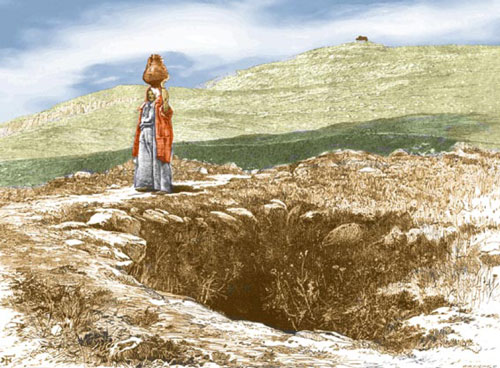
 The well and the field surrounding it were gifts from Jacob to Joseph.  And you will remember Joseph. He is the one who received good gifts from his father (the coat) and bad treatment from his brothers. I have no doubt that the well was, well, well-known to many who traveled though the area.  I’m sure it was on the map of those seeking to quench their thirst, thirst brought about by the day’s relentless heat.  John’s account tells us that as Jesus was traveling from one place to another he became tired and thirsty. He stopped outside the town of Sychar at the well to rest.

 As Jesus sat down near the edge of the well he told his disciples to go and get some food in the nearby town. It is midday. The sun is directly overhead and the heat is stifling. Jesus had no means of retrieving the water from the well. You can imagine someone being thirstier when they know that water is just out of reach.

 As Jesus sits resting a woman from the town of Sychar approaches the well carrying her clay jar (I am assuming some things here.).  The woman comes to the well in the middle of the day because, I believe, no one else will be there during the hottest part of the day. She has her reasons for not wanting to be around the other women of the town:  she sleeps around.

 Jesus, thirsty, asks the woman for a drink:  “Will you give me a drink?”

 The woman was at a loss as to what to think:

 The Samaritan woman said to him, “You are a Jew and I am a Samaritan woman. How can you ask me for a drink?” (For Jews do not associate with Samaritans.)

From the gospel account:

Jesus answered her, “If you knew the gift of God and who it is that asks you for a drink, you would have asked him and he would have given you living water.”

 “Sir,” the woman said, “you have nothing to draw with and the well is deep. Where can you get this living water? Are you greater than our father Jacob, who gave us the well and drank from it himself, as did also his sons and his livestock?”

  Jesus answered, “Everyone who drinks this water will be thirsty again, but whoever drinks the water I give them will never thirst. Indeed, the water I give them will become in them a spring of water welling up to eternal life.” (emphasis mine)

  The woman said to him, “Sir, give me this water so that I won’t get thirsty and have to keep coming here to draw water.”

  He told her, “Go, call your husband and come back.”

  “I have no husband,” she replied.

   Jesus said to her, “You are right when you say you have no husband. The fact is, you have had five husbands, and the man you now have is not your husband. What you have just said is quite true.”

  “Sir,” the woman said, “I can see that you are a prophet.  Our ancestors worshiped on this mountain, but you Jews claim that the place where we must worship is in Jerusalem.”

(Note:  The woman, like most of us, wanted to deflect the accounting of her sinful life.  Becoming polemical the woman quickly changed the subject and pressed Jesus about a heated religious and geopolitical issue of the day.)

Jesus, having already gotten the woman’s attention by recounting intimate details of her life, responded to her question about true and valid worship as the Source, the well-spring of Truth.

    “Woman,” Jesus replied, “believe me, a time is coming when you will worship the Father neither on this mountain nor in Jerusalem.  You Samaritans worship what you do not know; we worship what we do know, for salvation is from the Jews.  Yet a time is coming and has now come when the true worshipers will worship the Father in the Spirit and in truth, for they are the kind of worshipers the Father seeks.  God is spirit, and his worshipers must worship in the Spirit and in truth.”

  The woman said, “I know that Messiah” (called Christ) “is coming. When he comes, he will explain everything to us.”

  Then Jesus declared, “I, the one speaking to you—I am he.”

Water flows through John’s gospel.  John the Baptist baptized “with water so that He (Jesus) might be revealed by Israel.  In the above passage we learn about Jesus chatting with a woman as he sits next to a well. There He talks about the everlasting living water which wells up inside you if you accept it.  In a previous passage John recorded Jesus’s first sign:  turning water into wine at a wedding in Cana.  In the passage after the Jacob’s well story John tells us about a lame man who had been trying for thirty years to enter the healing pool in Bethesda.  The water of the pool would bubble up with curative power whenever the Spirit stirred it. But the man had his excuses for not being well. In a later passage John recounts Jesus walking on the water to meet the disciples in the middle of a lake.

Then one time …

On the last and greatest day of the festival, Jesus stood and said in a loud voice, “Let anyone who is thirsty come to me and drink.  Whoever believes in me, as Scripture has said, rivers of living water will flow from within them.” By this he meant the Spirit, whom those who believed in him were later to receive. Up to that time the Spirit had not been given, since Jesus had not yet been glorified. (emphasis mine)

Are you thirsty? Are you trying to quench your deepest thirst with the things of this world, things that quickly run ‘dry’ from everyday use?  Do more clothes, more electronic gadgets, more Facebook friends, more entertainments, more tattoos, more tipping points, more of anything this world has to offer satisfy your deepest thirst?

The woman at the well had her life of men.  She had her connections.  She also had her water bucket.  She brought this bucket to the well everyday to get the water she needed to survive.  The woman could argue religion and politics with the best of them but she was thirsting for something more.  She may have wondered “is that all there is?”  Is that all that life has to offer someone like me, a woman of Samaria marginalized by my own community and holding on to an unsure belief in an object of worship others are telling me to believe in.

Unknowingly, it was of the True Well of Life that she made her request:  “Sir, give me this water so that I won’t get thirsty and have to keep coming here to draw water.” Jesus responded:  If you knew the gift of God and who it is that asks you for a drink, you would have asked him and he would have given you living water.”

We know that drinking water is necessary for life.  We listen closely to health programs that tell us to drink several glasses of water a day to sustain our bodies, to help them function properly and to replenish the oxygen our systems need. As you would imagine the quality of water that you drink is critical.  Undoubtedly, water that contains filth would do more harm than good.  Is the well water you are drinking clean and pure, refreshing and restorative?  Or, is it filthy with parasites making you weak and sick?

The water that Jesus offers to you and me is greater and purer than the most abundant compound found on earth:  H2O.  It is the Living Water of the Holy Spirit.  This water teems with Abundant Life, the very oxygen of heaven. Once received its Spirit-life effervescence bubbles up within a person.  It then overflows your spirit and converges with the rivers of Living Water that have never stopped flowing throughout all of eternity except for that dark hour when the Gift of God Himself was poured out as a drink offering and He cried, “I am thirsty.”

*****

Shechem’s Archaeology

Looking Out for Number One and Finding Zero

 This past week, while riding the commuter home I sat down on an upper row seat not far from a young Indian woman. Her head was covered so I believed her to be a devoutly religious person. On her lap was Ayn Rand’s Atlas Shrugged. I wondered about her interest in Rand’s lengthy novel.

As you know much has been said in the media recently about corporate greed and fairness. OWS protests, though largely unfocused and self-trivializing, seem to want to generate a discussion about what is ethically the “right thing to do” in the world of money and specifically money as power or a force to use for “good” and not for selfish pleasure. It should be noted, though, that the message of the OWS protestors is certainly compromised by their own envy and greed. Their desire (and demand) to have the same things that someone else has stands as witness to their hypocrisy. But, let’s get back to the woman reading Atlas Shrugged.  Briefly, let’s look at the philosophy behind the book.

Ayn Rand’s (1905-1982) novels portray the philosophy of Objectivism. The (paper) weighty Atlas Shrugged and The Fountainhead clearly identify the key tenets of Objectivism: objective reality, reason, self-interest, capitalism.

Ayn Rand’s Objectivism:

Objective reality: a tree falls in the forest. The sound of the falling tree occurs whether you are there to hear it or not. There is no spiritual realm. When you are dead you are dead.

Reason: direct stimuli from nature; there is no God, no soul, no intuition, nothing beyond what we determine though reason.

Self-interest: your own self-interest and happiness is what life is all about. You take care of number one.

Capitalism: Objectivism’s ideal political expression. Capitalism for the Objectivist is all about individual rights and private property; self-reliance, free trade, entrepreneurship and initiative all operate freely and without coercion within capitalism and the free market system.

Ayn Rand’s Objectivism is atheistic, rejecting faith and religion. It believes only in reason and what the self can determine. This viewpoint is born out of a godless evolutionary view of life, the Enlightenment era and philosophical naturalism. Objectivism is blind faith in your self.

Rugged individualism, for Rand, was a force like other forces of nature and something to be reckoned with. As you might imagine this type of thinking would certainly feed the ego and especially if the person who embraces Objectivism is successful in life. For these people pride of place means you’ve made it to the top of the heap. Your self-esteem is rewarded. You are recognized by your peers as having objectively “made it.” (BTW: OWS protestors want to make it, too.)

Ayn Rand’s extreme philosophy is most likely a reaction to her early life in Russia during the Communist Revolution. As a child she learned to despise coercion, government intrusion and totalitarianism. She came to oppose statism and collectivism while she promoted social systems which protected individual rights and personal initiatives. As a romantic realist she hated the dystopian effects created by those seeking to create a man-made utopia. Though a polemic, Rand never insisted that others be made to accept her philosophy. She was “laissez faire” with respect to others.

Before Rand another voice of philosophical naturalism and the evolutionary world view had chosen a different atheistic force with which to respond to “the law of life.: Jack London (1876 – 1916).

London, the author of The Call of The Wild wrote about the rugged individualist in a Darwinian world where and at a time when man was being considered as just another evolved animal. London wrote about animal instincts (the dog Buck) including survival of the species. For the philosophical naturalist life was essentially a matter of staying alive. This meant a primordial existence: eating, having sex, avoiding pain, etc. There was no higher purpose.

Over time, though, London drifted into materialism as most atheistic evolutionists do. He became a member of the Socialist Party of America. He embraced materialist thinkers such as Karl Marx and Friedrich Nietzsche. It may be that because London, as depicted in his writings, saw humans at the mercy of nature’s massive forces that he decided that the best thing to do was to fight back by joining forces with other human animals via collectivism.

It could be said that both philosophical novelists, London and Rand, saw life as a Darwinian atheist did: having no divine purpose; first matter emerges then mind and then will-supplying force. And force, per Jack London and Karl Marx (and even these days, Obama) may be pooled into a collective. Or, force in the hands of Ayn Rand’s character Howard Roark in The Fountainhead, can be the individual who does it “My Way.” Either way, force is the means to an end: the “survival of the fittest,” a now-common phrase given to us by Herbert Spencer, nineteenth-century British philosopher who was huge proponent of evolution (and a significant influence on Jack London and it seems also of the OWS protestors).

As a Christian I believe that there is a lot about the basic wording of Rand’s philosophy of Objectivism that rings true while at the same time Rand’s self-directed fleshing out of the philosophy has nothing in common with Christianity.

To be sure there is objective reality but for the Christian it is the True Reality of the Kingdom of God. And those who have “ears to hear and eyes to see” can detect this Kingdom. It is spiritual and at the same time more real than this present world. Christians have wide-eyed belief in God.

Being created in the image of God a Christian also understands that reason is not an end in itself but a means to be in relationship with God and to work together with God to bring about His kingdom on earth.

Christian self-interest is the model for how we are to take care of others: “Love your neighbor as yourself”; “Husbands love your wives as yourself.” Our self-interest is not an end in itself. It is not bent inward. Remember, the Good Samaritan cared for the wounded man as he would have wanted to be cared for in the same situation. He wasn’t the rugged individualist who walked on by. Instead, he was the rugged individualist who cared for others.

Christian capitalism, man’s free, voluntary and individual exchange with others, is to be guided and tempered by a Christian’s self-governing virtue of justice – giving every man his due, of temperance, of prudence and of charity and not by government fiat. Remember, we are told in Scripture to “Pray for those in authority over you.” We pray for those in authority so that we can live in peace – a peace which means no government authority interfering in our lives. This allows for the free exchange of God’s goodness.

Collectivism, on the other hand, finds no place in Scripture apart from a brief mention of the early New Testament church. Yet, there are social engineers and social gospel advocates who build vast socialist ideologies around snippets of this New Testament history.  The U.S. Government is not the church of Jesus Christ. The world and the church are two separate entities. Governments are impersonal and do not have virtues. Governments are coercive and make demands.  In a democratic republic like the U.S. we must not elect leaders who create ever more egregious and imposing laws in hopes of creating the virtues we want to have around us. Be the virtue instead.

The Indian woman on the train woman reading Ayn Rand’s Atlas Shrugged may find that “the survival of the fittest” individual means that she cuts herself off from God and others to obtain it all. And, those with a humanistic-collective bent may find that they will lose themselves and God in the mix.

Jesus – The Way, The Truth and The Life.  Let The Way Occupy you.

****

Shakespeare had it right when Hamlet says. ‘And therefore as a stranger give it welcome. There are more things in heaven and earth, Horatio, than are dreamt of in your philosophy.’

Here are some related posts:

Wrestling With God

Just Say No

What’s Left. To Be Decided.

tête-à-tête

How Shall I Then Live?