There was a couple married for many years. When the day of their 25th anniversary came around the wife prepared a special meal as usual. She then waited anxiously for her husband to come home with flowers, as usual. When the door opened there was a strange man with flowers. He said “Your friends and neighbors said I was a better choice for you.”
We can all agree that 2020 was disorienting, dispiriting and depleting. We are reeling from the noxious effects of evil unleased in the midst of a great battle:
“There is no neutral ground in the universe. Every square inch, every split second is claimed by God, and counter claimed by Satan.” C.S. Lewis
2020 started on anything but a neutral ground. The enemy of our souls, allied with powerful cultural forces – corporate media, ivory tower professors, big-tech oligarchs, and social media publishers – had taken over the cultural terrain. To hold their ground, you and I have been hit with a constant torrent of subversive propaganda to weaken our defenses. The messaging seeks to disorient, dispirit and deplete those who oppose them. It negates and zeroes out everything that is good in terms of a Creator and resets truth to be what power declares it to be. Here is a short list of the anti-human messaging:
The world has no Creator. You are not to be considered a creature of a good personal God. You are to be considered a chance by-product of a natural process randomly occurring out of chaos. The human world is a human construct.
Your life motivation, like all else in the “red in tooth and claw” universe, is the will to power.
Truth is what friends (and voters, viewers, etc.) let me get away with saying.
Science is not about finding the truth. There is no truth (we are told). Science is about the means for the will to power.
Christianity is at the root of all the problems facing mankind. Since we are creatures of earth, we must turn to the earth for our salvation. Ideology is to replace religion.
Language and what you say must be controlled because you must not get away with saying anything that smacks of truth.
The repudiation of reason, history, tradition, and metanarrative – rejection of anything that gives society understanding, meaning and hope as to how and why and that stands apart from ideology – allows one to rise above the aforementioned, claim the power of deconstruction and look down and mock.
The way forward is through self-consciousness, moral relativism, pluralism and Globalism.
Onto a minefield plotted by nihilists desiring to blast God-given life out of you, communist agitators -BLM protestors – flew in. It is clear from the Black Futures Labdonation page that the protests were sponsored by the Chinese Progressive Association (an agency of the Chinese Communist Party or CCP) among other anti-American sources. COVID-19 – a bioweapon created and released by the Chinese Communist Party, also flew in.
Seeing a chance to claim a massive stretch of ground under the cover of crisis, western tech globalists and the Pope used the virus and their will to power. With their influence, money and authority (and the subservient corporate media) they sold “lockdowns”, a CCP containment model, as the means to achieve the Great Reset. The Great Reset is a complete restructuring of social and economic life on earth using as its model the CCP communist state.
The CCP uses biometric-technocratic surveillance of its people to keep them in line. You and I are under are to come under the same surveillance. You and I are to be made non-human obedient automatons of the Great Reset communist super-state. To enable this, the outcome of the 2020 election was manipulated.
According to Andrea Widburg “Facebook’s Mark Zuckerberg may have played one of the biggest roles in swinging the election outcome.” Putting the CCP-compromised Joe Biden and the pliable Kamala Harris into office by any means necessary -election fraud in swing states – facilitates the globalist agenda.
Totalitarian globalists have taken over 2020. In doing so, they have shown that they hate populists. They have shown their hatred via the corporate media and by the evidenced election fraud. Globalists want to disorient, dispirit and deplete populist America.
To wit, Amazon, Walmart and other globalist big box stores had surging profits in 2020 while small businesses across the nation were being eviscerated not by COVID-19 but by the globalist-imposed lockdowns.
Globalists hate you and me. Globalists love non-thinkers and TV watchers. These nihilists will tell you that there is nothing to understand so why think at all? Having power is all that matters. Those Gollums love those who have emptied themselves of resistance and follow them to Shelob’s lair.
2020. Disorienting. Dispiriting. Depleting. On purpose. You and I are reeling from the noxious effects of evil unleased in the midst of a great battle.
Disoriented? One of the aspects of encountering evil is not being able to think straight. Confusion brought on by the repetition of lies, contradictory statements, and the layering of self-deception coupled with moral relativism produces stupor – an inability to think or act. (Shelob’s venom was not intended to kill its victims but only to render them unconscious and keep their meat fresh.) Corporate media sponsored by Globalists is the main source of confusion (and venom) today.
Dispirited? Evil is in opposition to life. Evil is not empathetic. Evil protects itself, its image. Hence, evil is opposed to free speech and to religion. Evil is opposed to redemption. Hence, the removal of meaning through deconstructionism and the cancel culture. Evil pursues a world of Absence and Nothingness.
Depleted? Evil is not simply the absence of goodness — it is actively hateful and destructive. The will to power is behind the bioweapon unleashed in the world and the election fraud unleashed in America.
The following sums up the what you and I have been exposed to:
M. Scott Peck, Psychiatrist and author of People of the Lie: The Hope for Healing Human Evil defines evil as “the exercise of political power — that is, the imposition of one’s will upon others by overt or covert coercion — in order to avoid extending one’s self for the purpose of nurturing spiritual growth. Ordinary laziness is nonlove; evil is antilove.”
It has been said in clinical settings that naming something, in this case evil, gives us a certain amount of power over it. This power is not the will to power in order to control others, as the world defines. Rather, it is the power to not be overcome by evil and to resist evil in ourselves and to conquer evil with good …on the 2021 battlefield.
“I’m not saying COVID’s not real. I’m just saying, I’m not sick. I’m not sick and asymptomatic spread has been shown to be a myth, so why am I going to be treated like a sick person?
“Do you know that there have been fewer deaths in [2020] than in [2019]? All they’ve done is recategorize all the deaths. This is not what they’re telling us it is. It’s a lie. This is a lie, I’m telling you.
“It’s a lie and everyone’s buying it. And it will go on, and on, and on as long as they feed us this lie and we comply with it, and I am done. Tonight, I’ve reached a breaking point, I’m done. I know I’m not reaching any of you in here, I don’t care.”
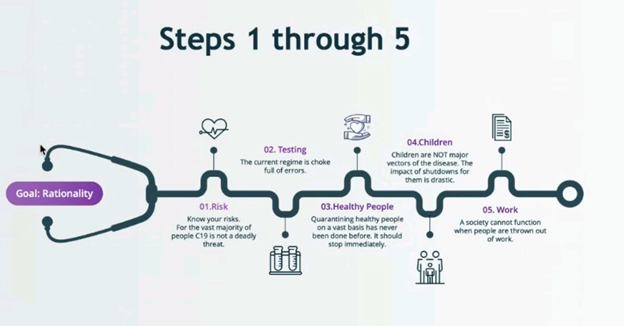
“As infectious disease epidemiologists and public health scientists we have grave concerns about the damaging physical and mental health impacts of the prevailing COVID-19 policies, and recommend an approach we call Focused Protection.”
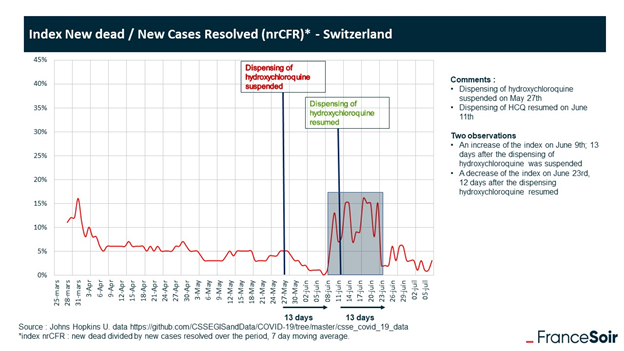
“According to a protocol-based treatment algorithm, among hospitalized patients, use of hydroxychloroquine alone and in combination with azithromycin was associated with a significant reduction in-hospital mortality compared to not receiving hydroxychloroquine.”
“The “Fauci Strategy” was to keep early infected patients quarantined at home without treatment until they developed a shortness of breath and had to be admitted to a hospital. Then they would they be given hydroxychloroquine. The Food and Drug Administration cluelessly agreed to this doctrine and it stated in its hydroxychloroquine Emergency Use Authorization (EUA) that “hospitalized patients were likely to have a greater prospect of benefit (compared to ambulatory patients with mild illness.
In reality just the opposite was true. This was a tragic mistake by Fauci and FDA Commissioner Dr. Stephen Hahn and it was a mistake that would cost the lives of thousands of Americans in the days to come.
“Yesterday (September 9th) it came out from Oxford University and the University of Queensland, that inhaled budesonide against Covid could cause at least 50% of the people to not have to be hospitalized,” Dr. Bartlett noted.
Why is Anthony Fauci, a media hog, goalpost mover, and dangerous buffoon, telling us how we should live our lives?
Whys are hydroxychloroquine and alternative COVID19 treatments blacklisted? Do you think big pharma and the big tech oligarchs and their foundations have something to do with that?
Years ago, now, I read the folk stories of Hans Christian Anderson to my two youngest. Storytime included The Ugly Duckling, Thumbelina, The Little Match Girl, The Princess and the Pea, The Steadfast Tin Soldierand… The Snow Queen.
First published in 1845, The Snow Queen centers on the struggle between good and evil as taken on by a little boy and girl, Kay and Gerda.
Below are the seven stories of the Snow Queen (audio and pdf).
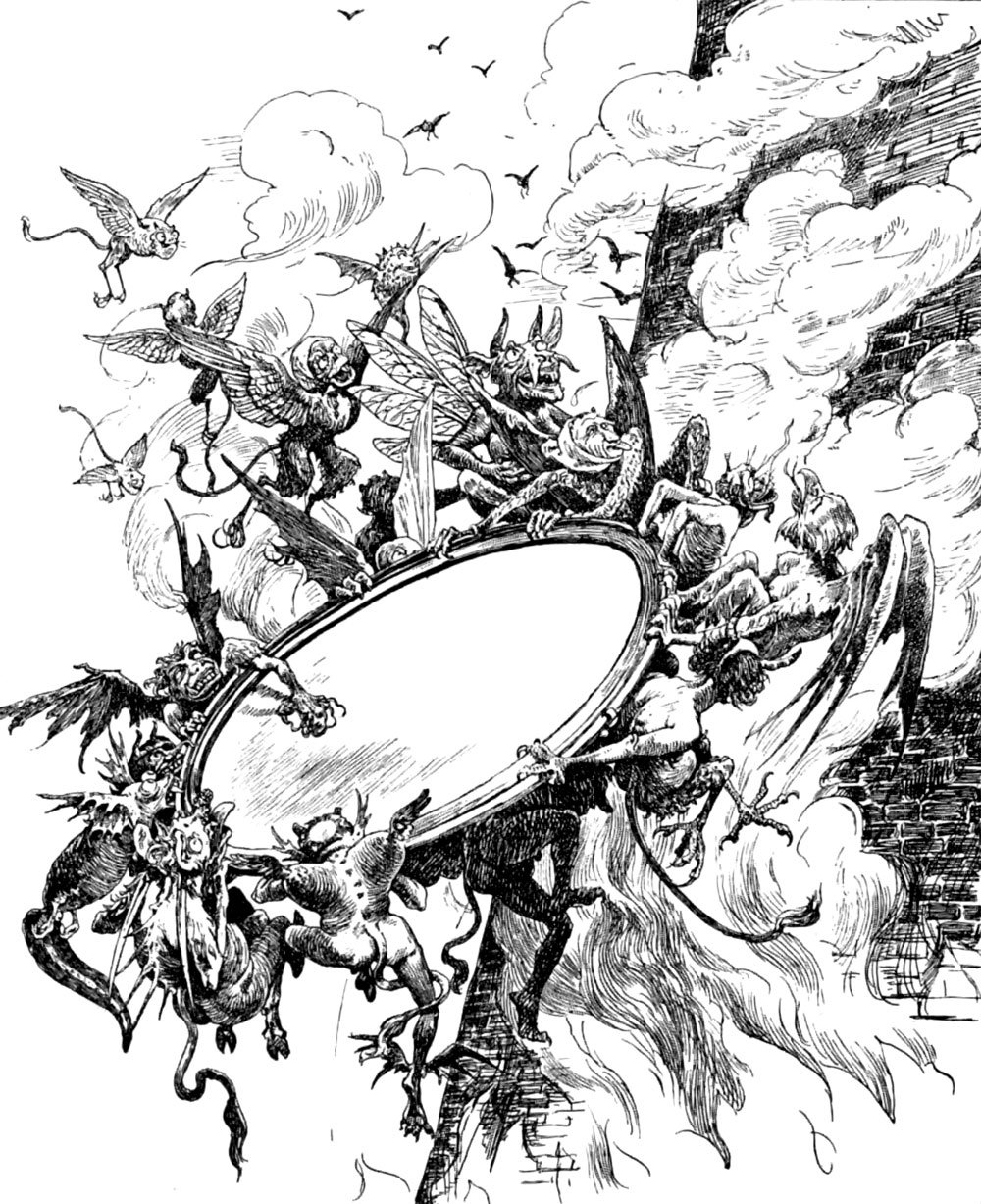
First Story: Which Treats of a Mirror and of the Splinters
Second Story: A little Boy and a Little Girl
Third Story: Of the Flower-Garden at the Old Woman’s Who Knew the Art of Sorcery
Fourth Story: The Prince and Princess
Fifth Story: The Little Robber Maiden
Sixth Story: The Lapland Woman and the Finland Woman
Seventh Story” What Took Place in the Palace of the Snow Queen, and What Happened Afterward
I ain’t blind and I don’t like what I think I see. – Takin’ it to the Streets, The Doobie Brothers
“Moreover, he knew nothing yet well enough to see it: you cannot see things till you know roughly what they are.” –C.S. Lewis, The Space Trilogy
Having trouble seeing things today? Do you “know roughly what they are” – the dark forces at work in the world today? You and I should know them well enough to see to them for what they are – opportunists of evil. To wit, opportunist evil doers act according to the following scheme:
You never let a serious crisis go to waste. And what I mean by that it’s an opportunity to do things you think you could not do before. – Former Chicago Mayor and Obama Chief of Staff Rahm Emanuel
You hear and read about these opportunists every day. Ruling class elites, tech giant CEOs, Fortune 500 CEOs, Democrat pols, mainstream icons and gatekeepers – globalists all. They are the gods. We are the peons. They look down on us. They want us to look up and pray “Thy elite will be done on earth as it is boardrooms, college classrooms and political backrooms.”
The crisis has presented an opportunity. Social engineering. The globalist elites are testing the resistance of people to a One World authority. They are doing this under the rubric of mitigating a “public health crisis.” Healthy political and social immune systems are being worn down.
You know what the evil opportunists are doing. Power is being transferred from the people to the state. State licensing is gutting small business with threats of revocation. Wealth is being transferred from the middle class to the wealthy (who do not bear the financial brunt of the lockdowns). Civil liberties are being trashed. People are being forced to kneel to the will of the state. The state had help from evil opportunists – sheep in wolves’ clothing -to make it all-powerful.
Globalist health organizations (the CDC, the WHO, and the NIH) are lockdown enablers. (see video below)
The Progressive state media (the NYT, WaPo, CNN, MSNBC, and Fox News) are re-educating the masses. The public is now being subjected to a 24/7 exposure to case numbers, positivity rates, death tickers and PSAs. The useful idiots of these media orgs want you to believe that contracting COVID-19 is a death sentence.
You will not find reported the number of those who have recovered (the word on the street is 99.9%). You will not find the number of cases to mortality rate reported. You will not find year over year mortality rates and causation. The latter was analyzed, graphed and posted on the internet only to be quickly retracted and removed “The article may have contributed to the spread of misinformation about COVID-19.” You and I are not allowed the whole truth.
The CDC classified all deaths that are related to COVID-19 simply as COVID-19 deaths. Even patients dying from other underlying diseases but are infected with COVID-19 count as COVID-19 deaths. This is likely the main explanation as to why COVID-19 deaths drastically increased while deaths by all other diseases experienced a significant decrease.
In other words, COVID-19 death counts replaced ‘typical’ causes of death counts. You and I are being manipulated by the media and health organizations.
The article noted that “in contrast to most people’s assumptions, the number of deaths by COVID-19 is not alarming. In fact, it has relatively no effect on deaths in the United States.” You and I are to be terrified and run into the arms of globalists. They are the gods who will save us.
(I am 68. I am not concerned about contracting the virus. If I do, my body will deal with it. My body will build immunity to the virus. I will not be taking the vaccine. In liberal parlance, “MY BODY, MY CHOICE!”
I am not a science denier. I am an engineer. I am also a Christian. I put my life in the hands of God and not in the hands of fortune-telling scientists who are subjects of Lucifer.)
You and I should know the evil opportunists well enough to see to them for what they are. Social media publishers are like the wardens of Europe:
As you are aware, there has been election fraud. Our Republic is now in crisis. Per Rahm’s tactic, media has taken control of free speech to manipulate your understanding of the crisis. Social media curators will edit you out. That is, if you post evidence of election fraud or about the communist china-compromised Biden family. Then, Twitter, Facebook, YouTube will ban you at their discretion. This is how censorship happens in a free-speech Republic. Media (and government) take control of free speech during a crisis. They publish their narrative – “consensus.”
Your evidence, opinions, values, and beliefs are stripped from their naked public square. Your voice is de-valued just as Democrats had no problem disenfranchising your vote with election fraud. Social media publishers have no problem dismissing election fraud evidence just as the mainstream media says “nothing to see here, move on”.
As you know, social media platforms have no problem inviting you into their world. They have commercial and political purposes. But you enter their world. You may be considered a virus if you don’t say the things that agree with their body politic. They may quarantine you. To remain in their world, you must be inoculated. The GroupThink vaccine works to inure one against the negative effects of censorship. The GroupThink vaccine causes one to react against actual journalism.
(A conservative blog was recently ‘de-platformed’ by WordPress for unknown ‘content’ violation. Questioning things and offering a countervailing opinion is apparently a ‘content’ violation. Is my WordPress blog next?)
Do you see the thinking behind censorship? It’s the logical relation of Orwell and Protagoras: some men are more the measure of all things.
You don’t need to be a Christian to be concerned about what is happening though. Big Tech tyranny must be stopped at all costs. The only way for that to happen is for us to exit their data silos and digital panopticons. – Then They Came for Christians: A Warning
You and I should be aware. Globalist-driven social media sites push to “obtain the future we want.” In other words, they want utopia. They curate to fashion the collective story of pluralism and peace. They promote the Great Reset.
While most of the ordinary citizenry are languishing in government-created poverty due to the mandatory shutdowns, the pompous Davos elites are busy exploiting the pandemic as an opportunity to push their Marxist agenda on everyone else. –What Is “The Great Reset”?
I have heard opportunist evil doers blame President Trump for pandemic deaths. Why? Globalists connected with China don’t want you to point a finger at China. A media narrative was created to deflect blame.
You should listen to this whistleblower! Chinese ophthalmologist and virologist Dr. Lei Meng Yan put the lie to the Communist Chinese Party’s propaganda: the virus exists in nature; the nature origin theory. Her white paper (below) shows that the virus was generated by the CCP. The virus is a weapon.
Note: Dr. Yan has fled China. Her mother, still in China, has been arrested. The CCP is very angry with Dr. Yan.
“The scientific evidence and records indicate that the current pandemic is not a result of accidental release of gain-of-function product but a planned attack using an Unrestricted Bioweapon. The current pandemic therefore should be considered as a result of Unrestricted Biowarfare.” From the paper SARS-CoV-2 Is an Unrestricted Bioweapon: A Truth Revealed through Uncovering a Large Scale, Organized Scientific Fraud & @ 15:28 in the video below.
Near the end of the above video (@21:00), a question is asked: “Why is there hesitancy in the science community …ten months into this, why does it take you Dr. Yan, to report on a bioweapon?”
There is a reason why there is a hesitancy in the “silence” community. In the next video, Dr. Shiva Ayyadurai, MIT PhD in biological engineering, talks about crisis opportunists. Big pharma and those in cahoots with them are pushing a vaccine mandate. You will find out why. Note: there are effective drugs already available, i.e., Ivermectin.
Did you know that Archbishop Viganò sent an open letter to President Trump about the globalist takeover? Here is an excerpt:
The purpose of the Great Reset is the imposition of a health dictatorship aiming at the imposition of liberticidal measures, hidden behind tempting promises of ensuring a universal income and cancelling individual debt. The price of these concessions from the International Monetary Fund will be the renunciation of private property and adherence to a program of vaccination against Covid-19 and Covid-21 promoted by Bill Gates with the collaboration of the main pharmaceutical groups.
Under cover of crisis evil opportunists are becoming ascendant. The billionaire aristocracy, the technocrats, oligarchs and the “dark green” religionists are moving into place. The rich globalists and their foundations are setting up state capitalism and totalitarian control. You are to be serfs and worker bees in their programs.
Did you know? The growing resistance to globalism is not about Trump. It is not about populism. It is not about Republicans and Democrats. We are fighting against evil opportunists and the dark spiritual forces that employ them. Everyone who loves freedom, including the Chinese diaspora, is resisting. Join the fight. The world is watching.
Evil is crouching at the door. Arm yourself with the sword of the spirit – the word of God. (and check out these sites to avoid the globalist narrative and censorship.)
No more suppressing the truth, no more controlling the narrative…. China has caused coronavirus the deaths.
Josh Phillips of The Epoch Times w/a documentary about the CCP Wuhan virus, a synthetic (not naturally mutated) virus designed for cross species transmission.
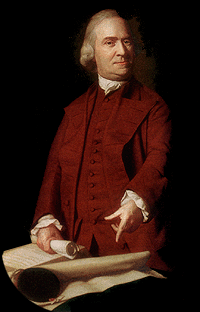
“If ye love wealth better than liberty, the tranquility of servitude better than the animating contest of freedom, go home from us in peace….We ask not your counsels or your arms. Crouch down and lick the hands which feed you. May your chains set lightly upon you, and may posterity forget that you were our countrymen.” ― Samuel Adams
“Democracy extends the sphere of individual freedom, socialism restricts it. Democracy attaches all possible value to each man; socialism makes each man a mere agent, a mere number. Democracy and socialism have nothing in common but one word: equality. But notice the difference: while democracy seeks equality in liberty, socialism seeks equality in restraint and servitude.” ― Alexis de Tocqueville, Democracy in America
Alexis de Tocqueville
“The American Republic will endure until the day Congress discovers that it can bribe the public with the public’s money.” ― Alexis de Tocqueville
While I was on Twitter, a few years ago, I would jump in on threads where socialism and capitalism were discussed (Better, the terms were tossed about.). The anti-capitalists would denounce capitalism as “unfair” and the rich as “greedy” while insinuating “equality” and “fairness” occurred naturally within the materialist realm of socialism. As an example, they pointed to Scandinavian countries (where, amazingly, none of them had the gumption to take up residence. That would take initiative and responsibility and money on their part.)
The anti-capitalists, assuming a superior moral position, never talked in-depth about the mechanics of socialism other than it being a redistribution of wealth from “rich” to “poor” via confiscatory taxation. And, whether they were oblivious to or welcoming of the growing soft despotism in America that gives people the illusion that they are in control, I could not determine.
On Twitter there were also those who proclaimed Jesus to be a “Progressive”. They offered a litany of “Progressive” attributes assigned to Jesus, among them “anti-rich”, their presumed antithesis to “Blessed are the poor” [“…in spirit”]. There were those, too, who said that the early church was an example of socialism because the early Christian shared everything in common. Apparently, these folks had never read that Jesus warned about the dangers of the love of riches and not that someone who was rich shouldn’t be. Did these folks also not comprehend that the early church did what they did out of love and not out of coercion?
In the current hopped-up milieu of socialism as social justice*, what is the mystique and lure of socialism, central planning, and top-down government when …
Above this race of men stands an immense and tutelary power, which takes upon itself alone to secure their gratifications, and to watch over their fate. That power is absolute, minute, regular, provident, and mild. It would be like the authority of a parent, if, like that authority, its object was to prepare men for manhood; but it seeks on the contrary to keep them in perpetual childhood: it is well content that the people should rejoice, provided they think of nothing but rejoicing.
For their happiness such a government willingly labors, but it chooses to be the sole agent and the only arbiter of that happiness: it provides for their security, foresees and supplies their necessities, facilitates their pleasures, manages their principal concerns, directs their industry, regulates the descent of property, and subdivides their inheritances – what remains, but to spare them all the care of thinking and all the trouble of living? Thus it every day renders the exercise of the free agency of man less useful and less frequent; it circumscribes the will within a narrower range, and gradually robs a man of all the uses of himself.
Long before social media came around fostering populist socialism, I inured myself against the idea of a free lunch. In the 80s I watched Milton and Rose Friedman’s Free to Choose Series on TV. The following video is part of that series.
Plain-spoken Milton Friedman, economist of the Chicago School of Economics, addresses the issue of social responsibility that seems to be the motivation behind a rejection of capitalism and the attraction of socialism. He also presents the fundamental difference between capitalism and socialism: capitalism – an economic market operating under the incentive of profit; socialism – the government market under the incentive of power. Included are his thoughts on collectivism, social justice, moral values, individual responsibility, the doctrine of social responsibility, and philanthropy.
For the many of you around the world who live in disparate circumstances and who read my blog, I pray that you will benefit greatly from this video.
A final word from our sponsors ….
It’s not an endlessly expanding list of rights — the ‘right’ to education, the ‘right’ to health care, the ‘right’ to food and housing. That’s not freedom, that’s dependency. Those aren’t rights, those are the rations of slavery — hay and a barn for human cattle. ― Alexis de Tocqueville
What good does it do me, after all, if an ever-watchful authority keeps an eye out to ensure that my pleasures will be tranquil and races ahead of me to ward off all danger, sparing me the need even to think about such things, if that authority, even as it removes the smallest thorns from my path, is also absolute master of my liberty and my life; if it monopolizes vitality and existence to such a degree that when it languishes, everything around it must also languish; when it sleeps, everything must also sleep; and when it dies, everything must also perish? ― Alexis de Tocqueville, Democracy in America
When I refuse to obey an unjust law, I do not contest the right of the majority to command, but I simply appeal from the sovereignty of the people to the sovereignty of mankind. ― Alexis de Tocqueville, Democracy in America
The liberties of our country, the freedoms of our civil Constitution are worth defending at all hazards; it is our duty to defend them against all attacks. We have received them as a fair inheritance from our worthy ancestors. They purchased them for us with toil and danger and expense of treasure and blood. It will bring a mark of everlasting infamy on the present generation – enlightened as it is – if we should suffer them to be wrested from us by violence without a struggle, or to be cheated out of them by the artifices of designing men. ― Samuel Adams
Let each citizen remember at the moment he is offering his vote…that he is executing one of the most solemn trusts in human society for which he is accountable to God and his country. ― Samuel Adams
The utopian schemes of leveling and a community of goods, are as visionary and impractical as those which vest all property in the crown. These ideas are arbitrary, despotic, and, in our government unconstitutional. ― Samuel Adams
As one can surmise, Francis welcomes the populism of socialism and “for the good of all” envisages a communist version of Catholicism. For example, if you are a Catholic in China, (or the world for that matter) in his vision you’ll be provided land, housing and work provided that you are the Chinese Communist Party’s version of a “good citizen”.
The above helps explain why Pope Francis deplores the populism that elected Trump. A movement of “free people” is hostile to coercive top down rule and to non-democratic central planning and to the liberty-annihilating communism the Pope dreams of and so desires so as to reshape the world into his Let Us Dream image. The Pope/CCP desires the Ring of Power to conform all men to its will.
The Trump movement seeks to take back life, liberty, and country –identity – from the Ruling Class Obama-Clinton-Biden-Cuomo types who talk down to Americans, considering them “bitter clingers” and “deplorables” and rubes. The Trump movement detests the privileged elites (including Francis), and the unelected bureaucrats, and, essentially, those who are “more equal than others” and deign to tell them who they are and what they are to think and what they are to do. The Trump movement fights to keep America from becoming a third world country, as Democrat mayors prove it is possible with their “Open World” policies.
The Trump movement deplores the overreach and suffocating control of globalism. The movement seeks to remove the tentacles of the “Open World” beast that wants to devour the U.S. – our individual rights, our liberty, our Constitution and our identity – to feed its One World Fratelli tuttichimera. “We the people” reject the Great Reset.
The One World forces and the purple and scarlet dressed Whore of Babylon are gathering to fight against the Lord, as foretold.
“The board is set, the pieces are moving. We come to it at last… The great battle of our time.”
Gandalf, The Lord of the Rings: The Return of the King
Did the media just elect Geritol-ad Joe Biden as president-elect of their sock puppet theater?
Does the media care whether your one vote is disenfranchised by two illegal/invalid votes?
Did illegal votes pour in just like illegal aliens poured in at the behest of Democrats?
Are you buying the narrative that by not conceding to the main stream media/Democrats and by demanding a thorough investigation into alleged election corruption you are delegitimizing Democracy?
Was the NYT headline of Nov. 11, 2020 American Democracy DEMANDS every legal vote to be counted and the rest tossed? Or, was it Election Officials Nationwide Find no Fraud?
Should we just get on with our lives and assume that what the NYT and the media tells us (“Nothing to see here.”) is “good enough for me”?
During the takeover of a country by the forces of a dictatorship, does the media ‘cooperate’ with the power they are in cahoots with?
Do you believe that the media has your best interest at heart?
Are you aware that the media and social media (Facebook, Twitter, etc.,) pose the greatest threats to democracy?
Are you OK with and feel secure in Groupthink?
Are you Ok with the shadow government of Democrats/media operating to take down President Trump the last four years?
Is the Democrat/Progressive party the party of Bolshevism?
Are you OK with submitting your income, your rights, yourself and your country to Bernie Sanders, BLM and the Socialist spice girls (Ocasio-Cortez, Rashida Tlaib, Ayanna Pressley, Ilhan Omar)?
Are you OK with the intolerance of the Democrats/Progressives/media and their desire to cancel you (your thoughts, your words, your religion) out?
Are you OK with being reduced to the lowest common denominator of life because socialism/Marxism says it must be so for equality?
Are you OK with Biden rescinding, through executive order, the immigration policies put in place to protect the country?
Have you heard of any terrorist attack on U.S. soil during the last four years?
Have you heard of the U.S. starting wars the last four years?
Are you OK with Biden placing America – its resources, its tax revenue and its people – at the behest of the self-serving token Paris Accord (a Tower of Babel) while the American private sector, the last four years, has produced alternative green energy sources and has made America energy independent?
What really matters: numbers of cases and positivity OR deaths directly and solely related to COVID-19?
Are you OK with a state government that shuts down your business and your livelihood as it plays God seeking to control a virus?
Will state government shut down communities and businesses for climate change and racism and “gun control” calling each a “public health crisis?
Who is the “public” in “public health”?
Is the “greater good” proffered by the state as the reason for its coercive and overbearing control of your life really the greater good?
Do you agree with a member of Biden’s new coronavirus task force and lockdown enthusiast, Dr. Zeke Emanuel, that life is not worth living past 75?
Who should have the say about your health: the state or you?
Do you believe the state is the answer to healthcare and not yourself?
Are we to obey all laws?
Am I ready for civil disobedience?
Are you OK with increased cases of depression, drug use, suicides, and child and spousal abuse that the lockdowns have produced?
Are you ready to disobey all state orders that hinder human flourishing, that are antisocial and inhuman and, that produce the negative effects as mentioned above?
Should we obey stay-at home advisories and orders? And, why?
Should we “cancel Thanksgiving” as Chicago’s Mayor Lightfoot has strongly advised?
Who should be quarantined?
Who should not be quarantined?
Should you be quarantined?
Who should not be forced to stay at home and to cancel Thanksgiving?
When Democrats propose policies do you challenge them and ask economist Thomas Sowell’s questions: “Compared to what?” and “At what cost?” and “What hard evidence do you have?”
Are you able to challenge them or are you cut off because you are not making them look good and they don’t have the answers to your questions?
Do Progressives care more about their vision than about humans they want to impose their vision on?
Are the U.S. public health policies driven by China, as are Hollywood and pro-sports?
Will compulsory vaccines, contact tracing and vaccine cards become the means to separate who’s in and who’s out of the New Globalist World Order in the coming days?
Are you OK with abuse of power and a Stalinist type enemies list and another Great Purge?
Do you rant and rave, calling America “racist” and society “systemically racist”, because you grew up in a single parent home without a father and never learned how to succeed in the world?
Are you OK with the individual being crushed, worn down, and reduced to powder in the mortar and pestle of the totalitarian Progressive Left?
Are you concerned about and afraid of firearms because the TV has relentlessly told you that you should be concerned about and afraid of firearms, as it has with Covid-19 and climate change and healthcare and a host of other socialist initiatives to get you feeding from the same trough?
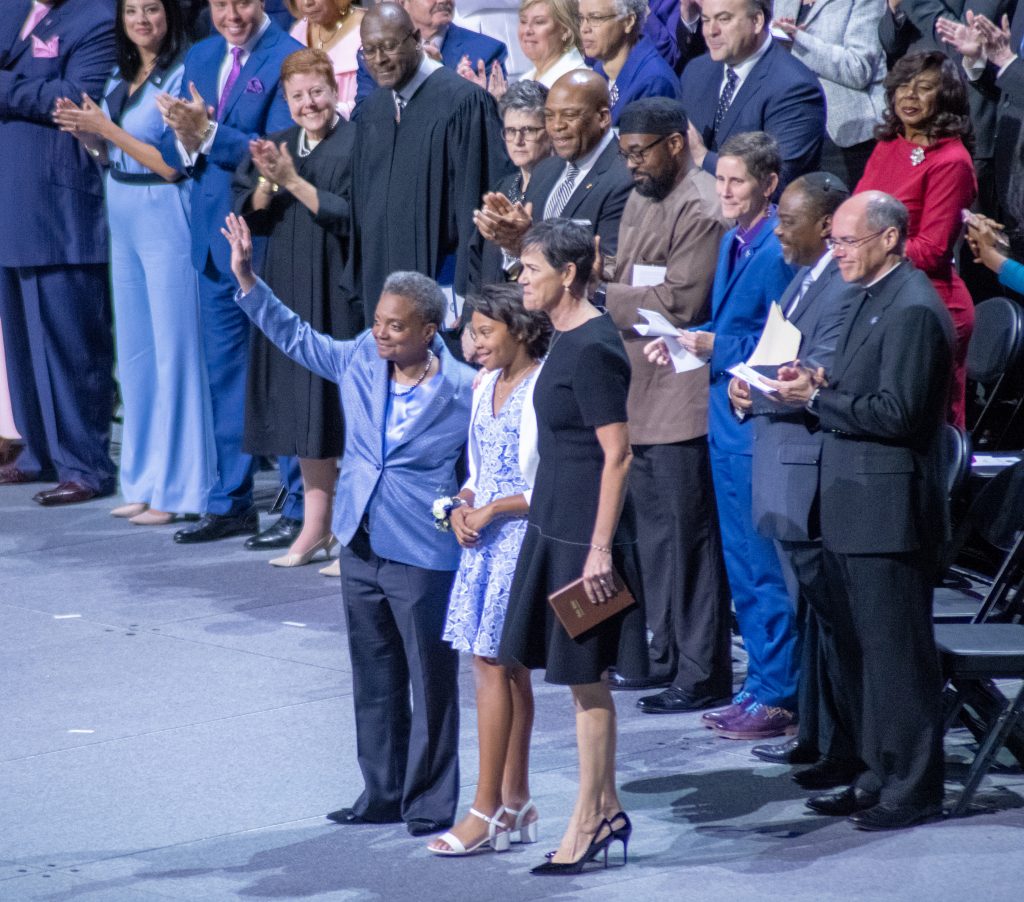
“For years, they’ve said Chicago ain’t ready for reform. Well, get ready, because reform is here,” announced Chicago’s first openly gay and African-American female mayor Lori Lightfoot during her inaugural address. Lightfoot defeated Preckwinkle in the runoff election, becoming mayor-elect of Chicago. on May 20, 2019.
Lori Lightfoot Mayor of
The mayoral election results confirmed that the threefer intersectionality of Lightfoot (black, female, lesbian) trumped the twofer intersectionality of Toni Preckwinkle (black, female) and that identity politics matters to Chicago Democrats. The election results confirmed that “change” was just one more label away.
“I campaigned on change. You voted for change. And I plan to deliver change to our government.”
In her latest attempt to “deliver change” and show Chicago that “reform is here”, Mayor Lightfoot, a former federal prosecutor, a former president of the Chicago Police Board and former chair of the Chicago Police Accountability Task Force, is taking steps to deal with the city’s crime and the coronavirus. “Change” is just a ticket and a mask away.
Mayor Lightfoot has proposed an intersectional two-fer to handle Chicago’s violent offenders and its budget crises: a city budget that includes speed-camera ticketing of drivers going over six MPH over the speed limit. If enacted, cars that speed away from drive-by shootings will be ticketed and the city will gain revenue. Reform is here. But, what about the city and state’s Covid-19 initiative?
Defeating Covid-19 and enforcing what some are calling “a culture of safetyism” are behind Illinois Gov. J.B. Pritzker’s latest mandate outlining new rules for restaurants, bars and social gatherings in multiple counties including Chicago’s Cook County. The rules included a decision to close indoor dining. The Governor, throwing the full weight of his office behind the new mandate, said Wednesday that he would send the Illinois State Police to the regions where restaurants and bars were defying his orders.
Mayor Lightfoot and Gov. Pritzker
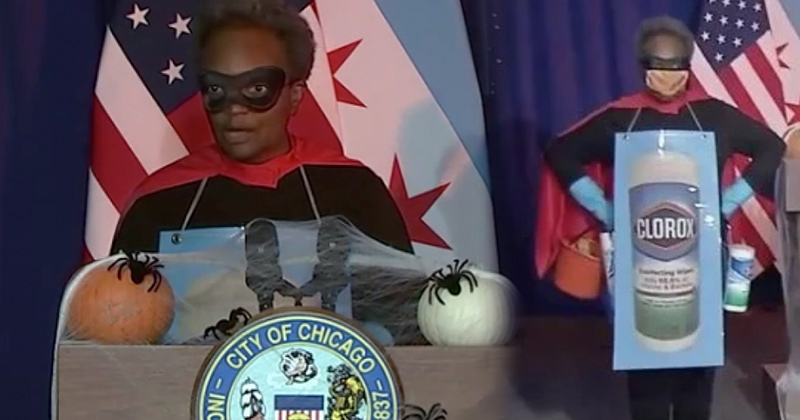
In the shadow of Gov. Pritzker, Mayor Lightfoot, on Oct. 1, 2020, offered her own tour de force – subjecting the Coronavirus to a triple threat of her intersectional power in super hero fashion. Mayor Lori Lightfoot and Dr. Allison Arwady, commissioner of the Chicago Department of Public Health, donned “Rona Destroyer” costumes for a pre-Halloween press conference.
Lightfoot as Rona Destroyer
On May 20, 2019, Lori Lightfoot was awarded Chicago’s four stars. Elections have consequences. So, watch out Covid-19.
Intersectionality at the Crossroad
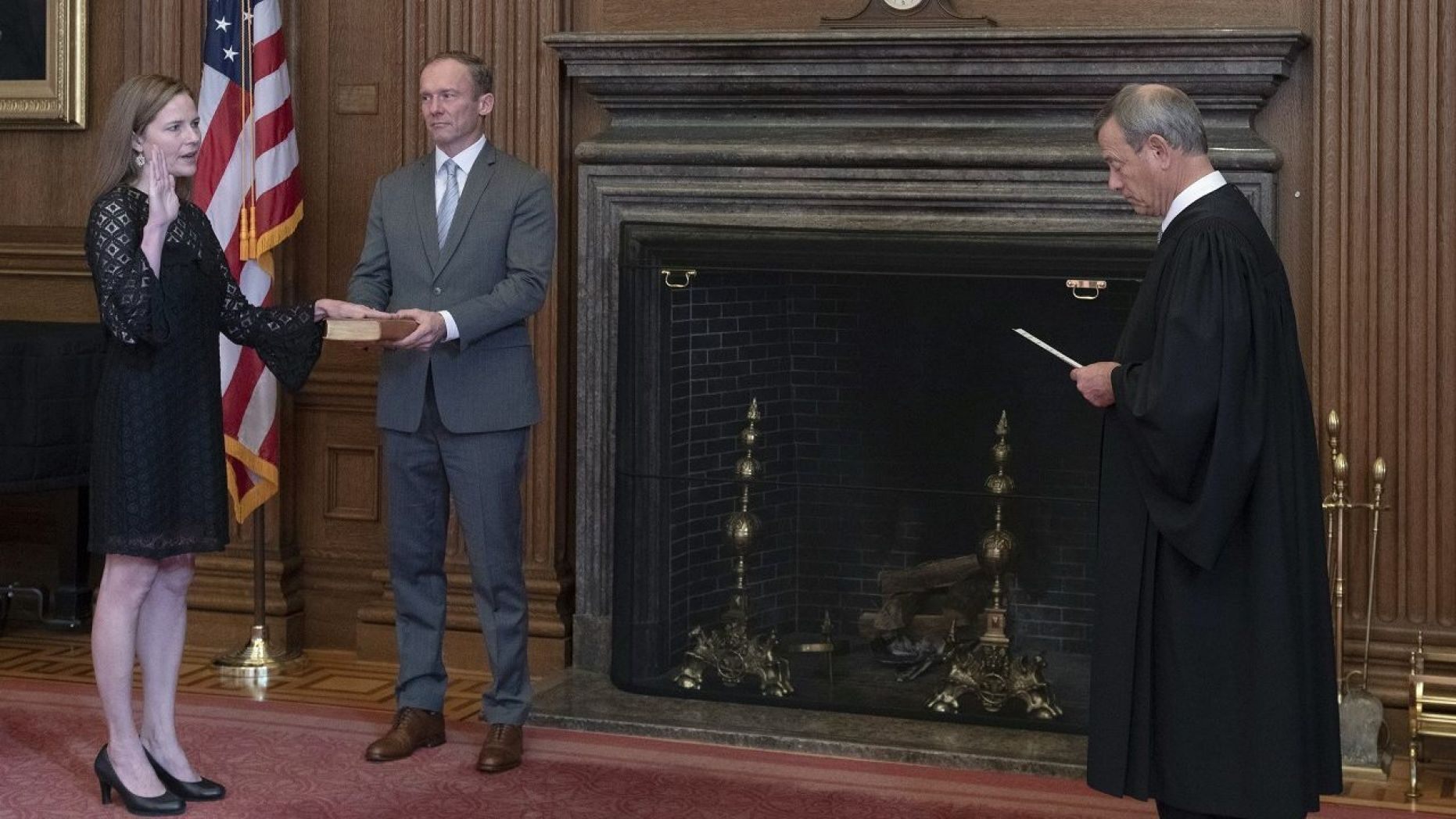
On Tuesday Oct. 27th, 2020, following a private ceremony in the Supreme Court’s East Conference Room, Judge Amy Coney Barrett officially became Justice Barrett. Chief Justice John Roberts administered the Judicial Oath to Barrett, as husband Jesse held the family Bible. Justice Barrett – wife, mother of seven, adoptive parent, lawyer, circuit judge on the U.S. Court of Appeals for the Seventh Circuit and, academic – became the ninth member of the Supreme Court.
Justice Barrett sworn in
Justice Barrett’s nomination was supported by every law clerk she had worked with and by all of her 49 faculty colleagues at Notre Dame Law school. The American Bar Assoc. Standing Committee gave her a “Well Qualified” rating. Colleagues and close associates lauded her as “Whip smart” “Brilliant writer and thinker” “Intellectual giant”.
Justice Barrett’s family
Justice Barrett revealed her legal aptitude and intellectual prowess during the senate committee’s questioning. Without notes, Judge Barrett answered each question with aplomb. And, unlike her activist predecessor, Ruth Bader Ginsburg, Barrett made it clear during the confirmation hearings that she would abide by the Constitution and not substitute her own views in rulings.
“A judge must apply the law as written. Judges are not policymakers, and they must be resolute in setting aside any policy views they might hold.”
Yet, the recounting of Barrett’s positive recommendations and stellar qualifications and her adroit answers fell on some deaf ears. The Democratic senators wanted to be heard instead.
During Barrett’s confirmation hearing the Democratic senators decried the timing of the nomination to their GOP colleagues on the committee. They also repeatedly questioned Barrett hoping that she would reveal a bias against the policies and laws they favor. They pleaded with her to recuse herself from cases where they desired favorable rulings, including a probable election case. The Democratic senators then brought in “expert witnesses” to echo their concerns and to provoke an activist sympathy in Judge Barrett. The witnesses gave pro-emotive accounts of abortion and the Affordable Care Act. One of the witnesses spoke of the “real-world harm of ending the ACA”.
The media, along with the Democratic Senators speaking outside the hearing, presented Barrett’s intersectionality – her faith and the law – as a problem. As a Catholic, conservative and Constitution Originalist, Justice Barret is seen as a triple threat to LGBT rights, abortion rights and healthcare rights held sacred by Progressives. Social media echoed the main stream media’s negative take.
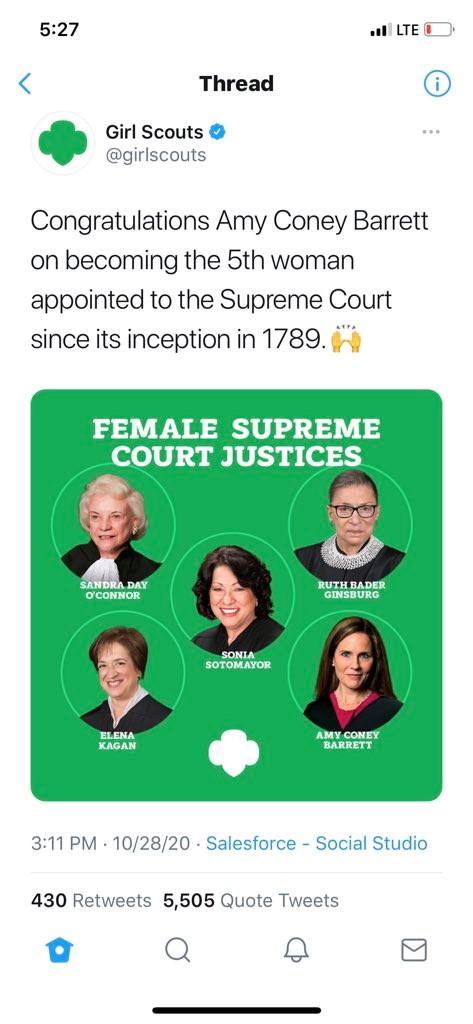
After Justice Barrett was sworn in, the Girl Scouts of America congratulated her on their Twitter and Facebook pages. But the posts were quickly deleted after social media erupted and began spewing vitriol against “the 5th woman appointed to the Supreme Court since its inception in 1789.”
Replying to the deletion, actress Amber Tamblyn tweeted “@girlscouts thank you for deleting the tweet. Be on our side – the side of girls who grow up to become women who fight for other women and girls and not the opposite.”
In a previous post, I related the local effects of the COVID lockdown. The effects included an increased rate of suicide and increased drug use and drug overdose. Behind these effects may be the isolation produced by state mandates, the loss of livelihood, a media obsessed with death and, state governments determining your freedom with COVID case numbers.
In this post I let the doctors speak. Dr. Richard Bartlett tells us how his patients are LIVING and not dying from COVID 19. Dr. David Nabarro speaks to the ruinous effects of the lockdown. Dr. Scott Atlas speaks to the efficacy of lockdowns, social distancing, school closings and government policies.
You will learn from Dr. Richard Bartlett that there is an effective, proven and simple means to deal with COVID and that waiting for a vaccine is not the answer. You will hear from Dr. David Nabarro that lockdowns are to be used as a last resort, as they have devastating effects on people and economies. From Dr. Scott Atlas you will gain a comprehensive overview of the contraindicative COVID mitigation policies and their deleterious effect on normal preventive health care. You will also hear that shutting down schools is “the most heinous misapplication of public policy in modern America”, as one of the monstrous effects is increased child abuse.
It is clear from the insight of these three doctors and from the continuing lockdowns that we have the means (and justification) but not the mentality to be free from the effects of terrible policies, partisan political decisions and, abysmal state and city governance.
“I am a left-leaning New York City public defender who voted for Bernie Sanders in the 2016 primaries and Hillary Clinton in the general election. I have never voted for a Republican candidate. I chose my career because I wanted to help those most defenseless in our society: indigent people accused and convicted of crimes and facing the awesome power of the state.
Until I saw the catastrophic effects that the lockdowns were having on the very people I sought to help…”
In a radio interview discussing her article, Ms. Younes, a lifelong Democrat, said she is voting for Trump based on the COVID-19 restrictions the Biden/Harris ticket would impose if elected.
“As infectious disease epidemiologists and public health scientists we have grave concerns about the damaging physical and mental health impacts of the prevailing COVID-19 policies, and recommend an approach we call Focused Protection.”
The following are some brief observations to consider for this election cycle. I offer my observations followed by observations (in bold) made by black American economist Thomas Sowell. Sowell, who turned 90 this past June, has had a lifetime to reflect and comment on issues economic, social and, political. I introduced this prolific author in a recent post Perspectives on Race Relations.
Consider white suburban women. They sit on their patios sipping chardonnay while watching illegal immigrants landscape their property. They chat each other up about yoga class, manicures and, vacationing in Cozumel. They prattle on about how proud they are of their children becoming socially aware in school and about how uncaring people are when it comes to climate change, immigration, gender issues, income inequality and, black lives. The dilettante’s conversation turns to their voting for Obama’s handmaiden – the Progressive black faux-nurse who never had a patient or held a full-time job in her life. They voted for her because the nurse-in-the-political-theater-sense-only wants healthcare for all and everyone should suck on government teat. For the onus to make the world a better place should be on everyone and not just on them. Like their candidate, they do not have the ‘patients’. They have yard signs and votes and garden parties.
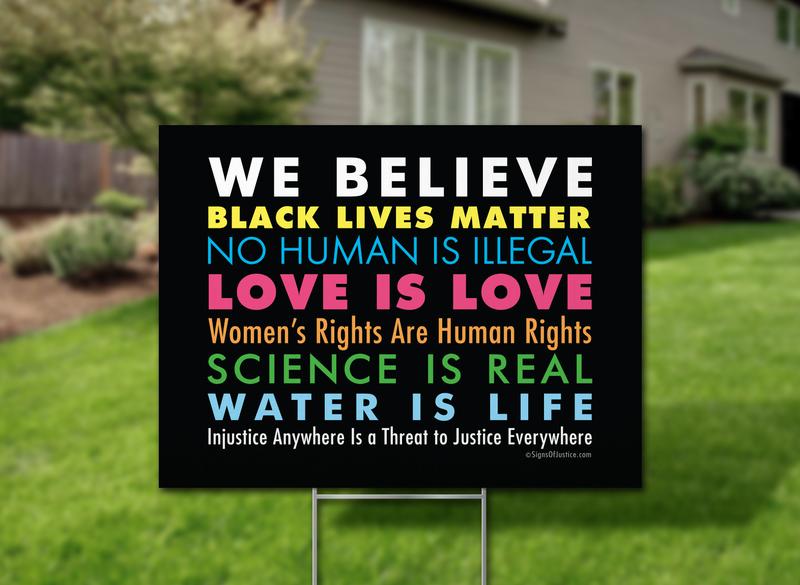
These woke women want you to notice that they are riding the wave of wokeness:
That sign and the Lauren UnderwoodFor Congress sign on their front yard confirms how much these champagne socialists care.
Some of the most vocal critics of the way things are being done are people who have done nothing themselves, and whose only contributions to society are their complaints and moral exhibitionism.
Although the big word on the left is ‘compassion,’ the big agenda on the left is dependency.
Liberals love to say things like, “We’re just asking everyone to pay their fair share.” But government is not about asking. It is about telling. The difference is fundamental. It is the difference between making love and being raped, between working for a living and being a slave. The Internal Revenue service is not asking anybody to do anything. It confiscates your assets and puts you behind bars if you don’t pay.
Consider the college professors ensconced in their ivory towers. They dole out ad nauseum their ideology – Marxism, anti-capitalism, gender theory, critical race theory, etc.- and suffer none of the consequences for what they dole out.
Apparently, there are enough sheep-like parents these days to let “experts” take control of their children at a critical juncture in their lives. But these “experts” suffer no consequences if their bright ideas lead some young person into disaster. It is the parent who will be left to pick up the pieces.
The most fundamental fact about the ideas of the political left is that they do not work. Therefore, we should not be surprised to find the left concentrated in institutions where ideas do not have to work in order to survive.
Too often what are called “educated” people are simply people who have been sheltered from reality for years in ivy-covered buildings. Those whose whole careers have been spent in ivy-colored buildings, insulated by tenure, can remain adolescents on into their golden retirement years.
Ours may become the first civilization destroyed, not by the power of our enemies, but by the ignorance of our teachers and the dangerous nonsense they are teaching our children. In an age of artificial intelligence, they are creating artificial stupidity.
Not since the days of the Hitler Youth have young people been subjected to more propaganda on more politically correct issues. At one time, educators boasted that their role was not to teach students what to think but how to think. Today, their role is far too often to teach students what to think on everything from immigration to global warming to the new sacred trinity of ‘race, class and gender.’
Intellect is not wisdom.
Consider the Democrat politicians and their apparatchiks. These demagogues assume a moral monopoly where one is either in or out of that monopoly. For them, there is no marketplace of ideas, only the sound of their voice, as in “We have to do the work!”
They invoke the conjuring word “science” with any descriptor to produce hysteria and conformity to their demands. “Medical science” is used to produce fealty to the Democrat governors and mayors and their “public health crisis” mandates. Consider the mandates a social experiment in controlling the population.
“Climate science” was used by apparatchik Ocasio-Cortez. She has informed us that “the world is gonna end in 12 years if we don’t address climate change”. Another apparatchik, a Democrat governor, invoked “social science” by declaring “racism” a public health crisis. She has mandated thatall state employees undergo “implicit bias training,” in order to “eradicate and prevent discrimination and racial inequity” because the “Implicit, unconscious bias exists within each of us”. The Democrat politicians and their apparatchiks have no problem projecting bad motives onto others, thereby giving their halos renewed luster.
The voice of the party, Democrat House Speaker Nancy Pelosi, fresh from a maskless blowout during an illegal salon visit, has no problem upbraiding the president after his COVID diagnosis, calling his behavior a “brazen invitation for something like this to happen”. No hypocrisy here. She is a Democrat, after all. And besides, she is on the side of “science”: “Simple Science says “Do what I say! (Not what I do!)”
To wipe away any tarnishing responsibility clinging to their hoary haloes and hacked hard drives, Democrats obfuscate and deflect: “People will do what they do” and “What difference at this point does it make?” They assume no responsibility or complicity for their actions; they receive no consequences for their actions.
Liberals seem to assume that, if you don’t believe in their particular political solutions, then you don’t really care about the people that they claim to want to help.
It is hard to imagine a more stupid or more dangerous way of making decisions than by putting those decisions in the hands of people who pay no price for being wrong. Yet that is what at least half of the bright ideas of the political left amount to.
It is amazing how many people think that they can answer an argument by attributing bad motives to those who disagree with them. Using this kind of reasoning, you can believe or not believe anything about anything, without having to bother to deal with facts or logic.
So many idealistic political movements for a better world have ended in mass-murdering dictatorships. Giving leaders enough power to create ‘social justice’ is giving them enough power to destroy all justice, all freedom, and all human dignity.
The more people who are dependent on government handouts, the more votes the left can depend on for an ever-expanding welfare state.
Since this is an era when many people are concerned about ‘fairness’ and ‘social justice,’ what is your ‘fair share’ of what someone else has worked for?”
All the political angst and moral melodrama about getting ‘the rich’ to pay ‘their fair share’ is part of a big charade. This is not about economics; it is about politics.
In liberal logic, if life is unfair then the answer is to turn more tax money over to politicians, to spend in ways that will increase their chances of getting reelected.
No one will really understand politics until they understand that politicians are not trying to solve our problems. They are trying to solve their own problems – of which getting elected and re-elected are number one and number two. Whatever is number three is far behind.
The fact that so many successful politicians are such shameless liars is not only a reflection on them, it is also a reflection on us. When the people want the impossible, only liars can satisfy.
Ronald Reagan had a vision of America. Barack Obama has a vision of Barack Obama.
Whether Barack Obama is simply incompetent as president or has some hidden agenda to undermine this country, at home and abroad, he has nearly everything he needs to ruin America, including a fool for a vice president.
Consider the celebrity: “I just think COVID is God’s gift to the left,” the Academy Award winner [Jane Fonda] said, laughing after she made the remark.
No response required.
Consider the millennial Messiahs – the perpetual student, the Woke graduate student, those that fail to launch, the whiners, the “safe space” denizens, the SJWs and, the societal parasites. Each, having arrived on the scene less than forty years ago, presume to tell us how to save the world. But first, they must save themselves by avoiding responsibility through socialism. Their revolutionary zeal is stoked by Starbucks, their hubris by social media. (How did the world ever function without them?)
Each new generation born is in effect an invasion of civilization by little barbarians, who must be civilized before it is too late.
For the anointed, traditions are likely to be seen as the dead hand of the past, relics of a less enlightened age, and not as the distilled experience of millions who faced similar human vicissitudes before.
There is much discussion of the haves and the have-nots, but very little discussion of the doers and the do-nots, those who contribute and those who merely take.
Too much of what is called ‘education’ is little more than an expensive isolation from reality.
Mystical references to society and its programs to help may warm the hearts of the gullible but what it really means is putting more power in the hands of bureaucrats.
Our schools and colleges are turning out people who cannot feel fulfilled unless they are telling other people what to do.
The problem isn’t that Johnny can’t read. The problem isn’t even that Johnny can’t think. The problem is that Johnny doesn’t know what thinking is; he confuses it with feeling.
If facts, logic, and scientific procedures are all just arbitrarily “socially constructed” notions, then all that is left is consensus–more specifically peer consensus, the kind of consensus that matters to adolescents or to many among the intelligentsia.
Consider the main-stream media, the “if it bleeds it leads” media, with its ego-centric talking heads who blather on with their fellow traveler talking points. These bloviating oracles relay what the Leftist gods want you to know and to believe. Just give them your palm (with the remote) and they will tell how to think and feel and who are the victims and who are the oppressors and, who to love and who to hate.
They will tell you that China has no ill intent towards the U.S. (especially with regard to basketball sneakers) as they salivate over China’s social behavior monitoring. They will tell you “Orange Man bad”; “Orange Man” is responsible for the wildfires and climate change; “Orange Man” is responsible for the rioting in Portland, Seattle and, elsewhere; “Orange Man” is responsible for the COVID-19 outbreak in the U.S. (absolving China of any complicity in spread of the Wuhan Red Death). They want you to fear Orange Man. In their political math (2 + 2 = 5) They will pronounce judgement on the “Orange Man” as “complicit” in a kidnapping attempt. Lies, hyperbole and sensationalism are the motivators they use to keep you coming back.
Out of their crystal toilet bowls come dire warnings: “Racism is a public health crisis”, “Climate change is a public health crisis”, (and next week?) “Gun owners are a public health crisis” (and, the following week) “Christians and Jews are a public health crisis.”
When you want to help people, you tell them the truth. When you want to help yourself, you tell them what they want to hear.
There are few modest talents so richly rewarded — especially in politics and the media — as the ability to portray parasites as victims, and portray demands for preferential treatment as struggles for equal rights.
One of the sad signs of our times is that we have demonized those who produce, subsidize those who refuse to produce, and canonize those who complain.
The New York Times’ long-standing motto, “All the News That’s Fit to Print” should be changed to reflect today’s reality: “Manufacturing News to Fit an Ideology.
Some things are believed because they are demonstrably true, but many other things are believed simply because they have been asserted repeatedly and repetition has been accepted as a substitute for evidence.
If people in the media cannot decide whether they are in the business of reporting news or manufacturing propaganda, it is all the more important that the public understand that difference, and choose their news sources accordingly.
Are you OK with the ends-justifying-the-means politicians? Are you OK with truth being whatever serves the revolution, as calling the rioting in Portland and Seattle “mostly peaceful protests”? Are you OK with injustice – lawlessness, releasing violent predatory criminals, the burning and looting and razing – thinking that the mythical phoenix of Justice will rise from the ashes? Are you OK with abortion and human beings being disposed of? Are you OK with class wars and race wars and constant societal division and unrest? Are you OK with people telling what to do and how to live? If so, then you will vote for Democrats and for the devils you think you know.
“I know what President Trump has done and what he’s said he will do. I don’t know what Vice President Biden has said he will do other than masks, listen to the scientists,” the 74-year-old Johnson said. He suggested the coronavirus response should weigh the tradeoffs of “pandemic safety” versus “economy growth.”
“I would rather know who I’m going to deal with in the White House. I’m going to know what regulatory decisions they’re going to make. What fiscal policy decisions, what monetary policies they’re going to make than to be taking a chance, particularly when you have the turbulence of a pandemic,” said Johnson, who in the past has been complimentary of Trump’s business-centric policies.
As I would not be a slave, so I would not be a master. This expresses my idea of democracy. ~Abraham Lincoln~
Added 10-13-20:
Added 10-15-20:
“I am a left-leaning New York City public defender who voted for Bernie Sanders in the 2016 primaries and Hillary Clinton in the general election. I have never voted for a Republican candidate. I chose my career because I wanted to help those most defenseless in our society: indigent people accused and convicted of crimes and facing the awesome power of the state.
Until I saw the catastrophic effects that the lockdowns were having on the very people I sought to help…”
In a radio interview discussing her article, Ms. Younes, a lifelong Democrat, said she is voting for Trump based on the COVID-19 restrictions the Biden/Harris ticket would impose if elected.
“We have entered, as I see it, a spiritual limbo. Our educational institutions are no longer the bearers of high culture, and public life has been deliberately moronised. But here and there, sheltered from the noise and glare of the media, the old spiritual forces are at work” Roger Scruton
*****
“When a common culture declines, the ethical life can be sustained and renewed only by a work of the imagination.”-Roger Scruton
*****
“Jesus prayed, “This is eternal life, that they may know You . . .” (John 17:3). The real meaning of eternal life is a life that can face anything it has to face without wavering. If we will take this view, life will become one great romance— a glorious opportunity of seeing wonderful things all the time. God is disciplining us to get us into this central place of power.” Oswald Chambers
*****
“No power on earth or in hell can conquer the Spirit of God in a human spirit, it is an inner unconquerableness.” Oswald Chambers
*****
To those who have had no agony Jesus says, “I have nothing for you; stand on your own feet, square your own shoulders. I have come for the man who knows he has a bigger handful than he can cope with, who knows there are forces he cannot touch; I will do everything for him if he will let Me. Only let a man grant he needs it, and I will do it for him.” The Shadow of an Agony,Oswald Chambers
*****
“If we wish to erect new structures, we must have a definite knowledge of the old foundations.” John Calvin Coolidge
*****
Atheism is a post-Christian phenomenon.
*****
If social justice looks like your hand in someone else’s pocket then you are stealing.
*****
“In Sweden, giving to charity, absurdly, came to be considered a lack of solidarity, since it undermined the need for the welfare state.” – Roland Martinsson
*****
“…to love democracy well, it is necessary to love it moderately.” Alexis de Tocqueville
*****
Capitalism seeks to help others through a servce or product it provides. Free Market Capitalism is the most moral and fair economic system available to man. Capitalism augments personal growth, responsibility and ownership. Charity flourishes under capitalism. Charity dies under subjective “fair share” government confiscatory policies. Socialism redistributes ambivalence and greed.
*****
“We are to regard existence as a raid or great adventure; it is to be judged, therefore, not by what calamities it encounters, but by what flag it follows and what high town it assaults. The most dangerous thing in the world is to be alive; one is always in danger of one’s life. But anyone who shrinks from that is a traitor to the great scheme and experiment of being.” G.K. Chesterton
*****
Any intelligent fool can make things bigger, more complex, and more violent.
It takes a touch of genius – and a lot of courage – to move in the opposite direction. Albert Einstein
*****
“You shall know the truth and the truth shall make you odd.” Flannery O’Connor
*****
“There is but one good; that is God. Everything else is good when it looks to Him and bad when it turns from Him.” C.S. Lewis, The Great Divorce
*****
“Though He slay me, yet will I trust Him” (Job 13:15).
*****
God’s grace is not about the allowance for sin. God’s grace is about the conversation God allows regarding sin.
*****
From the book of Proverbs: We are not to favor the rich or the poor. We are to pursue justice.
*****
“Always keep in contact with those books and those people that enlarge your horizon and make it possible for you to stretch yourself mentally.” Oswald Chambers
*****
One goldfish says to another, “If there is no God who keeps changing the water?”
*****
“The truth is always there in the morning.”
From Cat On A Hot Tin Roof script – playwright Tennessee Williams
*****
God blesses those who hunger and thirst for justice, for they will be satisfied.
*****
“America’s greatness has been the greatness of a free people who shared certain moral commitments. Freedom without moral commitment is aimless and promptly self-destructive.” John W. Gardner
**
“Men of integrity, by their very existence, rekindle the belief that as a people we can live above the level of moral squalor. We need that belief; a cynical community is a corrupt community.” John W. Gardner
*****
“In the world it is called Tolerance, but in hell it is called Despair, the sin that believes in nothing, cares for nothing, seeks to know nothing, interferes with nothing, enjoys nothing, hates nothing, finds purpose in nothing, lives for nothing, and remains alive because there is nothing for which it will die.” Dorothy L. Sayers
*****
“Art, like morality, consists of drawing the line somewhere.”
G. K. Chesterton
*****
“The battle line between good and evil runs through the heart of every man.” Alexander Solzhenitsyn
*****
This is what the LORD says:
“Stand at the crossroads and look;
ask for the ancient paths,
ask where the good way is, and walk in it,
and you will find rest for your souls.
But you said, ‘We will not walk in it.’
-The prophet Jeremiah, 6:16
*****
“…our common task is not so much discovering a truth hiding among contrary viewpoints as it is coming to possess a selfhood that no longer evades and eludes the truth with which it is importunately confronted.” James McClendon, Ethics: Systematic Theology, Vol. 1
*****



















A Parable of the 2020 Elections
January 9, 2021 Leave a comment
There was a couple married for many years. When the day of their 25th anniversary came around the wife prepared a special meal as usual. She then waited anxiously for her husband to come home with flowers, as usual. When the door opened there was a strange man with flowers. He said “Your friends and neighbors said I was a better choice for you.”
Rate this:
Filed under 2020 current events, 2020 election, Political Commentary, Politics Tagged with 2020 Presidential Election, politics, stolen election, Trump