800 Ordinary Beliefs

a short story…

Tomas took a bus across town to see Dr. Mendoza. His sister had told him that Dr. M would know what to do. On the bus Tomas talked to a lady with a sleeping child. Tomas told her that he wished he could sleep at night like the boy. The lady, a native of Guatemala, gave her advice: “You want to sleep like a baby? Add some epazote and menudo to your diet.”

Tomas entered Dr. M’s office. He signed in at the desk and was handed five pages of empty lines and boxes to fill out and to check. The doctor wouldn’t see him until all of the paperwork was complete. The only line that mattered to Tomas: “What brings you in today?”

Tomas wrote his down complaint and handed the five pages over to the receptionist. She told Tomas to have a seat. The crowded waiting room offered only one chair. When he sat down the old man next to Tomas told Tomas that he had been waiting for 45 minutes. In their conversation the man said he had no trouble sleeping at night but that his joints ached in the morning.

The door opened and a blue outfitted nurse called for the old man. “Hi, Mr. Long, how are you today?” The man responded, “I’ve been better.” Fifteen minutes later the nurse called for Tomas. She showed him to an examination room and told him to have a seat. “The doctor will be with you shortly.”

Twenty minutes later Dr. M entered the room. He looked at the chart. Not looking up he asked, “What brings you in today?”  Tomas described his lack of sleep as the doctor continued to look at the chart. Without looking up Dr. M said, “I see.” He put the chart down and began his examination.

Dr. M looked in eyes, his ears, his throat. He checked his blood pressure, his reflexes, his heart beat, his lungs and drew some blood. “About this condition of yours, tell me more.”

Tomas explained as best he could. But he couldn’t explain why he wasn’t sleeping. Dr. M tapped the chart with his pen and said, I may have something which can at least help you get to sleep at night. Dr. M prescribed a relaxant and said “Come back in two weeks and I will have your blood work results.” The nurse returned with the prescription and handed Tomas a business card. “Dr. M has a cousin who is an estate planner. He can help you get your house in order.”

“Am I going to die?”, Tomas searched Dr. M’s face.

“No. But you should always be prepared for the unexpected. His cousin should be able to ease your mind.”

Tomas left the room, his shoulders drooping. He didn’t think his condition was terminal but maybe the doctor knew something he didn’t. He decided to pay the cousin a visit that very morning. Preparing for the worst might relieve his condition.

After a phone call Tomas met with the cousin. The cousin said, “Fill out these forms so that I can see your personal financial profile. Include your beneficiaries and your assets.” Tomas spent the next twenty minutes filling out the forms. His only assets were his condo and some cash in the bank. His only beneficiary was his sister Marisa with five children. The cousin explained estate planning and his fee. Tomas accepted the cousin’s terms and signed on the bottom line. The cousin shook his hand and handed him a business card: “A. Mendoza, Funeral Director”.  Tomas searched the cousin’s face.

“My brother is a funeral director. He can take of your end of life needs.”

“But, I’m only 37 years old. I told your doctor cousin my condition. This …”

“You never know Tomas …there are things beyond our control. It’s best to be prepared for eventualities.” Tomas stuffed the card into his shirt pocket and left. He was hungry.

On his way back across town, Tomas came across a Chinese restaurant. He went in for some chop suey. When he had finished the waitress cleared the table and returned with a small plate holding a fortune cookie and an almond cookie. Tomas cracked open the fortune cookie. He read it out loud. “You never worry about the future.” Tomas took the business card out of his shirt pocket and held it next to the fortune cookie slip: Rest assured. When You Need Us, We’ll Be There.

The waitress, a slender young Indian woman, returned with the check. She noticed a look of anguish on Tomas’ face. “Is everything OK, sir?”

Tomas looked up. “Um, I have a lot on my mind these days.”

“I find that yoga helps me with stress. They say thatmuch of our stress comes from us being hard on ourselves. I internalize everything. My emotional brain takes over. Yoga helps me connect with my logical brain. Yoga helps me balance the connection between my body and mind. It helps me with depression and anxiety.”

Tomas searched her face. As he did, she wrote the name of her yoga studio, Yoga for Your Life, on the back of a check and handed it to Tomas. Tomas thanked her, paid his bill and left her a handsome tip.

Marisa had invited him to dinner that night. So Tomas decided to take a walk to the park to fill up the time. The midday sun was glaring and hot. The park’s trees would offer some cover.

Tomas crossed the street and walked past the bus stop. As he did he noticed an advert on the back of a bench:

Psychic Cruises. See your psychic landscape from a new perspective. Get on board with your future.

Tomas smiled. No medium would know what his sister knew. She seemed to know everybody’s business.

Tomas walked further and heard a boom box blaring. What he heard sounded like a three-year-old kicking the back of a booth at a restaurant and crying, “I want your bottle”.

Walking into the park he heard, “Till death do us part.” A wedding was taking place in the park’s gazebo.

Beyond, he paused to watch a father helping his son learn to ride a two-wheeler. The father, holding the bike and the boy in balance, said “You can do this.” The father gave a push and yelled, “Peddle, Peddle! You’ve got this!” until the bike wobbled out of control and the boy fell. The father rushed over and picked the boy up. The father searched the boy’s tearful eyes. Would he try again?

The path took him around a small lake. There he saw an old man fishing. He was wearing a wide-brimmed hat. The man sat as still as the water. The scene reminded Tomas of a painting. As Tomas stood there a young girl skipped past him. Her parents followed behind. They smiled in the direction of the girl between words that seemed difficult for the other to hear.

Around another bend the path went along the great lawn of the Pavilion. The afternoon sun bore down on the field. The air was heavy and dense. Across the lawn a boy and girl were running as fast as they could with a kite in tow. As Tomas watched the kite fluttered and stiffened and jerked and snapped and then darted to the ground. They picked it up and ran again. Kites were meant to fly.

At the pavilion there was a rehearsal for the evening production: Shakespeare in the Park Tonight Macbeth.

Tomas sat down under a tree and listened.

Out, out, brief candle! Life’s but a walking shadow, a poor player that struts and frets his hour upon the stage and is heard no more. It is a tale told by an idiot, full of sound and fury, signifying nothing.

As he sat there, his eyes became heavy. Lunch was heavy in his stomach. The warm smothering air was like a blanket comforting him. He began to doze off. But reveille sounded. Protestors on the street were shouting. “If we don’t get no justice, you don’t get no peace”. A voice through a loud speaker ask-demanded “What do we want? A fair contract!  When do we want it?  Now!”

A gaggle of protestors marched down the path near Tomas. They chanted their signs.

We’ve got the crisis fixed!  Tax, tax, tax the rich!

Education is a right, not just for the rich and white!

Hold the burgers, hold the fries, we want our wages super-sized!

Climate devastation will not be solved by corporations. That’s BS, get off it.  The enemy is profit!

Not the church, not the state, women must decide their fate!

I’m a dreamer You can’t deport ideals!

The sinuous commixture of grievances walked through the park. Did they know? We would all share common ground someday.

Tomas could not see any counter-protestors, only the father and mother who went on quarreling and the little girl who went on skipping and the boy and girl who ran and tugged a kite in tow. Kites were meant to fly.

Tomas got up and looked for the park exit. The pharmacy should be right over there. Maybe I’ll dream tonight, after I take my prescription. That would be ideal!

At the pharmacy Tomas handed the script the doctor had given him over to the pharmacist. He told Tomas it would take fifteen minutes to fill. He could have a seat.

Tomas sat down next to a woman with a walker. She looked him over. “I’ve been here ten minutes already. But I don’t have anything I need to do anyway.”

Tomas nodded and picked up a magazine from the rack next to him. Go healthy and happy! You are what you eat. Fitter, healthier, happier.

Seeing the magazine Tomas was reading, the old woman leaned over. “I eat only organic. I don’t want all those chemicals in my food.”

Tomas nodded politely.

“Ma’am your prescription is ready.” The woman at the counter waved the bag of pills.

The woman got up and Tomas reached over to steady the walker. “Thank you. I wish my grandkids would eat better.”

Making every step count the old woman walked over to the counter. Tomas sat down again. He reached for another magazine on the rack. Achieve Financial Security. Sleep better at Night Knowing Your Financial House is in Order. Opportunity has its Own Door. Knock on it! Success has a price. What are you Willing to Exchange for it?

“Sir, your prescription is ready.” The woman at the counter held up the bag of pills.

Tomas replaced the magazine in the rack. He went over to the counter.

“Have you had these before?” The woman asked.

“No, I haven’t.”

The woman called the pharmacist over to explain their effect.

“These are to help you relax”, he said.

“I have had trouble sleeping at night.”

“Well, then these should take care of that.”

With that Tomas paid for the prescription. He left the counter and walked outside. He decided to call his sister to see if needed to bring anything for dinner that night.

Marisa gave him a list over the phone: avocado, Café Bustelo, and some diapers.

Tomas asked about having menudo. Marisa said it would take too long to make, besides, she said, “I have four children running around driving me crazy.”

Tomas asked a passerby where the nearest grocery was. “Mercado Fresco was two blocks down”, the man with the umbrella said. Rain water was pouring down off the pharmacy awning. Tomas returned into the pharmacy and bought an umbrella. The woman at the counter said, “Nice weather. For ducks that is!” Tomas agreed.

Tomas walked quickly, dodging from one store awnings to the next to escape the wind-driven rain. His shoes were soaked when he entered the grocery. They squeaked when he walked over to the tables of avocados. “Are these organic?” Tomas asked the produce stocker.

The stocker looked the avocados over and said, “They look natural to me.” Tomas picked one out and placed in a plastic bag. He found the Café Bustelo, and some diapers and placed them in his cart. He gathered the ingredients for flan. He headed to the checkout.

At the checkout Tomas there were signs advertising money transfers to Mexico and the Lottery. Standing in line he had time to look over the headlines of the tabloids racked next to him.

Aliens Break their Silence! The Earth Will be Destroyed in Twelve Years! (with photo)

Woman Loses 300 Pounds Eating Only Turnips! (with before and after photos)

Couple divorces and remarries 3X Finds Love! (with photo)

Bigfoot Sighted in Big Boy parking Lot! (with photo)

Doctors tell man wanting to transition a 6th time: Five is the Limit! (with photo)

“Anything else for you, sir?” The woman at the counter asked as she rang up the amount.

“No. Thank you,” Tomas replied. “Do people read those things?” Tomas pointed to the rack.

“Oh, yes! They have all the latest gossip and interesting news. Your sister buys them all the time.”

Taken back, Tomas queried,  “You know my sister Marisa?”

“Oh, yes! She called me and said you might come in to buy some things for her. She wanted me to remind you to get diapers. She said you have a mole on your right cheek. An astrologer told me that moles on the right cheek is a sign of a sensitive person who gives a lot of respect to his parents. But the left cheek, not so good for you.”

Tomas thanked the cashier and walked away wondering if she was going to call Marisa. She did!

Outside, the rain had stopped. But a bus drove by splashing him with rain water. Now his pants were soaked, too. He decided to walk the five blocks to Marisa’s. The intermittent sun might dry his clothes. Through the city buildings he could see a segment of a rainbow. Was this a promise of no more rain?

Another bus approached. Tomas ducked into a nearby store’s doorway. There was a sign on the bus: Vote Angel Rodriguez for Alderman He Knows Where You Live.

Tomas smiled. Angel Rodriguez may want to rethink that slogan.

Tomas continue to walk. He passed a book store. The door opened and there was a gust of Jasmine. In the window, next to hanging crystals, there was a poster in the window: Individual and world peace comes from having a mind that is open to everything and attached to nothing.

Another store had a rainbow flag out front. House of Raven Love doesn’t have to be blind. What’s in store for you? Readings, Advice, Predictions, Fill Up Your Psychic Void Restore Your Aura.

A block further. Night & Day Spa & Salon Come as You Are Leave as you See Yourself Revitalize, Rethink, Relax Out with the Old In With the New.

Further down that same block, an army recruiting center. Be All You Can Be. Tee-shirted recruits stood in formation in the alley next to the store front. A Sargent paced and shouted.

The next three blocks were lined with bungalows. There were signs in many of the yards. Vote for so and so and so and so will bring change.

He arrived at Marisa’s bungalow. His nephews and niece greeted him.

Marisa called from the kitchen. “Did you get the diapers?”

“You know I did.” Thomas replied as he walked to the kitchen.

“Enrique, come here. I need to change you. Ahora!”

On the counter were several lottery tickets tucked under a Our Lady of Guadalupe figurine. And a tabloid with a photo of the face of Jesus in naan bread. Tomas set the bags down. Out the window he could see his brother-in-law Agustín in the garage. He was always working on cars. Los Tigres del Norte’s Historias Que Contar blared from the radio.

Marisa came back into the kitchen. “Did you see Dr. M?”

“You know I did.”

“C’mon Tomas. What did he tell you?”

“He said I checked out OK. But my blood pressure was a little high. He prescribed something to help me sleep at night.”

“When was the last time you went to confession Tomas?”

“You mean you didn’t call Father Sanchez to find out?”

“You are impossible.”

“This noise is impossible.” Marisa didn’t hear him.

“Can I turn this off?’ Una familia con suerte. Tomas turned the TV off.

After getting the kids to wash their hands and making Agustín wash his twice, Marisa bought the food to the table. Chicken Enchiladas, refried beans and ensalada. She asked Tomas to give the blessing.

“For this we are about to receive, we give Thee thanks. Amen”

“So, the doctor gave you something to sleep at night. I think a little …” “Agustín!” Marisa stopped him short.

“I brought some flan for dessert, instead.” Tomas replied darting his eyes from Agustín to Marisa and to the kids.

When the meal was over, Marisa made some coffee and brought out the flan. The kids were quiet the next thirty-seconds. Agustín ate and smiled a devilish smile. Marisa ate and stared at him. Tomas ate and avoided both sets of eyes.

The flan gone, the kids were excused from the table. Agustín got up and gave Marisa a kiss. “Sin tu amor

No se que valla a hacer conmigo…

“I know what will happen to you if you don’t get out of my hair.” Agustín winked at Tomas and returned to the garage singing.

Tomas offered to help with the dishes.

“I heard Father Sanchez is going to Lourdes. He can bring back some water for you, Tomas.”

“I have all the prescriptions I need, Marisa.”

“You need a wife and some kids. At least there will be a reason you won’t get a good night’s sleep.”

Marisa turned from the sink and put her hand on Tomas’ shoulder. “Are you depressed?”

“No. I don’t think so. It’s just that … It’s that there is so much to think about at night that I don’t sleep.”

“Maybe you should talk to a counselor. And look,” Marisa pointed to a flyer on the counter, “Adam Lock is coming to town. He’s a spiritual healer. You should …”

Dishes done, Tomas thanked Marisa for the dinner and said good night. A bus carried him a block from his condo.

At home Tomas clicked on the TV. Soccer. Commercials. News. Commercials. Talk shows. Commercials.

There was a commercial of the same prescription the doctor had given him. A man was tossing and turning in a bed. His wife woke up next to him looking irritated. Then came the benefits and contraindications of taking the prescription. And then the next night the man settles into bed next to his wife. And then, the next morning, he awakes stretching his arms out. He is fully rested. A new day. The sun is shining. The wife is beaming.

Tomas clicked the TV off. He went into the bedroom and put on his pajamas. He swallowed two of his prescribed pills and then settled into bed.

Now, he just had to wait for sleep. Kites were meant to fly. Nothing out of the ordinary.

© Jennifer A. Johnson, 2019, All Rights Reserved

Intersectional in All the Right Ways

Merriam-Webster’s Definition of intersectionality

: the complex, cumulative way in which the effects of multiple forms of discrimination (such as racism, sexism, and classism) combine, overlap, or intersect especially in the experiences of marginalized individuals or groups.

I am intersectionality challenged. I am a white woman who was born into a lower middle-class family. I have not chosen a gay lifestyle. I haven’t experienced racism; I may have experienced sexism but I wasn’t looking for it. I don’t think I qualify, as a white who was only given a Christian heritage and a work ethic and who has worked all her life to be successful, to be a victim of classism. Maybe next year it will all come together for me and then I can claim to be marginalized and dip into the slush fund of rights. I am already being marginalized for not being gay affirming. And hated by some presidential candidate wannabes for being capitalism affirming and pro-life.

Who is the most oppressed? That hotly contested matter was solved when intersectionality was given life. The Frankenstein monster was created by a mad critical race theory scientist in her ivory tower laboratory. The monster was stitched together from several kinds of oppressed bodies. “Behold! It’s alive!” The townsfolk are terrified.

The monster was created to promote social and political equity, according to its creator. Of course, the opposite effect occurs. Claiming layers of victimhood is the means to claim layers of power over others (e.g., racial, gender and diversity quotas; affirmative action; Title IX abuse). The townsfolk are terrified.

I am intersectionality challenged. But for now, I’ll do what I have to do come hell or high water or a Frankenstein SJW roaming the village streets.

Every day I encounter someone doing what they have to do. Just this morning there was a woman, a mother of six children, working the checkout at the grocery store. She mentioned to another customer that she had worked to eleven the night before and then they called her in to work at six this morning. Someone had called in sick. She took it in stride.

Doing what you have to do is not glamorous. It doesn’t put you on TV (unless you are featured on Mike Rowe’s Dirty Jobs and Somebody’s Gotta Do It). There are folks who do what is required regardless of their skin color or gender or social status. Day in and day out people do what they have to do in the context of the randomness of life. They don’t label themselves as “oppressed” or “intersectional”. They make demands on themselves and not on society. They don’t submit to the Groupthink of the victim class. Because of this, they are not featured on the main stream media. Their lives are matter of fact and routine. Their stories don’t fit the narrative talking points of talking heads.

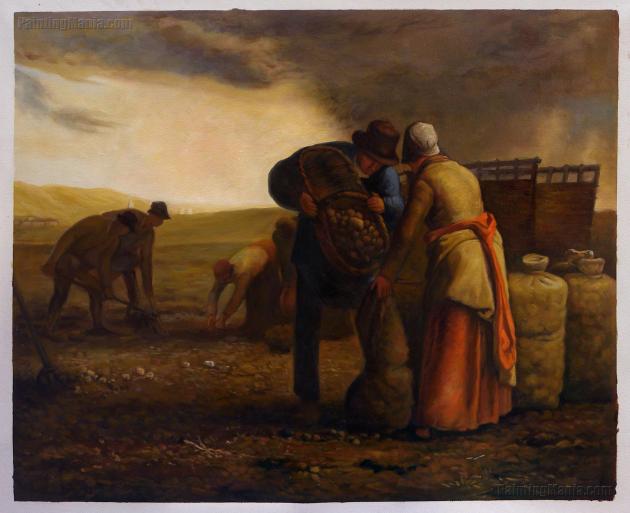
Potato Harvest – Jean-Francois Millet

Here’s one prime example of positive intersectionality within the Kingdom of God on earth. A father and mother raising children, a family connected with each other and to God and to their church and to the community is horizontal and vertical intersectionality. The hurting and oppressed are addressed within this intersectionality. Christians are mandated to “be steadfast, immovable and always abounding in the work of the Lord, knowing that their work in the Lord is not in vain”. Christians don’t let life run roughshod over them. They actively infuse life with good.

Status, whether as victim or as privileged, is not found in the Kingdom of God. The poor were not called victims by Jesus. The poor were ennobled by his words. Jesus changed their focus. James and John, the sons of thunder, were rebuked by the Lord for wanting special status in his kingdom. Jesus changed their focus. Jesus was not about to create any Frankenstein monsters on his watch. Those who are poor in spirit have kingdom status.

As someone in the kingdom “Do what you have to do” continues to be my mantra, even when tomorrow looks like last Monday and like the Monday before that. And that makes me intersectional in all the right ways.

~~~~~~~~~~~~~~~~~~~~~~~~~~~~~~~~~~~~~~~~~~~~~~~

Thomas Sowell is someone who could be labeled “intersectional” by definition. Yet, he is defined by and revered for his long scholarly career as an economist and as a common-sense conservative.

As for bad luck, there were years of that, too. But I learned a lot from that bad luck, so I am not sure that it was all bad luck in the long run.

-Thomas Sowell

You Don’t Need a Ph.D. to Help Your Child Get an Education

Thomas Sowell Biography

This Form Should Follow Function Out of Town

Every Sunday these days, as I attend church, I drive past a growing monstrosity. The miscreation covers one whole square block in the midst of a neighborhood of older classic-looking homes, homes with character that befits each homeowner. Even the new homes, as you will see, are fashioned with classic motifs. Both old and new houses in this neighborhood offer warmth, charm and beauty. These houses are homes. You want to be in them. For homeowners, fitting in matters and fitting in with beauty matters more. But now, these homeowners must view this place-destroying doesn’t-belong-here structure under construction.

The disjointed amalgam of glass boxes (cubist in profile) is to be the new public library in what one visitor called a “charming and quaint” little town. Other reviewers on a travel site had this to say: “If you long to be in vibrant Currier and Ives atmosphere, then this town is for you.” and “Straight out of a Norman Rockwell painting.  People come to this town from miles around to journey back in time to when warmth, charm and beauty mattered. The town’s architecture dates from mid-1800s. The town’s website proclaims an historic shopping district.

Now what does a public library contain, other than videos? It contains a wealth of information from the past. It contains literature and records of what has worked and what hasn’t. Modernism wants nothing to do with the past nor the wealth of accumulated aesthetics. Modernism wants to be “iconic” on its own and stand outside of historical (and the neighboring human) context. Enter cold, ugly, and de-humanizing modernism into the “charming and quaint” little town to quash human sensibilities. Its Form Should Follow Function Out of Town. See for yourself.

These photos were taken on a grey overcast day, not unlike the dreary ominous subject.

This new public library adds insult to injury. Witness previous desecration of the townscape. This is the police station just off the historic shopping district and across the street from more of the homes described above.

About three blocks from the new public library and just off the historical shopping district is the historical (150 years old) church I attend.

~~~~~~~

Modernist buildings exclude dialogue, and the void that they create around themselves is not a public space but a desertification

-Roger Scruton, philosopher

Coming Up Short

Two TV programs that I watch when I can: Bar Rescue with Jon Taffer and The Profit with Marcus Lemonis. I watch these programs from the perspective of a former business partner in a multi-million dollar enterprise and as a follower of Jesus. I watch them because they provide insight into human nature and the nature of rescue. (Blessedly, there are no Progressive Element talking points (race equality, gender equality, wage equality, etc.) in these programs. The only politics involved are the underlying business relationships of the owners, managers and employees.)

A different bar is presented during each hourly segment of Bar Rescue. If one were to watch Bar Rescue over many episodes, one would see that each new scenario has many of the same old problems. And one would hear that the owners are deep in debt. In many cases the owners have invested their life savings, their home’s equity and their retirement funds to keep the failing business afloat. Because of bad assumptions and broken processes and botched relationships the heavily-invested owners will not only lose their business in a matter of months, if not weeks, they will also lose everything invested. So, they agree “to pull back the doors, bust open the books, and make a call for help—to Bar Rescue.

Enter Bar Rescue’s Taffer. He is invited to assess the failing bar. My own assessment gathered from my many viewings of the program: the owners continue to do the same thing over and over hoping for a different result.

At the show’s opening Taffer is shown sitting in a car with two professionals, typically an experienced mixologist and a skilled chef. They view the bar via hidden cameras. They talk about what they see. Here’s a typical recounting of what they view from the car:

The bar’s name recognition is off. The signage is uninviting and confusing. The marketing is off and even off-putting. The signage is more of a liability than an asset.

The bar is chaotic. The employees have no direction and no constraints. The bartenders are drinking and over-pouring away the profits. Some of them sit at the bar. Others party with the customers. In one episode a woman, one of three equal partners, sits at the end of the bar every night smoking and drinking. She told Taffer that she thought that’s what her partners wanted.

The owners and managers appear indifferent and helpless and overwhelmed as to what is going on before their very eyes.

Relationships, at home and in the business, are dysfunctional. Denial and finger-pointing create more distance between partners. Employees and managers verbally fight in front of customers. The alcohol in their systems adds to the bar-family drama and acrimony.

Customers are given horrible beyond-expiration-dated food. The kitchen is unsanitary or unusable. The cook, often a novice, struggles to make decent food. The bar waitresses serve their customers slop.

As a “food and beverage industry consultant specializing in nightclubs, bars, and pubs”, Taffer becomes riled up as he watches. He storms into the bar and confronts the owners about what he saw. And what he saw was what has been right in front of the owner’s eyes for months.

Taffer, in a confrontational style, points out to the owners what he just witnessed via the hidden cameras. He makes “them face reality”: “nobody is being a manager!”; “It looks like the blind leading the blind!” In response, the bar’s owners usually become defensive and deny doing anything to create the situation. They deflect responsibility by acting as if they deserve better treatment from Taffer. They hold a sense of entitlement but not a sense of responsibility.

The staff confirms to Taffer what has been going on in the bar. He encounters employees who are conscientious and desire step-up management. And there are others who make excuses for their behavior after being caught on camera. The owners and managers are no different. Though the bar is obviously failing before their eyes, their pride is the resistance to accepting responsibility for the obvious failure. They balk at personal change. Taffer makes the reality of their dysfunction clear with a stress test: “If you can’t manage an empty bar, how will you manage when it’s filled?!”

After some initial training of the bartenders and the cook, Taffer invites in a crowd to see how the bar functions. By overwhelming the bar with customers, the test reveals to the staff that they cannot handle the level of business they need to succeed to meet monthly expenses, including employee paychecks, let alone be profitable.

Though the bar had opened successfully years before and brought in a stream of revenue, lack of good business practices and an “Anything Goes” mentality brought the bar to the brink of bankruptcy. Taffer opens the books. The bar’s revenue is less than half of what it was at the beginning. The heavily invested owners are about to lose their homes, their retirement and more.

Taffer talks to the owners one on one. He asks about the bar’s early years. With empathy he addresses issues both business and personal. Getting the business’s underlying relationships in order is a priority. Dysfunction has created the chaos and mounting losses. Regarding the unpaid staff, Taffer tells the owners “When you own a business you need to give the employees a better life.” Taffer seeks to light a fire under the owners/entrepreneurs. He offers a new vision and a new bar design with new tools. He offers hope for the bar’s turnaround.

“Let’s get to work!” Taffer tells the bar staff. The two experts are brought in to train the staff. The mixologist trains the bartenders in making properly poured cocktails. The chef trains the cook how to make delicious bar food. After the bar is rehabbed, Taffer presents the new look to the anxious staff. They are overwhelmed by the change. The bar’s signage is inviting and brand declarative. (Sometimes a new name is required despite the owners balking.)  Renewed and revived, they gear up for a new opening of the bar.

The opening is flooded with guests. The processes begin to work as they should. Taffer had told the staff, countering their assumptions, “The guests don’t want cocktails, they want the experience.” The experience begins to happen for the guests. The bar appears ready for success. Taffer leaves after many hugs and the owners saying “Thank you.”


For the sake of brevity, I’ll sum up what I see of human nature and the nature of rescue from both reality TV shows.  But first, some background on The Profit.

Marcus Lemonis is presented with applications from failing business (some 44,000 per Inc.com). When he picks a company, he considers it as a possible investment opportunity. “My ultimate goal is to make a reasonable return,” he says. “If I can average 15 to 18 percent on my money, I’m happy.

The Inc. com web article Marcus Lemonis: The Way of the Profit starts with this:

Both on screen and off, Marcus Lemonis is the king of turning around failing small businesses. But his obsession with fixing companies comes at a price.

And, later in the article we learn of Marcus’ and the viewer’s perspective:

“In most cases, the people who apply to get on the show are really in need of more than just financial help,” Lemonis says gently, and when he offers more, as he often does–by calling out a bully boss or defending an overworked and underappreciated employee–that’s when viewers might see parallels with Dr. Phil or even the Dog Whisperer. A lot can happen in those 40 unscripted minutes.


Where Bar Rescue presents a consultant-rescuer, The Profit presents an investor-rescuer. Both men must deal with the underlying issues that negatively affect a business. Both offer retooling and reimaging the business. Both encounter a wall of resistance to change. Pride, denial and the owner’s excuse “we’ve always done it this way” impede the business. The consultant and the investor challenge the assumptions, the habits and the lack of accountability they find. The business will not grow and, worse, it may fail completely if their advice is not taken.

Both offer a rescue from the way things are for the heavily invested and the deeply in debt. As Taffer said on one occasion, “We need to take a different path.” Both men give stern warnings about the business’s state of affairs. They each point to the wall of resistance and to the wall of reality.

For both the consultant and the investor, the business’s outcome becomes personal. People’s lives and their welfare are at stake. The business is an extension of the owner’s personal failure or his success.

Both men command respect. They speak with strong self-assured voices. And both are empathetic to the owner’s plight, especially as it concerns relationships that have soured. Their combined benevolent authority and considerate empathy bring about change in the businesses they rescue.


Human nature: Man is often antagonistic to personal change. Man will point to the circumstances and/or others as the problem. Man has blind spots. Man’s pride keeps him from seeing what is right before his own eyes. Man often refuses to communicate his shortcomings wanting to appear in control of himself as things he cares for spin out of control. Man resents being told he is going down the wrong path and that he has come up short. Man is often lazy and seeks the minimum of effort to correct what is wrong. Man invests heavily in himself as the captain of his fate. Yet, his Titanic ego doesn’t let him see the icebergs until it is almost too late.


Rescue: An authoritarian voice is required. There are those third-party consultants and investors with years of experience who can show a man the way to succeed. They are able to see things as they are without emotional attachment.

Rescue requires turning around and taking a new path. Rescue requires meekness. Rescue requires learning new habits and processes. Rescue requires facing reality and throwing away assumptions based on unreality. Rescue requires a man taking responsibility for his actions. Rescue requires a man seeing he has come up short and seeking the advice to fill up what was lacking in himself.


~~~~~~~~~~~~~

One very clear dynamic I see in both programs: employees want to be part of something successful and worthy of their effort. They gain a sense of dignity when they invest themselves in things that they deem profitable to their well-being, to their self-esteem and to other’s well-being. They want to tie their wagons to owners/managers who are success bound and who are both firmly directive and also have good human relations skills such that make them able to convey direction. They desire managers and bosses who are empathetic when it is called for. Employees desire training to improve their skills, to achieve success personally.

Employees want to see themselves involved in something much higher than a bottom line. The owners/managers must evoke a vision that dignifies and elevates the work being done, especially in light of the customer. Work must be all-around humanizing.

~~~~~~~~~~~~~


For those of you who know they have come up short of the glory of God and have put their trust in the One True Authoritative and Empathetic Counselor Jesus, you can rejoice in “the proper goal of your faith – namely, the rescue of your lives. 1 Peter 1:8-9

“Let’s get to work!”

Living Out of Context


A recent Twitter conversation offers some insight into the thinking of many.

Background: a presidential candidate presents himself as Christian and gay. A Twitter post highlighting this candidate was replied to by a well-known religious figure (XYZ). The reply stated unequivocally that you cannot be Christian and gay. (I am purposely leaving out the names (and politics) involved because there is a greater issue going on here. Politics adds another level of misanthropy to an already contentious and serious issue lurking beneath.)

In a reply to XYZ’s censuring Twitter post, a gay man (rainbow flag tagged) replied:

 “Jesus NEVER SAID ONE WORD about being gay He did however warn us about false prophets – like XYZ.”

After reading many similar replies over the past two years the selective blind-men and the elephant thinking behind such responses goes something like this: Jesus the Progressive revolutionary showed up one day to bring about change we can believe in. God’s initial project – keeping the Law – was too off-putting and not inclusive. Besides, there are no more animal sacrifices the Law required. Jesus deemed the project a failure. And so, he rejected that plan and began a new one of love, grace and mercy, of inclusion and diversity. To make his point Jesus had to kick some butt, the butt of those who judge and of hypocrites (since man is the measure of all things and feelings are truth). And because of the new radical program imparted by Jesus, Biblical accounts like the account of Sodom and Gomorrah therefore must be revised to fit the new narrative: God’s fire and brimstone judgement was not brought on by the attempted homosexual rape of Lot’s guests but due to people not being welcoming and inclusive. Does this sound familiar?

As I have witnessed time and again, the standard replies from gays and social justice warriors (SJWs) on Twitter (as evidenced above) is that Jesus, as Condemner, did not mention homosexuality and therefore gave it a pass. This way of thinking, of course, is not inclusive (except in revisionist form) of all that happened before Jesus showed up, nor of the whole of Scripture and its narrative of the Enduring Context. These gays and SJWs live out of context.

Though the gospel accounts record Jesus saying that he did not come to abolish the Law and the Prophets but came to fulfill them (Matt. 5:17), it seems that many today think that Jesus did abolish the Law and the Prophets in effect. They understand the gospels as Jesus freeing people from the letter of the Law and offering a more human (read liberal) way of living apart from the Law. They posit a contrast between the (negative) Jews who sought to please God by keeping the Law and the (positive) Jesus who they believe taught that you can only please God by having faith and love. The law-following Jews, stereotyped, are seen as rigid and obsessed with the Law the many deem antiquated. Jesus is seen as modern, flexible and love obsessed. Jesus’ encounters with the Pharisees is brought up as the example of this contrast.

The Pharisees were devout men who sought to keep the letter of the law. Jesus did not upbraid them for doing so. Rather, he challenged their keeping the spirit of the Law, their intentionality. And, it would be wrong to superimpose the understanding of the Law held by the Pharisees onto all Judaism at the time of Jesus. The Pharisees were among several religious groups at that time. Each held their own interpretation of the Law. It would be equally wrong to interpret Jesus’ encounters with the Pharisees as his rejection of the Law and his replacing it with love.

When the Pharisees test Jesus “Teacher, which commandment in the law is the greatest?” Jesus summarizes all of the commandments with words from the book of the law, the Torah’s Deuteronomy (6:5): Love the LORD your God with all your heart and with all your soul and with all your strength. And, from Leviticus (19:18): ‘Do not seek revenge or bear a grudge against anyone among your people, but love your neighbor as yourself. I am the LORD.

The gospel writer Matthew, whose account was intended for a Jewish audience, recorded Jesus’ the above encounter with the scribes (Matt. 22:34-40). His record of the Sermon on the mount is all about Jesus infusing the Law and Prophets with its intended meaning: to create a people who would represent the true humanity to the world.

When Jesus says, “You’ve heard that it was said…” Jesus is not contradicting the Torah. Jesus was providing a radical interpretation of its meaning and effect – to produce righteousness and life in his kingdom on earth. Jesus ends his sermon with “Be perfect, therefore, as your father in heaven is perfect.” (Matt. 5:48)

Like Matthew, the Apostle Paul, a scholar of the law, was keen to present the gospel within the context and continuity of the law and the prophets. He strove to make it clear what the law was intended for and not intended for. Early on Paul was adamant to write that the law was not what declared us righteous or gave us life or the promises of God (Rom. 4:13). He wrote to the church in Galatia in this regard and to admonish them (and Peter’s recent behavior) regarding the Law’s matter of circumcision, Gentile believers and being in the Messiah. He states that his law-keeping heritage is not what produces what is freely offered by the One Who is Faithful to the Law and its promises:

“We are Jews by birth, not “Gentile sinners”. But we know that a person is not declared “righteous” by works of the Jewish law, but through the faithfulness of Jesus the Messiah.” (Gal. 3:15)

Later in the same passage, he writes of the law’s purpose:

Before this faithfulness arrived, we were kept under guard by the law, in close confinement until the coming faithfulness should be revealed. Thus the law was like a babysitter for us, looking after us until the coming of the Messiah, so that we might be given covenant membership on the basis of faithfulness. (Ga. 3: 23-24)

Earlier, Paul writes of the law, the babysitter, keeping him in line with God’s intention:

Let me explain it like this. Through the law I died to the law, so that I might live to God. I have been crucified with the Messiah. I am, however, alive – but it isn’t me any longer; it’s the Messiah who lives in me. And the life I do still live in the flesh, I live by the faithfulness of God. (Gal. 3: 19-20)

And…

Let me put it like this. As long as the heir is a child, he is no different than a slave –even if, in fact, he is master of everything! He is kept under guardians and stewards until the time set by his father.

When we were children (babysat children), we were kept in “slavery” under the “elements of the world.” But when the fulness of time arrived, God sent his son, born of a woman, born under the law, so that he might redeem those under the law, so that we might receive the adoption of sons. (Gal. 4: 1-5).

Pauls’ letter to the church at Rome is an explanation of the gospel of Jesus Christ by means of its coherence with and continuity of the Old Testament. Paul writes, as above, that the Law was given to God’s people to shepherd them until an Israelite would one day come and completely obey the perfect law of the Lord (Rom. 5:18). Out of God’s righteousness, his covenant faithfulness, came Jesus, the Messiah, who obeyed his Father perfectly. Pauls’ letter to the church in Rome goes into great detail about the righteousness of God – his faithfulness to the covenants he made, as recorded in the Torah. God’s law would be fulfilled by God’s covenant. The reason God made a covenant with Abraham was to undo the sin of Adam and its effects, as revealed by the law. The law babysat those who received the covenant, keeping them in line with God’s promises until the Faithful One appeared and rescued the world.


Returning to the opening conversation, it is important to note that Jesus came to his people Israel. He spoke in the context of what they knew: the law and prophets. He did not speak to pagan issues such as idol worship and homosexuality. The law forbade that behavior. The Jews in Jesus day were well aware of this. Jesus commissioned Paul as “apostle of the gentiles” (Rom. 11:13). Paul did speak to those issues. Maybe that’s why many today reject Paul’s writings and choose an ends-justifying-the-means lawlessness.

In summary, if one hangs their hat on a just few chosen words of Jesus that justifies their worldview, then God’s worldview[i] as recorded in the Law and the Prophets and continued in the New Testament is meaningless to them. They are living out of context, just like the prodigal son.

The Prodigal Son 1888 John Macallan Swan 1847-1910


I am reminded of what Grace said at the end of the goings on in C.S. Lewis’ That Hideous Strength:


Those who call for Nonsense will find that it comes.”

~~~~~~~~~~~~~~~~~~~~~~~~~~~~~~~~~~~~~~~~~~~~~~~~~~

[i] We read in Genesis that God created heaven and earth. It was to be a His temple. Images of God – humans – were placed in the temple. Humans were to tend to it. Humans failed. The garden, the temple, became despoiled by sin. The law would not only act as Israel’s guardian but also the guardian of creation. If humans mess up, the creation is hurt.
Abraham was chosen to undo the sin of Adam. To make this happen, God promised him descendants as many as the stars and a tract of land. His descendants would be the caretakers of that smaller garden. Israel failed as the true humanity. They could not keep the law. They went into exile.
A Savior came to rescue the world. The kingdom of God on earth was initiated. The church was founded with the giving of the Holy Spirit into the likes of Peter, fallible humans. The church was created to reveal the true humanity to the world. The image of God would be restored in humans. Humanity and creation are to be redeemed as the church awaits the appearing of the Lord and final redemption.
God dwells with man in the New Heaven and New Earth. The law of the land: justice, righteousness and peace. There will be no, “Jesus NEVER SAID ONE WORD about …” It will be UNDERSTOOD.


Are You Witnesses of All This?


Over the last several posts I’ve written about philosophers (Epicurus in particular and Protagoras) and philosophies (Epicureanism and Stoicism). Taken together they state, among other things I described earlier, that this life is all there is. There would be no hereafter in that way of thinking. During the first century the Apostle Paul, the “the apostle of the Gentiles”, encountered those worldviews on the streets where he sold his tents and in the early churches where he taught.

Writing to those in the Corinthian church whose Gentile members denied a resurrection of the dead, Paul responded in a rather taunting manner to their philosophical take on death as final. The gospel he proclaimed – Jesus is Lord, forgiveness of sins, new creation, the kingdom of God on earth has been launched – all hinged on the resurrection of Jesus.

And if the Messiah wasn’t raised, your faith is pointless, and you are still in your sins. 1 Cor. 15:7

After addressing and closing the dead are raised issue with an eye witness defense (1 Cor. 15: 3-8), Paul responds to the heart of the Corinthian objection to resurrection: the nature of future bodies. He mocks their materialist objections using an analogy from nature:

But someone is now going to say, “How are the dead raised? What sort of body will they have when they come back? Stupid! What you sow doesn’t come back to life unless it dies. 1 Cor. 15: 35

No doubt, Paul also heard that Jesus responded in a similar fashion when he rebuked the Sadducees who denied the resurrection (as recorded in Luke 20:38 and below, in Mark 12:

“Where you are going wrong,” replied Jesus, “is that you don’t know the scriptures, or God’s power. When people rise from the dead, they don’t marry, nor do people give them in marriage. They are like angels in heaven.

However, to show that the dead are indeed raised, surely you’ve read in the book of Moses, in the passage about the bush, what God says to Moses? ‘I am Abraham’s God, Isaac’s God, and Jacob’s God’? He isn’t the God of the dead, but of the living. You are completely mistaken.”

In the same letter (1 Cor.15:19), agitated Paul, in talking about people’s motivations in light of their position on the resurrection, recommends Epicurean self-pity if the dead are not raised.

If it’s only in this present life that we have hope in the Messiah, we are the most pitiable members of the human race.

He later quotes a popular Epicurean saying that embraces self-pity and self-indulgence in light off…

…If the dead are not raised,

“Let us eat and drink,

for tomorrow we die.”

1 Cor. 15:32

What was Paul’s background that offered him insight into Greek philosophies? We learn from Acts 21: 37 -39 as he defends himself against highly agitated Jews who clamored for his arrest.  He is brought before a Roman tribune:

“Am I allowed to say something to you??” he asked.

“Well!” replied the tribune. “So you know some Greek, do you? Aren’t you the Egyptian who raised a revolt some while back and led those four thousand ‘assassins’ into the desert?”

“Actually, replied Paul. “I am a Jew! I am from Tarsus in Cilica. That’s not an insignificant place to be a citizen of. Please let me speak to the people.”

Inferring his Roman citizenship, Paul goes on to defend his Jewish background in the face of his Jewish accusers:

“I am a Jew, he continued, “and born in Tarsus in Cilicia. I received my education here in this city, and I studied at the feet of Gamaliel. I was trained in the strictest interpretations of our ancestral laws and became zealous for God, just as all of you today.”

Paul had significant first-hand knowledge of Greek, Roman and Jewish worldviews. Paul was more than able to respond to the Epicurean context of the Gentiles. Paul was more than able to present the gospel in the context of the Jewish worldview, a worldview of monotheism, the Temple, eschatology and …resurrection.

The narrative of the resurrection and an eschatology of the age to come took on great import during the Second Temple Judaism. Other than the words of Moses and some metaphorical allusions to resurrection by Isaiah (Isaiah 26:19) and Ezekiel (37), there isn’t mention of the resurrection in the Old Testament. Those allusions were applied during the Babylonian exile. They refer to the restoration of Israel as a nation and the reoccurring theme of exodus from bondage. The scribe Daniel is the first to mention the resurrection in non-metaphorical terms when he describes the “wise”, the Jewish resistance to Antiochus, not dying in vain (Daniel 11).

It was during the intertestamental period that scribes began writing about the resurrection of the dead, among many other topics of concern during late Second Temple Judaism. The Qumran community kept these writings in clay jars within caves in case the community was taken out by the Romans.

The Jewish religious leaders in Jesus’ time knew these writings, e.g., The Epistle of Enoch and 2 Maccabees. The disciples knew them. Paul knew them. The writings were talked about in the synagogues and on the streets. These writings offered a Messianic hope for the coming day when God would put things right. In the meantime, they stoked courage against the looming threat of Roman authority. It is very likely that Mary and Martha would have known about these writing as well. It appears that Martha had an understanding of them when she confronts Jesus after her brother Lazarus dies.

When Martha heard that Jesus had arrived, she went to meet him. Mary, meanwhile stayed sitting at home.

“Master,” said Martha to Jesus, “if only you’d been here! Then my brother wouldn’t have died! But even now I know that God will give you whatever you ask him for.”

“Your brother will rise again,” replied Jesus.

“I know he will rise on the last day.”

(Notice the role reversals from the previous Mary and Martha encounter with Jesus in their home? Martha, the fussbudget homebody, is now interested to hear what Jesus has to say. She goes to meet him. Mary, who doted on Jesus at his feet, stays at home where she grieves and perhaps sulks that Jesus wasn’t there for her brother. She was given another chance at Jesus’ feet.)

Jesus responded to Martha.

“I am the resurrection and the life,” replied Jesus. “Anyone who believes in me will live, even if they die. And anyone who lives and believes in me will never, ever die. Do you believe this?”

“Yes, master,” she said. “This is what I’ve come to believe: that you are the Messiah, the son of God, the one who was to come into the world.”

Jesus responded to Martha’s eschatological understanding with, in effect, “I am revising your understanding with personal present tense knowledge of me”. Jesus then asks for Mary. Proximity to Jesus matters and not only for Mary and Martha’s sake but also for Jesus’ sake. He wants to see for himself the loss, the grief and the pain we feel. He would carry our griefs and sorrows to the cross and then remove the sting of death with his (and then our) resurrection.

When Mary came to where Jesus was, she saw him and fell down at his feet.

“Master!” she said, “If only you’d been here, my brother wouldn’t have died!”

When Jesus saw her crying, and the Judeans who had come with her crying, he was deeply stirred in his spirit, and very troubled…”

Mary and Martha witnessed the resurrection of their brother Lazarus. The three of them would learn of and perhaps be among the over five-hundred brothers and sisters who saw Jesus alive after his resurrection (1 Cor. 15: 5). All of them were witnesses of the things that came to pass. And what came to pass was not a doctrine or a philosophy or an apparition – a ghost. It was bodily resurrection.

No mere manmade philosophy, ancient or otherwise, could ever revive the dead or comfort the living in their loss with “Let us eat and drink, for tomorrow we die.” No amount of pleasure reduces the pain we feel. No amount of materialism and its cheerleading proponent Progressivism – a political pandering to self-pity – will provide hope for today. Those philosophical positions are about nursing wounds. Those philosophical positions are ephemera compared to the reality of the bodily Resurrection of Jesus and the new life offered to those who believe.

Only the Resurrection and the Life can reverse the downward spiral of mankind and provide hope that doesn’t pass away with a meal. Live in the present tense Resurrection and Life as Mary and Martha and hundreds of early followers of Jesus did.

Are you witnesses of all this? Of the resurrection? Or, are you witnesses of the Easter bunny? I think that’s what Paul had in mind when he mocked the Corinthians.

Empty tomb

~~~~~~~~~~~~~~~~~~~~~~~~~~~


The Resurrection is the central theme in every Christian sermon reported in the Acts. The Resurrection, and its consequences were the “gospel” or good news which the Christians brought: what we call the “gospels,” the narratives of Our Lord’s life and death, were composed later for the benefit of those who had already accepted the gospel. They were in no sense the basis of Christianity: they were written for those already converted. The miracle of the Resurrection, and the theology of that miracle, comes first: the biography comes later as a comment on it. Nothing could be more unhistorical than to pick out selected sayings of Christ from the gospels and to regard those as the datum and the rest of the New Testament as a construction upon it. The first fact in the history of Christendom is a number of people who say they have seen the Resurrection.

Miracles, C.S. Lewis

Genealogies of Straw?


…If the dead are not raised,

“Let us eat and drink,

for tomorrow we die.”

1 Cor. 15:32


People delight in looking into their genealogy to tell them where they came from and their ancestral background. But, what about the genealogy of our thoughts and our beliefs that are passed down? Continuing with the theme of my previous post, man as logos and centerpiece of the universe, man considers himself left to his own devices and to fend for himself. The “dead are not raised” has been passed down to us. Also passed down, la dolce vita, the Epicurean worldview prevalent today.

The originator of Epicureanism, the Greek philosopher Epicurus, and many others since, decided that God was not good at being God so man must take his place. In terms of the evil man encounters, this thinking is restated in the Epicurean paradox.

Per the Oxford Dictionary, Epicurus (341-270 B.C) was a “Greek philosopher, founder of Epicureanism. His physics is based on Democritus’ theory of a materialist universe composed of indestructible atoms moving in a void, unregulated by divine providence”.

According to several accounts, Epicurus lived and taught a philosophy of the unnoticed good life. He posited that man, a collection of particles he called atoms, would return to the earth when he died. From atoms to atoms you shall return, he postulated. When you are dead you are dead and while you are alive, as Epicurus advocated, seek pleasure and avoid pain.

Epicurus was not a political nor a spiritual man. He was more of a homebody given to a small circle of friends. Per Epicurus, everything to be trusted and believed came through the senses. And so, he deemed that God was remote if at all. And friends were real and to be trusted.

Epicurus also taught that nothing should be believed, except for that which was tested through direct observation and logical deduction – believed via the sensate and reason. Hence, the beginning of the fact/value split so prevalent in man’s thinking today. It is likely that Epicurus formed this worldview when he decided that God was uninvolved and impersonal at best and that he had to fend for himself.

Epicurean thought was embraced by some and passed down through the centuries. The Roman poet Lucretius, a disciple of Epicurus’s teachings and someone who lived about 70 years before Jesus, promoted the “god is angry” meme along with the theory of atomism formulated by Demetrius (460-370 B.C.), who died 29 years before the birth of Epicurus.

The atomic theory of the cosmos in brief: random, unguided ‘atoms’ smash into each other, thereby create the world and life as we know it. Such a hypothesis turned philosophy by Epicurus offered the ‘means’ to do away with a personally involved god and remove human accountability to God. Lucretius went on to tweak Demetrius’ theory.

Demetrius said that atoms do not always go in straight lives but can “swerve”. As such, his philosophy was then able to avoid atomism’s inherent determinism and to allow for man’s free will.

“What was most important in Epicurus’ philosophy of nature was the overall conviction that our life on this earth comes with no strings attached; that there is no Maker whose puppets we are; that there is no script for us to follow and be constrained by; that it is up to us to discover the real constraints which our own nature imposes on us.” ― Epicurus, The Epicurus Reader

Unlike the innocuous passing-on-sex Epicurus, the Romans took Epicureanism to new lows. The name of the Roman Emperor Caligula is associated today with unbridled decadence. Licentiousness continues today as the justification for the avoid-pain-seek-pleasure self.

The Enlightenment furthered Epicurean acceptance. As many began to claim science as the explainer for things being as they are and man as the interpreter of things as they are, the Enlightenment augmented the fact/value split. With science being claimed as the only arbiter of truth and reality, the transcendent was eschewed, as being unreasonable to ponder. Materialism and utilitarian atomism replaced the transcendent and facilitated the self-made man as the imago homo. An honest look around today would reveal that the worldview from the days of Epicurus down through the Enlightenment has been passed down to us.

“It is folly for a man to pray to the gods for that which he has the power to obtain by himself.” –Epicurus

As I see it, underlying cultural Marxism, secular humanism, Progressivism and the American Dream is the philosophy of Epicurus: extreme preoccupation with and indulgence of one’s feelings, desires, etc.; egoistic self-absorption, aka, solipsism. It is the worldview of safe spaces. It is the philosophy behind the Progressive’s push for acceptance of multiculturalism whereby all cultures are deemed equal including the dehumanizing ones so that individual culture has a larger safe space to operate in. The philosophy promotes universal healthcare as another safe space in the form of insurance against financial suffering as paid for by others so one can live an Epicurean lifestyle without pain. It is the worldview of the virtue-signaling relativist social justice warriors – I want a safe space for me to live my life as I see fit so I will serve up my self-justifying, self-righteous viewpoint of high-sounding humanitarianism. Epicureanism is the doctrine of the Religion of Humanity and the paean to mind and matter as savior.

Epicureanism underlies identity politics and individual rights. It promotes a circling of the wagons around your ersatz ‘friends’, your tribe, to protect your values and your territory for further self-satisfaction. It promotes dehumanization with its message that life has no meaning other than what you give it; life is only material and sensate. So, grab yours while you are alive. Out of this dehumanizing process comes the art, music, literature, media and architecture which degrade human existence and the imago dei in humans. But. Modern man, left to his own Epicurean devices, comes up short.

The narrator in C.S. Lewis’ Space Trilogy novel That Hideous Strength tells us about one of the central characters Mark Studdock. He is a young academic, a sociologist, and a member of the Progressive Element at Bracton College. He is an ambitious, self-centered and shallow intellectual who has come into the service of the National Institute of Coordinated Sciences (NICE). He believes NICE will serve the best interest of humanity through progress at any cost. Once he stopped hemming and hawing about joining the organization he is welcomed into the inner circle. But he soon finds that he has committed himself to a hellish organization which plans to re-do humanity by force so that only the best humans (in NICE’s view) remain. He is made aware that the tentacles of the organization are growing.

Studdock is told in no uncertain terms that the organization wants his wife Jane to join him. He is ordered to bring her in. With no moral depth and no moral base outside himself to guide him, Mark is perplexed and now in great fear for his life. Pain and death are the only things that are real for him.

It must be remembered that in Mark’s mind hardly one rag of noble thought, either Christian or Pagan, had a secure lodging. His education had been neither scientific or classical – merely “Modern”. The seventies both of abstraction and of high human tradition had passed him by: and he had neither peasant shrewdness nor aristocratic honor to help him. He was a man of straw, a glib examinee in subjects that require no exact knowledge (he had always done well on Essays and General Papers) and the first hint of a real threat to his bodily life knocked him sprawling. And his head ached so terribly and he felt sick. Luckily he now kept a bottle of whisky in his room. A stiff one enabled him to shave and dress.

What is your genealogy of thought and belief? Is it a genealogy of strawmen?

~~~~~~~~~

The opening quote is from the Apostle Paul’s letter to the Corinthian church. He is countering the embedded Epicureanism active in the church in Corinth. He does so with the resurrection.

To be continued.

Lost in Self-logos


Thus, in the conception of Humanity, the three essential aspects of Positivism, its subjective principle, its objective dogma, and its practical object, are united. Towards Humanity, who is for us the only true Great Being, we, the conscious elements of whom she is composed, shall henceforth direct every aspect of our life, individual or collective. Our thoughts will be devoted to the knowledge of Humanity, our affections to her love, our actions to her service. -Auguste Comte, A General View of Positivism [1848]


Mankind learned centuries ago, by the efforts of men like Polish astronomer Copernicus, that we do not exist in a geocentric universe. Now, according to some physicists, mankind is at the center of the cosmos. In order to avoid a Creator scenario, these scientists promote the anthropic theory:  the reason for the perfectly-tuned universe, for its fundamental physical constants, and the reason why things exist as they are on earth is that human existence required it. To support this theory, they posit a multiverse scenario with infinite trials and errors until man could exist.

Amir Aczel, PH. D., in his book Why Science Does Not Disprove God, describes some physicists’ viewpoint:

…if we are here, and the parameters need to be perfectly chosen for us to be here, then surely there must be infinitely many other places where parameters are wrong. We are here because we can only live where the parameters are right for our existence.

Now, I have no issue with the possibility of multiverses. But as Dr. Aczel writes, the proposed multiverse-as-cause theory to replace the creation narrative offers no mechanism to create the multiverses. The theory proposes an infinite number of somehow existing parameters doing something over and over infinitely many times to finally ‘create’ the perfect conditions for a habitable zone. Dr. Aczel goes on to state, “The anthropic theory is the weakest route to the multiverse.” As I see it, the theory has no mechanism for merit other than those who promote a God-less universe. The theory is basically one of effect with no Ultimate Cause. It is a theory of chance which says man is the reason for his existence.

Man-centered philosophical endorsement would come from the likes of Nietzsche. His “God is dead” rejection of Christian values was a push for mankind to move beyond good and evil and to loving necessity. One is therefore to live with uncertainty as a “superman”, above and center of it all. From the mighty-warrior Nimrod to Wagnerian heroes to the present FX-ed generated superheroes versions of Nietzsche’s “superman” have been around since the Garden. The “superman” notion is akin to Darwin’s theory natural selection and the survival of the fittest. In Nietzschean terms, What doesn’t kill you, makes you stronger.

Social scientists place man at the center of the universe. Since Adam and Eve’s forced exit from the Garden of Eden, man, it seems to me, has always struggled to reclaim the Garden. Many seek to create a Garden Utopia through a relentless and self-directed improvement of the species. Darwin’s On the Origin of the Species supplies the process: selection, struggle, favored, preservation. Engels and Marx, Lenin, Trotsky, Stalin, and MaoTse-tung used Darwin’s theory of natural selection as justification for their “class struggle” political and economic theories. Millions have been imprisoned and slaughtered under the banner of “class struggle”. Strands of this ‘societal improvement’ is behind the current humanist thinking which is now being promulgated systematically by the Progressive Element. For Progressives, the social multiverses are the identity-centered tribes they select and deem struggling and require favored status and preservation.

Man, as the principle cause and logos of the universe, creates his own values. Thus, the religion of humanity. Secular humanitarianism is the tie that binds the Progressive Element: atheists, agnostics, deists, social Darwinists and those who buy into sentimental Christianity for the sake of progress. The creation of man-as-logos values produces a querulous society of competing values, hence the culture wars. Amorphous and relativistic values are promoted under the high-sounding and ambiguous rubric of “social justice”. Individualism is turned inward toward self-centered anodyne interest to be protected by “rights”. Progressivism inverts The Second Commandment: “love me as you love yourself”.

Vying for special status, groups call themselves “marginalized” and “victims”. This self-centered push for center stage drives identity politics: self-designated victims ‘struggling’ to ‘survive’ require ‘protection’ (rights). “I’ll make you care about what I care about – me” is the right to impose myself on others and call it “social justice”. Man, as logos, defines the impetus of the “social justice warrior:  resentment disguised as compassion which drives the will to power.

Resentment? Life is not easy to begin with. The arbitrariness of life and the forces beyond our control fuel resentment when contemplated in the context of others. Resentment leads to claiming that one’s gender or sexual proclivity or income status or healthcare as being victimized by others. Such a worldview, one without meaning except for self and necessity and a belief that relationships are defined by power, breeds contempt for those having some perceived advantage. Hence, the demand for societal and economic reparations and at any cost to others. Resentment is fueled by zero-sum thinking: one does not have because someone else has.

Resentment disguised as compassion? Man, as logos, wants to be seen as a self-justified humanitarian. Virtue signaling accomplishes that while being resentful at the same time. It is no-cost faux-altruism intended to make one appear empathetic and compassionate without appearing resentful except for those who question their virtue signaling. This is underneath the self-righteous clamor for the right of universal healthcare, of potable water, of inclusion, diversity, equity and the host of arbitrary self-placating categories.

Resentment disguised as compassion which drives the will to power? In an age that is increasingly nihilistic, power has become the transcendent meaning to life. And once you believe that relationships are defined by power you exercise the will to power to subjugate others to the relationships you desire. The exercise of the will to power implements mental-conditioning of its subjects, hence the revision of language and of history, to fit the narrative. The power to create one’s own truth is what is desired.

The best way to sum this mash of words is with the clarity of two Scripture readings from today. The first relates the man-as-logos worldview. The second reading describes those who are Logos centered.

The Parable of the Prodigal Son was the gospel reading for today: Luke 15: 11-32. The would-be Prodigal Son demands his rights (inheritance) from his father. The son considers his father dead to him. The father transfers assets over to his son. His son turns his shares into cash as he sells the property his father had accumulated over time through the father’s effort. The universe of one departs with his values and his will to power. He’s off to a distant land, far from the logos he knows. He leaves behind his father and the remaining older son to pick up his portion of work.

A lifestyle of nihilistic (sever famine) and sensate pleasure (self-directed compassion) has him eating slop in a pig sty. He’s sees that he is just another animal. His humanism ran out of money. He returns to his senses and heads home. His father sees his son a long way off and runs to meet him. The prodigal repents and the father rejoices in his return from the distant land of self. There is a celebration for the son who was lost but is found … alive. They are reconciled. But the brother has a growing resentment disguised as compassion for his father (“I’ve been slaving for you all these years!”) which drives his will to power to up his rights. He feels his rights, his pride of place, is diminished by his brother’s return and the father showering him with a wealth of unintended consequences.

The second reading is from the Epistles: 2 Corinthians 5: 16- 17. Paul writes about a Logos worldview that sees humanity from a kingdom perspective. He writes what the Prodigal experiences when he returns to the Logos and what the other brother claims as his right to experience.

From this moment on, therefore, we don’t regard anybody from a merely human point of view. Even if we once regarded the Messiah that way, we don’t do so any longer. Thus, if any man is in the Messiah, there is a new creation! Old things have gone, and look – everything has become new!


~~~

I recommend reading The Hideous Strength by C. S. Lewis for insight into humanism.

The Bill of Rumored Rights


Retired prison psychiatrist Anthony Daniels (Theodore Dalrymple) speaks and writes with keen insight gathered from his experience of the human condition and of its surrounding culture. Here is a short introduction of Daniels from the website Goodreads:

Anthony Malcolm Daniels, who generally uses the pen name Theodore Dalrymple, is an English writer and retired prison doctor and psychiatrist. He worked in a number of Sub-Saharan African countries as well as in the east end of London. Before his retirement in 2005, he worked in City Hospital, Birmingham and Winson Green Prison in inner-city Birmingham, England.

Daniels is a contributing editor to City Journal, published by the Manhattan Institute, where he is the Dietrich Weismann Fellow. In addition to City Journal, his work has appeared in The British Medical Journal, The Times, The Observer, The Daily Telegraph, The Spectator, The Salisbury Review, National Review, and Axess magasin.

In 2011, Dalrymple received the 2011 Freedom Prize from the Flemish think tank Libera!.

Not only is Anthony Daniels a prolific writer and well-read, as you’ll discover, he is also well-traveled. His accounts of staying in five countries (North Korea, Albania, Romania, Vietnam and Cuba), all five of which operate under leftist-ideology based regimes, is recorded in The Wilder Shores of Marx: Journeys in a Vanishing World. Would-be fellow travelers in the long march of cultural Marxism, both young and old, would do well to read about life in the totalitarian state under centralized government. Daniel’s accounts would be especially revelatory for the would-be fellow travelers promoting ‘democratic’ socialism, the ‘gateway drug’ to full-blown addiction to life under top down government. Democratic socialism is currently being promoted as the means to secure peace of mind (aka happiness) by coercively and exhaustively taxing the wealthy and then having unelected central planners redistribute the take. The uninformed traveler could also read about the state of Venezuela.

I first encountered Anthony Daniels via his essays in The New Criterion, a monthly literary magazine I subscribe to. His extensive bibliography is listed in the Wikipedia entry Theodore Dalrymple.

Having read several of his books, I recommend, for starters, the book noted above and the two books shown below.

Life at the Bottom: The Worldview That Makes the Underclass (start with this book)

Admirable Evasions: How Psychology Undermines Morality

Numerous articles written by Anthony Daniels appear in the Law and Liberty blog.

Below is a video of Anthony Daniels speaking at the Property and Freedom Society Annual Meeting last year (2018). His talk on multiculturalism begins with the subject of rights as misunderstood and misapplied today. My take: rights-gatherers employ victim status leveraged with inalienability to secure advantages in society. With their Bill of Rumored Rights they seek to bypass “the pursuit of happiness” and go directly to happiness.


How did our culture get turned on its head? “German Marxists”…”Marx and Freud”…”the Frankfurt school… left-wing academics… Columbia University”…

[Italian communist Antonio] Gramsci also looked to culture. If the Left truly wanted to win, it needed to first seize the “cultural means of production”: the culture-forming institutions such as the media and universities and even churches. He saw societal transformation coming about by a “march through the institutions.”…

Gramsci insisted that leftist intellectuals needed to question everything, including moral absolutes and the Judeo-Christian basis of Western civilization. They needed to frame seemingly benign conventions as systematic injustices that must be exposed. This is where we got professors fulminating against everything from “the patriarchy” to “white imperialism” to “transphobia.”

Marx at 200: Cultural Marxism’s Long Happy March Through the Institutions


How is the Cultural Revolution brought to bear on others? Enforceable Subjectivity (article by Theodore Dalrymple):

According to the Metropolitan Police, “evidence of the hate element is not a requirement. You do not need to personally perceive the incident to be hate related. It would be enough if another person, a witness or even a police officer thought that the incident was hate related.”

Example given:

Had a message from Guildford police tonight about my tweets following an appearance on @GMB with Susie Green and Piers Morgan. Susie Green has reported me for misgendering her daughter.

https://twitter.com/CF_Farrow/status/1107779340723515392

“A British police force is investigating @CF_Farrow, a journalist, because of words that she published,” writes @jameskirkup

https://twitter.com/SpectatorUSA/status/1108144367716302848

The Enduring Context


It was about this time of the year back in 2000 when I took my two oldest to Chicago’s Field Museum of Natural History (the Field Museum today). What did we go to see?

CHICAGO — For the first time in 50 years, the Dead Sea Scrolls will visit Chicago in a special exhibition at The Field Museum March 10 through June 11.

Written on parchment and papyrus more than 2,000 years ago, the scrolls contain what are believed to be the oldest surviving copies of the books of the Old Testament…

Portions of 15 difference scrolls will be on display in The Field Museum’s exhibition, including five that have never traveled outside of Israel. One of those five is a segment from the book Deuteronomy, which includes the Ten Commandments; the other four contain language and concepts similar to those in the Gospels of the New Testament — written more than 100 years later.

The exhibition will also feature 80 artifacts from Qumran, the archeological site near which the scrolls were discovered;

Dead Sea Scrolls to be displayed in Chicago


I was enthralled by the exhibit. Parchment that is over 2000 years old containing Jewish manuscripts gave witness to the community of the “sons of light”. These “men of the covenant” cursed Belial and his unclean spirits, worshiped with angels and preserved the understanding of those who set themselves apart from the Second Temple they believed to be corrupted by sinful leadership.

The almost nine-hundred manuscripts found in eleven caves at Qumran provide us with the context for the time of Jesus. They record the Qumran community’s messianic hopes for salvation in the very near future. They speak of the resurrection, of angels and demons, of the Law and Prophets and of secular matters at the time.

The gap between the Protestant Testaments, with the exception of the book of Daniel, is about four-hundred years. The Old Testament doesn’t provide context for the time of Jesus other than in large broad strokes of God’s dealing with beastly kingdoms and the hope of God intervening to save His people. The Old Testament established the narrative that leads us to the fullness of time when Jesus was born and his kingdom on earth announced. The scrolls continue the narrative and connect the Old and New Testament times. And, more importantly, they help us understand the thinking of the first century Jew. They explain the words and phrases Jesus uses in conjunction with contemporary Jewish thought and theology. They explain Jesus as a Jew.

Though I was fascinated by the scrolls, my two boys would show more interest in another exhibit a few months later. In a sense the two exhibits ran parallel – discoveries reveling context.


SUE finally made a dramatic debut in Stanley Field Hall on May 17, 2000


In 2000 Sue the T. rex, a 67-million-year-old fossilized skeleton, was put on display. It is said to be the most complete specimen of its kind.  This display became the starting point to my accepting evolutionary creation.

I met up with more dinosaurs a few years ago. The company I work for held its one-hundred-and-twenty-fiftieth anniversary celebration in the great hall of the Field Museum. (Job-keeping disclaimer: the dinosaurs are not the people I work with!) The anniversary celebration was another reminder of the Enduring Context. Men and women have been working together for 125 years within an engineering company providing solutions that help mankind.

Just a few weeks ago I visited my mother. She is almost ninety and in hospice care. Once again, I was reminded of the Enduring Context. Mom’s and dad’s steadfast faith in God, which they received from their parents, has been passed down to their children, to their grandchildren and to a multitude of great-grandchildren.

We will do well to remember the past, its fragments and as it is fragmented before us, for we are not without its context. Whether it be dinosaur bones attesting to God’s evolutionary creation or scroll fragments attesting to a community that wanted to keep God’s narrative alive over 2000 years ago the presence of testimony from the past shouldn’t be discounted. The Enduring Context which began in God before the Big Bang is God’s desire for the universe He created. The Enduring Context can be summed up in the words of the Lord’s prayer: “Thy will be done on earth as it is in heaven.”

jacopo-tintoretto-crucifixion-1500s

There is art, music, literature, and architecture created with the Enduring Context in mind. And, there is art, music, literature, and architecture which knows knowing of the Enduring Context. The Progressive Element, eschewing the past, deems itself the only context that matters every time it rewrites history. Unless you are God or a Progressive demi-god, there is no present without the past for the likes of us. And if, as the English metaphysical poet John Donne wrote, “No man is an island entire of itself” then certainly no man is a context entirely to himself. A modern philosopher had this to say about context:


“We must strive to be worthy of an inheritance that we did not create, and to amend it only when we have first understood it” Roger Scruton Rousseau and the Origins of Liberalism


And though it seems to us in our daily struggles that sickness, death, injustice and evil are the Enduring Context, these are temporary. The resurrection of Jesus made sure of that. Our resurrection will continue the Enduring Context.

As followers of Jesus we imitate the One and the ones who are the Enduring Context. Our Lord’s context becomes our context as we walk in the Enduring Context of our citizenship:

So, my dear family, I want you, all together, to watch what I do and copy me. You’ve got us as a pattern of behavior; pay careful attention to people who follow it.

You see, there are several people who behave as enemies of the cross of the Messiah. I told you about them often enough, and now I am weeping as I say it again. They are on the road to destruction; their stomach is their god, and they find glory in their own shame. All they ever think about is what’s on the earth.

We are citizens of heaven, you see, and we’re eagerly waiting for the savior, the Lord Jesus, who is going to come from there.