“I am thirsty.” These words spoken just before Jesus gave up His spirit on the cross reveal the need for life’s most basic requirement: life-sustaining water for the body and the soul.
The crucifixion’s slow and agonizing death with its depletion of bodily fluids would cause a human body to dehydrate to the point of suffocation. The blood pouring from the Lord’s hands and feet and from His lash wounds would deprive His body of its normal blood flow, blood flow which carried necessary oxygen to all of the body’s organs. Water was desperately needed. Instead, Jesus was mockingly offered a sponge soaked with wine which had turned. After tasting it he rejected the old wine and its numbing effects.
“I am thirsty” indicates the Lord’s need for water but more importantly these words also reveal that the Living Water, God the Holy Spirit, was also leaving the Lord at this point in time. Because Jesus bore the sins of the world He could not have fellowship with His Father and the Holy Spirit until His work of atonement was complete. Until then The Trinitarian Well of eternal fellowship was cut off from the Son of God. In place of this Well, Jesus chose to drink from the bitter cup of God’s will.
King David prophesied about the relational and physical torment that the Messiah was to suffer on the cross. From Psalm 22:
My God, my God, why have you forsaken me?
Why are you so far from saving me,
so far from my cries of anguish?
My God, I cry out by day, but you do not answer,
by night, but I find no rest….
I am poured out like water,
and all my bones are out of joint.
My heart has turned to wax;
it has melted within me.
My mouth is dried up like a potsherd,
and my tongue sticks to the roof of my mouth;
you lay me in the dust of death.
In this act of substitutionary atonement the Lord’s body bore all the sin of all men for all time. On the cross Jesus rapidly became depleted from loss of fluid and, as Psalm 22 tells us, from the loss of Living Water – Jesus was forsaken by the Father and the Spirit. “Because he poured out Himself to death” Jesus became as a barren desert, a desolate place with no water. He was made sin for us.
John’s Gospel account offers the Creator’s context for the words “I am thirsty.”
In the gospel narrative the apostle John relates the true story of Jesus meeting a woman of Samaria at Jacob’s well.
The well and the field surrounding it were gifts from Jacob to Joseph. And you will remember Joseph. He is the one who received good gifts from his father (the coat) and bad treatment from his brothers. I have no doubt that the well was, well, well-known to many who traveled though the area. I’m sure it was on the map of those seeking to quench their thirst, thirst brought about by the day’s relentless heat. John’s account tells us that as Jesus was traveling from one place to another he became tired and thirsty. He stopped outside the town of Sychar at the well to rest.
As Jesus sat down near the edge of the well he told his disciples to go and get some food in the nearby town. It is midday. The sun is directly overhead and the heat is stifling. Jesus had no means of retrieving the water from the well. You can imagine someone being thirstier when they know that water is just out of reach.
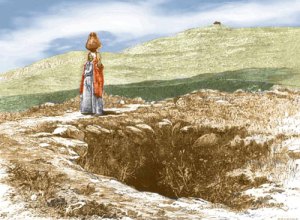
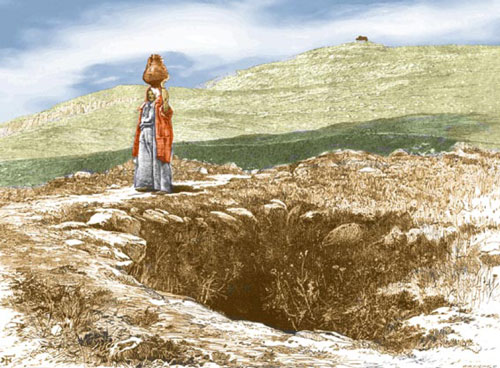
As Jesus sits resting a woman from the town of Sychar approaches the well carrying her clay jar (I am assuming some things here.). The woman comes to the well in the middle of the day because, I believe, no one else will be there during the hottest part of the day. She has her reasons for not wanting to be around the other women of the town: she sleeps around.
Jesus, thirsty, asks the woman for a drink: “Will you give me a drink?”
The woman was at a loss as to what to think:
The Samaritan woman said to him, “You are a Jew and I am a Samaritan woman. How can you ask me for a drink?” (For Jews do not associate with Samaritans.)
From the gospel account:
Jesus answered her, “If you knew the gift of God and who it is that asks you for a drink, you would have asked him and he would have given you living water.”
“Sir,” the woman said, “you have nothing to draw with and the well is deep. Where can you get this living water? Are you greater than our father Jacob, who gave us the well and drank from it himself, as did also his sons and his livestock?”
Jesus answered, “Everyone who drinks this water will be thirsty again, but whoever drinks the water I give them will never thirst. Indeed, the water I give them will become in them a spring of water welling up to eternal life.” (emphasis mine)
The woman said to him, “Sir, give me this water so that I won’t get thirsty and have to keep coming here to draw water.”
He told her, “Go, call your husband and come back.”
“I have no husband,” she replied.
Jesus said to her, “You are right when you say you have no husband. The fact is, you have had five husbands, and the man you now have is not your husband. What you have just said is quite true.”
“Sir,” the woman said, “I can see that you are a prophet. Our ancestors worshiped on this mountain, but you Jews claim that the place where we must worship is in Jerusalem.”
(Note: The woman, like most of us, wanted to deflect the accounting of her sinful life. Becoming polemical the woman quickly changed the subject and pressed Jesus about a heated religious and geopolitical issue of the day.)
Jesus, having already gotten the woman’s attention by recounting intimate details of her life, responded to her question about true and valid worship as the Source, the well-spring of Truth.
“Woman,” Jesus replied, “believe me, a time is coming when you will worship the Father neither on this mountain nor in Jerusalem. You Samaritans worship what you do not know; we worship what we do know, for salvation is from the Jews. Yet a time is coming and has now come when the true worshipers will worship the Father in the Spirit and in truth, for they are the kind of worshipers the Father seeks. God is spirit, and his worshipers must worship in the Spirit and in truth.”
The woman said, “I know that Messiah” (called Christ) “is coming. When he comes, he will explain everything to us.”
Then Jesus declared, “I, the one speaking to you—I am he.”
Water flows through John’s gospel. John the Baptist baptized “with water so that He (Jesus) might be revealed by Israel. In the above passage we learn about Jesus chatting with a woman as he sits next to a well. There He talks about the everlasting living water which wells up inside you if you accept it. In a previous passage John recorded Jesus’s first sign: turning water into wine at a wedding in Cana. In the passage after the Jacob’s well story John tells us about a lame man who had been trying for thirty years to enter the healing pool in Bethesda. The water of the pool would bubble up with curative power whenever the Spirit stirred it. But the man had his excuses for not being well. In a later passage John recounts Jesus walking on the water to meet the disciples in the middle of a lake.
Then one time …
On the last and greatest day of the festival, Jesus stood and said in a loud voice, “Let anyone who is thirsty come to me and drink. Whoever believes in me, as Scripture has said, rivers of living water will flow from within them.” By this he meant the Spirit, whom those who believed in him were later to receive. Up to that time the Spirit had not been given, since Jesus had not yet been glorified. (emphasis mine)
Are you thirsty? Are you trying to quench your deepest thirst with the things of this world, things that quickly run ‘dry’ from everyday use? Do more clothes, more electronic gadgets, more Facebook friends, more entertainments, more tattoos, more tipping points, more of anything this world has to offer satisfy your deepest thirst?
The woman at the well had her life of men. She had her connections. She also had her water bucket. She brought this bucket to the well everyday to get the water she needed to survive. The woman could argue religion and politics with the best of them but she was thirsting for something more. She may have wondered “is that all there is?” Is that all that life has to offer someone like me, a woman of Samaria marginalized by my own community and holding on to an unsure belief in an object of worship others are telling me to believe in.
Unknowingly, it was of the True Well of Life that she made her request: “Sir, give me this water so that I won’t get thirsty and have to keep coming here to draw water.” Jesus responded: If you knew the gift of God and who it is that asks you for a drink, you would have asked him and he would have given you living water.”
We know that drinking water is necessary for life. We listen closely to health programs that tell us to drink several glasses of water a day to sustain our bodies, to help them function properly and to replenish the oxygen our systems need. As you would imagine the quality of water that you drink is critical. Undoubtedly, water that contains filth would do more harm than good. Is the well water you are drinking clean and pure, refreshing and restorative? Or, is it filthy with parasites making you weak and sick?
The water that Jesus offers to you and me is greater and purer than the most abundant compound found on earth: H2O. It is the Living Water of the Holy Spirit. This water teems with Abundant Life, the very oxygen of heaven. Once received its Spirit-life effervescence bubbles up within a person. It then overflows your spirit and converges with the rivers of Living Water that have never stopped flowing throughout all of eternity except for that dark hour when the Gift of God Himself was poured out as a drink offering and He cried, “I am thirsty.”
*****
Shechem’s Archaeology




No News Here: Friday the Thirteenth, 2012 Edition
April 13, 2012 Leave a comment
US education failure poses a national threat: Wow! And just think what the failing US education system (thanks to the teacher’s union, its lobby and liberal universities) does for the election process: A lack of critical thinking which leads to populist voting which in turn leads to stage one laws being enacted which in turn leads to bureaucracy which in turn leads to totalitarianism (in a nutshell). (Leads to totalitarianism because people will be too stupid to know any better and they will have given up all of their freedom to the intellectual elite contingent that has been anxiously waiting for that day when you say “I can’t do this anymore.”
Activist Judges are not Inactive: Ruth Bader Ginsberg Associate Justice of SCOTUS fame during one of her “teaching moments” at an “Arab Spring” conference: “I would not look to the U.S. Constitution if I were drafting a constitution in the year 2012.”
This in spite of the fact that our Constitution has been the template that has supported her free range blather all of her life. Now, instead of fidelity to the U.S. Constitution, RBG prefers a constitution based on International Law (basically, One World humanism administered by ad hoc panels made up of hand-wringing liberals).
Like Obama and the Dems, RBG is on a much higher humanitarian plane than the rest of us crass peons. She’s at altitudes where there is little or no oxygen.
The franchised system of bureaucracy known as Obamacare will cost a lot more than expected: Also, did you know that with Obamacare coverage will be mandated but care will not? You didn’t? Well, you know that according to Nancy Pelosi, another high-flying Democrat, “We needed to pass the bill to find out what was in it.”
Not the Scooby-Doo ending: Voting for Democrats is voting for the decline of America and the rise of totalitarianism and the likes of the Supreme People’s Party and its chief Defense Minister, Fear.
better yet,
Voting for Democrats is like shooting yourself in the right foot and then shooting yourself in the left foot just to be sure you’re being fair.
Fuzzy Logic has more No News Here: <<<
Rate this:
Filed under 2012 election, Liberalism, Life As I See It, Political Commentary, Politics, Progressivism Tagged with 2012 election, economy, Lt. Gov. Rebecca Kleefisch, NEA, Obamacare, politics, Ruth Bader Ginsberg, SCOTUS, Sly Sylvester, US education