Coming Up Short

Two TV programs that I watch when I can: Bar Rescue with Jon Taffer and The Profit with Marcus Lemonis. I watch these programs from the perspective of a former business partner in a multi-million dollar enterprise and as a follower of Jesus. I watch them because they provide insight into human nature and the nature of rescue. (Blessedly, there are no Progressive Element talking points (race equality, gender equality, wage equality, etc.) in these programs. The only politics involved are the underlying business relationships of the owners, managers and employees.)

A different bar is presented during each hourly segment of Bar Rescue. If one were to watch Bar Rescue over many episodes, one would see that each new scenario has many of the same old problems. And one would hear that the owners are deep in debt. In many cases the owners have invested their life savings, their home’s equity and their retirement funds to keep the failing business afloat. Because of bad assumptions and broken processes and botched relationships the heavily-invested owners will not only lose their business in a matter of months, if not weeks, they will also lose everything invested. So, they agree “to pull back the doors, bust open the books, and make a call for help—to Bar Rescue.

Enter Bar Rescue’s Taffer. He is invited to assess the failing bar. My own assessment gathered from my many viewings of the program: the owners continue to do the same thing over and over hoping for a different result.

At the show’s opening Taffer is shown sitting in a car with two professionals, typically an experienced mixologist and a skilled chef. They view the bar via hidden cameras. They talk about what they see. Here’s a typical recounting of what they view from the car:

The bar’s name recognition is off. The signage is uninviting and confusing. The marketing is off and even off-putting. The signage is more of a liability than an asset.

The bar is chaotic. The employees have no direction and no constraints. The bartenders are drinking and over-pouring away the profits. Some of them sit at the bar. Others party with the customers. In one episode a woman, one of three equal partners, sits at the end of the bar every night smoking and drinking. She told Taffer that she thought that’s what her partners wanted.

The owners and managers appear indifferent and helpless and overwhelmed as to what is going on before their very eyes.

Relationships, at home and in the business, are dysfunctional. Denial and finger-pointing create more distance between partners. Employees and managers verbally fight in front of customers. The alcohol in their systems adds to the bar-family drama and acrimony.

Customers are given horrible beyond-expiration-dated food. The kitchen is unsanitary or unusable. The cook, often a novice, struggles to make decent food. The bar waitresses serve their customers slop.

As a “food and beverage industry consultant specializing in nightclubs, bars, and pubs”, Taffer becomes riled up as he watches. He storms into the bar and confronts the owners about what he saw. And what he saw was what has been right in front of the owner’s eyes for months.

Taffer, in a confrontational style, points out to the owners what he just witnessed via the hidden cameras. He makes “them face reality”: “nobody is being a manager!”; “It looks like the blind leading the blind!” In response, the bar’s owners usually become defensive and deny doing anything to create the situation. They deflect responsibility by acting as if they deserve better treatment from Taffer. They hold a sense of entitlement but not a sense of responsibility.

The staff confirms to Taffer what has been going on in the bar. He encounters employees who are conscientious and desire step-up management. And there are others who make excuses for their behavior after being caught on camera. The owners and managers are no different. Though the bar is obviously failing before their eyes, their pride is the resistance to accepting responsibility for the obvious failure. They balk at personal change. Taffer makes the reality of their dysfunction clear with a stress test: “If you can’t manage an empty bar, how will you manage when it’s filled?!”

After some initial training of the bartenders and the cook, Taffer invites in a crowd to see how the bar functions. By overwhelming the bar with customers, the test reveals to the staff that they cannot handle the level of business they need to succeed to meet monthly expenses, including employee paychecks, let alone be profitable.

Though the bar had opened successfully years before and brought in a stream of revenue, lack of good business practices and an “Anything Goes” mentality brought the bar to the brink of bankruptcy. Taffer opens the books. The bar’s revenue is less than half of what it was at the beginning. The heavily invested owners are about to lose their homes, their retirement and more.

Taffer talks to the owners one on one. He asks about the bar’s early years. With empathy he addresses issues both business and personal. Getting the business’s underlying relationships in order is a priority. Dysfunction has created the chaos and mounting losses. Regarding the unpaid staff, Taffer tells the owners “When you own a business you need to give the employees a better life.” Taffer seeks to light a fire under the owners/entrepreneurs. He offers a new vision and a new bar design with new tools. He offers hope for the bar’s turnaround.

“Let’s get to work!” Taffer tells the bar staff. The two experts are brought in to train the staff. The mixologist trains the bartenders in making properly poured cocktails. The chef trains the cook how to make delicious bar food. After the bar is rehabbed, Taffer presents the new look to the anxious staff. They are overwhelmed by the change. The bar’s signage is inviting and brand declarative. (Sometimes a new name is required despite the owners balking.)  Renewed and revived, they gear up for a new opening of the bar.

The opening is flooded with guests. The processes begin to work as they should. Taffer had told the staff, countering their assumptions, “The guests don’t want cocktails, they want the experience.” The experience begins to happen for the guests. The bar appears ready for success. Taffer leaves after many hugs and the owners saying “Thank you.”


For the sake of brevity, I’ll sum up what I see of human nature and the nature of rescue from both reality TV shows.  But first, some background on The Profit.

Marcus Lemonis is presented with applications from failing business (some 44,000 per Inc.com). When he picks a company, he considers it as a possible investment opportunity. “My ultimate goal is to make a reasonable return,” he says. “If I can average 15 to 18 percent on my money, I’m happy.

The Inc. com web article Marcus Lemonis: The Way of the Profit starts with this:

Both on screen and off, Marcus Lemonis is the king of turning around failing small businesses. But his obsession with fixing companies comes at a price.

And, later in the article we learn of Marcus’ and the viewer’s perspective:

“In most cases, the people who apply to get on the show are really in need of more than just financial help,” Lemonis says gently, and when he offers more, as he often does–by calling out a bully boss or defending an overworked and underappreciated employee–that’s when viewers might see parallels with Dr. Phil or even the Dog Whisperer. A lot can happen in those 40 unscripted minutes.


Where Bar Rescue presents a consultant-rescuer, The Profit presents an investor-rescuer. Both men must deal with the underlying issues that negatively affect a business. Both offer retooling and reimaging the business. Both encounter a wall of resistance to change. Pride, denial and the owner’s excuse “we’ve always done it this way” impede the business. The consultant and the investor challenge the assumptions, the habits and the lack of accountability they find. The business will not grow and, worse, it may fail completely if their advice is not taken.

Both offer a rescue from the way things are for the heavily invested and the deeply in debt. As Taffer said on one occasion, “We need to take a different path.” Both men give stern warnings about the business’s state of affairs. They each point to the wall of resistance and to the wall of reality.

For both the consultant and the investor, the business’s outcome becomes personal. People’s lives and their welfare are at stake. The business is an extension of the owner’s personal failure or his success.

Both men command respect. They speak with strong self-assured voices. And both are empathetic to the owner’s plight, especially as it concerns relationships that have soured. Their combined benevolent authority and considerate empathy bring about change in the businesses they rescue.


Human nature: Man is often antagonistic to personal change. Man will point to the circumstances and/or others as the problem. Man has blind spots. Man’s pride keeps him from seeing what is right before his own eyes. Man often refuses to communicate his shortcomings wanting to appear in control of himself as things he cares for spin out of control. Man resents being told he is going down the wrong path and that he has come up short. Man is often lazy and seeks the minimum of effort to correct what is wrong. Man invests heavily in himself as the captain of his fate. Yet, his Titanic ego doesn’t let him see the icebergs until it is almost too late.


Rescue: An authoritarian voice is required. There are those third-party consultants and investors with years of experience who can show a man the way to succeed. They are able to see things as they are without emotional attachment.

Rescue requires turning around and taking a new path. Rescue requires meekness. Rescue requires learning new habits and processes. Rescue requires facing reality and throwing away assumptions based on unreality. Rescue requires a man taking responsibility for his actions. Rescue requires a man seeing he has come up short and seeking the advice to fill up what was lacking in himself.


~~~~~~~~~~~~~

One very clear dynamic I see in both programs: employees want to be part of something successful and worthy of their effort. They gain a sense of dignity when they invest themselves in things that they deem profitable to their well-being, to their self-esteem and to other’s well-being. They want to tie their wagons to owners/managers who are success bound and who are both firmly directive and also have good human relations skills such that make them able to convey direction. They desire managers and bosses who are empathetic when it is called for. Employees desire training to improve their skills, to achieve success personally.

Employees want to see themselves involved in something much higher than a bottom line. The owners/managers must evoke a vision that dignifies and elevates the work being done, especially in light of the customer. Work must be all-around humanizing.

~~~~~~~~~~~~~


For those of you who know they have come up short of the glory of God and have put their trust in the One True Authoritative and Empathetic Counselor Jesus, you can rejoice in “the proper goal of your faith – namely, the rescue of your lives. 1 Peter 1:8-9

“Let’s get to work!”

Living Out of Context


A recent Twitter conversation offers some insight into the thinking of many.

Background: a presidential candidate presents himself as Christian and gay. A Twitter post highlighting this candidate was replied to by a well-known religious figure (XYZ). The reply stated unequivocally that you cannot be Christian and gay. (I am purposely leaving out the names (and politics) involved because there is a greater issue going on here. Politics adds another level of misanthropy to an already contentious and serious issue lurking beneath.)

In a reply to XYZ’s censuring Twitter post, a gay man (rainbow flag tagged) replied:

 “Jesus NEVER SAID ONE WORD about being gay He did however warn us about false prophets – like XYZ.”

After reading many similar replies over the past two years the selective blind-men and the elephant thinking behind such responses goes something like this: Jesus the Progressive revolutionary showed up one day to bring about change we can believe in. God’s initial project – keeping the Law – was too off-putting and not inclusive. Besides, there are no more animal sacrifices the Law required. Jesus deemed the project a failure. And so, he rejected that plan and began a new one of love, grace and mercy, of inclusion and diversity. To make his point Jesus had to kick some butt, the butt of those who judge and of hypocrites (since man is the measure of all things and feelings are truth). And because of the new radical program imparted by Jesus, Biblical accounts like the account of Sodom and Gomorrah therefore must be revised to fit the new narrative: God’s fire and brimstone judgement was not brought on by the attempted homosexual rape of Lot’s guests but due to people not being welcoming and inclusive. Does this sound familiar?

As I have witnessed time and again, the standard replies from gays and social justice warriors (SJWs) on Twitter (as evidenced above) is that Jesus, as Condemner, did not mention homosexuality and therefore gave it a pass. This way of thinking, of course, is not inclusive (except in revisionist form) of all that happened before Jesus showed up, nor of the whole of Scripture and its narrative of the Enduring Context. These gays and SJWs live out of context.

Though the gospel accounts record Jesus saying that he did not come to abolish the Law and the Prophets but came to fulfill them (Matt. 5:17), it seems that many today think that Jesus did abolish the Law and the Prophets in effect. They understand the gospels as Jesus freeing people from the letter of the Law and offering a more human (read liberal) way of living apart from the Law. They posit a contrast between the (negative) Jews who sought to please God by keeping the Law and the (positive) Jesus who they believe taught that you can only please God by having faith and love. The law-following Jews, stereotyped, are seen as rigid and obsessed with the Law the many deem antiquated. Jesus is seen as modern, flexible and love obsessed. Jesus’ encounters with the Pharisees is brought up as the example of this contrast.

The Pharisees were devout men who sought to keep the letter of the law. Jesus did not upbraid them for doing so. Rather, he challenged their keeping the spirit of the Law, their intentionality. And, it would be wrong to superimpose the understanding of the Law held by the Pharisees onto all Judaism at the time of Jesus. The Pharisees were among several religious groups at that time. Each held their own interpretation of the Law. It would be equally wrong to interpret Jesus’ encounters with the Pharisees as his rejection of the Law and his replacing it with love.

When the Pharisees test Jesus “Teacher, which commandment in the law is the greatest?” Jesus summarizes all of the commandments with words from the book of the law, the Torah’s Deuteronomy (6:5): Love the LORD your God with all your heart and with all your soul and with all your strength. And, from Leviticus (19:18): ‘Do not seek revenge or bear a grudge against anyone among your people, but love your neighbor as yourself. I am the LORD.

The gospel writer Matthew, whose account was intended for a Jewish audience, recorded Jesus’ the above encounter with the scribes (Matt. 22:34-40). His record of the Sermon on the mount is all about Jesus infusing the Law and Prophets with its intended meaning: to create a people who would represent the true humanity to the world.

When Jesus says, “You’ve heard that it was said…” Jesus is not contradicting the Torah. Jesus was providing a radical interpretation of its meaning and effect – to produce righteousness and life in his kingdom on earth. Jesus ends his sermon with “Be perfect, therefore, as your father in heaven is perfect.” (Matt. 5:48)

Like Matthew, the Apostle Paul, a scholar of the law, was keen to present the gospel within the context and continuity of the law and the prophets. He strove to make it clear what the law was intended for and not intended for. Early on Paul was adamant to write that the law was not what declared us righteous or gave us life or the promises of God (Rom. 4:13). He wrote to the church in Galatia in this regard and to admonish them (and Peter’s recent behavior) regarding the Law’s matter of circumcision, Gentile believers and being in the Messiah. He states that his law-keeping heritage is not what produces what is freely offered by the One Who is Faithful to the Law and its promises:

“We are Jews by birth, not “Gentile sinners”. But we know that a person is not declared “righteous” by works of the Jewish law, but through the faithfulness of Jesus the Messiah.” (Gal. 3:15)

Later in the same passage, he writes of the law’s purpose:

Before this faithfulness arrived, we were kept under guard by the law, in close confinement until the coming faithfulness should be revealed. Thus the law was like a babysitter for us, looking after us until the coming of the Messiah, so that we might be given covenant membership on the basis of faithfulness. (Ga. 3: 23-24)

Earlier, Paul writes of the law, the babysitter, keeping him in line with God’s intention:

Let me explain it like this. Through the law I died to the law, so that I might live to God. I have been crucified with the Messiah. I am, however, alive – but it isn’t me any longer; it’s the Messiah who lives in me. And the life I do still live in the flesh, I live by the faithfulness of God. (Gal. 3: 19-20)

And…

Let me put it like this. As long as the heir is a child, he is no different than a slave –even if, in fact, he is master of everything! He is kept under guardians and stewards until the time set by his father.

When we were children (babysat children), we were kept in “slavery” under the “elements of the world.” But when the fulness of time arrived, God sent his son, born of a woman, born under the law, so that he might redeem those under the law, so that we might receive the adoption of sons. (Gal. 4: 1-5).

Pauls’ letter to the church at Rome is an explanation of the gospel of Jesus Christ by means of its coherence with and continuity of the Old Testament. Paul writes, as above, that the Law was given to God’s people to shepherd them until an Israelite would one day come and completely obey the perfect law of the Lord (Rom. 5:18). Out of God’s righteousness, his covenant faithfulness, came Jesus, the Messiah, who obeyed his Father perfectly. Pauls’ letter to the church in Rome goes into great detail about the righteousness of God – his faithfulness to the covenants he made, as recorded in the Torah. God’s law would be fulfilled by God’s covenant. The reason God made a covenant with Abraham was to undo the sin of Adam and its effects, as revealed by the law. The law babysat those who received the covenant, keeping them in line with God’s promises until the Faithful One appeared and rescued the world.


Returning to the opening conversation, it is important to note that Jesus came to his people Israel. He spoke in the context of what they knew: the law and prophets. He did not speak to pagan issues such as idol worship and homosexuality. The law forbade that behavior. The Jews in Jesus day were well aware of this. Jesus commissioned Paul as “apostle of the gentiles” (Rom. 11:13). Paul did speak to those issues. Maybe that’s why many today reject Paul’s writings and choose an ends-justifying-the-means lawlessness.

In summary, if one hangs their hat on a just few chosen words of Jesus that justifies their worldview, then God’s worldview[i] as recorded in the Law and the Prophets and continued in the New Testament is meaningless to them. They are living out of context, just like the prodigal son.

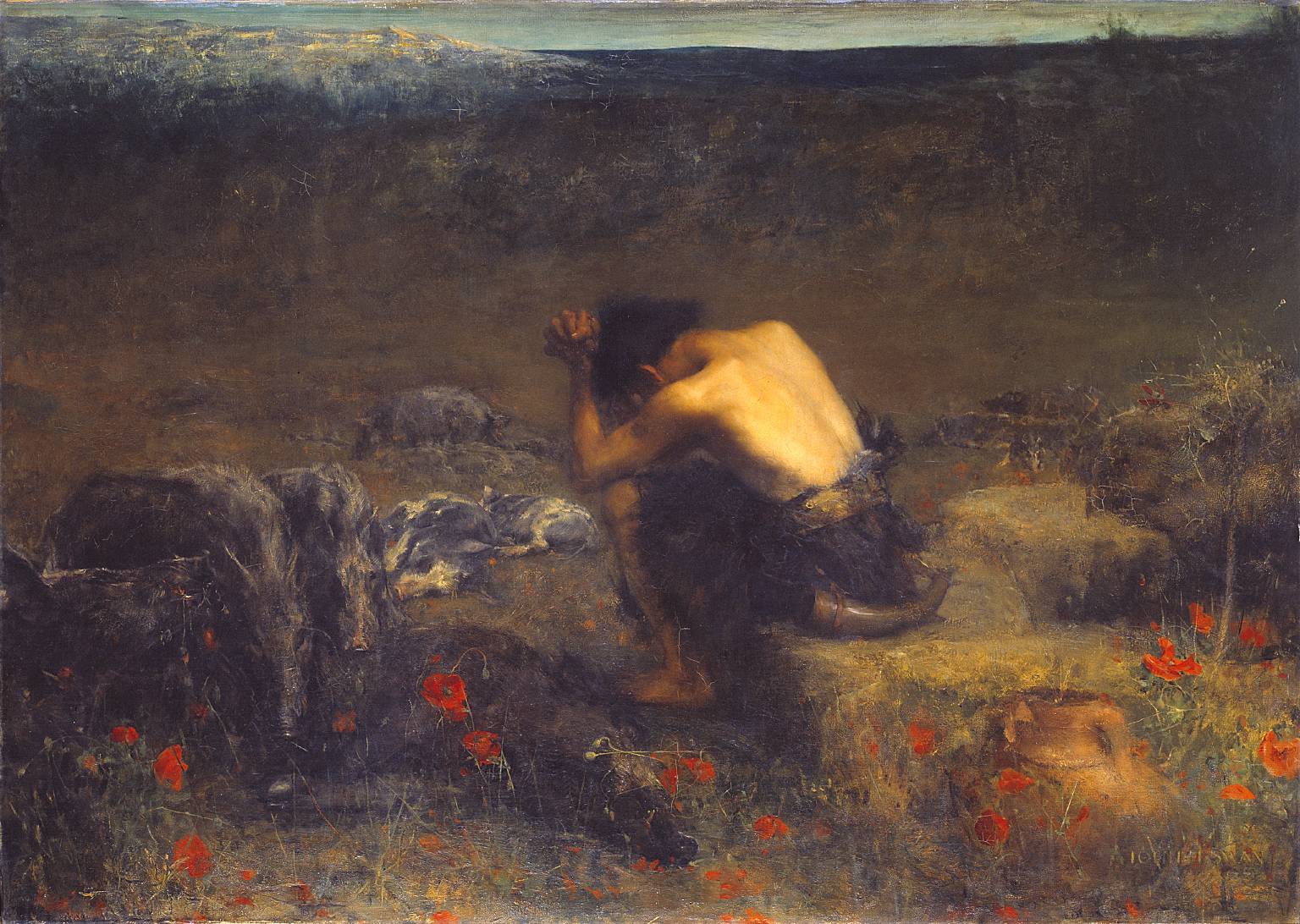
The Prodigal Son 1888 John Macallan Swan 1847-1910


I am reminded of what Grace said at the end of the goings on in C.S. Lewis’ That Hideous Strength:


Those who call for Nonsense will find that it comes.”

~~~~~~~~~~~~~~~~~~~~~~~~~~~~~~~~~~~~~~~~~~~~~~~~~~

[i] We read in Genesis that God created heaven and earth. It was to be a His temple. Images of God – humans – were placed in the temple. Humans were to tend to it. Humans failed. The garden, the temple, became despoiled by sin. The law would not only act as Israel’s guardian but also the guardian of creation. If humans mess up, the creation is hurt.
Abraham was chosen to undo the sin of Adam. To make this happen, God promised him descendants as many as the stars and a tract of land. His descendants would be the caretakers of that smaller garden. Israel failed as the true humanity. They could not keep the law. They went into exile.
A Savior came to rescue the world. The kingdom of God on earth was initiated. The church was founded with the giving of the Holy Spirit into the likes of Peter, fallible humans. The church was created to reveal the true humanity to the world. The image of God would be restored in humans. Humanity and creation are to be redeemed as the church awaits the appearing of the Lord and final redemption.
God dwells with man in the New Heaven and New Earth. The law of the land: justice, righteousness and peace. There will be no, “Jesus NEVER SAID ONE WORD about …” It will be UNDERSTOOD.


Are You Witnesses of All This?


Over the last several posts I’ve written about philosophers (Epicurus in particular and Protagoras) and philosophies (Epicureanism and Stoicism). Taken together they state, among other things I described earlier, that this life is all there is. There would be no hereafter in that way of thinking. During the first century the Apostle Paul, the “the apostle of the Gentiles”, encountered those worldviews on the streets where he sold his tents and in the early churches where he taught.

Writing to those in the Corinthian church whose Gentile members denied a resurrection of the dead, Paul responded in a rather taunting manner to their philosophical take on death as final. The gospel he proclaimed – Jesus is Lord, forgiveness of sins, new creation, the kingdom of God on earth has been launched – all hinged on the resurrection of Jesus.

And if the Messiah wasn’t raised, your faith is pointless, and you are still in your sins. 1 Cor. 15:7

After addressing and closing the dead are raised issue with an eye witness defense (1 Cor. 15: 3-8), Paul responds to the heart of the Corinthian objection to resurrection: the nature of future bodies. He mocks their materialist objections using an analogy from nature:

But someone is now going to say, “How are the dead raised? What sort of body will they have when they come back? Stupid! What you sow doesn’t come back to life unless it dies. 1 Cor. 15: 35

No doubt, Paul also heard that Jesus responded in a similar fashion when he rebuked the Sadducees who denied the resurrection (as recorded in Luke 20:38 and below, in Mark 12:

“Where you are going wrong,” replied Jesus, “is that you don’t know the scriptures, or God’s power. When people rise from the dead, they don’t marry, nor do people give them in marriage. They are like angels in heaven.

However, to show that the dead are indeed raised, surely you’ve read in the book of Moses, in the passage about the bush, what God says to Moses? ‘I am Abraham’s God, Isaac’s God, and Jacob’s God’? He isn’t the God of the dead, but of the living. You are completely mistaken.”

In the same letter (1 Cor.15:19), agitated Paul, in talking about people’s motivations in light of their position on the resurrection, recommends Epicurean self-pity if the dead are not raised.

If it’s only in this present life that we have hope in the Messiah, we are the most pitiable members of the human race.

He later quotes a popular Epicurean saying that embraces self-pity and self-indulgence in light off…

…If the dead are not raised,

“Let us eat and drink,

for tomorrow we die.”

1 Cor. 15:32

What was Paul’s background that offered him insight into Greek philosophies? We learn from Acts 21: 37 -39 as he defends himself against highly agitated Jews who clamored for his arrest.  He is brought before a Roman tribune:

“Am I allowed to say something to you??” he asked.

“Well!” replied the tribune. “So you know some Greek, do you? Aren’t you the Egyptian who raised a revolt some while back and led those four thousand ‘assassins’ into the desert?”

“Actually, replied Paul. “I am a Jew! I am from Tarsus in Cilica. That’s not an insignificant place to be a citizen of. Please let me speak to the people.”

Inferring his Roman citizenship, Paul goes on to defend his Jewish background in the face of his Jewish accusers:

“I am a Jew, he continued, “and born in Tarsus in Cilicia. I received my education here in this city, and I studied at the feet of Gamaliel. I was trained in the strictest interpretations of our ancestral laws and became zealous for God, just as all of you today.”

Paul had significant first-hand knowledge of Greek, Roman and Jewish worldviews. Paul was more than able to respond to the Epicurean context of the Gentiles. Paul was more than able to present the gospel in the context of the Jewish worldview, a worldview of monotheism, the Temple, eschatology and …resurrection.

The narrative of the resurrection and an eschatology of the age to come took on great import during the Second Temple Judaism. Other than the words of Moses and some metaphorical allusions to resurrection by Isaiah (Isaiah 26:19) and Ezekiel (37), there isn’t mention of the resurrection in the Old Testament. Those allusions were applied during the Babylonian exile. They refer to the restoration of Israel as a nation and the reoccurring theme of exodus from bondage. The scribe Daniel is the first to mention the resurrection in non-metaphorical terms when he describes the “wise”, the Jewish resistance to Antiochus, not dying in vain (Daniel 11).

It was during the intertestamental period that scribes began writing about the resurrection of the dead, among many other topics of concern during late Second Temple Judaism. The Qumran community kept these writings in clay jars within caves in case the community was taken out by the Romans.

The Jewish religious leaders in Jesus’ time knew these writings, e.g., The Epistle of Enoch and 2 Maccabees. The disciples knew them. Paul knew them. The writings were talked about in the synagogues and on the streets. These writings offered a Messianic hope for the coming day when God would put things right. In the meantime, they stoked courage against the looming threat of Roman authority. It is very likely that Mary and Martha would have known about these writing as well. It appears that Martha had an understanding of them when she confronts Jesus after her brother Lazarus dies.

When Martha heard that Jesus had arrived, she went to meet him. Mary, meanwhile stayed sitting at home.

“Master,” said Martha to Jesus, “if only you’d been here! Then my brother wouldn’t have died! But even now I know that God will give you whatever you ask him for.”

“Your brother will rise again,” replied Jesus.

“I know he will rise on the last day.”

(Notice the role reversals from the previous Mary and Martha encounter with Jesus in their home? Martha, the fussbudget homebody, is now interested to hear what Jesus has to say. She goes to meet him. Mary, who doted on Jesus at his feet, stays at home where she grieves and perhaps sulks that Jesus wasn’t there for her brother. She was given another chance at Jesus’ feet.)

Jesus responded to Martha.

“I am the resurrection and the life,” replied Jesus. “Anyone who believes in me will live, even if they die. And anyone who lives and believes in me will never, ever die. Do you believe this?”

“Yes, master,” she said. “This is what I’ve come to believe: that you are the Messiah, the son of God, the one who was to come into the world.”

Jesus responded to Martha’s eschatological understanding with, in effect, “I am revising your understanding with personal present tense knowledge of me”. Jesus then asks for Mary. Proximity to Jesus matters and not only for Mary and Martha’s sake but also for Jesus’ sake. He wants to see for himself the loss, the grief and the pain we feel. He would carry our griefs and sorrows to the cross and then remove the sting of death with his (and then our) resurrection.

When Mary came to where Jesus was, she saw him and fell down at his feet.

“Master!” she said, “If only you’d been here, my brother wouldn’t have died!”

When Jesus saw her crying, and the Judeans who had come with her crying, he was deeply stirred in his spirit, and very troubled…”

Mary and Martha witnessed the resurrection of their brother Lazarus. The three of them would learn of and perhaps be among the over five-hundred brothers and sisters who saw Jesus alive after his resurrection (1 Cor. 15: 5). All of them were witnesses of the things that came to pass. And what came to pass was not a doctrine or a philosophy or an apparition – a ghost. It was bodily resurrection.

No mere manmade philosophy, ancient or otherwise, could ever revive the dead or comfort the living in their loss with “Let us eat and drink, for tomorrow we die.” No amount of pleasure reduces the pain we feel. No amount of materialism and its cheerleading proponent Progressivism – a political pandering to self-pity – will provide hope for today. Those philosophical positions are about nursing wounds. Those philosophical positions are ephemera compared to the reality of the bodily Resurrection of Jesus and the new life offered to those who believe.

Only the Resurrection and the Life can reverse the downward spiral of mankind and provide hope that doesn’t pass away with a meal. Live in the present tense Resurrection and Life as Mary and Martha and hundreds of early followers of Jesus did.

Are you witnesses of all this? Of the resurrection? Or, are you witnesses of the Easter bunny? I think that’s what Paul had in mind when he mocked the Corinthians.
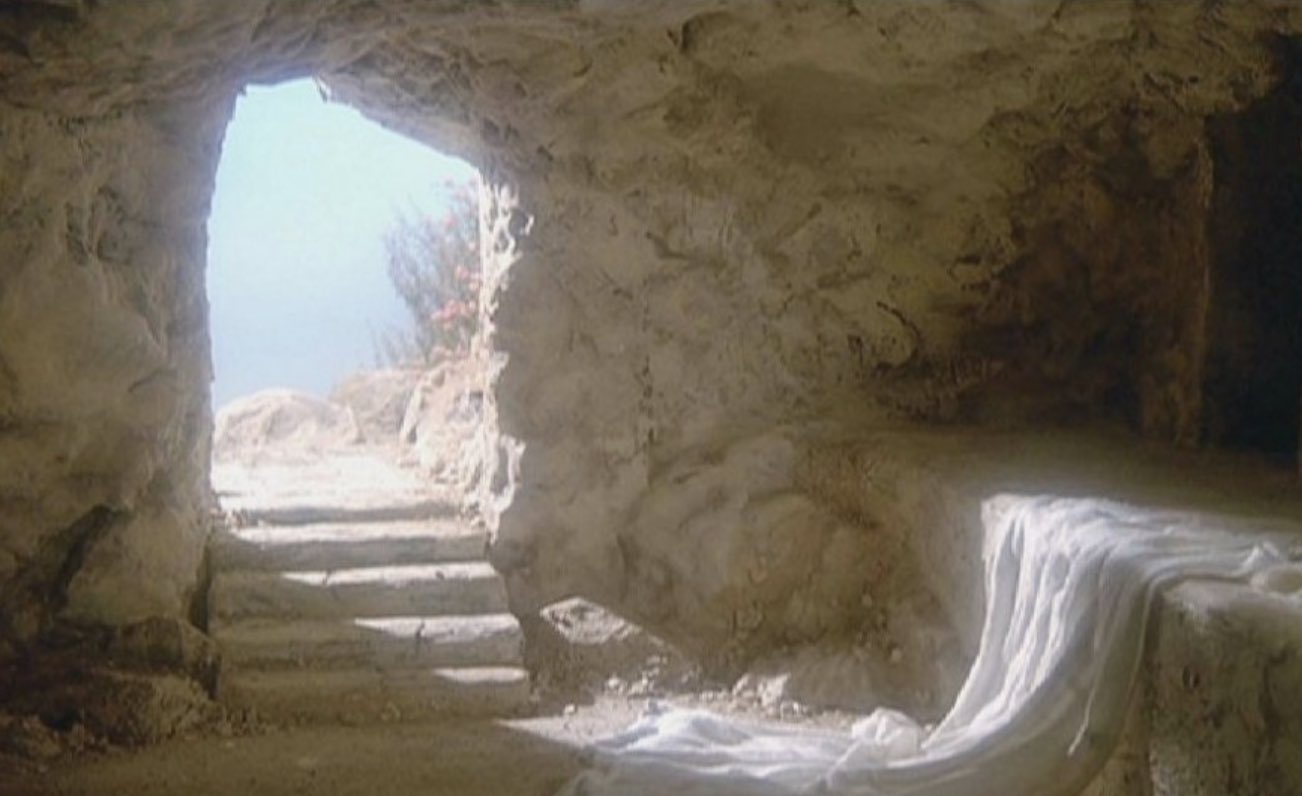
Empty tomb

~~~~~~~~~~~~~~~~~~~~~~~~~~~


The Resurrection is the central theme in every Christian sermon reported in the Acts. The Resurrection, and its consequences were the “gospel” or good news which the Christians brought: what we call the “gospels,” the narratives of Our Lord’s life and death, were composed later for the benefit of those who had already accepted the gospel. They were in no sense the basis of Christianity: they were written for those already converted. The miracle of the Resurrection, and the theology of that miracle, comes first: the biography comes later as a comment on it. Nothing could be more unhistorical than to pick out selected sayings of Christ from the gospels and to regard those as the datum and the rest of the New Testament as a construction upon it. The first fact in the history of Christendom is a number of people who say they have seen the Resurrection.

Miracles, C.S. Lewis

Genealogies of Straw?


…If the dead are not raised,

“Let us eat and drink,

for tomorrow we die.”

1 Cor. 15:32


People delight in looking into their genealogy to tell them where they came from and their ancestral background. But, what about the genealogy of our thoughts and our beliefs that are passed down? Continuing with the theme of my previous post, man as logos and centerpiece of the universe, man considers himself left to his own devices and to fend for himself. The “dead are not raised” has been passed down to us. Also passed down, la dolce vita, the Epicurean worldview prevalent today.

The originator of Epicureanism, the Greek philosopher Epicurus, and many others since, decided that God was not good at being God so man must take his place. In terms of the evil man encounters, this thinking is restated in the Epicurean paradox.

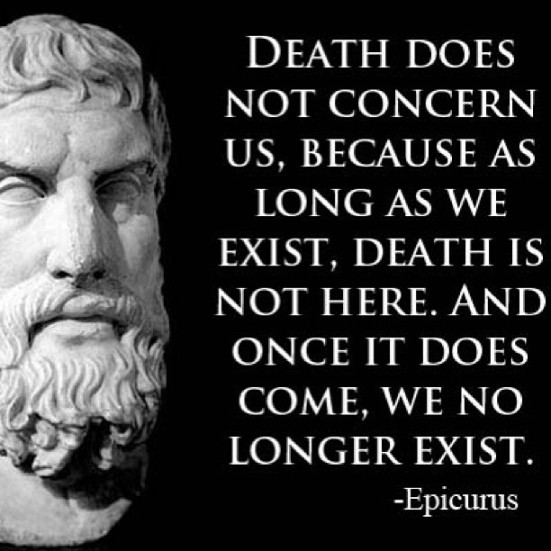
Per the Oxford Dictionary, Epicurus (341-270 B.C) was a “Greek philosopher, founder of Epicureanism. His physics is based on Democritus’ theory of a materialist universe composed of indestructible atoms moving in a void, unregulated by divine providence”.

According to several accounts, Epicurus lived and taught a philosophy of the unnoticed good life. He posited that man, a collection of particles he called atoms, would return to the earth when he died. From atoms to atoms you shall return, he postulated. When you are dead you are dead and while you are alive, as Epicurus advocated, seek pleasure and avoid pain.

Epicurus was not a political nor a spiritual man. He was more of a homebody given to a small circle of friends. Per Epicurus, everything to be trusted and believed came through the senses. And so, he deemed that God was remote if at all. And friends were real and to be trusted.

Epicurus also taught that nothing should be believed, except for that which was tested through direct observation and logical deduction – believed via the sensate and reason. Hence, the beginning of the fact/value split so prevalent in man’s thinking today. It is likely that Epicurus formed this worldview when he decided that God was uninvolved and impersonal at best and that he had to fend for himself.

Epicurean thought was embraced by some and passed down through the centuries. The Roman poet Lucretius, a disciple of Epicurus’s teachings and someone who lived about 70 years before Jesus, promoted the “god is angry” meme along with the theory of atomism formulated by Demetrius (460-370 B.C.), who died 29 years before the birth of Epicurus.

The atomic theory of the cosmos in brief: random, unguided ‘atoms’ smash into each other, thereby create the world and life as we know it. Such a hypothesis turned philosophy by Epicurus offered the ‘means’ to do away with a personally involved god and remove human accountability to God. Lucretius went on to tweak Demetrius’ theory.

Demetrius said that atoms do not always go in straight lives but can “swerve”. As such, his philosophy was then able to avoid atomism’s inherent determinism and to allow for man’s free will.

“What was most important in Epicurus’ philosophy of nature was the overall conviction that our life on this earth comes with no strings attached; that there is no Maker whose puppets we are; that there is no script for us to follow and be constrained by; that it is up to us to discover the real constraints which our own nature imposes on us.” ― Epicurus, The Epicurus Reader

Unlike the innocuous passing-on-sex Epicurus, the Romans took Epicureanism to new lows. The name of the Roman Emperor Caligula is associated today with unbridled decadence. Licentiousness continues today as the justification for the avoid-pain-seek-pleasure self.

The Enlightenment furthered Epicurean acceptance. As many began to claim science as the explainer for things being as they are and man as the interpreter of things as they are, the Enlightenment augmented the fact/value split. With science being claimed as the only arbiter of truth and reality, the transcendent was eschewed, as being unreasonable to ponder. Materialism and utilitarian atomism replaced the transcendent and facilitated the self-made man as the imago homo. An honest look around today would reveal that the worldview from the days of Epicurus down through the Enlightenment has been passed down to us.

“It is folly for a man to pray to the gods for that which he has the power to obtain by himself.” –Epicurus

As I see it, underlying cultural Marxism, secular humanism, Progressivism and the American Dream is the philosophy of Epicurus: extreme preoccupation with and indulgence of one’s feelings, desires, etc.; egoistic self-absorption, aka, solipsism. It is the worldview of safe spaces. It is the philosophy behind the Progressive’s push for acceptance of multiculturalism whereby all cultures are deemed equal including the dehumanizing ones so that individual culture has a larger safe space to operate in. The philosophy promotes universal healthcare as another safe space in the form of insurance against financial suffering as paid for by others so one can live an Epicurean lifestyle without pain. It is the worldview of the virtue-signaling relativist social justice warriors – I want a safe space for me to live my life as I see fit so I will serve up my self-justifying, self-righteous viewpoint of high-sounding humanitarianism. Epicureanism is the doctrine of the Religion of Humanity and the paean to mind and matter as savior.

Epicureanism underlies identity politics and individual rights. It promotes a circling of the wagons around your ersatz ‘friends’, your tribe, to protect your values and your territory for further self-satisfaction. It promotes dehumanization with its message that life has no meaning other than what you give it; life is only material and sensate. So, grab yours while you are alive. Out of this dehumanizing process comes the art, music, literature, media and architecture which degrade human existence and the imago dei in humans. But. Modern man, left to his own Epicurean devices, comes up short.

The narrator in C.S. Lewis’ Space Trilogy novel That Hideous Strength tells us about one of the central characters Mark Studdock. He is a young academic, a sociologist, and a member of the Progressive Element at Bracton College. He is an ambitious, self-centered and shallow intellectual who has come into the service of the National Institute of Coordinated Sciences (NICE). He believes NICE will serve the best interest of humanity through progress at any cost. Once he stopped hemming and hawing about joining the organization he is welcomed into the inner circle. But he soon finds that he has committed himself to a hellish organization which plans to re-do humanity by force so that only the best humans (in NICE’s view) remain. He is made aware that the tentacles of the organization are growing.

Studdock is told in no uncertain terms that the organization wants his wife Jane to join him. He is ordered to bring her in. With no moral depth and no moral base outside himself to guide him, Mark is perplexed and now in great fear for his life. Pain and death are the only things that are real for him.

It must be remembered that in Mark’s mind hardly one rag of noble thought, either Christian or Pagan, had a secure lodging. His education had been neither scientific or classical – merely “Modern”. The seventies both of abstraction and of high human tradition had passed him by: and he had neither peasant shrewdness nor aristocratic honor to help him. He was a man of straw, a glib examinee in subjects that require no exact knowledge (he had always done well on Essays and General Papers) and the first hint of a real threat to his bodily life knocked him sprawling. And his head ached so terribly and he felt sick. Luckily he now kept a bottle of whisky in his room. A stiff one enabled him to shave and dress.

What is your genealogy of thought and belief? Is it a genealogy of strawmen?

~~~~~~~~~

The opening quote is from the Apostle Paul’s letter to the Corinthian church. He is countering the embedded Epicureanism active in the church in Corinth. He does so with the resurrection.

To be continued.

Lost in Self-logos


Thus, in the conception of Humanity, the three essential aspects of Positivism, its subjective principle, its objective dogma, and its practical object, are united. Towards Humanity, who is for us the only true Great Being, we, the conscious elements of whom she is composed, shall henceforth direct every aspect of our life, individual or collective. Our thoughts will be devoted to the knowledge of Humanity, our affections to her love, our actions to her service. -Auguste Comte, A General View of Positivism [1848]


Mankind learned centuries ago, by the efforts of men like Polish astronomer Copernicus, that we do not exist in a geocentric universe. Now, according to some physicists, mankind is at the center of the cosmos. In order to avoid a Creator scenario, these scientists promote the anthropic theory:  the reason for the perfectly-tuned universe, for its fundamental physical constants, and the reason why things exist as they are on earth is that human existence required it. To support this theory, they posit a multiverse scenario with infinite trials and errors until man could exist.

Amir Aczel, PH. D., in his book Why Science Does Not Disprove God, describes some physicists’ viewpoint:

…if we are here, and the parameters need to be perfectly chosen for us to be here, then surely there must be infinitely many other places where parameters are wrong. We are here because we can only live where the parameters are right for our existence.

Now, I have no issue with the possibility of multiverses. But as Dr. Aczel writes, the proposed multiverse-as-cause theory to replace the creation narrative offers no mechanism to create the multiverses. The theory proposes an infinite number of somehow existing parameters doing something over and over infinitely many times to finally ‘create’ the perfect conditions for a habitable zone. Dr. Aczel goes on to state, “The anthropic theory is the weakest route to the multiverse.” As I see it, the theory has no mechanism for merit other than those who promote a God-less universe. The theory is basically one of effect with no Ultimate Cause. It is a theory of chance which says man is the reason for his existence.

Man-centered philosophical endorsement would come from the likes of Nietzsche. His “God is dead” rejection of Christian values was a push for mankind to move beyond good and evil and to loving necessity. One is therefore to live with uncertainty as a “superman”, above and center of it all. From the mighty-warrior Nimrod to Wagnerian heroes to the present FX-ed generated superheroes versions of Nietzsche’s “superman” have been around since the Garden. The “superman” notion is akin to Darwin’s theory natural selection and the survival of the fittest. In Nietzschean terms, What doesn’t kill you, makes you stronger.

Social scientists place man at the center of the universe. Since Adam and Eve’s forced exit from the Garden of Eden, man, it seems to me, has always struggled to reclaim the Garden. Many seek to create a Garden Utopia through a relentless and self-directed improvement of the species. Darwin’s On the Origin of the Species supplies the process: selection, struggle, favored, preservation. Engels and Marx, Lenin, Trotsky, Stalin, and MaoTse-tung used Darwin’s theory of natural selection as justification for their “class struggle” political and economic theories. Millions have been imprisoned and slaughtered under the banner of “class struggle”. Strands of this ‘societal improvement’ is behind the current humanist thinking which is now being promulgated systematically by the Progressive Element. For Progressives, the social multiverses are the identity-centered tribes they select and deem struggling and require favored status and preservation.

Man, as the principle cause and logos of the universe, creates his own values. Thus, the religion of humanity. Secular humanitarianism is the tie that binds the Progressive Element: atheists, agnostics, deists, social Darwinists and those who buy into sentimental Christianity for the sake of progress. The creation of man-as-logos values produces a querulous society of competing values, hence the culture wars. Amorphous and relativistic values are promoted under the high-sounding and ambiguous rubric of “social justice”. Individualism is turned inward toward self-centered anodyne interest to be protected by “rights”. Progressivism inverts The Second Commandment: “love me as you love yourself”.

Vying for special status, groups call themselves “marginalized” and “victims”. This self-centered push for center stage drives identity politics: self-designated victims ‘struggling’ to ‘survive’ require ‘protection’ (rights). “I’ll make you care about what I care about – me” is the right to impose myself on others and call it “social justice”. Man, as logos, defines the impetus of the “social justice warrior:  resentment disguised as compassion which drives the will to power.

Resentment? Life is not easy to begin with. The arbitrariness of life and the forces beyond our control fuel resentment when contemplated in the context of others. Resentment leads to claiming that one’s gender or sexual proclivity or income status or healthcare as being victimized by others. Such a worldview, one without meaning except for self and necessity and a belief that relationships are defined by power, breeds contempt for those having some perceived advantage. Hence, the demand for societal and economic reparations and at any cost to others. Resentment is fueled by zero-sum thinking: one does not have because someone else has.

Resentment disguised as compassion? Man, as logos, wants to be seen as a self-justified humanitarian. Virtue signaling accomplishes that while being resentful at the same time. It is no-cost faux-altruism intended to make one appear empathetic and compassionate without appearing resentful except for those who question their virtue signaling. This is underneath the self-righteous clamor for the right of universal healthcare, of potable water, of inclusion, diversity, equity and the host of arbitrary self-placating categories.

Resentment disguised as compassion which drives the will to power? In an age that is increasingly nihilistic, power has become the transcendent meaning to life. And once you believe that relationships are defined by power you exercise the will to power to subjugate others to the relationships you desire. The exercise of the will to power implements mental-conditioning of its subjects, hence the revision of language and of history, to fit the narrative. The power to create one’s own truth is what is desired.

The best way to sum this mash of words is with the clarity of two Scripture readings from today. The first relates the man-as-logos worldview. The second reading describes those who are Logos centered.

The Parable of the Prodigal Son was the gospel reading for today: Luke 15: 11-32. The would-be Prodigal Son demands his rights (inheritance) from his father. The son considers his father dead to him. The father transfers assets over to his son. His son turns his shares into cash as he sells the property his father had accumulated over time through the father’s effort. The universe of one departs with his values and his will to power. He’s off to a distant land, far from the logos he knows. He leaves behind his father and the remaining older son to pick up his portion of work.

A lifestyle of nihilistic (sever famine) and sensate pleasure (self-directed compassion) has him eating slop in a pig sty. He’s sees that he is just another animal. His humanism ran out of money. He returns to his senses and heads home. His father sees his son a long way off and runs to meet him. The prodigal repents and the father rejoices in his return from the distant land of self. There is a celebration for the son who was lost but is found … alive. They are reconciled. But the brother has a growing resentment disguised as compassion for his father (“I’ve been slaving for you all these years!”) which drives his will to power to up his rights. He feels his rights, his pride of place, is diminished by his brother’s return and the father showering him with a wealth of unintended consequences.

The second reading is from the Epistles: 2 Corinthians 5: 16- 17. Paul writes about a Logos worldview that sees humanity from a kingdom perspective. He writes what the Prodigal experiences when he returns to the Logos and what the other brother claims as his right to experience.

From this moment on, therefore, we don’t regard anybody from a merely human point of view. Even if we once regarded the Messiah that way, we don’t do so any longer. Thus, if any man is in the Messiah, there is a new creation! Old things have gone, and look – everything has become new!


~~~

I recommend reading The Hideous Strength by C. S. Lewis for insight into humanism.

The Enduring Context


It was about this time of the year back in 2000 when I took my two oldest to Chicago’s Field Museum of Natural History (the Field Museum today). What did we go to see?

CHICAGO — For the first time in 50 years, the Dead Sea Scrolls will visit Chicago in a special exhibition at The Field Museum March 10 through June 11.

Written on parchment and papyrus more than 2,000 years ago, the scrolls contain what are believed to be the oldest surviving copies of the books of the Old Testament…

Portions of 15 difference scrolls will be on display in The Field Museum’s exhibition, including five that have never traveled outside of Israel. One of those five is a segment from the book Deuteronomy, which includes the Ten Commandments; the other four contain language and concepts similar to those in the Gospels of the New Testament — written more than 100 years later.

The exhibition will also feature 80 artifacts from Qumran, the archeological site near which the scrolls were discovered;

Dead Sea Scrolls to be displayed in Chicago


I was enthralled by the exhibit. Parchment that is over 2000 years old containing Jewish manuscripts gave witness to the community of the “sons of light”. These “men of the covenant” cursed Belial and his unclean spirits, worshiped with angels and preserved the understanding of those who set themselves apart from the Second Temple they believed to be corrupted by sinful leadership.

The almost nine-hundred manuscripts found in eleven caves at Qumran provide us with the context for the time of Jesus. They record the Qumran community’s messianic hopes for salvation in the very near future. They speak of the resurrection, of angels and demons, of the Law and Prophets and of secular matters at the time.

The gap between the Protestant Testaments, with the exception of the book of Daniel, is about four-hundred years. The Old Testament doesn’t provide context for the time of Jesus other than in large broad strokes of God’s dealing with beastly kingdoms and the hope of God intervening to save His people. The Old Testament established the narrative that leads us to the fullness of time when Jesus was born and his kingdom on earth announced. The scrolls continue the narrative and connect the Old and New Testament times. And, more importantly, they help us understand the thinking of the first century Jew. They explain the words and phrases Jesus uses in conjunction with contemporary Jewish thought and theology. They explain Jesus as a Jew.

Though I was fascinated by the scrolls, my two boys would show more interest in another exhibit a few months later. In a sense the two exhibits ran parallel – discoveries reveling context.


SUE finally made a dramatic debut in Stanley Field Hall on May 17, 2000


In 2000 Sue the T. rex, a 67-million-year-old fossilized skeleton, was put on display. It is said to be the most complete specimen of its kind.  This display became the starting point to my accepting evolutionary creation.

I met up with more dinosaurs a few years ago. The company I work for held its one-hundred-and-twenty-fiftieth anniversary celebration in the great hall of the Field Museum. (Job-keeping disclaimer: the dinosaurs are not the people I work with!) The anniversary celebration was another reminder of the Enduring Context. Men and women have been working together for 125 years within an engineering company providing solutions that help mankind.

Just a few weeks ago I visited my mother. She is almost ninety and in hospice care. Once again, I was reminded of the Enduring Context. Mom’s and dad’s steadfast faith in God, which they received from their parents, has been passed down to their children, to their grandchildren and to a multitude of great-grandchildren.

We will do well to remember the past, its fragments and as it is fragmented before us, for we are not without its context. Whether it be dinosaur bones attesting to God’s evolutionary creation or scroll fragments attesting to a community that wanted to keep God’s narrative alive over 2000 years ago the presence of testimony from the past shouldn’t be discounted. The Enduring Context which began in God before the Big Bang is God’s desire for the universe He created. The Enduring Context can be summed up in the words of the Lord’s prayer: “Thy will be done on earth as it is in heaven.”

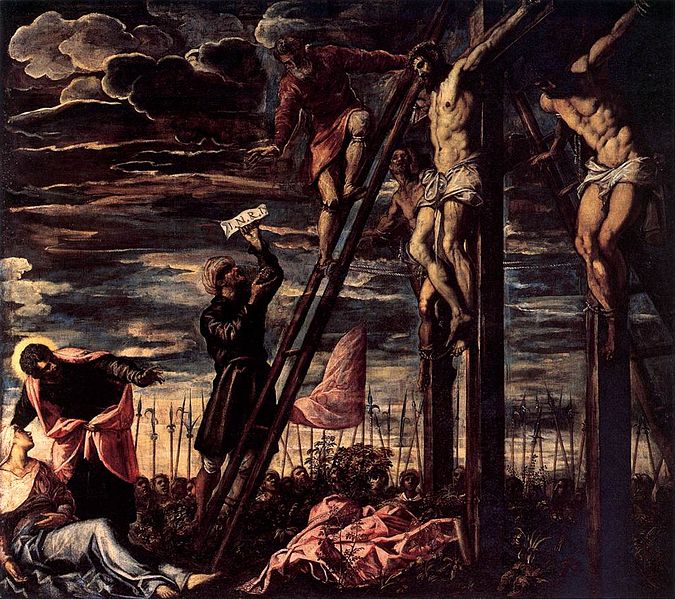
jacopo-tintoretto-crucifixion-1500s

There is art, music, literature, and architecture created with the Enduring Context in mind. And, there is art, music, literature, and architecture which knows knowing of the Enduring Context. The Progressive Element, eschewing the past, deems itself the only context that matters every time it rewrites history. Unless you are God or a Progressive demi-god, there is no present without the past for the likes of us. And if, as the English metaphysical poet John Donne wrote, “No man is an island entire of itself” then certainly no man is a context entirely to himself. A modern philosopher had this to say about context:


“We must strive to be worthy of an inheritance that we did not create, and to amend it only when we have first understood it” Roger Scruton Rousseau and the Origins of Liberalism


And though it seems to us in our daily struggles that sickness, death, injustice and evil are the Enduring Context, these are temporary. The resurrection of Jesus made sure of that. Our resurrection will continue the Enduring Context.

As followers of Jesus we imitate the One and the ones who are the Enduring Context. Our Lord’s context becomes our context as we walk in the Enduring Context of our citizenship:

So, my dear family, I want you, all together, to watch what I do and copy me. You’ve got us as a pattern of behavior; pay careful attention to people who follow it.

You see, there are several people who behave as enemies of the cross of the Messiah. I told you about them often enough, and now I am weeping as I say it again. They are on the road to destruction; their stomach is their god, and they find glory in their own shame. All they ever think about is what’s on the earth.

We are citizens of heaven, you see, and we’re eagerly waiting for the savior, the Lord Jesus, who is going to come from there.

Not All Roads Lead Home


In truth, all through the haunted forest there could be nothing more frightful than the figure of Goodman Brown.

Before the Technicolor fairy tale of a quartet of troubled characters trekking through a foreboding forest hoping to gain what they lack from the “great and powerful” Self-Gnosis (The Wizard of OZ), there is a tale of a young man taking a similar journey. And though there is no fear of “lions and tigers and bears” in this tale, there is “What if the devil himself should be at my very elbow!”.

It seems to me that both tales are about journeys into the dark side – the nocturnal forest – to look for an esoteric mystical experience that would supply what is missing. But unlike the “There’s no place like home” heartening ending of the OZ tale, we find in the second tale that those who covenant to journey into the forest and the deepest darkest part of it, come home disillusioned and faithless.

Often, especially in our youth, we begin to question the religious beliefs and worldviews of our families, of our mentors and of those around us. We see hypocrisy around us and despise it and yet become two-faced in our own sought out experiences wrought in the dark. We then begin to take on ambivalence about evil, giving ourselves the ‘grace’ to operate in both good and evil ways. Moral relativism is that form of grace.

We tell ourselves that there are people who are restrictive, conservative and Puritanical – “They don’t know me.”. We tell ourselves that we have become too worldly-wise to be like them: “I have Jesus. I’m above all that narrow-minded out-of-date conventionalism. I’m the progressive sort.” So, we journey into the dark forest, into the deepest darkest part of the forest, and think ourselves to be impervious to whatever lurks there. With each step we tell ourselves “I am only seeking understanding”.

We give ourselves permission to investigate the dark side. We say to ourselves “I will do it just one time. Why be left out?  Why not join the “communion of our race””? Thus, we journey into the night and encounter evil. And like Goodman Brown, in Nathaniel Hawthorne’s 1835 short story by the same name, we come home disillusioned, our faith destroyed.

Young Goodman Brown sets out one night to gain existential insight into good and evil. The story, set in 17th century Puritan New England, operates within the Puritan context of sin, grace and unconditional salvific election. I consider the tale an allegory, as it employs symbols starting with the names Goodman and Faith.

In the tale before us, Goodman Brown leaves his saintly wife Faith at the threshold of their home. She is wearing a pink ribbon on her cap. The pink ribbon, mentioned throughout, I read as a symbol of the admixture of purity (white) and sin (red). The color speaks to Goodman Brown’s spiritual understanding based on his Puritan beliefs and also to his rose-colored romance-based naiveté about the nature of evil.

“Poor little Faith!” thought he, for his heart smote him. “What a wretch am I to leave her on such an errand! She talks of dreams, too. Methought as she spoke there was trouble in her face, as if a dream had warned her what work is to be done tonight. But no, no; ‘t would kill her to think it. Well, she’s a blessed angel on earth; and after this one night I’ll cling to her skirts and follow her to heaven.”

With this excellent resolve for the future, Goodman Brown felt himself justified in making more haste on his present evil purpose. He had taken a dreary road, darkened by all the gloomiest trees of the forest, which barely stood aside to let the narrow path creep through, and closed immediately behind. It was all as lonely as could be; and there is this peculiarity in such a solitude, that the traveller knows not who may be concealed by the innumerable trunks and the thick boughs overhead; so that with lonely footsteps he may yet be passing through an unseen multitude.

As Goodman sets out, he does so under the cover of night and the cover of assumption: as a Puritan, Goodman Brown considers himself one of the elect. He carries with him a Puritan/Calvinist ‘good hands’ insurance card – the doctrine of predestination. He doesn’t leave home without it. And, as you read above, Goodman assumes that his association with the right people – his wife Faith in particular and the town’s good church folk in general – that he will follow them to the heavenly home. Goodman Brown goes out into the portentous night feeling safe and secure from all alarms. But his predetermined confidence quickly melts away as soon as he steps into the mysterious dark woods.

He had taken a dreary road, darkened by all the gloomiest trees of the forest, which barely stood aside to let the narrow path creep through, and closed immediately behind. It was all as lonely as could be; and there is this peculiarity in such a solitude, that the traveller knows not who may be concealed by the innumerable trunks and the thick boughs overhead; so that with lonely footsteps he may yet be passing through an unseen multitude.

Goodman’s first encounter in the woods is an old man who reminds him of his goodly grandfather. The old man appears to be waiting for Goodman. He says, “You are late, Goodman Brown.” Goodman replies “Faith kept me back awhile”.

Though the old man appears similar to Brown in many pedestrian ways the old man also appears to have “an indescribable air of one who knew the world”. And there’s something else Goodman notices and tries to explain away.

But the only thing about him that could be fixed upon as remarkable was his staff, which bore the likeness of a great black snake, so curiously wrought that it might almost be seen to twist and wriggle itself like a living serpent. This, of course, must have been an ocular deception, assisted by the uncertain light.

It is clear to the reader that the old man is the devil who is supported by the serpent staff, He does his best to entice Goodman Brown down the road to what is later called “the communion of your race” where he will learn of the “secret deeds” of his fellow townsfolk and see hypocrisy countenanced.

Goodman balks, claiming to be one of a breed of men who is above the riff-raff.

“Too far! too far!” exclaimed the goodman, unconsciously resuming his walk. “My father never went into the woods on such an errand, nor his father before him. We have been a race of honest men and good Christians since the days of the martyrs; and shall I be the first of the name of Brown that ever took this path and kept—”

Goodman’s journey away from faith is stop and go as wrestles with the temptation of going on. He encounters something he initially resists and uses the honor of his good name and of those before him as a reason to rethink things before giving on to going on. But, he doesn’t use his faith as a shield and so bends in to temptation. He continues his journey with the old man’s urging.

The old man tries to persuade Goodman to get up and continue. He does so by using Goodman’s own argument. The old man conjures up a kinship with men like Goodman. He lies about having personal knowledge and acquaintance of Goodman’s family. He then speaks of townsfolk – deacons and those in power – as personal references. He cajoles Goodman to continue their ‘association’ by journeying on.

Goodman Brown once considered himself impervious to all the devil’s wiles. After all he was one of the elect and associated with the right people. But each step he took in the wrong direction away from faith weakened his resolve. His compromises were reinforced by his inordinate curiosity. He continues his journey into the deepest darkest part of the forest and sees what the “communion of our race” so desires, “that the good shrank not from the wicked, nor were sinners abashed”.


There are several interpretations and critiques of the story. Some will say that Hawthorne is pointing out the hypocrisy of a society that prides itself on its high moral and civic standing and makes outcasts of those who do not live up to its standards. Other interpreters go out on a dark forest limb with their construal:

Modern critics have interpreted “Young Goodman Brown” in many ways. The story as a critique of society stands out to some. To psychologically inclined readers, Brown journeys into the psyche. The village represents the superego, whereas the forest and darkness become equivalents of the Freudian id. The entire story becomes a portrait of one human mind that discovers the usually suppressed and disquieting reality of animal instinct

The story’s symbols lend its meaning to a wide audience and to many interpretations. As you read it you will have your own takeaway. I consider it an allegory or parable about assumptions, hypocrisy and the lure of evil to pull one away from one’s home base of faith toward the “reality of animal instincts”.

The story doesn’t tell us Brown’s motives other than “present evil purpose” Conjecture would lead us to think that young Goodman Brown had become questioning about evil and the devil even though he lived surrounded by strict warnings against both in Puritan village. One gets the sense that Brown goes out by himself to just stick his nose in on evil for the sake of understanding the world he lives in and perhaps the fear of evil inculcated in him by his upbringing.


I have provided some of my take on Young Goodman Brown and some excerpts from the story with the hope that you will read the short story (it should take about fifteen minutes). I invite you to consider what road you are taking when you want to stick your nose in on evil. Consider where it leads and what you will encounter. And, where it will lead you. This road does not lead home.

We are told in Scripture to “test the spirits” so that we may know what is good and true and from God. That is not what is going on in Young Goodman Brown. Rather, this a young man who leaves faith behind and takes a walk on the wild side and ends up at a satanic ritual. His road did not lead back home to faith. It led to nihilism and despair and the resolve to no longer exist.

In truth, all through the haunted forest there could be nothing more frightful than the figure of Goodman Brown. On he flew among the black pines, brandishing his staff with frenzied gestures, now giving vent to an inspiration of horrid blasphemy, and now shouting forth such laughter as set all the echoes of the forest laughing like demons around him. The fiend in his own shape is less hideous than when he rages in the breast of man. Thus sped the demoniac on his course, until…


Well, you’ll just have to read the story:

We’ve Been Down This Road Before


One does not need a degree in cultural studies to see that our culture is charmed by and suffused with charismatic self-knowledge, self-love, self-esteem, and self-awareness. The powerful, the glamorous, the ministers of inclusion, and the gurus of self-help each promote their version of snake oil which, by application, would lift the unenlightened feeble off of terra firma to the heights of self-dom. Their special tonic is said to awaken consciousness, to liberate from conditioning and to provide relief from suffering. Mystical, intuitive, subjective, inward, and emotional approaches to truth are everywhere promoted as leading to a higher plane of existence where self-knowledge is knowledge of the divine. The self and the divine are to be perceived and experienced as identical.

One quote from a gnostic teaching website is sufficient to reveal the ‘higher road’ many are taking:

“Yet to know oneself, at the deepest level, is simultaneously to know God; this is the secret of gnosis. Another gnostic teacher, Monoimus, says:

Abandon the search for God and the creation and other matters of a similar sort. Look for him by taking yourself as the starting point. Learn who it is within you who makes everything his own and says,” My God, my mind, my thought, my soul, my body.” Learn the sources of sorrow:, joy, love, hate … If you carefully investigate these matters you will find him in yourself.”

In the Garden of Eden, the serpent asked, “Did God really say…?” And, based on what I am seeing today, I can imagine that It also whispered “What does the god within you say?” The choice Adam and Eve made put them on the road leading out of the garden. This is the road most travelled.

As I was considering this topic the Technicolor image of the cowardly lion wringing his hands came to mind. I had the misfortune of seeing the musical fantasy Wizard of Oz in my youth.

Why the misfortune? While it made fantasy-tale sense that characters made of straw and tin needed something to be humanish, what was a humanish animal requiring courage about? What was it about this movie that disturbed me? It took me some time to sort out – discern – why I do not like the movie: it’s promotion of Gnosticism in the morally vacuous Land of Oz and the wimpy withering lion.

The lion in the Wizard of Oz is the anthropomorphic personification of presumably silly and timid humans lacking self-awareness. The lion comes into the story like a bleating lamb and leaves as a roaring lion. How did the transformation happen? Through gnosis. The lion is told by a wizard (a professor; a spiritual guide and self-help guru of sorts) that the lion must acknowledge the courage he already possesses inside. The same self-knowledge mirror is held up for the Straw Man and the Tin Man.

And what is the purpose of the new found-in-self brain, heart and courage in the moral vacuum of Oz? To “awaken their consciousness and liberate them from conditioning”? And the reason for courage? Courage to not be afraid of what? Of things that go “Boo” in the night? Courage to be yourself?

Lest anyone think that I am being picayune about a now beloved child’s fantasy they should pull back the curtain and see what’s lurks there in light of the above and with today’s culture in view.

In the moral vacuum of the Land of Oz, does gnosis-courage mean one bravely acts to be one’s self at all costs? If the only moral reference points are yourself and someone telling you have what it takes within, are you prone to then embrace your base desires to be one’s self? Are we to believe ‘wizards’ that through self-knowledge we change from baaing sheep into roaring lions? See for yourself what’s come out from behind the curtain in the Land of Oz:

Actress Judy Garland (1922–1969) is widely considered a gay icon. The Advocate has called Garland “The Elvis of homosexuals”. The reasons frequently given for her standing as an icon among gay men are admiration of her ability as a performer, the way her personal struggles seemed to mirror those of gay men in America during the height of her fame, and her value as a camp figure. Garland’s role as Dorothy Gale in The Wizard of Oz is particularly noted for contributing to this status. – Judy Garland as gay icon

Has Western culture has followed the Yellow Brick Road? Besides the ubiquitous adverts by wizards of enlightenment coming out with their brand of snake oil, we hear almost every day in the media of someone coming out (via self-knowledge) as gay. This gnostic way of understanding has been confirmed by Pope Francis when he said “God made you this way.”

It is no secret that Progressive elements in our culture promote being oneself as one walks along on their wide Yellow Brick Road of self-discovery. This way is touted as the higher, more “universal” and thus “neutral” perspective and that the meta-narrative of Christianity is the narrow road which must be avoided and declared the wrong way. Progressivism doesn’t see its own meta-narrative of identity politics and of reducing the moral universe to the god within. Progressivism isn’t self-aware.

Universities, under the thrall of Progressivism and of course benefactors, are incubators of gnosis. They seek to awaken a new vision and to stir up dormant impulses in cowardly lions. Pseudo-disciplines like women’s studies, black studies, LGBTQ studies, etc., offer Woke gnosis.

The Land of Oz campus admins create physical safe spaces so that self-realization is safely tucked in and away from things that go “Boo!” in the day. For Land of Oz sustainability, Marxism and socialism are taught as the means to create financial safe space. The idea is to make others pay so the disciples of self don’t have to concern themselves with material concerns. This, so one can continue to grow in self-awareness and be an SJW with a moral center carefully crafted around gnosis.

At graduation, participation trophies are presented to the brave – those who stood inside safe spaces against outside knowledge, and to the compassionate (for others like themselves). A diploma, a medal and a ticking heart-shaped watch are passed onto to another generation. These trinkets of gnosis are bestowed under a ceremonial banner, which reads: “Know thyself, Be Thyself. We are here for our own sake”.

There is a Yellow Brick way that seems right to a man who seeks to find what it takes to be one’s self, but the ends thereof are the ways of self.


~~~

Of course, not all self-reflection is be rejected. Proper introspection is to occur in the prayer closet. There, in the Light of the Lord, sin is exposed and named. You learn to see yourself as the Lord sees you. You confess your sin and ask for forgiveness. Then the Lord returns you to the road before you to walk in his resurrection power.

Now, it takes no courage whatsoever to tell others how to live to make them comfortable for you to be around. That is social justice for the woke generation. It does take considerable courage to look into one’s soul and see the darkness within, to repent and to cast out any unclean spirits in the name of the Jesus.

The absolutions of the Woke World humanist religion are self-justification and self-righteousness. Both are repulsed by the Lord. Prayer-closet courage is required to resist both.

The Serpent’s Apprentice(s)

The Fall of the Damned, Peter Paul Rubens

Spiritual reality surrounds us. This fact is attested to at the very least by the numerous TV programs about the paranormal. Shown are ‘investigations’ of the dead, and of ghosts and of supposed haunting spirits. But what are those fascinated and even obsessed about the spirit world connecting with? What do we know about the unclean spirits, the ones Jesus cast out of humans (See my previous post Deliver Us from Evil)?

Genesis opens with God and His temple building creation of earth. We learn of light and darkness. And we soon learn of the spiritual forces of darkness that want control of the temple where God is to dwell with man.

Right from the start of man’s existence another voice interprets God’s word for its own purposes: “Did God really say you couldn’t?”; “You will not certainly die if you do eat the fruit.”; “God has held back nothing from you but the fruit of this tree. Eat it and know what He knows.” Humans fall into sin by willfully accepting the Serpent’s interpretation of becoming like God. Adam and Eve took the bait (an apple leading to God-like knowledge) into their hands. The enmity between humans and the serpent begins.

Prior to the fall of man, the Satan had a falling out with God. What happened is explained in detail in Ezekiel 28. A description of ascendant pride, whether of the Satan or of man’s, is recorded in Isaiah 14. The fallout of enmity between God and the red dragon, an emblem of the Satan, is described in Daniel 8 and here, in Revelation 12: 3-4:

Then another sign appeared in heaven: an enormous red dragon with seven heads and ten horns and seven crowns on its heads.  Its tail swept a third of the stars out of the sky and flung them to the earth.

Proverbs 16:18 sums the result of pride and opposition to God: “Pride goes before destruction, a haughty spirit before a fall”.

The fallen angels were booted from Heaven and were no longer able to return. Where did the fallen angels go after being kicked out of heaven? Genesis 6: 1-7 tells us indirectly.

When human beings began to increase in number on the earth and daughters were born to them, the sons of God saw that the daughters of humans were beautiful, and they married any of them they chose.

Then the LORD said, “My Spirit will not contend with humans forever, for they are mortal; their days will be a hundred and twenty years.”

The Nephilim were on the earth in those days—and also afterward—when the sons of God went to the daughters of humans and had children by them. They were the heroes of old, men of renown.

The LORD saw how great the wickedness of the human race had become on the earth, and that every inclination of the thoughts of the human heart was only evil all the time.

The LORD regretted that he had made human beings on the earth, and his heart was deeply troubled.

So the LORD said, “I will wipe from the face of the earth the human race I have created—and with them the animals, the birds and the creatures that move along the ground—for I regret that I have made them.”


In Scripture the “sons of God” typically refer to angels. Above are fallen angels. This passage infers that the first incarnation and sacrilege took place – fallen angels impregnated humans.  They had illicit intercourse with women thereby creating a super race of warriors. Then, as now, the fallen angels mean to deface the image of God in humans. They seek to undo what God has created and to ‘create’ a race of Un-men*.

The cast-out angels did what they apprenticed to do by their father, the serpent or the “Bent One” as so described in C.S. Lewis’ Space Trilogy. They came to down earth to create chaos and to gain the power and favor they lost. As agents of evil they come under the description of evil as provided in N.T. Wright’s book Evil and the Justice of God:

Evil is the force of anti-creation, anti-life, the force which opposes and seeks to deface and destroy God’s good world of space, time and matter, and above all God’s image-bearing human creatures.

As we read above, the fallen angels deface Gods’ image bearing humans in the temple of their bodies. Using human sexuality and man’s willful acceptance they debase that image. Does any of this collusion with evil leading to self-imposed temple defilement look familiar today?

Fallen angels multiplied what happened in the garden of Eden. Mankind’s wickedness grew with the earth’s population. Until the flood. Then, except for Noah and his family and selected animals, the human race was wiped from the face of the earth along with the Nephilim (“giants” in the Septuagint), the offspring of the intercourse of fallen angels with women. It may be assumed that with the decimating flood the hosts of the unclean spirits died and the unclean spirits were released into, for a lack of a better word, the ether.

Intertestamental Jewish writings provide the context of Jesus’ ministry including the existence of unclean spirits. These writing fill in roughly four-hundred years of information about Jewish thought and theology between the Old and New Testament. Topics include angels, demons, the messiah, the resurrection and the law of Moses. Each of these topics, which were on the minds of the Jews, is addressed in the gospels. Jesus responds to each topic, each question, and each confrontation with authority.

Adding to the context of Jesus’ day, synagogues, mentioned in the gospels but not mentioned in the Pentateuch, likely originated in exile and in Babylonia. The opening chapter of Mark’s gospel finds Jesus in a synagogue casting out an unclean spirit.

What about written context beyond Genesis chapter 6? Other than the reference in Genesis, there is nothing written about fallen angels/unclean spirits until the intertestamental books. The topic of demons in these books may have been due to Babylonian interest in lesser gods and demons and their writing about them. Here is a passage from the Book of the Watchers (15: 6-12), written around 300 BCE:

And though ye were holy, spiritual, living the eternal life, you have defiled yourselves with the blood of women, and have begotten (children) with the blood of flesh, and, as the children of men, have lusted after flesh and blood as those also do who die and perish. Therefore have I given them wives also that they might impregnate them, and beget children by them, that thus nothing might be wanting to them on earth. But you were formerly spiritual, living the eternal life, and immortal for all generations of the world. And therefore I have not appointed wives for you; for as for the spiritual ones of the heaven, in heaven is their dwelling.
And now, the giants, who are produced from the spirits and flesh, shall be called evil spirits upon
the earth, and on the earth shall be their dwelling. Evil spirits have proceeded from their bodies; because they are born from men and from the holy Watchers is their beginning and primal origin; they shall be evil spirits on earth, and evil spirits shall they be called. [As for the spirits of heaven, in heaven shall be their dwelling, but as for the spirits of the earth which were born upon the earth, on the earth shall be their dwelling.]
And the spirits of the giants afflict, oppress, destroy, attack, do battle, and work destruction on the earth, and cause trouble: they take no food, but nevertheless hunger and thirst, and cause offences. And these spirits shall rise up against the children of men and against the women, because they have proceeded from them.

The “Watchers” designation tells us that these spirits are restless and never sleep. These disembodied spirits are able to dwell in humans and animals. We learn that they cause havoc: “the spirits of the giants afflict, oppress, destroy, attack, do battle, and work destruction on the earth, and cause trouble”. They are the ones Jesus casts out (again and again) as he begins His kingdom on earth.


In a previous post, See Him as He Is, I posited that followers of Jesus must see Jesus as He is as recorded in all of Scripture’s narrative and as revealed to them by the Holy Spirit. They are not to view him through a tainted by evil rose-colored glass worldview. Absolute clarity requires the Lord’s followers to remove their hands from their eyes and their fingers from their ears and to take in the reality of Jesus and the world around us. In my last post I noted that the unclean spirit in Mark chapter one knew exactly who Jesus is. The unclean spirit saw with absolute clarity. And, like Jesus, we are to see enemy as he is and then cast him out.

Now, the Evil One and his apprentices don’t care about your politics. They don’t care if you are Republican or Democrat. They don’t care about the color of your skin or about the colors of your flag. They don’t care if you are rich or poor or male or female. Here is what they care about: to “afflict, oppress, destroy, attack, do battle, and work destruction on the earth, and cause trouble”. The Evil One’s apprentices seek to deface creation and the image of God in each human. Throughout cultures and nations and throughout time, the apprentices entice, lie and pervert humans, turning them into beasts which live to satisfy animal urges.

In C.S. Lewis’ The Screwtape Letters, Screwtape (the Evil One), apprentices Wormwood. In the quote below note Screwtape’s frustration with how things were created by God and how that which has been created must be perverted:

”He [God] has a bourgeois mind. He has filled His world full of pleasures. There are things for humans to do all day long without His minding in the least – sleeping, washing, eating, drinking, making love, playing, praying, working. Everything has to be twisted before it’s any use to us. We fight under cruel disadvantages. Nothing is naturally on our side.”


Don’t let twisted pleasure and appetites define you. Abhor evil. Cling to good. Don’t become an apprentice of the Evil One. Don’t give the enemy advantage. Don’t toy with evil. Stay away from mediums, Tarot cards, Ouija Boards, astrology, séances, pornography, drugs and …entertainment, the devil’s playground.

Disney’s Fantasia is one example of how entertainment downplays the forces of darkness. Consider the animated short wherein Mickey Mouse portrays a sorcerer’s apprentice. The popular cartoon character plays with magic and conjures up all kinds of out-of-control havoc. The ‘approving’ adult background music is Paul Dukas’ The Sorcerer’s Apprentice. Watching this, a child is lured into relating to and empathizing with evil’s apprentice, an endearing cutesy child-like character in a wizard hat who experiments with magic and gets into ‘innocent’ trouble. On the surface, the animated short comes across as cautionary tale against disobeying the rules. But it actually encourages a child to try again and to avoid the consequences next time.

The twaddle of Harry Potter books and movies is meant to entertain and to make a huge profit for its creator and producers. Yet, the fantasy series has nothing good to offer the partaker. The series is just diversion, a distraction from reality. And worse. Like Disney’s Sorcerer’s Apprentice, its main characters engage with magic arts. Entertainment, like all temptations including the ones posed to the Lord, are, in essence, about denying reality and obtaining power to control reality. Once your child partakes of this ‘amusement’, he or she is hooked. See your enemy as he is. He wants your child to experiment with evil to obtain power. If you think I am kidding, look around at the pagan invasion of children’s culture. (A book I highly recommend: A Landscape with Dragons: The Battle for Your Child’s Mind by Michael O’Brien)

Unclean spirits promote fantasy. Their temptations come in the form of fantasy. Just as in the Garden they want you to entertain notions of unrestricted freedom and narcissistic god-like power (e.g., R. Kelly’s “I Believe I Can Fly”). The temptation to convert fantasy into reality – more money and notoriety – is behind the Jussie Smollett hoax. There is a vast difference between a healthy imagination in which good and evil and outcomes are considered and fantasy which projects into reality.

“… we need to make a distinction between fantasy and imagination. Both fantasy and imagination concern unrealities; but while the unrealities of fantasy penetrate and pollute the world, those of the imagination exist in a world of their own, in which we wander freely and in full knowledge of the really real…Fantasy covets the gross, the explicit, the no-holds-barred display of the unobtainable; and in the crisis of display the unobtainable is vicariously obtained.”

-Roger Scruton, Chapter 6, Fantasy, Imagination and the Salesman, An Intelligent Person’s Guide to Modern Culture

Spiritual reality surrounds us. This fact is substantially attested to by the influences of the perverse paranormal on humans. Look around at the effects of unclean spirits on humans. You find cynicism and sentimentality promoted. You find projection and scapegoating. You find a culture embracing victimhood instead of personal responsibility. You find unexplained mental illness and depression. You read reports of suicide. Evil, promoted day and night, afflicts, oppresses, and destroys the good.

Turn on the radio and you will hear music from the bowels of hell. Art and architecture are increasingly de-humanized. As you sit in front of any media outlet you come across daily headlines and a continuous stream of entertainment filled with accounts of murder, violence, sex abuse, revenge, racism, and all manner of evil. The dark web is a “malignant outgrowth of evil – a sub-culture collective of hive-minded individuals wreaking havoc today, even now as you read your computer screen”. The spirit of lawlessness surrounds us and encounters us everywhere we are, even in our beds.

This world, until Jesus returns to reign on earth, is under attack by the agents, apprentices, and accusers of the Evil One. These spiritual entities will do all they can with your permission to diminish the glory of God in the temples where the image of God dwells. And, just as unclean spirits impregnated women, these same unclean spirits want to impregnate and defile your temple – your body, mind and spirit – with inordinate desires with and for the proliferation of pornography obsession, homosexuality, promiscuity, pedophilia and all manner of sexual perversion.

We are told in Scripture to test the spirits. Test the spirits in your church. If you are hearing spiritual platitudes or prosperity gospel or that “God made you that way” or social justice and rights and political power promotions but you are not hearing evil being addressed and cast out and “Jesus is Lord” every Sunday then there is something very, very wrong. The apprentices have done their work by creating the “Holy Church of Christ Without Christ” (Wise Blood, Flannery O’Connor) with the blessing of those in the pews.

Just as in the coliseum of Rome, Christians today are surrounded by roaring lions that seek to devour us. Some of us will be martyred. Others will deny or ignore or even try to placate the lions with compromise and then be consumed by them when a comprise is reached. Some will deny the Lord. Others of us will stand our ground and use the word of God to fell them.

Stay in control of yourselves; stay awake. Your enemy, the devil, is stalking around like a roaring lion, looking for someone to devour. Resist him, staying resolute in your faith, and knowing that other family members in the rest of the world are facing identical sufferings. Then, after you have suffered a little while, the God of all grace, who called you in the Messiah Jesus to the glory of his new age, will himself put you in good order, and will establish and strengthen you and set you on firm foundations. To him be the power forever. Amen. 1 Peter 5: 8-11

What are those fascinated with and even obsessed about the spirt world connecting with? They are connecting with the unclean spirits that left the bodies of giants during the Flood and the spirits that left the bodies of pigs when they rushed into the water and all of the unclean demonic host cast out of heaven and unable to return. We must heed the Apostle Paul. Paul saw the enemy as he is. So, he warned the church at Ephesus, a church surrounded by sex cults and idolatry and inundated with unclean spirits, (Eph. 6:12):

The warfare we’re engaged in, you see, isn’t against flesh and blood. It’s against the leaders, against the authorities, against the powers that rule the world in this dark age, against the wicked spiritual elements in the heavenly places.

See your enemy as he is. Your enemy sees you as you are – the image-bearing creation of the One who cast them out of His Presence.


And though this world, with devils filled,
should threaten to undo us,
we will not fear, for God hath willed
his truth to triumph through us.
The Prince of Darkness grim,
we tremble not for him;
his rage we can endure,
for lo, his doom is sure;
one little word shall fell him.

–        “A Mighty Fortress is our God” by Martin Luther


Lord, the whole of your creation, including me, groans waiting for your return to put things right, to finally cast out the red dragon and his apprentices, the unclean spirits. Help me as I wait to see the enemy as It is and to cast It out. Give me discernment from your Holy Spirit to be able to test the spirits in your church. If You are not declared Lord in the church we attend then help us, by your Spirit, to test the spirits of that church and to put things right.

Help me to overcome my resistance to being different than the Dark World. I am born of you, the Light of the world. That is why I find no pleasure in the media or the politics of power. I want to dwell in your Light all of my days and in the age to come.

Father, your beloved and begotten son Jesus is Lord of the Universe. Amen.


~~~

Lord willing, I’ll have a future post about dealing with evil.

(*) In C.S. Lewis’ Space Trilogy novel Perelandra, Ransom the protagonist names Weston, the evil antagonist, the Un-man. Weston becomes less human and more evil as the story progresses.

Somewhere Over and Under the Rainbow

The Evil One and his minions never rest. Unclean spirits roam the earth looking for someone to inhabit. We are told in Scripture (1 Peter 5:8) that the enemy of our souls, Satan, walks about like a roaring lion seeking whom he will devour. He will use enticements to lure his prey. And a when human is devoured by the Satan they become devoid of humanness and thus a puppet-disciple of the Evil One. In the novel Perelandra we find a depiction of such a one. His name is Weston.

In Perelandra, the second novel in C.S. Lewis’ Space Trilogy (see my last two posts for background), we find Ransom the invitee arriving on Perelandra (Venus) and meeting the Green Lady. Ransom finds her to be childlike, innocent, and unspoiled by that which despoiled earth. Upon meeting her, Ransom thinks…

What overwhelmed him was not in the least the fact that she, like himself, was totally naked. Embarrassment and desire were both a thousand miles away from his experience: and if he was a little ashamed of his own body, that shame had nothing to do with the difference of sex and turned only on the fact that he knew his body to be a little ugly and a little ridiculous.

Ransom and the Green Lady converse, trying understand each other and their unique worlds. At one point they both see an object fall from heavy into the sea. Later, Ransom sees Weston (introduced in the previous post) emerge from a spacecraft. Ransom is filled with horror. Why did Weston come to Perealndra? His last encounter with Weston on Malandra was anything but good. Weston was sent back to earth because of his behavior.

Ransom’s initial conversation with the newly arrived Weston, the uninvited, was philosophical and rather benign. It appears that Weston meant to soften Ransom’s attitude toward himself. But Weston soon changes from humanist-philosopher-scientist to an inhuman creature – the Un-man.

Following a night of sleep Ransom awakens and begins walking to find Weston who vanished the day before. As Ransom walks, he comes across a horrible sight – a mutilated frog. As he goes further, he finds a trial of mutilated frogs, unthinkable in the unspoiled teeming world of Perelandra. At the end of the trial he finds Weston mutilating a frog with his long sharp nails.

Here’s what Ransom thought when he encountered the figure of Weston:

If Ransom said nothing, it was because he could not speak. He saw a man who was certainly not ill, to judge from his easy stance and the powerful use he had just been making with his fingers. He saw a man who was certainly Weston, to judge from his height and build and coloring and features. In that sense he was quite recognizable. But the terror was that he was also unrecognizable. He did not look like a sick man: but looked like a very dead one. The face which he raised from torturing the frog had that terrible power which the face of a corpse sometimes has of simply rebuffing every conceivable human attitude one can adopt towards it. The expressionless mouth, the unwinking stare of the eyes, something heavy and inorganic in the very folds of the cheek, said clearly: “I have features as you have, but there is nothing in common between you and me.’ It was this that kept Ransom speechless…the conviction [came] that this, in fact, was not a man: that Weston’s body was kept, walking and undecaying, in Perelandra by some wholly different kind of life, and that Weston himself was gone…

Weston’ body, traveling in a space-ship, had been the bridge by which something else had invaded Perealndra – whether that supreme and original evil whom they call the Bent One, or one of his lesser followers, made no difference.


As you read on you see that evil has devoured Weston. He is not content to keep it to himself. Evil is isolating. Weston or It must corrupt those around It for company in hell. And so, Weston begins to ply the Green Lady with words. He tells her that Maledil, The Lord of the universe, wouldn’t mind if she went to the Fixed Land (forbidden to her). He tells her that good will come of it and that Maledil desires for her to break His word to her.

With endless words and cajoling Weston entices the Green Lady. Ransom tries to refute Weston’s untruth and the confusion he is invoking in the Green Lady. At one point he says, “In our world to be older is not always to be wiser.”.

Going back to Ransom’s and Weston’s initial conversation occurring when Weston arrived on Perelandra and the one before Weston was de-humanized into the walking dead, we learn of the synthetic gnostic thinking which had enticed him and reduced him to his low estate. Here’s Weston, the Tempter, responding to Ransom:

“Now your mentioning the Devil is very interesting, “said Weston, who had by this time quite recovered his normal manner. “It is a most interesting thing in popular religion, this tendency to fissiparate, to breed pairs of opposites: heaven and hell, God and Devil. I need hardly say that in my view no real dualism in the universe is admissible; to reject these pairs of doublets as pure mythology. It would have been a profound error. The cause of this universal religious tendency is to be sought much deeper. The doublets are really portraits of Spirit., of cosmic energy – self-portraits, indeed, for it is the Life-Force itself which has been deposited in our brains.” …

“Your Devil and your God, “said Weston, “are both pictures of the same Force.”

(Regarding aspects of dualism, see my previous post Don’t Adjust the Contrast. Regarding the dehumanizing aspects of evil read Perelandra.)

What are the characteristics of evil shown on Perelandra and about us in various measure on earth?

Evil is grandiose. Weston boasted of all the benefits the Green Lady would obtain by doing things his way.

Evil is manipulative. Evil will use good attributes (beauty, older and wiser, etc.) to ensnare a person to do evil.

Evil holds up a self-gratifying mirror for the headstrong: “Malignant narcissism is characterized by an unsubmitted will.” Scott Peck, M.D. People of the Lie*

Evil people lack the motivation to be good but want to appear good. The will consistently lie to protect their appearance and to deceive themselves.

Conversations with evil people will always create confusion.

Nothing is ever fair for those in the thrall of evil. The evil live in an unsatisfied state.

Evil people are chronic scapegoaters. The evil lash out at others who don’t affirm them. The evil project their own perverted emotional state onto others. They have no problem calling people some form of phobic.

Evil people are consistent with their sins. Evil is known by its rotten fruits.

Evil people are destructive. They do not forgive others. And they do not forgive themselves because they do not acknowledge their sin or guilt.

Evil people refuse to have any sense of their sinfulness. They refuse self-examination. They deaden their conscience. They become very defensive against any personal responsibility and guilt.


Now, no one is born evil. (I don’t accept the premise of original sin whereby sin is somehow transmitted via the parents to a newborn child. Each person is born a tabula rasa regarding sin.) A person can become evil by continuing to deceive themselves. Out of that self-deception they will make a series of choices which degrade the truth. They will compound lies and compartmentalize them into their evil self so as to look normal on the outside. They must maintain their outward moral purity at all costs. They are the people of the lie*. Evil parents maintain a perverse environment which breeds the mental illness of evil in their children. The evil work to inhibit the spiritual growth of others.

The embrace of evil doesn’t happen overnight. As Ransom listens to Weston drone on in endless babble, he thinks…

If the remains of Weston were, at such a moments, speaking through the lips of the Un-man, then Weston was not a man at all. The forces which had begun, perhaps years ago, to eat away his humanity had now been slowly poisoning the intelligence and the affectation had now at last poisoned itself and the whole psychic organism had fallen to pieces. Only a ghost was left – and everlasting unrest, a crumbling, a ruin, an odour of decay. “And this, “thought Ransom, “might be my destination; or hers [the Green Lady].


As Followers of the Lord of the Universe it is important for to understand evil. But we should not focus on evil or be overcome by evil or call others evil. We are to recognize the dynamics of evil so that we can discern when we are being tempted to synthesize what God calls good with what God has called sinful. There is much of this Gnostic synthesis going on churches today in their effort to be inclusive.

“Inclusive” is the popular political word that on the surface sounds wonderful. Yet, it hides the dreadful desire to purge the dualism God has put in place and to replace it with New Age pluralism. God’s dualism is deemed too harsh and too exclusive. Remember, there is territorial spiritual warfare going on all around us. This warfare affects our culture and our politics. The forces for good battle the forces for evil. As C.S. Lewis put it, “There is no neutral ground in the universe: every square inch, every split second is claimed by God and counterclaimed by Satan.” Weston’s efforts to entice the Green Lady reveal the extent to which the forces of evil will go to persuade one to come over to the dark side:

It was on those lines that the enemy now worked almost exclusively. Though the [Green] Lady had no word for Duty he [Weston] made it appear to her in light of a Duty that she should continue to fondle the idea of disobedience, and convinced her that it would be a cowardice if she repulsed him. The ideas of the Great Deed, of the Great Risk, of a kind of martyrdom, were presented to her every day, varied in a thousand forms.

The Tempter goes on to entice the Green lady into disobedience with feminism.


As recounted in part above, what Weston embraced leading to his mental illness and dehumanized state is common to modern man under the rainbow. Weston proceeded to take his poisoned soul over the rainbow to another planet where he began to sow seeds of deception with the likes of “Did Maledil really say that?”. Don’t be deceived or devoured by evil. For now, the Followers of Jesus are to be the people of the tension – choosing the good and abhorring the evil all around us.

“See here,” Jesus continued, “I’m sending you out like sheep surrounded by wolves. So be shrewd as snakes and as innocent of doves.” Matthew10:16


~~~

I recommend C.S. Lewis’ Space Trilogy. The above passages are only a small selection from a trio of novels which depict good and evil and more spiritual realities via fiction. You’ll be better for it.

*I recommend M. Scott Peck’s People of the Lie, The Hope for Healing Human Evil, quoted above. Peck, a psychiatrist, provides eye-opening accounts and descriptions of human evil.