Genealogies of Straw?
April 7, 2019 Leave a comment
…If the dead are not raised,
“Let us eat and drink,
for tomorrow we die.”
1 Cor. 15:32
People delight in looking into their genealogy to tell them where they came from and their ancestral background. But, what about the genealogy of our thoughts and our beliefs that are passed down? Continuing with the theme of my previous post, man as logos and centerpiece of the universe, man considers himself left to his own devices and to fend for himself. The “dead are not raised” has been passed down to us. Also passed down, la dolce vita, the Epicurean worldview prevalent today.
The originator of Epicureanism, the Greek philosopher Epicurus, and many others since, decided that God was not good at being God so man must take his place. In terms of the evil man encounters, this thinking is restated in the Epicurean paradox.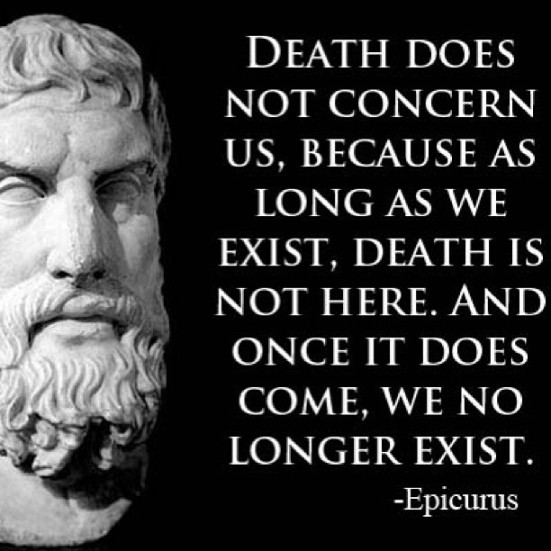
Per the Oxford Dictionary, Epicurus (341-270 B.C) was a “Greek philosopher, founder of Epicureanism. His physics is based on Democritus’ theory of a materialist universe composed of indestructible atoms moving in a void, unregulated by divine providence”.
According to several accounts, Epicurus lived and taught a philosophy of the unnoticed good life. He posited that man, a collection of particles he called atoms, would return to the earth when he died. From atoms to atoms you shall return, he postulated. When you are dead you are dead and while you are alive, as Epicurus advocated, seek pleasure and avoid pain.
Epicurus was not a political nor a spiritual man. He was more of a homebody given to a small circle of friends. Per Epicurus, everything to be trusted and believed came through the senses. And so, he deemed that God was remote if at all. And friends were real and to be trusted.
Epicurus also taught that nothing should be believed, except for that which was tested through direct observation and logical deduction – believed via the sensate and reason. Hence, the beginning of the fact/value split so prevalent in man’s thinking today. It is likely that Epicurus formed this worldview when he decided that God was uninvolved and impersonal at best and that he had to fend for himself.
Epicurean thought was embraced by some and passed down through the centuries. The Roman poet Lucretius, a disciple of Epicurus’s teachings and someone who lived about 70 years before Jesus, promoted the “god is angry” meme along with the theory of atomism formulated by Demetrius (460-370 B.C.), who died 29 years before the birth of Epicurus.
The atomic theory of the cosmos in brief: random, unguided ‘atoms’ smash into each other, thereby create the world and life as we know it. Such a hypothesis turned philosophy by Epicurus offered the ‘means’ to do away with a personally involved god and remove human accountability to God. Lucretius went on to tweak Demetrius’ theory.
Demetrius said that atoms do not always go in straight lives but can “swerve”. As such, his philosophy was then able to avoid atomism’s inherent determinism and to allow for man’s free will.
“What was most important in Epicurus’ philosophy of nature was the overall conviction that our life on this earth comes with no strings attached; that there is no Maker whose puppets we are; that there is no script for us to follow and be constrained by; that it is up to us to discover the real constraints which our own nature imposes on us.” ― Epicurus, The Epicurus Reader
Unlike the innocuous passing-on-sex Epicurus, the Romans took Epicureanism to new lows. The name of the Roman Emperor Caligula is associated today with unbridled decadence. Licentiousness continues today as the justification for the avoid-pain-seek-pleasure self.
The Enlightenment furthered Epicurean acceptance. As many began to claim science as the explainer for things being as they are and man as the interpreter of things as they are, the Enlightenment augmented the fact/value split. With science being claimed as the only arbiter of truth and reality, the transcendent was eschewed, as being unreasonable to ponder. Materialism and utilitarian atomism replaced the transcendent and facilitated the self-made man as the imago homo. An honest look around today would reveal that the worldview from the days of Epicurus down through the Enlightenment has been passed down to us.
“It is folly for a man to pray to the gods for that which he has the power to obtain by himself.” –Epicurus
As I see it, underlying cultural Marxism, secular humanism, Progressivism and the American Dream is the philosophy of Epicurus: extreme preoccupation with and indulgence of one’s feelings, desires, etc.; egoistic self-absorption, aka, solipsism. It is the worldview of safe spaces. It is the philosophy behind the Progressive’s push for acceptance of multiculturalism whereby all cultures are deemed equal including the dehumanizing ones so that individual culture has a larger safe space to operate in. The philosophy promotes universal healthcare as another safe space in the form of insurance against financial suffering as paid for by others so one can live an Epicurean lifestyle without pain. It is the worldview of the virtue-signaling relativist social justice warriors – I want a safe space for me to live my life as I see fit so I will serve up my self-justifying, self-righteous viewpoint of high-sounding humanitarianism. Epicureanism is the doctrine of the Religion of Humanity and the paean to mind and matter as savior.
Epicureanism underlies identity politics and individual rights. It promotes a circling of the wagons around your ersatz ‘friends’, your tribe, to protect your values and your territory for further self-satisfaction. It promotes dehumanization with its message that life has no meaning other than what you give it; life is only material and sensate. So, grab yours while you are alive. Out of this dehumanizing process comes the art, music, literature, media and architecture which degrade human existence and the imago dei in humans. But. Modern man, left to his own Epicurean devices, comes up short.
The narrator in C.S. Lewis’ Space Trilogy novel That Hideous Strength tells us about one of the central characters Mark Studdock. He is a young academic, a sociologist, and a member of the Progressive Element at Bracton College. He is an ambitious, self-centered and shallow intellectual who has come into the service of the National Institute of Coordinated Sciences (NICE). He believes NICE will serve the best interest of humanity through progress at any cost. Once he stopped hemming and hawing about joining the organization he is welcomed into the inner circle. But he soon finds that he has committed himself to a hellish organization which plans to re-do humanity by force so that only the best humans (in NICE’s view) remain. He is made aware that the tentacles of the organization are growing.
Studdock is told in no uncertain terms that the organization wants his wife Jane to join him. He is ordered to bring her in. With no moral depth and no moral base outside himself to guide him, Mark is perplexed and now in great fear for his life. Pain and death are the only things that are real for him.
It must be remembered that in Mark’s mind hardly one rag of noble thought, either Christian or Pagan, had a secure lodging. His education had been neither scientific or classical – merely “Modern”. The seventies both of abstraction and of high human tradition had passed him by: and he had neither peasant shrewdness nor aristocratic honor to help him. He was a man of straw, a glib examinee in subjects that require no exact knowledge (he had always done well on Essays and General Papers) and the first hint of a real threat to his bodily life knocked him sprawling. And his head ached so terribly and he felt sick. Luckily he now kept a bottle of whisky in his room. A stiff one enabled him to shave and dress.
What is your genealogy of thought and belief? Is it a genealogy of strawmen?
~~~~~~~~~
The opening quote is from the Apostle Paul’s letter to the Corinthian church. He is countering the embedded Epicureanism active in the church in Corinth. He does so with the resurrection.
To be continued.


















 Cindy Wity
‘Tis the Season to Rethink Equal Outcomes
November 10, 2018 Leave a comment
The Progressive’s notion of equal outcomes: “income equality” realized through redistribution; test results based on tests revised so that certain people could pass the test; participation-trophy type merit; laws that ‘fix’ opportunity for certain people; verdicts and sentencing of activist judges who rule based on a defendant’s social circumstances rather than by the crime committed upon another; homosexual ‘marriage’ as marriage equality; “equal pay for equal work” which dismisses the resultant quality of what each worker produces; a state in which people have approximately the same material wealth and achieve equal levels of income; equating equal opportunities with equal results…
Economist Thomas Sowell gives us some insight into Progressive thinking:
Equal opportunity does not mean equal results, despite how many laws and policies proceed as if it does, or how much fashionable rhetoric equates the two.
An example of that rhetoric was the title of a recent New York Times column: “A Ticket to Bias.” That column recalled bitterly the experience of a woman in a wheelchair who bought a $300 ticket to a rock concert but was unable to see when other people around her stood up. This was equated with “bias” on the part of those who ran the arena.
The woman in the wheel chair declared, “true equality remains a dream out of reach.” Apparently only equality of results is “true’ equality….
…Confusion between equal opportunity and equal results is a dangerous confusion behind many kinds of spoiled brat politics. -Thomas Sowell from Spoiled Brat Politics, The Thomas Sowell Reader
To put us in the proper reflective mood for the Season to Rethink Equal Outcomes, below are three accounts from Scripture which reveal to us God’s concept of equal outcomes.
But the king replied to Araunah, “No, I insist on paying you for it. I will not sacrifice to the LORD my God burnt offerings that cost me nothing.” So David bought the threshing floor and the oxen and paid fifty shekels of silver for them. 2 Samuel 24:24
The first thing I notice about the above account is that forms of capitalism have been around for a long time. That is, capitalism, simply defined, as an economic and social system in which property, business, and industry are privately owned and directed towards making the greatest possible profits for successful organizations and people, especially as contrasted to cooperatively or state-owned means of wealth.
In the above account there was a cooperative exchange of private property between two individuals. Both were satisfied with the outcome. And, apparently God was satisfied with the outcome. David’s desire was to not give God the impression that he was doing something good for God, a.k.a. virtue signal or tokenism, but to pay proper respect and attribute worth to God through his offering.
David built an altar to the LORD there and sacrificed burnt offerings and fellowship offerings. Then the LORD answered his prayer in behalf of the land, and the plague on Israel was stopped. 2 Samuel 24:25
The second thing I notice is restraint. Though Araunah offered his property freely to king David (2 Sam. 24:23) the king did not accept it without paying Araunah its worth to Araunah and perhaps more. That cost David. The king could have just taken the property to begin with. Beastly kings and rulers throughout history have seized property for themselves and for “the masses”. David was not about to disrespect his neighbor Araunuh or his God by stiffing either. The king did not exploit Araunuh for righteous ends.
Worth had to be accounted for with regard to Araunah’s property and with regard to a show of respect to God. “I will not sacrifice to the LORD my God burnt offerings that cost me nothing.” That is what David said and that is what the widow thought.
Then Jesus sat down opposite the offering box, and watched the crowd putting coins into it. Many rich people were throwing in large amounts. And a poor widow came and put in two small copper coins, worth less than a penny. He called his disciples and said to them, “I tell you the truth, this poor widow has put more into the offering box than all the others. For they all gave out of their wealth. But she, out of her poverty, put in what she had to live on, everything she had.” Mark 12:41-44
The first thing we notice in this account is the virtue signaling and tokenism of cha-ching-ers who want to appear to profit God while incurring little or no cost to themselves. In kingdom contrast, the unassuming widow, like king David, gave an offering that cost her appreciably and was God’s Temple worthy. The widow gave her financial security. The Lord was pleased to acknowledge her gift acknowledging the God Who is Faithful (Psalm 146: 8). She loved God more than life itself. Now, did you notice in these two stories that taking into account the worth of each party and their property creates equal outcomes – both parties being satisfied and even pleased with what is exchanged? This method of accounting, making sure the ‘other’ is considered and is valued as at least equal with ourselves, can be applied to all interactions.
In a previous post I wrote:
We are told by Jesus to “love your neighbors as yourself”. To do this we must consider our own self-interest and then apply the same measure of self-interest toward our neighbors. This parity of accounting is not unlike the Lord’s accounting of forgiveness: “forgive us our trespasses as we forgive others their trespasses.” […,] the resentment worldview has a perverted accounting system: the self is to be credited and others must be debited for there to be parity in their world. If the word “fairness” is ever to be applied socially and economically to our culture then these two commands of our Lord define its limited and personal application.
As shown from Scripture, God endorsed equal outcomes are marriages of opportunities with offerings. The outcomes are not forced or determined by a higher power or the state. The individuals involved come to an agreement about the outcome. A marriage of a man and woman is the archetype of this union of opportunity and offering.
The man and woman exchange vows and rings and, over time, their lives. The opportunity: they met and each determined that an exchange of their life for the other would make both happy. The offering: they give themselves which costs everything. They do so freely. The exchange is not coerced as in a shot-gun wedding or when those in power decide to take your property by force. When things are forced and a person is acted upon without it being offered it is called rape. It is called stealing when a person’s property is forcibly taken.
The equal outcome of marriage is that the two become one. The transaction creates a greater good (including little ones) and both parties equally, with God’s help, continue to be satisfied with the outcome.
One more illustration from Scripture regarding the marriage of opportunity and offering. Remember this woman?
While Jesus was at Bethany, in the house of Simon (known as “the Leper’), a woman came to him who had an alabaster vase of extremely valuable ointment. She poured it on his head as he was reclining at the table.
When the disciples saw it, they were furious.
“What’s the point of all this waste?” they said. “This could have been sold for a fortune, and the money could have been given to the poor!”
Jesus knew what they were thinking.
“Why make life difficult for the woman?” he said. “It’s a lovely thing, what she’s done for me. You always have the poor with you, don’t you? But you won’t always have me. When she poured this ointment on my body, you see, she did it to prepare me for burial. “I’m telling you the truth: where this gospel is announced in all the world, what she has done will be told, and people will remember her.”
Matthew 26: 6-13
What do we learn about opportunity and offering from this account of a woman pouring a very expensive offering onto Jesus’ head? We learn that the Progressives around Jesus were highly offended when they couldn’t control the outcome of the “alabaster vase of extremely valuable ointment”. We also learn from Jesus about the opportunity that brought them together: “… you won’t always have me”. The woman’s offering was what she could have lavished on herself. Maybe she applied David’s words to her head: “I will not sacrifice to the LORD my God burnt offerings that cost me nothing.”
The extravagant and expensive offering given freely was freely accepted by Jesus in preparation for his burial. In fact, he tells us that the equally shared outcome of what she had done was worth proclaiming: the marriage of opportunity and sacrificial offering as an act of love.
Rate this:
Filed under Christianity, Culture, Economics, Political Commentary, Politics, Progressivism, socialism Tagged with Christianity, culture, Economics, equal outcomes, politics, progressivism, Scripture